belt HYUNDAI PALISADE 2022 Repair Manual
[x] Cancel search | Manufacturer: HYUNDAI, Model Year: 2022, Model line: PALISADE, Model: HYUNDAI PALISADE 2022Pages: 663, PDF Size: 15.74 MB
Page 352 of 663
5-18
Driving your vehicle
When the battery is discharged:
You cannot shift the gear when the
battery is discharged.
In emergencies, do the following to
move the shift button to N (Neutral)
on a level ground.
1. Connect the battery cables fromanother vehicle or from a another
battery to the jump-starting termi-
nals inside the engine compart-
ment.
For more information refer to
"Jump Starting" in chapter 6.
2. Release the parking brake with the Engine Start/Stop button in the
ON position.
3. Shift the gear to the N(Neutral) position. Refer to the "Stay in
Neutral when vehicle is Off" in this
chapter.
Parking
Always come to a complete stop and
continue to depress the brake pedal.
Press the P button, apply the parking
brake, and place the ignition switch
in the LOCK/OFF position. Take the
Key with you when exiting the vehi-
cle.
The gear is shifted to P (Park)position automatically for safety
under the following conditions.
- When the driver unfastens theseat belt and opens the driver’s
door.
- When the engine is turned off with the gear shifted to R (Reverse), D
(Drive) or N (Neutral). When you stay in the vehicle
with the engine running, be
careful not to depress the accel-
erator pedal for a long period of
time. The engine or exhaust
system may overheat and start
a fire.
The exhaust gas and the
exhaust system are very hot.
Keep away from the exhaust
system components.
Do not stop or park over flam-
mable materials, such as dry
grass, paper or leaves. They
may ignite and cause a fire.WARNING
Page 355 of 663
5-21
Driving your vehicle
5
Do not drive with your foot restingon the brake pedal. Even light, but
consistent pedal pressure can
result in the brakes overheating,
brake wear and possibly even
brake failure.
When driving in sports mode, slow down before shifting to a lower
gear. Otherwise, the lower gear
may not be engaged if the engine
RPMs are outside of the allowable
range.
Always apply the parking brake when leaving the vehicle. Do not
depend on placing the transmis-
sion in P (Park) to keep the vehicle
from moving.
Exercise extreme caution when driving on a slippery surface. Be
especially careful when braking,
accelerating or shifting gears. On a
slippery surface, an abrupt change
in vehicle speed can cause the
drive wheels to lose traction and
may cause loss of vehicle control
resulting in an accident
Optimum vehicle performance and economy is obtained by smoothly
depressing and releasing the
accelerator.
In the event your vehicle
leaves the roadway, do not
steer sharply. Instead, slow
down before pulling back into
the travel lanes.
HYUNDAI recommends you
follow all posted speed limits.
To reduce the risk of SERIOUS
INJURY or DEATH:
ALWAYS wear your seatbelt.
In a collision, an unbelted
occupant is significantly more
likely to be seriously injured
or killed than a properly belt-
ed occupant.
Avoid high speeds when cor-
nering or turning.
Do not make quick steering
wheel movements, such as
sharp lane changes or fast,
sharp turns.
The risk of rollover is greatly
increased if you lose control
of your vehicle at highway
speeds.
Loss of control often occurs if
two or more wheels drop off
the roadway and the driver
over steers to reenter the
roadway.
WARNING
Page 359 of 663
5-25
Driving your vehicle
5
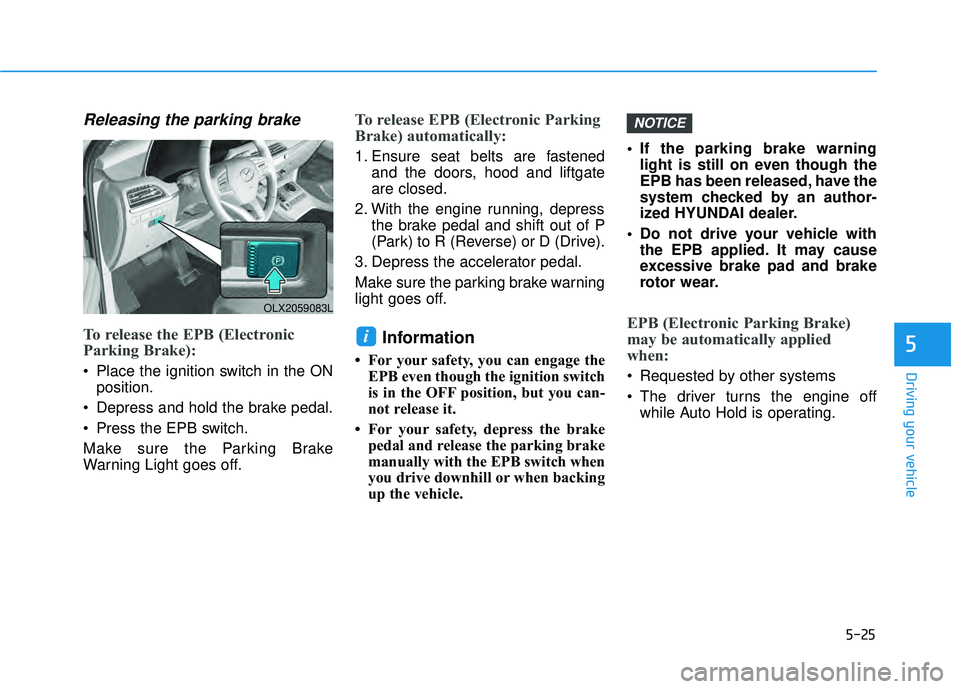
Releasing the parking brake
To release the EPB (Electronic
Parking Brake):
Place the ignition switch in the ONposition.
Depress and hold the brake pedal.
Press the EPB switch.
Make sure the Parking Brake
Warning Light goes off.
To release EPB (Electronic Parking
Brake) automatically:
1. Ensure seat belts are fastened and the doors, hood and liftgate
are closed.
2. With the engine running, depress the brake pedal and shift out of P
(Park) to R (Reverse) or D (Drive).
3. Depress the accelerator pedal.
Make sure the parking brake warning
light goes off.
Information
• For your safety, you can engage the EPB even though the ignition switch
is in the OFF position, but you can-
not release it.
• For your safety, depress the brake pedal and release the parking brake
manually with the EPB switch when
you drive downhill or when backing
up the vehicle. If the parking brake warning
light is still on even though the
EPB has been released, have the
system checked by an author-
ized HYUNDAI dealer.
Do not drive your vehicle with the EPB applied. It may cause
excessive brake pad and brake
rotor wear.
EPB (Electronic Parking Brake)
may be automatically applied
when:
Requested by other systems
The driver turns the engine offwhile Auto Hold is operating.
NOTICE
i
OLX2059083L
Page 360 of 663
5-26
Driving your vehicle
Warning messages
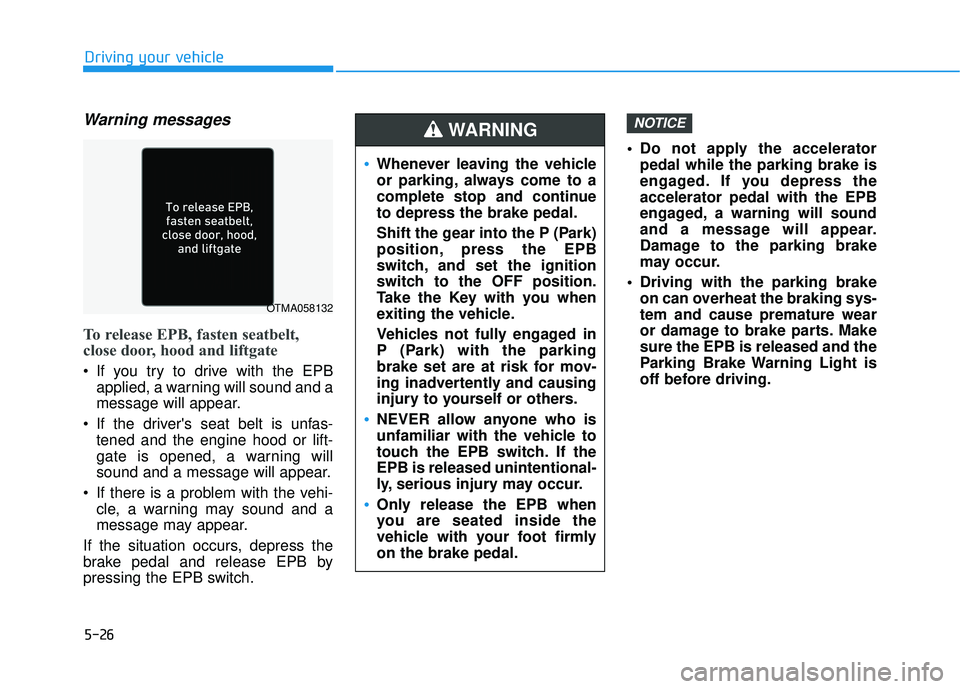
To release EPB, fasten seatbelt,
close door, hood and liftgate
If you try to drive with the EPBapplied, a warning will sound and a
message will appear.
If the driver's seat belt is unfas- tened and the engine hood or lift-
gate is opened, a warning will
sound and a message will appear.
If there is a problem with the vehi- cle, a warning may sound and a
message may appear.
If the situation occurs, depress the
brake pedal and release EPB by
pressing the EPB switch. Do not apply the accelerator
pedal while the parking brake is
engaged. If you depress the
accelerator pedal with the EPB
engaged, a warning will sound
and a message will appear.
Damage to the parking brake
may occur.
Driving with the parking brake on can overheat the braking sys-
tem and cause premature wear
or damage to brake parts. Make
sure the EPB is released and the
Parking Brake Warning Light is
off before driving.
NOTICE
Whenever leaving the vehicle
or parking, always come to a
complete stop and continue
to depress the brake pedal.
Shift the gear into the P (Park)
position, press the EPB
switch, and set the ignition
switch to the OFF position.
Take the Key with you when
exiting the vehicle.
Vehicles not fully engaged in
P (Park) with the parking
brake set are at risk for mov-
ing inadvertently and causing
injury to yourself or others.
NEVER allow anyone who is
unfamiliar with the vehicle to
touch the EPB switch. If the
EPB is released unintentional-
ly, serious injury may occur.
Only release the EPB when
you are seated inside the
vehicle with your foot firmly
on the brake pedal.
WARNING
OTMA058132
Page 379 of 663
5-45
Driving your vehicle
5
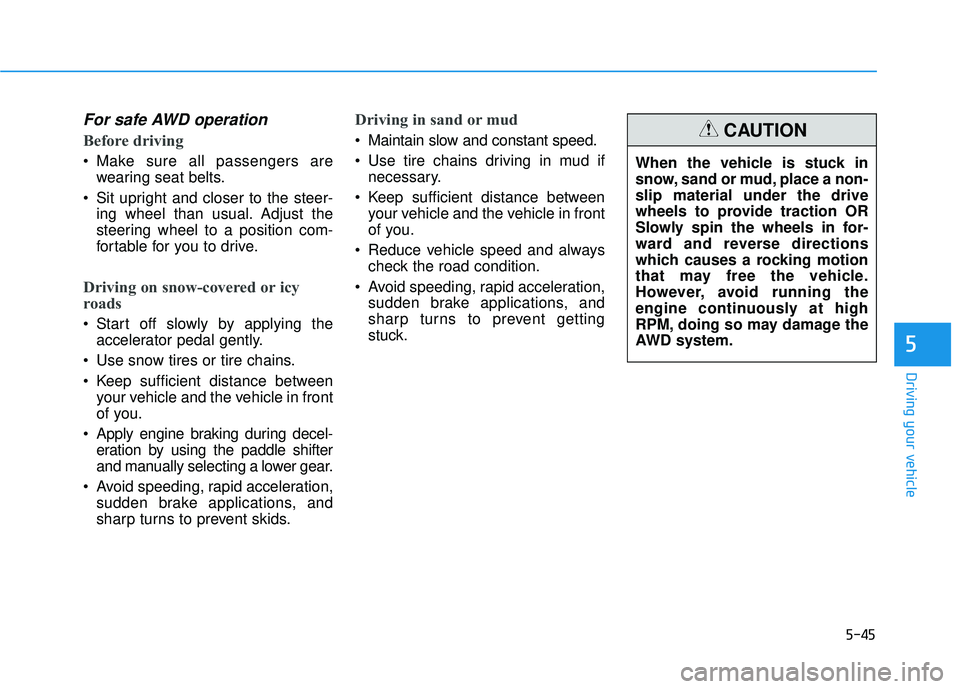
For safe AWD operation
Before driving
Make sure all passengers arewearing seat belts.
Sit upright and closer to the steer- ing wheel than usual. Adjust the
steering wheel to a position com-
fortable for you to drive.
Driving on snow-covered or icy
roads
Start off slowly by applying theaccelerator pedal gently.
Use snow tires or tire chains.
Keep sufficient distance between your vehicle and the vehicle in front
of you.
Apply engine braking during decel- eration by using the paddle shifter
and manually selecting a lower gear.
Avoid speeding, rapid acceleration, sudden brake applications, and
sharp turns to prevent skids.
Driving in sand or mud
Maintain slow and constant speed.
Use tire chains driving in mud ifnecessary.
Keep sufficient distance between your vehicle and the vehicle in front
of you.
Reduce vehicle speed and always check the road condition.
Avoid speeding, rapid acceleration, sudden brake applications, and
sharp turns to prevent getting
stuck. When the vehicle is stuck in
snow, sand or mud, place a non-
slip material under the drive
wheels to provide traction OR
Slowly spin the wheels in for-
ward and reverse directions
which causes a rocking motion
that may free the vehicle.
However, avoid running the
engine continuously at high
RPM, doing so may damage the
AWD system.CAUTION
Page 384 of 663
5-50
Driving your vehicle
The Idle Stop and Go (ISG) system
automatically and temporarily shuts
down the engine when the vehicle is
stopped and idling to improve fuel
efficiency and reduce exhaust gas
emissions. (i.e. red stop light, stop
sign, and traffic jam).
The engine is automatically started
upon satisfying the starting condi-
tions.
The ISG system is always active,
when the engine is running.
Information
When the engine is automatically
started by the ISG system, some warn-
ing lights (i.e. ABS, ESC, ESC OFF,
EPS, and parking brake warning
light) may illuminate for a few sec-
onds due to the low battery voltage.
However, it does not indicate a mal-
function with the ISG system.
To Activate the ISG System
Prerequisite for activation
The ISG system operates in the fol-
lowing situations.
The driver's seatbelt is fastened
The driver's door and hood are closed
The brake vacuum pressure is adequate
The battery sensor is activated and the battery is sufficiently charged
Outside temperature is not too low or too high
The vehicle is driven over a con- stant speed and stops
The climate control system satis- fies the conditions
The vehicle is sufficiently warmed up
The incline is gradual
The steering wheel is turned less than 180 degrees and then the
vehicle stops
Information
The ISG system is
not activated, when
the prerequisites to
activate the ISG sys-
tem are unsatisfied.
In this case, the ISG
OFF button indicator illuminates,
and the auto stop indicator ( )
illuminates in yellow on the instru-
ment cluster.
• When the above indicator remains illuminated on the instrument clus-
ter, we recommend that you have
the IGS system checked by an
authorized HYUNDAI dealer.
i
i
I IS S G G ( ( I ID D L LE E S S T T O O P P A A N N D D G G O O ) ) S S Y Y S ST T E EM M ( ( I IF F E E Q Q U UI IP P P PE ED D ) )
•
Page 386 of 663
5-52
Driving your vehicle
Auto start
To restart the engine in the auto
stop mode
Release the brake pedal.
- When Auto Hold is activated, if yourelease the brake pedal, the
engine will be in the auto stop
state. However, if you depress the
accelerator pedal, the engine will
start again.
The auto stop indicator ( ) goes
OFF on the instrument cluster, when
the engine is restarted.
The engine is automatically restart-
ed in the following situations.
The brake vacuum pressure is low
The engine has stopped for about 5 minutes
The air conditioning is ON with the fan speed set to the highest posi-
tion
The front defroster is ON
The battery is weak
The cooling and heating perform- ance of the climate control system
is unsatisfactory
The vehicle is shifted to P (Park) when Auto Hold is activated
The door is opened or the seatbelt is unfastened when Auto Hold is
activated
The EPB switch is pressed when Auto Hold is activated
The auto stop indicator ( ) blinks
in green for 5 seconds on the instru-
ment cluster.
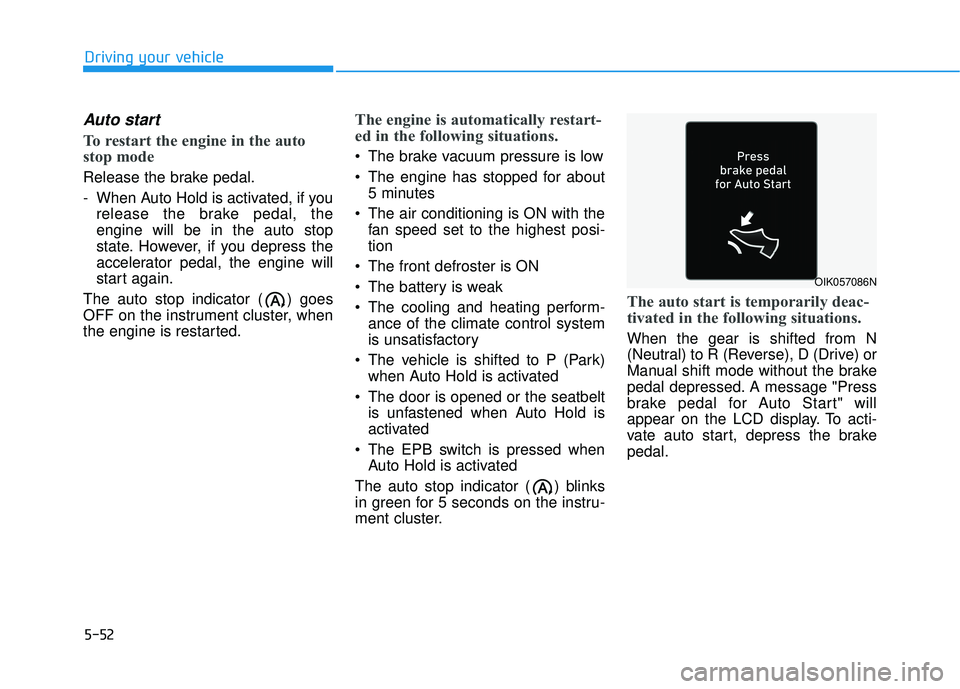
The auto start is temporarily deac-
tivated in the following situations.
When the gear is shifted from N
(Neutral) to R (Reverse), D (Drive) or
Manual shift mode without the brake
pedal depressed. A message "Press
brake pedal for Auto Start" will
appear on the LCD display. To acti-
vate auto start, depress the brake
pedal.
OIK057086N
Page 403 of 663
5-69
Driving your vehicle
5
Information
In a situation where a collision is
imminent, braking may be assisted by
Forward Collision-Avoidance Assist
when braking is insufficient by the
driver.
i
Depending on the road and
driving conditions, Forward
Collision-Avoidance Assist
may warn the driver late or
may not warn the driver.
During Forward Collision-
Avoidance Assist operation,
the vehicle may stop sudden-
ly injuring passengers and
shifting loose objects. Ensure
all occupants have their seat
belt on and keep loose
objects secured.
If any other system's warning
message is displayed or audi-
ble warning is generated,
Forward Collision-Avoidance
Assist warning message may
not be displayed and audible
warning may not be generat-
ed.
You may not hear the warning
sound of Forward Collision-
Avoidance Assist if the sur-
roundings are noisy.
Forward Collision-Avoidance
Assist may turn off or may not
operate properly or may oper-
ate unnecessarily depending
on the road conditions and
the surroundings.
Even if there is a problem with
Forward Collision-Avoidance
Assist, the vehicle's basic
braking performance will
operate normally.
During emergency braking,
braking control by Forward
Collision-Avoidance Assist
will automatically cancel
when the driver excessively
presses the accelerator pedal
or sharply steers the vehicle.
WARNING
Forward Collision-Avoidance
Assist operating speed range
may reduce due to the condi-
tions of the vehicle, pedestri-
an or cyclist in front or sur-
roundings. Depending on the
speed, the function may only
warn the driver, or the func-
tion may not operate.
Forward Collision-Avoidance
Assist will operate under cer-
tain conditions by judging the
risk level based on the condi-
tion of the oncoming vehicle,
driving direction, speed and
surroundings.
CAUTION
Page 438 of 663
5-104
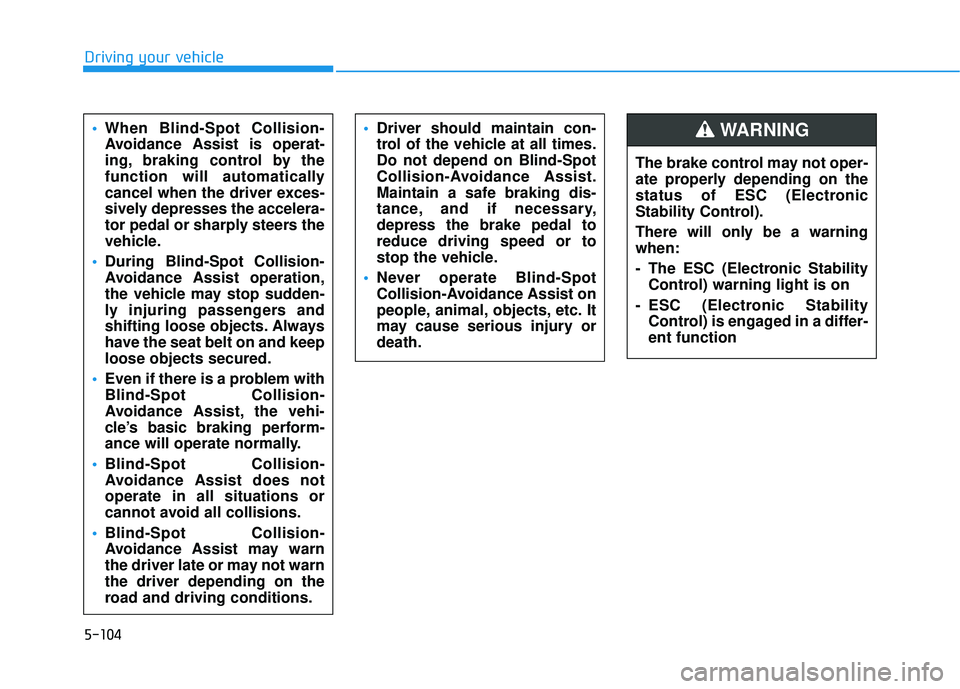
Driving your vehicle When Blind-Spot Collision-
Avoidance Assist is operat-
ing, braking control by the
function will automatically
cancel when the driver exces-
sively depresses the accelera-
tor pedal or sharply steers the
vehicle.
During Blind-Spot Collision-
Avoidance Assist operation,
the vehicle may stop sudden-
ly injuring passengers and
shifting loose objects. Always
have the seat belt on and keep
loose objects secured.
Even if there is a problem with
Blind-Spot Collision-
Avoidance Assist, the vehi-
cle’s basic braking perform-
ance will operate normally.
Blind-Spot Collision-
Avoidance Assist does not
operate in all situations or
cannot avoid all collisions.
Blind-Spot Collision-
Avoidance Assist may warn
the driver late or may not warn
the driver depending on the
road and driving conditions.
Driver should maintain con-
trol of the vehicle at all times.
Do not depend on Blind-Spot
Collision-Avoidance Assist.
Maintain a safe braking dis-
tance, and if necessary,
depress the brake pedal to
reduce driving speed or to
stop the vehicle.
Never operate Blind-Spot
Collision-Avoidance Assist on
people, animal, objects, etc. It
may cause serious injury or
death.
The brake control may not oper-
ate properly depending on the
status of ESC (Electronic
Stability Control).
There will only be a warning
when:
- The ESC (Electronic Stability
Control) warning light is on
- ESC (Electronic Stability Control) is engaged in a differ-
ent function
WARNING
Page 458 of 663
5-124
Driving your vehicle
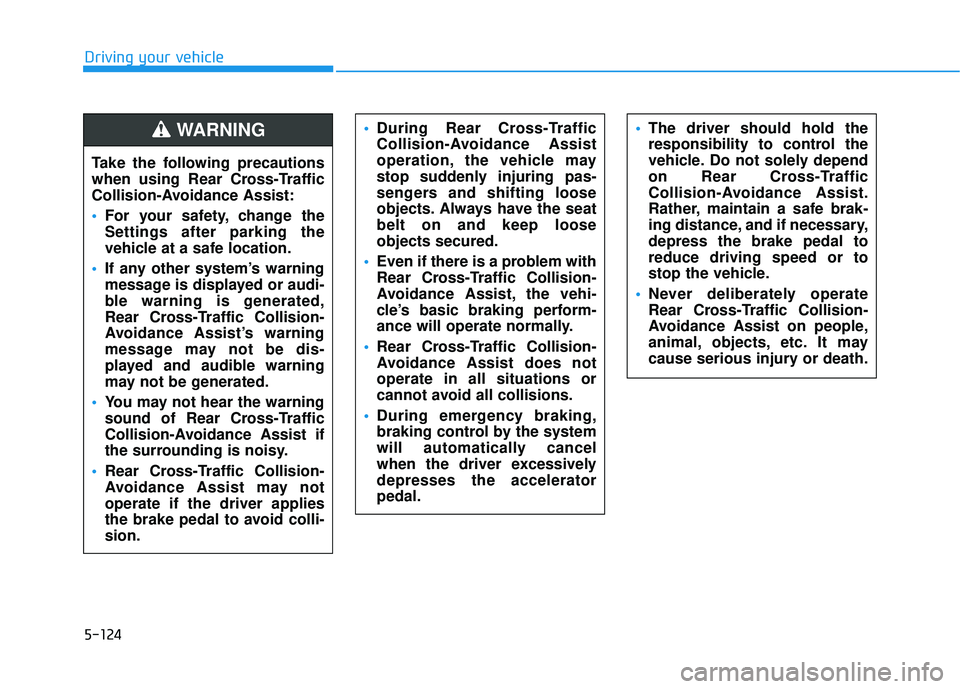
Take the following precautions
when using Rear Cross-Traffic
Collision-Avoidance Assist:
For your safety, change the
Settings after parking the
vehicle at a safe location.
If any other system’s warning
message is displayed or audi-
ble warning is generated,
Rear Cross-Traffic Collision-
Avoidance Assist’s warning
message may not be dis-
played and audible warning
may not be generated.
You may not hear the warning
sound of Rear Cross-Traffic
Collision-Avoidance Assist if
the surrounding is noisy.
Rear Cross-Traffic Collision-
Avoidance Assist may not
operate if the driver applies
the brake pedal to avoid colli-
sion.
During Rear Cross-Traffic
Collision-Avoidance Assist
operation, the vehicle may
stop suddenly injuring pas-
sengers and shifting loose
objects. Always have the seat
belt on and keep loose
objects secured.
Even if there is a problem with
Rear Cross-Traffic Collision-
Avoidance Assist, the vehi-
cle’s basic braking perform-
ance will operate normally.
Rear Cross-Traffic Collision-
Avoidance Assist does not
operate in all situations or
cannot avoid all collisions.
During emergency braking,
braking control by the system
will automatically cancel
when the driver excessively
depresses the accelerator
pedal.The driver should hold the
responsibility to control the
vehicle. Do not solely depend
on Rear Cross-Traffic
Collision-Avoidance Assist.
Rather, maintain a safe brak-
ing distance, and if necessary,
depress the brake pedal to
reduce driving speed or to
stop the vehicle.
Never deliberately operate
Rear Cross-Traffic Collision-
Avoidance Assist on people,
animal, objects, etc. It may
cause serious injury or death.WARNING