Low side Hyundai Santa Fe 2008 User Guide
[x] Cancel search | Manufacturer: HYUNDAI, Model Year: 2008, Model line: Santa Fe, Model: Hyundai Santa Fe 2008Pages: 355, PDF Size: 12.36 MB
Page 59 of 355
1
FEATURES OF YOUR HYUNDAI
47
!
!
WARNING:
!
WARNING:
Always use seat belts and child restraints
– every trip, every time, everyone! Air
bags inflate with considerable force and
in the blink of an eye. Seat belts help
keep occupants in proper position to
obtain maximum benefit from the air
bag. Even with advanced air bags, im-
properly and unbelted occupants can be
severely injured when the air bag in-
flates. Always follow the precautions
about seat belts, air bags and occupant
safety contained in this manual.
To reduce the chance of serious or fatal
injuries and receive the maximum safety
benefit from your restraint system:
o Never place a child in any child or
booster seat in the front seat (see
child restraints 1-33).
o ABC – Always Buckle Children in the
back seat. It is the safest place for
children of any age to ride
o Front and side impact air bags can
injure occupants improperly posi-
tioned in the front seatso Move your seat as far back as pos-
sible from the front airbags, while still
maintaining control of the vehicle.
o Never sit or lean unnecessarily close
to the front or side air bags
o Never lean against the door or center
console – always sit in an upright
position
o Do not allow a passenger to ride in the
front seat when the “Passenger Air
bag OFF” indicator is illuminated, be-
cause the air bag will not deploy in the
event of a moderate or severe frontal
crash.
o Never place objects over or near any
air bag module (front or side impact
air bags), because these objects can
injure passengers in a crash
o Never place covers, blankets or after-
market seat warmers on the passen-
ger seat as these may interfere with
the occupant classification system
o Do not tamper with or disconnect SRS
wiring or other components. Injuries
could result from inadvertent deploy-
ment or failure of the air bag to deploy
in a crash.o If the SRS air bag warning light (see pg
1-68) remains illuminated while the
vehicle is being driven, have an au-
thorized Hyundai dealer inspect the
air bag system as soon as possible.
o Air bags can only be used once – have
an authorized Hyundai dealer replace
the air bag immediately after deploy-
ment.
o The SRS is designed to deploy the
front air bags only when an impact is
sufficiently severe and when the im-
pact angle is within a range as mea-
sured from the forward longitudinal
axis of the vehicle. The front air bags
will not deploy in side, rear or rollover
impacts. Additionally, the air bags will
only deploy once. Seat belts must be
worn at all times.
WARNING:
Page 60 of 355
1FEATURES OF YOUR HYUNDAI48
!
WARNING:
o No objects should be placed over or
near the air bag modules on the steer-
ing wheel, instrument panel, and the
front passenger's panel above the
glove box, because any such object
could cause harm if the vehicle is in a
crash severe enough to cause the air
bags to deploy.
o If the air bags deploy, they must be
replaced by an authorized Hyundai
dealer. Deployed air bags WILL NOT
inflate again and will provide no pro-
tection in subsequent collisions.
o Do not tamper with or disconnect SRS
wiring or other components of the
SRS system. Doing so could result in
injury, due to accidental deployment
of the air bags or by rendering the SRS
inoperative.
o Do not install a child restraint system
in the front passenger seat position.
A child restraint system must never
be placed in the front seat. The infant
or child could be severely injured or
killed by an air bag deployment in
case of an accident.
o Children younger than 13 years must
always be properly restrained in the
rear seat. Never allow children to ride
in the front passenger seat. If a child
over 13 must be seated in the front
seat, he or she must be properly belted
and the seat should be moved as far
back as possible.
o For maximum safety protection in all
types of crashes, all occupants in-
cluding the driver should always wear
their seat belts whether or not an air
bag is also provided at their seating
position to minimize the risk of severe
injury or death in the event of a crash.
Do not sit or lean unnecessarily close
to the air bag while the vehicle is in
motion.
o Sitting improperly or out of position
can result in serious or fatal injury in
a crash. All occupants should sit up-
right in their seats with their feet on
the floor until the vehicle is parked
and the ignition key is removed.
!
WARNING:
B240A02CM
!
Rear impact
Side Impact
Rollover
o Move your seat as far back as prac-
tical from the front air bags, while still
maintaining control of the vehicle. You
and your passengers should never
sit or lean unnecessarily close to the
air bags. Improperly positioned driv-
ers and passengers can be severely
injured by inflating air bags.
WARNING:
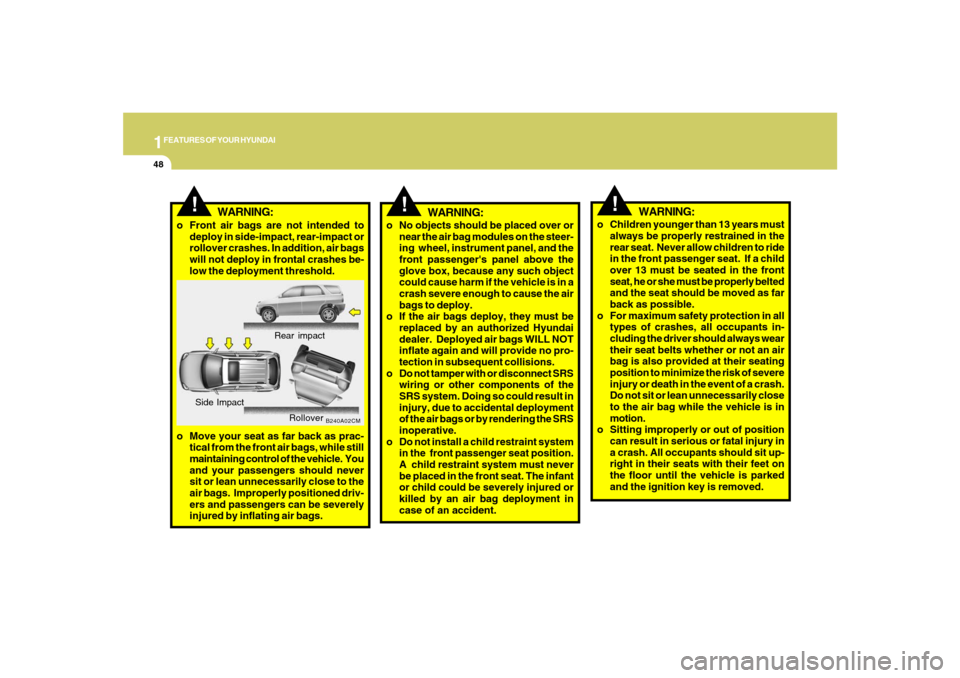
o Front air bags are not intended to
deploy in side-impact, rear-impact or
rollover crashes. In addition, air bags
will not deploy in frontal crashes be-
low the deployment threshold.
Page 61 of 355
1
FEATURES OF YOUR HYUNDAI
49
!
WARNING:
o The SRS air bag system must deploy
very rapidly to provide protection in a
crash. If an occupant is out of position
because of not wearing a seat belt, the
air bag may forcefully contact the
occupant causing serious or fatal in-
juries.
o Your vehicle has been designed to
absorb impact and deploy the air
bag(s) in certain collisions. Installing
aftermarket bumper guards, side
steps or replacing a bumper with non-
genuine parts may adversely affect
your vehicles collision and air bag
deployment performance.
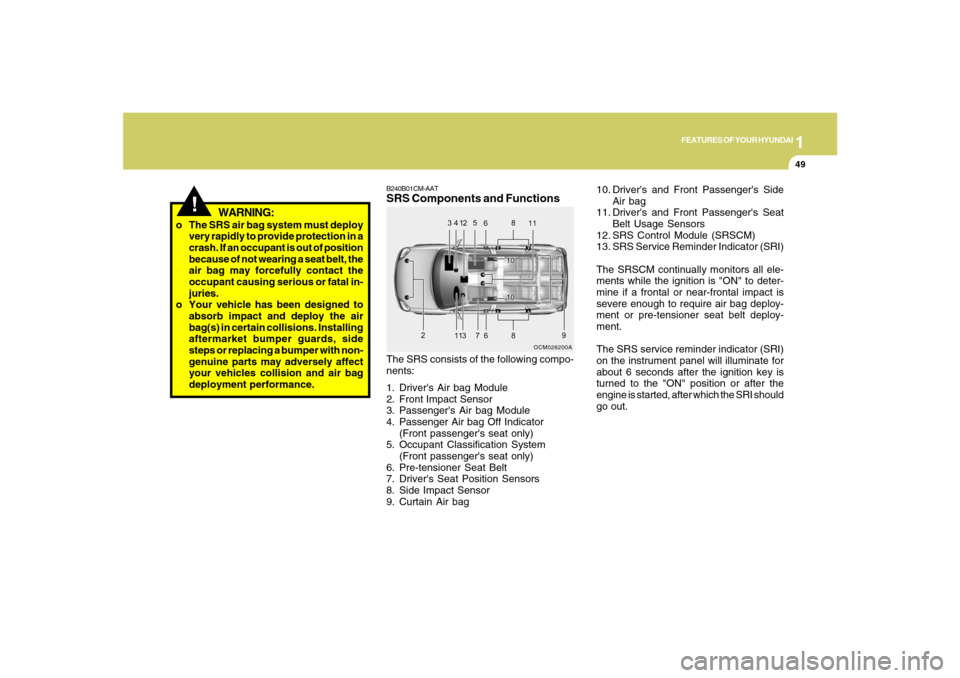
B240B01CM-AATSRS Components and FunctionsThe SRS consists of the following compo-
nents:
1. Driver's Air bag Module
2. Front Impact Sensor
3. Passenger's Air bag Module
4. Passenger Air bag Off Indicator
(Front passenger's seat only)
5. Occupant Classification System
(Front passenger's seat only)
6. Pre-tensioner Seat Belt
7. Driver's Seat Position Sensors
8. Side Impact Sensor
9. Curtain Air bag
OCM026200A
10. Driver's and Front Passenger's Side
Air bag
11. Driver's and Front Passenger's Seat
Belt Usage Sensors
12. SRS Control Module (SRSCM)
13. SRS Service Reminder Indicator (SRI)
The SRSCM continually monitors all ele-
ments while the ignition is "ON" to deter-
mine if a frontal or near-frontal impact is
severe enough to require air bag deploy-
ment or pre-tensioner seat belt deploy-
ment.
The SRS service reminder indicator (SRI)
on the instrument panel will illuminate for
about 6 seconds after the ignition key is
turned to the "ON" position or after the
engine is started, after which the SRI should
go out.
Page 63 of 355
1
FEATURES OF YOUR HYUNDAI
51
CAUTION:
When installing a container of liquid air
freshener inside the vehicle, do not place
it near the instrument cluster nor on the
instrument panel surface. If there is any
leakage from the air freshener onto these
areas (instrument cluster, instrument
panel or air ventilator), it may damage
these parts. If the liquid from the air
freshener does leak onto these areas,
wash them with water immediately.
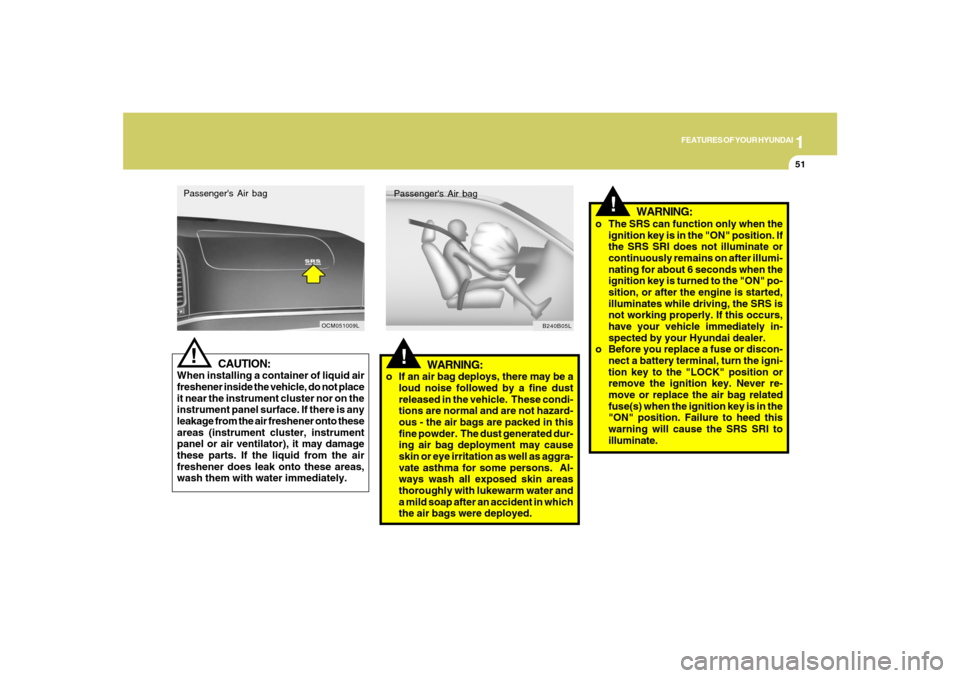
!Passenger's Air bag
OCM051009L
!
WARNING:
o If an air bag deploys, there may be a
loud noise followed by a fine dust
released in the vehicle. These condi-
tions are normal and are not hazard-
ous - the air bags are packed in this
fine powder. The dust generated dur-
ing air bag deployment may cause
skin or eye irritation as well as aggra-
vate asthma for some persons. Al-
ways wash all exposed skin areas
thoroughly with lukewarm water and
a mild soap after an accident in which
the air bags were deployed.Passenger's Air bag
B240B05L
!
o The SRS can function only when the
ignition key is in the "ON" position. If
the SRS SRI does not illuminate or
continuously remains on after illumi-
nating for about 6 seconds when the
ignition key is turned to the "ON" po-
sition, or after the engine is started,
illuminates while driving, the SRS is
not working properly. If this occurs,
have your vehicle immediately in-
spected by your Hyundai dealer.
o Before you replace a fuse or discon-
nect a battery terminal, turn the igni-
tion key to the "LOCK" position or
remove the ignition key. Never re-
move or replace the air bag related
fuse(s) when the ignition key is in the
"ON" position. Failure to heed this
warning will cause the SRS SRI to
illuminate.
WARNING:
Page 64 of 355
1FEATURES OF YOUR HYUNDAI52
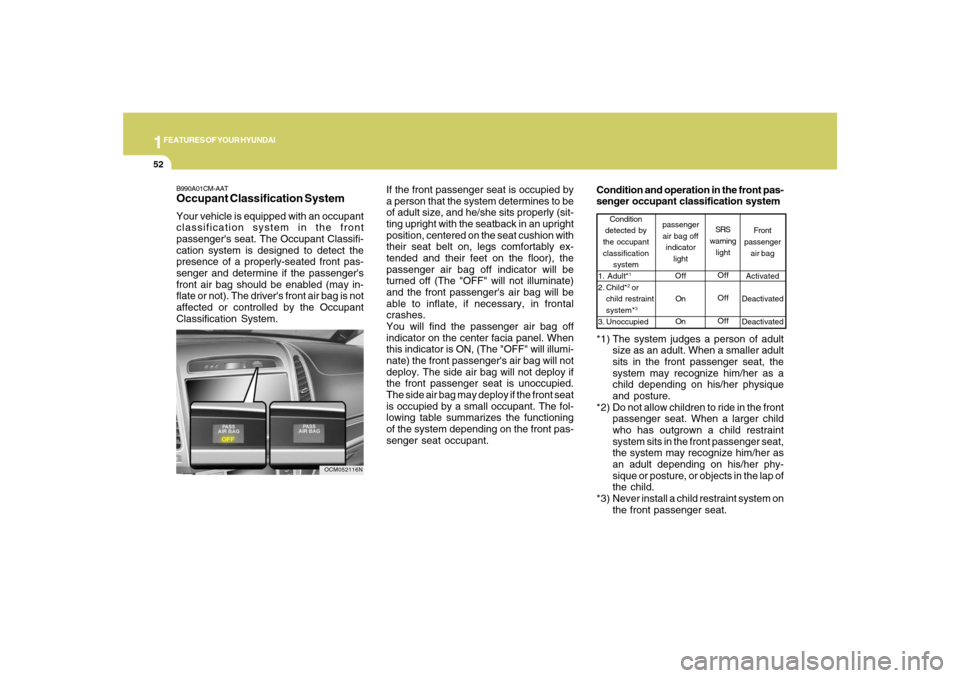
If the front passenger seat is occupied by
a person that the system determines to be
of adult size, and he/she sits properly (sit-
ting upright with the seatback in an upright
position, centered on the seat cushion with
their seat belt on, legs comfortably ex-
tended and their feet on the floor), the
passenger air bag off indicator will be
turned off (The "OFF" will not illuminate)
and the front passenger's air bag will be
able to inflate, if necessary, in frontal
crashes.
You will find the passenger air bag off
indicator on the center facia panel. When
this indicator is ON, (The "OFF" will illumi-
nate) the front passenger's air bag will not
deploy. The side air bag will not deploy if
the front passenger seat is unoccupied.
The side air bag may deploy if the front seat
is occupied by a small occupant. The fol-
lowing table summarizes the functioning
of the system depending on the front pas-
senger seat occupant.*1) The system judges a person of adult
size as an adult. When a smaller adult
sits in the front passenger seat, the
system may recognize him/her as a
child depending on his/her physique
and posture.
*2) Do not allow children to ride in the front
passenger seat. When a larger child
who has outgrown a child restraint
system sits in the front passenger seat,
the system may recognize him/her as
an adult depending on his/her phy-
sique or posture, or objects in the lap of
the child.
*3) Never install a child restraint system on
the front passenger seat. Condition and operation in the front pas-
senger occupant classification system
Front
passenger
air bag
Activated
Deactivated
Deactivated Condition
detected by
the occupant
classification
system
1. Adult*
1
2. Child*
2 or
child restraint
system*3
3. UnoccupiedSRS
warning
light
Off
Off
Off passenger
air bag off
indicator
light
Off
On
On
B990A01CM-AATOccupant Classification SystemYour vehicle is equipped with an occupant
classification system in the front
passenger's seat. The Occupant Classifi-
cation system is designed to detect the
presence of a properly-seated front pas-
senger and determine if the passenger's
front air bag should be enabled (may in-
flate or not). The driver's front air bag is not
affected or controlled by the Occupant
Classification System.
OCM052116N
Page 69 of 355
1
FEATURES OF YOUR HYUNDAI
57
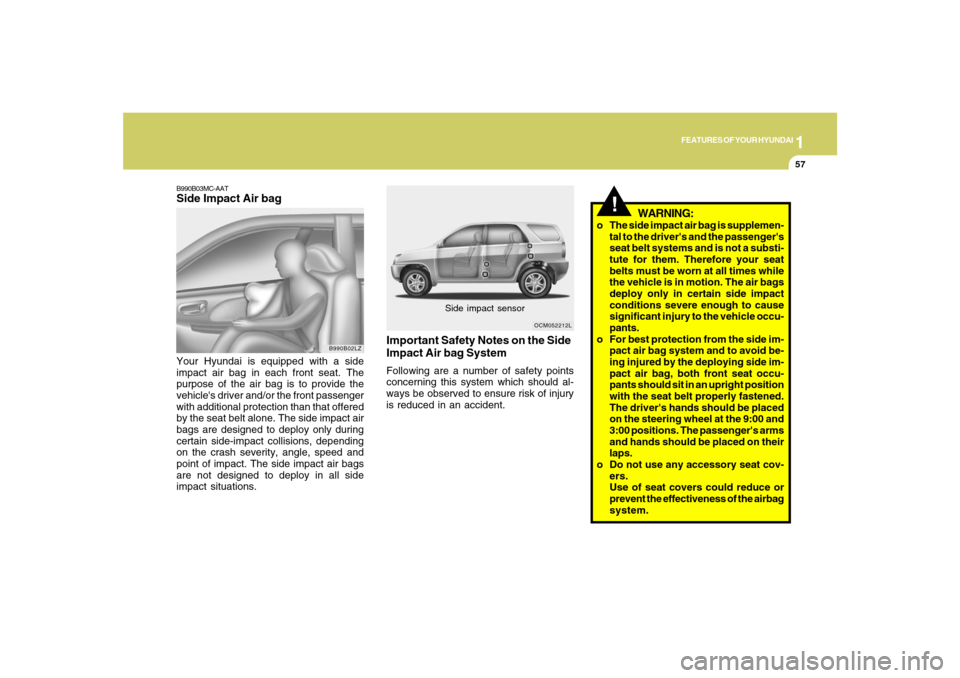
B990B03MC-AATSide Impact Air bagYour Hyundai is equipped with a side
impact air bag in each front seat. The
purpose of the air bag is to provide the
vehicle's driver and/or the front passenger
with additional protection than that offered
by the seat belt alone. The side impact air
bags are designed to deploy only during
certain side-impact collisions, depending
on the crash severity, angle, speed and
point of impact. The side impact air bags
are not designed to deploy in all side
impact situations.
B990B02LZ
OCM052212L
Side impact sensor
Important Safety Notes on the Side
Impact Air bag SystemFollowing are a number of safety points
concerning this system which should al-
ways be observed to ensure risk of injury
is reduced in an accident.
WARNING:
o The side impact air bag is supplemen-
tal to the driver's and the passenger's
seat belt systems and is not a substi-
tute for them. Therefore your seat
belts must be worn at all times while
the vehicle is in motion. The air bags
deploy only in certain side impact
conditions severe enough to cause
significant injury to the vehicle occu-
pants.
o For best protection from the side im-
pact air bag system and to avoid be-
ing injured by the deploying side im-
pact air bag, both front seat occu-
pants should sit in an upright position
with the seat belt properly fastened.
The driver's hands should be placed
on the steering wheel at the 9:00 and
3:00 positions. The passenger's arms
and hands should be placed on their
laps.
o Do not use any accessory seat cov-
ers.
Use of seat covers could reduce or
prevent the effectiveness of the airbag
system.
!
Page 70 of 355
1FEATURES OF YOUR HYUNDAI58
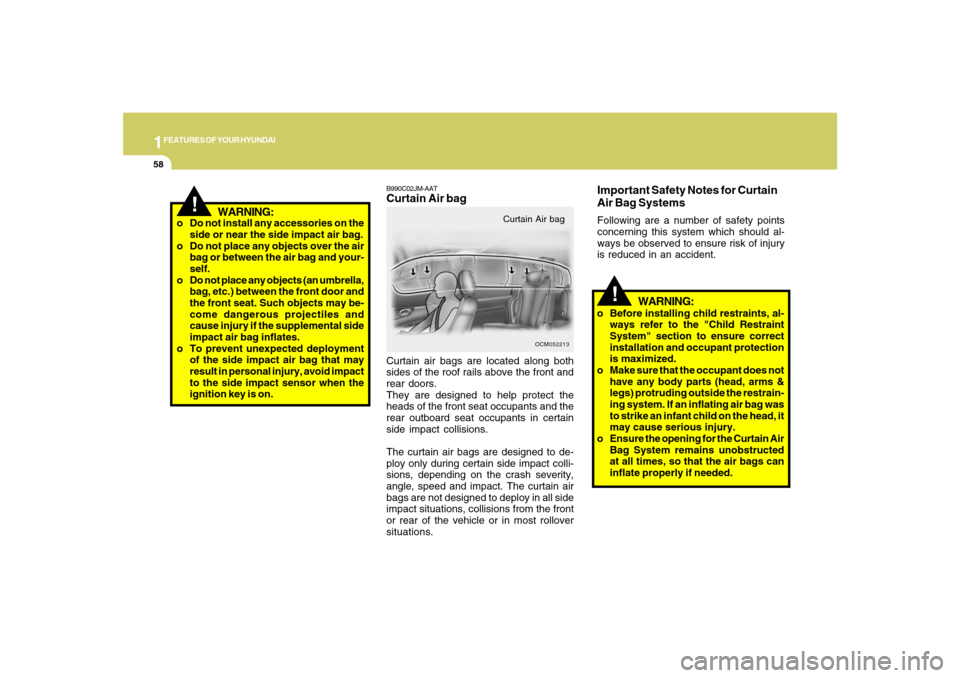
B990C02JM-AATCurtain Air bagCurtain air bags are located along both
sides of the roof rails above the front and
rear doors.
They are designed to help protect the
heads of the front seat occupants and the
rear outboard seat occupants in certain
side impact collisions.
The curtain air bags are designed to de-
ploy only during certain side impact colli-
sions, depending on the crash severity,
angle, speed and impact. The curtain air
bags are not designed to deploy in all side
impact situations, collisions from the front
or rear of the vehicle or in most rollover
situations.
OCM052213
Curtain Air bag
!
o Do not install any accessories on the
side or near the side impact air bag.
o Do not place any objects over the air
bag or between the air bag and your-
self.
o Do not place any objects (an umbrella,
bag, etc.) between the front door and
the front seat. Such objects may be-
come dangerous projectiles and
cause injury if the supplemental side
impact air bag inflates.
o To prevent unexpected deployment
of the side impact air bag that may
result in personal injury, avoid impact
to the side impact sensor when the
ignition key is on.
WARNING:
!
WARNING:
o Before installing child restraints, al-
ways refer to the "Child Restraint
System" section to ensure correct
installation and occupant protection
is maximized.
o Make sure that the occupant does not
have any body parts (head, arms &
legs) protruding outside the restrain-
ing system. If an inflating air bag was
to strike an infant child on the head, it
may cause serious injury.
o Ensure the opening for the Curtain Air
Bag System remains unobstructed
at all times, so that the air bags can
inflate properly if needed.Important Safety Notes for Curtain
Air Bag SystemsFollowing are a number of safety points
concerning this system which should al-
ways be observed to ensure risk of injury
is reduced in an accident.
Page 75 of 355

1
FEATURES OF YOUR HYUNDAI
63
1. Low Windshield Washer Fluid Level Warning Light
2. Malfunction Indicator Light (MIL)
3. TPMS (Tire Pressure Monitoring System) Malfunction
Indicator
4. Low Tire Pressure Position Telltale
5. Low Tire Pressure Telltale
6. AWD System Warning Light (If installed)
7. AWD Lock Indicator Light (If installed)
8. Odometer / Tripmeter / Trip Computer (If installed)
9. Fuel Gauge
10. Low Fuel Warning Light
11. Seat Belt Warning Light (Driver's Side)
12. Parking Brake/Low Brake Fluid Level Warning Light
13. Charging System Warning Light
14. Coolant Temperature Gauge15. Low Oil Pressure Warning Light
16. Supplemental Restraint (Air bag) System
Service Reminder Indicator (SRI)
17. Tail Gate Open Warning Light
18. Door Ajar Warning Light
19. Automatic Transaxle Position Indicator Light (If installed)
20. High Beam Indicator Light
21. Cruise SET Indicator Light
22. Cruise Indicator Light
23. ABS Service Reminder Indicator
24. Turn Signal Indicator Light
25. Speedometer
26. Electronic Stability Control (ESC) Indicator Light
27. Immobilizer Warning Indicator Light (If Installed)
28. Tachometer
Page 77 of 355
1
FEATURES OF YOUR HYUNDAI
65
!
WARNING:
Significantly low tire pressure makes
the vehicle unstable and can contribute
to loss of vehicle control and increased
braking distances.
Continued driving on low pressure tires
may cause the tires to overheat and fail. Avoid hard braking and overcorrecting at
the steering wheel. Inflate the tires to the
proper pressure as indicated on the
vehicle’s tire information placard.
If you have a flat tire, the Low tire Pressure
and Position Telltales will illuminate.
Replace the flat tire with the spare tire(see
page 3-12)
Each wheel is equipped with a tire pres-
sure sensor mounted inside the tire be-
hind the valve stems. You must use TPMS
specific wheels. IT is recommended that
you always have tires serviced by your
Hyundai dealer or qualified technician.
After you replace the flat tire, the Low Tire
Pressure and Position Telltales remain
illuminated. This is normal; the system is
not monitoring the spare tire pressure.
Check the spare tire pressure to make sure
it is correct.B260T01O-GAT
AWD (All Wheel Drive)
System Warning Light
(If installed)
When the key is turned to the "ON" position,
the AWD(All Wheel Drive) system warning
light will illuminate and then go off in a few
seconds.
CAUTION:
If the AWD system warning light ( )
blinks while driving, this indicates that
there is a malfunction in the AWD sys-
tem. If this occurs, have your vehicle
checked by an authorized Hyundai dealer
as soon as possible.
!
CAUTION:
Never use a puncture-repair agent in a
flat tire. If used, the tire pressure sensor
will be damaged and will require replace-
ment. Have the flat tire repaired by a
Hyundai dealer or qualified technician
as soon as possible.
!
B260V01CM-GAT
AWD (All Wheel Drive) Lock
Indicator Light (If installed)
The AWD (All Wheel Drive) lock indicator
light in the instrument cluster is illuminated
when the AWD lock switch is pushed.
The purpose of this switch is to increase
the drive power when driving on wet pave-
ment, snow-covered roads and/or off-road.
The AWD lock indicator light is turned off by
pushing the switch again.NOTE:Do not use AWD LOCK on normal dry
pavement conditions.
Page 85 of 355
1
FEATURES OF YOUR HYUNDAI
73
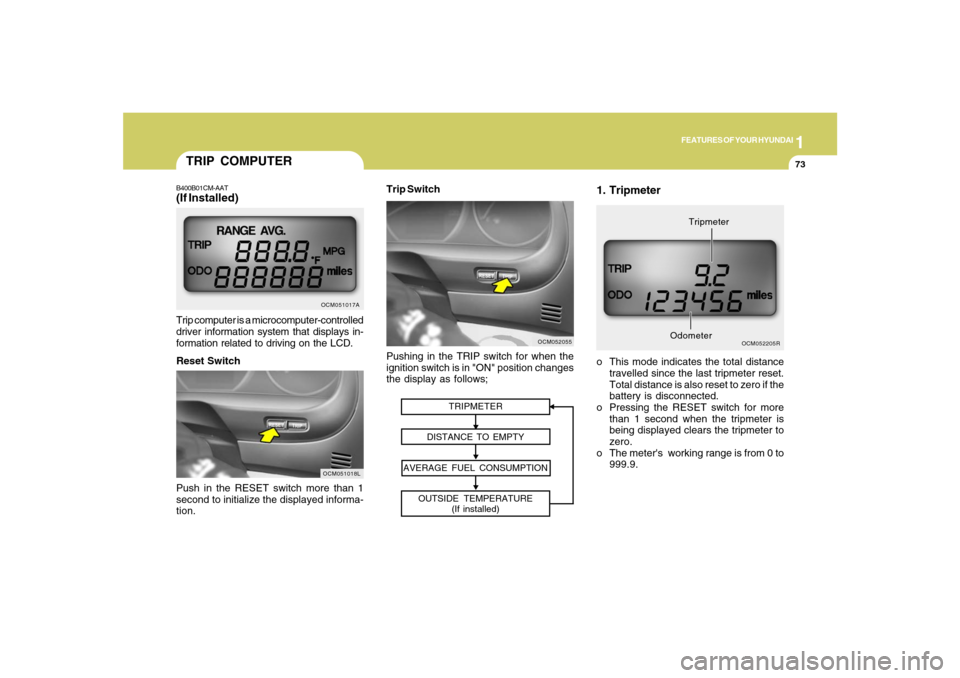
Push in the RESET switch more than 1
second to initialize the displayed informa-
tion.
OCM051018L
Reset Switch
TRIPMETER
DISTANCE TO EMPTY
AVERAGE FUEL CONSUMPTION
OUTSIDE TEMPERATURE
(If installed)
Pushing in the TRIP switch for when the
ignition switch is in "ON" position changes
the display as follows;
OCM052055
Trip Switch
TRIP COMPUTERB400B01CM-AAT(If Installed)Trip computer is a microcomputer-controlled
driver information system that displays in-
formation related to driving on the LCD.
OCM051017A
1. Tripmetero This mode indicates the total distance
travelled since the last tripmeter reset.
Total distance is also reset to zero if the
battery is disconnected.
o Pressing the RESET switch for more
than 1 second when the tripmeter is
being displayed clears the tripmeter to
zero.
o The meter's working range is from 0 to
999.9.
OCM052205R
OdometerTripmeter