warning light Hyundai Santa Fe 2009 - RHD (UK, Australia) Owner's Guide
[x] Cancel search | Manufacturer: HYUNDAI, Model Year: 2009, Model line: Santa Fe, Model: Hyundai Santa Fe 2009Pages: 269, PDF Size: 9.78 MB
Page 151 of 269
2DRIVING YOUR HYUNDAI
6
!
C050B02S-AAT Normal Conditions The Starting Procedure:
1. Insert key, and fasten the seat belt.
2. Depress the clutch pedal fully and
place the gearshift lever (manual transaxle) in neutral or the selector lever (automatic transaxle) in "P" (park) position.
3. After turning the ignition key to the "ON" position, make certain all warn-ing lights and gauges are functioningproperly before starting the engine.
4. On vehicles equipped with the diesel
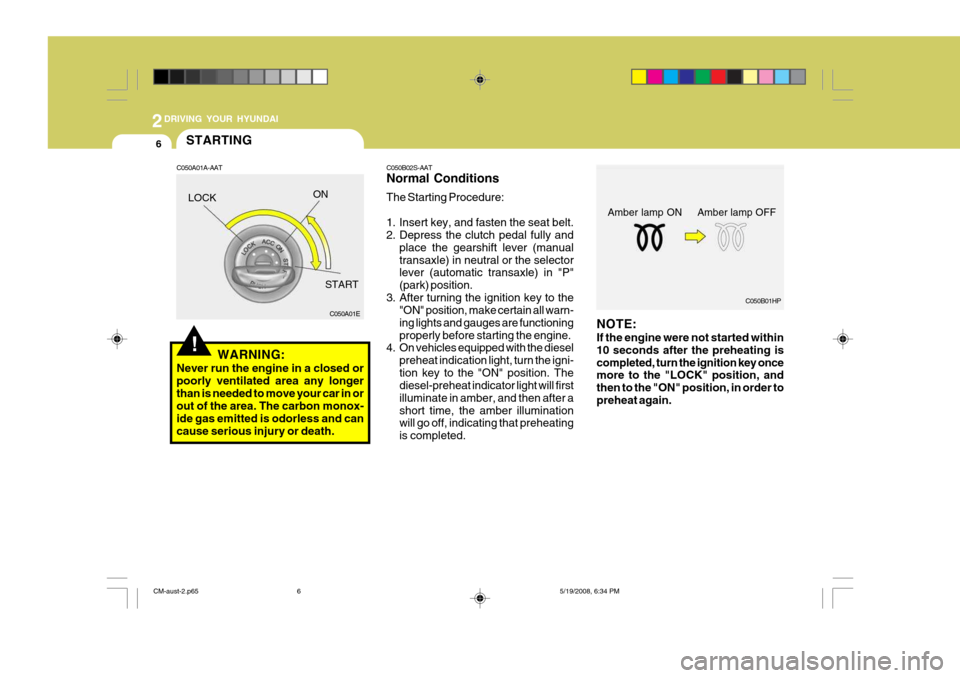
preheat indication light, turn the igni-tion key to the "ON" position. The diesel-preheat indicator light will first illuminate in amber, and then after ashort time, the amber illumination will go off, indicating that preheating is completed.
STARTING
C050A01A-AAT
WARNING:
Never run the engine in a closed or poorly ventilated area any longerthan is needed to move your car in or out of the area. The carbon monox- ide gas emitted is odorless and cancause serious injury or death. C050A01E
LOCK
ON
START
C050B01HP
Amber lamp ON Amber lamp OFF
NOTE: If the engine were not started within 10 seconds after the preheating iscompleted, turn the ignition key once more to the "LOCK" position, and then to the "ON" position, in order topreheat again.
CM-aust-2.p65 5/19/2008, 6:34 PM
6
Page 159 of 269
2DRIVING YOUR HYUNDAI
14
o The risk of rollover is greatly in-
creased if you lose control of your vehicle at highway speeds.
o Loss of control often occurs if two or more wheels drop off theroadway and the driver oversteers to reenter the roadway.
o In the event your vehicle leaves the roadway, do not steer sharply.Instead, slow down before pull- ing back into the travel lanes.
o Never exceed posted speed lim- its.
o If your vehicle becomes stuck in
snow, mud, sand, etc., then youmay attempt to rock the vehicle free by moving it forward andbackward. Do not attempt this procedure if people or objects are anywhere near the vehicle.During the rocking operation the vehicle may suddenly move for- ward of backward as it becomesunstuck, causing injury or dam- age to nearby people or objects.!WARNING:
Your ABS (ESP) will not prevent accidents due to improper or dan-gerous driving manoeuvres. Even though vehicle control is improved during emergency braking, alwaysmaintain a safe distance between you and objects ahead. Vehicle speeds should always be reducedduring extreme road conditions. The braking distance for cars equipped with an anti-lock brakingsystem (the electronic stability pro- gram) may be longer than for those without it in the following road con-ditions. These roads should be driven at reduced speeds.
o Rough, gravel or snow-covered roads.
o With tyre chains installed.
o On roads where the road surface is pitted or has different surface height.
ANTI-LOCK BRAKE SYSTEM
C120A01FC-DAT The Anti-Lock Brake System (ABS) is designed to prevent wheel lock-up dur- ing sudden braking or on hazardous road surfaces. The ABS control modulemonitors the wheel speed and controls the pressure applied to each brake. Thus, in emergency situations or onslick roads, ABS will increase vehicle control during braking. NOTE:
o A click sound may be heard in the engine compartment when the vehicle begins to move after the engine is started. These condi- tions are normal and indicate thatthe anti-lock brake system (Elec- tronic Stability Program) is func- tioning properly.
o During ABS (ESP) operation, a
slight pulsation may be felt in thebrake pedal when the brakes are applied. Also, a noise may be heard in the engine compartmentwhile braking. These conditions are normal and indicate that the anti-lock brake system (ElectronicStability Program) is functioning properly.
CM-aust-2.p65 5/19/2008, 6:35 PM
14
Page 164 of 269
2
DRIVING YOUR HYUNDAI
19
!
4WD LOCK SYSTEM
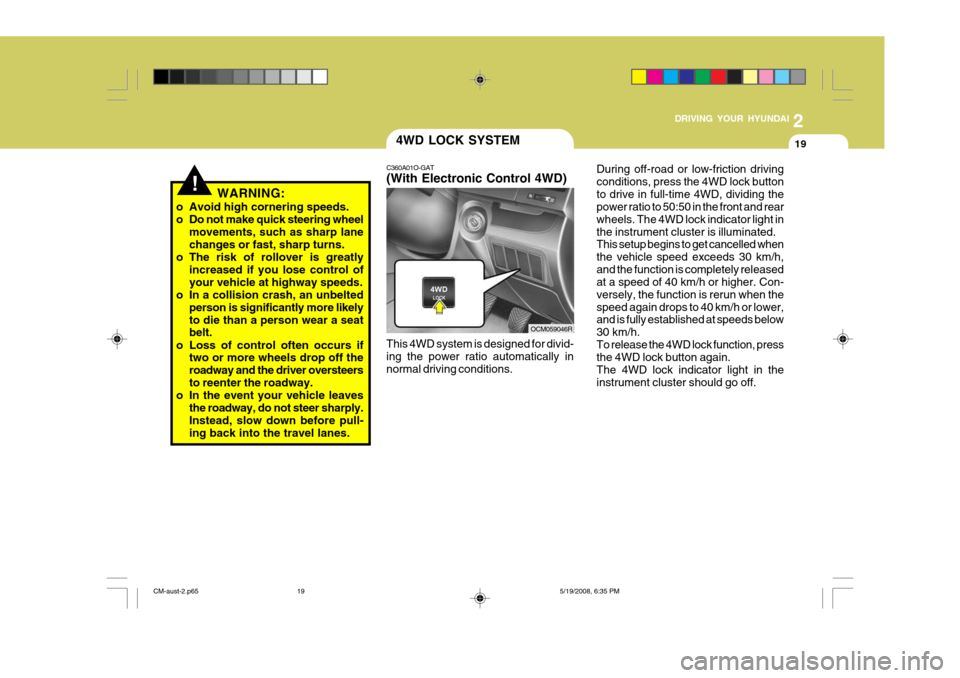
C360A01O-GAT (With Electronic Control 4WD) This 4WD system is designed for divid- ing the power ratio automatically innormal driving conditions. During off-road or low-friction drivingconditions, press the 4WD lock buttonto drive in full-time 4WD, dividing the power ratio to 50:50 in the front and rear wheels. The 4WD lock indicator light inthe instrument cluster is illuminated. This setup begins to get cancelled when the vehicle speed exceeds 30 km/h,and the function is completely released at a speed of 40 km/h or higher. Con- versely, the function is rerun when thespeed again drops to 40 km/h or lower, and is fully established at speeds below 30 km/h.To release the 4WD lock function, press the 4WD lock button again. The 4WD lock indicator light in theinstrument cluster should go off.
OCM059046R
WARNING:
o Avoid high cornering speeds.
o Do not make quick steering wheel movements, such as sharp lane changes or fast, sharp turns.
o The risk of rollover is greatly increased if you lose control ofyour vehicle at highway speeds.
o In a collision crash, an unbelted person is significantly more likelyto die than a person wear a seat belt.
o Loss of control often occurs if two or more wheels drop off the roadway and the driver oversteersto reenter the roadway.
o In the event your vehicle leaves the roadway, do not steer sharply. Instead, slow down before pull- ing back into the travel lanes.
CM-aust-2.p65 5/19/2008, 6:35 PM
19
Page 165 of 269
2DRIVING YOUR HYUNDAI
20
!
GOOD BRAKING PRACTICES
C130A01A-DAT o Don't coast down hills with the car
out of gear. This is extremely haz- ardous. Keep the car in gear at all times, use the brakes to slow down,then shift to a lower gear so thatengine braking will help you maintaina safe speed.
o Don't "ride" the brake pedal. Resting
your foot on the brake pedal whiledriving can be dangerous because itcan result in the brakes overheatingand losing their effectiveness. It alsoincreases the wear of the brake com-ponents.
o If a tyre goes flat while you are driving, apply the brakes gently andkeep the car pointed straight aheadwhile you slow down. When you aremoving slowly enough for it to besafe to do so, pull off the road and stop in a safe place.
o If your car is equipped with an auto-
matic transaxle, don't let your car creep forward. To avoid creepingforward, keep your foot on the brakepedal when the car is stopped.
o Use caution when parking on a hill. Engage the parking brake and placethe gear selector lever in "P" (auto-matic transaxle) or in first or re-
verse gear (manual transaxle).
WARNING:
Nothing should be carried on top ofthe shelf panel behind the rear seat. If there were an accident or a suddenstop, such objects could move for- ward and cause damage to the ve- hicle or injure the occupants.
o After being parked, check to be sure the parking brake is not engaged and that the parking brake indicator light is out before driving away.
o Driving through water may get the brakes wet. They can also get wet when the car is washed. Wet brakescan be dangerous! Your car will not stop as quickly if the brakes are wet. Wet brakes cause the car to pull toone side. To dry the brakes, apply the brakes lightly until the braking action returns to normal, taking careto keep the car under control at all times. If the braking action does not return to normal, stop as soon as it issafe to do so and call your Hyundai dealer for assistance.
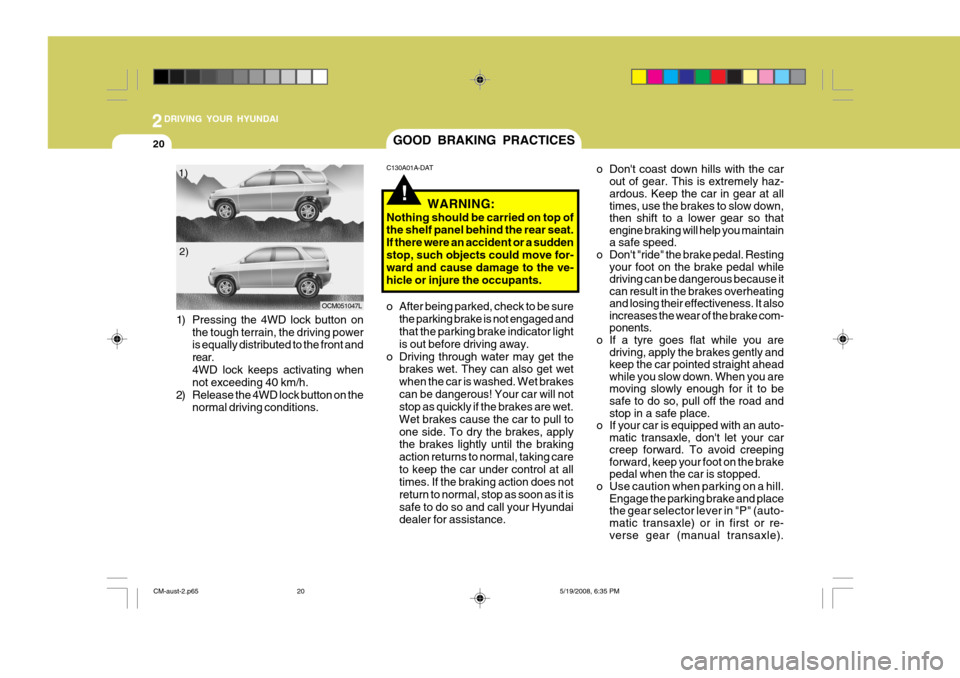
1) Pressing the 4WD lock button on
the tough terrain, the driving power is equally distributed to the front and rear. 4WD lock keeps activating when not exceeding 40 km/h.
2) Release the 4WD lock button on the normal driving conditions.
1)
2)
OCM051047L
CM-aust-2.p65 5/19/2008, 6:35 PM
20
Page 171 of 269
2DRIVING YOUR HYUNDAI
26
!
C190B02S-DAT Trailer Towbar Select the proper towbar and ball com- bination, making sure that it's locationis compatible with that of the trailer or vehicle being towed. We recommend only genuine Hyundai towbars (thetowbars are made and tested in Austra- lia/NZ for local conditions). Use a quality non-equalising towbarwhich distributes the tongue load uni- formly throughout the chassis. Tongue loads can be increased or de- creased by redistributing the load in the trailer. This can be verified by checkingthe total weight of the loaded trailer and then checking the load on the tongue.
WARNING:
Improperly loading your car and trailer can serious affect its steering and braking performance causing a crash in which you may be seriouslyinjured.
TRAILER OR VEHICLE TOWING
C190A01A-DAT If you are considering towing with your vehicle, you should first check with your State Department of Motor Ve- hicles to determine their legal require-ments. Since laws vary from state to state, the requirements for towing trailers, cars,other types of vehicles or apparatus may differ. Ask your Hyundai dealer for further details before towing.
CAUTION:
Do not do any towing with your car during its first 2,000km (1,200 miles) in order to allow the engine to prop-erly bed in. Failure to heed this cau- tion may result in serious engine or transaxle damage.
!
USE OF LIGHTS
C180A01A-AAT Check your lights regularly for correct operation and always keep them clean. When driving during the day in condi- tions of poor visibility, it is helpful todrive with headlights on low beam. This enables you to be seen as well as to see.
CM-aust-2.p65 5/19/2008, 6:35 PM
26
Page 174 of 269
2
DRIVING YOUR HYUNDAI
29
!
C190F01A-DAT Trailer and Vehicle Towing Tips
1. Before towing, check towbar and
safety chain connections as well as proper operation of the trailer running lights, brake lights and turn signals.
2. Always drive your vehicle at a mod- erate speed (Less than 100 km/h).
3. Trailer towing requires more fuel than
normal conditions.
4. To maintain engine braking efficiency and electrical charging performance, do not use fifth gear (manualtransaxle) or overdrive (automatic transaxle).
5. Always secure items in the trailer to prevent load shift while driving.
6. Check the condition and air pressure
of all tyres on the trailer and your car. Low tyre pressure can seriously af- fect the handling. Also check the spare tyre.
7. The vehicle/trailer combination is more affected by crosswind and buf-feting. When being passed by alarge vehicle, keep a constant speed and steer straight ahead. If there is too much wind buffeting, slow downto get out of the other vehicle's air turbulence. 8. When parking your car and trailer,
especially on a hill, be sure to follow all the normal precautions. Turn your front wheel into the curb, set the parking brake firmly, and put thetransaxle in 1st or Reverse (manual) or Park (automatic). In addition, place wheel chocks at each of the trailer'styres.
9. If the trailer has electric brakes, drive
your vehicle with the trailer attached,and then apply the trailer brakes by hand. This test confirms the opera- tion of the trailer brakes and alsochecks your electrical connection at the same time.
10. During your trip, check occasionally to be sure that the load is secure,and that the lights and any trailer brakes are still working.
11. Avoid jerky starts, sudden accel- eration or sudden stops.
12. Avoid sharp turns and rapid lane changes.
13. Avoid holding the brake pedal down
too long or too frequently. This couldcause the brakes to overheat, re- sulting in reduced braking efficiency.
CAUTION:
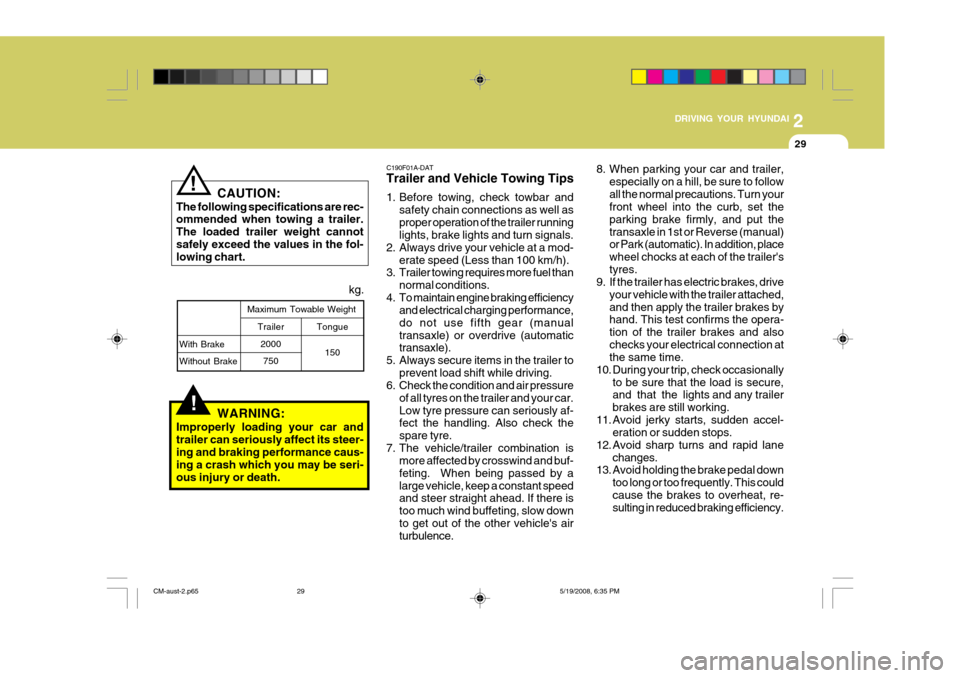
The following specifications are rec-ommended when towing a trailer. The loaded trailer weight cannotsafely exceed the values in the fol- lowing chart.
!
Maximum Towable Weight kg.
With Brake Without Brake
WARNING:
Improperly loading your car and trailer can seriously affect its steer-ing and braking performance caus- ing a crash which you may be seri- ous injury or death.
Tongue
150
Trailer
2000750
CM-aust-2.p65 5/19/2008, 6:35 PM
29
Page 177 of 269
3WHAT TO DO IN AN EMERGENCY
2
!
IF THE ENGINE WILL NOT START
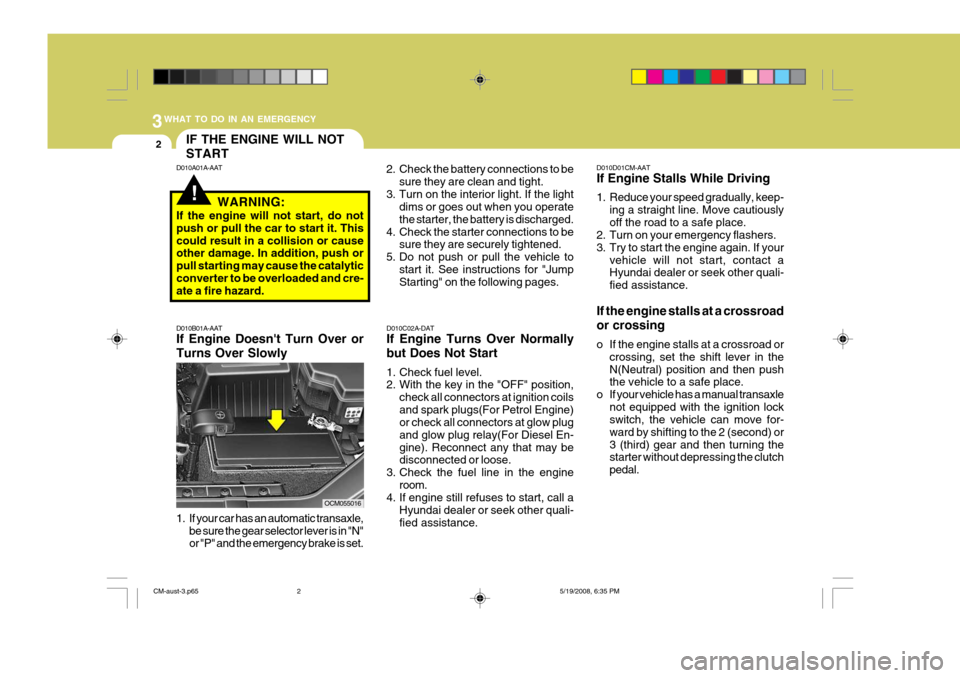
1. If your car has an automatic transaxle, be sure the gear selector lever is in "N" or "P" and the emergency brake is set.
D010B01A-AAT If Engine Doesn't Turn Over or Turns Over Slowly
D010A01A-AAT
D010D01CM-AAT If Engine Stalls While Driving
1. Reduce your speed gradually, keep-
ing a straight line. Move cautiously off the road to a safe place.
2. Turn on your emergency flashers.
3. Try to start the engine again. If your
vehicle will not start, contact a Hyundai dealer or seek other quali- fied assistance.
If the engine stalls at a crossroad or crossing
o If the engine stalls at a crossroad or crossing, set the shift lever in the N(Neutral) position and then push the vehicle to a safe place.
o If your vehicle has a manual transaxle not equipped with the ignition lockswitch, the vehicle can move for- ward by shifting to the 2 (second) or3 (third) gear and then turning the starter without depressing the clutch pedal.
D010C02A-DAT If Engine Turns Over Normally but Does Not Start
1. Check fuel level.
2. With the key in the "OFF" position,
check all connectors at ignition coils and spark plugs(For Petrol Engine) or check all connectors at glow plug and glow plug relay(For Diesel En-gine). Reconnect any that may be disconnected or loose.
3. Check the fuel line in the engine
room.
4. If engine still refuses to start, call a
Hyundai dealer or seek other quali- fied assistance.
WARNING:
If the engine will not start, do notpush or pull the car to start it. Thiscould result in a collision or cause other damage. In addition, push or pull starting may cause the catalyticconverter to be overloaded and cre- ate a fire hazard.
OCM0550162. Check the battery connections to be
sure they are clean and tight.
3. Turn on the interior light. If the light dims or goes out when you operate the starter, the battery is discharged.
4. Check the starter connections to be sure they are securely tightened.
5. Do not push or pull the vehicle to start it. See instructions for "Jump Starting" on the following pages.
CM-aust-3.p65 5/19/2008, 6:35 PM
2
Page 178 of 269
3
WHAT TO DO IN AN EMERGENCY
3
!
OCM054001
JUMP STARTING
D020A02A-AAT
WARNING:
The gas produced by the battery during the jump-start operation ishighly explosive. If these instruc- tions are not followed exactly, seri- ous personal injury and damage tothe vehicle may occur! If you are not sure how to follow this procedure, seek qualified assistance. Automo-bile batteries contain sulfuric acid. This is poisonous and highly corro- sive. When jump starting, wear pro-tective glasses and be careful not to get acid on yourself, your clothing or on the car. o If you should accidentally get acid on
your skin or in your eyes, immedi-ately remove any contaminated cloth- ing and flush the area with clear water for at least 15 minutes. Thenpromptly obtain medical attention. If you must be transported to an emer- gency facility, continue to apply wa-ter to the affected area with a sponge or cloth.
o The gas produced by the battery
during the jump-start operation ishighly explosive. Do not smoke or allow a spark or open flame in thevicinity.
o The battery being used to provide the
jump start must be 12-volts. If youcannot determine that it is a 12-volt battery, do not attempt to use it for the jump start.
o To jump start a car with a discharged battery, follow this procedure ex-actly: 1. If the booster battery is installed in
another vehicle, be sure the twovehicles are not touching.
2. Turn off all unnecessary lights and
accessories in both vehicles.
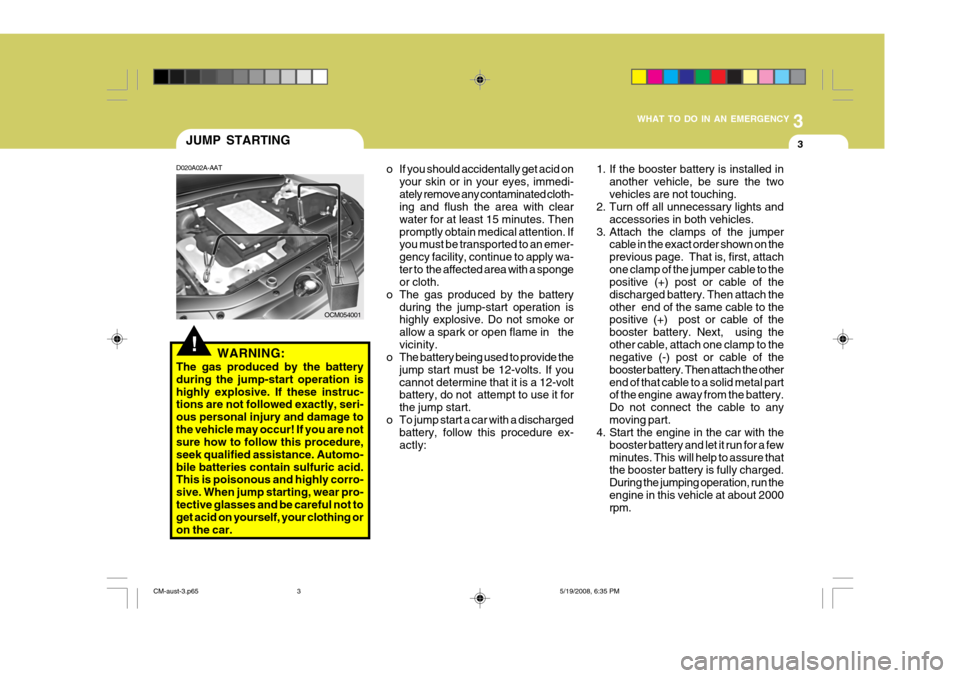
3. Attach the clamps of the jumper cable in the exact order shown on theprevious page. That is, first, attachone clamp of the jumper cable to the positive (+) post or cable of the discharged battery. Then attach theother end of the same cable to the positive (+) post or cable of the booster battery. Next, using theother cable, attach one clamp to the negative (-) post or cable of the booster battery. Then attach the otherend of that cable to a solid metal part of the engine away from the battery. Do not connect the cable to anymoving part.
4. Start the engine in the car with the
booster battery and let it run for a fewminutes. This will help to assure that the booster battery is fully charged. During the jumping operation, run theengine in this vehicle at about 2000 rpm.
CM-aust-3.p65 5/19/2008, 6:35 PM
3
Page 179 of 269
3WHAT TO DO IN AN EMERGENCY
4
!
IF THE ENGINE OVERHEATS
4. Check to see if the water pump drivebelt is missing. If it is not missing, check to see that it is tight. If the drive belt seems to be satisfactory, check for coolant leaking from theradiator, hoses or under the car. (If the air conditioning had been in use, it is normal for cold water to bedraining from it when you stop).
D030A02TB-DAT If your temperature gauge indicates overheating, you experience a loss of power, or hear loud pinging or knocking, the engine is probably too hot. If thishappens to you, you should:
1. Pull off the road and stop as soon as
it is safe to do so.
2. Place the gear selector lever in "P"
(automatic), or neutral (manual transaxle) and set the parking brake. If the air conditioning is on, turn it off.
3. If coolant is running out under the car or steam is coming out from underthe bonnet, stop the engine. Do not open the bonnet until the coolant hasstopped running or the steaming has stopped. If there is no visible loss of coolant and no steam, leave theengine running and check to be sure the engine cooling fan is operating. If the fan is not running, turn the engineoff. WARNING:
While the engine is running, keephands and clothing away from mov-ing parts such as the fan and drive belts to prevent injury.
5. Start the engine in the car with the
discharged battery using the normal starting procedure. After the enginestarts, leave the jumper cables con- nected and let the engine run at fast idle or about 2000 rpm for severalminutes.
6. Carefully remove the jumper cables
in the reverse order of attachment.
If you do not know why your batterybecame discharged (because the lightswere left on, etc.), have the charging system checked by your Hyundai dealer.
CM-aust-3.p65 5/19/2008, 6:35 PM
4
Page 225 of 269
6DO-IT-YOURSELF MAINTENANCE
18
!
G120E02A-DAT
Adding Brake Fluid
WARNING:
Handle brake fluid carefully. It can
damage your vision if it gets into your eyes. Use only DOT 3 or DOT 4 specification fluid from a sealed container. Do not allow the fluidbottle or reservoir to remain open any longer than required. This will avoid entry of dirt and moisturewhich can damage the brake sys- tem and cause improper operation. To add brake fluid, first wipe away any dirt then unscrew the fluid reservoir cap. Slowly pour the recommendedfluid into the reservoir. Do not overfill. Carefully replace the cap on the reser- voir and tighten.
G120D01CM-AAT
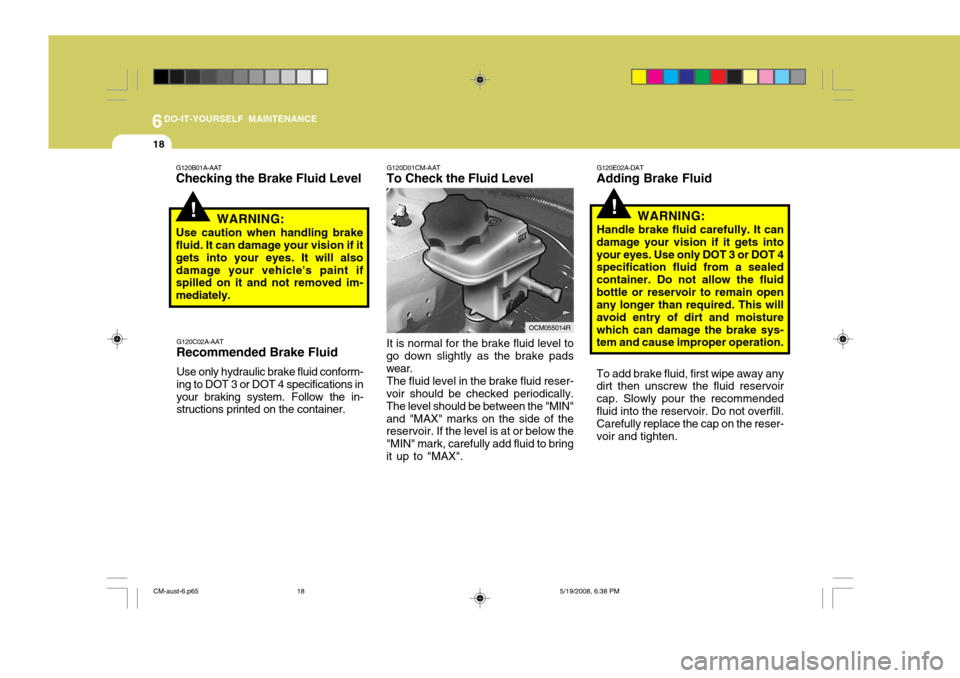
To Check the Fluid Level It is normal for the brake fluid level to
go down slightly as the brake pads wear.
The fluid level in the brake fluid reser-
voir should be checked periodically.The level should be between the "MIN"and "MAX" marks on the side of the reservoir. If the level is at or below the "MIN" mark, carefully add fluid to bringit up to "MAX".
OCM055014R
G120C02A-AAT
Recommended Brake Fluid
Use only hydraulic brake fluid conform- ing to DOT 3 or DOT 4 specifications inyour braking system. Follow the in- structions printed on the container.
!
G120B01A-AAT Checking the Brake Fluid Level
WARNING:
Use caution when handling brake fluid. It can damage your vision if it gets into your eyes. It will alsodamage your vehicle's paint if spilled on it and not removed im- mediately.
CM-aust-6.p65 5/19/2008, 6:38 PM
18