load capacity Hyundai Santa Fe 2009 Owner's Manual - RHD (UK, Australia)
[x] Cancel search | Manufacturer: HYUNDAI, Model Year: 2009, Model line: Santa Fe, Model: Hyundai Santa Fe 2009Pages: 269, PDF Size: 9.78 MB
Page 149 of 269
2DRIVING YOUR HYUNDAI
4
!
TO START THE ENGINE
C030A01A-GAT COMBINATION IGNITION SWITCH
o If your Hyundai is equipped with a manual transaxle, place the shift lever in neutral and depress the clutch pedal fully.
o If your Hyundai has an automatic
transaxle, place the shift lever in "P"(park).
o To start the engine, insert the ignition key and turn it to the "START" posi-tion. Release it as soon as the en- gine starts. Do not hold the key in the"START" position for more than 15 seconds.
NOTE: For safety, the engine will not start if the clutch pedal is not depressed
fully (Manual Transaxle) or the shift lever is not in "P" or "N" Position(Automatic Transaxle).
WARNING:
Your vehicle is equipped with tyres designed to provide for safe ride and handling capability.Do not use a size and type of tyre and wheel that is different from the one that was originally installed on yourvehicle. It can affect the safety and performance of your vehicle, which could lead to handling failure orrollover and serious injury. When replacing the tyres, be sure to equip all four tyres with the tyre andwheel of the same size, type, tread, brand and load-carrying capacity. If you nevertheless decide to equipyour vehicle with any tyre/wheel com- bination not recommended by Hyundai for off-road driving, youshould not use these tyres for high- way driving.
!WARNING:
Always wear appropriate shoes when operating your vehicle.Unsuitable shoes (high heels, ski boots, etc.) may interfere with your ability to use the brake and accelera-tor pedal, and the clutch (if installed).
!WARNING (DIESEL ENGINE):
To ensure that sufficient vacuum exists within the brake system dur-ing cold weather start-up conditions, it is necessary to run the engine at idle for several seconds after start-ing the engine.
!WARNING:
When you intend to park or stop the vehicle with the engine on, be care- ful not to depress the accelerator pedal for a long period of time. It mayoverheat the engine or exhaust sys- tem and cause fire.
CM-aust-2.p65 5/19/2008, 6:34 PM
4
Page 162 of 269
2
DRIVING YOUR HYUNDAI
17
!
(7)The full-time 4WD vehicle cannot
be towed by an ordinary tow truck. Make sure that the vehicle is towed with its four wheels raised off the ground.
o If the vehicle is towed with its only two wheels raised off the ground,the 4WD system could be dam- aged.
o In unavoidable case, if the vehicle
is being towed with all four wheelson the ground, it should be towed only forward direction with rope.
o While towing, check the following items.
1. The ignition switch is in "ACC" or "ON".
2. Place the shift lever in neutral
(For Automatic Transaxle, "N" position).
3. Release the parking brake.
NOTE: To avoid serious damage to your 4WD vehicle, limit towing to 15 km/h (10 mph) and not for more than 1.5km (1 mile) at ANY TIME.
(5)The stopping distance of the full-
time 4WD vehicle differs very littlefrom that of the 2WD vehicle. When driving on a snow-covered road or a slippery, muddy surface, makesure that you keep a sufficient dis- tance between your vehicle and the one ahead of you.
(6)Since the driving torque is always applied to the 4 wheels, the perfor-mance of the full-time 4WD vehicleis greatly affected by the condition of the tyres. Be sure to equip it with all four tyres of the same size and type.
o When replacement of any of the tyres or disc wheels is necessary,replace all of them.
o Rotate the tyres and check the tyre pressure at regular intervals. WARNING:
Your vehicle is equipped with tyresdesigned to provide for safe ride and handling capability. Do not use a size and type of tyre andwheel that is different from the one that was originally installed on your vehicle. It can affect the safety andperformance of your vehicle, which could lead to handling failure or rollover and serious injury.When replacing the tyres, be sure to equip all four tyres with the tyre and wheel of the same size, type, tread,brand and load-carrying capacity. If you nevertheless decide to equip your vehicle with any tyre/wheel com-bination not recommended by Hyundai for off-road driving, you should not use these tyres for high-way driving.
CM-aust-2.p65 5/19/2008, 6:35 PM
17
Page 183 of 269
3WHAT TO DO IN AN EMERGENCY
8
!
1VQA4023
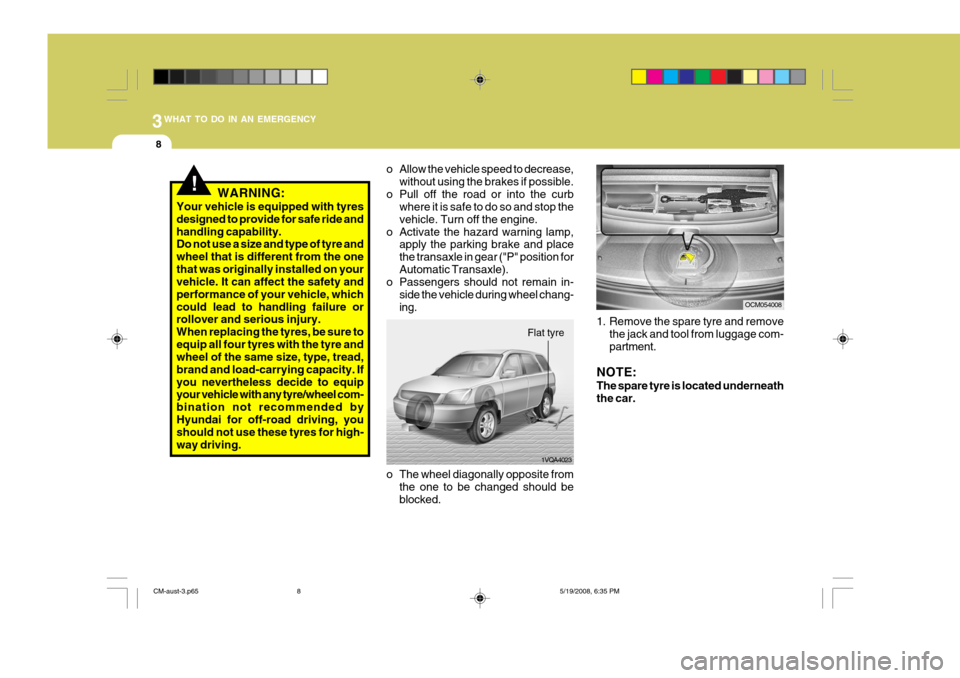
o The wheel diagonally opposite from the one to be changed should be blocked. 1. Remove the spare tyre and remove
the jack and tool from luggage com-partment.
NOTE: The spare tyre is located underneath the car.
WARNING:
Your vehicle is equipped with tyresdesigned to provide for safe ride andhandling capability. Do not use a size and type of tyre and wheel that is different from the onethat was originally installed on your vehicle. It can affect the safety and performance of your vehicle, whichcould lead to handling failure or rollover and serious injury. When replacing the tyres, be sure toequip all four tyres with the tyre and wheel of the same size, type, tread, brand and load-carrying capacity. Ifyou nevertheless decide to equip your vehicle with any tyre/wheel com- bination not recommended byHyundai for off-road driving, you should not use these tyres for high- way driving. o Allow the vehicle speed to decrease,
without using the brakes if possible.
o Pull off the road or into the curb where it is safe to do so and stop thevehicle. Turn off the engine.
o Activate the hazard warning lamp, apply the parking brake and placethe transaxle in gear ("P" position forAutomatic Transaxle).
o Passengers should not remain in-
side the vehicle during wheel chang-ing.
OCM054008
Flat tyre
CM-aust-3.p65 5/19/2008, 6:35 PM
8
Page 256 of 269

8CONSUMER INFORMATION
4
!
CAUTION:
Always observe the following:
o Check pressures when the tyres are cold. That is, after the car has been parked for at least threehours and hasn't been driven more than 1.6 km or one mile since starting up.
o Check the pressure of your spare tyre each time you check the pres-sure of other tyres.
o Never overload your car. Be espe- cially careful about overloading if you equip your car with a lug- gage rack or car top carrier. I040A01S-DAT
SNOW TYRES
If you equip your car with snow tyres,
they should be the same size and have the same load capacity as the original tyres. Snow tyres should beinstalled on all four wheels; otherwise, poor handling may result.
Snow tyres should carry 28 kPa (4 psi)
more air pressure than the pressure recommended for the standard tyreson the tyre label on the drive side centre pillar outer panel, or up to the maximum pressure shown on the tyresidewall whichever is less.
Do not drive faster than 120 km/h (75
mph) when your car is equipped withsnow tyres.
These pressures were chosen to pro-vide the most satisfactory combina- tion of ride comfort, tyre wear and stability under normal conditions.Tyre pressures should be checkedmonthly at least. Proper tyre inflationpressures should be maintained for these reasons:
o Lower-than-recommended tyre pres-
sures cause uneven tread wear and poor handling.
o Higher-than-recommended tyre pres-
sures increase the chance of dam- age from impacts and cause un- even tread wear.
7.0Jx17 7.0Jx18
4.0Tx17 TYRE SIZE
RIM
SIZE PRESSURE, kPa (PSI)
235/65R17235/60R18
T165/90R17 REAR
210(30)210(30)420(60) FRONT
220(32)220(32) 420(60)
NORMAL LOAD
MAXIMUM LOAD
REAR
220(32) 220(32) 420(60)
FRONT
210(30) 210(30)420(60)
CM-aust-8.p65 5/19/2008, 6:41 PM
4
Page 259 of 269
8
CONSUMER INFORMATION
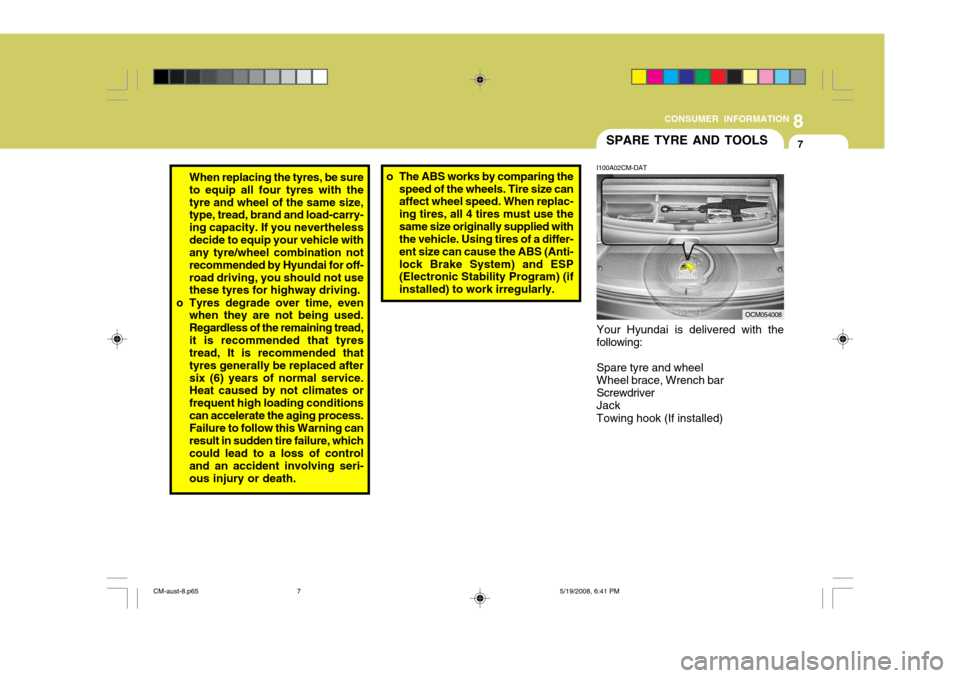
7SPARE TYRE AND TOOLS
I100A02CM-DAT Your Hyundai is delivered with the following: Spare tyre and wheel Wheel brace, Wrench bar Screwdriver Jack Towing hook (If installed)
When replacing the tyres, be sure to equip all four tyres with thetyre and wheel of the same size, type, tread, brand and load-carry- ing capacity. If you neverthelessdecide to equip your vehicle with any tyre/wheel combination not recommended by Hyundai for off-road driving, you should not use these tyres for highway driving.
o Tyres degrade over time, even when they are not being used. Regardless of the remaining tread,it is recommended that tyres tread, It is recommended that tyres generally be replaced aftersix (6) years of normal service. Heat caused by not climates or frequent high loading conditionscan accelerate the aging process.Failure to follow this Warning canresult in sudden tire failure, which could lead to a loss of control and an accident involving seri-ous injury or death.
OCM054008
o The ABS works by comparing the
speed of the wheels. Tire size can affect wheel speed. When replac- ing tires, all 4 tires must use thesame size originally supplied with the vehicle. Using tires of a differ- ent size can cause the ABS (Anti-lock Brake System) and ESP (Electronic Stability Program) (if installed) to work irregularly.
CM-aust-8.p65 5/19/2008, 6:41 PM
7
Page 261 of 269

9VEHICLE SPECIFICATIONS
2
4650 (183.1) 4675 (184.1)1890 (74.4) 1725 (67.9)1795 (70.7)
2700 (106.3) 1615 (63.6) 1620 (63.7)
J010A01CM-GAT DIMENSIONS
Overall length Overall width Overall height Wheel baseWheel tread
mm (in.)
Standard Option Standard with Roof Rack Front Rear
J030A01CM-DAT
TYRE
Full
Temporary Size
Type Inflation pressure kPa (psi)
235/65R17 235/60R18
T165/90R17 NORMAL
LOAD MAXIMUM
LOAD
220(32) 420(60)
210(30)420(60)
J060A01CM-DAT FUEL SYSTEM
Fuel tank capacity
75 litres
J050A01CM-GAT BRAKE
Dual hydraulic with brake booster Ventilated discDisc typeCable operated on rear wheel
TypeFront brake typeRear brake typeParking brake
CM-aust-9.p65
5/19/2008, 6:41 PM
2