coolant Hyundai Santa Fe 2011 Owner's Guide
[x] Cancel search | Manufacturer: HYUNDAI, Model Year: 2011, Model line: Santa Fe, Model: Hyundai Santa Fe 2011Pages: 408, PDF Size: 8.63 MB
Page 361 of 408
Maintenance
42
7
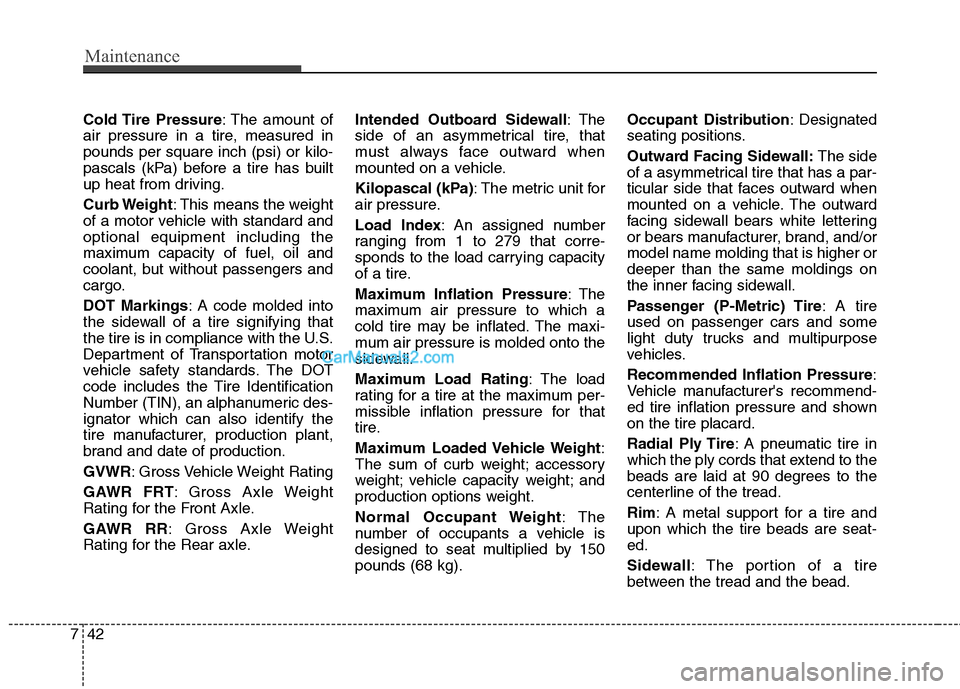
Cold Tire Pressure : The amount of
air pressure in a tire, measured in
pounds per square inch (psi) or kilo-
pascals (kPa) before a tire has built
up heat from driving.
Curb Weight : This means the weight
of a motor vehicle with standard and
optional equipment including the
maximum capacity of fuel, oil and
coolant, but without passengers and
cargo.
DOT Markings : A code molded into
the sidewall of a tire signifying that
the tire is in compliance with the U.S.
Department of Transportation motor
vehicle safety standards. The DOT
code includes the Tire Identification
Number (TIN), an alphanumeric des-
ignator which can also identify the
tire manufacturer, production plant,
brand and date of production.
GVWR : Gross Vehicle Weight Rating
GAWR FRT : Gross Axle Weight
Rating for the Front Axle.
GAWR RR : Gross Axle Weight
Rating for the Rear axle. Intended Outboard Sidewall
: The
side of an asymmetrical tire, that
must always face outward when
mounted on a vehicle.
Kilopascal (kPa) : The metric unit for
air pressure.
Load Index : An assigned number
ranging from 1 to 279 that corre-
sponds to the load carrying capacity
of a tire.
Maximum Inflation Pressure : The
maximum air pressure to which a
cold tire may be inflated. The maxi-
mum air pressure is molded onto the
sidewall.
Maximum Load Rating : The load
rating for a tire at the maximum per-
missible inflation pressure for that
tire.
Maximum Loaded Vehicle Weight :
The sum of curb weight; accessory
weight; vehicle capacity weight; and
production options weight.
Normal Occupant Weight :The
number of occupants a vehicle is
designed to seat multiplied by 150
pounds (68 kg). Occupant Distribution
: Designated
seating positions.
Outward Facing Sidewall: The side
of a asymmetrical tire that has a par-
ticular side that faces outward when
mounted on a vehicle. The outward
facing sidewall bears white lettering
or bears manufacturer, brand, and/or
model name molding that is higher or
deeper than the same moldings on
the inner facing sidewall.
Passenger (P-Metric) Tire : A tire
used on passenger cars and some
light duty trucks and multipurpose
vehicles.
Recommended Inflation Pressure :
Vehicle manufacturer's recommend-
ed tire inflation pressure and shown
on the tire placard.
Radial Ply Tire : A pneumatic tire in
which the ply cords that extend to the
beads are laid at 90 degrees to the
centerline of the tread.
Rim : A metal support for a tire and
upon which the tire beads are seat-
ed.
Sidewall : The portion of a tire
between the tread and the bead.
Page 388 of 408
769
Maintenance
EMISSION CONTROL SYSTEM
G270000AFD
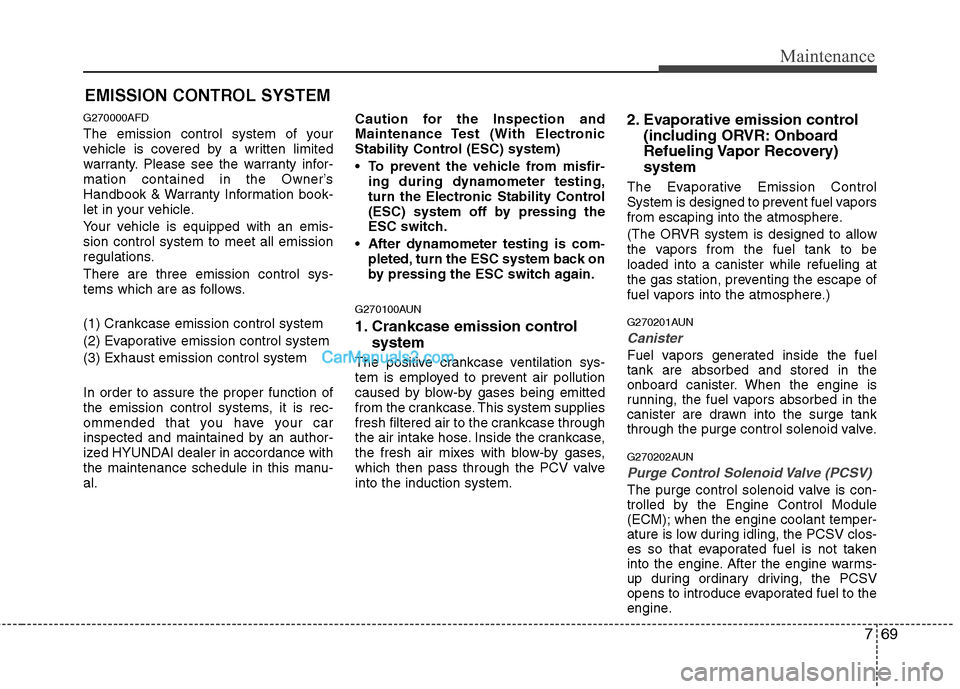
The emission control system of your
vehicle is covered by a written limited
warranty. Please see the warranty infor-
mation contained in the Owner’s
Handbook & Warranty Information book-
let in your vehicle.
Your vehicle is equipped with an emis-
sion control system to meet all emission
regulations.
There are three emission control sys-
tems which are as follows.
(1) Crankcase emission control system
(2) Evaporative emission control system
(3) Exhaust emission control system
In order to assure the proper function of
the emission control systems, it is rec-
ommended that you have your car
inspected and maintained by an author-
ized HYUNDAI dealer in accordance with
the maintenance schedule in this manu-
al.Caution for the Inspection and
Maintenance Test (With Electronic
Stability Control (ESC) system)
To prevent the vehicle from misfir-
ing during dynamometer testing,
turn the Electronic Stability Control
(ESC) system off by pressing the
ESC switch.
After dynamometer testing is com- pleted, turn the ESC system back on
by pressing the ESC switch again.
G270100AUN
1. Crankcase emission control system
The positive crankcase ventilation sys-
tem is employed to prevent air pollution
caused by blow-by gases being emitted
from the crankcase. This system supplies
fresh filtered air to the crankcase through
the air intake hose. Inside the crankcase,
the fresh air mixes with blow-by gases,
which then pass through the PCV valve
into the induction system.
2. Evaporative emission control(including ORVR: Onboard
Refueling Vapor Recovery)
system
The Evaporative Emission Control
System is designed to prevent fuel vapors
from escaping into the atmosphere.
(The ORVR system is designed to allow
the vapors from the fuel tank to be
loaded into a canister while refueling at
the gas station, preventing the escape of
fuel vapors into the atmosphere.)
G270201AUN
Canister
Fuel vapors generated inside the fuel
tank are absorbed and stored in the
onboard canister. When the engine is
running, the fuel vapors absorbed in the
canister are drawn into the surge tank
through the purge control solenoid valve.
G270202AUN
Purge Control Solenoid Valve (PCSV)
The purge control solenoid valve is con-
trolled by the Engine Control Module
(ECM); when the engine coolant temper-
ature is low during idling, the PCSV clos-
es so that evaporated fuel is not taken
into the engine. After the engine warms-
up during ordinary driving, the PCSV
opens to introduce evaporated fuel to the
engine.
Page 395 of 408
Specifications, Consumer information, Reporting safety defects
4
8
RECOMMENDED LUBRICANTS AND CAPACITIES
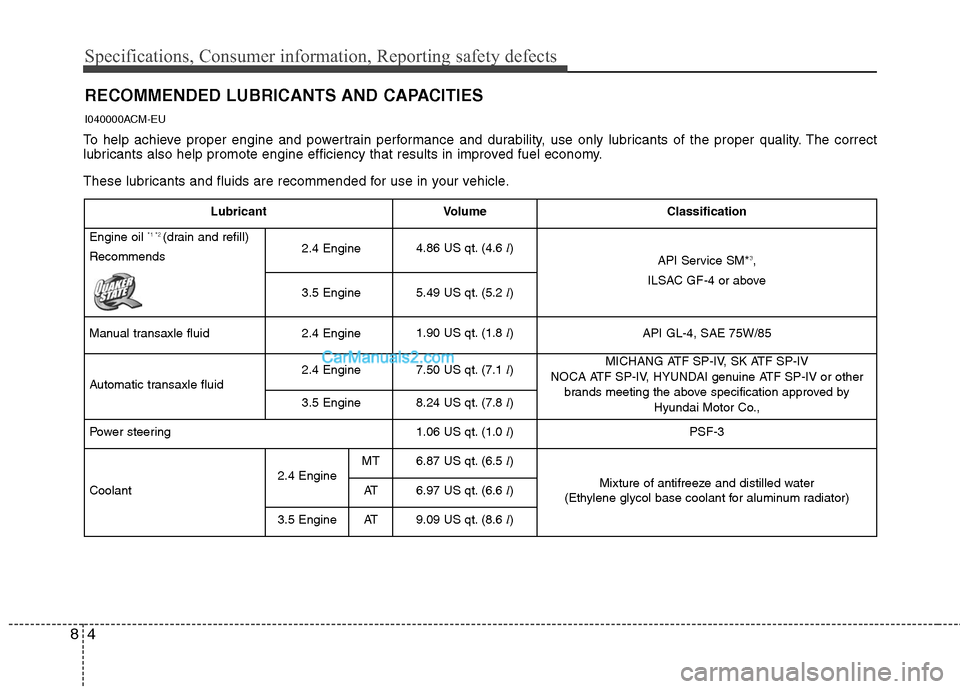
To help achieve proper engine and powertrain performance and durability, use only lubricants of the proper quality. The correct
lubricants also help promote engine efficiency that results in improved fuel economy.
These lubricants and fluids are recommended for use in your vehicle.
I040000ACM-EU
LubricantVolumeClassification
Engine oil *1 *2 (drain and refill)
Recommends2.4 Engine4.86 US qt. (4.6 l)API Service SM*3,
ILSAC GF-4 or above
3.5 Engine5.49 US qt. (5.2 l)
Manual transaxle fluid2.4 Engine1.90 US qt. (1.8 l)API GL-4, SAE 75W/85
Automatic transaxle fluid2.4 Engine7.50 US qt. (7.1 l)MICHANG ATF SP-IV, SK ATF SP-IV
NOCA ATF SP-IV, HYUNDAI genuine ATF SP-IV or other brands meeting the above specification approved by Hyundai Motor Co.,
3.5 Engine8.24 US qt. (7.8 l)
Power steering1.06 US qt. (1.0 l)PSF-3
Coolant 2.4 EngineMT6.87 US qt. (6.5 l)
Mixture of antifreeze and distilled water
(Ethylene glycol base coolant for aluminum radiator)AT6.97 US qt. (6.6 l)
3.5 EngineAT9.09 US qt. (8.6 l)
Page 404 of 408

I3
Index
Defroster ··················\
··················\
··················\
··················\
4-66
Dimensions ··················\
··················\
··················\
················8-2
Door locks··················\
··················\
··················\
················4-14Central door lock switch ··················\
··················\
···········4-8
Child-protector rear door lock ··················\
··················\
·4-10
Economical operation ··················\
··················\
················5-37
Emergency starting ··················\
··················\
··················\
····6-4 Jump starting ··················\
··················\
··················\
···········6-4
Push starting ··················\
··················\
··················\
············6-5
Emission control system ··················\
··················\
············7-69 Crankcase emission control system··················\
···········7-69
Evaporative emission control (including ORVR:Onboard Refueling Vapor Recovery) System ···········7-69
Exhaust emission control system ··················\
··············7-70
Engine compartment ··················\
··················\
············2-4, 7-2
Engine coolant ··················\
··················\
··················\
·········7-15
Engine number ··················\
··················\
··················\
···········8-8
Engine oil ··················\
··················\
··················\
·················7-14\
Explanation of scheduled maintenance items ···············7-11
Exterior features··················\
··················\
··················\
·······4-98 Roof rack ··················\
··················\
··················\
···············4-98 Fuel filler lid ··················\
··················\
··················\
············4-19
Fuel requirements ··················\
··················\
··················\
······1-2
Fuses ··················\
··················\
··················\
··················\
······7-45
Fuse/relay panel description ··················\
··················\
····7-49
Main fuse ··················\
··················\
··················\
···············7-48
Memory fuse··················\
··················\
··················\
··········7-47
Hazard warning flasher ··················\
··················\
··············4-56
Hood··················\
··················\
··················\
··················\
·······4-17
How to use this manual ··················\
··················\
···············1-2
If the engine overheats··················\
··················\
·················6-6
If the engine will not start ··················\
··················\
···········6-3
If you have a flat tire ··················\
··················\
·················6-13\
Changing tires··················\
··················\
··················\
········6-16
Compact spare tire ··················\
··················\
··················\
·6-20
Jack and tools ··················\
··················\
··················\
········6-13
Removing and storing the spare tire···········\
·················6-13\
D
E
F
H
I