overheating Hyundai Santa Fe 2015 Owner's Manual - RHD (UK, Australia)
[x] Cancel search | Manufacturer: HYUNDAI, Model Year: 2015, Model line: Santa Fe, Model: Hyundai Santa Fe 2015Pages: 699, PDF Size: 15.65 MB
Page 33 of 699
313
Safety features of your vehicle
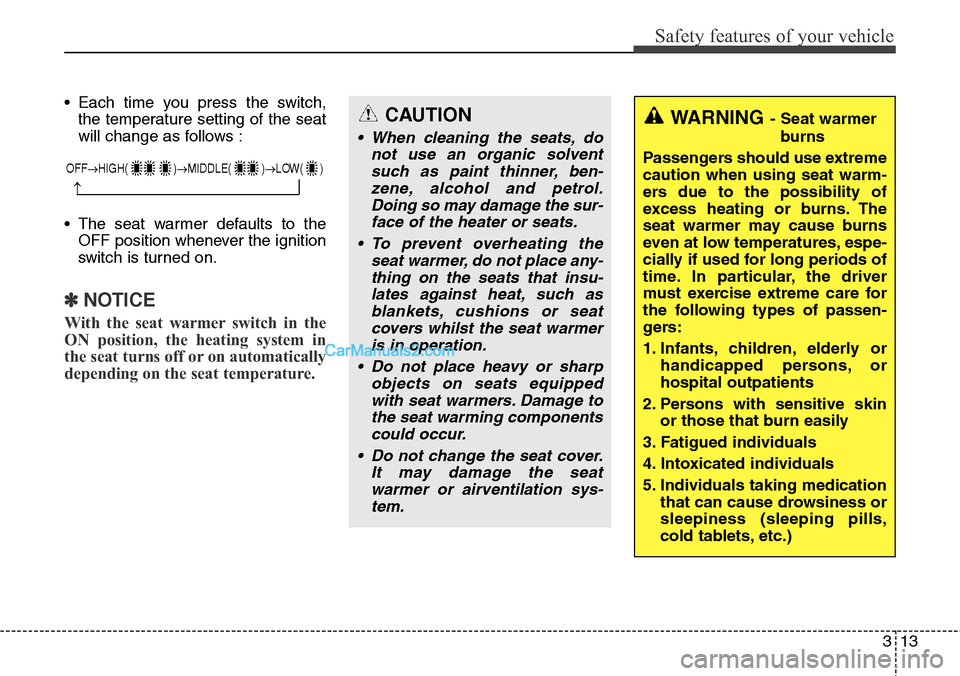
• Each time you press the switch,
the temperature setting of the seat
will change as follows :
• The seat warmer defaults to the
OFF position whenever the ignition
switch is turned on.
✽NOTICE
With the seat warmer switch in the
ON position, the heating system in
the seat turns off or on automatically
depending on the seat temperature.
OFF→HIGH( )→MIDDLE( )→LOW( )
→
CAUTION
• When cleaning the seats, do
not use an organic solvent
such as paint thinner, ben-
zene, alcohol and petrol.
Doing so may damage the sur-
face of the heater or seats.
• To prevent overheating the
seat warmer, do not place any-
thing on the seats that insu-
lates against heat, such as
blankets, cushions or seat
covers whilst the seat warmer
is in operation.
• Do not place heavy or sharp
objects on seats equipped
with seat warmers. Damage to
the seat warming components
could occur.
• Do not change the seat cover.
It may damage the seat
warmer or airventilation sys-
tem.
WARNING- Seat warmer
burns
Passengers should use extreme
caution when using seat warm-
ers due to the possibility of
excess heating or burns. The
seat warmer may cause burns
even at low temperatures, espe-
cially if used for long periods of
time. In particular, the driver
must exercise extreme care for
the following types of passen-
gers:
1. Infants, children, elderly or
handicapped persons, or
hospital outpatients
2. Persons with sensitive skin
or those that burn easily
3. Fatigued individuals
4. Intoxicated individuals
5. Individuals taking medication
that can cause drowsiness or
sleepiness (sleeping pills,
cold tablets, etc.)
Page 34 of 699
Safety system of your vehicle
14 3
Seat cooler
(Air ventilation seat)
(if equipped)
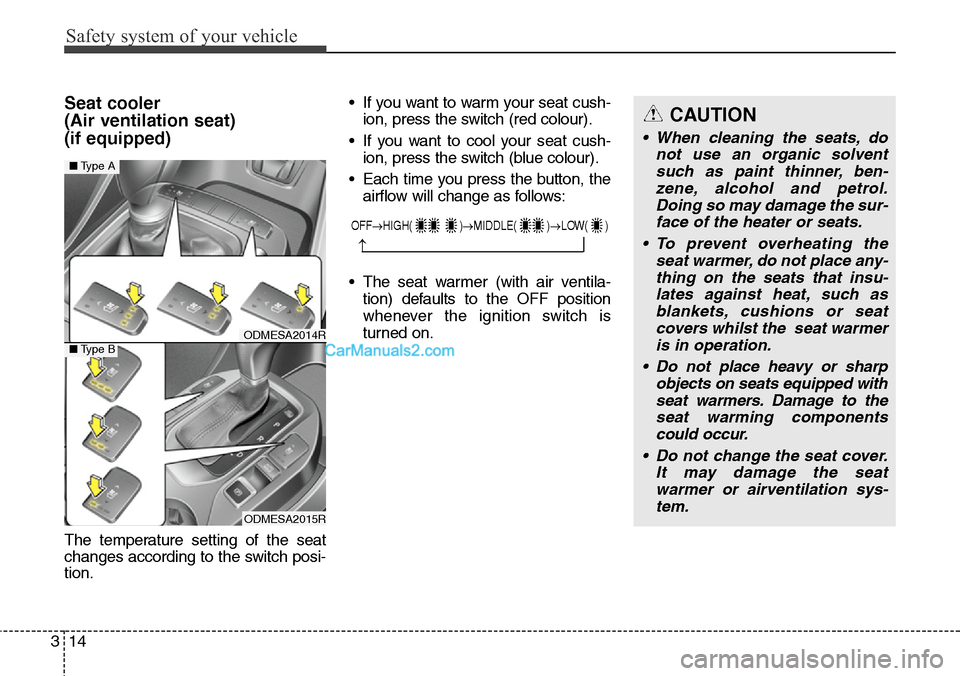
The temperature setting of the seat
changes according to the switch posi-
tion.• If you want to warm your seat cush-
ion, press the switch (red colour).
• If you want to cool your seat cush-
ion, press the switch (blue colour).
• Each time you press the button, the
airflow will change as follows:
• The seat warmer (with air ventila-
tion) defaults to the OFF position
whenever the ignition switch is
turned on.
OFF→HIGH( )→MIDDLE( )→LOW( )
→
CAUTION
• When cleaning the seats, do
not use an organic solvent
such as paint thinner, ben-
zene, alcohol and petrol.
Doing so may damage the sur-
face of the heater or seats.
• To prevent overheating the
seat warmer, do not place any-
thing on the seats that insu-
lates against heat, such as
blankets, cushions or seat
covers whilst the seat warmer
is in operation.
• Do not place heavy or sharp
objects on seats equipped with
seat warmers. Damage to the
seat warming components
could occur.
• Do not change the seat cover.
It may damage the seat
warmer or airventilation sys-
tem.
ODMESA2014R
ODMESA2015R
■Type A
■Type B
Page 44 of 699
Safety features of your vehicle
24 3
Seat warmer
(if equipped, for 2nd row seat)
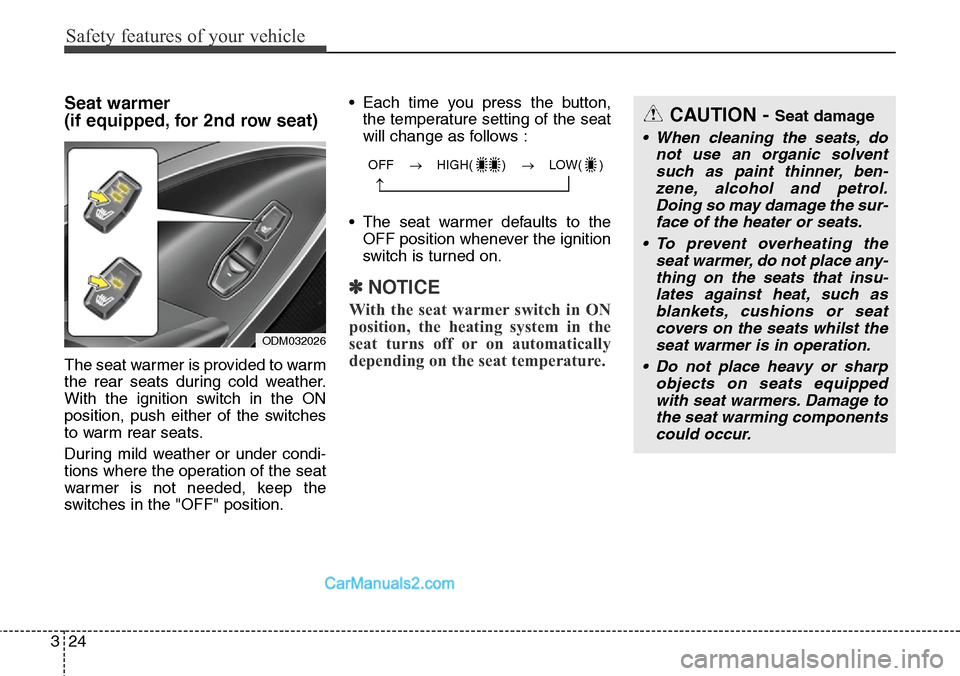
The seat warmer is provided to warm
the rear seats during cold weather.
With the ignition switch in the ON
position, push either of the switches
to warm rear seats.
During mild weather or under condi-
tions where the operation of the seat
warmer is not needed, keep the
switches in the "OFF" position.• Each time you press the button,
the temperature setting of the seat
will change as follows :
• The seat warmer defaults to the
OFF position whenever the ignition
switch is turned on.
✽NOTICE
With the seat warmer switch in ON
position, the heating system in the
seat turns off or on automatically
depending on the seat temperature.
OFF → HIGH( ) → LOW( )
→
CAUTION - Seat damage
• When cleaning the seats, do
not use an organic solvent
such as paint thinner, ben-
zene, alcohol and petrol.
Doing so may damage the sur-
face of the heater or seats.
• To prevent overheating the
seat warmer, do not place any-
thing on the seats that insu-
lates against heat, such as
blankets, cushions or seat
covers on the seats whilst the
seat warmer is in operation.
• Do not place heavy or sharp
objects on seats equipped
with seat warmers. Damage to
the seat warming components
could occur.
ODM032026
Page 169 of 699

471
Features of your vehicle
Engine Coolant Temperature
Gauge
This gauge indicates the tempera-
ture of the engine coolant when the
ignition switch or Engine Start/Stop
button is ON.
Fuel Gauge
This gauge indicates the approxi-
mate amount of fuel remaining in the
fuel tank.
WARNING
Never remove the radiator cap
when the engine is hot. The
engine coolant is under pres-
sure and could severe burns.
Wait until the engine is cool
before adding coolant to the
reservoir.
CAUTION
If the gauge pointer moves
beyond the normal range area
toward the “130 or H” position, it
indicates overheating that may
damage the engine.
Do not continue driving with an
overheated engine. If your vehi-
cle overheats, refer to “If the
Engine Overheats” in chapter 6.
ODMEMM2223/ODMNMM2223 ■Type A
ODMEMM2351/ODMNMM2351 ■Type B
ODMEMM2222/ODMNMM2222 ■Type A
ODMEMM2352/ODMNMM2352 ■Type B
Page 196 of 699

Features of your vehicle
98 4
Charging System
Warning Light
This warning light illuminates:
• Once you set the ignition switch or
Engine Start/Stop Button to the ON
position.
- It remains on until the engine is
started.
• When there is a malfunction with
either the alternator or electrical
charging system.
If there is a malfunction with either the
alternator or electrical charging system:
1. Drive carefully to the nearest safe
location and stop your vehicle.
2. Turn the engine off and check the
alternator drive belt for looseness
or breakage.
If the belt is adjusted properly,
there may be a problem in the
electrical charging system.
In this case, we recommend that
you have the vehicle inspected by
a HYUNDAI authorised repairer
as soon as possible.
Engine Coolant
Temperature Warning
Light (if equipped)
This warning light illuminates:
• When the engine coolant tempera-
ture is above 120°C (248°F). This
means that the engine is overheat-
ed and may be damaged.
If your vehicle is overheated, refer
to “Overheating” in chapter 6.
CAUTION - Diesel Engine
If the Malfunction Indicator
Lamp (MIL) blinks, some error
related to the injection quantity
adjustment occurs which could
result in loss of engine power,
combustion noise and poor
emission.
In this case, we recommend that
you have the engine control
system inspected by a
HYUNDAI authorised repairer.
CAUTION - Engine
Overheating
Do not continue driving with the
engine overheated. Otherwise
engine may be damaged.
Page 261 of 699

4163
Features of your vehicle
Air conditioning (if equipped)
HYUNDAI Air Conditioning Systems
are filled with environmentally friend-
ly refrigerant*.
1. Start the engine. Push the air con-
ditioning button.
2. Set the mode to the position.
3. Set the air intake control to the out-
side air or recirculated air position.
4. Adjust the fan speed control and
temperature control to maintain
maximum comfort.
*: Your vehicle is filled with R-134a or
R-1234yf according to the regula-
tion in your country at the time of
producing. You can find out which
air conditioning refrigerant is
applied your vehicle at the label
inside of the engine room. Refer to
section 8 for more detail location of
air conditioning refrigerant label.
✽NOTICE
• When using the air conditioning
system, monitor the temperature
gauge closely whilst driving up
hills or in heavy traffic when out-
side temperatures are high. Air
conditioning system operation
may cause engine overheating.
Continue to use the blower fan but
turn the air conditioning system
off if the temperature gauge indi-
cates engine overheating.
• When opening the windows in
humid weather air conditioning
may create water droplets inside
the vehicle. Since excessive water
droplets may cause damage to
electrical equipment, air condi-
tioning should only be used with
the windows closed.CAUTION
• The refrigerant system should
only be serviced by trained and
certified technicians to insure
proper and safe operation.
• The refrigerant system should
be serviced in a well-ventilat-
ed place.
• The air conditioning evaporator
(cooling coil) shall never be
repaired or replaced with one
removed from a used or sal-
vaged vehicle and new replace-
ment MAC evaporator s shall
be certified (and labeled) as
meeting SAE Standard J2842.
Page 276 of 699

Features of your vehicle
178 4
Air conditioning (if equipped)
HYUNDAI Air Conditioning Systems
are filled with environmentally friend-
ly refrigerant*.
1. Start the engine. Push the air con-
ditioning button.
2. Set the mode to the position.
3. Set the air intake control to the
outside air or recirculated air posi-
tion.
4. Adjust the fan speed control and
temperature control to maintain
maximum comfort.
*: Your vehicle is filled with R-134a or
R-1234yf according to the regula-
tion in your country at the time of
producing. You can find out which
air conditioning refrigerant is
applied your vehicle at the label
inside of bonnet. Refer to section 8
for more detail location of air con-
ditioning refrigerant label.
✽NOTICE
• When using the air conditioning
system, monitor the temperature
gauge closely whilst driving up
hills or in heavy traffic when out-
side temperatures are high. Air
conditioning system operation
may cause engine overheating.
Continue to use the blower fan but
turn the air conditioning system
off if the temperature gauge indi-
cates engine overheating.
• When opening the windows in
humid weather air conditioning
may create water droplets inside
the vehicle. Since excessive water
droplets may cause damage to
electrical equipment, air condi-
tioning should only be used with
the windows closed.CAUTION
• The refrigerant system should
only be serviced by trained
and certified technicians to
insure proper and safe opera-
tion.
• The refrigerant system should
be serviced in a well-ventilat-
ed place.
• The air conditioning evapora-
tor (cooling coil) shall never
be repaired or replaced with
one removed from a used or
salvaged vehicle and new
replacement MAC evaporator
s shall be certified (and
labeled) as meeting SAE
Standard J2842.
Page 288 of 699

Features of your vehicle
190 4
INTERIOR FEATURES
Cigarette lighter (if equipped)
For the cigarette lighter to work, the
ignition switch must be in the ACC
position or the ON position.
To use the cigarette lighter:
1. Open the cover by pressing the
switch.
2. Push the lighter all the way into the
socket.
When the element has heated, the
lighter will pop out to the "ready"
position.We recommend that you use parts
for replacement from a HYUNDAI
authorised repairer.
Ashtray (if equipped)
To use the ashtray, open the cover.
To clean or empty the ashtray, pull it
out.
CAUTION
The use of plug-in accessories
(shavers, hand-held vacuums,
and coffee pots, for example)
may damage the socket or
cause electrical failure.WARNING- Ashtray use
• Do not use the vehicle’s ash-
tray as a waste receptacle.
• Putting lit cigarettes or match-
es in an ashtray with other
combustible materials may
cause a fire.
WARNING
• Holding the lighter in after it is
heated will cause it to over-
heat.
• If the lighter does not pop out
within 30 seconds, remove it
to prevent overheating.
• Do not insert foreign objects
into the socket of the cigarette
lighter. It may damage the cig-
arette lighter.
ODMECO2063RODMECO2065R
Page 518 of 699

Driving your vehicle
60 5
• Do not "ride" the brake pedal.
Resting your foot on the brake
pedal whilst driving can be danger-
ous because it can result in the
brakes overheating and losing their
effectiveness. It also increases the
wear of the brake components.
• If a tyre goes flat whilst you are
driving, apply the brakes gently
and keep the vehicle pointed
straight ahead whilst you slow
down. When you are moving slow-
ly enough for it to be safe to do so,
pull off the road and stop in a safe
place.
• If your vehicle is equipped with an
automatic transaxle, do not let your
vehicle creep forward. To avoid
creeping forward, keep your foot
firmly on the brake pedal when the
vehicle is stopped.• Be cautious when parking on a hill.
Firmly engage the parking brake
and place the shift lever in P (auto-
matic transaxle) or in first or
reverse gear (manual transaxle). If
your vehicle is facing downhill, turn
the front wheels into the kerb to
help keep the vehicle from rolling. If
your vehicle is facing uphill, turn
the front wheels away from the
kerb to help keep the vehicle from
rolling. If there is no kerb or if it is
required by other conditions to
keep the vehicle from rolling, block
the wheels.
• Under some conditions your park-
ing brake can freeze in the
engaged position. This is most like-
ly to happen when there is an
accumulation of snow or ice
around or near the rear brakes or if
the brakes are wet. If there is a risk
that the parking brake may freeze,
apply it only temporarily whilst you
put the shift lever in P (automatic
transaxle) or in first or reverse gear
(manual transaxle) and block the
rear wheels so the vehicle cannot
roll. Then release the parking
brake.• Do not hold the vehicle on the
upgrade with the accelerator
pedal. This can cause the transaxle
to overheat. Always use the brake
pedal or parking brake.
Page 539 of 699

581
Driving your vehicle
• If your tyres are not in good condi-
tion, making a quick stop on wet
pavement can cause a skid and
possibly lead to an accident. Be
sure your tyres are in good shape.
• Turn on your headlights to make it
easier for others to see you.
• Driving too fast through large pud-
dles can affect your brakes. If you
must go through puddles, try to
drive through them slowly.
• If you believe you may have gotten
your brakes wet, apply them lightly
whilst driving until normal braking
operation returns.Driving in flooded areas
Avoid driving through flooded areas
unless you are sure the water is no
higher than the bottom of the wheel
hub. Drive through any water slowly.
Allow adequate stopping distance
because brake performance may be
affected.
After driving through water, dry the
brakes by gently applying them sev-
eral times whilst the vehicle is mov-
ing slowly.
Driving off-road
Drive carefully off-road because your
vehicle may be damaged by rocks of
roots of trees. Become familiar with
the off-road conditions where you
are going to drive before you begin
driving.
Highway driving
Tyres
Adjust the tyre inflation pressures to
specification. Low tyre inflation pres-
sures will result in overheating and
possible failure of the tyres.
Avoid using worn or damaged tyres
which may result in reduced traction
or tyre failure.
✽NOTICE
Never exceed the maximum tyre
inflation pressure shown on the
tyres.
1VQA1004R