tow Hyundai Santa Fe 2015 Owner's Manual - RHD (UK, Australia)
[x] Cancel search | Manufacturer: HYUNDAI, Model Year: 2015, Model line: Santa Fe, Model: Hyundai Santa Fe 2015Pages: 699, PDF Size: 15.65 MB
Page 12 of 699

17
Introduction
No special run-in period is needed.
By following a few simple precau-
tions for the first 600 miles (1,000
km) you may add to the perform-
ance, economy and life of your vehi-
cle.
• Do not race the engine.
• Whilst driving, keep your engine
speed (rpm, or revolutions per
minute) between 2,000 rpm and
4,000 rpm.
• Do not maintain a single speed for
long periods of time, either fast or
slow. Varying engine speed is
needed to properly run-in the
engine.
• Avoid hard stops, except in emer-
gencies, to allow the brakes to seat
properly.
• Don't tow a trailer/caravan during
the first 1,200 miles (2,000 km) of
operation.As with other vehicles of this type,
failure to operate this vehicle correct-
ly may result in loss of control, an
accident or vehicle rollover.
Specific design characteristics (high-
er ground clearance, track, etc.) give
this vehicle a higher centre of gravity
than other types of vehicles. In other
words they are not designed for cor-
nering at the same speeds as con-
ventional 2-wheel drive vehicles.
Avoid sharp turns or abrupt manoeu-
vres. Again, failure to operate this
vehicle correctly may result in loss of
control, an accident or vehicle
rollover.Be sure to read the
“Reducing the risk of a rollover”
driving guidelines, in section 5 of
this manual.
VEHICLE HANDLING
INSTRUCTIONS VEHICLE RUN-IN PROCESS
Page 14 of 699

Your vehicle at a glance
2 2
EXTERIOR OVERVIEW
1. Towing hook ........................................... 6-38
2. Front windscreen wiper blades ...............7-29
3. Outside rearview mirror ..........................4-62
4. Door locks...............................................4-20
5. Headlamp ...............................................7-65
6. Front fog light ........................................4-139
7. Bonnet ....................................................4-42
8. Tyres and wheels.............................7-35, 8-4
9. Panorama sunroof ..................................4-47
ODMEIN2001R
■Front view
❈The actual shape may differ from the illustration.
Page 15 of 699

23
Your vehicle at a glance
1. Antenna ................................................4-202
2. Defroster ...............................................4-153
3. Parking assist system ...............4-109, 4-113
4. Fuel filler lid ............................................4-44
5. Towing hook ............................................6-38
6. Rear combination lamp ..........................7-74
7. Rear window wiper blade .......................7-31
8. High mounted stop lamp ........................7-77
9. Rearview camera..................................4-131
ODM012002
■Rear view
❈The actual shape may differ from the illustration.
Page 30 of 699
Safety features of your vehicle
10 3
Forward and backward adjustment
(if equipped)
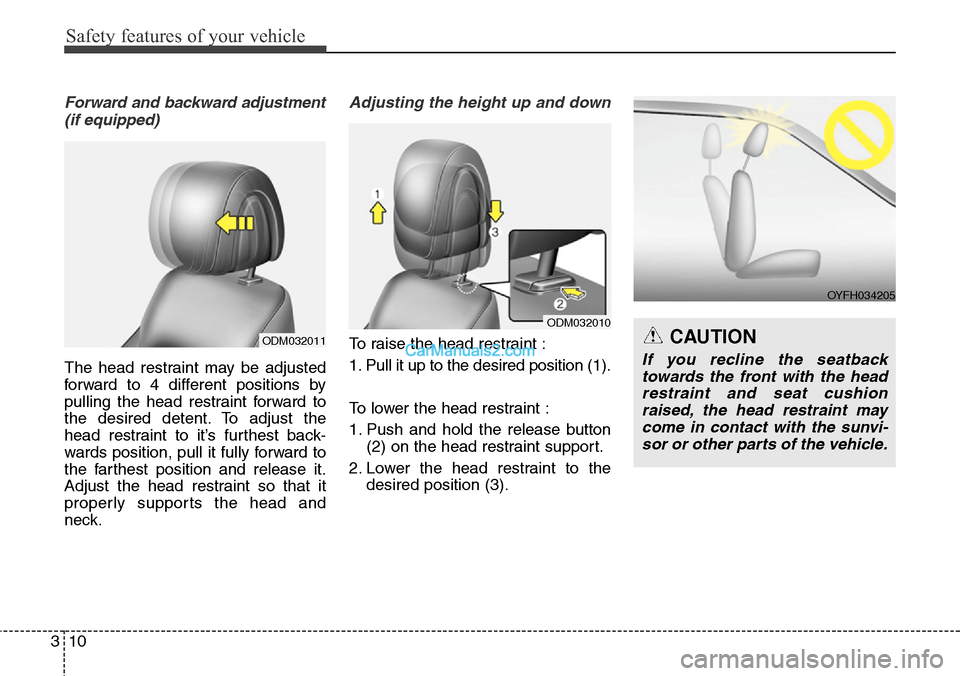
The head restraint may be adjusted
forward to 4 different positions by
pulling the head restraint forward to
the desired detent. To adjust the
head restraint to it’s furthest back-
wards position, pull it fully forward to
the farthest position and release it.
Adjust the head restraint so that it
properly supports the head and
neck.
Adjusting the height up and down
To raise the head restraint :
1. Pull it up to the desired position (1).
To lower the head restraint :
1. Push and hold the release button
(2) on the head restraint support.
2. Lower the head restraint to the
desired position (3).ODM032011
ODM032010
OYFH034205
CAUTION
If you recline the seatback
towards the front with the head
restraint and seat cushion
raised, the head restraint may
come in contact with the sunvi-
sor or other parts of the vehicle.
Page 38 of 699
Safety features of your vehicle
18 3
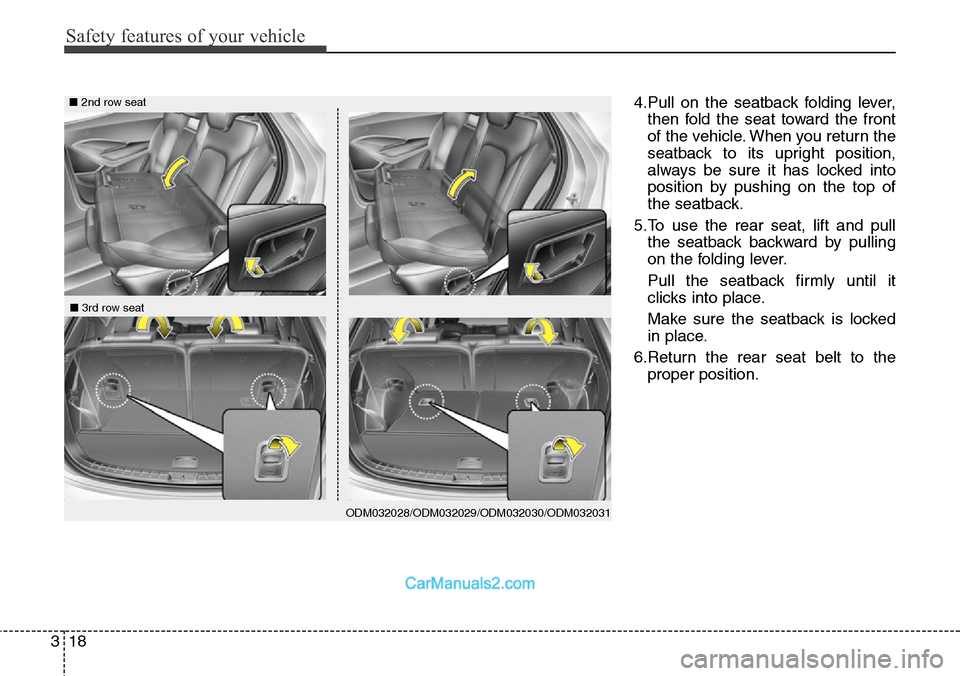
4.Pull on the seatback folding lever,
then fold the seat toward the front
of the vehicle. When you return the
seatback to its upright position,
always be sure it has locked into
position by pushing on the top of
the seatback.
5.To use the rear seat, lift and pull
the seatback backward by pulling
on the folding lever.
Pull the seatback firmly until it
clicks into place.
Make sure the seatback is locked
in place.
6.Return the rear seat belt to the
proper position.■2nd row seat
ODM032028/ODM032029/ODM032030/ODM032031
■3rd row seat
Page 39 of 699
319
Safety features of your vehicle
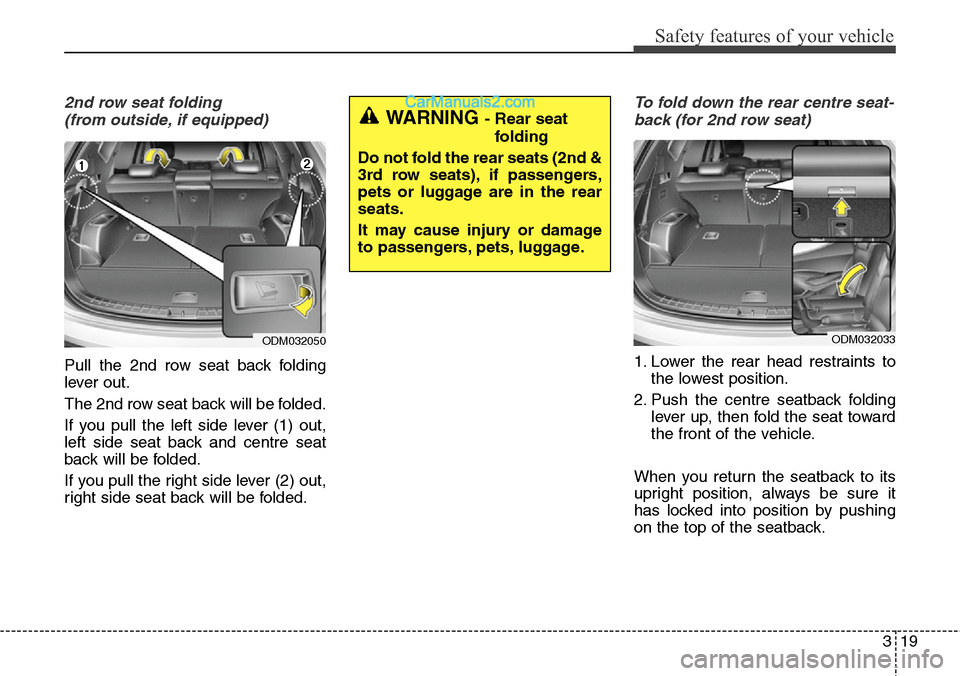
2nd row seat folding
(from outside, if equipped)
Pull the 2nd row seat back folding
lever out.
The 2nd row seat back will be folded.
If you pull the left side lever (1) out,
left side seat back and centre seat
back will be folded.
If you pull the right side lever (2) out,
right side seat back will be folded.
To fold down the rear centre seat-
back (for 2nd row seat)
1. Lower the rear head restraints to
the lowest position.
2. Push the centre seatback folding
lever up, then fold the seat toward
the front of the vehicle.
When you return the seatback to its
upright position, always be sure it
has locked into position by pushing
on the top of the seatback.
ODM032033ODM032050
WARNING - Rear seat
folding
Do not fold the rear seats (2nd &
3rd row seats), if passengers,
pets or luggage are in the rear
seats.
It may cause injury or damage
to passengers, pets, luggage.
Page 50 of 699
Safety features of your vehicle
30 3
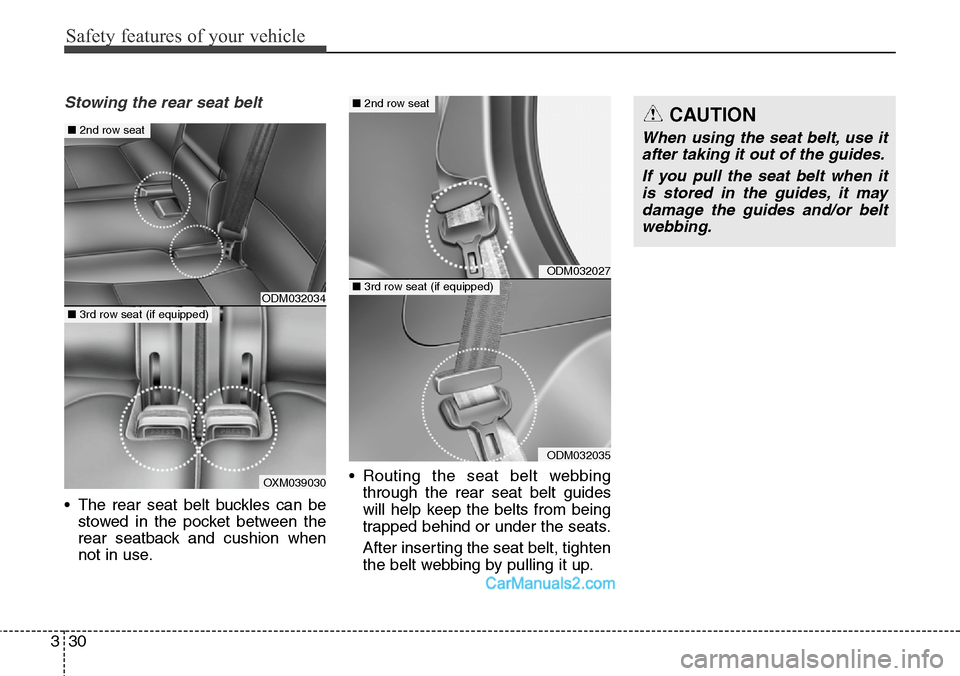
Stowing the rear seat belt
• The rear seat belt buckles can be
stowed in the pocket between the
rear seatback and cushion when
not in use.• Routing the seat belt webbing
through the rear seat belt guides
will help keep the belts from being
trapped behind or under the seats.
After inserting the seat belt, tighten
the belt webbing by pulling it up.
ODM032034
OXM039030
■2nd row seat
■3rd row seat (if equipped)
ODM032027
ODM032035
■2nd row seat
■3rd row seat (if equipped)
CAUTION
When using the seat belt, use it
after taking it out of the guides.
If you pull the seat belt when it
is stored in the guides, it may
damage the guides and/or belt
webbing.
Page 62 of 699

Safety features of your vehicle
42 3
3. Buckle the seat belt and allow the
seat belt to take up any slack. After
installation of the child restraint
system, try to move it in all direc-
tions to be sure the child restraint
system is securely installed.
If you need to tighten the belt, pull
more webbing toward the retractor.
When you unbuckle the seat belt and
allow it to retract, the retractor will
automatically revert back to its nor-
mal seated passenger emergency
locking usage condition.
OEN036104
Child Seat Restraint Suitability For Seat Position using the Seat Belt
Use child safety seats that have been officially approved and are appropriate
for your children. When using the child safety seats, refer to the following
table.
U : suitable for "universal" category restraints approved for use in this mass
group
U* : suitable for "universal" category restraints approved for use in this
mass group.
But 2nd seat should be adjusted to the foremost positions.
Mass GroupSeating Position
Front
Passenger2nd
outboard2nd
Centre3rd outboard
(if equipped)
0 : Up to 10kg
(0-9 months)UUU U*
0 + : Up to 13kg
(0 - 2 years)UUU U*
I : 9 to 18kg
(9 months - 4 years)UUU U*
II : 15 to 25kg U U U U*
II & III : 22 to 36kg U U U U*
Page 88 of 699

Safety features of your vehicle
68 3
WARNING - if equipped
with rollover sensor
If your vehicle is equipped with
side and curtain air bag, set the
ignition switch to OFF or ACC
position when the vehicle is
being towed.
The side and curtain air bag
may deploy when the ignition is
ON, and the rollover sensor
detects the situation as a rollover.WARNING
• Do not hit or allow any objects
to impact the locations where
air bag or sensors are installed.
This may cause unexpected
air bag deployment, which
could result in serious per-
sonal injury or death.
• If the installation location or
angle of the sensors is altered
in any way, the air bags may
deploy when they should not
or they may not deploy when
they should, causing severe
injury or death.
Therefore, do not try to per-
form maintenance on or
around the air bag sensors.
We recommend that the sys-
tem be serviced by a
HYUNDAI authorised repairer.
(Continued)
(Continued)
• Problems may arise if the sen-
sor installation angles are
changed due to the deforma-
tion of the front bumper, body,
front door or B pillar and C pil-
lars where side collision sen-
sors are installed. We recom-
mend that the system be serv-
iced by a HYUNDAI authorised
repairer.
•Y
our vehicle has been designed
to absorb impact and deploy the
air bag(s) in certain collisions.
Installing bumper guards or
replacing a bumper with non-
genuine parts may adversely
affect your vehicles collision
and air bag deployment per-
formance.
Page 112 of 699

Features of your vehicle
14 4
Unlocking
1. Carry the smart key.
2. Press the button of the front out-
side door handle.
3. All doors will unlock and the hazard
warning lights will blink twice. Also,
the outside rearview mirror will auto-
matically unfold when the outside
rearview mirror folding switch is in
the AUTO position (if equipped).
✽NOTICE
• The button will only operate when
the smart key is within 0.7 m (28
in.) from the outside door handle.
• When the smart key is recognized
in the area of 0.7 m (28 in.) from
the front outside door handle, other
people can also open the doors.
• After unlocking all doors, the
doors will lock automatically
unless a door is opened.
Tailgate unlocking
1.Carry the smart key.
2.Press the tailgate handle switch.
3.The tailgate will unlock.
✽NOTICE
• Once the tailgate is opened and
then closed, the tailgate will lock
automatically.
• The button will only operate when
the smart key is within 0.7 m (28
in.) from the tailgate handle.
Smart key precautions
✽NOTICE
• If, for some reason, you happen to
lose your smart key, you will not be
able to start the engine. Tow the
vehicle, if necessary, and we rec-
ommend that you contact a
HYUNDAI authorised repairer.
• A maximum of 2 smart keys can be
registered to a single vehicle. If you
lose a smart key, we recommend
that you take the vehicle and key to
your HYUNDAI authorised repair-
er to protect it from potential theft.
• The smart key will not work if any
of the following occurs:
- The smart key is close to a radio
transmitter such as a radio sta-
tion or an airport which can
interfere with normal operation
of the smart key.
- The smart key is near a mobile
two-way radio system or a
mobile phone.
- Another vehicle’s smart key is
being operated close to your
vehicle.
(Continued)