service Hyundai Santa Fe 2016 - RHD (UK, Australia) Owner's Guide
[x] Cancel search | Manufacturer: HYUNDAI, Model Year: 2016, Model line: Santa Fe, Model: Hyundai Santa Fe 2016Pages: 699, PDF Size: 15.65 MB
Page 582 of 699
What to do in an emergency
26 6
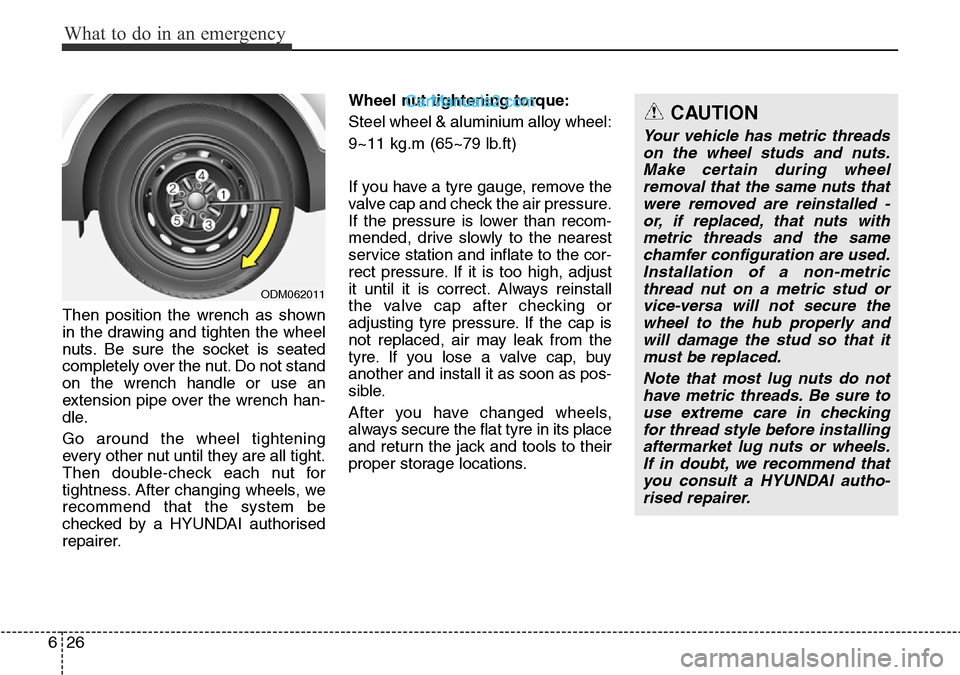
Then position the wrench as shown
in the drawing and tighten the wheel
nuts. Be sure the socket is seated
completely over the nut. Do not stand
on the wrench handle or use an
extension pipe over the wrench han-
dle.
Go around the wheel tightening
every other nut until they are all tight.
Then double-check each nut for
tightness. After changing wheels, we
recommend that the system be
checked by a HYUNDAI authorised
repairer.Wheel nut tightening torque:
Steel wheel & aluminium alloy wheel:
9~11 kg.m (65~79 lb.ft)
If you have a tyre gauge, remove the
valve cap and check the air pressure.
If the pressure is lower than recom-
mended, drive slowly to the nearest
service station and inflate to the cor-
rect pressure. If it is too high, adjust
it until it is correct. Always reinstall
the valve cap after checking or
adjusting tyre pressure. If the cap is
not replaced, air may leak from the
tyre. If you lose a valve cap, buy
another and install it as soon as pos-
sible.
After you have changed wheels,
always secure the flat tyre in its place
and return the jack and tools to their
proper storage locations.
CAUTION
Your vehicle has metric threads
on the wheel studs and nuts.
Make certain during wheel
removal that the same nuts that
were removed are reinstalled -
or, if replaced, that nuts with
metric threads and the same
chamfer configuration are used.
Installation of a non-metric
thread nut on a metric stud or
vice-versa will not secure the
wheel to the hub properly and
will damage the stud so that it
must be replaced.
Note that most lug nuts do not
have metric threads. Be sure to
use extreme care in checking
for thread style before installing
aftermarket lug nuts or wheels.
If in doubt, we recommend that
you consult a HYUNDAI autho-
rised repairer.
ODM062011
Page 591 of 699
635
What to do in an emergency
Distributing the sealant
11. Immediately drive approximately
4~6miles (7~10km or, about
10min) to evenly distribute the
sealant in the tyre.
Checking the tyre inflation
pressure
1.After driving approximately 4~6
miles (7~10 km or about 10 min-
utes), stop at a suitable location.
2.Connect connection hose (9) of the
compressor directly to the tyre
valve.
3.Connect between compressor and
the vehicle battery using the cable
and connectors.
4.Adjust the tyre inflation pressure to
200 kPa (29 psi). With the ignition
switched on, proceed as follows.
- To increase the inflation pres-
sure:Switch on the compressor,
position I. To check the current
inflation pressure setting, briefly
switch off the compressor.- To reduce the inflation pres-
sure:Press the button (8) on the
compressor.
WARNING
Do not let the compressor run
for more than 10 minutes, other-
wise the device will overheat
and may be damaged.
CAUTION
If the inflation pressure is not
maintained, drive the vehicle a
second time, refer to
Distributing the sealant. Then
repeat steps 1 to 4.
Use of the TMK may be ineffec-
tual for tyre damage larger than
approximately 4 mm (0.16 in).
We recommend that you contact
a HYUNDAI authorised repairer
if the tyre cannot be made road-
worthy with the Tyre Mobility
Kit.
WARNING
The tyre inflation pressure must
be at least 200 kPa (29 psi). If it
is not, do not continue driving.
Call for road side service or
towing.
CAUTION
Do not exceed a speed of 35
mph (60 km/h). If possible, do
not fall below a speed of 12 mph
(20 km/h).
Whilst driving, if you experience
any unusual vibration, ride dis-
turbance or noise, reduce your
speed and drive with caution
until you can safely pull off of
the side of the road. Call for
road side service or towing.
When you use the Tyre Mobility
Kit, the tyre pressure sensors
and wheel may be damaged by
sealant, remove the sealant
stained with tyre pressure sen-
sors and wheel and we recom-
mend that inspect at a HYUNDAI
authorised repairer.
Page 593 of 699
637
What to do in an emergency
TOWING
Towing service
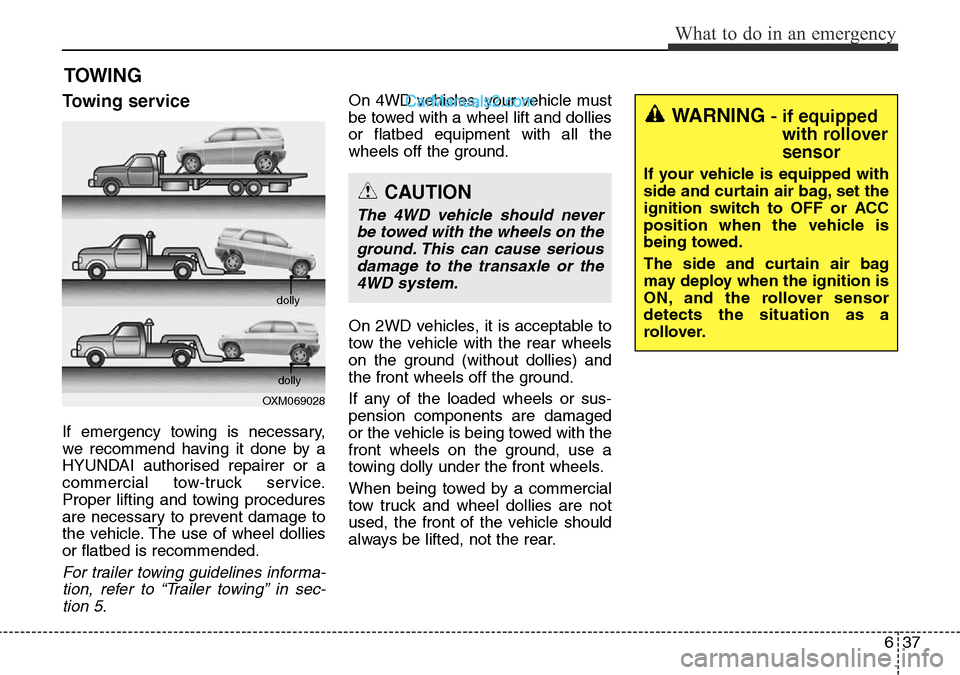
If emergency towing is necessary,
we recommend having it done by a
HYUNDAI authorised repairer or a
commercial tow-truck service.
Proper lifting and towing procedures
are necessary to prevent damage to
the vehicle. The use of wheel dollies
or flatbed is recommended.
For trailer towing guidelines informa-
tion, refer to “Trailer towing” in sec-
tion 5.
On 4WD vehicles, your vehicle must
be towed with a wheel lift and dollies
or flatbed equipment with all the
wheels off the ground.
On 2WD vehicles, it is acceptable to
tow the vehicle with the rear wheels
on the ground (without dollies) and
the front wheels off the ground.
If any of the loaded wheels or sus-
pension components are damaged
or the vehicle is being towed with the
front wheels on the ground, use a
towing dolly under the front wheels.
When being towed by a commercial
tow truck and wheel dollies are not
used, the front of the vehicle should
always be lifted, not the rear.
OXM069028dolly
dolly
CAUTION
The 4WD vehicle should never
be towed with the wheels on the
ground. This can cause serious
damage to the transaxle or the
4WD system.
WARNING - if equipped
with rollover
sensor
If your vehicle is equipped with
side and curtain air bag, set the
ignition switch to OFF or ACC
position when the vehicle is
being towed.
The side and curtain air bag
may deploy when the ignition is
ON, and the rollover sensor
detects the situation as a
rollover.
Page 595 of 699
639
What to do in an emergency
3.Install the towing hook by turning it
clockwise into the hole until it is
fully secured.
4.Remove the towing hook and
install the cover after use.Emergency towing
If towing is necessary, we recom-
mend you to have it done by a
HYUNDAI authorised repairer or a
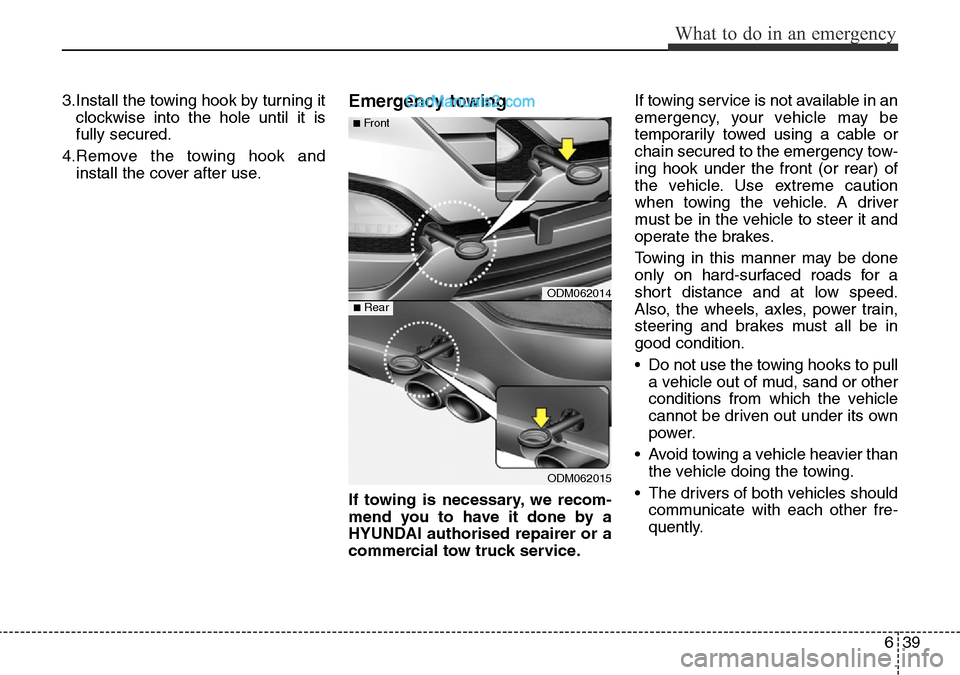
commercial tow truck service.If towing service is not available in an
emergency, your vehicle may be
temporarily towed using a cable or
chain secured to the emergency tow-
ing hook under the front (or rear) of
the vehicle. Use extreme caution
when towing the vehicle. A driver
must be in the vehicle to steer it and
operate the brakes.
Towing in this manner may be done
only on hard-surfaced roads for a
short distance and at low speed.
Also, the wheels, axles, power train,
steering and brakes must all be in
good condition.
• Do not use the towing hooks to pull
a vehicle out of mud, sand or other
conditions from which the vehicle
cannot be driven out under its own
power.
• Avoid towing a vehicle heavier than
the vehicle doing the towing.
• The drivers of both vehicles should
communicate with each other fre-
quently.
ODM062014
ODM062015
■Front
■Rear
Page 596 of 699
What to do in an emergency
40 6
• Before emergency towing, check
that the hook is not broken or dam-
aged.
• Fasten the towing cable or chain
securely to the hook.
• Do not jerk the hook. Apply steady
and even force.
• To avoid damaging the hook, do
not pull from the side or at a verti-
cal angle. Always pull straight
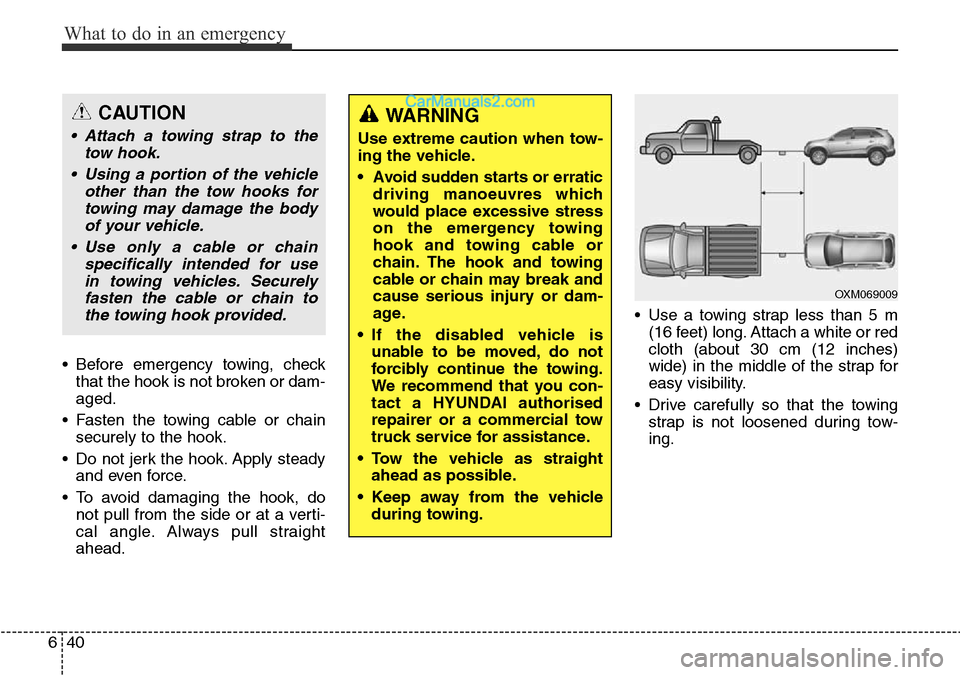
ahead.• Use a towing strap less than 5 m
(16 feet) long. Attach a white or red
cloth (about 30 cm (12 inches)
wide) in the middle of the strap for
easy visibility.
• Drive carefully so that the towing
strap is not loosened during tow-
ing.
WARNING
Use extreme caution when tow-
ing the vehicle.
• Avoid sudden starts or erratic
driving manoeuvres which
would place excessive stress
on the emergency towing
hook and towing cable or
chain. The hook and towing
cable or chain may break and
cause serious injury or dam-
age.
• If the disabled vehicle is
unable to be moved, do not
forcibly continue the towing.
We recommend that you con-
tact a HYUNDAI authorised
repairer or a commercial tow
truck service for assistance.
• Tow the vehicle as straight
ahead as possible.
• Keep away from the vehicle
during towing.
OXM069009
CAUTION
• Attach a towing strap to the
tow hook.
• Using a portion of the vehicle
other than the tow hooks for
towing may damage the body
of your vehicle.
• Use only a cable or chain
specifically intended for use
in towing vehicles. Securely
fasten the cable or chain to
the towing hook provided.
Page 598 of 699
Maintenance
7
Engine compartment . . . . . . . . . . . . . . . . . . . . . . . . 7-3
Maintenance services . . . . . . . . . . . . . . . . . . . . . . . . 7-5
• Owner’s responsibility . . . . . . . . . . . . . . . . . . . . . . . . . 7-5
• Owner maintenance precautions . . . . . . . . . . . . . . . . . 7-5
• Engine compartment precautions (Diesel engine) . . . 7-7
Owner maintenance . . . . . . . . . . . . . . . . . . . . . . . . . 7-8
• Owner maintenance schedule. . . . . . . . . . . . . . . . . . . . 7-8
Scheduled maintenance service. . . . . . . . . . . . . . . 7-10
Explanation of scheduled maintenance items . . . 7-11
Engine oil. . . . . . . . . . . . . . . . . . . . . . . . . . . . . . . . . 7-15
• Checking the engine oil level . . . . . . . . . . . . . . . . . . . 7-15
• Changing the engine oil and filter . . . . . . . . . . . . . . . 7-16
Engine coolant . . . . . . . . . . . . . . . . . . . . . . . . . . . . 7-17
• Checking the coolant level . . . . . . . . . . . . . . . . . . . . . 7-17
• Changing the coolant . . . . . . . . . . . . . . . . . . . . . . . . . 7-19
Brake/clutch fluid . . . . . . . . . . . . . . . . . . . . . . . . . . 7-20
• Checking the brake/clutch fluid level . . . . . . . . . . . . 7-20
Power steering fluid . . . . . . . . . . . . . . . . . . . . . . . . 7-21
• Checking the power steering fluid level . . . . . . . . . 7-21
• Checking the power steering hose . . . . . . . . . . . . . . . 7-21
Washer fluid . . . . . . . . . . . . . . . . . . . . . . . . . . . . . . 7-22
• Checking the washer fluid level . . . . . . . . . . . . . . . . . 7-22
Parking brake . . . . . . . . . . . . . . . . . . . . . . . . . . . . . 7-23
• Checking the parking brake. . . . . . . . . . . . . . . . . . . . 7-23
Fuel filter (for Diesel) . . . . . . . . . . . . . . . . . . . . . . . 7-24
• Draining water from fuel filter . . . . . . . . . . . . . . . . . 7-24
Air cleaner. . . . . . . . . . . . . . . . . . . . . . . . . . . . . . . . 7-25
• Filter replacement . . . . . . . . . . . . . . . . . . . . . . . . . . . . 7-25
Climate control air filter . . . . . . . . . . . . . . . . . . . . 7-27
• Filter inspection . . . . . . . . . . . . . . . . . . . . . . . . . . . . . . 7-27
• Filter replacement . . . . . . . . . . . . . . . . . . . . . . . . . . . . 7-27
Wiper blades . . . . . . . . . . . . . . . . . . . . . . . . . . . . . . 7-29
• Blade inspection . . . . . . . . . . . . . . . . . . . . . . . . . . . . . . 7-29
• Blade replacement . . . . . . . . . . . . . . . . . . . . . . . . . . . . 7-29
Battery . . . . . . . . . . . . . . . . . . . . . . . . . . . . . . . . . . . 7-32
• For best battery service . . . . . . . . . . . . . . . . . . . . . . . 7-32
• Battery capacity label . . . . . . . . . . . . . . . . . . . . . . . . . 7-33
• Battery recharging . . . . . . . . . . . . . . . . . . . . . . . . . . . 7-34
• Reset items . . . . . . . . . . . . . . . . . . . . . . . . . . . . . . . . . . 7-34
Tyres and wheels . . . . . . . . . . . . . . . . . . . . . . . . . . 7-35
• Tyre care . . . . . . . . . . . . . . . . . . . . . . . . . . . . . . . . . . . . 7-35
• Recommended cold tyre inflation pressures . . . . . . . 7-35
• Checking tyre inflation pressure . . . . . . . . . . . . . . . . 7-37
• Tyre rotation . . . . . . . . . . . . . . . . . . . . . . . . . . . . . . . . 7-38
• Wheel alignment and tyre balance . . . . . . . . . . . . . . 7-39
• Tyre replacement . . . . . . . . . . . . . . . . . . . . . . . . . . . . . 7-39
• Wheel replacement . . . . . . . . . . . . . . . . . . . . . . . . . . . 7-41
• Tyre traction. . . . . . . . . . . . . . . . . . . . . . . . . . . . . . . . . 7-41
• Tyre maintenance . . . . . . . . . . . . . . . . . . . . . . . . . . . . 7-41
Page 602 of 699
75
Maintenance
MAINTENANCE SERVICES
You should exercise the utmost care
to prevent damage to your vehicle
and injury to yourself whenever per-
forming any maintenance or inspec-
tion procedures.
Inadequate, incomplete or insuffi-
cient servicing may result in opera-
tional problems with your vehicle that
could lead to vehicle damage, an
accident, or personal injury.Owner’s responsibility
✽NOTICE
Maintenance Service and Record
Retention are the owner's responsi-
bility.
We recommend in general that you
have your vehicle serviced by a
HYUNDAI authorised repairer.
You should retain documents that
show proper maintenance has been
performed on your vehicle in accor-
dance with the scheduled mainte-
nance service charts. You need this
information to establish your compli-
ance with the servicing and mainte-
nance requirements of your vehicle
warranties.
Detailed warranty information is pro-
vided in your Warranty Booklet.
Repairs and adjustments required as
a result of improper maintenance or
a lack of required maintenance are
not covered when your vehicle is
covered by warranty.
Owner maintenance precau-
tions
Improper or incomplete service may
result in problems. This section gives
instructions only for the maintenance
items that are easy to perform.
✽NOTICE
Improper owner maintenance dur-
ing the warranty period may affect
warranty coverage. For details, read
the separate Warranty Booklet pro-
vided with the vehicle. If you're
unsure about any servicing or main-
tenance procedure, we recommend
that the system be seviced by a
HYUNDAI authorised repairer.
Page 607 of 699
Maintenance
10 7
SCHEDULED MAINTENANCE SERVICE
Follow Normal Maintenance
Schedule if the vehicle is usually
operated where none of the following
conditions apply. If any of the follow-
ing conditions apply, follow
Maintenance Under Severe Usage
Conditions.
• Repeated short distance driving.
• Driving in dusty conditions or
sandy areas.
• Extensive use of brakes.
• Driving in areas where salt or other
corrosive materials are being used.
• Driving on rough or muddy roads.
• Driving in mountainous areas.
• Extended periods of idling or low
speed operation.
• Driving for a prolonged period in
cold temperatures and/or extreme-
ly humid climates.
• More than 50% driving in heavy
city traffic during hot weather
above 32°C (90°F).If your vehicle is operated under the
above conditions, you should
inspect, replace or refill more fre-
quently than "Normal Maintenance
Schedule which is provied in your
Service Booklet."
Page 609 of 699
Maintenance
12 7
Vapour hose and fuel filler cap
The vapour hose and fuel filler cap
should be inspected at those inter-
vals specified in the maintenance
schedule. Make sure that a new
vapour hose or fuel filler cap is cor-
rectly replaced.
Vacuum crankcase ventilation
hoses (if equipped)
Inspect the surface of hoses for evi-
dence of heat and/or mechanical
damage. Hard and brittle rubber,
cracking, tears, cuts, abrasions, and
excessive swelling indicate deterio-
ration. Particular attention should be
paid to examine those hose surfaces
nearest to high heat sources, such
as the exhaust manifold.
Inspect the hose routing to assure
that the hoses do not come in con-
tact with any heat source, sharp
edges or moving component which
might cause heat damage or
mechanical wear. Inspect all hose
connections, such as clamps and
couplings, to make sure they are
secure, and that no leaks are pres-
ent. Hoses should be replaced
immediately if there is any evidence
of deterioration or damage.
Air cleaner filter
We recommend that the air cleaner
filter be replaced by a HYUNDAI
authorised repairer.
Spark plugs
(for petrol engine)
Make sure to install new spark plugs
of the correct heat range.
Valve clearance
(for petrol engine)
Inspect excessive valve noise and/or
engine vibration and adjust if neces-
sary. We recommend that the system
be serviced by a HYUNDAI autho-
rised repairer.
WARNING
Do not disconnect and inspect
spark plugs when the engine is
hot. You may burn yourself.
Page 620 of 699
723
Maintenance
PARKING BRAKE
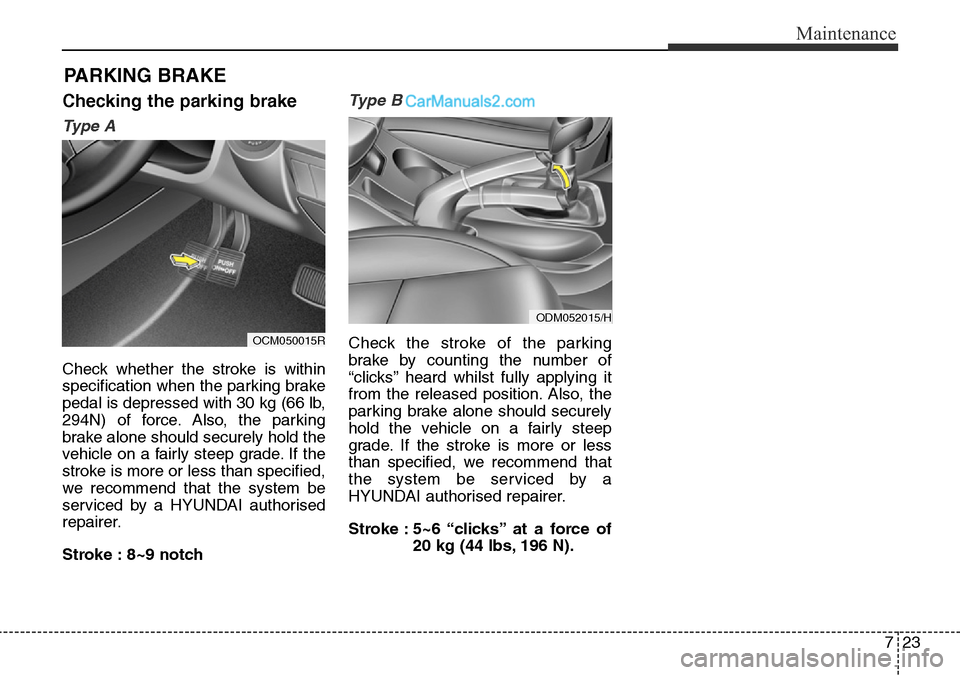
Checking the parking brake
Ty p e A
Check whether the stroke is within
specification when the parking brake
pedal is depressed with 30 kg (66 lb,
294N) of force. Also, the parking
brake alone should securely hold the
vehicle on a fairly steep grade. If the
stroke is more or less than specified,
we recommend that the system be
serviced by a HYUNDAI authorised
repairer.
Stroke : 8~9 notch
Type B
Check the stroke of the parking
brake by counting the number of
“clicks’’ heard whilst fully applying it
from the released position. Also, the
parking brake alone should securely
hold the vehicle on a fairly steep
grade. If the stroke is more or less
than specified, we recommend that
the system be serviced by a
HYUNDAI authorised repairer.
Stroke : 5~6 “clicks’’ at a force of
20 kg (44 lbs, 196 N).OCM050015R
ODM052015/H