run flat Hyundai Santa Fe 2016 Owner's Manual - RHD (UK, Australia)
[x] Cancel search | Manufacturer: HYUNDAI, Model Year: 2016, Model line: Santa Fe, Model: Hyundai Santa Fe 2016Pages: 699, PDF Size: 15.65 MB
Page 565 of 699
69
What to do in an emergency
Always check the TPMS malfunction
telltale after replacing one or more
tyres or wheels on your vehicle to
ensure that the replacement or alter-
nate tyres and wheels allow the
TPMS to continue to function proper-
ly.
✽NOTICE
If any of the below happens, we rec-
ommend that the system be checked
by a HYUNDAI authorised repairer.
1.The low tyre pressure telltale/
TPMS malfunction indicator do
not illuminate for 3 seconds when
the ignition switch is turned to the
ON position or engine is running.
2. The TPMS malfunction indicator
remains illuminated after blinking
for approximately 1 minute.
3. The Low tyre pressure position
telltale remains illuminated.
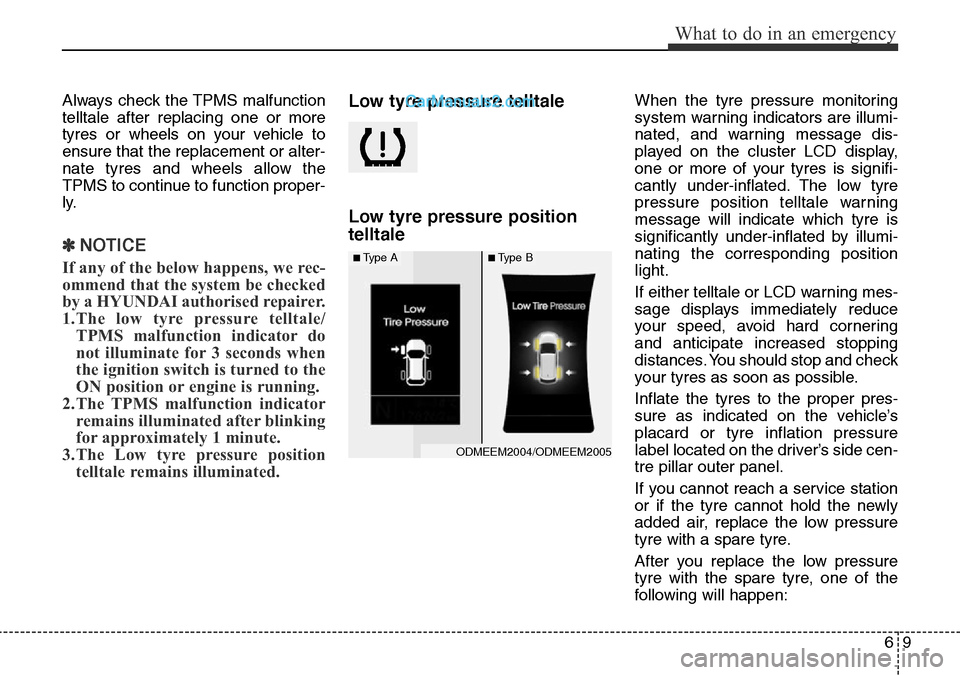
Low tyre pressure telltale
Low tyre pressure position
telltaleWhen the tyre pressure monitoring
system warning indicators are illumi-
nated, and warning message dis-
played on the cluster LCD display,
one or more of your tyres is signifi-
cantly under-inflated. The low tyre
pressure position telltale warning
message will indicate which tyre is
significantly under-inflated by illumi-
nating the corresponding position
light.
If either telltale or LCD warning mes-
sage displays immediately reduce
your speed, avoid hard cornering
and anticipate increased stopping
distances. You should stop and check
your tyres as soon as possible.
Inflate the tyres to the proper pres-
sure as indicated on the vehicle’s
placard or tyre inflation pressure
label located on the driver’s side cen-
tre pillar outer panel.
If you cannot reach a service station
or if the tyre cannot hold the newly
added air, replace the low pressure
tyre with a spare tyre.
After you replace the low pressure
tyre with the spare tyre, one of the
following will happen:
ODMEEM2004/ODMEEM2005
■Type A■Type B
Page 571 of 699
615
What to do in an emergency
✽NOTICE
If any of the below happens, we rec-
ommend that the system be checked
by a HYUNDAI authorised repairer.
1.The low tyre pressure telltale/
TPMS malfunction indicator does
not illuminate for 3 seconds when
Engine Start/Stop button is turned
to the ON or engine is running.
2. The TPMS malfunction indicator
remains illuminated after blinking
for approximately 1 minute.
3. The Low tyre pressure position
telltale remains illuminated.
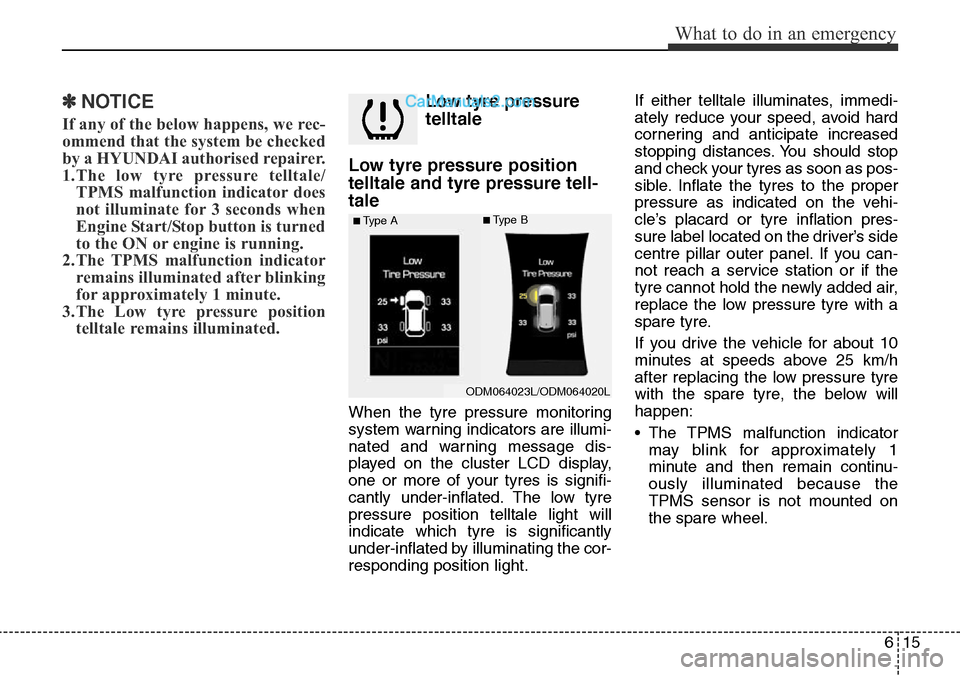
Low tyre pressure
telltale
Low tyre pressure position
telltale and tyre pressure tell-
tale
When the tyre pressure monitoring
system warning indicators are illumi-
nated and warning message dis-
played on the cluster LCD display,
one or more of your tyres is signifi-
cantly under-inflated. The low tyre
pressure position telltale light will
indicate which tyre is significantly
under-inflated by illuminating the cor-
responding position light.If either telltale illuminates, immedi-
ately reduce your speed, avoid hard
cornering and anticipate increased
stopping distances. You should stop
and check your tyres as soon as pos-
sible. Inflate the tyres to the proper
pressure as indicated on the vehi-
cle’s placard or tyre inflation pres-
sure label located on the driver’s side
centre pillar outer panel. If you can-
not reach a service station or if the
tyre cannot hold the newly added air,
replace the low pressure tyre with a
spare tyre.
If you drive the vehicle for about 10
minutes at speeds above 25 km/h
after replacing the low pressure tyre
with the spare tyre, the below will
happen:
• The TPMS malfunction indicator
may blink for approximately 1
minute and then remain continu-
ously illuminated because the
TPMS sensor is not mounted on
the spare wheel.
ODM064023L/ODM064020L
■Type A■Type B
Page 577 of 699
621
What to do in an emergency
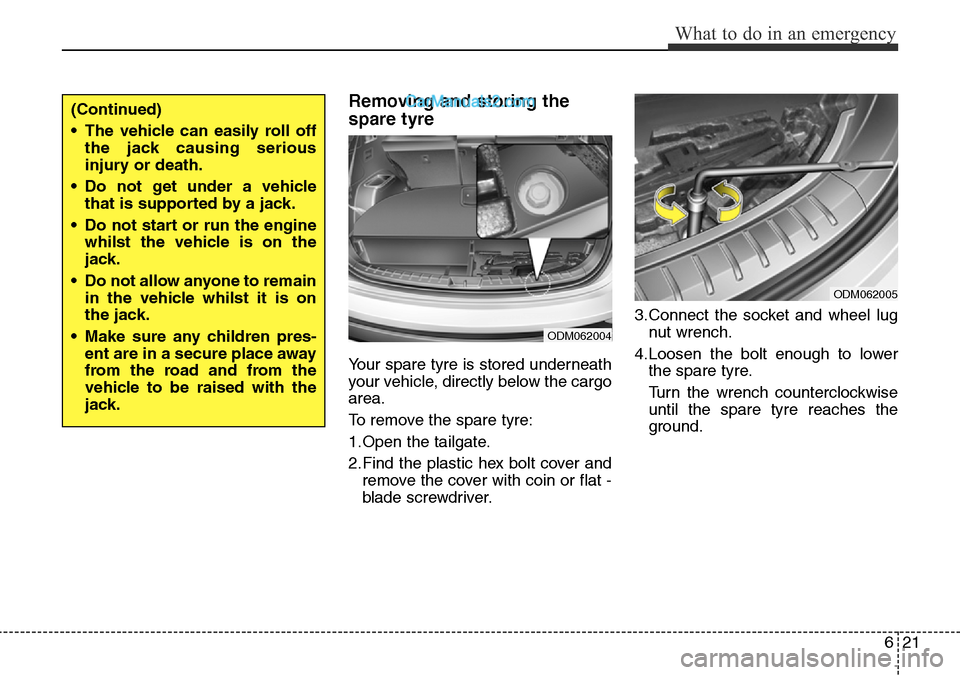
Removing and storing the
spare tyre
Your spare tyre is stored underneath
your vehicle, directly below the cargo
area.
To remove the spare tyre:
1.Open the tailgate.
2.Find the plastic hex bolt cover and
remove the cover with coin or flat -
blade screwdriver.3.Connect the socket and wheel lug
nut wrench.
4.Loosen the bolt enough to lower
the spare tyre.
Turn the wrench counterclockwise
until the spare tyre reaches the
ground.
ODM062004
(Continued)
• The vehicle can easily roll off
the jack causing serious
injury or death.
• Do not get under a vehicle
that is supported by a jack.
• Do not start or run the engine
whilst the vehicle is on the
jack.
• Do not allow anyone to remain
in the vehicle whilst it is on
the jack.
• Make sure any children pres-
ent are in a secure place away
from the road and from the
vehicle to be raised with the
jack.
ODM062005
Page 588 of 699
What to do in an emergency
32 6
It is possible that some tyres, espe-
cially with larger punctures or dam-
age to the sidewall, cannot be sealed
completely.
Air pressure loss in the tyre may
adversely affect tyre performance.
For this reason, you should avoid
abrupt steering or other driving
manoeuvres, especially if the vehicle
is heavily loaded or if a trailer is in
use.
The TMK is not designed or intended
as a permanent tyre repair method
and is to be used for one tyre only.
This instruction shows you step by
step how to temporarily seal the
puncture simply and reliably.
Read the section "Notes on the safe
use of the Tyre Mobility Kit".
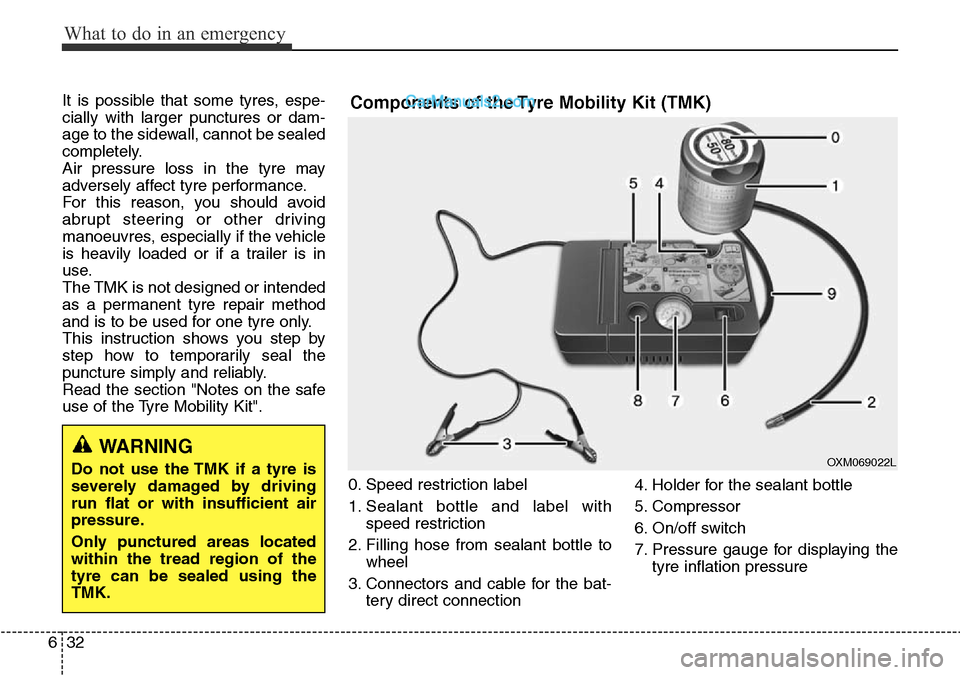
0. Speed restriction label
1. Sealant bottle and label with
speed restriction
2. Filling hose from sealant bottle to
wheel
3. Connectors and cable for the bat-
tery direct connection4. Holder for the sealant bottle
5. Compressor
6. On/off switch
7. Pressure gauge for displaying the
tyre inflation pressureComponents of the Tyre Mobility Kit (TMK)
OXM069022LWARNING
Do not use the TMK if a tyre is
severely damaged by driving
run flat or with insufficient air
pressure.
Only punctured areas located
within the tread region of the
tyre can be sealed using the
TMK.
Page 590 of 699
What to do in an emergency
34 6
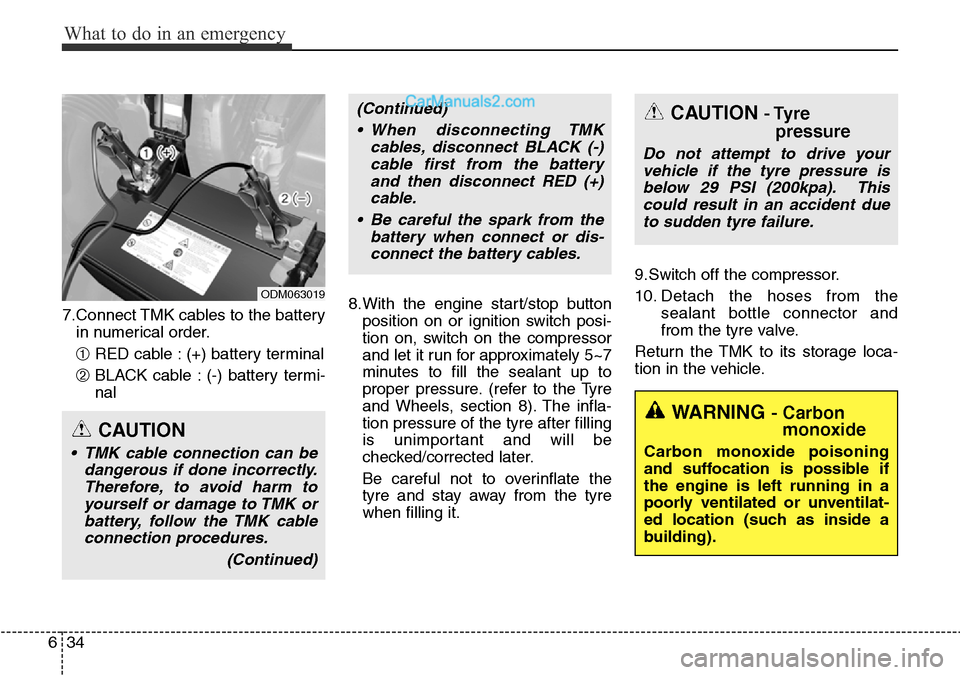
7.Connect TMK cables to the battery
in numerical order.
➀RED cable : (+) battery terminal
➁BLACK cable : (-) battery termi-
nal8.With the engine start/stop button
position on or ignition switch posi-
tion on, switch on the compressor
and let it run for approximately 5~7
minutes to fill the sealant up to
proper pressure. (refer to the Tyre
and Wheels, section 8). The infla-
tion pressure of the tyre after filling
is unimportant and will be
checked/corrected later.
Be careful not to overinflate the
tyre and stay away from the tyre
when filling it.9.Switch off the compressor.
10. Detach the hoses from the
sealant bottle connector and
from the tyre valve.
Return the TMK to its storage loca-
tion in the vehicle.
WARNING - Carbon
monoxide
Carbon monoxide poisoning
and suffocation is possible if
the engine is left running in a
poorly ventilated or unventilat-
ed location (such as inside a
building).
CAUTION - Tyre
pressure
Do not attempt to drive your
vehicle if the tyre pressure is
below 29 PSI (200kpa). This
could result in an accident due
to sudden tyre failure.
CAUTION
• TMK cable connection can be
dangerous if done incorrectly.
Therefore, to avoid harm to
yourself or damage to TMK or
battery, follow the TMK cable
connection procedures.
(Continued)
ODM063019
(Continued)
• When disconnecting TMK
cables, disconnect BLACK (-)
cable first from the battery
and then disconnect RED (+)
cable.
• Be careful the spark from the
battery when connect or dis-
connect the battery cables.
Page 591 of 699
635
What to do in an emergency
Distributing the sealant
11. Immediately drive approximately
4~6miles (7~10km or, about
10min) to evenly distribute the
sealant in the tyre.
Checking the tyre inflation
pressure
1.After driving approximately 4~6
miles (7~10 km or about 10 min-
utes), stop at a suitable location.
2.Connect connection hose (9) of the
compressor directly to the tyre
valve.
3.Connect between compressor and
the vehicle battery using the cable
and connectors.
4.Adjust the tyre inflation pressure to
200 kPa (29 psi). With the ignition
switched on, proceed as follows.
- To increase the inflation pres-
sure:Switch on the compressor,
position I. To check the current
inflation pressure setting, briefly
switch off the compressor.- To reduce the inflation pres-
sure:Press the button (8) on the
compressor.
WARNING
Do not let the compressor run
for more than 10 minutes, other-
wise the device will overheat
and may be damaged.
CAUTION
If the inflation pressure is not
maintained, drive the vehicle a
second time, refer to
Distributing the sealant. Then
repeat steps 1 to 4.
Use of the TMK may be ineffec-
tual for tyre damage larger than
approximately 4 mm (0.16 in).
We recommend that you contact
a HYUNDAI authorised repairer
if the tyre cannot be made road-
worthy with the Tyre Mobility
Kit.
WARNING
The tyre inflation pressure must
be at least 200 kPa (29 psi). If it
is not, do not continue driving.
Call for road side service or
towing.
CAUTION
Do not exceed a speed of 35
mph (60 km/h). If possible, do
not fall below a speed of 12 mph
(20 km/h).
Whilst driving, if you experience
any unusual vibration, ride dis-
turbance or noise, reduce your
speed and drive with caution
until you can safely pull off of
the side of the road. Call for
road side service or towing.
When you use the Tyre Mobility
Kit, the tyre pressure sensors
and wheel may be damaged by
sealant, remove the sealant
stained with tyre pressure sen-
sors and wheel and we recom-
mend that inspect at a HYUNDAI
authorised repairer.
Page 604 of 699
77
Maintenance
Engine compartment precau-
tions (Diesel engine)
• The piezo injector operates at high
voltage (maximum 200v).
Therefore, the following accidents
may occur.
- Direct contact with the injector or
injector wiring may cause electric
shock or damage your muscle or
nerve system.
- The electromagnetic wave from
the operating injector may cause
the artificial heart pacemaker to
malfunction.
• Follow the safety tips provided
below, when you are checking the
engine room whilst the engine is
running.
- Do not touch the injector, injector
wirings, and the engine computer
whilst the engine is running.
- Do not remove the injector con-
nector whilst the engine is run-
ning.
- People using pacemakers must
not go near the engine whilst the
engine is starting or running.
WARNING- Diesel Engine
Never work on injection system
with engine running or within 30
seconds after shutting off
engine. High-pressure pump,
rail, injectors and high-pressure
pipes are subject to high pres-
sure even after the engine
stopped. The fuel jet produced
by fuel leaks may cause serious
injury, if it touches the body.
People using pacemakers
should not move than 30cm
closer to the ECU or wiring har-
ness within the engine room
whilst engine is running, since
the high currents in the elec-
tronic engine control system
produce considerable magnetic
fields.(Continued)
• When you remove the interior
trim cover with a flat head (-)
driver, be careful not to dam-
age the cover.
• Be careful when you replace
and clean bulbs to avoid
burns or electrical shock.