check engine Hyundai Santa Fe 2016 Repair Manual
[x] Cancel search | Manufacturer: HYUNDAI, Model Year: 2016, Model line: Santa Fe, Model: Hyundai Santa Fe 2016Pages: 759, PDF Size: 29.36 MB
Page 706 of 759
Maintenance
64
7
If the headlights or other electrical
components do not work and the
fuses are OK, check the fuse block in
the engine compartment. If a fuse is
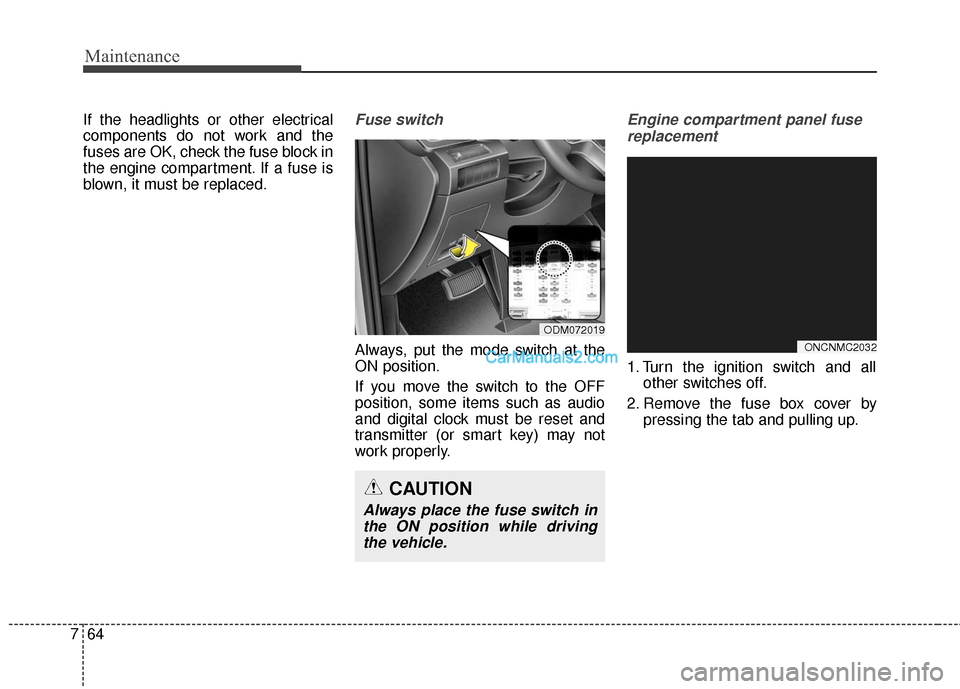
blown, it must be replaced.Fuse switch
Always, put the mode switch at the
ON position.
If you move the switch to the OFF
position, some items such as audio
and digital clock must be reset and
transmitter (or smart key) may not
work properly.
Engine compartment panel fuse
replacement
1. Turn the ignition switch and all other switches off.
2. Remove the fuse box cover by pressing the tab and pulling up.
ODM072019
CAUTION
Always place the fuse switch inthe ON position while drivingthe vehicle.
ONCNMC2032
Page 707 of 759
765
Maintenance
3. Check the removed fuse; replace itif it is blown. To remove or insert
the fuse, use the fuse puller in the
engine compartment fuse panel.
4. Push in a new fuse of the same rating, and make sure it fits tightly
in the clips. If it fits loosely, consult
an authorized HYUNDAI dealer.Multi fuse
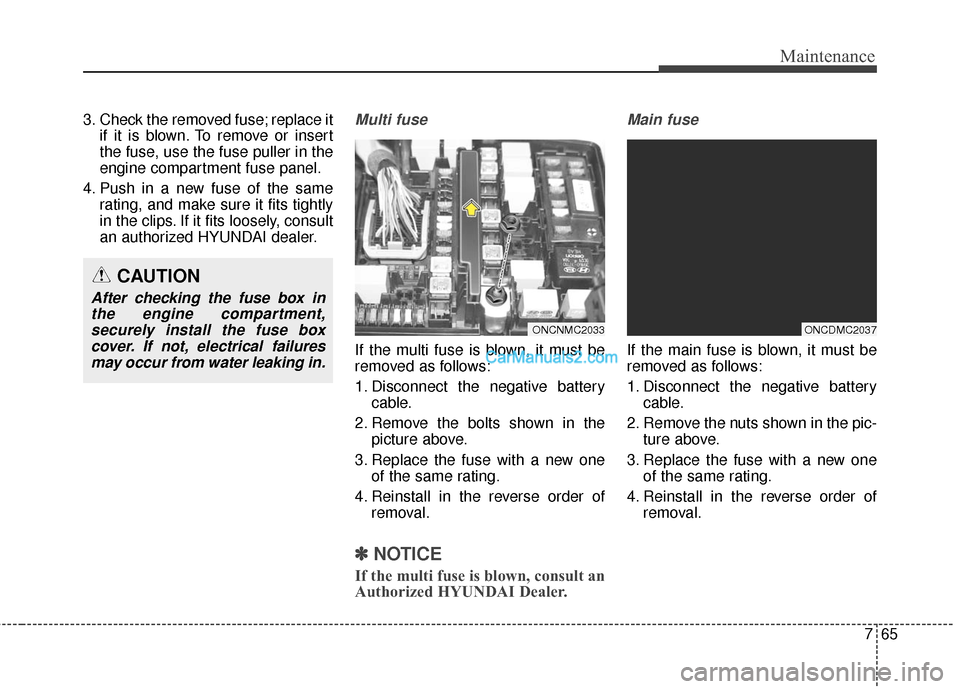
If the multi fuse is blown, it must be
removed as follows:
1. Disconnect the negative batterycable.
2. Remove the bolts shown in the picture above.
3. Replace the fuse with a new one of the same rating.
4. Reinstall in the reverse order of removal.
✽ ✽NOTICE
If the multi fuse is blown, consult an
Authorized HYUNDAI Dealer.
Main fuse
If the main fuse is blown, it must be
removed as follows:
1. Disconnect the negative battery
cable.
2. Remove the nuts shown in the pic- ture above.
3. Replace the fuse with a new one of the same rating.
4. Reinstall in the reverse order of removal.
ONCNMC2033ONCDMC2037
CAUTION
After checking the fuse box inthe engine compartment,securely install the fuse boxcover. If not, electrical failuresmay occur from water leaking in.
Page 734 of 759
Maintenance
92
7
Purge Control Solenoid Valve
(PCSV)
The purge control solenoid valve is
controlled by the Engine Control
Module (ECM); when the engine
coolant temperature is low during
idling, the PCSV closes so that evap-
orated fuel is not taken into the
engine. After the engine warms-up
during ordinary driving, the PCSV
opens to introduce evaporated fuel to
the engine.
3. Exhaust emission control system
The Exhaust Emission Control
System is a highly effective system
which controls exhaust emissions
while maintaining good vehicle per-
formance.
Vehicle modifications
This vehicle should not be modified.
Modification of your vehicle could
affect its performance, safety or
durability and may even violate gov-
ernmental safety and emissions reg-
ulations.
In addition, damage or performance
problems resulting from any modifi-
cation may not be covered under
warranty.
If you use unauthorized electronic
devices, it may cause the vehicle to
operate abnormally, wire damage,
battery discharge and fire. For your
safety, do not use unauthorized
electronic devices.
Engine exhaust gas precautions
(carbon monoxide)
Carbon monoxide can be present with other exhaust fumes. Therefore,
if you smell exhaust fumes of any
kind inside your vehicle, have it
inspected and repaired immediately.
If you ever suspect exhaust fumes
are coming into your vehicle, drive it
only with all the windows fully open.
Have your vehicle checked and
repaired immediately.
WARNING - Exhaust
Engine exhaust gases contain
carbon monoxide (CO). Though
colorless and odorless, it is
dangerous and could be lethal if
inhaled. Follow the instructions
on this page to avoid CO poi-
soning.
Page 744 of 759
Recommended SAE viscosity
number Engine oil viscosity (thickness) has an
effect on fuel economy and cold
weather operating (engine start and
engine oil flowability). Lower viscosity
engine oils can provide better fuel
economy and cold weather perform-
ance, however, higher viscosity engine
oils are required for satisfactory lubri-
cation in hot weather. Using oils of any
viscosity other than those recommend-
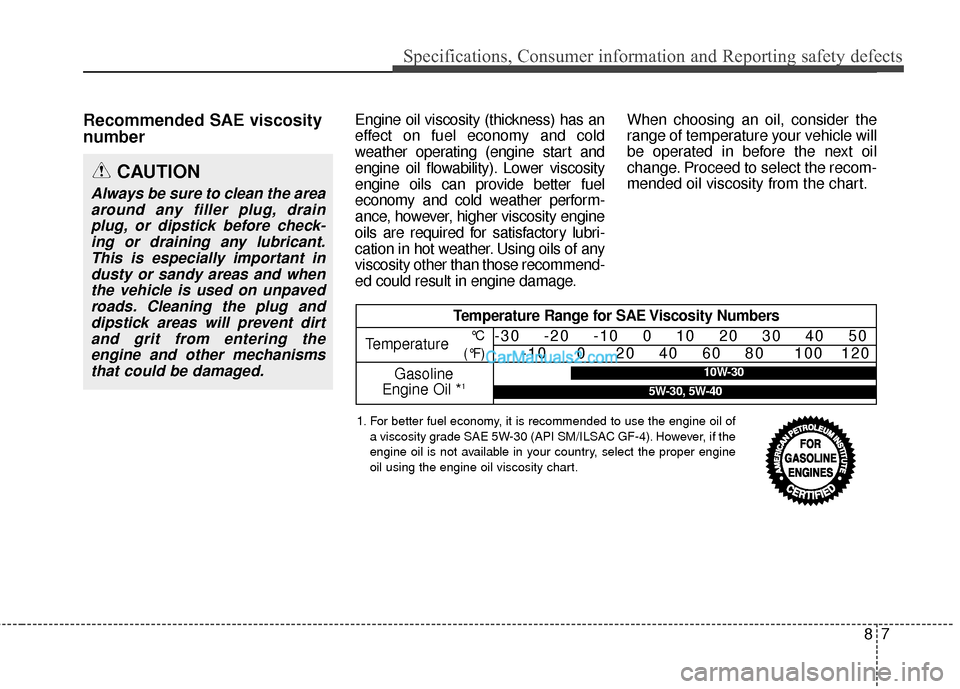
ed could result in engine damage.When choosing an oil, consider the
range of temperature your vehicle will
be operated in before the next oil
change. Proceed to select the recom-
mended oil viscosity from the chart.
CAUTION
Always be sure to clean the area
around any filler plug, drainplug, or dipstick before check-ing or draining any lubricant.This is especially important industy or sandy areas and whenthe vehicle is used on unpavedroads. Cleaning the plug anddipstick areas will prevent dirtand grit from entering theengine and other mechanismsthat could be damaged.
Temperature Range for SAE Viscosity Numbers
Temperature
Gasoline
Engine Oil *
1
°C
(°F)-30 -20 -10 0 10 20 30 40 50 -10 0 20 40 60 80 100 120
10W-30
5W-30, 5W-40
1. For better fuel economy, it is recommended to use the engine oil of
a viscosity grade SAE 5W-30 (API SM/ILSAC GF-4). However, if the
engine oil is not available in your country, select the proper engine
oil using the engine oil viscosity chart.
87
Specifications, Consumer information and Reporting safety defects
Page 751 of 759
I3
Index
Anti-lock brake system (ABS) ..................................5-32
Downhill brake control (DBC) .................................5-40
Electronic stability control (ESC) .............................5-35
Hill-start assist control (HAC) ..................................5-42
Parking brake ............................................................5-30
Power brakes .............................................................5-28
Vehicle stability management (VSM) .......................5-39
Brakes fluid............................................................\
.......7-35
Bulb replacement ..........................................................7-74
Bulb wattage ...................................................................8-3
Button start/stop, see engine start/stop button................5-9
California perchlorate notice ........................................7-95
Camera (Rear view)....................................................4-109
Capacities (Lubricants) ...................................................8-6
Care Exterior care ..............................................................7-84
Interior care ...............................................................7-89
Tire care.....................................................................7-4\
8
Care of seat belts ..........................................................3-39
Cargo security screen .................................................4-157
Center console storage................................................4-147
Central door lock switch...............................................4-23
Certification label ...........................................................8-8
Chains, See Tire chains ................................................5-66
Checking tire inflation pressure ...................................7-49 Child restraint system ...................................................3-40
Lower anchor system ................................................3-47
Tether anchor system.................................................3-45
Child-protector rear door lock ......................................4-25
Cigarette lighter ..........................................................4-150
Climate control air filter .............................................4-133
Clothes hanger ............................................................4-155
Combined instrument, see Instrument cluster ..............4-71
Compact spare tire ........................................................6-27
Consumer information ..................................................8-10
Coolant........................................................................\
..7-32
Cooling fluid, see engine coolant .................................7-32
Crankcase emission control system..............................7-91
Cruise control switch ....................................................5-46
Cruise control system ...................................................5-45 Cruise control switch ................................................5-46
Cup holder ..................................................................4-150
Curtain air bag ..............................................................3-68
Dashboard illumination, see Instrument cluster illumination.................................................................4-71
Dashboard, see Instrument cluster................................4-71
Day/night rearview mirror ............................................4-59
Daytime running light.................................................4-112
Defogging (Windshield) .............................................4-144
Defroster (Rear window) ............................................4-124
C
D