child seat Hyundai Santa Fe 2018 Owner's Guide
[x] Cancel search | Manufacturer: HYUNDAI, Model Year: 2018, Model line: Santa Fe, Model: Hyundai Santa Fe 2018Pages: 570, PDF Size: 16.8 MB
Page 73 of 570
Safety features of your vehicle
52
3
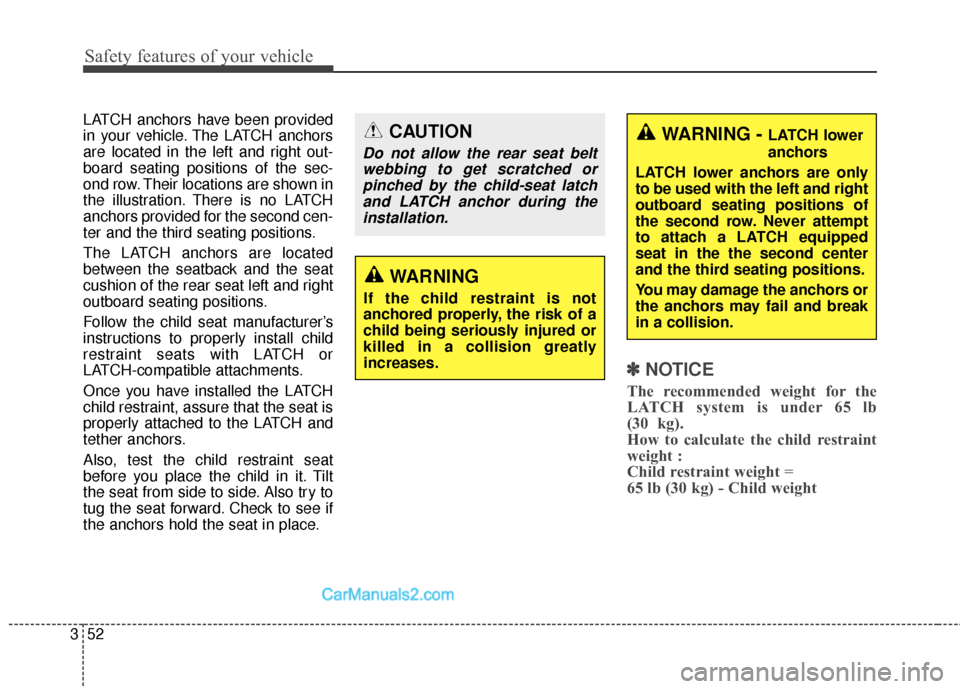
LATCH anchors have been provided
in your vehicle. The LATCH anchors
are located in the left and right out-
board seating positions of the sec-
ond row. Their locations are shown in
the illustration. There is no LATCH
anchors provided for the second cen-
ter and the third seating positions.
The LATCH anchors are located
between the seatback and the seat
cushion of the rear seat left and right
outboard seating positions.
Follow the child seat manufacturer’s
instructions to properly install child
restraint seats with LATCH or
LATCH-compatible attachments.
Once you have installed the LATCH
child restraint, assure that the seat is
properly attached to the LATCH and
tether anchors.
Also, test the child restraint seat
before you place the child in it. Tilt
the seat from side to side. Also try to
tug the seat forward. Check to see if
the anchors hold the seat in place.
✽ ✽
NOTICE
The recommended weight for the
LATCH system is under 65 lb
(30 kg).
How to calculate the child restraint
weight :
Child restraint weight =
65 lb (30 kg) - Child weight
WARNING
If the child restraint is not
anchored properly, the risk of a
child being seriously injured or
killed in a collision greatly
increases.
CAUTION
Do not allow the rear seat belt
webbing to get scratched orpinched by the child-seat latchand LATCH anchor during theinstallation.
WARNING - LATCH lower
anchors
LATCH lower anchors are only
to be used with the left and right
outboard seating positions of
the second row. Never attempt
to attach a LATCH equipped
seat in the the second center
and the third seating positions.
You may damage the anchors or
the anchors may fail and break
in a collision.
Page 77 of 570
Safety features of your vehicle
56
3
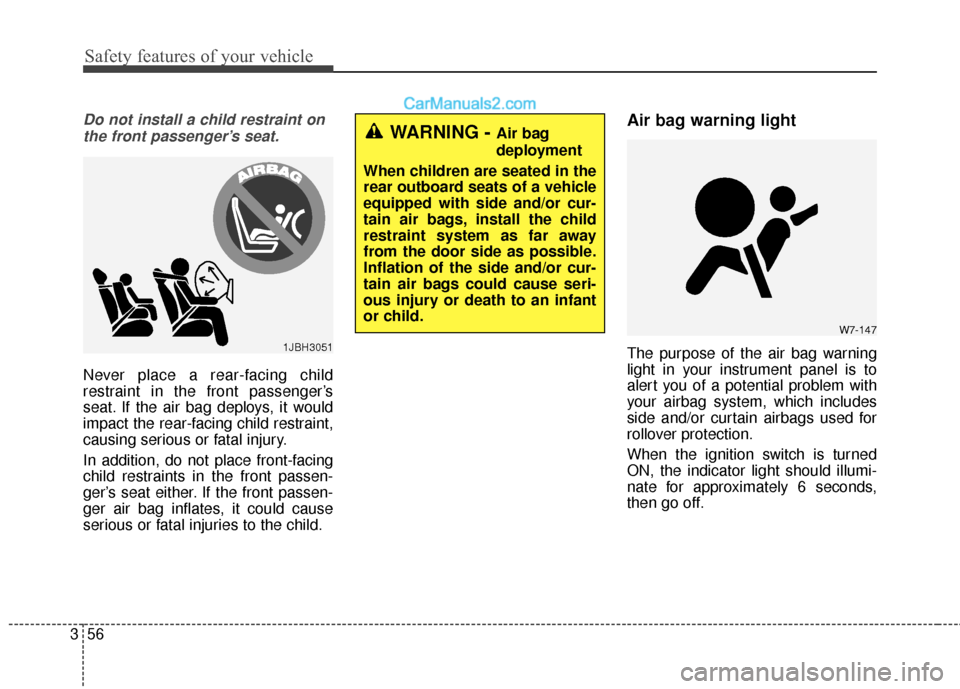
Do not install a child restraint on
the front passenger’s seat.
Never place a rear-facing child
restraint in the front passenger’s
seat. If the air bag deploys, it would
impact the rear-facing child restraint,
causing serious or fatal injury.
In addition, do not place front-facing
child restraints in the front passen-
ger’s seat either. If the front passen-
ger air bag inflates, it could cause
serious or fatal injuries to the child.
Air bag warning light
The purpose of the air bag warning
light in your instrument panel is to
alert you of a potential problem with
your airbag system, which includes
side and/or curtain airbags used for
rollover protection.
When the ignition switch is turned
ON, the indicator light should illumi-
nate for approximately 6 seconds,
then go off.
W7-147
WARNING - Air bag
deployment
When children are seated in the
rear outboard seats of a vehicle
equipped with side and/or cur-
tain air bags, install the child
restraint system as far away
from the door side as possible.
Inflation of the side and/or cur-
tain air bags could cause seri-
ous injury or death to an infant
or child.
1JBH3051
Page 83 of 570
Safety features of your vehicle
62
3
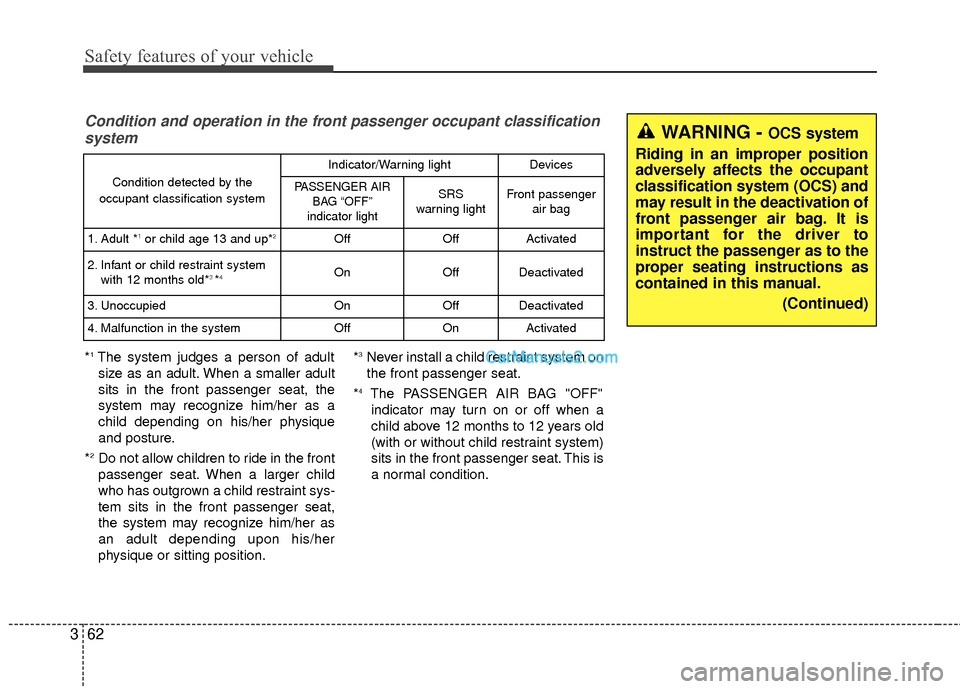
Condition and operation in the front passenger occupant classification
system
*1The system judges a person of adult
size as an adult. When a smaller adult
sits in the front passenger seat, the
system may recognize him/her as a
child depending on his/her physique
and posture.
*
2Do not allow children to ride in the front
passenger seat. When a larger child
who has outgrown a child restraint sys-
tem sits in the front passenger seat,
the system may recognize him/her as
an adult depending upon his/her
physique or sitting position. *
3Never install a child restraint system on
the front passenger seat.
*
4The PASSENGER AIR BAG "OFF" indicator may turn on or off when a
child above 12 months to 12 years old
(with or without child restraint system)
sits in the front passenger seat. This is
a normal condition.
Condition detected by the
occupant classification system
Indicator/Warning lightDevices
PASSENGER AIR BAG “OFF”
indicator lightSRS
warning lightFront passenger air bag
1. Adult *1or child age 13 and up*2OffOffActivated
2. Infant or child restraint system with 12 months old*3 *4OnOffDeactivated
3. Unoccupied OnOffDeactivated
4. Malfunction in the systemOffOnActivated
WARNING - OCS system
Riding in an improper position
adversely affects the occupant
classification system (OCS) and
may result in the deactivation of
front passenger air bag. It is
important for the driver to
instruct the passenger as to the
proper seating instructions as
contained in this manual. (Continued)
Page 86 of 570
365
Safety features of your vehicle
WARNING
Even though your vehicle isequipped with the occupant
classification system, never
install a child restraint system
in the front passenger's seat.
A deploying air bag can force-
fully strike a child resulting in
serious injuries or death. Any
child age 12 and under should
ride in the rear seat. Children
too large for child restraints
should use the available
lap/shoulder belts. No matter
what type of crash, children of
all ages are safer when
restrained in the rear seat.
The occupant classification system may not work properly
if water, coffee or any other
liquid on the front passenger
seat. Keep the front seat dry
at all times.
(Continued)
(Continued)
If the PASSENGER AIR BAG"OFF" indicator is illuminated
when the front passenger's
seat is occupied by an adult
and he/she sits properly (sit-
ting upright with the seatback
in an upright position, cen-
tered on the seat cushion with
their seat belt on, legs com-
fortably extended and their
feet on the floor), have that
person sit in the rear seat.
Do not modify or replace the front passenger seat. Don't
place anything on or attach
anything such as a blanket or
seat heater to the front pas-
senger seat. This can adverse-
ly affect the occupant classifi-
cation system.
Do not sit on sharp objects such as tools when occupying
the front passenger seat. This
can adversely affect the occu-
pant classification system.
(Continued)(Continued)
Do not use accessory seatcovers on the front seats.
Accident statistics show that children are safer if they are
restrained in the rear, as
opposed to the front seat. It is
recommended that child
restraints be secured in a rear
seat, including an infant riding
in a rear-facing infant seat, a
child riding in a forward-fac-
ing child seat and an older
child riding in a booster seat.
Air bags can only be used once – have an authorized
HYUNDAI dealer replace the
air bag immediately after
deployment.
(Continued)
Page 87 of 570
Safety features of your vehicle
66
3
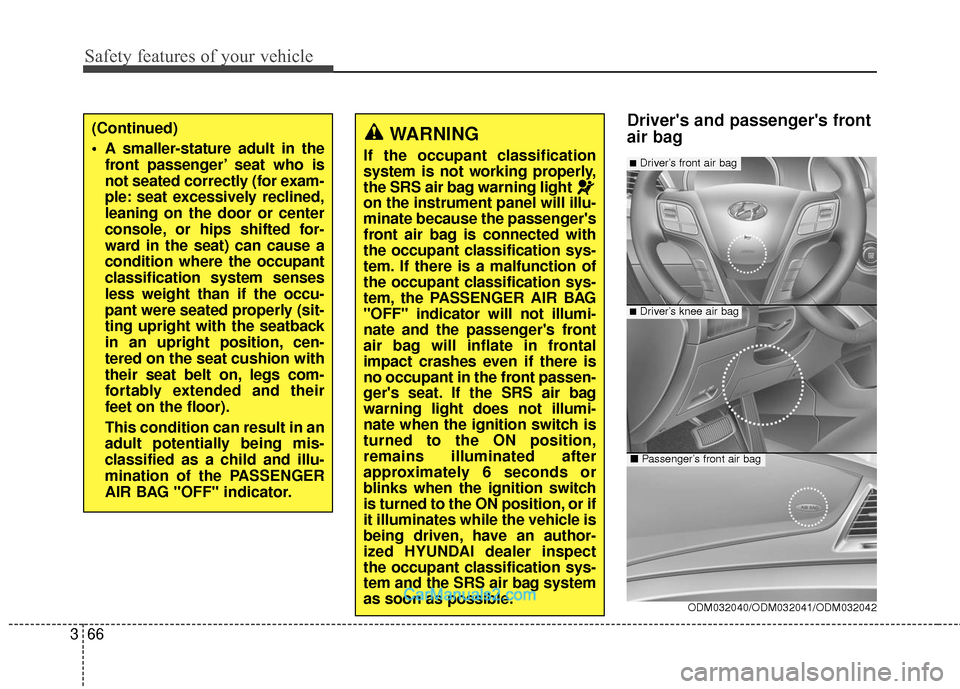
Driver's and passenger's front
air bagWARNING
If the occupant classification
system is not working properly,
the SRS air bag warning light
on the instrument panel will illu-
minate because the passenger's
front air bag is connected with
the occupant classification sys-
tem. If there is a malfunction of
the occupant classification sys-
tem, the PASSENGER AIR BAG
"OFF" indicator will not illumi-
nate and the passenger's front
air bag will inflate in frontal
impact crashes even if there is
no occupant in the front passen-
ger's seat. If the SRS air bag
warning light does not illumi-
nate when the ignition switch is
turned to the ON position,
remains illuminated after
approximately 6 seconds or
blinks when the ignition switch
is turned to the ON position, or if
it illuminates while the vehicle is
being driven, have an author-
ized HYUNDAI dealer inspect
the occupant classification sys-
tem and the SRS air bag system
as soon as possible.
(Continued)
A smaller-stature adult in the
front passenger’ seat who is
not seated correctly (for exam-
ple: seat excessively reclined,
leaning on the door or center
console, or hips shifted for-
ward in the seat) can cause a
condition where the occupant
classification system senses
less weight than if the occu-
pant were seated properly (sit-
ting upright with the seatback
in an upright position, cen-
tered on the seat cushion with
their seat belt on, legs com-
fortably extended and their
feet on the floor).
This condition can result in an
adult potentially being mis-
classified as a child and illu-
mination of the PASSENGER
AIR BAG "OFF" indicator.
ODM032040/ODM032041/ODM032042
■Driver’s knee air bag
■Driver’s front air bag
■ Passenger’s front air bag
Page 89 of 570
Safety features of your vehicle
68
3
✽
✽
NOTICE
• Be sure to read information about
the SRS on the labels provided on
the sun visor.
• Advanced air bags are combined with pre-tensioner seat belts to
help provide enhanced occupant
protection in frontal crashes.
Front air bags are not intended to
deploy in collisions in which pro-
tection can be provided by the pre-
tensioner seat belt.
WARNING
If you are considering modifica-
tion of your vehicle due to a dis-
ability, please contact the
HYUNDAI Customer Assistance
Center at 1-800-633-5151.
WARNING
Do not place any objects under-
neath the front seats as they
could interfere with the occu-
pant classification system.
WARNING
Always use seat belts and child
restraints – every trip, every
time, everyone! Air bags inflate
with considerable force and in
the blink of an eye. Seat belts
help keep occupants in proper
position to obtain maximum
benefit from the air bag. Even
with advanced air bags, improp-
erly and unbelted occupants
can be severely injured when
the air bag inflates.
Always follow the precautions
about seat belts, air bags and
occupant safety contained in this
manual. To reduce the chance of
serious or fatal injuries and
receive the maximum safety ben-
efit from your restraint system:
Never place a child in any
child or booster seat in the
front seat.
ABC – Always Buckle Children in the back seat. It is
the safest place for children of
any age to ride.
(Continued)
Page 91 of 570
Safety features of your vehicle
70
3
(Continued)
Sitting improperly or out of
position can result in serious
or fatal injury in a crash. All
occupants should sit upright
with the seatback in an
upright position, centered on
the seat cushion with their
seat belt on, legs comfortably
extended and their feet on the
floor until the vehicle is
parked and the ignition key is
removed.
The SRS air bag system must deploy very rapidly to provide
protection in a crash. If an
occupant is out of position
because of not wearing a seat
belt, the air bag may forcefully
contact the occupant causing
serious or fatal injuries.(Continued)
Front air bags are not intend-ed to deploy in side-impact,
rear-impact or rollover crash-
es. However, when frontal
deployment threshold is sat-
isfied at side-impact, front air
bags may deploy. In addition,
front air bags will not deploy
in frontal crashes below the
deployment threshold.
Even though your vehicle is equipped with the occupant
classification system, do not
install a child restraint system
in the front passenger seat
position. A child restraint sys-
tem must never be placed in
the front seat. The infant or
child could be severely
injured or killed by an air bag
deployment in case of an acci-
dent.
(Continued)(Continued)
Children age 12 and undermust always be properly
restrained in the rear seat.
Never allow children to ride in
the front passenger seat. If a
child over 12 must be seated
in the front seat, he or she
must be properly belted and
the seat should be moved as
far back as possible.
For maximum safety protec- tion in all types of crashes, all
occupants including the driv-
er should always wear their
seat belts whether or not an
air bag is also provided at
their seating position to mini-
mize the risk of severe injury
or death in the event of a
crash. Do not sit or lean
unnecessarily close to the air
bag while the vehicle is in
motion.
(Continued)
Page 94 of 570
373
Safety features of your vehicle
They are designed to help protect
occupants in certain side impacts
and to help prevent them from eject-
ing out of the vehicle as a result of a
rollover, especially when the seat-
belts are also in use.
to deploy during certain side
impact collisions, depending on the
crash severity, angle, speed and
point of impact. However, when
side deployment threshold is satis-
fied at front-impact, curtain air
bags may deploy.
The curtain air bags may deploy on the side of the impact.
Also, the curtain air bags on both sides of the vehicle will deploy in
certain rollover situations.
The curtain air bags are not designed to deploy in all side
impact or rollover situations.(Continued)
Do not hang other objectsexcept clothes, especially
hard or breakable objects. In
an accident, it may cause
vehicle damage or personal
injury.
Do not allow the passengers to lean their heads or bodies
onto doors, put their arms on
the doors, stretch their arms
out of the window, or place
objects between the doors
and passengers when they
are seated on seats equipped
with side and/or curtain air
bags.
Never try to open or repair any components of the side cur-
tain air bag system. This
should only be done by an
authorized HYUNDAI dealer.
Failure to follow the above
instructions can result in injury
or death to the vehicle occu-
pants in an accident.WARNING
In order for side and curtain air bags to provide the best
protection, front seat occu-
pants and outboard rear occu-
pants should sit in an upright
position with the seat belts
properly fastened.
Importantly, children should
sit in a proper child restraint
system in the rear seat.
When children are seated in the rear outboard seats, they
must be seated in the proper
child restraint system. Make
sure to put the child restraint
system as far away from the
door side as possible, and
secure the child restraint sys-
tem in a locked position.
Do not place any objects over the air bag. Also, do not attach
any objects around the area
the air bag inflates such as
the door, side door glass,
front and rear pillar, roof side
rail.
(Continued)
Page 102 of 570
381
Safety features of your vehicle
Passengers should not place
hard or sharp objects between
themselves and the air bags.
Carrying hard or sharp objects on
your lap or in your mouth can result
in injuries if an air bag inflates.
Keep occupants away from the
air bag covers. All occupants
should sit upright, fully back in their
seats with their seat belts on and
their feet on the floor. If occupants
are too close to the air bag covers,
they could be injured if the air bags
inflate.
Do not attach or place objects
on or near the air bag covers.
Any object attached to or placed
on the front or side air bag covers
could interfere with the proper
operation of the air bags.
Do not modify the front seats.
Modification of the front seats
could interfere with the operation of
the supplemental restraint system
sensing components or side air
bags.
Do not place items under the
front seats. Placing items under
the front seats could interfere with
the operation of the supplemental
restraint system sensing compo-
nents and wiring harnesses.
Never hold an infant or child on
your lap. The infant or child could
be seriously injured or killed in the
event of a crash. All infants and
children should be properly
restrained in appropriate child
safety seats or seat belts in the
rear seat.
WARNING
Sitting improperly or out of position can cause occupants
to be shifted too close to a
deploying air bag, strike the
interior structure or be thrown
from the vehicle resulting in
serious injury or death.
(Continued)
(Continued)
Always sit upright with theseatback in an upright posi-
tion, centered on the seat
cushion with your seat belt
on, legs comfortably extended
and your feet on the floor.
Always have the ignition OFF when the vehicle is being
towed or where it may other-
wise be tilted, since the side
and/or curtain air bags may
inflate if the sensors interpret
those tilt angles as a potential
rollover.
Be careful not to cause impact to the doors when the ignition
is ON. The air bags may
inflate.
Page 297 of 570
55
Driving your vehicle
Before starting
Close and lock all doors.
Position the seat so that all con-trols are easily reached.
Adjust the inside and side view mir- rors.
Be sure that all lights work.
Check all gauges.
Check the operation of warning lights when the ignition switch is
turned to the ON position.
Release the parking brake and make sure the brake warning light
goes out.
For safe operation, be sure you are
familiar with your vehicle and its
equipment.WARNING- Driving under
the influence of alcohol or
drugs
Drinking and driving is danger-
ous. Drunk driving is the num-
ber one contributor to the high-
way death toll each year. Even a
small amount of alcohol will
affect your reflexes, percep-
tions and judgement. Driving
while under the influence of
drugs is as dangerous or more
dangerous than driving drunk.
You are much more likely to
have a serious accident if you
drink or take drugs and drive.
If you are drinking or taking
drugs, do not drive. Do not ride
with a driver who has been
drinking or taking drugs.
Choose a designated driver or
call a cab.WARNING
All passengers must be proper-
ly belted whenever the vehicle
is moving. Refer to "Seat belts"
in section 3 for more informa-
tion on their proper use.
WARNING
Always check the surrounding
areas near your vehicle for peo-
ple, especially children, before
putting a vehicle into D (Drive)
or R (Reverse).