Seat Hyundai Santa Fe 2018 Owner's Manual
[x] Cancel search | Manufacturer: HYUNDAI, Model Year: 2018, Model line: Santa Fe, Model: Hyundai Santa Fe 2018Pages: 570, PDF Size: 16.8 MB
Page 7 of 570
1
2
3
4
5
6
7
8I
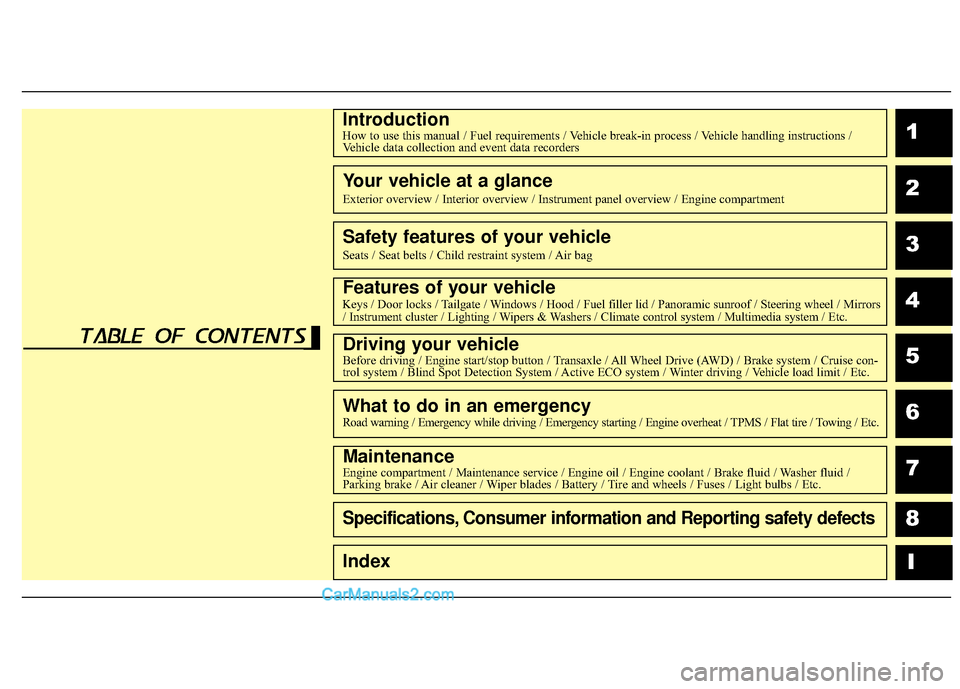
IntroductionHow to use this manual / Fuel requirements / Vehicle break-in process / Vehicle handling instructions /Vehicle data collection and event data recorders
Your vehicle at a glance
Exterior overview / Interior overview / Instrument panel overview / Engi\
ne compartment
Safety features of your vehicle
Seats / Seat belts / Child restraint system / Air bag
Features of your vehicleKeys / Door locks / Tailgate / Windows / Hood / Fuel filler lid / Panoramic sunroof / Steering wheel / Mirrors
/ Instrument cluster / Lighting / Wipers & Washers / Climate control system / Multimedia system / Etc.
Driving your vehicleBefore driving / Engine start/stop button / Transaxle / All Wheel Drive (AWD) / Brake system / Cruise con-
trol system / Blind Spot Detection System / Active ECO system / Winter driving / Vehicle load limit / Etc.
What to do in an emergencyRoad warning / Emergency while driving / Emergency starting / Engine overheat / TPMS / Flat tire / Towing / Etc.
MaintenanceEngine compartment / Maintenance service / Engine oil / Engine coolant /\
Brake fluid / Washer fluid /
Parking brake / Air cleaner / Wiper blades / Battery / Tire and wheels / Fuses / Light bulbs / Etc.
Specifications, Consumer information and Reporting safety defects
Index
table of contents
Page 13 of 570
Introduction
61
VEHICLE BREAK-IN PROCESS
No special break-in period is need-
ed. By following a few simple precau-
tions for the first 600 miles (1,000
km) you may add to the perform-
ance, economy and life of your vehi-
cle.
Do not race the engine.
While driving, keep your enginespeed (rpm, or revolutions per
minute) between 2,000 rpm and
4,000 rpm.
Do not maintain a single vehicle speed for long periods of time,
either fast or slow. Varying the
engine speed is needed to proper-
ly break-in the engine.
Avoid hard stops, except in emer- gencies, to allow the brakes to seat
properly. As with other vehicles of this type,
failure to operate this vehicle correct-
ly may result in loss of control, an
accident or vehicle rollover.
Specific design characteristics (high-
er ground clearance, track, etc.) give
this vehicle a higher center of gravity
than other types of vehicles. It is not
designed for cornering at the same
speeds as a conventional 2-wheel
drive sedans or sports coupe. Avoid
sharp turns or abrupt maneuvers.
Failure to operate this vehicle cor-
rectly may result in loss of control, an
accident or vehicle rollover.
Be sure
to read the "Reducing the risk of a
rollover" driving guidelines, in
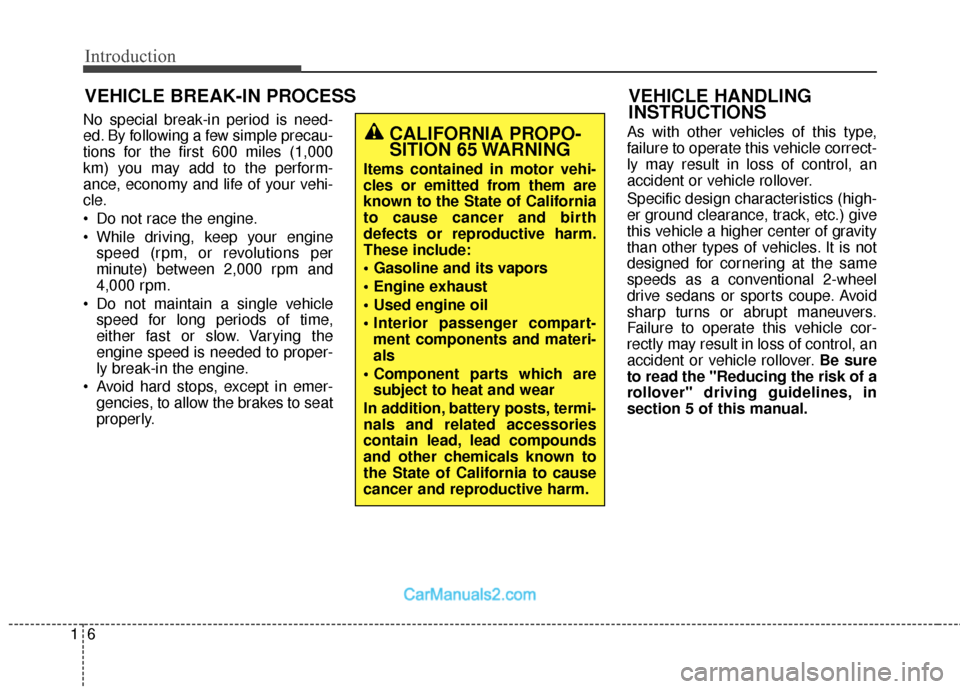
section 5 of this manual.CALIFORNIA PROPO-
SITION 65 WARNING
Items contained in motor vehi-
cles or emitted from them are
known to the State of California
to cause cancer and birth
defects or reproductive harm.
These include:
ment components and materi-
als
subject to heat and wear
In addition, battery posts, termi-
nals and related accessories
contain lead, lead compounds
and other chemicals known to
the State of California to cause
cancer and reproductive harm.
VEHICLE HANDLING
INSTRUCTIONS
Page 18 of 570
Your vehicle at a glance
42
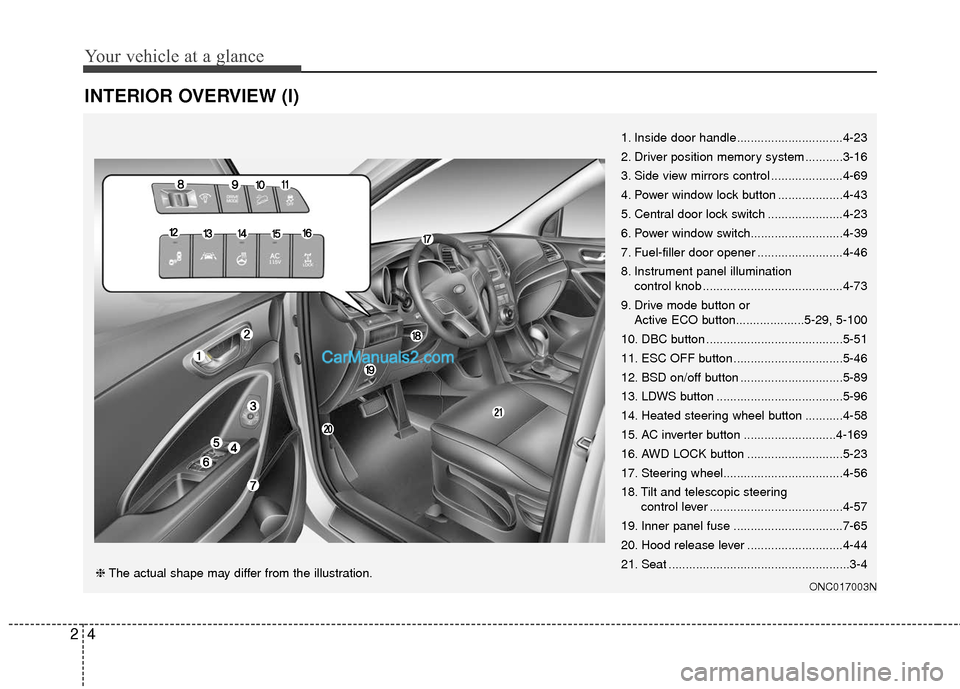
INTERIOR OVERVIEW (I)
1. Inside door handle...............................4-23
2. Driver position memory system ...........3-16
3. Side view mirrors control .....................4-69
4. Power window lock button ...................4-43
5. Central door lock switch ......................4-23
6. Power window switch...........................4-39
7. Fuel-filler door opener .........................4-46
8. Instrument panel illumination control knob .........................................4-73
9. Drive mode button or Active ECO button....................5-29, 5-100
10. DBC button ........................................5-51
11. ESC OFF button ................................5-46
12. BSD on/off button ..............................5-89
13. LDWS button .....................................5-96
14. Heated steering wheel button ...........4-58
15. AC inverter button ...........................4-169
16. AWD LOCK button ............................5-23
17. Steering wheel...................................4-56
18. Tilt and telescopic steering control lever .......................................4-57
19. Inner panel fuse ................................7-65
20. Hood release lever ............................4-44
21. Seat .....................................................3-4
ONC017003N❈ The actual shape may differ from the illustration.
Page 19 of 570
25
Your vehicle at a glance
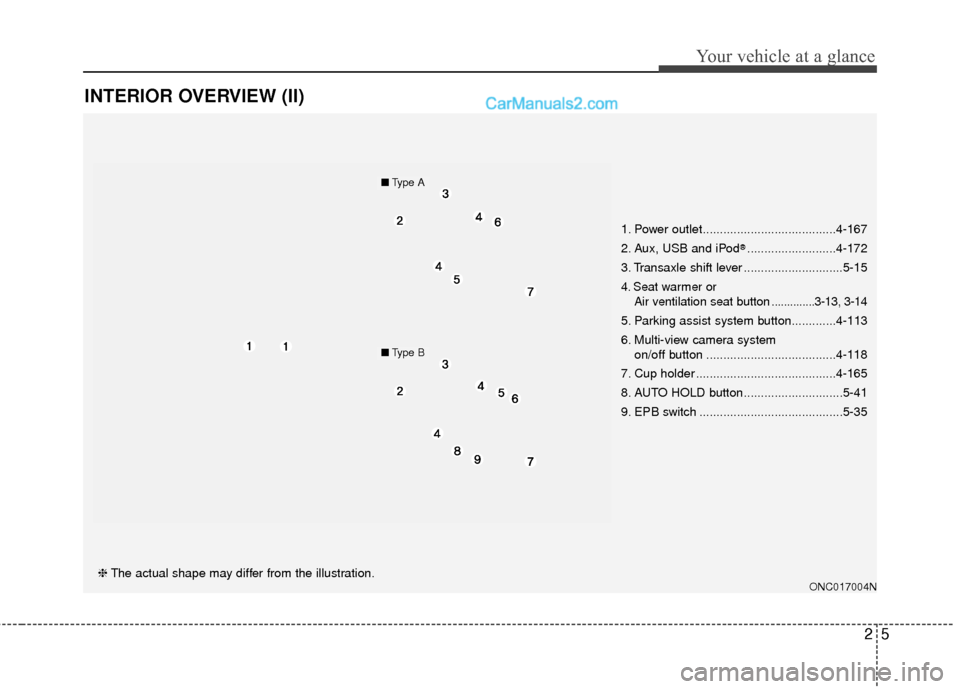
INTERIOR OVERVIEW (II)
ONC017004N❈The actual shape may differ from the illustration. 1. Power outlet.......................................4-167
2. Aux, USB and iPod
®..........................4-172
3. Transaxle shift lever .............................5-15
4. Seat warmer or Air ventilation seat button ..............3-13, 3-14
5. Parking assist system button.............4-113
6. Multi-view camera system
on/off button ......................................4-118
7. Cup holder .........................................4-165
8. AUTO HOLD button.............................5-41
9. EPB switch ..........................................5-35
■ Type A
■Type B
Page 22 of 570
Safety features of your vehicle
Important safety precautions . . . . . . . . . . . . . . . . . 3-2
• Always Wear Your Seat Belt . . . . . . . . . . . . . . . . . . . . 3-2
. . . . . . . . . . . . . . . . . . . . . . . . . . 3-2
. . . . . . . . . . . . . . . . . . . . . . . . . . . . . . 3-2
. . . . . . . . . . . . . . . . . . . . . . . . . . . . . 3-2
. . . . . . . . . . . . . . . . . . . . . . . . . . . . 3-3
Seats . . . . . . . . . . . . . . . . . . . . . . . . . . . . . . . . . . . . \
. . 3-4
. . . . . . . . . . . . . . . . . 3-7
. . . . . . . . . . . . . . . . . . . 3-8
. . . . . . . . . . . . . . . . . 3-16
. . . . . . . . . . . . . . . . . . . . . . . . . 3-18
Seat belts . . . . . . . . . . . . . . . . . . . . . . . . . . . . . . . . . 3-30
. . . . . . . . . . . . . . . . . . . . . . 3-30
. . . . . . . . . . . . . . . . . . . . . . . . 3-36
. . . . . . . . . . . . . . . . . . . . . . . . . . 3-39
. . . . . . . . . . . . . . . . . . . . . . . . . . . . . 3-42
Child restraint system . . . . . . . . . . . . . . . . . . . . . . 3-43
. . . . . . . . . . . . . . . . . . 3-45
. . . . . . . . . . . . . . . . . . . . . . . . . 3-49
lower anchor system . . . . . . . . . . . . . . . . . . . . . . . . 3-51
Air bag - advanced supplemental restraint system . . . . . . . . . . . . . . . . . . . . . . . . . . . . . . . . . . 3-53\
. . . . . . . . . . . . 3-54
. . . . . . . . . . . . . . . . . . . . . . . . . 3-56
. . . . . . . . . . . . . . . . . 3-57
system . . . . . . . . . . . . . . . . . . . . . . . . . . . . . . . . . . . . \
3-61
. . . . . . . . . . . 3-66
. . . . . . . . . . . . . . . . . . . . . . . . . . . . . . . . . 3-71
. . . . . . . . . . . . . . . . . . . . . . . . . . . . . . 3-72
. . . . . . . . . . . . . . . . . . . . . . . . . . . . . . . . . . . 3-\
79
. . . . . . . . . . . . . . . . . . . . . . . . . 3-82
3
Page 23 of 570
Safety features of your vehicle
23
You will find many safety precautions
and recommendations throughout
this section, and throughout this
manual. The safety precautions in
this section are among the most
important.
Always Wear Your Seat Belt
A seat belt is your best protection in
all types of accidents. Air bags are
designed to supplement seat belts,
not replace them. So even though
your vehicle is equipped with air
bags, ALWAYS make sure you and
your passengers wear your seat
belts, and wear them properly.
Restrain All Children
All children under age 13 should ride
in your vehicle properly restrained in
a rear seat, not the front seat. Infants
and small children should be
restrained in an appropriate child
restraint. Larger children should use
a booster seat with the lap/shoulder
belt until they can use the seat belt
properly without a booster seat.
Air Bag Hazards
While air bags can save lives, they
can also cause serious or fatal
injuries to occupants who sit too
close to them, or who are not prop-
erly restrained. Infants, young chil-
dren, and shorter adults are at the
greatest risk of being injured by an
inflating air bag. Follow all instruc-
tions and warnings in this manual.
Driver Distraction
Driver distraction presents a serious
and potentially deadly danger, espe-
cially for inexperienced drivers.
Safety should be the first concern
when behind the wheel and drivers
need to be aware of the wide array of
potential distractions, such as
drowsiness, reaching for objects,
eating, personal grooming, other
passengers, and using cellular
phones.
Drivers can become distracted when
they take their eyes and attention off
the road or their hands off the wheel
to focus on activities other than driv-
ing. To reduce your risk of distraction
or getting into an accident:
IMPORTANT SAFETY PRECAUTIONS
Page 25 of 570
Safety features of your vehicle
43
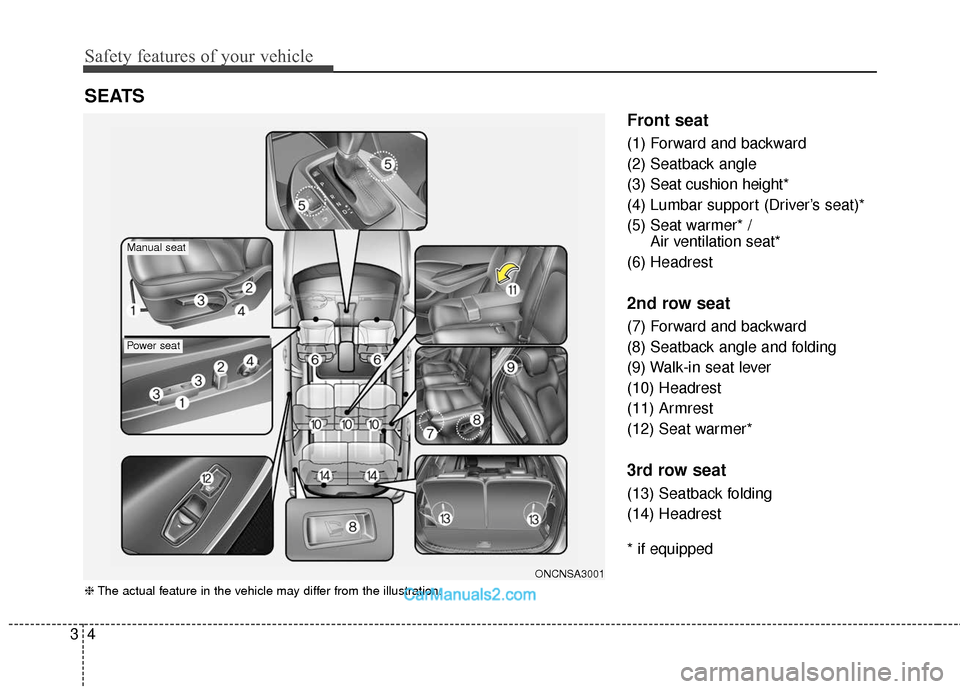
Front seat
(1) Forward and backward
(2) Seatback angle
(3) Seat cushion height*
(4) Lumbar support (Driver’s seat)*
(5) Seat warmer* / Air ventilation seat*
(6) Headrest
2nd row seat
(7) Forward and backward
(8) Seatback angle and folding
(9) Walk-in seat lever
(10) Headrest
(11) Armrest
(12) Seat warmer*
3rd row seat
(13) Seatback folding
(14) Headrest
* if equipped
SEATS
ONCNSA3001
❈ The actual feature in the vehicle may differ from the illustration.
Manual seat
Power seat
Page 26 of 570
35
Safety features of your vehicle
WARNING -Loose
objects
Loose objects in the driver’s
foot area could interfere with
the operation of the foot pedals,
possibly causing an accident.
Do not place anything under the
front seats.WARNING -Driver
responsibility for passengers
Riding in a vehicle with the
seatback reclined could lead to
serious or fatal injury in an acci-
dent. If a seat is reclined during
an accident, the occupant’s
hips may slide under the lap
portion of the seat belt, apply-
ing great force to the unprotect-
ed abdomen. Serious or fatal
internal injuries could result.
The driver must advise the pas-
senger to keep the seatback in
an upright position whenever
the vehicle is in motion.
WARNING - Uprighting
seat
When you return the seatback
to its upright position, hold the
seatback and return it slowly
and be sure there are no other
occupants around the seat. If
the seatback is returned with-
out being held and controlled,
the back of the seat could
spring forward resulting in acci-
dental injury to a person struck
by the seatback.
WARNING
Occupants should never sit on
seat cushions. The passenger's
hips may slide under the lap
portion of the seat belt during
an accident or a sudden stop.
Serious or fatal internal injuries
could result because the seat
belt cannot operate normally.
WARNING - Driver’s seat
To avoid serious injury or death:
Never attempt to adjust the seat while the vehicle is mov-
ing. This could result in loss
of control, and an accident
causing death, serious injury,
or property damage.
Do not allow anything to inter- fere with the normal position
of the seatback. Storing items
against a seatback or in any
other way interfering with
proper locking of a seatback
could result in serious or fatal
injury in a sudden stop or col-
lision.
In order to avoid unnecessary and perhaps severe air bag
injuries, always sit as far back
as possible from the steering
wheel while maintaining com-
fortable control of the vehicle.
We recommend that your
chest be at least 10 inches
(250 mm) away from the steer-
ing wheel.
Page 27 of 570
Safety features of your vehicle
63
WARNING - Rear
seatbacks
The rear seatback must be securely latched. If not, pas-
sengers and objects could be
thrown forward resulting in
serious injury or death in the
event of a sudden stop or col-
lision.
No passenger should ride in the cargo area or sit or lie on
folded seatbacks while the
vehicle is moving. All passen-
gers must be properly seated
in seats and restrained prop-
erly while riding.
When resetting the seatback to the upright position, make
sure it is securely latched by
pushing it forward and rear-
wards.
To avoid the possibility of burns, do not remove the car-
pet in the cargo area. Emission
control devices beneath this
floor generate high tempera-
tures.
(Continued)(Continued)
Luggage and other cargoshould be laid flat in the cargo
area or on the folded rear
seatback. If objects are large,
heavy, or must be piled, they
must be secured. Under no
circumstances should cargo
be piled higher than the seat-
backs. Failure to follow these
warnings could result in seri-
ous injury or death in the
event of a sudden stop, colli-
sion or rollover.
WARNING
After adjusting the seat, always
check that it is securely locked
into place by attempting to
move the seat forward or
reverse without using the lock
release lever. Sudden or unex-
pected movement of the dri-
ver's seat could cause you to
lose control of the vehicle
resulting in an accident.
WARNING
Do not adjust the seat whilewearing seat belts. Moving the
seat cushion forward may
cause strong pressure on the
abdomen.
Use extreme caution so that hands or other objects are not
caught in the seat mechanisms
while the seat is moving.
Do not place a cigarette lighter on the floor or seat.
When you operate the seat,
gas may exit out of the lighter
and cause a fire.
Use extreme caution when picking small objects trapped
under the seats or between
the seat and the center con-
sole. Your hands might be cut
or injured by the sharp edges
of the seats mechanism.
Page 28 of 570
37
Safety features of your vehicle
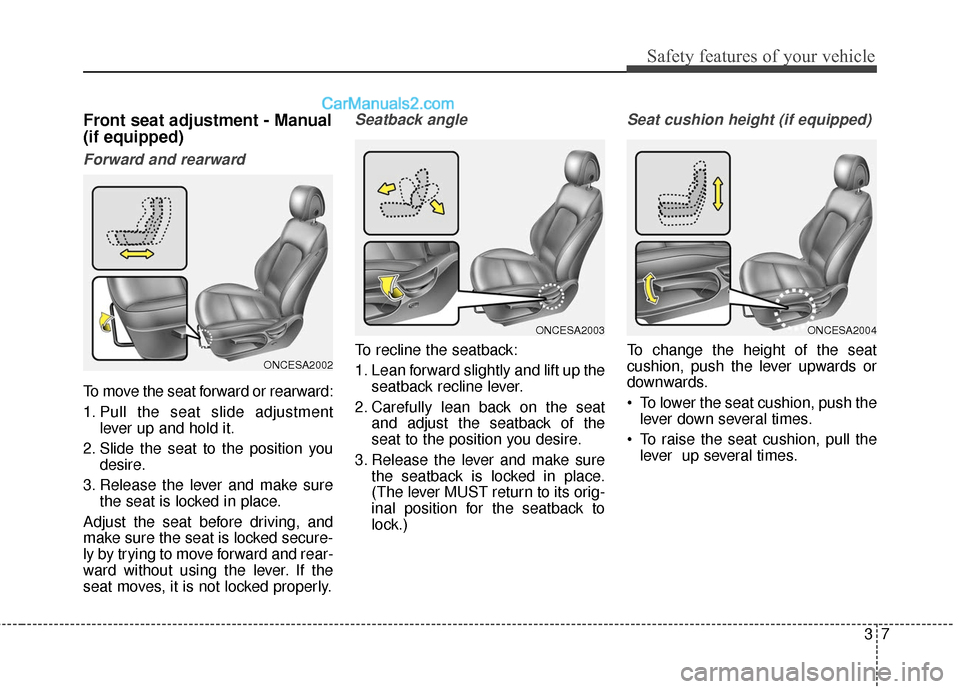
Front seat adjustment - Manual
(if equipped)
Forward and rearward
To move the seat forward or rearward:
1. Pull the seat slide adjustmentlever up and hold it.
2. Slide the seat to the position you desire.
3. Release the lever and make sure the seat is locked in place.
Adjust the seat before driving, and
make sure the seat is locked secure-
ly by trying to move forward and rear-
ward without using the lever. If the
seat moves, it is not locked properly.
Seatback angle
To recline the seatback:
1. Lean forward slightly and lift up the seatback recline lever.
2. Carefully lean back on the seat and adjust the seatback of the
seat to the position you desire.
3. Release the lever and make sure the seatback is locked in place.
(The lever MUST return to its orig-
inal position for the seatback to
lock.)
Seat cushion height (if equipped)
To change the height of the seat
cushion, push the lever upwards or
downwards.
To lower the seat cushion, push thelever down several times.
To raise the seat cushion, pull the lever up several times.ONCESA2002
ONCESA2003ONCESA2004