service Hyundai Santa Fe 2019 - RHD (UK, Australia) User Guide
[x] Cancel search | Manufacturer: HYUNDAI, Model Year: 2019, Model line: Santa Fe, Model: Hyundai Santa Fe 2019Pages: 682, PDF Size: 16.24 MB
Page 260 of 682
![Hyundai Santa Fe 2019 - RHD (UK, Australia) User Guide 3-169
Convenient features of your vehicle
3
System maintenance
Climate control air filter
[A] : Outside air, [B] : Recirculated air
[C] : Climate control air filter, [D] : Blower
[E] : Evaporator cor](/img/35/16317/w960_16317-259.png "Hyundai Santa Fe 2019 - RHD (UK, Australia) User Guide 3-169
Convenient features of your vehicle
3
System maintenance
Climate control air filter
[A] : Outside air, [B] : Recirculated air
[C] : Climate control air filter, [D] : Blower
[E] : Evaporator cor")
3-169
Convenient features of your vehicle
3
System maintenance
Climate control air filter
[A] : Outside air, [B] : Recirculated air
[C] : Climate control air filter, [D] : Blower
[E] : Evaporator core, [F] : Heater core
This filter is installed behind the
glove box. It filters the dust or other
pollutants that enter the vehicle
through the heating and air condi-
tioning system.
We recommend that the climate con-
trol air filter be replaced by a
HYUNDAI authorised repairer
according to the maintenance sched-
ule.If the vehicle is being driven in
severe conditions such as dusty or
rough roads, more frequent climate
control filter inspections and
changes are required.
If the air flow rate suddenly decreas-
es, we recommend the system be
checked at a HYUNDAI authorised
repairer.
It is important that the correct
type and amount of oil and refrig-
erant is used. Otherwise, damage
to the compressor and abnormal
system operation may occur.
Checking the amount of air con-
ditioner refrigerant and com-
pressor lubricant
When the amount of refrigerant is
low, the performance of the air con-
ditioning is reduced. Overfilling also
reduces the performance of the air
conditioning system.
Therefore, if abnormal operation is
found, we recommend that the sys-
tem be inspected by a HYUNDAI
authorised repairer.
NOTICE
Vehicles equipped with R-134a
Because the refriger-
ant is at very high
pressure, the air condi-
tioning system should
only be serviced by trained and
certified technicians. It is impor-
tant that the correct type and
amount of oil and refrigerant is
used. Otherwise, it may cause
damage to the vehicle and per-
sonal inju
ry.
WARNING OIK047401L
Page 261 of 682
3-170
We recommend the air conditioning
system be serviced by a HYUNDAI
authorised repairer.
Air conditioning refrigerant
label
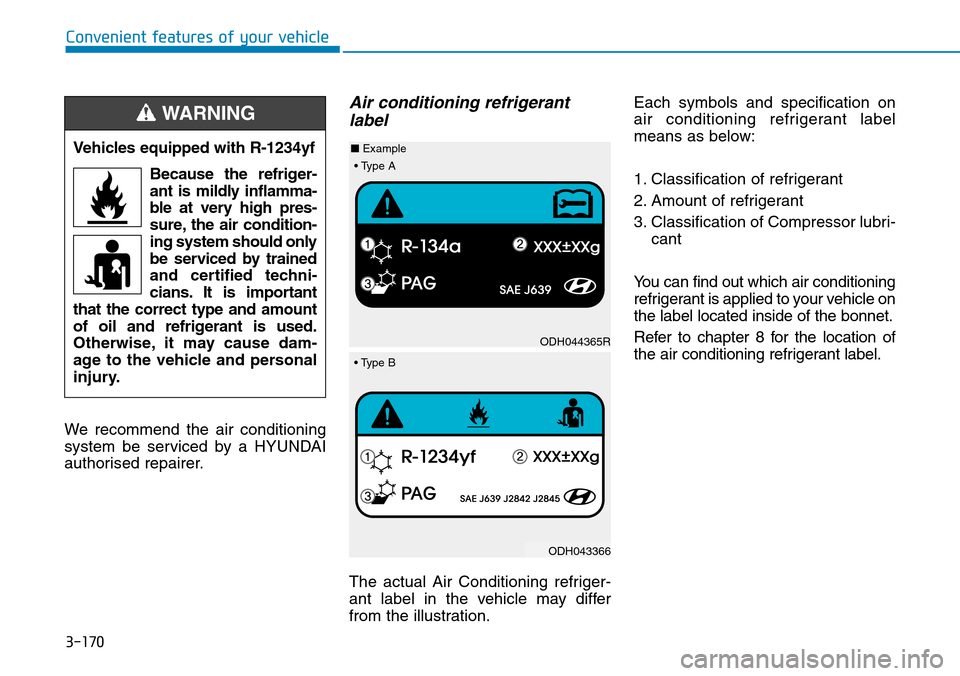
The actual Air Conditioning refriger-
ant label in the vehicle may differ
from the illustration.Each symbols and specification on
air conditioning refrigerant label
means as below:
1. Classification of refrigerant
2. Amount of refrigerant
3. Classification of Compressor lubri-
cant
You can find out which air conditioning
refrigerant is applied to your vehicle on
the label located inside of the bonnet.
Refer to chapter 8 for the location of
the air conditioning refrigerant label.
Convenient features of your vehicle
Vehicles equipped with R-1234yf
Because the refriger-
ant is mildly inflamma-
ble at very high pres-
sure, the air condition-
ing system should only
be serviced by trained
and certified techni-
cians. It is important
that the correct type and amount
of oil and refrigerant is used.
Otherwise, it may cause dam-
age to the vehicle and personal
injury.
WARNING
ODH044365R
ODH043366 ■Example
• Type B• Type A
Page 269 of 682
3-178
Air conditioning
HYUNDAI Air Conditioning Systems
are filled with R-134a or R-1234yf
refrigerant.
1. Start the engine. Push the air con-
ditioning button.
2. Set the mode to the position.
3. Set the air intake control to the out-
side air or recirculated air position.
4. Adjust the fan speed control and
temperature control to maintain
maximum comfort.
Information
Your vehicle is filled with R-134a or
R-1234yf according to the regulation
in your country at the time of produc-
tion. You can find out which air condi-
tioning refrigerant is applied to your
vehicle on the label located inside of
the bonnet. Refer to chapter 8 for the
location of the air conditioning refrig-
erant label.• The refrigerant system should
only be serviced by trained and
certified technicians to insure
proper and safe operation.
• The refrigerant system should
be serviced in a well-ventilated
place.
• The air conditioning evaporator
(cooling coil) shall never be
repaired or replaced with one
removed from a used or salvaged
vehicle and new replacement
MAC evaporators shall be certi-
fied (and labelled) as meeting
SAE Standard J2842.
• When using the air conditioning
system, monitor the temperature
gauge closely whilst driving up
hills or in heavy traffic when out-
side temperatures are high. Air
conditioning system operation
may cause engine overheating.
Continue to use the fan but turn
the air conditioning system off if
the temperature gauge indicates
engine overheating.• When opening the windows in
humid weather air conditioning
may create water droplets inside
the vehicle. Since excessive
water droplets may cause dam-
age to electrical equipment, air
conditioning should only be
used with the windows closed.
Air conditioning system operation
tips
• If the vehicle has been parked in
direct sunlight during hot weather,
open the windows for a short time
to let the hot air inside the vehicle
escape.
• After sufficient cooling has been
achieved, switch back from the
recirculated air to the fresh outside
air position.
• To help reduce moisture inside of
the windows on rainy or humid
days, decrease the humidity inside
the vehicle by operating the air con-
ditioning system with the windows
and sunroof closed.
• Use the air conditioning system
every month for a few minutes to
ensure maximum system perform-
ance.
NOTICE
NOTICE
i
Convenient features of your vehicle
Page 270 of 682
3-179
Convenient features of your vehicle
• If you operate the air conditioner
excessively, the difference between
the temperature of the outside air
and that of the windscreen could
cause the outer surface of the wind-
screen to fog up, causing loss of
visibility. In this case, set the mode
selection button to the position
and set the fan speed control knob
to the lowest speed setting.
System maintenance
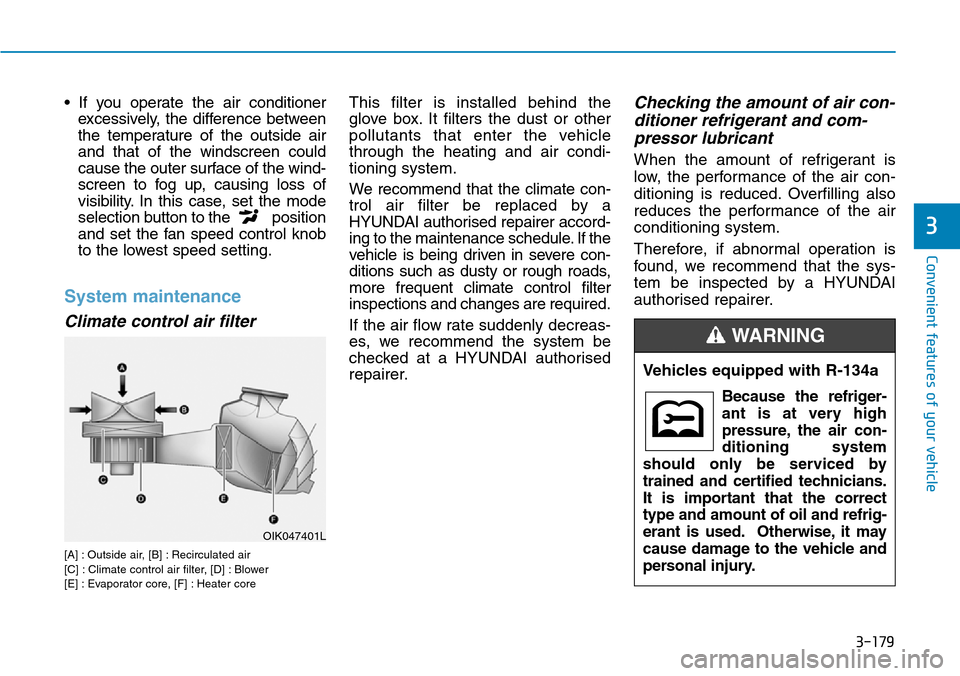
Climate control air filter
[A] : Outside air, [B] : Recirculated air
[C] : Climate control air filter, [D] : Blower
[E] : Evaporator core, [F] : Heater core
This filter is installed behind the
glove box. It filters the dust or other
pollutants that enter the vehicle
through the heating and air condi-
tioning system.
We recommend that the climate con-
trol air filter be replaced by a
HYUNDAI authorised repairer accord-
ing to the maintenance schedule. If the
vehicle is being driven in severe con-
ditions such as dusty or rough roads,
more frequent climate control filter
inspections and changes are required.
If the air flow rate suddenly decreas-
es, we recommend the system be
checked at a HYUNDAI authorised
repairer.Checking the amount of air con-
ditioner refrigerant and com-
pressor lubricant
When the amount of refrigerant is
low, the performance of the air con-
ditioning is reduced. Overfilling also
reduces the performance of the air
conditioning system.
Therefore, if abnormal operation is
found, we recommend that the sys-
tem be inspected by a HYUNDAI
authorised repairer.
3
Vehicles equipped with R-134a
Because the refriger-
ant is at very high
pressure, the air con-
ditioning system
should only be serviced by
trained and certified technicians.
It is important that the correct
type and amount of oil and refrig-
erant is used. Otherwise, it may
cause damage to the vehicle and
personal injury.
WARNING
OIK047401L
Page 271 of 682
3-180
Convenient features of your vehicle
We recommend the air conditioning
system be serviced by a HYUNDAI
authorised repairer.
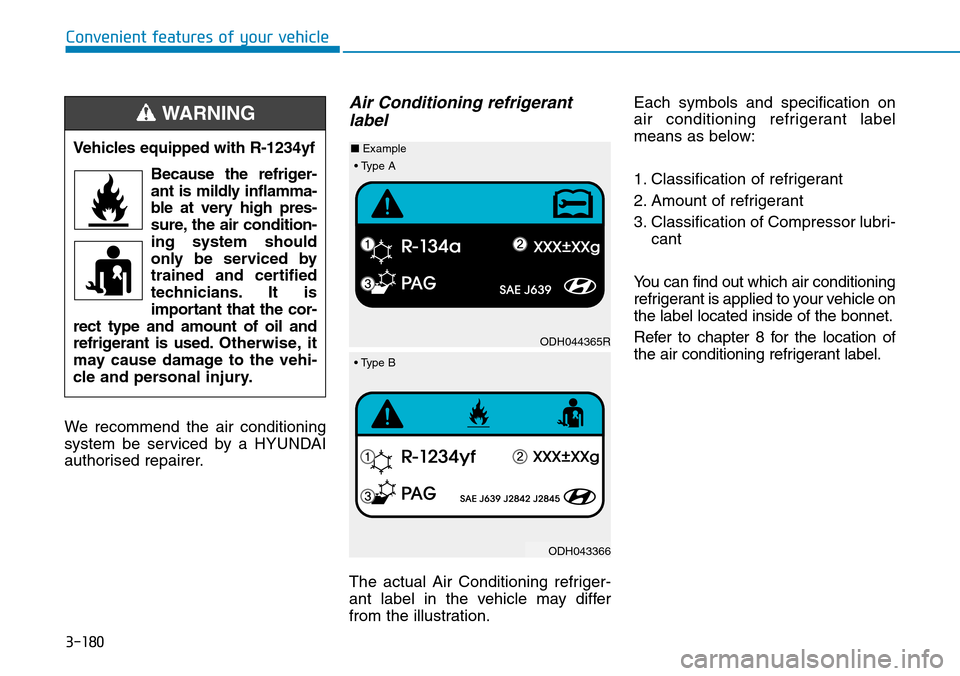
Air Conditioning refrigerant
label
The actual Air Conditioning refriger-
ant label in the vehicle may differ
from the illustration.Each symbols and specification on
air conditioning refrigerant label
means as below:
1. Classification of refrigerant
2. Amount of refrigerant
3. Classification of Compressor lubri-
cant
You can find out which air conditioning
refrigerant is applied to your vehicle on
the label located inside of the bonnet.
Refer to chapter 8 for the location of
the air conditioning refrigerant label. Vehicles equipped with R-1234yf
Because the refriger-
ant is mildly inflamma-
ble at very high pres-
sure, the air condition-
ing system should
only be serviced by
trained and certified
technicians. It is
important that the cor-
rect type and amount of oil and
refrigerant is used.Otherwise, it
may cause damage to the vehi-
cle and personal injury.
WARNING
ODH044365R
ODH043366 ■Example
• Type B• Type A
Page 527 of 682
5-198
Driving your vehicle
Always place the vehicle in P (Park),
apply the parking brake and turn off
the engine before installing snow
chains.
When using tyre chains:
• Wrong size chains or improperly
installed chains can damage
your vehicle's brake lines, sus-
pension, body and wheels.
• Use SAE “S” class or wire chains.
• If you hear noise caused by
chains contacting the body,
retighten the chain to prevent
contact with the vehicle body.
• To prevent body damage, retight-
en the chains after driving 0.3~0.6
miles (0.5~1.0 km).
• Do not use tyre chains on vehi-
cles equipped with aluminium
wheels. If unavoidable, use a
wire type chain.
• Use wire chains less than 15 mm
(0.59 in) wide to prevent damage
to the chain’s connection.
Winter Precautions
Use high quality ethylene glycol
coolant
Your vehicle is delivered with high
quality ethylene glycol coolant in the
cooling system. It is the only type of
coolant that should be used because
it helps prevent corrosion in the cool-
ing system, lubricates the water
pump and prevents freezing. Be sure
to replace or replenish your coolant
in accordance with the maintenance
schedule. Before winter, have your
coolant tested to assure that its
freezing point is sufficient for the
temperatures anticipated during the
winter.
Check battery and cables
Winter temperatures affect battery
performance.Inspect the battery
and cables, as specified in the
chapter 7.The battery charging level
can be checked by a HYUNDAI
authorised repairer or in a service
station.Change to "winter weight" oil if
necessary
In some regions during winter, it is
recommended to use the "winter
weight" oil with lower viscosity. For
further information, refer to the chap-
ter 8. When you are not sure about a
type of winter weight oil, consult a
HYUNDAI authorised repairer.
Check spark plugs and ignition
system
Inspect the spark plugs, as speci-
fied in the chapter 7.If necessary,
replace them. Also check all ignition
wirings and components for any
cracks, wear-out, and damage.
To prevent locks from freezing
To prevent the locks from being
frozen, spray approved de-icing fluid
or glycerin into key holes. When a
lock opening is already covered with
ice, spray approved de-icing fluid
over the ice to remove it. When an
internal part of a lock freezes, try to
thaw it with a heated key. Carefully
use the heated key to avoid an injury.
NOTICE
Page 537 of 682
5-208
Driving your vehicle
Ready to leave after parking on
a hill
1. With the shift lever in P (Park, for
automatic transmission vehicle) or
neutral (for manual transmission
vehicle), apply your brakes and
hold the brake pedal down whilst
you:
• Start your engine;
• Shift into gear; and
• Release the parking brake.
2. Slowly remove your foot from the
brake pedal.
3. Drive slowly until the trailer is clear
of the chocks.
4. Stop and have someone pick up
and store the chocks.
Maintenance when towing a
trailer
Your vehicle will need service more
often when you regularly pull a trail-
er. Important items to pay particular
attention to include engine oil, auto-
matic transmission fluid, axle lubri-
cant and cooling system fluid. Brake
condition is another important item to
frequently check. If you're trailering,
it's a good idea to review these items
before you start your trip. Don't forget
to also maintain your trailer and tow-
bar. Follow the maintenance sched-
ule that accompanied your trailer and
check it periodically. Preferably, con-
duct the check at the start of each
day's driving. Most importantly, all
towbar nuts and bolts should be
tight.To prevent vehicle damage:
• Due to higher load during trailer
usage, overheating might occur
on hot days or during uphill driv-
ing. If the coolant gauge indi-
cates over-heating, switch off
the air conditioner and stop the
vehicle in a safe area to cool
down the engine.
• Do not switch off the engine
whilst the coolant gauge indi-
cates over-heating.
(Keep the engine idle to cool
down the engine)
• When towing check automatic
transmission fluid more fre-
quently.
• If your vehicle is not equipped
with an air conditioner, you
should install a condenser fan
to improve engine performance
when towing a trailer.
NOTICE
Page 539 of 682
What to do in an emergency
Hazard warning flasher ........................................6-2
In case of an emergency whilst driving .............6-2
If the engine stalls whilst driving ..................................6-2
If the engine stalls at a crossroad or crossing .........6-2
If you have a flat tyre whilst driving ..........................6-3
If the engine will not start ...................................6-3
If the engine doesn't turn over
or turns over slowly .........................................................6-3
If the engine turns over normally
but doesn't start ................................................................6-4
Jump starting ..........................................................6-4
If the engine overheats ........................................6-7
Tyre pressure monitoring system (TPMS) .........6-9
Check tyre pressure .........................................................6-9
Tyre pressure monitoring system ...............................6-10
Low tyre pressure telltale.............................................6-11
Low tyre pressure position telltale
and tyre pressure telltale..............................................6-11
TPMS (Tyre Pressure Monitoring System)
malfunction indicator .....................................................6-12
Changing a tyre with TPMS .........................................6-13
If you have a flat tyre (with spare tyre) .........6-15
Jack and tools ..................................................................6-15
Removing and storing the spare tyre ........................6-16
Changing tyres .................................................................6-17
Jack label ...........................................................................6-24
EC Declaration of conformity for Jack......................6-25
If you have a flat tyre
(with tyre mobility kit) ........................................6-26
Introduction ......................................................................6-26
Notes on the safe use of the Tyre Mobility Kit......6-27
Components of the Tyre Mobility Kit ........................6-28
Using the Tyre Mobility Kit...........................................6-29
Checking the tyre inflation pressure .........................6-31
Towing ...................................................................6-33
Towing service .................................................................6-33
Removable towing hook ................................................6-34
Emergency towing ..........................................................6-35
Emergency commodity ........................................6-37
Fire extinguisher .............................................................6-37
First aid kit ........................................................................6-37
Triangle reflector ............................................................6-37
Tyre pressure gauge ......................................................6-37
6
Page 542 of 682
6-4
What to do in an emergency
If the engine turns over nor-
mally but doesn't start
• Check the fuel level and add fuel if
necessary.
If the engine still does not start, we
recommend that you call a HYUNDAI
authorised repairer for assistance.Jump starting can be dangerous if
done incorrectly. Follow the jump
starting procedure in this section to
avoid serious injury or damage to
your vehicle. If in doubt about how to
properly jump start your vehicle, we
strongly recommend that you have a
service technician or towing service
do it for you.
JUMP STARTING
To prevent SERIOUS INJURY or
DEATH to you or bystanders,
always follow these precautions
when working near or handling
the battery:
Always read and follow
instructions carefully
when handling a battery.
Wear eye protection
designed to protect the
eyes from acid splashes.
Keep all flames, sparks,
or smoking materials
away from the battery.
WARNING
Hydrogen is always
present in battery cells,
is highly combustible,
and may explode if ignit-
ed.
Keep batteries out of
reach of children.
Batteries contain sulfu-
ric acid which is highly
corrosive. Do not allow
acid to contact your
eyes, skin or clothing.
If acid gets into your eyes, flush
your eyes with clean water for at
least 15 minutes and get imme-
diate medical attention. If acid
gets on your skin, thoroughly
wash the area. If you feel pain or
a burning sensation, get med-
ical attention immediately.
•When lifting a plastic-cased
battery, excessive pressure
on the case may cause battery
acid to leak. Lift with a battery
carrier or with your hands on
opposite corners.
Page 549 of 682
6-11
What to do in an emergency
6
If any of the below happens, we rec-
ommend that the system be
checked by a HYUNDAI authorised
repairer.
1. The low tyre pressure telltale/
TPMS malfunction indicator
does not illuminate for 3 sec-
onds when the ignition switch
is turned to the ON position or
the engine is running.
2. The TPMS malfunction indicator
remains illuminated after blink-
ing for approximately 1 minute.
3. The Low tyre pressure position
telltale remains illuminated.
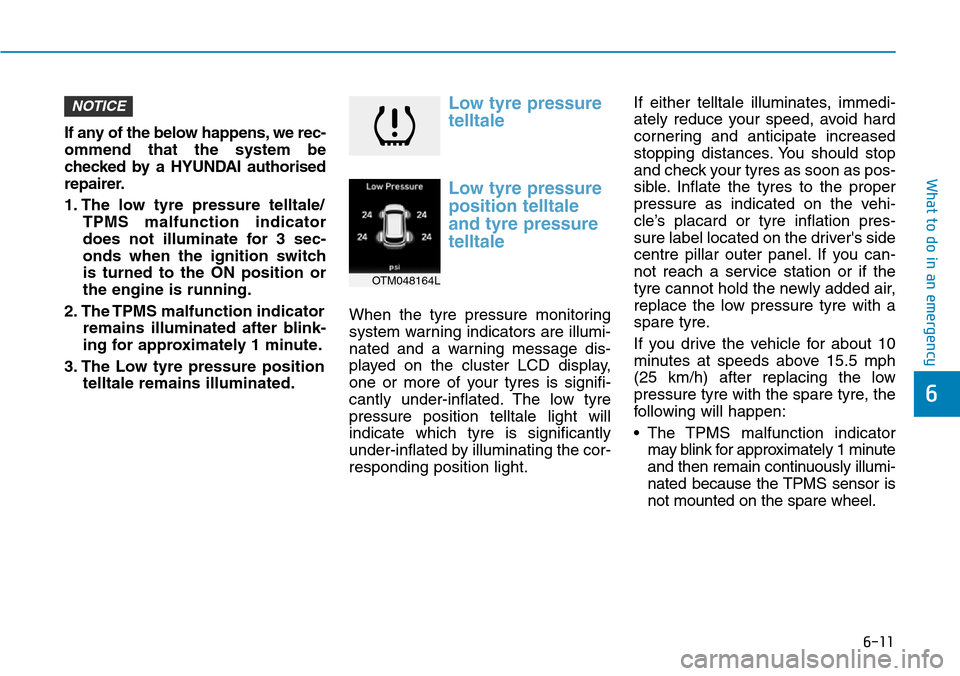
Low tyre pressure
telltale
Low tyre pressure
position telltale
and tyre pressure
telltale
When the tyre pressure monitoring
system warning indicators are illumi-
nated and a warning message dis-
played on the cluster LCD display,
one or more of your tyres is signifi-
cantly under-inflated. The low tyre
pressure position telltale light will
indicate which tyre is significantly
under-inflated by illuminating the cor-
responding position light.If either telltale illuminates, immedi-
ately reduce your speed, avoid hard
cornering and anticipate increased
stopping distances. You should stop
and check your tyres as soon as pos-
sible. Inflate the tyres to the proper
pressure as indicated on the vehi-
cle’s placard or tyre inflation pres-
sure label located on the driver's side
centre pillar outer panel. If you can-
not reach a service station or if the
tyre cannot hold the newly added air,
replace the low pressure tyre with a
spare tyre.
If you drive the vehicle for about 10
minutes at speeds above 15.5 mph
(25 km/h) after replacing the low
pressure tyre with the spare tyre, the
following will happen:
• The TPMS malfunction indicator
may blink for approximately 1 minute
and then remain continuously illumi-
nated because the TPMS sensor is
not mounted on the spare wheel.
NOTICE
OTM048164L