EPS Hyundai Santa Fe 2019 Owner's Guide
[x] Cancel search | Manufacturer: HYUNDAI, Model Year: 2019, Model line: Santa Fe, Model: Hyundai Santa Fe 2019Pages: 557, PDF Size: 14.8 MB
Page 310 of 557
5-36
Driving your vehicle
Driving with wheels and tires with dif-
ferent sizes may cause the ESC sys-
tem to malfunction. Before replacing
tires, make sure all four tires and
wheels are the same size. Never
drive the vehicle with different sized
tires and wheels installed.
Hill-Start Assist Control (HAC)
The Hill-Start Assist Control (HAC)
helps prevent the vehicle from rolling
backwards when starting a vehicle
from a stop on a hill. The system
operates the brakes automatically for
approximately 2 seconds and releas-
es the brake after 2 seconds or when
the accelerator pedal is depressed.
The HAC does not operate when the shift lever is in P (Park) or N
(Neutral)
The HAC activates even though the ESC (Electronic Stability
Control) is off but does not acti-
vate when the ESC has malfunc-
tioned.
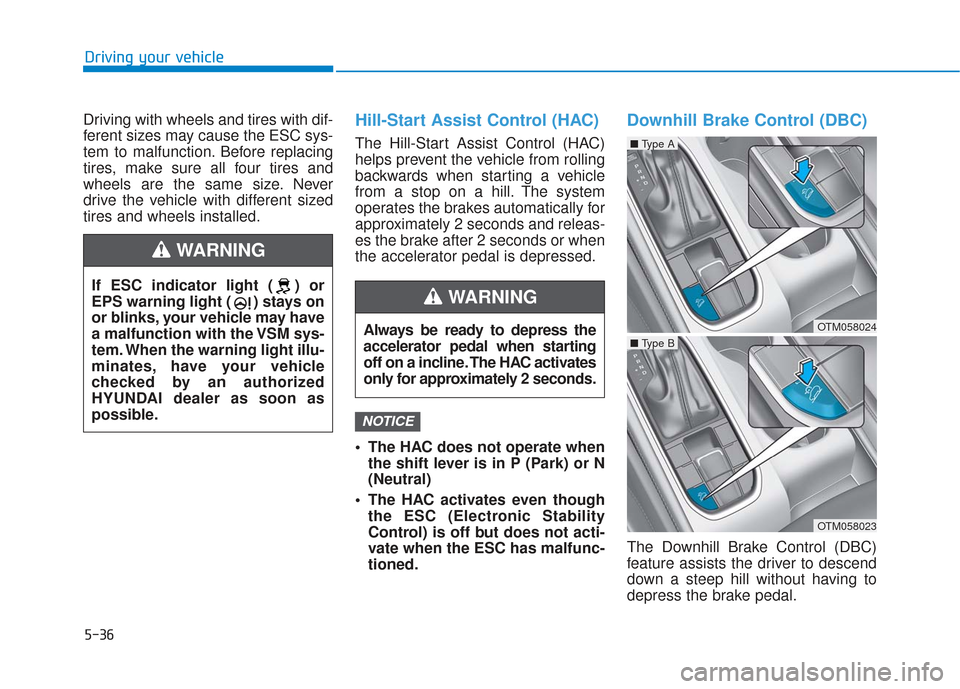
Downhill Brake Control (DBC)
The Downhill Brake Control (DBC)
feature assists the driver to descend
down a steep hill without having to
depress the brake pedal.
NOTICE
If ESC indicator light ( ) or
EPS warning light ( ) stays on
or blinks, your vehicle may have
a malfunction with the VSM sys-
tem. When the warning light illu-
minates, have your vehicle
checked by an authorized
HYUNDAI dealer as soon as
possible.
WARNING
Always be ready to depress the
accelerator pedal when starting
off on a incline. The HAC activates
only for approximately 2 seconds.
WARNING
OTM058024
■ Type A
OTM058023
■ Type B
Page 320 of 557
5-46
The ISG system is to help reduce the
fuel consumption by automatically
shutting down the engine, when the
vehicle is at a standstill (i.e. red stop
light, stop sign, and traffic jam).
The engine is automatically started
upon satisfying the starting condi-
tions.
The ISG system is always active,
when the engine is running.
Information
When the engine is automatically
started by the ISG system, some warn-
ing lights (i.e. ABS, ESC, ESC OFF,
EPS, and parking brake warning
light) may illuminate for a few sec-
onds due to the low battery voltage.
However, it does not indicate a mal-
function with the ISG system.
To Activate the ISG System
Prerequisite for activation
The ISG system operates in the fol-
lowing situations.
- The driver's seatbelt is fastened.
- The driver's door and the hood areclosed.
- The brake vacuum pressure is adequate.
- The battery is sufficiently charged.
- The outside temperature is between 14 °F and 95 °F (-10 °C and 35 °C).
- The engine coolant temperature is not too low.
- The system is not in the diagnostic mode.
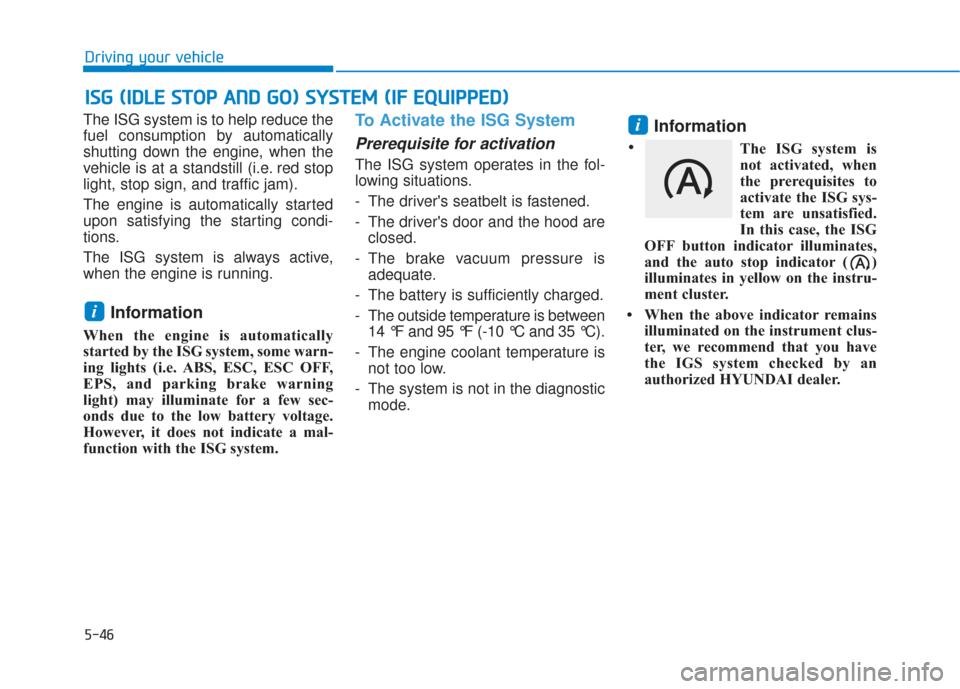
Information
The ISG system is
not activated, when
the prerequisites to
activate the ISG sys-
tem are unsatisfied.
In this case, the ISG
OFF button indicator illuminates,
and the auto stop indicator ( )
illuminates in yellow on the instru-
ment cluster.
• When the above indicator remains illuminated on the instrument clus-
ter, we recommend that you have
the IGS system checked by an
authorized HYUNDAI dealer.
i
i
I
IS
S G
G
(
( I
ID
D L
LE
E
S
S T
T O
O P
P
A
A N
N D
D
G
G O
O )
)
S
S Y
Y S
ST
T E
EM
M
(
( I
IF
F
E
E Q
Q U
UI
IP
P P
PE
ED
D )
)
Driving your vehicle
•
Page 391 of 557
5-117
Driving your vehicle
5
Normal:Vehicle speed following the front
vehicle to maintain the set distance
is normal.
Slow: Vehicle speed following the front
vehicle to maintain the set distance
is slower than normal speed.
Information
The last selected speed sensitivity of
the smart cruise control is remained in
the system.
To Convert to Cruise Control
Mode
The driver may choose to switch to
use the conventional Cruise Control
mode (speed only control function)
by following these steps:
1. Push the CRUISE button on the steering wheel to turn the system
on. The cruise ( ) indi-
cator will illuminate.
2. Push and hold the Vehicle-to- Vehicle Distance button for more
than 2 seconds.
3. Choose between "Smart Cruise Control" and "Cruise Control".
When the system is canceled using
the CRUISE button or the CRUISE
button is used after the engine is
turned on, the Smart Cruise Control
mode will turn on.
i
When using the conventional
Cruise Control mode, you must
manually adjust the distance to
other vehicles by depressing
the brake pedal. The system
does not automatically adjust
the distance to vehicles in front
of you.
WARNING
Page 402 of 557
5-128
Driving your vehicle
Reducing the Risk of a
Rollover
Your multi-purpose passenger vehi-
cle is defined as a Sports Utility
Vehicle (SUV). SUV's have higher
ground clearance and a narrower
track to make them capable of per-
forming in a wide variety of off-road
applications. The specific design
characteristics give them a higher
center of gravity than ordinary vehi-
cles making them more likely to roll
over if you make abrupt turns. Utility
vehicles have a significantly higher
rollover rate than other types of vehi-
cles. Due to this risk, driver and pas-
sengers are strongly recommended
to buckle their seat belts. In a rollover
crash, an unbelted person is signifi-
cantly more likely to die than a per-
son wearing a seat belt.
There are steps that a driver can
make to reduce the risk of a rollover.
If at all possible, avoid sharp turns or
abrupt maneuvers, do not load your
vehicle with heavy cargo on the roof,
and never modify your vehicle in any
way.Utility vehicles have a signifi-
cantly higher rollover rate than
other types of vehicles. To pre-
vent rollovers or loss of control:
Take corners at slower speeds
than you would with a passen-
ger vehicle.
Avoid sharp turns and abrupt
maneuvers.
Do not modify your vehicle in
any way that you would raise
the center of gravity.
Keep tires properly inflated.
Do not carry heavy cargo on
the roof.
WARNING
Page 407 of 557
5-133
Driving your vehicle
5
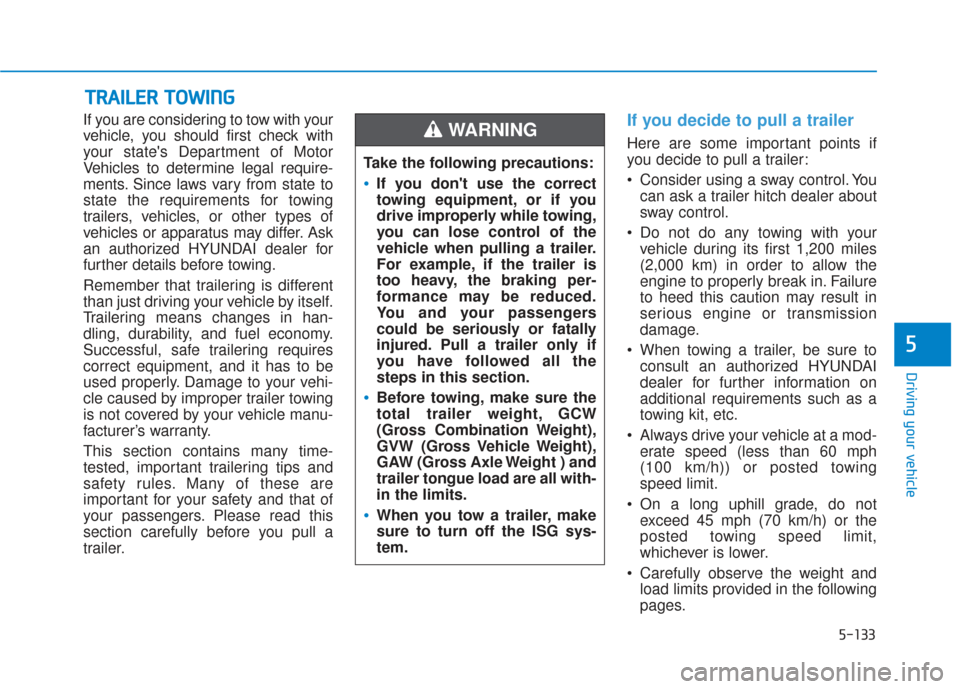
If you are considering to tow with your
vehicle, you should first check with
your state's Department of Motor
Vehicles to determine legal require-
ments. Since laws vary from state to
state the requirements for towing
trailers, vehicles, or other types of
vehicles or apparatus may differ. Ask
an authorized HYUNDAI dealer for
further details before towing.
Remember that trailering is different
than just driving your vehicle by itself.
Trailering means changes in han-
dling, durability, and fuel economy.
Successful, safe trailering requires
correct equipment, and it has to be
used properly. Damage to your vehi-
cle caused by improper trailer towing
is not covered by your vehicle manu-
facturer’s warranty.
This section contains many time-
tested, important trailering tips and
safety rules. Many of these are
important for your safety and that of
your passengers. Please read this
section carefully before you pull a
trailer.If you decide to pull a trailer
Here are some important points if
you decide to pull a trailer:
Consider using a sway control. Youcan ask a trailer hitch dealer about
sway control.
Do not do any towing with your vehicle during its first 1,200 miles
(2,000 km) in order to allow the
engine to properly break in. Failure
to heed this caution may result in
serious engine or transmission
damage.
When towing a trailer, be sure to consult an authorized HYUNDAI
dealer for further information on
additional requirements such as a
towing kit, etc.
Always drive your vehicle at a mod- erate speed (less than 60 mph
(100 km/h)) or posted towing
speed limit.
On a long uphill grade, do not exceed 45 mph (70 km/h) or the
posted towing speed limit,
whichever is lower.
Carefully observe the weight and load limits provided in the following
pages.
T TR
R A
A I
IL
L E
E R
R
T
T O
O W
W I
IN
N G
G
Take the following precautions:
If you don't use the correct
towing equipment, or if you
drive improperly while towing,
you can lose control of the
vehicle when pulling a trailer.
For example, if the trailer is
too heavy, the braking per-
formance may be reduced.
You and your passengers
could be seriously or fatally
injured. Pull a trailer only if
you have followed all the
steps in this section.
Before towing, make sure the
total trailer weight, GCW
(Gross Combination Weight),
GVW (Gross Vehicle Weight),
GAW (Gross Axle Weight ) and
trailer tongue load are all with-
in the limits.
When you tow a trailer, make
sure to turn off the ISG sys-
tem.
WARNING
Page 417 of 557
5-143
Driving your vehicle
5
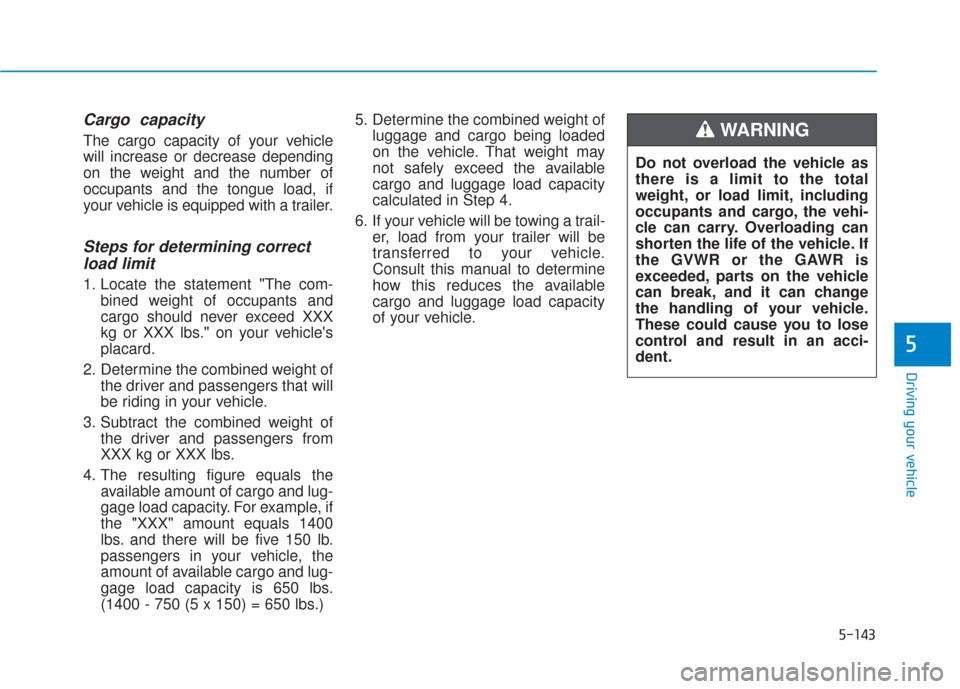
Cargo capacity
The cargo capacity of your vehicle
will increase or decrease depending
on the weight and the number of
occupants and the tongue load, if
your vehicle is equipped with a trailer.
Steps for determining correctload limit
1. Locate the statement "The com-
bined weight of occupants and
cargo should never exceed XXX
kg or XXX lbs." on your vehicle's
placard.
2. Determine the combined weight of the driver and passengers that will
be riding in your vehicle.
3. Subtract the combined weight of the driver and passengers from
XXX kg or XXX lbs.
4. The resulting figure equals the available amount of cargo and lug-
gage load capacity. For example, if
the "XXX" amount equals 1400
lbs. and there will be five 150 lb.
passengers in your vehicle, the
amount of available cargo and lug-
gage load capacity is 650 lbs.
(1400 - 750 (5 x 150) = 650 lbs.) 5. Determine the combined weight of
luggage and cargo being loaded
on the vehicle. That weight may
not safely exceed the available
cargo and luggage load capacity
calculated in Step 4.
6. If your vehicle will be towing a trail- er, load from your trailer will be
transferred to your vehicle.
Consult this manual to determine
how this reduces the available
cargo and luggage load capacity
of your vehicle. Do not overload the vehicle as
there is a limit to the total
weight, or load limit, including
occupants and cargo, the vehi-
cle can carry. Overloading can
shorten the life of the vehicle. If
the GVWR or the GAWR is
exceeded, parts on the vehicle
can break, and it can change
the handling of your vehicle.
These could cause you to lose
control and result in an acci-
dent.
WARNING
Page 436 of 557
6-16
What to do in an emergency
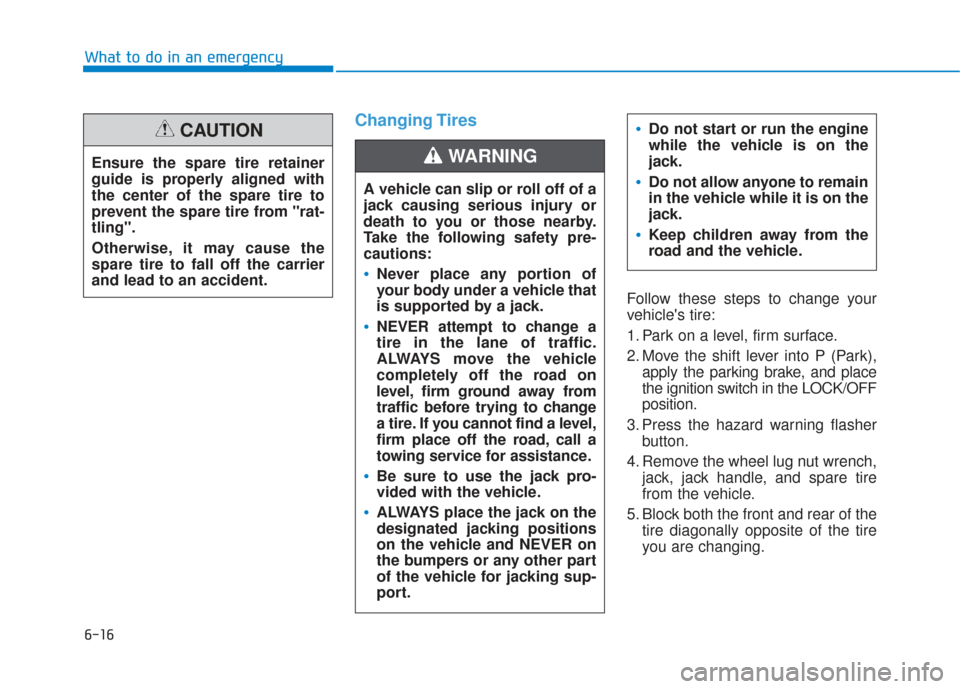
Changing Tires
Follow these steps to change your
vehicle's tire:
1. Park on a level, firm surface.
2. Move the shift lever into P (Park),apply the parking brake, and place
the ignition switch in the LOCK/OFF
position.
3. Press the hazard warning flasher button.
4. Remove the wheel lug nut wrench, jack, jack handle, and spare tire
from the vehicle.
5. Block both the front and rear of the tire diagonally opposite of the tire
you are changing.
A vehicle can slip or roll off of a
jack causing serious injury or
death to you or those nearby.
Take the following safety pre-
cautions:
Never place any portion of
your body under a vehicle that
is supported by a jack.
NEVER attempt to change a
tire in the lane of traffic.
ALWAYS move the vehicle
completely off the road on
level, firm ground away from
traffic before trying to change
a tire. If you cannot find a level,
firm place off the road, call a
towing service for assistance.
Be sure to use the jack pro-
vided with the vehicle.
ALWAYS place the jack on the
designated jacking positions
on the vehicle and NEVER on
the bumpers or any other part
of the vehicle for jacking sup-
port.
Do not start or run the engine
while the vehicle is on the
jack.
Do not allow anyone to remain
in the vehicle while it is on the
jack.
Keep children away from the
road and the vehicle.
WARNING Ensure the spare tire retainer
guide is properly aligned with
the center of the spare tire to
prevent the spare tire from "rat-
tling".
Otherwise, it may cause the
spare tire to fall off the carrier
and lead to an accident.
CAUTION
Page 548 of 557
I-5
Electric Power Steering (EPS) ........................................3-28
Electrochromic mirror (ECM) ........................................3-32
Electronic child safety lock system ................................3-19
Electronic Stability Control (ESC) .................................5-32
Emission control system .................................................7-84Crankcase emission control system ...........................7-84
Evaporative emission control System ........................7-84
Exhaust emission control system ...............................7-85
Engine compartment..................................................1-7, 7-3
Engine compartment panel fuse replacement .................7-54
Engine coolant ................................................................7-23
Engine coolant temperature gauge .................................3-70
Engine number ................................................................8-11
Engine oil ........................................................................\
7-21
Engine specification..........................................................8-2
Engine Start/Stop button ...................................................5-9
EPB (Electronic Parking Brake) .....................................5-21
Evaporative emission control System.............................7-84
Event Data Recorder (EDR) ...........................................F-10
Exhaust emission control system....................................7-85
Explanation of scheduled maintenance items.................7-18
Exterior care....................................................................7-76\
Exterior overview Front view ....................................................................1-2
Rear view......................................................................1-\
3 Flat tire ........................................................................\
....6-14
Changing tires ............................................................6-16
Floor mat anchor(s).......................................................3-176
Fluid Brake fluid ..................................................................7-26
Washer fluid ...............................................................7-27
Forward Collision-Avoidance Assist (FCA) system ......5-54
Four Wheel Drive (4WD), see All Wheel Drive (AWD) .. 5-40
Front fog lamp ..............................................................3-120
Front seat adjustment ........................................................2-6 Manual adjustment .......................................................2-6
Power adjustment .........................................................2-9
Front seat head restraints ................................................2-18 Adjusting the height up and down .............................2-18
Removal/Reinstallation ..............................................2-19
Fuel filler door ................................................................3-64
Fuel gauge .......................................................................3\
-71
Fuel requirements .............................................................F-7 Fuel additives ...............................................................F-8
Fuses ........................................................................\
.......7-52 Blade type fuse ...........................................................7-54
Cartridge type fuse .....................................................7-54
Engine compartment panel fuse replacement ............7-54
Fuse/relay panel description .......................................7-55
Instrument panel fuse replacement.............................7-53
Multi fuse ...................................................................7-54
I
Index
EF
Page 554 of 557
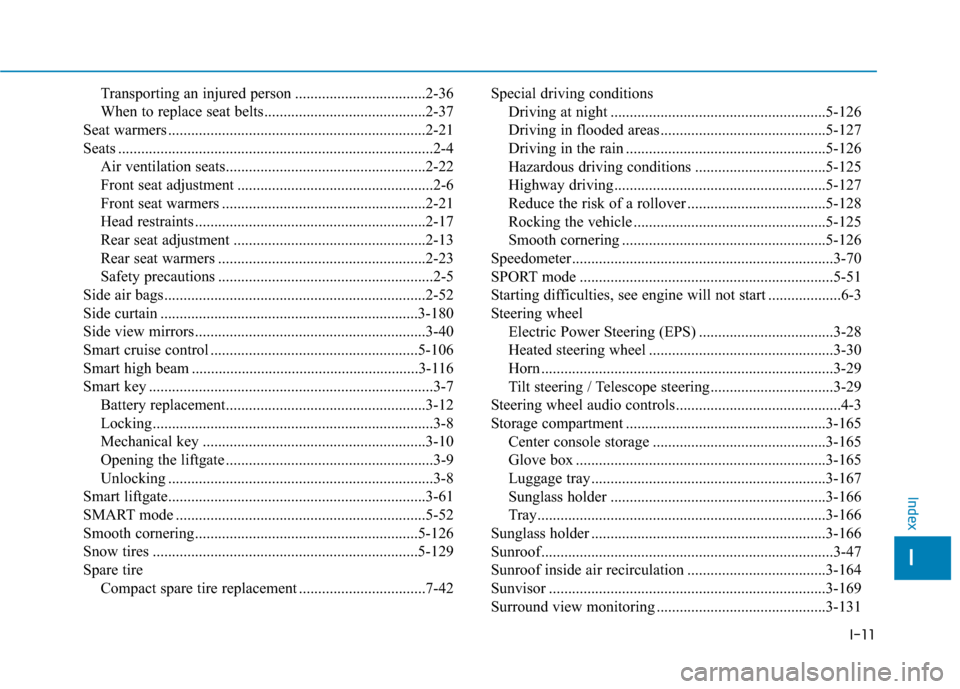
I-11
Transporting an injured person ..................................2-36
When to replace seat belts..........................................2-37
Seat warmers ...................................................................2-21
Seats ........................................................................\
..........2-4 Air ventilation seats....................................................2-22
Front seat adjustment ...................................................2-6
Front seat warmers .....................................................2-21
Head restraints ............................................................2-17
Rear seat adjustment ..................................................2-13
Rear seat warmers ......................................................2-23
Safety precautions ........................................................2-5
Side air bags....................................................................2-52\
Side curtain ...................................................................3-180\
Side view mirrors............................................................3-40
Smart cruise control ......................................................5-106
Smart high beam ...........................................................3-116
Smart key ........................................................................\
..3-7 Battery replacement....................................................3-12
Locking........................................................................\
.3-8
Mechanical key ..........................................................3-10
Opening the liftgate ......................................................3-9
Unlocking .....................................................................3-8\
Smart liftgate...................................................................3-61
SMART mode .................................................................5-52
Smooth cornering..........................................................5-126
Snow tires .....................................................................5-1\
29
Spare tire Compact spare tire replacement .................................7-42 Special driving conditions
Driving at night ........................................................5-126
Driving in flooded areas ...........................................5-127
Driving in the rain ....................................................5-126
Hazardous driving conditions ..................................5-125
Highway driving.......................................................5-127
Reduce the risk of a rollover ....................................5-128
Rocking the vehicle ..................................................5-125
Smooth cornering .....................................................5-126
Speedometer....................................................................3-70\
SPORT mode ..................................................................5-51
Starting difficulties, see engine will not start ...................6-3
Steering wheel Electric Power Steering (EPS) ...................................3-28
Heated steering wheel ................................................3-30
Horn ........................................................................\
....3-29
Tilt steering / Telescope steering................................3-29
Steering wheel audio controls...........................................4-3
Storage compartment ....................................................3-165 Center console storage .............................................3-165
Glove box .................................................................3-165
Luggage tray.............................................................3-167
Sunglass holder ........................................................3-166
Tray........................................................................\
...3-166
Sunglass holder .............................................................3-166
Sunroof........................................................................\
....3-47
Sunroof inside air recirculation ....................................3-164
Sunvisor ........................................................................\
3-169
Surround view monitoring ............................................3-131
I
Index
Page 556 of 557
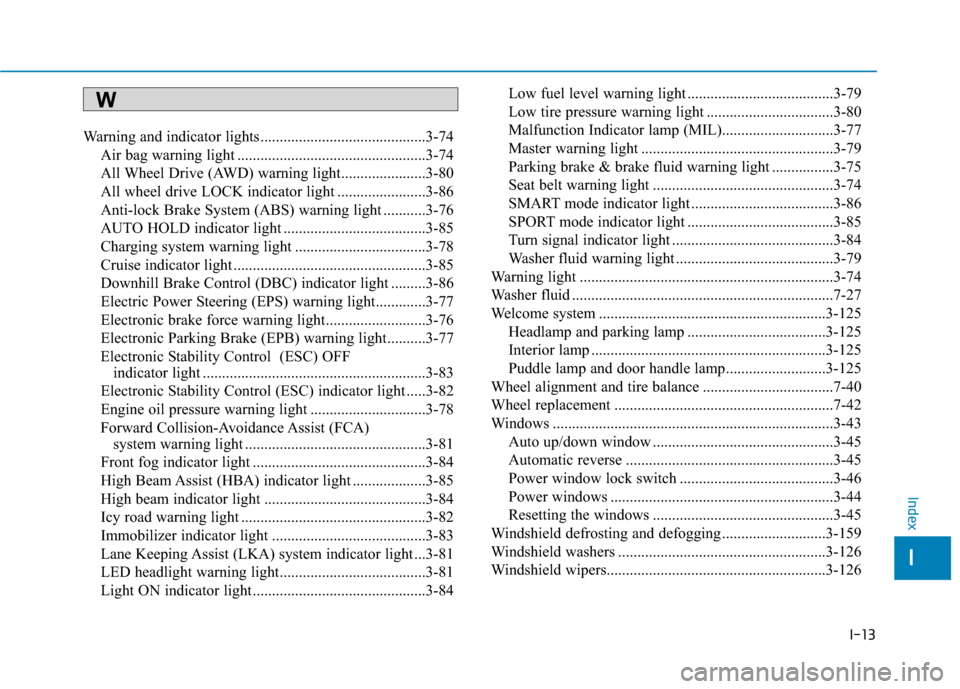
I-13
Warning and indicator lights...........................................3-74Air bag warning light .................................................3-74
All Wheel Drive (AWD) warning light......................3-80
All wheel drive LOCK indicator light .......................3-86
Anti-lock Brake System (ABS) warning light ...........3-76
AUTO HOLD indicator light .....................................3-85
Charging system warning light ..................................3-78
Cruise indicator light ..................................................3-85
Downhill Brake Control (DBC) indicator light .........3-86
Electric Power Steering (EPS) warning light.............3-77
Electronic brake force warning light..........................3-76
Electronic Parking Brake (EPB) warning light..........3-77
Electronic Stability Control (ESC) OFF indicator light ..........................................................3-83
Electronic Stability Control (ESC) indicator light .....3-82
Engine oil pressure warning light ..............................3-78
Forward Collision-Avoidance Assist (FCA) system warning light ...............................................3-81
Front fog indicator light .............................................3-84
High Beam Assist (HBA) indicator light ...................3-85
High beam indicator light ..........................................3-84
Icy road warning light ................................................3-82
Immobilizer indicator light ........................................3-83
Lane Keeping Assist (LKA) system indicator light ...3-81
LED headlight warning light......................................3-81
Light ON indicator light .............................................3-84 Low fuel level warning light ......................................3-79
Low tire pressure warning light .................................3-80
Malfunction Indicator lamp (MIL).............................3-77
Master warning light ..................................................3-79
Parking brake & brake fluid warning light ................3-75
Seat belt warning light ...............................................3-74
SMART mode indicator light .....................................3-86
SPORT mode indicator light ......................................3-85
Turn signal indicator light ..........................................3-84
Washer fluid warning light .........................................3-79
Warning light ..................................................................3-74
Washer fluid ....................................................................7-27\
Welcome system ...........................................................3-125 Headlamp and parking lamp ....................................3-125
Interior lamp .............................................................3-125
Puddle lamp and door handle lamp..........................3-125
Wheel alignment and tire balance ..................................7-40
Wheel replacement .........................................................7-42
Windows ........................................................................\
.3-43 Auto up/down window ...............................................3-45
Automatic reverse ......................................................3-45
Power window lock switch ........................................3-46
Power windows ..........................................................3-44
Resetting the windows ...............................................3-45
Windshield defrosting and defogging ...........................3-159
Windshield washers ......................................................3-126
Windshield wipers........................................................\
.3-126
I
Index
W