Head Hyundai Santa Fe 2019 Owner's Manual
[x] Cancel search | Manufacturer: HYUNDAI, Model Year: 2019, Model line: Santa Fe, Model: Hyundai Santa Fe 2019Pages: 557, PDF Size: 14.8 MB
Page 19 of 557
Safety system of your vehicle
Important Safety Precautions ..............................2-2
Always Wear Your Seat Belt ..........................................2-2
Restrain All Children .........................................................2-2
Air Bag Hazards .................................................................2-2
Driver Distraction ..............................................................2-2
Control Your Speed ...........................................................2-3
Keep Your Vehicle in Safe Condition ............................2-3
Seats ........................................................................\
2-4
Safety Precautions ...........................................................2-5
Front Seats ........................................................................\
.2-6
Rear Seats........................................................................\
.2-13
Head Restraints ...............................................................2-17
Seat Warmers and Air Ventilation Seats ...................2-21
Seat Belts ..............................................................2-25
Seat Belt Safety Precautions .......................................2-25
Seat Belt Warning Light ................................................2-26
Seat Belt Restraint System...........................................2-28
Additional Seat Belt Safety Precautions ...................2-34
Care of Seat Belts...........................................................2-37
Child Restraint System (CRS) .............................2-38
Children Always in the Rear .........................................2-38
Selecting a Child Restraint System (CRS) .................2-39
Installing a Child Restraint System (CRS)..................2-41
AIR BAG
- Advanced Supplemental Restraint System ...2-49
Where Are the Air Bags? ..............................................2-51
How Does the Air Bag System Operate?..................2-54
What to Expect After an Air Bag Inflates ................2-59
Occupant Classification System (OCS).......................2-60
Why Didn't My Air Bag Go Off in a Collision? ........2-65
SRS Care ........................................................................\
....2-70
Additional Safety Precautions .....................................2-71
Air Bag Warning Labels .................................................2-71
This chapter provides you with important information about how to protect yourself and your passengers.
It explains how to properly use your seats and seat belts, and how your air bags work.
Additionally, this chapter explains how to properly restrain infants and children in your vehicle.
2
Page 22 of 557
2-4
Safety system of your vehicle
S
SE
E A
A T
TS
S
OTMA038001
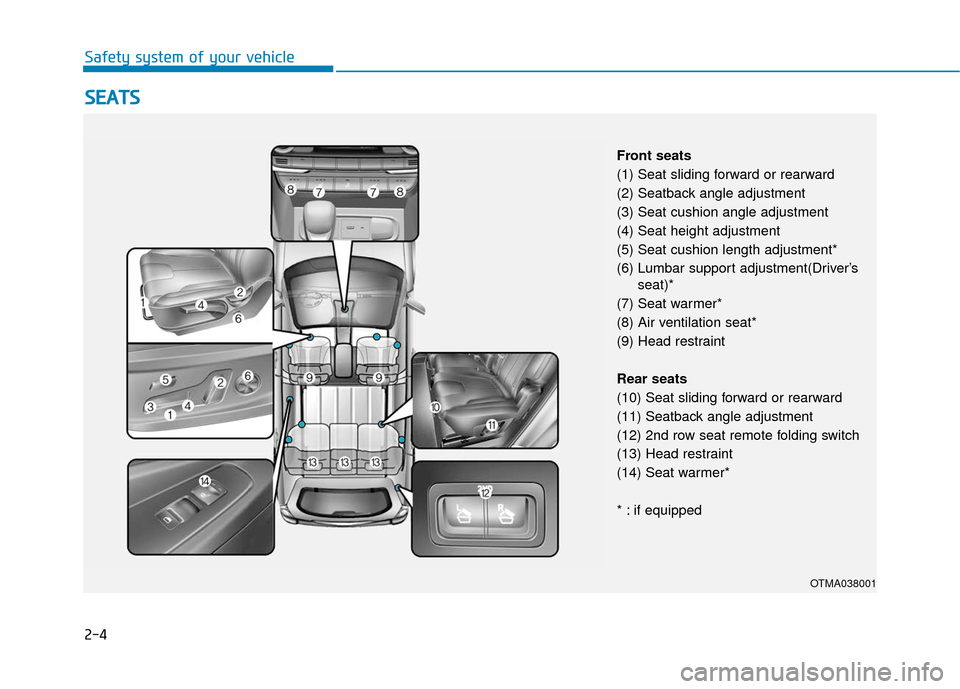
Front seats
(1) Seat sliding forward or rearward
(2) Seatback angle adjustment
(3) Seat cushion angle adjustment
(4) Seat height adjustment
(5) Seat cushion length adjustment*
(6) Lumbar support adjustment(Driver’s
seat)*
(7) Seat warmer*
(8) Air ventilation seat*
(9) Head restraint
Rear seats
(10) Seat sliding forward or rearward
(11) Seatback angle adjustment
(12) 2nd row seat remote folding switch
(13) Head restraint
(14) Seat warmer*
* : if equipped
Page 32 of 557
2-14
Safety system of your vehicle
Folding the rear seat
The rear seatbacks can be folded to
facilitate carrying long items or to
increase the luggage capacity of the
vehicle.To fold down the rear seatback:
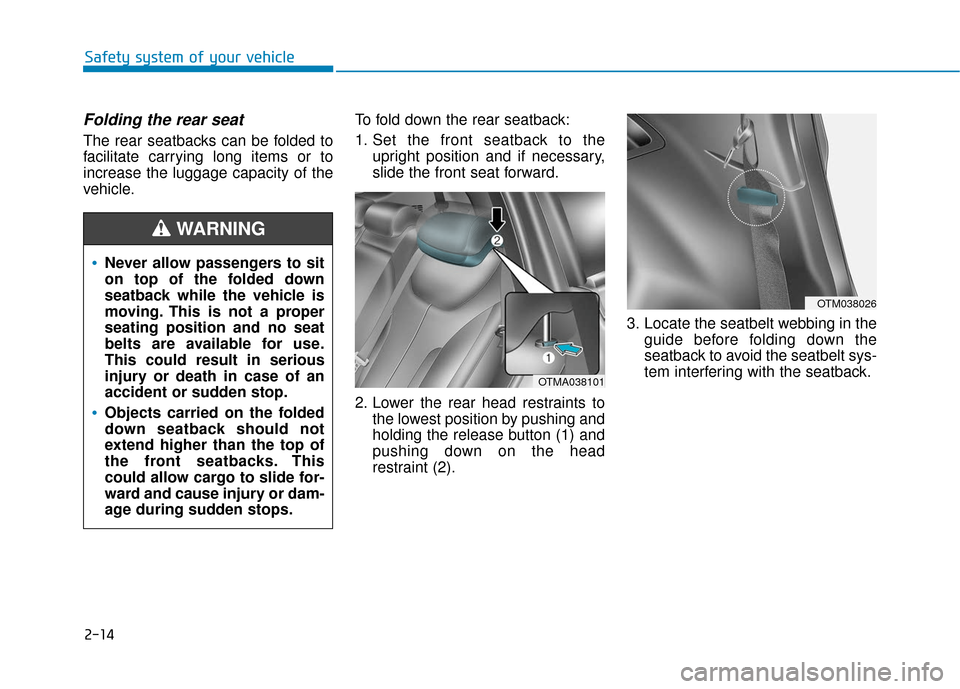
1. Set the front seatback to the
upright position and if necessary,
slide the front seat forward.
2. Lower the rear head restraints to the lowest position by pushing and
holding the release button (1) and
pushing down on the head
restraint (2). 3. Locate the seatbelt webbing in the
guide before folding down the
seatback to avoid the seatbelt sys-
tem interfering with the seatback.
OTMA038101
OTM038026
Never allow passengers to sit
on top of the folded down
seatback while the vehicle is
moving. This is not a proper
seating position and no seat
belts are available for use.
This could result in serious
injury or death in case of an
accident or sudden stop.
Objects carried on the folded
down seatback should not
extend higher than the top of
the front seatbacks. This
could allow cargo to slide for-
ward and cause injury or dam-
age during sudden stops.
WARNING
Page 35 of 557
2-17
Safety system of your vehicle
2
Rear occupant alert system (if equipped)
This function alerts the driver when
you get out of the car with the pas-
senger remaining in the 2nd row
seat.
If you open the door with the pas-
senger in the 2nd row seat, a warn-
ing message appears on the cluster
to give a first warning. If the move-
ment is detected in the 2nd row seat
after you lock all doors, a second
warning alerts you.
Make sure to check for passengers
in 2nd row seat before you get off.
For more details, refer to the “Rear
Occupant Alert System” in chap-
ter 3.
Head Restraints
The vehicle's front and rear seats
have adjustable head restraints. The
head restraints provide comfort for
passengers, but more importantly
they are designed to help protect
passengers from whiplash and other
neck and spinal injuries during an
accident, especially in a rear impact
collision.
To reduce the risk of serious
injury or death in an accident,
take the following precautions
when adjusting your head
restraints:
Always properly adjust the
head restraints for all passen-
gers BEFORE starting the
vehicle.
NEVER let anyone ride in a
seat with the head restraints
removed or reversed.
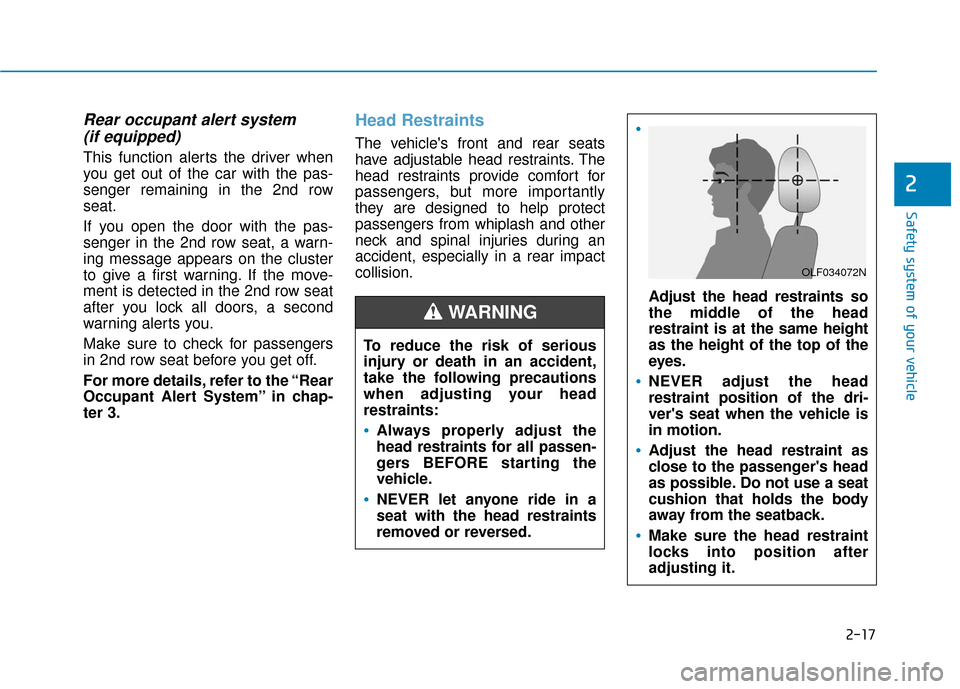
Adjust the head restraints so
the middle of the head
restraint is at the same height
as the height of the top of the
eyes.
NEVER adjust the head
restraint position of the dri-
ver's seat when the vehicle is
in motion.
Adjust the head restraint as
close to the passenger's head
as possible. Do not use a seat
cushion that holds the body
away from the seatback.
Make sure the head restraint
locks into position after
adjusting it.
WARNING
OLF034072N
Page 36 of 557
2-18
Safety system of your vehicle
To prevent damage, NEVER hit or
pull on the head restraints.
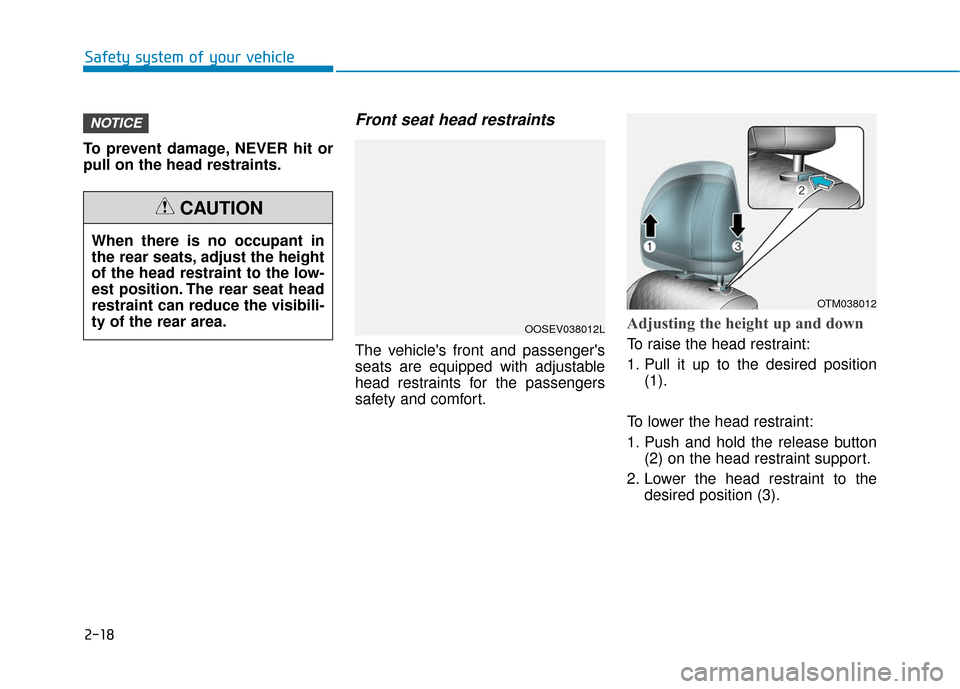
Front seat head restraints
The vehicle's front and passenger's
seats are equipped with adjustable
head restraints for the passengers
safety and comfort.
Adjusting the height up and down
To raise the head restraint:
1. Pull it up to the desired position (1).
To lower the head restraint:
1. Push and hold the release button (2) on the head restraint support.
2. Lower the head restraint to the desired position (3).
NOTICE
OOSEV038012L
OTM038012
When there is no occupant in
the rear seats, adjust the height
of the head restraint to the low-
est position. The rear seat head
restraint can reduce the visibili-
ty of the rear area.
CAUTION
Page 37 of 557
2-19
Safety system of your vehicle
2
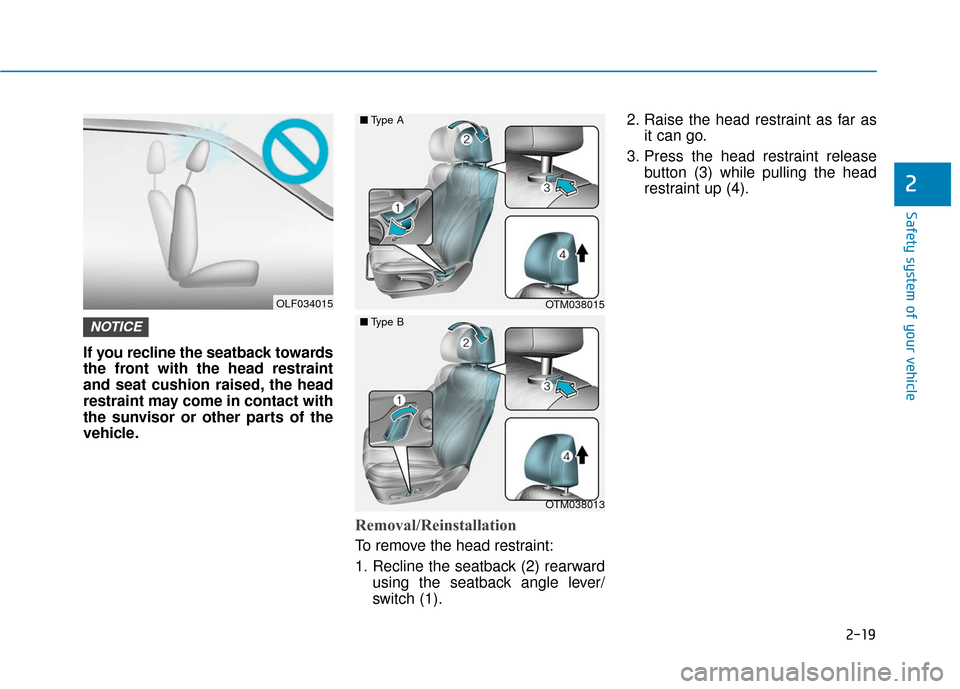
If you recline the seatback towards
the front with the head restraint
and seat cushion raised, the head
restraint may come in contact with
the sunvisor or other parts of the
vehicle.
Removal/Reinstallation
To remove the head restraint:
1. Recline the seatback (2) rearwardusing the seatback angle lever/
switch (1). 2. Raise the head restraint as far as
it can go.
3. Press the head restraint release button (3) while pulling the head
restraint up (4).
NOTICE
OTM038015
OTM038013
■Type A
■Type B
OLF034015
Page 38 of 557
2-20
Safety system of your vehicle
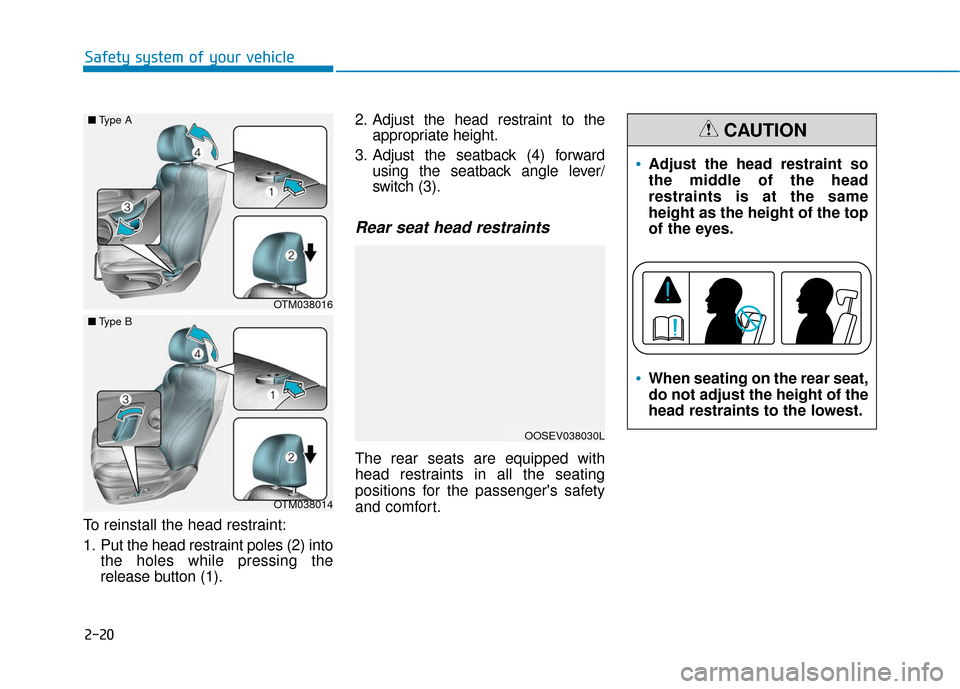
To reinstall the head restraint:
1. Put the head restraint poles (2) into the holes while pressing the
release button (1). 2. Adjust the head restraint to the
appropriate height.
3. Adjust the seatback (4) forward using the seatback angle lever/
switch (3).
Rear seat head restraints
The rear seats are equipped with
head restraints in all the seating
positions for the passenger's safety
and comfort.
OOSEV038030L
Adjust the head restraint so
the middle of the head
restraints is at the same
height as the height of the top
of the eyes.
When seating on the rear seat,
do not adjust the height of the
head restraints to the lowest.
CAUTION
OTM038016
OTM038014
■Type A
■Type B
Page 39 of 557
2-21
Safety system of your vehicle
2
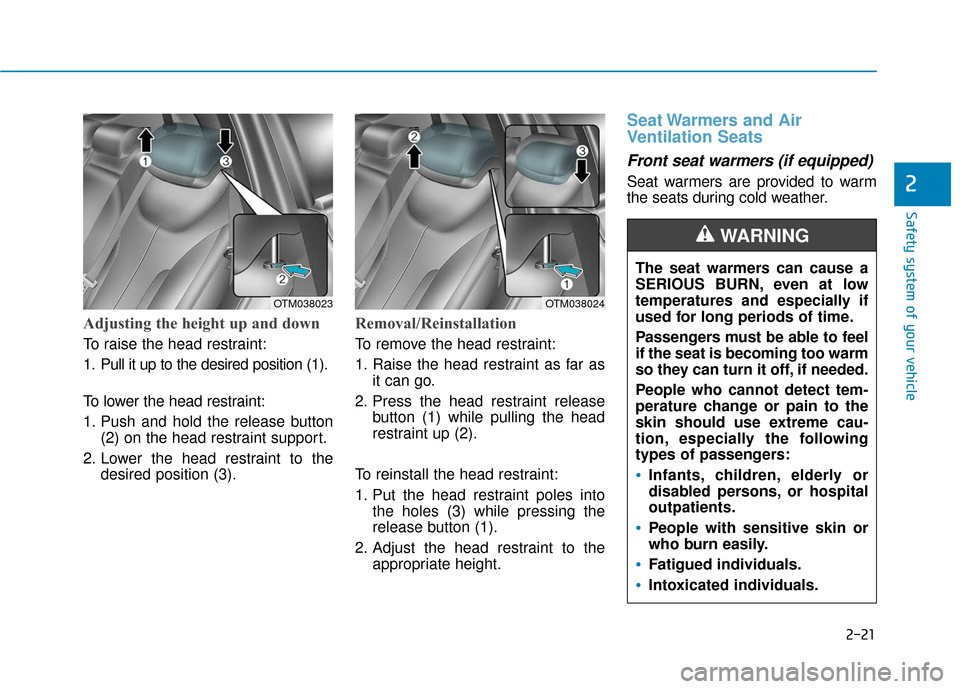
Adjusting the height up and down
To raise the head restraint:
1. Pull it up to the desired position (1).
To lower the head restraint:
1. Push and hold the release button(2) on the head restraint support.
2. Lower the head restraint to the desired position (3).
Removal/Reinstallation
To remove the head restraint:
1. Raise the head restraint as far asit can go.
2. Press the head restraint release button (1) while pulling the head
restraint up (2).
To reinstall the head restraint:
1. Put the head restraint poles into the holes (3) while pressing the
release button (1).
2. Adjust the head restraint to the appropriate height.
Seat Warmers and Air
Ventilation Seats
Front seat warmers (if equipped)
Seat warmers are provided to warm
the seats during cold weather.
OTM038024
The seat warmers can cause a
SERIOUS BURN, even at low
temperatures and especially if
used for long periods of time.
Passengers must be able to feel
if the seat is becoming too warm
so they can turn it off, if needed.
People who cannot detect tem-
perature change or pain to the
skin should use extreme cau-
tion, especially the following
types of passengers:
Infants, children, elderly or
disabled persons, or hospital
outpatients.
People with sensitive skin or
who burn easily.
Fatigued individuals.
Intoxicated individuals.
WARNING
OTM038023
Page 57 of 557
2-39
Safety system of your vehicle
2
Child restraint system (CRS)
Infants and younger children must be
restrained in an appropriate rear-fac-
ing or forward-facing CRS that has
first been properly secured to the
rear seat of the vehicle. Read and
comply with the instructions for
installation and use provided by the
manufacturer of the child restraint.
Selecting a Child Restraint
System (CRS)
When selecting a CRS for your child,
always:
Make sure the CRS has a labelcertifying that it meets applicable
Federal Motor Vehicle Safety
Standards (FMVSS 213).
Select a child restraint based on your child's height and weight. The
required label or the instructions
for use typically provide this infor-
mation.
Select a child restraint that fits the vehicle seating position where it
will be used.
Read and comply with the warn- ings and instructions for installa-
tion and use provided with the
child restraint system.
Always properly restrain your
child in the child restraint.
If the vehicle head restraint
prevents proper installation of
a child seat (as described in
the child restraint system
manual), the head restraint of
the respective seating posi-
tion shall be readjusted or
entirely removed.
Do not use an infant carrier or
a child safety seat that
"hooks" over a seatback, it
may not provide adequate
protection in an accident.
After an accident, have a
HYUNDAI dealer check the
child restraint system, seat
belts, tether anchors and
lower anchors.
An improperly secured child
restraint can increase the risk
of SERIOUS INJURY or DEATH
in an accident. Always take the
following precautions when
using a child restraint system:
NEVER install a child or infant
restraint in the front passen-
ger's seat.
Always properly secure the
child restraint to a rear seat of
the vehicle.
Always follow the child
restraint system manufactur-
er's instructions for installa-
tion and use.
WARNING
Page 59 of 557
2-41
Safety system of your vehicle
2
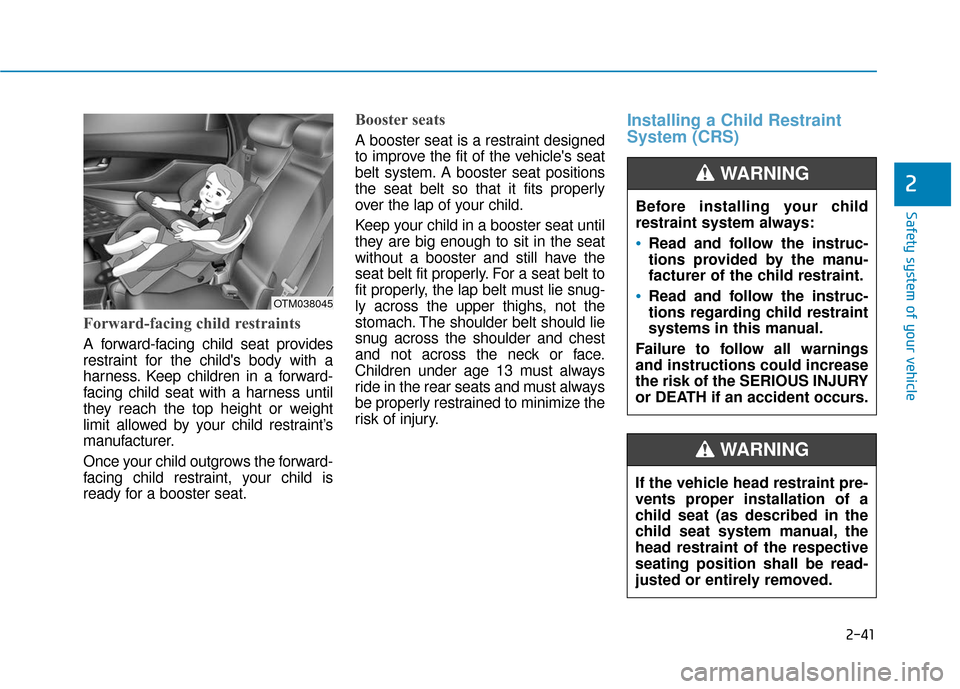
Forward-facing child restraints
A forward-facing child seat provides
restraint for the child's body with a
harness. Keep children in a forward-
facing child seat with a harness until
they reach the top height or weight
limit allowed by your child restraint’s
manufacturer.
Once your child outgrows the forward-
facing child restraint, your child is
ready for a booster seat.
Booster seats
A booster seat is a restraint designed
to improve the fit of the vehicle's seat
belt system. A booster seat positions
the seat belt so that it fits properly
over the lap of your child.
Keep your child in a booster seat until
they are big enough to sit in the seat
without a booster and still have the
seat belt fit properly. For a seat belt to
fit properly, the lap belt must lie snug-
ly across the upper thighs, not the
stomach. The shoulder belt should lie
snug across the shoulder and chest
and not across the neck or face.
Children under age 13 must always
ride in the rear seats and must always
be properly restrained to minimize the
risk of injury.
Installing a Child Restraint
System (CRS)
Before installing your child
restraint system always:
Read and follow the instruc-
tions provided by the manu-
facturer of the child restraint.
Read and follow the instruc-
tions regarding child restraint
systems in this manual.
Failure to follow all warnings
and instructions could increase
the risk of the SERIOUS INJURY
or DEATH if an accident occurs.
WARNING
If the vehicle head restraint pre-
vents proper installation of a
child seat (as described in the
child seat system manual, the
head restraint of the respective
seating position shall be read-
justed or entirely removed.
WARNING
OTM038045