ABS HYUNDAI SANTA FE 2021 Owner's Guide
[x] Cancel search | Manufacturer: HYUNDAI, Model Year: 2021, Model line: SANTA FE, Model: HYUNDAI SANTA FE 2021Pages: 636, PDF Size: 81.2 MB
Page 609 of 636
09
9-59
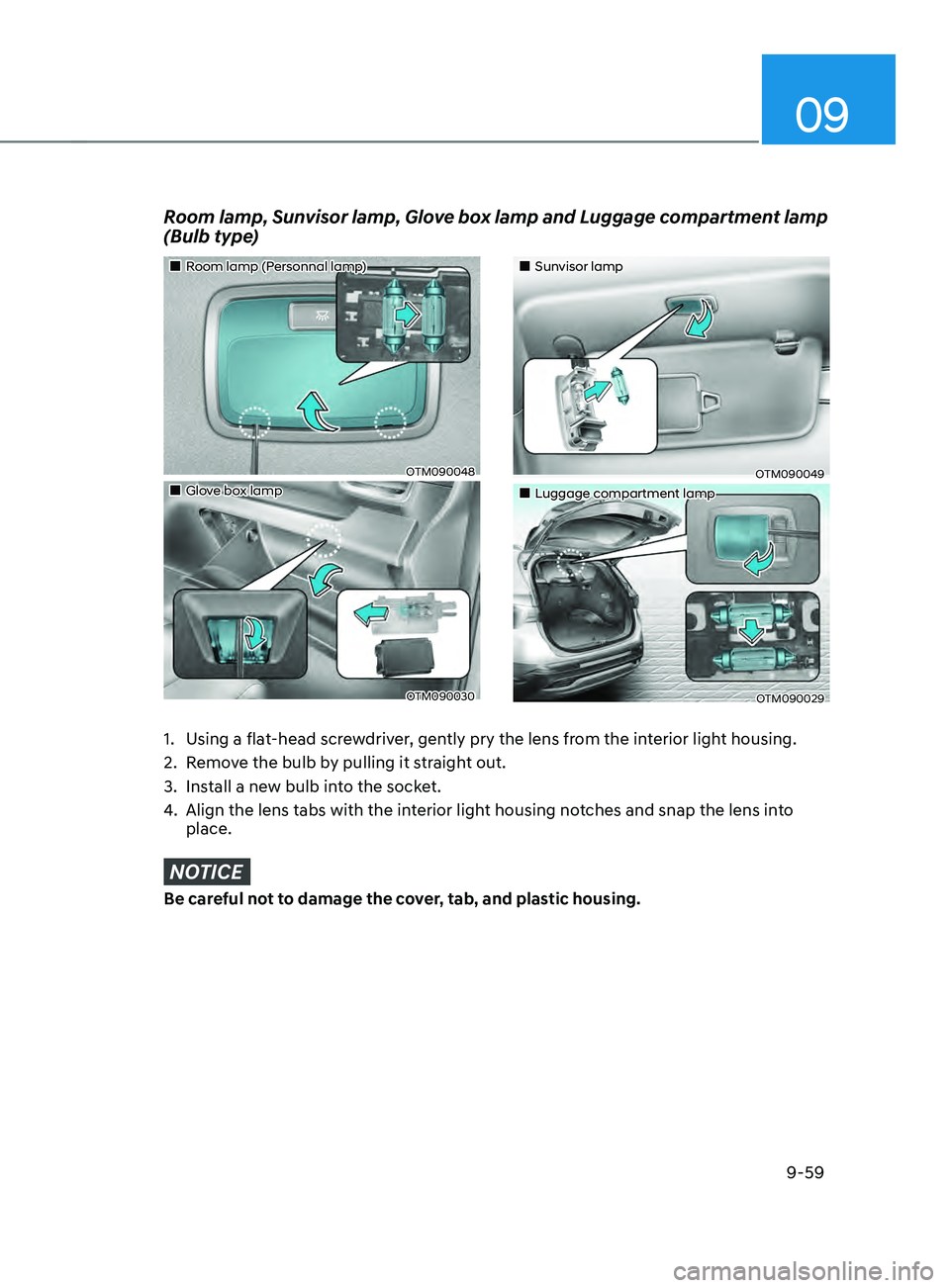
Room lamp, Sunvisor lamp, Glove box lamp and Luggage compartment lamp
(Bulb type)
1. Using a flat-head screwdriver, gently pry the lens from the interior light housing.
2.
Remo
ve the bulb by pulling it straight out.
3.
Install a ne
w bulb into the socket.
4.
Align the lens tabs with the int
erior light housing notches and snap the lens into
place.
NOTICE
Be careful not to damage the cover, tab, and plastic housing.
„„Room lamp (Personnal lamp)
OTM090048
„„Glove box lamp
OTM090030
„„Sunvisor lamp
OTM090049
„„Luggage compartment lamp
OTM090029
Page 618 of 636

Maintenance
9-68
- OilRemo ve oil instantly with
absorbable cloth and wipe with
stain remover used only for natural
leather.
- Chewing gum
Har
den the gum with ice and
remove gradually.
• Handling prime napa leather (if
equipped)
Try to avoid excessive sunlight and
heat exposure. Excessive sunlight
and heat exposure naturally fades
and dries out napa leather, causing
wrinkles and discoloration. If the napa
leather is wet with liquid, immediately
clean it with lint-free cloth to minimize
damage. Do not scratch the napa
leather surface with a sharp object.
If your napa leather seat is bright
colored, it may be contaminated or
stained from dyed materials such as
jeans.
Interior wooden trim
• Use a wooden furniture protector (e.g.
wax, coating compound) to clean the
interior wooden trim.
• Often wipe the interior wooden
trim with a lint-free, clean cloth to
maintain the unique wooden textures
for a longer period of time.
• If you spill beverage (e.g. water,
coffee) over the interior wooden trim,
immediately wipe it with clean, dry
cloth.
• Sharp objects (e.g. driver, knife),
adhesive materials, or tapes may
damage the interior wooden trim.
• Any strong impacts may damage the
interior wooden trim.
• If the coating finish over the interior
wooden trim is removed, moisture
may damage or change wood traits.
• If the interior wooden trim is
damaged, you may get a splinter
from the wood surface. Therefore,
you should immediately have the
damaged interior wooden trim
replaced by an authorized HYUNDAI
dealer.
Cleaning the seat belt webbing
Clean the belt webbing with any
mild soap solution recommended for
cleaning upholstery or carpet. Follow
the instructions provided with the soap.
Do not bleach or re-dye the webbing
because this may weaken the seat belt.
Cleaning the interior window glass
If the interior glass surfaces of the
vehicle become fogged (that is, covered
with an oily, greasy or waxy film), they
should be cleaned with glass cleaner.
Follow the directions on the glass cleaner
container.
NOTICE
Do not scrape or scratch the inside of
the rear window. This may result in
damage to the rear window defroster
grid.
Page 619 of 636

09
9-69
The emission control system of your
vehicle is covered by a written limited
warranty. Please see the warranty
information contained in the Service
Passport in your vehicle.
Your vehicle is equipped with an
emission control system to meet all
applicable emission regulations. There
are three emission control systems, as
follows.
(1)
Crank
case emission control system
(2)
Ev
aporative emission control system
(3)
Exhaust emission con
trol system
In order to ensure the proper function
of the emission control systems, it
is recommended that you have your
vehicle inspected and maintained
by an authorized HYUNDAI dealer in
accordance with the maintenance
schedule in this manual.
NOTICE
For the Inspection and Maintenance
Test (with Electronic Stability Control
(ESC) system)
• To prevent the vehicle from misfiring
during dynamometer testing, turn
the Electronic Stability Control
(ESC) system off by pressing the ESC
switch (ESC OFF light illuminated).
• After dynamometer testing is
completed, turn the ESC system back
on by pressing the ESC switch again.
1. Crankcase emission control
sy
stem
The positive crankcase ventilation system
is employed to prevent air pollution
caused by blow-by gases being emitted
from the crankcase. This system supplies
fresh filtered air to the crankcase through
the air intake hose. Inside the crankcase,
the fresh air mixes with blow-by gases,
which then pass through the PCV valve
into the induction system.
2. Evaporative emission control
system
The Evaporative Emission Control System
is designed to prevent fuel vapors from
escaping into the atmosphere.
Canister
Fuel vapors generated inside the fuel
tank are absorbed and stored in the
onboard canister. When the engine is
running, the fuel vapors absorbed in the
canister are drawn into the surge tank
through the purge control solenoid valve.
Purge Control Solenoid Valve (PCSV)
The purge control solenoid valve
is controlled by the Engine Control
Module (ECM); when the engine coolant
temperature is low during idling, the
PCSV closes so that evaporated fuel
is not taken into the engine. After the
engine warms-up during ordinary
driving, the PCSV opens to introduce
evaporated fuel to the engine.
EMISSION CONTROL SYSTEM
Page 625 of 636

I
I-3
B
Battery
........................................................................\
.........................................9-28
Battery capacity label ........................................................................\
...............9-30
Battery recharging ........................................................................\
.................... 9-30
For best battery service ........................................................................\
............9-29
Reset items ........................................................................\
............................... 9-31
Before driving
........................................................................\
................................ 6-4
Before entering the vehicle ........................................................................\
........6-4
Before starting ........................................................................\
............................ 6-4
Blind-Spot Collision-Avoidance
Assist (BCA)
..................................................7-25
System malfunction and limitations ................................................................. 7-34
System operation ........................................................................\
...................... 7-29
System settings ........................................................................\
......................... 7-27
Blind-Spot
View Monitor (BVM)
...................................................................... 7-51
System malfunction ........................................................................\
.................. 7-52
System operation ........................................................................\
...................... 7-51
System settings ........................................................................\
......................... 7-51
Brake fluid
........................................................................\
................................... 9-21
Checking the brake fluid level ........................................................................\
.9-21
Braking system
........................................................................\
............................ 6-34
Anti-lock Brake System (ABS) ........................................................................\
6-43
Auto Hold (if equipped) ........................................................................\
........... 6-39
Disc brakes wear indicator ........................................................................\
.......6-34
Downhill Brake Control (DBC) ......................................................................6-48
Electronic Parking Brake (EPB) .....................................................................6-35
Electronic Stability Control (ESC) ...................................................................6-44
Good braking practices ........................................................................\
............. 6-51
Hill-Start Assist Control (HAC) ......................................................................6-48
Power-assist brakes ........................................................................\
.................. 6-34
Vehicle Stability Management (VSM) ............................................................6-47
Bulb wattage
........................................................................\
.................................. 2-9