brakes HYUNDAI SANTA FE 2021 Owner's Guide
[x] Cancel search | Manufacturer: HYUNDAI, Model Year: 2021, Model line: SANTA FE, Model: HYUNDAI SANTA FE 2021Pages: 636, PDF Size: 81.2 MB
Page 521 of 636
08
8-3
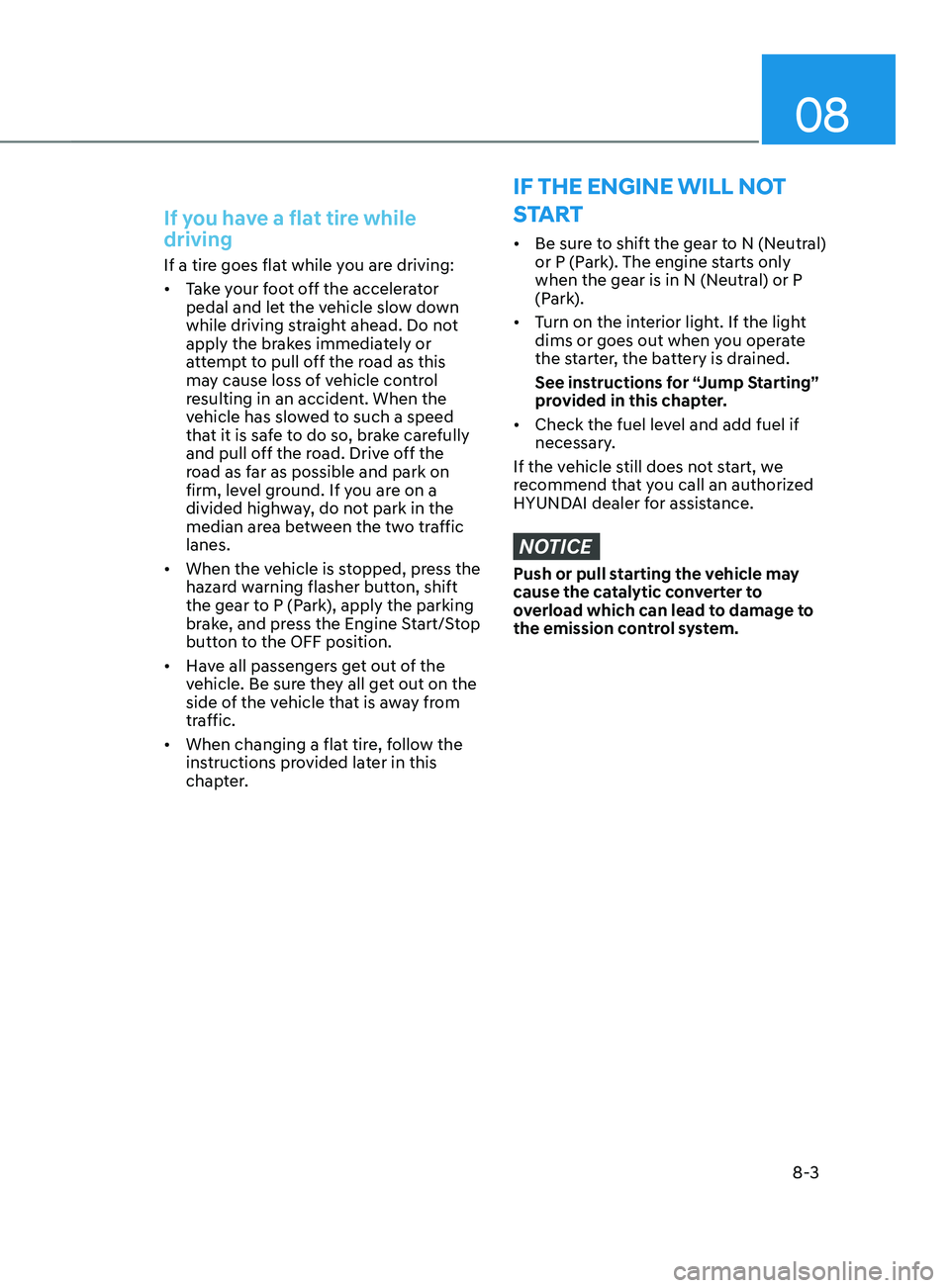
If you have a flat tire while
driving
If a tire goes flat while you are driving:
• Take your foot off the accelerator
pedal and let the vehicle slow down
while driving straight ahead. Do not
apply the brakes immediately or
attempt to pull off the road as this
may cause loss of vehicle control
resulting in an accident. When the
vehicle has slowed to such a speed
that it is safe to do so, brake carefully
and pull off the road. Drive off the
road as far as possible and park on
firm, level ground. If you are on a
divided highway, do not park in the
median area between the two traffic
lanes.
• When the vehicle is stopped, press the
hazard warning flasher button, shift
the gear to P (Park), apply the parking
brake, and press the Engine Start/Stop
button to the OFF position.
• Have all passengers get out of the
vehicle. Be sure they all get out on the
side of the vehicle that is away from
traffic.
• When changing a flat tire, follow the
instructions provided later in this
chapter.
IF THE ENGINE WILL NOT
S TA
RT
• Be sure to shift the gear to N (Neutral)
or P (Park). The engine starts only
when the gear is in N (Neutral) or P
(Park).
• Turn on the interior light. If the light
dims or goes out when you operate
the starter, the battery is drained.
See instructions for “Jump Starting”
provided in this chapter.
• Check the fuel level and add fuel if
necessary.
If the vehicle still does not start, we
recommend that you call an authorized
HYUNDAI dealer for assistance.
NOTICE
Push or pull starting the vehicle may
cause the catalytic converter to
overload which can lead to damage to
the emission control system.
Page 531 of 636
08
8-13
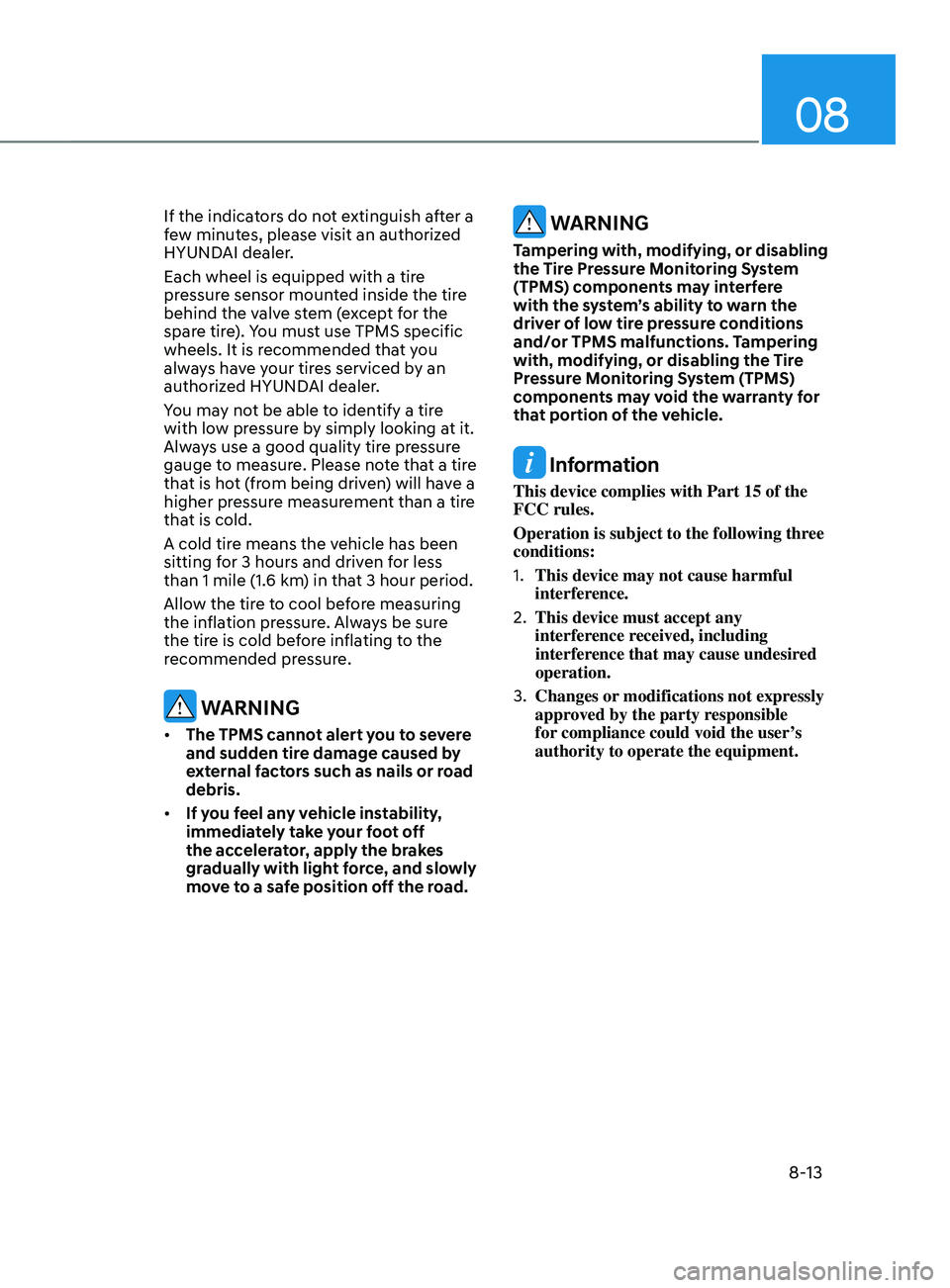
If the indicators do not extinguish after a
few minutes, please visit an authorized
HYUNDAI dealer.
Each wheel is equipped with a tire
pressure sensor mounted inside the tire
behind the valve stem (except for the
spare tire). You must use TPMS specific
wheels. It is recommended that you
always have your tires serviced by an
authorized HYUNDAI dealer.
You may not be able to identify a tire
with low pressure by simply looking at it.
Always use a good quality tire pressure
gauge to measure. Please note that a tire
that is hot (from being driven) will have a
higher pressure measurement than a tire
that is cold.
A cold tire means the vehicle has been
sitting for 3 hours and driven for less
than 1 mile (1.6 km) in that 3 hour period.
Allow the tire to cool before measuring
the inflation pressure. Always be sure
the tire is cold before inflating to the
recommended pressure.
WARNING
• The TPMS cannot alert you to severe
and sudden tire damage caused by
external factors such as nails or road
debris.
• If you feel any vehicle instability,
immediately take your foot off
the accelerator, apply the brakes
gradually with light force, and slowly
move to a safe position off the road.
WARNING
Tampering with, modifying, or disabling
the Tire Pressure Monitoring System
(TPMS) components may interfere
with the system’s ability to warn the
driver of low tire pressure conditions
and/or TPMS malfunctions. Tampering
with, modifying, or disabling the Tire
Pressure Monitoring System (TPMS)
components may void the warranty for
that portion of the vehicle.
Information
This device complies with Part 15 of the
FCC rules.
Operation is subject to the following three
conditions:
1.
This device may not cause harmful
interference.
2.
This device must accept any
interference r
eceived, including
interference that may cause undesired
operation.
3.
Changes or modifications not expr
essly
approved by the party responsible
for compliance could void the user’s
authority to operate the equipment.
Page 561 of 636
09
9-11
Normal maintenance schedule
MAINTENANCE INTERVALS
MAINTENANCE
ITEM Number of months or driving distance, whichever comes first
Months 12 24 36 48 60 72 84 96 108 120 132 144 156
Miles×1,000 8 16 24 32 40 48 56 64 72 80 88 96 104
Km×1,000 13 26 39 52 65 78 91 104 117 130 143 156 169
Cooling system Inspect coolant level for leak every day
At first, inspect 40,000 miles (60,000 km) or 48 months.
After that, inspect every 20,000 miles (30,000 km) or 24 months
Engine coolant TGDI
At first, replace at 80,000 miles (130,000 km) or 10 years.
After that, replace every 24,000 miles (39,000 km) or 24 months
EXCEPT TGDI At first, replace at 120,000 miles (200,000 km) or 120 months.
After that, replace every 30,000 miles (50,000 km) or 24 months
Battery condition I I I I I I I I I I I I I
Brake lines, hoses and connections I I I I I I I I I I I I I
Brake pedal IIIIII
Parking brake (if equipped) IIIIII
Brake fluid TGDI
Inspect every 6,000 miles (10,000 km) or 12 months,
Replace every 48,000 miles (80,000 km) or 48 months
EXCEPT TGDI Inspect every 7,500 miles (12,000 km) or 12 months,
Replace every 60,000 miles (96,000 km) or 48 monthsI : Inspect and if necessary, adjust, correct, clean or replace.
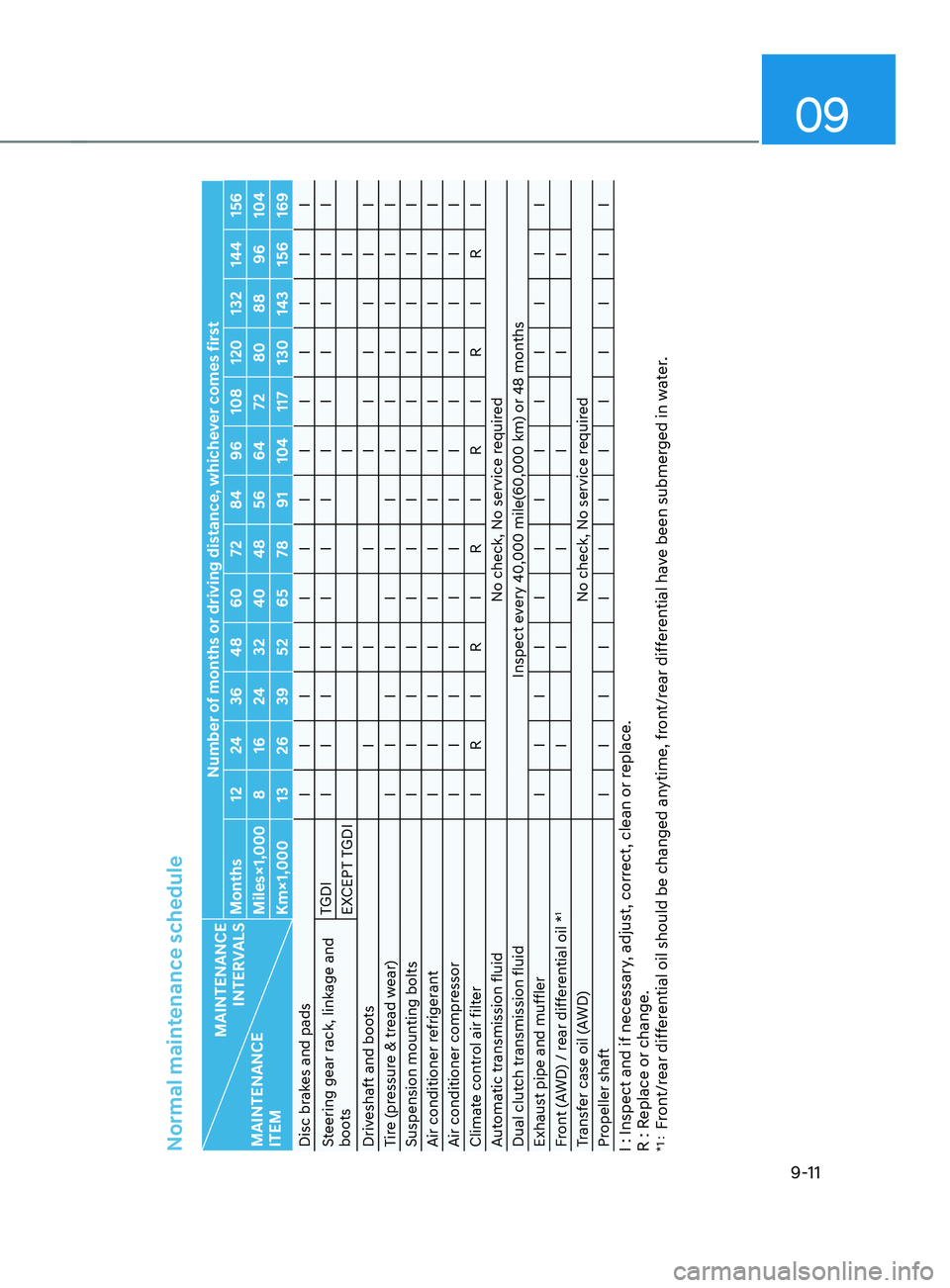
R : Replace or change.Normal maintenance schedule
MAINTENANCE
INTERVALS
MAINTENANCE
ITEM Number of months or driving distance, whichever comes first
Months 12 24 36 48 60 72 84 96 108 120 132 144 156
Miles×1,000 8 16 24 32 40 48 56 64 72 80 88 96 104
Km×1,000 13 26 39 52 65 78 91 104 117 130 143 156 169
Disc brakes and pads I I I I I I I I I I I I I
Steering gear rack, linkage and
boots TGDI
I I I I I I I I I I I I I
EXCEPT TGDI III
Driveshaft and boots IIII I I I I I
Tire (pressure & tread wear) I I I I I I I I I I I I I
Suspension mounting bolts I I I I I I I I I I I I I
Air conditioner refrigerant I I I I I I I I I I I I I
Air conditioner compressor I I I I I I I I I I I I I
Climate control air filter I R I R I R I R I R I R I
Automatic transmission fluid No check, No service required
Dual clutch transmission fluid Inspect every 40,000 mile(60,000 km) or 48 months
Exhaust pipe and muffler I I I I I I I I I I I I I
Front (AWD) / rear differential oil *
1
I IIIII
Transfer case oil (AWD) No check, No service required
Propeller shaft I I I I I I I I I I I I I
I : Inspect and if necessary, adjust, correct, clean or replace.
R : Replace or change.*1 : Front/rear differential oil should be changed anytime, front/rear differential have been submerged in water.
Page 562 of 636
Maintenance
9-12
Maintenance under severe usage conditions
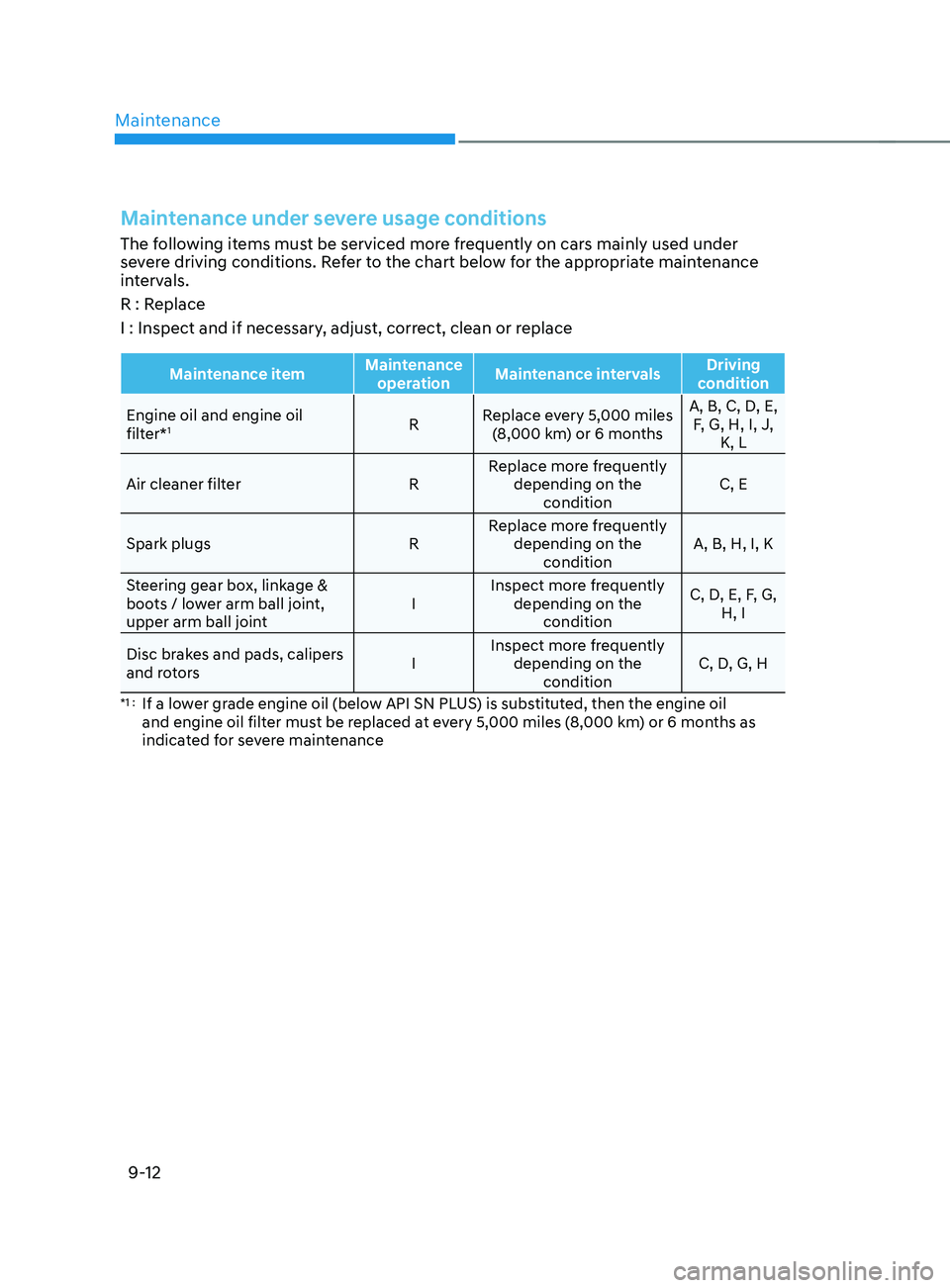
The following items must be serviced more frequently on cars mainly used under
severe driving conditions. Refer to the chart below for the appropriate maintenance
intervals.
R : Replace
I : Inspect and if necessary, adjust, correct, clean or replace
Maintenance itemMaintenance
operation Maintenance intervals Driving
condition
Engine oil and engine oil
filter*
1R Replace every 5,000 miles
(8,000 km) or 6 months A, B, C, D, E,
F, G, H, I, J, K, L
Air cleaner filter RReplace more frequently
depending on the condition C, E
Spark plugs RReplace more frequently
depending on the condition A, B, H, I, K
Steering gear box, linkage &
boots / lower arm ball joint,
upper arm ball joint IInspect more frequently
depending on the condition C, D, E, F, G,
H, I
Disc brakes and pads, calipers
and rotors IInspect more frequently
depending on the condition C, D, G, H
*1 : If a lower grade engine oil (below API SN PLUS) is substituted, then the engine oil
and engine oil filter must be replaced at every 5,000 miles (8,000 km) or 6 months as
indicated for severe maintenance
Page 610 of 636
Maintenance
9-60
Exterior care
Exterior general caution
It is very important to follow the label
directions when using any chemical
cleaner or polish. Read all warning and
caution statements that appear on the
label.
Finish maintenance
Washing
To help protect your vehicle’s finish from
rust and deterioration, wash it thoroughly
and frequently at least once a month
with lukewarm or cold water.
If you use your vehicle for off-road
driving, you should wash it after each
off-road trip. Pay special attention to the
removal of any accumulation of salt, dirt,
mud, and other foreign materials. Make
sure the drain holes in the lower edges
of the doors and rocker panels are kept
clear and clean.
Insects, tar, tree sap, bird droppings,
industrial pollution and similar deposits
can damage your vehicle’s finish if not
removed immediately.
Even prompt washing with plain water
may not completely remove all these
deposits. A mild soap, safe for use on
painted surfaces, should be used.
After washing, rinse the vehicle
thoroughly with lukewarm or cold water.
Do not allow soap to dry on the finish.High-pressure washing
•
When using high-pressure washers,
make sure to maintain sufficient
distance from the vehicle.
Insufficient clearance or excessive
pressure can lead to component
damage or water penetration.
• Do not spray the camera, sensors or
its surrounding area directly with a
high pressure washer. Shock applied
from high pressure water may cause
the device to not operate normally.
• Do not bring the nozzle tip close to
boots (rubber or plastic covers) or
connectors as they may be damaged
if they come into contact with high
pressure water.
WARNING
After washing the vehicle, test the
brakes while driving slowly to see
if they have been affected by water
before getting on the road. If braking
performance is impaired, dry the
brakes by applying them lightly while
maintaining a slow forward speed.
APPEARANCE CARE
Page 613 of 636

09
9-63
Bright-metal maintenance
• To remove road tar and insects, use
a tar remover, not a scraper or other
sharp object.
• To protect the surfaces of bright metal
parts from corrosion, apply a coating
of wax or chrome preservative and rub
to a high luster.
• During winter weather or in coastal
areas, cover the bright metal parts
with a heavier coating of wax or
preservative. If necessary, coat the
parts with non-corrosive petroleum
jelly or other protective compound.
Underbody maintenance
Corrosive materials used for ice and
snow removal and dust control may
collect on the underbody. If these
materials are not removed, accelerated
rusting can occur on underbody parts
such as the fuel lines, frame, floor pan
and exhaust system, even though they
have been treated with rust protection.
Thoroughly flush the vehicle underbody
and wheel openings with lukewarm or
cold water once a month, after off-road
driving and at the end of each winter. Pay
special attention to these areas because
it is difficult to see all the mud and dirt.
It will do more harm than good to wet
down the road grime without removing
it. The lower edges of doors, rocker
panels, and frame members have drain
holes that should not be allowed to clog
with dirt; trapped water in these areas
can cause rusting.
WARNING
After washing the vehicle, test the
brakes while driving slowly to see if
they have been affected by water. If
braking performance is impaired, dry
the brakes by applying them lightly
while maintaining a slow forward
speed.
Aluminum wheel maintenance
The aluminum wheels are coated with a
clear protective finish.
• Do not use abrasive cleaner, polishing
compound, solvent, or wire brushes
on aluminum wheels.
• Clean the wheel when it has cooled.
• Use only a mild soap or neutral
detergent, and rinse thoroughly with
water. Also, clean the wheels after
driving on salted roads.
• Do not wash the wheels with high-
speed car wash brushes.
• Do not use any cleaners containing
acid or alkaline detergents.
Page 625 of 636

I
I-3
B
Battery
........................................................................\
.........................................9-28
Battery capacity label ........................................................................\
...............9-30
Battery recharging ........................................................................\
.................... 9-30
For best battery service ........................................................................\
............9-29
Reset items ........................................................................\
............................... 9-31
Before driving
........................................................................\
................................ 6-4
Before entering the vehicle ........................................................................\
........6-4
Before starting ........................................................................\
............................ 6-4
Blind-Spot Collision-Avoidance
Assist (BCA)
..................................................7-25
System malfunction and limitations ................................................................. 7-34
System operation ........................................................................\
...................... 7-29
System settings ........................................................................\
......................... 7-27
Blind-Spot
View Monitor (BVM)
...................................................................... 7-51
System malfunction ........................................................................\
.................. 7-52
System operation ........................................................................\
...................... 7-51
System settings ........................................................................\
......................... 7-51
Brake fluid
........................................................................\
................................... 9-21
Checking the brake fluid level ........................................................................\
.9-21
Braking system
........................................................................\
............................ 6-34
Anti-lock Brake System (ABS) ........................................................................\
6-43
Auto Hold (if equipped) ........................................................................\
........... 6-39
Disc brakes wear indicator ........................................................................\
.......6-34
Downhill Brake Control (DBC) ......................................................................6-48
Electronic Parking Brake (EPB) .....................................................................6-35
Electronic Stability Control (ESC) ...................................................................6-44
Good braking practices ........................................................................\
............. 6-51
Hill-Start Assist Control (HAC) ......................................................................6-48
Power-assist brakes ........................................................................\
.................. 6-34
Vehicle Stability Management (VSM) ............................................................6-47
Bulb wattage
........................................................................\
.................................. 2-9