warning HYUNDAI SANTA FE HYBRID 2021 User Guide
[x] Cancel search | Manufacturer: HYUNDAI, Model Year: 2021, Model line: SANTA FE HYBRID, Model: HYUNDAI SANTA FE HYBRID 2021Pages: 598, PDF Size: 66.6 MB
Page 26 of 598

Foreword / Hybrid System Overview
1-22
NOTICE
• When the vehicle is paint baked, do
not bake over 30 minutes in 158°F
(70°C) or 20 minutes in 176°F (80°C)
degree.
• Do not wash the engine
compartment, using water. Water
may cause an electric shock and
damage the electronic components.
WARNING
This hybrid vehicle uses the hybrid
battery system inverter and converter
to generate high voltage. High voltage
in the hybrid battery system is very
dangerous and may cause severe burns
and electric shock. This may result in
serious injury or death.
• For your safety, never touch,
replace, disassemble or remove the
hybrid battery system including
components, cables and connectors.
Severe burns or electric shock may
result in serious injury or death when
you fail to follow this warning.
• When the hybrid battery system
operates, the hybrid battery system
can be hot. Always be careful
because burns or electric shock may
be caused by high voltage.
• Do not spill liquid on the HPCU, HSG,
motor and fuses. If the hybrid system
components come in contact with
liquid, it may result in electric shock.
Service interlock connector
OTMHQ010016
In case of emergency, cut the service
interlock connector cable to isolate the
high voltage of the battery.
WARNING
Never disconnect the service interlock
connector or cut the wire except in an
emergency situation.
Serious problems may occur, such as
the vehicle will not start.
Hybrid battery cooling duct
OTMHQ010017
The hybrid battery cooling duct is
located of the Passenger’s seat. The
cooling duct cools down the hybrid
battery. When the hybrid battery cooling
duct is blocked, the hybrid battery may
be overheated.
Clean the cooling duct for the hybrid
battery with a dry cloth on a regular
basis.
Page 27 of 598

01
1-23
WARNING
• Never clean the cooling duct of the
hybrid battery with a wet cloth. If
any water enters the cooling duct
of the hybrid battery, the hybrid
battery may cause an electric shock,
resulting in a serious damage, an
injury or a death.
• The hybrid battery is composed of
lithium-ion polymer. If the hybrid
battery is improperly handled, it is
dangerous to the environment. Also
it may cause electrical shock and
severe burns, resulting in a serious
injury or a death.
• Do not spill liquid over the cooling
duct of the hybrid battery. Doing
so is very dangerous. It may cause
electric shock or serious injury.
• Do not cover the cooling duct with
objects.
• Do not put any objects into the
cooling duct of the hybrid battery.
Doing so may cause loss of cooling
duct volume to the hybrid battery.
When the cooling duct is blocked
with any objects, immediately
contact your HYUNDAI dealer.
• Never place a container of liquid on
or near the cooling duct. If the liquid
spills, the hybrid battery located in
the under floor may be damaged.
• Do not obstruct the cooling duct
with any other objects.
If an accident occurs
WARNING
• For your safety, do not touch the
high voltage cables, connectors
and package modules. High voltage
components are orange in color.
• Exposed cables or wires may be
visible inside or outside of the
vehicle. Never touch the wires or
cables, because an electrical shock,
an injury, or a death may occur.
• Any gas or electrolyte leakage from
your vehicle is not only poisonous
but also flammable. Upon witnessing
one of those, open the windows,
and remain a safe distance from the
vehicle out of the road.
Immediately call an emergency
services or contact an authorized
HYUNDAI dealer and advise them
that a hybrid vehicle is involved.
• When the vehicle is severely
damaged, remain a safe distance of
49 feet or more between your vehicle
and other vehicles/flammables.
Page 28 of 598

Foreword / Hybrid System Overview
1-24
WARNING
If a fire occurs:
• If a small scale fire occurs, use a fire
extinguisher (ABC, BC) that is meant
for electrical fires.
If it is impossible to extinguish
the fire in the early stage, remain
a safe distance from the vehicle
and immediately call your local
fire emergency responders. Also,
advise them that a hybrid vehicle is
involved.
If the fire spreads to the high voltage
battery, large amount of water is
needed to put out the fire.
Using small amount of water or
fire extinguishers not meant for
electrical fires could cause serious
injury or death from electrical
shocks.
• Upon witnessing any sparks, gases,
flames, or fuel leakage of your
vehicle, immediately call emergency
services or contact an authorized
HYUNDAI dealer. Also, advise them
that a hybrid vehicle is involved.
WARNING
When a submersion in water occurs:
When your vehicle is flooded in water, a
high-voltage battery may cause shock
or fires. Thus, turn the hybrid system
OFF, take the key in your possession and
escape to a safe place. Never attempt
physical contact with your flooded
vehicle.
Immediately contact an authorized
HYUNDAI dealer and advise them that a
hybrid vehicle is involved.
When the hybrid vehicle shuts
off
When the high voltage battery or 12 volt
battery is discharged, or when the fuel
tank is empty, the hybrid system may
not operate while driving. When the
Hybrid system does not operate, do the
following:
1. Gradually reduce the vehicle speed.
Pull over your vehicle off the road in a
safe area.
2. Make sure the shift button is in P
(Park).
3. Turn ON the hazard warning flashers.
4. Turn OFF the vehicle, and try to
start the hybrid system again, while
depressing the brake pedal and
turning on the ignition switch.
5. When the hybrid system still does
not operate, refer to “Jump starting”
section in chapter 8.
Before jump-starting the vehicle,
check the fuel level and the exact
procedure to jump start. For further
details, refer to “Jump starting”
section in chapter 8. When the fuel
level is low, do not attempt to drive
the vehicle only with the battery
power. The high voltage battery may
be discharged, and the hybrid system
will turn OFF.
Page 33 of 598
2-5
02
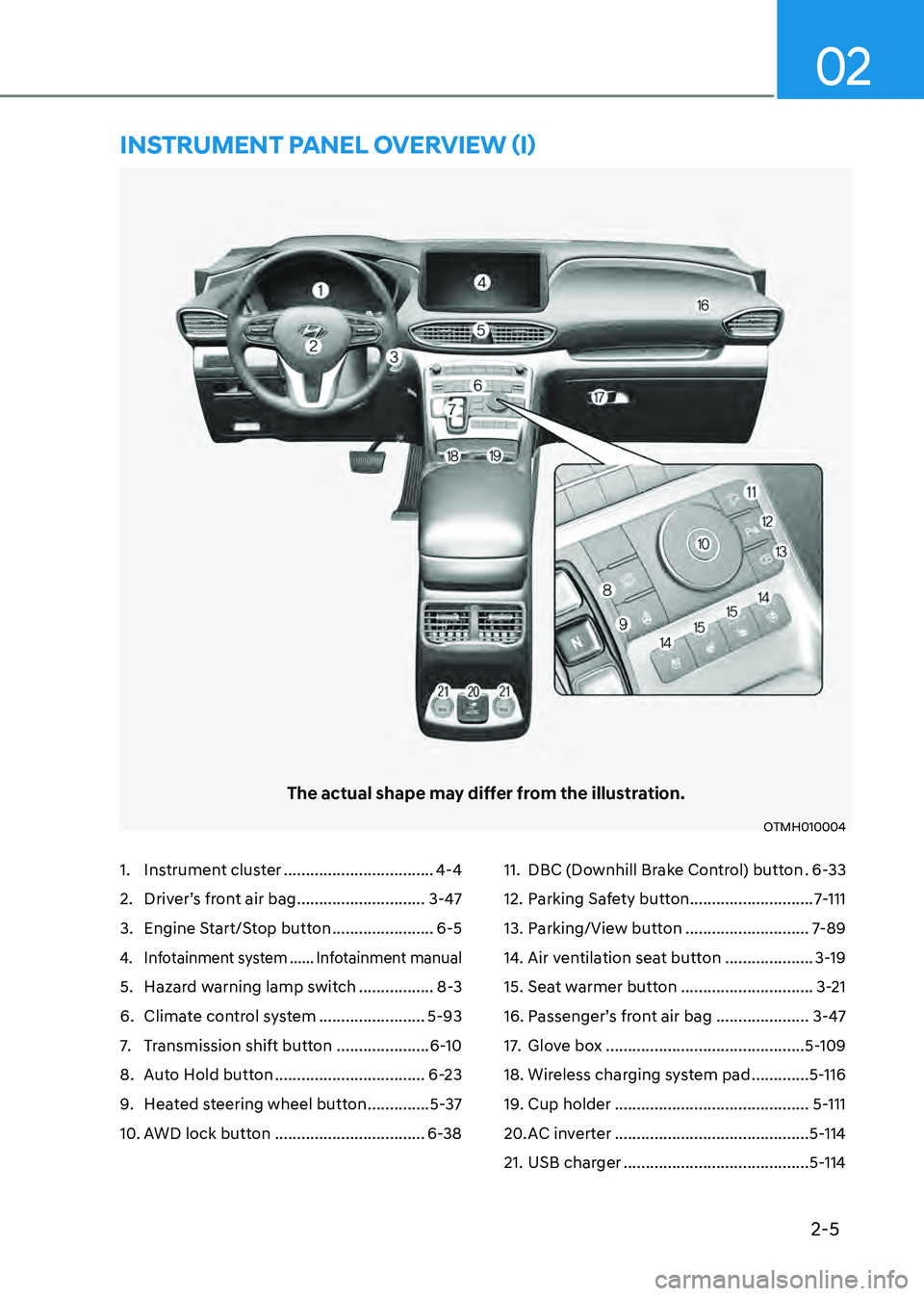
1. Instrument cluster ..................................4-4
2. Driver’s front air bag .............................3-47
3. Engine Start/Stop button .......................6-5
4. Infotainment system ......Infotainment manual
5. Hazard warning lamp switch .................8-3
6. Climate control system ........................5-93
7. Transmission shift button .....................6-10
8. Auto Hold button ..................................6-23
9. Heated steering wheel button ..............5-37
10. AWD lock button ..................................6-38
11. DBC (Downhill Brake Control) button .6-33
12. Parking Safety button ............................7-111
13. Parking/View button ............................7-89
14. Air ventilation seat button ....................3-19
15. Seat warmer button ..............................3-21
16. Passenger’s front air bag .....................3-47
17. Glove box .............................................5-109
18. Wireless charging system pad .............5-116
19. Cup holder ............................................5-111
20. AC inverter ............................................5-114
21. USB charger ..........................................5-114
The actual shape may differ from the illustration.
OTMH010004
INSTRUMENT PANEL OVERVIEW (I)
Page 44 of 598

Vehicle Information, Consumer Information and Reporting Safety Defects
2-16
This consumer information has been prepared in accordance with regulations issued
by the National Highway Traffic Safety Administration of the U.S. Department of
Transportation.Your HYUNDAI dealer will help answer any questions you may have as
you read this information.
HYUNDAI motor vehicles are designed and manufactured to meet or exceed all
applicable safety standards.
For your safety, however, we strongly urge you to read and follow all directions in
this Owner’s Manual, particularly the information under the headings “NOTICE”,
“CAUTION” and “WARNING”.
If, after reading this manual, you have any questions regarding the operation of your
vehicle, please contact the Hyundai Customer Care Center.
Hyundai Customer Care
P.O. Box 20850
Fountain Valley, CA 92728
800-633-5151
[email protected]
Hyundai’s Customer Care Center representatives are available Monday through Friday,
between the hours of 6:00 AM and 5:00 PM PST
and Saturday between 6:30 AM and 3:00 PM PST (English).
For Customer Care Center assistance in Spanish or Korean, representatives are
available Monday through Friday between 6:30 AM and 3:00 PM PST.
CONSUMER INFORMATION
Page 46 of 598

Seats & Safety System
3.Seats & Safety System
Important safety precautions ........................................................................\
...3-2Always wear your seat belt ........................................................................\
..................3-2
Restrain all children ........................................................................\
..............................3-2
Air bag hazards ........................................................................\
.....................................3-2
Driver distraction ........................................................................\
..................................3-2
Control your speed ........................................................................\
...............................3-2
Keep your vehicle in safe condition ........................................................................\
....3-2
Seats ........................................................................\
..........................................3-3Safety precautions ........................................................................\
...............................3-4
Front seats
........................................................................\
............................................3-5
Rear seats ........................................................................\
............................................3-11
Head restraint ........................................................................\
......................................3-15
Seat warmers ........................................................................\
......................................3-19
Air ventilation seat ........................................................................\
............................... 3-21
Rear Occupant Alert (ROA)
........................................................................\
...............3-22
Seat belts ........................................................................\
.................................3-24Seat belt safety precautions ........................................................................\
..............3-24
Seat belt warning light ........................................................................\
.......................3-25
Seat belt restraint system ........................................................................\
..................3-26
Additional seat belt safety precautions .....................................................................3-31
Care of seat belts ........................................................................\
................................ 3-33
Child Restraint System (CRS) ........................................................................\
.3-34Our recommendation: Children always in the rear ..................................................3-34
Selecting a Child Restraint System (CRS) .................................................................3-35
Installing a Child Restraint System (CRS) .................................................................3-37
Air bag - supplemental restraint system .......................................................3-45Where are the air bags? ........................................................................\
.....................3-47
How does the air bags system operate? ...................................................................3-51
What to expect after an air bag inflates ...................................................................3-54
Occupant Classification System (OCS) .....................................................................3-55
Why didn’t my air bag go off in a collision? ..............................................................3-61
SRS care ........................................................................\
.............................................3-66
Additional safety precautions ........................................................................\
............ 3-67
Air bag warning labels........................................................................\
........................ 3-67
This chapter provides you with important information about how to protect yourself and your
passengers. It explains how to properly use your seats and seat belts, and how your air bags work.
Additionally, this chapter explains how to properly restrain infants and children in your vehicle.
3
Page 47 of 598
Seats & Safety System
3-2
You will find many safety precautions
and recommendations throughout this
section, and throughout this manual.
The safety precautions in this section are
among the most important.
Always wear your seat belt
A seat belt is your best protection in all
types of accidents. Air bags are designed
to supplement seat belts, not replace
them. So even though your vehicle is
equipped with air bags, ALWAYS make
sure you and your passengers wear your
seat belts, and wear them properly.
Restrain all children
All children under age 13 should ride
in your vehicle properly restrained in a
rear seat, not the front seat. Infants and
small children should be restrained in
an appropriate Child Restraint System.
Larger children should use a booster
seat with the lap/shoulder belt until they
can use the seat belt properly without a
booster seat.
Air bag hazards
While air bags can save lives, they can
also cause serious or fatal injuries to
occupants who sit too close to them, or
who are not properly restrained. Infants,
young children, and short adults are at
the greatest risk of being injured by an
inflating air bag. Follow all instructions
and warnings in this manual.
Driver distraction
Driver distraction presents a serious and
potentially deadly danger, especially for
inexperienced drivers. Safety should be
the first concern when behind the wheel
and drivers need to be aware of the wide
array of potential distractions, such as
drowsiness, reaching for objects, eating,
personal grooming, other passengers,
and using mobile phones.Drivers can become distracted when
they take their eyes and attention off
the road or their hands off the wheel to
focus on activities other than driving.
To reduce your risk of distraction and an
accident:
•
ALWAYS set up your mobile devices
(i.e., MP3 players, phones, navigation
units, etc.) when your vehicle is
parked or safely stopped.
• ONLY use your mobile device when
allowed by laws and conditions permit
safe use. NEVER text or email while
driving. Most countries have laws
prohibiting drivers from texting. Some
countries and cities also prohibit
drivers from using handheld phones.
• NEVER let the use of a mobile device
distract you from driving. You have a
responsibility to your passengers and
others on the road to always drive
safely, with your hands on the wheel
as well as your eyes and attention on
the road.
Control your speed
Excessive speed is a major factor in crash
injuries and deaths. Generally, the higher
the speed, the greater the risk, but
serious injuries can also occur at lower
speeds. Never drive faster than is safe
for current conditions, regardless of the
maximum speed posted.
Keep your vehicle in safe
condition
Having a tire blowout or a mechanical
failure can be extremely hazardous. To
reduce the possibility of such problems,
check your tire pressures and condition
frequently, and perform all regularly
scheduled maintenance.
IMPORTANT SAFETY PRECAUTIONS
Page 49 of 598

Seats & Safety System
3-4
Safety precautions
Adjusting the seats so that you are sitting
in a safe and comfortable position plays
an important role for the safety of the
driver and passengers, along with seat
belts and air bags when in an accident.
WARNING
Do not use a cushion that reduces
friction between the seat and the
passenger. The passenger’s hips may
slide under the lap portion of the seat
belt during an accident or a sudden
stop.
Serious or fatal internal injuries could
result because the seat belt cannot
operate properly.
Air bags
You can take steps to reduce the risk
of being injured by an inflating air bag.
Sitting too close to an air bag greatly
increases the risk of injury in the event
the air bag inflates.
The National Highway Traffic Safety
Administration (NHTSA) recommends
that drivers allow at least 10 inches
(25cm) between the center of the
steering wheel and their chest.
WARNING
To reduce the risk of serious injury or
death from an inflating air bag, take the
following precautions:
• Adjust the driver’s seat as far to the
rear as possible maintaining the
ability to control the vehicle.
• Adjust the front passenger seat as far
to the rear as possible.
• Hold the steering wheel by the rim
with hands at the 9 o’clock and 3
o’clock positions to minimize the risk
of injuries to your hands and arms.
• NEVER place anything or anyone
between you and the air bag.
• Do not allow the front passenger to
place feet or legs on the dashboard
to minimize the risk of leg injuries.
Seat belts
Always fasten your seat belt before
starting any trip. At all times, passengers
should sit upright and be properly
restrained. Infants and small children
must be restrained in appropriate Child
Restraint Systems. Children who have
outgrown a booster seat and adults must
be restrained using the seat belts.
WARNING
Take the following precautions when
adjusting your seat belt:
• NEVER use one seat belt for more
than one occupant.
• Always position the seatback upright
with the lap portion of the seat belt
snug and low across the hips.
• NEVER allow children or small infants
to ride on a passenger’s lap.
• Do not route the seat belt across your
neck, across sharp edges, or reroute
the shoulder strap away from your
body.
• Do not allow the seat belt to become
caught or jammed.
Page 50 of 598

03
3-5
Front seats
WARNING
Take the following precautions when
adjusting your seat:
• NEVER attempt to adjust the seat
while the vehicle is moving. The seat
could respond with unexpected
movement and may cause loss
of vehicle control resulting in an
accident.
• Do not place anything under the
front seats. Loose objects in the
driver’s foot area could interfere
with the operation of the foot pedals,
causing an accident.
• Do not allow anything to interfere
with the normal position and proper
locking of the seatback.
• Do not place a cigarette lighter on
the floor or seat. When you operate
the seat, gas may exit out of the
lighter causing a fire.
• Use extreme caution when picking
up small objects trapped under the
seats or between the seat and the
center console. Your hands might be
cut or injured by the sharp edges of
the seat mechanism.
• If there are occupants in the rear
seats, be careful while adjusting the
front seat position.
• Make sure that the seat is locked in
place after the adjustment. If not,
the seat might move unexpectedly
resulting in an accident.
CAUTION
To prevent injury:
• Do not adjust your seat while
wearing your seat belt. Moving the
seat cushion forward may cause
strong pressure on your abdomen.
• Do not allow your hands or fingers to
get caught in the seat mechanisms
while the seat is moving.
Page 52 of 598

03
3 -7
WARNING
NEVER ride with a reclined seatback
when the vehicle is moving.
Riding with a reclined seatback
increases your chance of serious or fatal
injuries in the event of a collision or
sudden stop.
Drivers and passengers should ALWAYS
sit well back in their seats, properly
belted, and with the seatbacks upright.
Seat belts must be snug against your
hips and chest to work properly. When
the seatback is reclined, the shoulder
belt cannot do its job because it will not
be snug against your chest. Instead,
it will be in front of you. During an
accident, you could be thrown into the
seat belt, causing neck or other injuries.
The more the seatback is reclined,
the greater chance the passenger’s
hips will slide under the lap belt or the
passenger’s neck will strike the shoulder
belt.
OTM030040
Seat cushion height (if equipped)
To change the height of the seat cushion:
• Push down the lever several times, to
lower the seat cushion.
• Pull up the lever several times, to raise
the seat cushion.
OTM030044
Lumbar support
(for driver’s seat, if equipped)
• The lumbar support can be adjusted
by pressing the lumbar support
switch.
• Press the front portion of the switch
(1) to increase support or the rear
portion of the switch (2) to decrease
support.