instrument panel HYUNDAI SANTA FE HYBRID 2021 Owners Manual
[x] Cancel search | Manufacturer: HYUNDAI, Model Year: 2021, Model line: SANTA FE HYBRID, Model: HYUNDAI SANTA FE HYBRID 2021Pages: 598, PDF Size: 66.6 MB
Page 29 of 598
2.Vehicle Information,
Consumer Information and
Reporting Safety Defects
Vehicle Information, Consumer Information and Reporting Safety Defects
Exterior overview (I) ........................................................................\
...................2-2
Exterior overview (II)
........................................................................\
..................2-3
Interior overview
........................................................................\
......................2-4
Instrument panel overview (I)
........................................................................\
.2-5
Instrument panel overview (II)
........................................................................\
2-6
Engine compartment
........................................................................\
.................2-7
Dimensions
........................................................................\
................................2-8
Engine
........................................................................\
........................................2-8
Bulb wattage
........................................................................\
.............................2-9
Tires and wheels
........................................................................\
......................2-10
Air conditioning system
........................................................................\
............2-11
Volume and weight
........................................................................\
...................2-11
Recommended lubricants and capacities
.....................................................2-12Recommended SAE viscosity number ......................................................................2-13
Vehicle identification number (VIN) ...............................................................2-14
Vehicle certification label
........................................................................\
........2-14
Tire specification and pressure label
..............................................................2-15
Engine number
........................................................................\
.........................2-15
Air conditioner compressor label
...................................................................2-15
Consumer Information
........................................................................\
............2-16
Reporting Safety Defects
........................................................................\
........2-17
2
Page 32 of 598
![HYUNDAI SANTA FE HYBRID 2021 Owners Manual 2-4
Vehicle Information, Consumer Information and Reporting Safety Defects
The actual shape may differ from the illustration.
OTMA020001C[A] : Type A, [B] : Type B
1. Inside door handle ..............](/img/35/56184/w960_56184-31.png "HYUNDAI SANTA FE HYBRID 2021 Owners Manual 2-4
Vehicle Information, Consumer Information and Reporting Safety Defects
The actual shape may differ from the illustration.
OTMA020001C[A] : Type A, [B] : Type B
1. Inside door handle ..............")
2-4
Vehicle Information, Consumer Information and Reporting Safety Defects
The actual shape may differ from the illustration.
OTMA020001C[A] : Type A, [B] : Type B
1. Inside door handle ................................5-28
2. Power window switches ......................5-54
3. Power window lock switch .................5-56
/Electronic child safety lock button
....5-30
4. Side view mirror folding button ............5-51
5. Side view mirror control switch ............5-51
6. Central door lock switch ......................5-28
7. Instrument panel illumination control
switch
......................................................4-5
8. Lane Safety button ................................7-19
9. Power Liftgate open/close button ......5-66
10. ESC (Electronic Stability Control) OFF
button
....................................................6-28
11. EPB (Electronic Parking Brake) switch .6-19
12. Steering wheel ......................................5-36
13. Steering wheel tilt/telescopic switch ...5-37
14. Fuse box ................................................9-43
15. Hood release lever ................................5-63
16. Seat ..........................................................3-3
INTERIOR OVERVIEW
Page 33 of 598
2-5
02
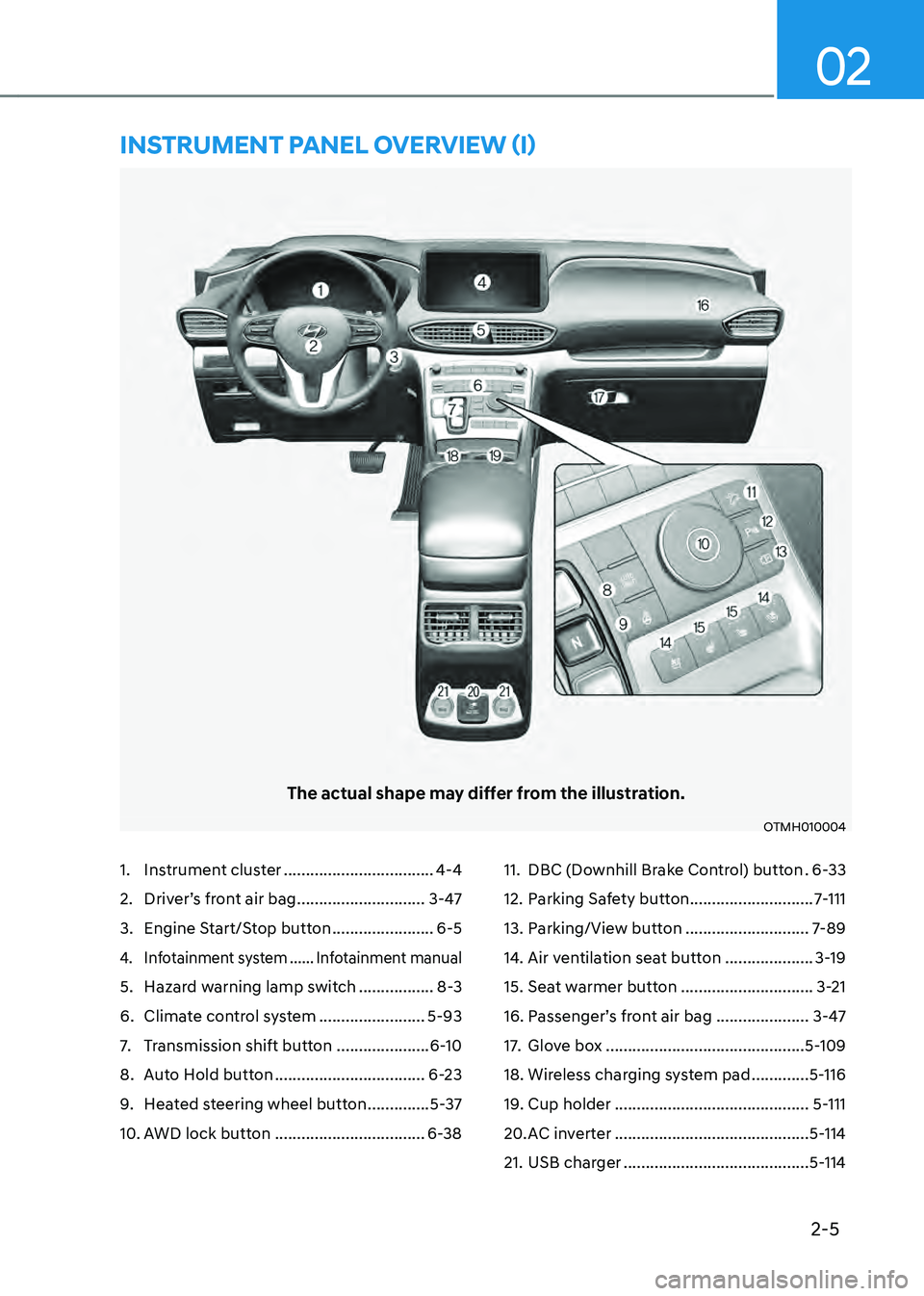
1. Instrument cluster ..................................4-4
2. Driver’s front air bag .............................3-47
3. Engine Start/Stop button .......................6-5
4. Infotainment system ......Infotainment manual
5. Hazard warning lamp switch .................8-3
6. Climate control system ........................5-93
7. Transmission shift button .....................6-10
8. Auto Hold button ..................................6-23
9. Heated steering wheel button ..............5-37
10. AWD lock button ..................................6-38
11. DBC (Downhill Brake Control) button .6-33
12. Parking Safety button ............................7-111
13. Parking/View button ............................7-89
14. Air ventilation seat button ....................3-19
15. Seat warmer button ..............................3-21
16. Passenger’s front air bag .....................3-47
17. Glove box .............................................5-109
18. Wireless charging system pad .............5-116
19. Cup holder ............................................5-111
20. AC inverter ............................................5-114
21. USB charger ..........................................5-114
The actual shape may differ from the illustration.
OTMH010004
INSTRUMENT PANEL OVERVIEW (I)
Page 34 of 598
2-6
Vehicle Information, Consumer Information and Reporting Safety Defects
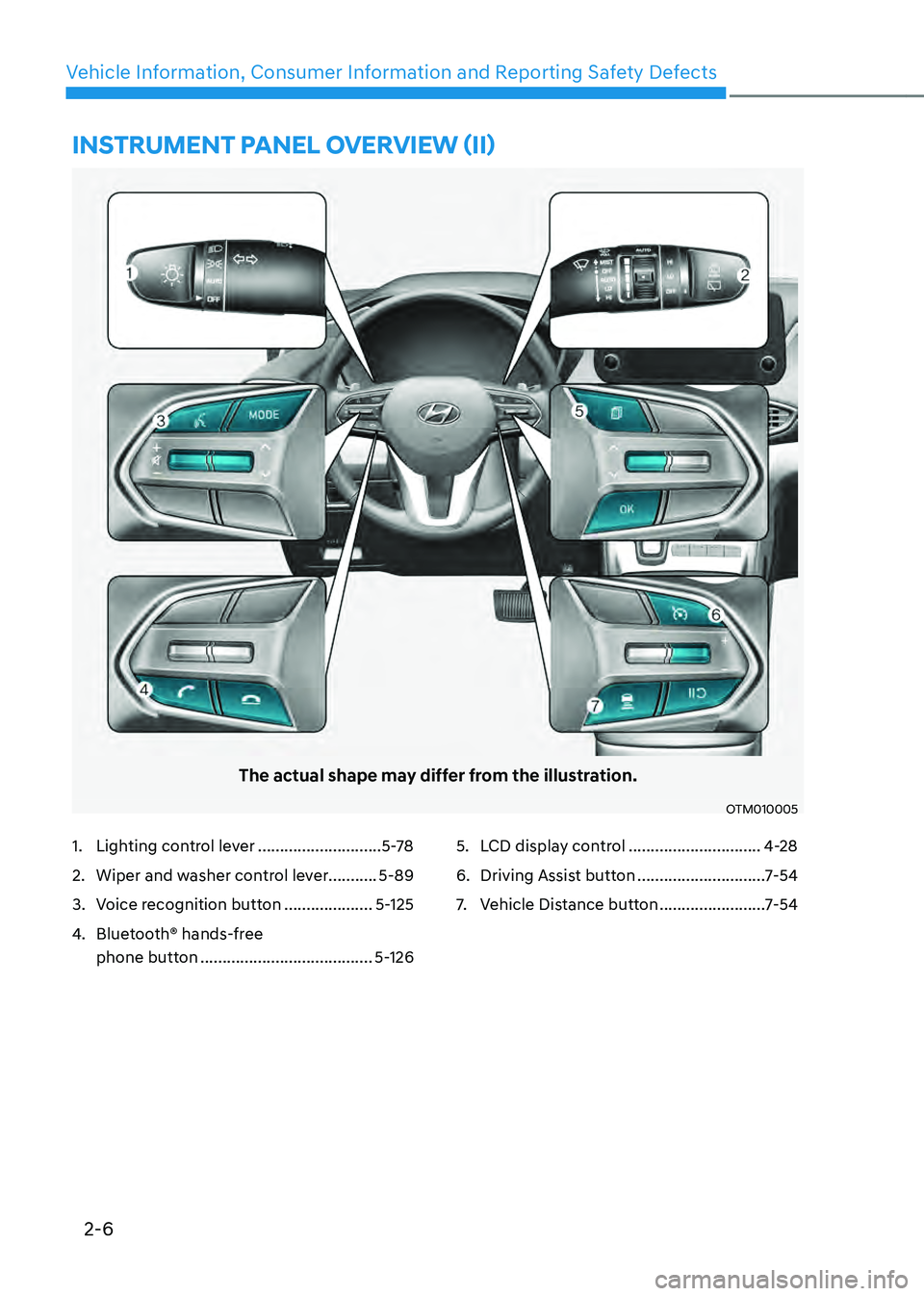
1. Lighting control lever ............................5-78
2. Wiper and washer control lever...........5-89
3. Voice recognition button ....................5-125
4. Bluetooth® hands-free
phone button
.......................................5-126
5. LCD display control ..............................4-28
6. Driving Assist button .............................7-54
7. Vehicle Distance button ........................7-54
INSTRUMENT PANEL OVERVIEW (II)
The actual shape may differ from the illustration.
OTM010005
Page 53 of 598
Seats & Safety System
3-8
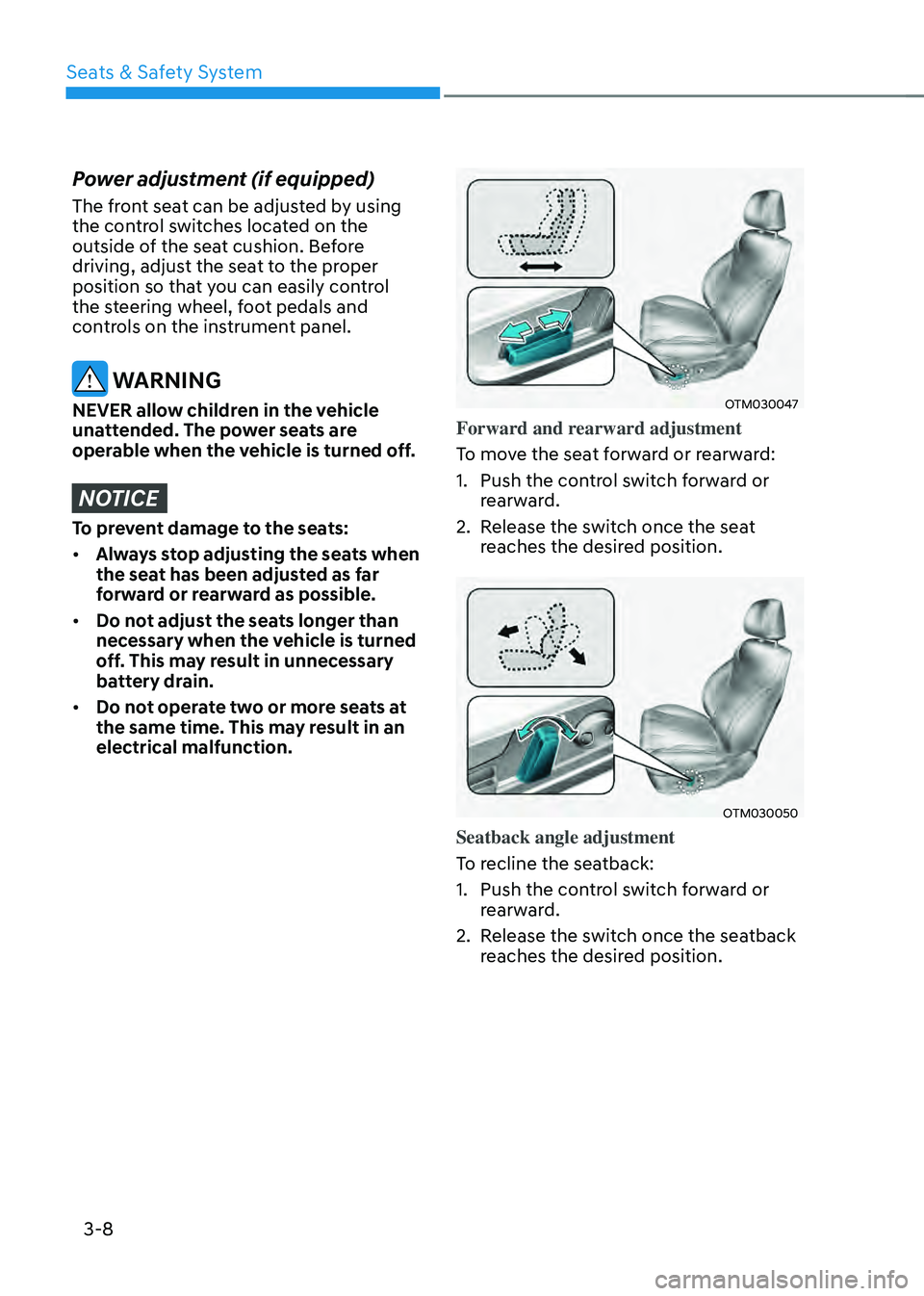
Power adjustment (if equipped)
The front seat can be adjusted by using
the control switches located on the
outside of the seat cushion. Before
driving, adjust the seat to the proper
position so that you can easily control
the steering wheel, foot pedals and
controls on the instrument panel.
WARNING
NEVER allow children in the vehicle
unattended. The power seats are
operable when the vehicle is turned off.
NOTICE
To prevent damage to the seats:
• Always stop adjusting the seats when
the seat has been adjusted as far
forward or rearward as possible.
• Do not adjust the seats longer than
necessary when the vehicle is turned
off. This may result in unnecessary
battery drain.
• Do not operate two or more seats at
the same time. This may result in an
electrical malfunction.
OTM030047
Forward and rearward adjustment
To move the seat forward or rearward:
1. Push the control switch forward or
rearward.
2. Release the switch once the seat
reaches the desired position.
OTM030050
Seatback angle adjustment
To recline the seatback:
1. Push the control switch forward or
rearward.
2. Release the switch once the seatback
reaches the desired position.
Page 93 of 598
Seats & Safety System
3-48
WARNING
To reduce the risk of serious injury or
death from inflating front air bags, take
the following precautions:
• Seat belts must be worn at all times
to help keep occupants positioned
properly.
• Move your seat as far back as
possible from front air bags, while
still maintaining control of the
vehicle.
• Never lean against the door or center
console.
• Do not allow the front passenger
to place their feet or legs on the
dashboard.
• No objects (such as crash pad
cover, mobile phone holder, cup
holder, perfume or stickers) should
be placed over or near the air bag
modules on the steering wheel,
instrument panel, windshield glass,
and the front passenger’s panel
above the glove box. Such objects
could cause harm if the vehicle is in a
crash severe enough to cause the air
bags to deploy.
• Do not attach any objects on the
front windshield and inside mirror.
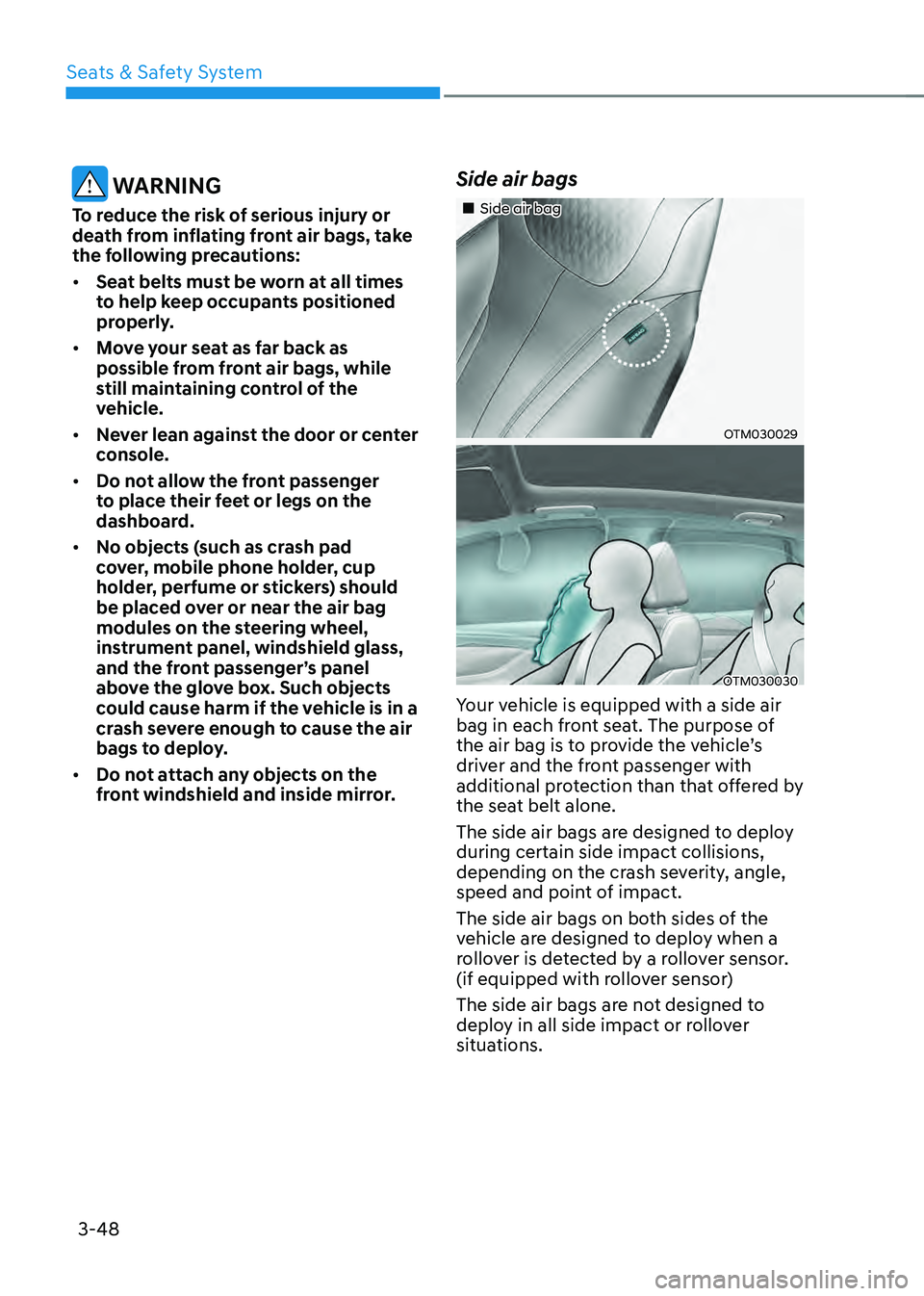
Side air bags
„„Side air bag
OTM030029
OTM030030
Your vehicle is equipped with a side air
bag in each front seat. The purpose of
the air bag is to provide the vehicle’s
driver and the front passenger with
additional protection than that offered by
the seat belt alone.
The side air bags are designed to deploy
during certain side impact collisions,
depending on the crash severity, angle,
speed and point of impact.
The side air bags on both sides of the
vehicle are designed to deploy when a
rollover is detected by a rollover sensor.
(if equipped with rollover sensor)
The side air bags are not designed to
deploy in all side impact or rollover
situations.
Page 96 of 598
03
3-51
How does the air bags system
operate?
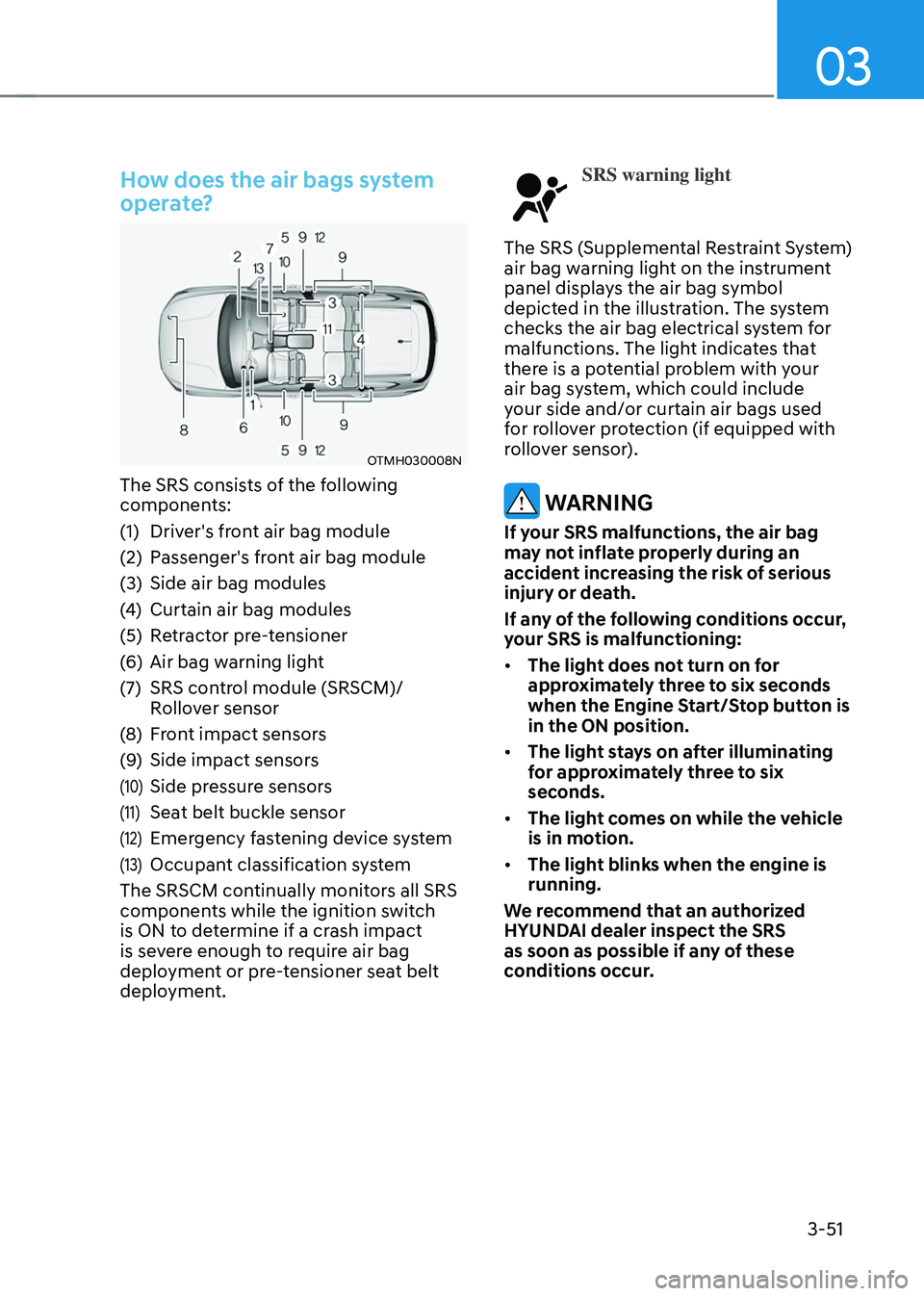
OTMH030008N
The SRS consists of the following
components:
(1) Driver's front air bag module
(2) Passenger's front air bag module
(3) Side air bag modules
(4) Curtain air bag modules
(5) Retractor pre-tensioner
(6) Air bag warning light
(7) SRS control module (SRSCM)/
Rollover sensor
(8) Front impact sensors
(9) Side impact sensors
(10) Side pressure sensors
(11) Seat belt buckle sensor
(12) Emergency fastening device system
(13) Occupant classification system
The SRSCM continually monitors all SRS
components while the ignition switch
is ON to determine if a crash impact
is severe enough to require air bag
deployment or pre-tensioner seat belt
deployment.
SRS warning light
The SRS (Supplemental Restraint System)
air bag warning light on the instrument
panel displays the air bag symbol
depicted in the illustration. The system
checks the air bag electrical system for
malfunctions. The light indicates that
there is a potential problem with your
air bag system, which could include
your side and/or curtain air bags used
for rollover protection (if equipped with
rollover sensor).
WARNING
If your SRS malfunctions, the air bag
may not inflate properly during an
accident increasing the risk of serious
injury or death.
If any of the following conditions occur,
your SRS is malfunctioning:
• The light does not turn on for
approximately three to six seconds
when the Engine Start/Stop button is
in the ON position.
• The light stays on after illuminating
for approximately three to six
seconds.
• The light comes on while the vehicle
is in motion.
• The light blinks when the engine is
running.
We recommend that an authorized
HYUNDAI dealer inspect the SRS
as soon as possible if any of these
conditions occur.
Page 99 of 598
Seats & Safety System
3-54
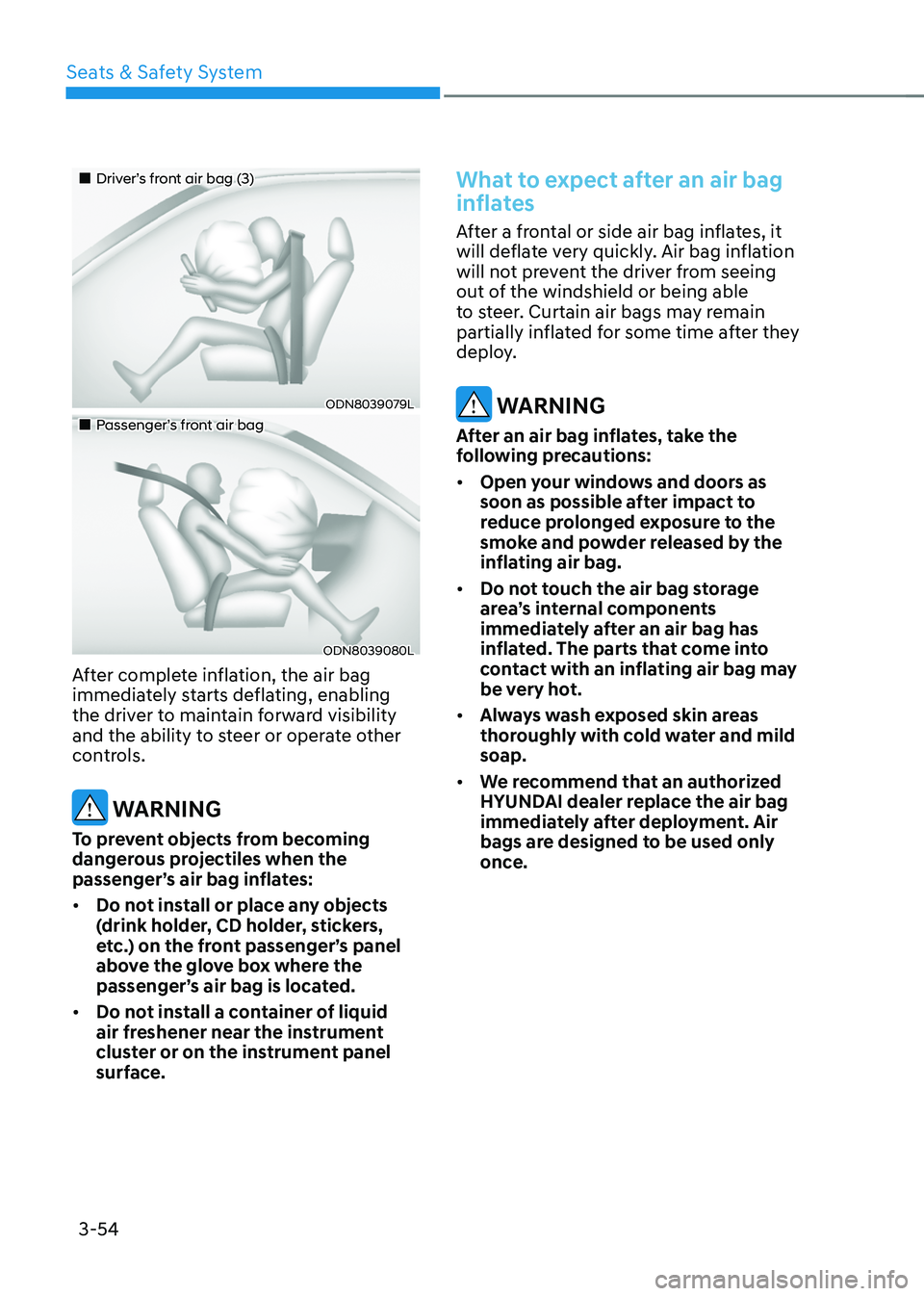
„„Driver’s front air bag (3)
ODN8039079L
„„Passenger’s front air bag
ODN8039080L
After complete inflation, the air bag
immediately starts deflating, enabling
the driver to maintain forward visibility
and the ability to steer or operate other
controls.
WARNING
To prevent objects from becoming
dangerous projectiles when the
passenger’s air bag inflates:
• Do not install or place any objects
(drink holder, CD holder, stickers,
etc.) on the front passenger’s panel
above the glove box where the
passenger’s air bag is located.
• Do not install a container of liquid
air freshener near the instrument
cluster or on the instrument panel
surface.
What to expect after an air bag
inflates
After a frontal or side air bag inflates, it
will deflate very quickly. Air bag inflation
will not prevent the driver from seeing
out of the windshield or being able
to steer. Curtain air bags may remain
partially inflated for some time after they
deploy.
WARNING
After an air bag inflates, take the
following precautions:
• Open your windows and doors as
soon as possible after impact to
reduce prolonged exposure to the
smoke and powder released by the
inflating air bag.
• Do not touch the air bag storage
area’s internal components
immediately after an air bag has
inflated. The parts that come into
contact with an inflating air bag may
be very hot.
• Always wash exposed skin areas
thoroughly with cold water and mild
soap.
• We recommend that an authorized
HYUNDAI dealer replace the air bag
immediately after deployment. Air
bags are designed to be used only
once.
Page 101 of 598
Seats & Safety System
3-56
Main components of the Occupant
Classification System
• A detection device located within the
front passenger seat cushion.
• Electronic system to determine
whether the passenger air bag
systems should be activated or
deactivated.
• An indicator light located on the
instrument panel which illuminates
the words “PASSENGER AIR BAG OFF”
indicating the front passenger air bag
system is deactivated.
• The instrument panel air bag indicator
light is interconnected with the OCS.
The OCS is designed to help detect
the presence of a properly-seated
front passenger and determine if the
passenger’s front air bag should be
enabled (may inflate) or not.
The purpose is to help reduce the risk
of injury or death from an inflating air
bag to certain front passenger seat
occupants, such as children, by requiring
the air bag to be automatically turned
OFF.
For example, if a child restraint of the
type specified in the regulations is on the
seat, the occupant classification sensor
can detect it and cause the air bag to
turn OFF.
Front passenger seat adult occupants
who are properly seated and wearing the
seat belt properly, should not cause the
passenger air bag to be automatically
turned OFF. For smaller adults it may turn
OFF, however, if the occupant does not
sit in the seat properly (for example, by
not sitting upright, by sitting on the edge
of the seat, or by otherwise being out of
position), this could cause the sensor to
turn the air bag OFF. You will find the “PASSENGER AIR BAG
OFF” indicator on the overhead console
panel. This system detects the conditions
1-4 in the following table and activates or
deactivates the front passenger air bag
based on these conditions.
Always be sure that you and all vehicle
occupants are seated properly and
wearing the seat belt properly for the
most effective protection by the air bag
and the seat belt.
The OCS may not function properly if the
passenger takes actions which can affect
the classification system. These include:
•
Failing to sit in an upright position.
• Leaning against the door or center
console.
• Sitting towards the sides of the front
of the seat.
• Putting their legs on the dashboard or
resting them on other locations which
reduce the passenger weight on the
front seat.
• Wearing the seat belt improperly.
• Reclining the seatback.
• Wearing thick clothes like ski wear or
hip protection wear.
• Putting an additional thick cushion on
the seat.
• Putting electrical devices (e.g.
notebook, satellite radio) on the seat
with inverter charging.
Page 111 of 598
Seats & Safety System
3-66
SRS care
The SRS is virtually maintenance-free
and there are no parts you can safely
service by yourself. If the SRS air bag
warning light does not illuminate when
the Engine Start/Stop button is in the
ON position, or continuously remains
on, we recommend that the system be
immediately inspected by an authorized
HYUNDAI dealer.
We recommend any work on the SRS
system, such as removing, installing,
repairing, or any work on the steering
wheel, the front passenger’s panel, front
seats and roof rails be performed by an
authorized HYUNDAI dealer. Improper
handling of the SRS system may result in
serious personal injury. WARNING
To reduce the risk of serious injury or
death take the following precautions:
• Do not attempt to modify or
disconnect the SRS components or
wiring, including the addition of any
kind of badges to the pad covers or
modifications to the body structure.
• Do not place objects over or near
the air bag modules on the steering
wheel, instrument panel, and the
front passenger’s panel above the
glove box.
• Clean the air bag pad covers with
a soft cloth moistened with plain
water. Solvents or cleaners could
adversely affect the air bag covers
and proper deployment of the
system.
• We recommend that inflated air
bags be replaced by an authorized
HYUNDAI dealer.
• If components of the air bag system
must be discarded, or if the vehicle
must be scrapped, certain safety
precautions must be observed.
We recommend that you consult
an authorized HYUNDAI dealer for
the necessary information. Failure
to follow these precautions could
increase the risk of personal injury.