trailer Hyundai Santa Fe XL 2019 Owner's Guide
[x] Cancel search | Manufacturer: HYUNDAI, Model Year: 2019, Model line: Santa Fe XL, Model: Hyundai Santa Fe XL 2019Pages: 570, PDF Size: 16.74 MB
Page 443 of 570
623
What to do in an emergency
When using a temporary compact
spare tire, observe the following pre-
cautions:
Under no circumstances should youexceed 50 mph (80 km/h); higher
speeds could damage the tire.
Ensure that you drive slowly enough for the road conditions to avoid all
hazards. Any road hazard, such as a
pothole or debris, could seriously
damage the compact spare.
Any continuous road use of this tire could result in tire failure, loss of
vehicle control, and possible per-
sonal injury.
Do not exceed the vehicle’s maxi- mum load rating or the load-carry-
ing capacity shown on the sidewall
of the compact spare tire.
Avoid driving over obstacles. The compact spare tire diameter is
smaller than the diameter of a con-
ventional tire and reduces the
ground clearance approximately 1
inch (25 mm), which could result in
damage to the vehicle.
Do not take the vehicle through an automatic car wash while the com-
pact spare tire is installed. Do not use tire chains on the com-
pact spare tire. Because of the small-
er size, a tire chain will not fit proper-
ly. This could damage the vehicle
and result in loss of the chain.
Do not use the compact spare tire on any other vehicle because this
tire has been designed especially
for your vehicle.
The compact spare tire’s tread life is shorter than a regular tire. Inspect
your compact spare tire regularly
and replace worn compact spare
tires with the same size and design,
mounted on the same wheel.
The compact spare tire should not be used on any other wheels, nor
should standard tires, snow tires,
wheel covers or trim rings be used
with the compact spare wheel. If
such use is attempted, damage to
these items or other car compo-
nents may occur.
Do not use more than one compact spare tire at a time.
Do not tow a trailer while the com- pact spare tire is installed.
Page 445 of 570
625
What to do in an emergency
TOWING
Towing service
If emergency towing is necessary,
we recommend having it done by an
authorized HYUNDAI dealer or a
commercial tow-truck service.
Proper lifting and towing procedures
are necessary to prevent damage to
the vehicle. The use of wheel dollies
or flatbed is recommended.
For trailer towing guidelines informa-
tion, refer to "Trailer towing" in chap-
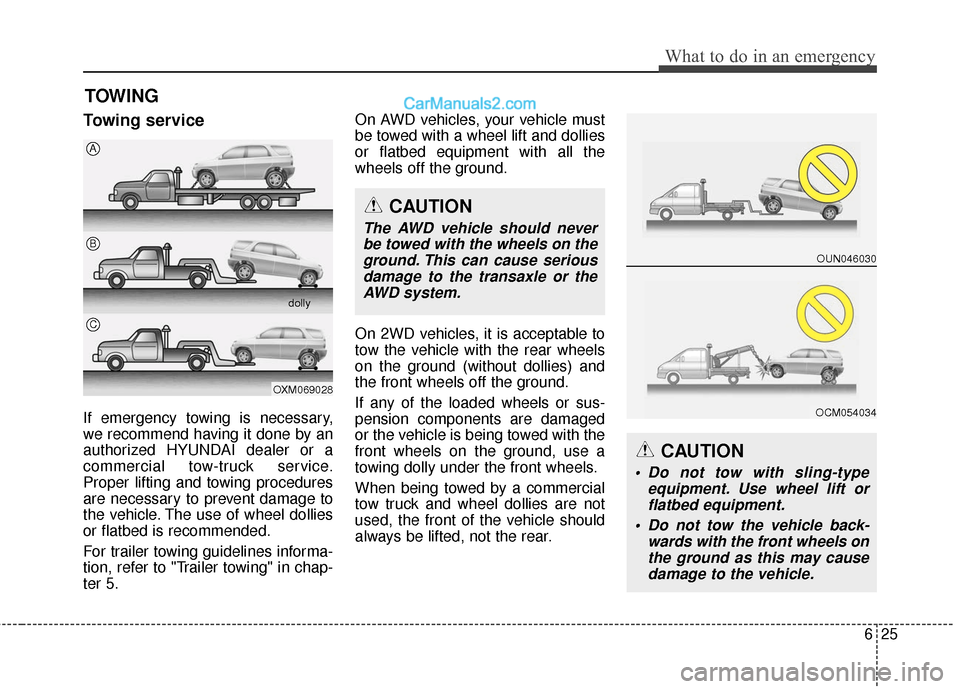
ter 5.On AWD vehicles, your vehicle must
be towed with a wheel lift and dollies
or flatbed equipment with all the
wheels off the ground.
On 2WD vehicles, it is acceptable to
tow the vehicle with the rear wheels
on the ground (without dollies) and
the front wheels off the ground.
If any of the loaded wheels or sus-
pension components are damaged
or the vehicle is being towed with the
front wheels on the ground, use a
towing dolly under the front wheels.
When being towed by a commercial
tow truck and wheel dollies are not
used, the front of the vehicle should
always be lifted, not the rear.
OXM069028
dolly
A
B
C
CAUTION
Do not tow with sling-type
equipment. Use wheel lift orflatbed equipment.
Do not tow the vehicle back- wards with the front wheels onthe ground as this may causedamage to the vehicle.
CAUTION
The AWD vehicle should neverbe towed with the wheels on theground. This can cause seriousdamage to the transaxle or theAWD system.
OUN046030
OCM054034
Page 473 of 570
725
Maintenance
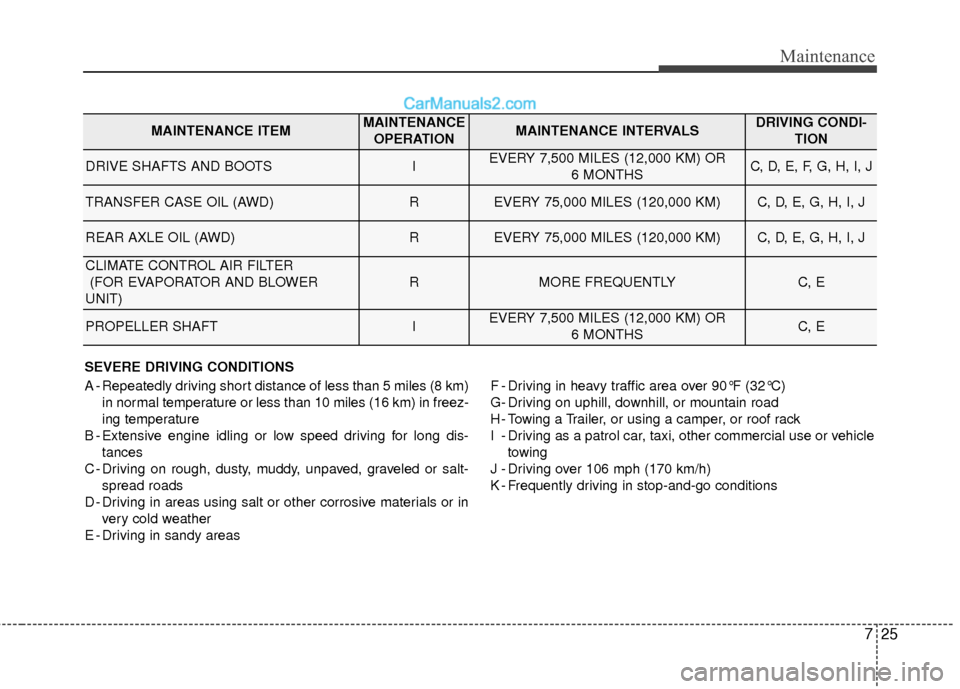
SEVERE DRIVING CONDITIONS
A - Repeatedly driving short distance of less than 5 miles (8 km)in normal temperature or less than 10 miles (16 km) in freez-
ing temperature
B - Extensive engine idling or low speed driving for long dis- tances
C - Driving on rough, dusty, muddy, unpaved, graveled or salt- spread roads
D - Driving in areas using salt or other corrosive materials or in very cold weather
E - Driving in sandy areas F - Driving in heavy traffic area over 90°F (32°C)
G- Driving on uphill, downhill, or mountain road
H - Towing a Trailer, or using a camper, or roof rack
I - Driving as a patrol car, taxi, other commercial use or vehicle
towing
J - Driving over 106 mph (170 km/h)
K - Frequently driving in stop-and-go conditions
MAINTENANCE ITEMMAINTENANCE OPERATIONMAINTENANCE INTERVALSDRIVING CONDI- TION
DRIVE SHAFTS AND BOOTSIEVERY 7,500 MILES (12,000 KM) OR 6 MONTHSC, D, E, F, G, H, I, J
TRANSFER CASE OIL (AWD) REVERY 75,000 MILES (120,000 KM)C, D, E, G, H, I, J
REAR AXLE OIL (AWD)REVERY 75,000 MILES (120,000 KM)C, D, E, G, H, I, J
CLIMATE CONTROL AIR FILTER(FOR EVAPORATOR AND BLOWER
UNIT)
RMORE FREQUENTLYC, E
PROPELLER SHAFTIEVERY 7,500 MILES (12,000 KM) OR 6 MONTHSC, E
Page 522 of 570
Maintenance
74
7
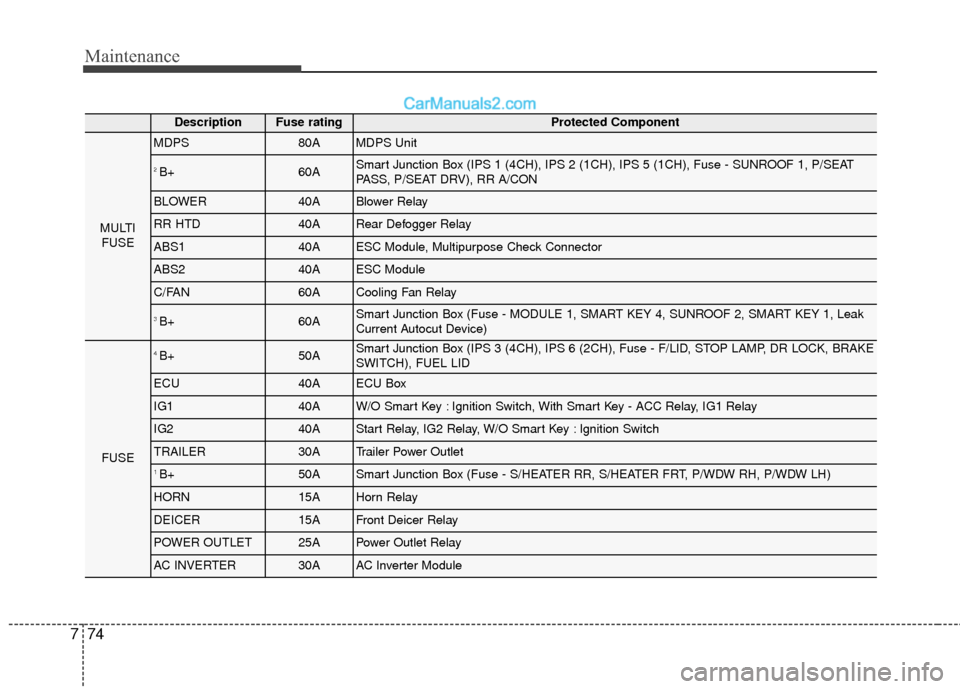
DescriptionFuse ratingProtected Component
MULTI
FUSE
MDPS80AMDPS Unit
2 B+60ASmart Junction Box (IPS 1 (4CH), IPS 2 (1CH), IPS 5 (1CH), Fuse - SUNROOF 1, P/SEAT
PASS, P/SEAT DRV), RR A/CON
BLOWER40ABlower Relay
RR HTD40ARear Defogger Relay
ABS140AESC Module, Multipurpose Check Connector
ABS240AESC Module
C/FAN60ACooling Fan Relay
3 B+60ASmart Junction Box (Fuse - MODULE 1, SMART KEY 4, SUNROOF 2, SMART KEY 1, Leak
Current Autocut Device)
FUSE
4 B+50ASmart Junction Box (IPS 3 (4CH), IPS 6 (2CH), Fuse - F/LID, STOP LAMP, DR LOCK, BRAKE
SWITCH), FUEL LID
ECU40AECU Box
IG140AW/O Smart Key : Ignition Switch, With Smart Key - ACC Relay, IG1 Relay
IG240AStart Relay, IG2 Relay, W/O Smart Key : Ignition Switch
TRAILER30ATrailer Power Outlet
1 B+50ASmart Junction Box (Fuse - S/HEATER RR, S/HEATER FRT, P/WDW RH, P/WDW LH)
HORN15AHorn Relay
DEICER15AFront Deicer Relay
POWER OUTLET25APower Outlet Relay
AC INVERTER30AAC Inverter Module
Page 569 of 570
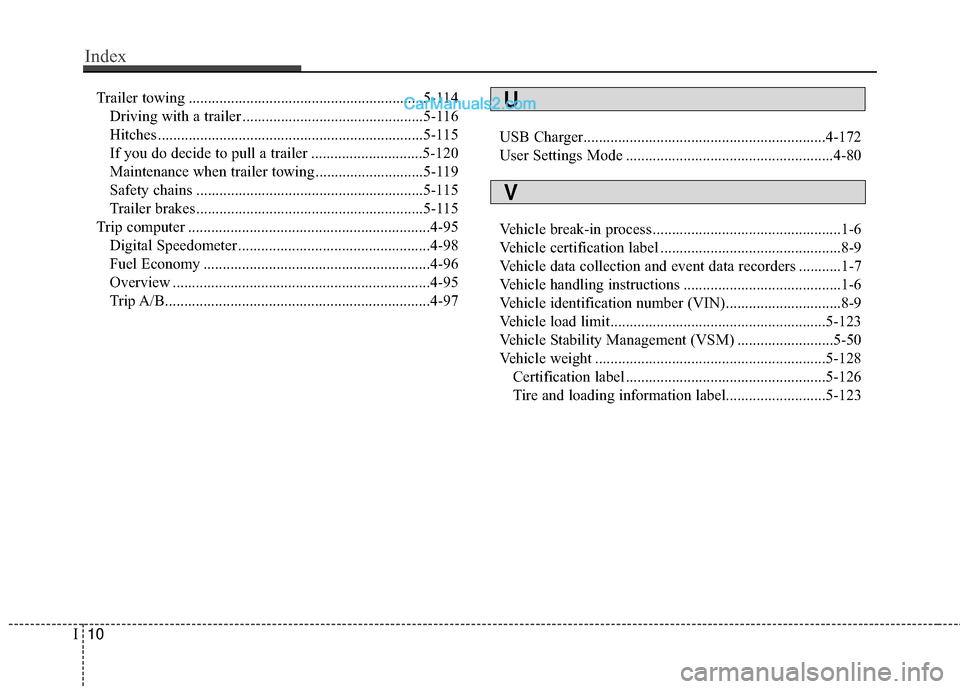
Trailer towing .............................................................5-114Driving with a trailer ...............................................5-116
Hitches .....................................................................5-1\
15
If you do decide to pull a trailer .............................5-120
Maintenance when trailer towing ............................5-119
Safety chains ...........................................................5-115
Trailer brakes ...........................................................5-115
Trip computer ...............................................................4-95 Digital Speedometer ..................................................4-98
Fuel Economy ...........................................................4-96
Overview ...................................................................4-95
Trip A/B.....................................................................4-9\
7 USB Charger...............................................................4-172
User Settings Mode ......................................................4-80
Vehicle break-in process .................................................1-6
Vehicle certification label ...............................................8-9
Vehicle data collection and event data recorders ...........1-7
Vehicle handling instructions .........................................1-6
Vehicle identification number (VIN)..............................8-9
Vehicle load limit........................................................5-123
Vehicle Stability Management (VSM) .........................5-50
Vehicle weight ............................................................5-128
Certification label ....................................................5-126
Tire and loading information label..........................5-123
I10
Index
U
V