child restraint Hyundai Sonata
[x] Cancel search | Manufacturer: HYUNDAI, Model Year: , Model line: , Model:Pages: 285, PDF Size: 9.38 MB
Page 45 of 285
1FEATURES OF YOUR HYUNDAI32
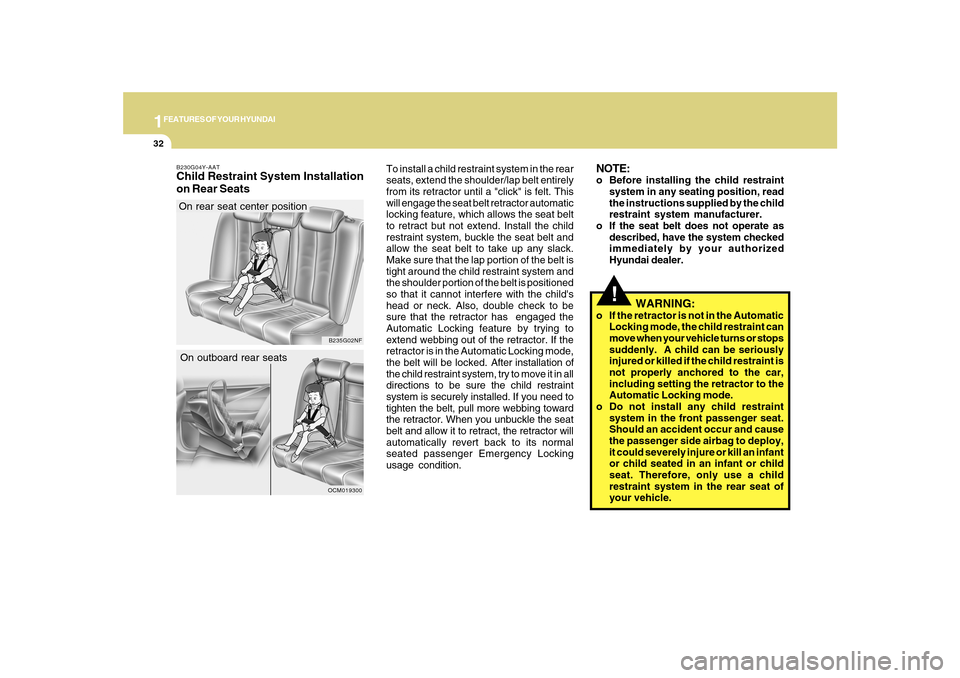
B230G04Y-AATChild Restraint System Installation
on Rear Seats
OCM019300
On outboard rear seats
B235G02NF
On rear seat center positionTo install a child restraint system in the rear
seats, extend the shoulder/lap belt entirely
from its retractor until a "click" is felt. This
will engage the seat belt retractor automatic
locking feature, which allows the seat belt
to retract but not extend. Install the child
restraint system, buckle the seat belt and
allow the seat belt to take up any slack.
Make sure that the lap portion of the belt is
tight around the child restraint system and
the shoulder portion of the belt is positioned
so that it cannot interfere with the child's
head or neck. Also, double check to be
sure that the retractor has engaged the
Automatic Locking feature by trying to
extend webbing out of the retractor. If the
retractor is in the Automatic Locking mode,
the belt will be locked. After installation of
the child restraint system, try to move it in all
directions to be sure the child restraint
system is securely installed. If you need to
tighten the belt, pull more webbing toward
the retractor. When you unbuckle the seat
belt and allow it to retract, the retractor will
automatically revert back to its normal
seated passenger Emergency Locking
usage condition.
!
WARNING:
o If the retractor is not in the Automatic
Locking mode, the child restraint can
move when your vehicle turns or stops
suddenly. A child can be seriously
injured or killed if the child restraint is
not properly anchored to the car,
including setting the retractor to the
Automatic Locking mode.
o Do not install any child restraint
system in the front passenger seat.
Should an accident occur and cause
the passenger side airbag to deploy,
it could severely injure or kill an infant
or child seated in an infant or child
seat. Therefore, only use a child
restraint system in the rear seat of
your vehicle.NOTE:o Before installing the child restraint
system in any seating position, read
the instructions supplied by the child
restraint system manufacturer.
o If the seat belt does not operate as
described, have the system checked
immediately by your authorized
Hyundai dealer.
Page 50 of 285
1
FEATURES OF YOUR HYUNDAI
37
!
!
WARNING:
Always use seat belts and child restraints
– every trip, every time, everyone!
Airbags inflate with considerable force
and in the blink of an eye. Seat belts help
keep occupants in proper position to
obtain maximum benefit from the airbag.
Even with advanced airbags, improperly
belted and unbelted occupants can be
severely injured when the airbag inflates.
Always follow the precautions about seat
belts, airbags and occupant safety
contained in this manual.
To reduce the chance of serious or fatal
injuries and receive the maximum safety
benefit from your restraint system:
o Never place a child in any child or
booster seat in the front seat (see
child restraints 1-27).
o ABC – Always Buckle Children in the
back seat. It is the safest place for
children of any age to ride.
o Front and side impact airbags can
injure occupants improperly
positioned in the front seats.
o Move your seat as far back as
practical from the front airbags, while
still maintaining control of the vehicle.
o Never sit or lean unnecessarily close
to the front or side airbags.
!
WARNING:
o Modification to the seat structure can
adversely affect the seat track position
sensor and cause the airbag to deploy
at a different level than should be pro-
vided.
o Do not place any objects underneath
the front seats as they could damage
the seat track position sensor or
interfere with the occupant classifica-
tion system.
o Do not place any objects that may cause
magnetic fields near the front seat.
These may cause a malfunction of the
seat track position sensor.NOTE:o Be sure to read information about the
SRS on the labels provided on the back-
side of the sun visor.
o Advanced airbags are combined with
pre-tensioner seat belts to help provide
enhanced occupant protection in frontal
crashes. Front airbags are not intended
to deploy in collisions in which sufficient
protection can be provided by the pre-
tensioner seat belt.
o If you are considering modification of
your vehicle due to a disability, please
contact the Hyundai Customer Assis-
tance Center at 1-800-633-5151.o Never lean against the door or center
console – always sit in an upright posi-
tion.
o Do not allow an adult passenger to ride
in the front seat when the "Passenger
Airbag OFF" indicator is illuminated,
because the airbag will not deploy in the
event of a moderate or severe frontal
crash.
o Never place objects over or near any
airbag module (front or side impact
airbags), because these objects can
injure passengers in a crash.
o Never place covers, blankets or after-
market seat warmers on the passenger
seat as these may interfere with the
occupant classification system.
o Do not tamper or disconnect SRS wiring
or other components. Injuries could
result from inadvertent deployment or
failure of the airbag to deploy in a crash.
o If the SRS airbag warning light (see pg
1-52) remains illuminated while the ve-
hicle is being driven, have an autho-
rized Hyundai dealer inspect the airbag
system as soon as possible.
o Airbags can only be used once – have
an authorized Hyundai dealer replace
the airbag immediately after
deployment.
WARNING:
Page 51 of 285
1FEATURES OF YOUR HYUNDAI38
!
WARNING:
o Move your seat as far back as
practical from the front airbags, while
still maintaining control of the vehicle.
You and your passengers should
never sit or lean unnecessarily close
to the airbags. Improperly positioned
drivers and passengers can be
severely injured by inflating airbags.
o No objects should be placed over or
near the airbag modules on the steer-
ing wheel, instrument panel, and the
front passenger's panel above the
glove box, because any such object
could cause harm if the vehicle is in a
crash severe enough to cause the
airbags to deploy.
o If the airbags deploy, they must be
replaced by an authorized Hyundai
dealer. Deployed airbags WILL NOT
inflate again and will provide no
protection in subsequent collisions.
o Do not tamper with or disconnect SRS
wiring or other components of the
SRS system. Doing so could result in
injury, due to accidental deployment
of the airbags or by rendering the SRS
inoperative.
!
WARNING:
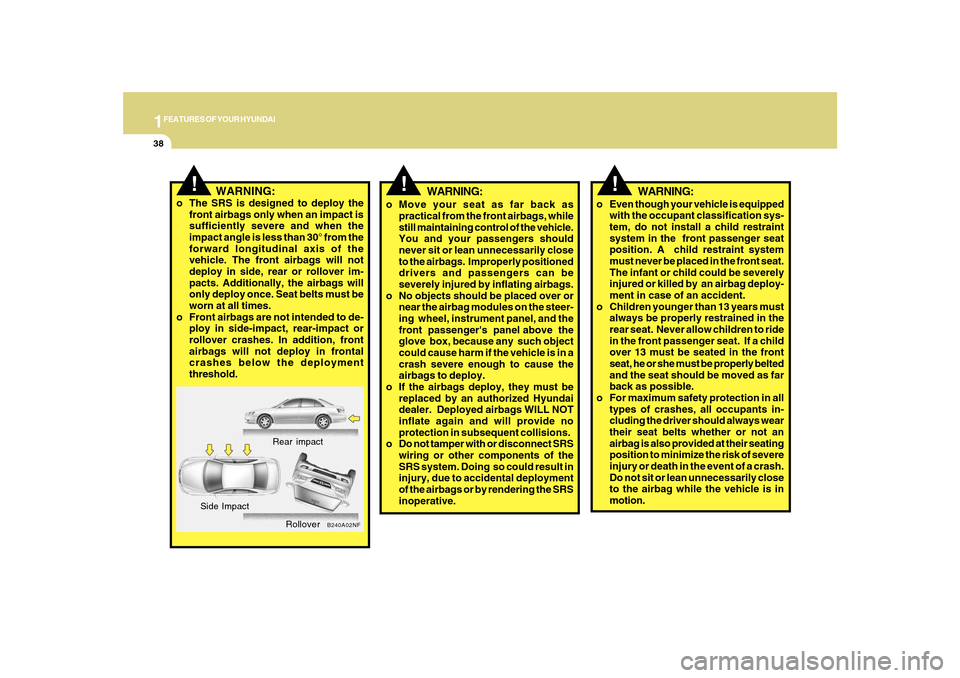
o The SRS is designed to deploy the
front airbags only when an impact is
sufficiently severe and when the
impact angle is less than 30° from the
forward longitudinal axis of the
vehicle. The front airbags will not
deploy in side, rear or rollover im-
pacts. Additionally, the airbags will
only deploy once. Seat belts must be
worn at all times.
o Front airbags are not intended to de-
ploy in side-impact, rear-impact or
rollover crashes. In addition, front
airbags will not deploy in frontal
crashes below the deployment
threshold.
!
WARNING:
o Even though your vehicle is equipped
with the occupant classification sys-
tem, do not install a child restraint
system in the front passenger seat
position. A child restraint system
must never be placed in the front seat.
The infant or child could be severely
injured or killed by an airbag deploy-
ment in case of an accident.
o Children younger than 13 years must
always be properly restrained in the
rear seat. Never allow children to ride
in the front passenger seat. If a child
over 13 must be seated in the front
seat, he or she must be properly belted
and the seat should be moved as far
back as possible.
o For maximum safety protection in all
types of crashes, all occupants in-
cluding the driver should always wear
their seat belts whether or not an
airbag is also provided at their seating
position to minimize the risk of severe
injury or death in the event of a crash.
Do not sit or lean unnecessarily close
to the airbag while the vehicle is in
motion.
B240A02NF
Rear impact
Side Impact
Rollover
Page 56 of 285
1
FEATURES OF YOUR HYUNDAI
43
!
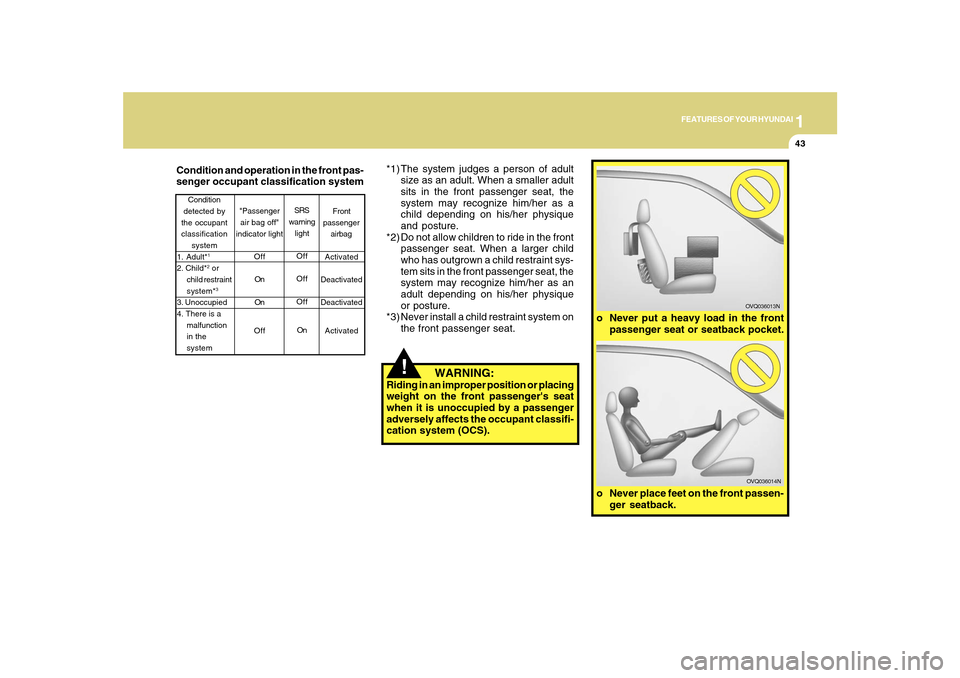
Condition and operation in the front pas-
senger occupant classification system
WARNING:
Riding in an improper position or placing
weight on the front passenger's seat
when it is unoccupied by a passenger
adversely affects the occupant classifi-
cation system (OCS).
o Never place feet on the front passen-
ger seatback.
OVQ036014N
o Never put a heavy load in the front
passenger seat or seatback pocket.
OVQ036013N
Front
passenger
airbag
Activated
Deactivated
Deactivated
Activated Condition
detected by
the occupant
classification
system
1. Adult*
1
2. Child*
2 or
child restraint
system*3
3. Unoccupied
4. There is a
malfunction
in the
systemSRS
warning
light
Off
Off
Off
On
"Passenger
air bag off"
indicator light
Off
On
On
Off
*1) The system judges a person of adult
size as an adult. When a smaller adult
sits in the front passenger seat, the
system may recognize him/her as a
child depending on his/her physique
and posture.
*2) Do not allow children to ride in the front
passenger seat. When a larger child
who has outgrown a child restraint sys-
tem sits in the front passenger seat, the
system may recognize him/her as an
adult depending on his/her physique
or posture.
*3) Never install a child restraint system on
the front passenger seat.
Page 59 of 285
1FEATURES OF YOUR HYUNDAI46
!
WARNING:
o Even though your vehicle is equipped
with the occupant classification sys-
tem, never install a child restraint
system in the front passenger's seat.
A deploying air bag can forcefully
strike a child resulting in serious inju-
ries or death. Any child age 12 and
under should ride in the rear seat.
Children too large for child restraints
should use the available lap/shoulder
belts. No matter what type of crash,
children of all ages are safer when
restrained in the rear seat.
o If the "PASSENGER AIR BAG OFF"
indicator is illuminated when the front
passenger's seat is occupied by an
adult and he/she sits properly (sitting
upright with the seatback in an upright
position, centered on the seat cushion
with their seat belt on, legs comfortably
extended and their feet on the floor),
have that person sit in the rear seat.
o Do not modify or replace the front
passenger seat. Don't place anything
on or attach anything such as a blanket
or after market seat heater to the
front passenger seat. This can
adversely affect the occupant classi-
fication system.
o Do not sit on sharp objects such as tools
when occupying the front passenger
seat. This can adversely affect the occu-
pant classification system.
o Do not use accessory seat covers on
the front seats.
o Accident statistics show that children
are safer if they are restrained in the
rear, as opposed to the front seat. It is
recommended that child restraints be
secured in a rear seat, including an infant
riding in a rear-facing infant seat, a child
riding in a forward-facing child seat and
an older child riding in a booster seat.
o Air bags can only be used once – have
an authorized Hyundai dealer replace
the air bag immediately after
deployment.
o A smaller-stature adult who is not seated
correctly (for example: seat excessively
reclined, leaning on the door or center
console or hips shifted forward in the
seat) can cause a condition where the
advanced frontal air bag system senses
less weight than if the occupant were
seated properly (sitting upright with the
seatback in an upright position, cen-
tered on the seat cushion with their seat
belt on, legs comfortably extended and
their feet on the floor). This condition can
result in an adult potentially being
misclassified and illumination of the
"PASSENGER AIR BAG OFF" indicator.
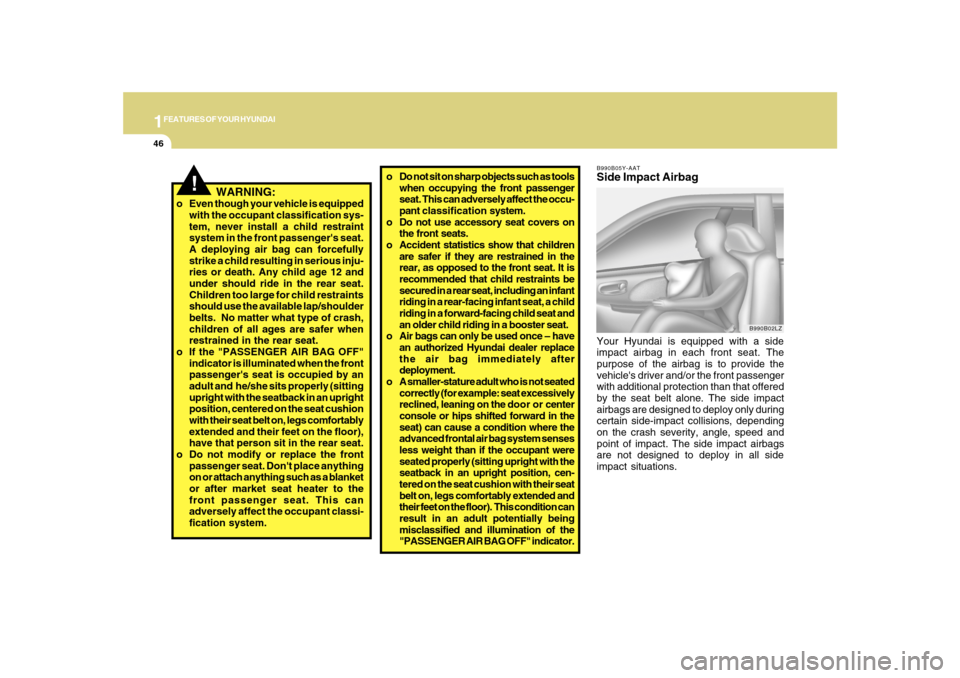
B990B05Y-AATSide Impact AirbagYour Hyundai is equipped with a side
impact airbag in each front seat. The
purpose of the airbag is to provide the
vehicle's driver and/or the front passenger
with additional protection than that offered
by the seat belt alone. The side impact
airbags are designed to deploy only during
certain side-impact collisions, depending
on the crash severity, angle, speed and
point of impact. The side impact airbags
are not designed to deploy in all side
impact situations.
B990B02LZ
Page 61 of 285
1FEATURES OF YOUR HYUNDAI48
o If the airbags inflate, they must be
replaced by an authorized Hyundai
dealer.
o Do not tamper with or disconnect SRS
wiring, or other components of the
SRS system. Doing so could result in
injury, due to accidental inflation of
the airbags or by rendering the SRS
inoperative.
o If components of the airbag system
must be discarded, or if the vehicle
must be scrapped, certain safety
precautions must be observed. Your
Hyundai dealer knows these precau-
tions and can give you the necessary
information. Failure to follow these
precautions and procedures could in-
crease the risk of personal injury.
o If your car was flooded and has soaked
carpeting or water on flooring, you
shouldn't try to start the engine; have
the car towed to an authorized Hyundai
dealer.
!
WARNING:
B240C03NF-AATSRS CareThe SRS is virtually maintenance-free and
so there are no parts you can safely service
by yourself. If the SRS airbag warning light
does not illuminate, or continuously re-
mains on, have your vehicle immediately
inspected by your Hyundai dealer.
Any work on the SRS system, such as
removing, installing, repairing, or any work
on the steering wheel must be performed
by a qualified Hyundai technician. Improper
handling of the SRS system may result in
serious personal injury.
WARNING:
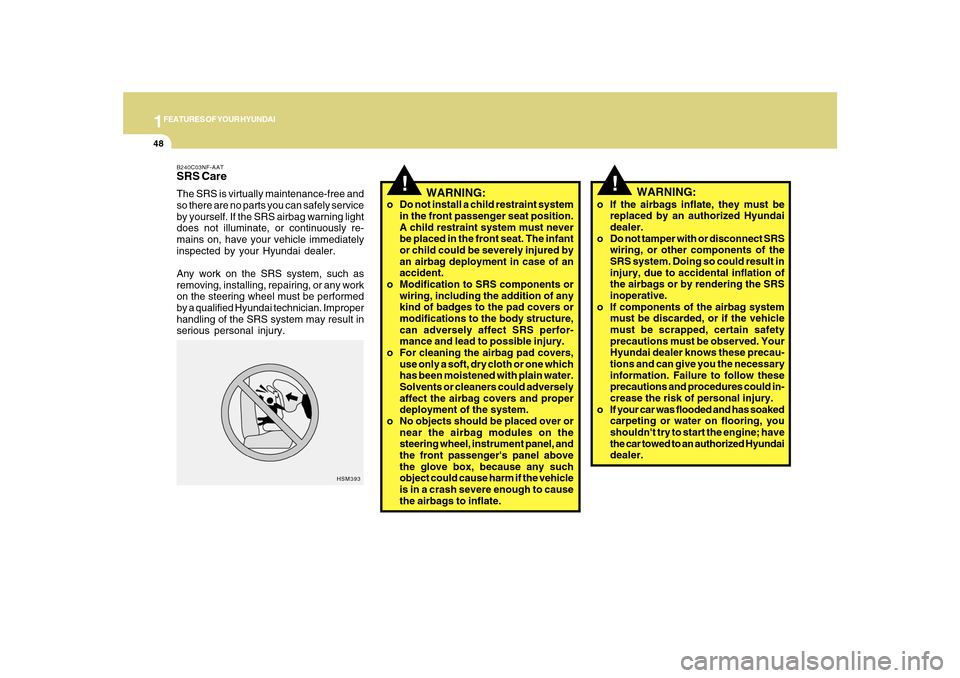
o Do not install a child restraint system
in the front passenger seat position.
A child restraint system must never
be placed in the front seat. The infant
or child could be severely injured by
an airbag deployment in case of an
accident.
o Modification to SRS components or
wiring, including the addition of any
kind of badges to the pad covers or
modifications to the body structure,
can adversely affect SRS perfor-
mance and lead to possible injury.
o For cleaning the airbag pad covers,
use only a soft, dry cloth or one which
has been moistened with plain water.
Solvents or cleaners could adversely
affect the airbag covers and proper
deployment of the system.
o No objects should be placed over or
near the airbag modules on the
steering wheel, instrument panel, and
the front passenger's panel above
the glove box, because any such
object could cause harm if the vehicle
is in a crash severe enough to cause
the airbags to inflate.
!
HSM393
Page 62 of 285
1
FEATURES OF YOUR HYUNDAI
49
B240D02NF-AATAdditional Safety PrecautionsoNever let passengers ride in the cargo
area (trunk) or on top of a folded-down
back seat. All occupants should sit
upright, fully back in their seats with
their seat belts on and their feet on the
floor.
oPassengers should not move out of or
change seats while the vehicle is mov-
ing. A passenger who is not wearing a
seat belt during a crash or emergency
stop can be thrown against the inside of
the vehicle, against other occupants, or
out of the vehicle.
oEach seat belt is designed to restrain
one occupant. If more than one person
uses the same seat belt, they could be
seriously injured or killed in a collision.
oDo not use any accessories on seat
belts. Devices claiming to improve oc-
cupant comfort or reposition the seat
belt can reduce the protection provided
by the seat belt and increase the chance
of serious injury in a crash.oPassengers should not place hard or
sharp objects between themselves
and the airbags. Carrying hard or sharp
objects on your lap or in your mouth can
result in injuries if an airbag inflates.
oKeep occupants away from the airbag
covers. All occupants should sit upright,
fully back in their seats with their seat
belts on and their feet on the floor. If
occupants are too close to the airbag
covers, they could be injured if the
airbags inflate.
oDo not attach or place objects on or
near the airbag covers. Any object
attached to or placed on the front or side
impact airbag covers could interfere
with the proper operation of the airbags.
oDo not modify the front seats. Modifi-
cation of the front seats could interfere
with the operation of the supplemental
restraint system sensing components
or side impact airbags.
oDo not place items under the front
seats. Placing items under the front
seats could interfere with the operation
of the supplemental restraint system
sensing components and wiring
harnesses.
!
WARNING:
o Sitting improperly or out of position
can cause occupants to be shifted too
close to a deploying airbag, strike the
interior structure or be thrown from
the vehicle resulting in serious injury
or death.
o Always sit upright with the seatback
in an upright position, centered on the
seat cushion with your seat belt on,
legs comfortably extended and your
feet on the floor. oNever hold an infant or child on your
lap. The infant or child could be seriously
injured or killed in the event of a crash.
All infants and children should be
properly restrained in appropriate child
safety seats or seat belts in the rear seat.Adding Equipment to or Modifying
Your Airbag-Equipped Vehicle.If you modify your vehicle by changing
your vehicle's frame, bumper system, front
end or side sheet metal or ride height, this
may affect the operation of your vehicle's
airbag system.
Page 181 of 285
2
DRIVING YOUR HYUNDAI
28
!
WARNING:
Items you carry inside your vehicle
can strike and injure people in a
sudden stop or turn, or in a crash.
o Put things in the cargo area of
your vehicle. Try to spread the
weight evenly.
o Never stack items, like suitcases,
inside the vehicle above the tops
of the seats.
o Do not leave an unsecured child
restraint in your vehicle.
o When you carry something inside
the vehicle, secure it.
o Do not drive with a seat folded
down unless necessary. NOTE:
o Overloading your vehicle may
cause damage. Repairs would not
be covered by your warranty. Do
not overload your vehicle.
o Using heavier suspension com-
ponents to get added durability
might not change your weight rat-
ings. Ask your dealer to help you
load your vehicle the right way.
The label will help you decide how much
cargo and installed equipment your
vehicle can carry.
If you carry items inside your vehicle –
like suitcases, tools, packages, or any-
thing else – they move as fast as the
vehicle goes. If you have to stop or turn
quickly, or if there is a crash, the items
will keep going and can cause an injury
if they strike the driver or a passenger.
!
WARNING:
o Overloading your vehicle can
cause heat buildup in your
vehicle's tires and possible tire
failure that could lead to a crash.
o Overloading your vehicle can
cause increased stopping dis-
tances that could lead to a crash.
o A crash resulting from poor han-
dling vehicle damage, tire failure,
or increased stopping distances
could result in serious injury or
death.
Page 281 of 285
10
INDEX
2
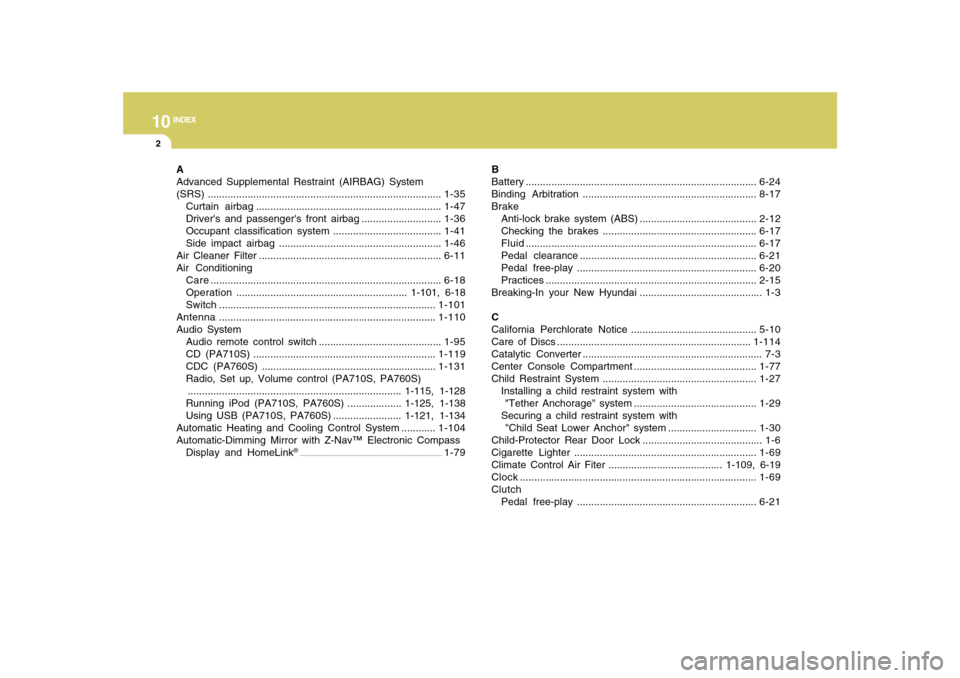
A
Advanced Supplemental Restraint (AIRBAG) System
(SRS)..................................................................................1-35
Curtain airbag .................................................................1-47
Driver's and passenger's front airbag ............................1-36
Occupant classification system ......................................1-41
Side impact airbag .........................................................1-46
Air Cleaner Filter ................................................................6-11
Air Conditioning
Care.................................................................................6-18
Operation............................................................ 1-101, 6-18
Switch............................................................................1-101
Antenna............................................................................1-110
Audio System
Audio remote control switch ...........................................1-95
CD (PA710S) ................................................................1-119
CDC (PA760S) .............................................................1-131
Radio, Set up, Volume control (PA710S, PA760S)
........................................................................... 1-115, 1-128
Running iPod (PA710S, PA760S) ................... 1-125, 1-138
Using USB (PA710S, PA760S) ........................ 1-121, 1-134
Automatic Heating and Cooling Control System ............1-104
Automatic-Dimming Mirror with Z-Nav™ Electronic Compass
Display and HomeLink
®
......................................................................................
1-79B
Battery .................................................................................6-24
Binding Arbitration .............................................................8-17
Brake
Anti-lock brake system (ABS) .........................................2-12
Checking the brakes ......................................................6-17
Fluid.................................................................................6-17
Pedal clearance ..............................................................6-21
Pedal free-play ...............................................................6-20
Practices..........................................................................2-15
Breaking-In your New Hyundai ........................................... 1-3
C
California Perchlorate Notice ............................................5-10
Care of Discs ....................................................................1-114
Catalytic Converter ............................................................... 7-3
Center Console Compartment ...........................................1-77
Child Restraint System ......................................................1-27
Installing a child restraint system with
"Tether Anchorage" system ...........................................1-29
Securing a child restraint system with
"Child Seat Lower Anchor" system ...............................1-30
Child-Protector Rear Door Lock .......................................... 1-6
Cigarette Lighter ................................................................1-69
Climate Control Air Fiter ........................................ 1-109, 6-19
Clock ...................................................................................1-69
Clutch
Pedal free-play ...............................................................6-21