stop start Hyundai Sonata
[x] Cancel search | Manufacturer: HYUNDAI, Model Year: , Model line: , Model:Pages: 285, PDF Size: 9.38 MB
Page 161 of 285
2
DRIVING YOUR HYUNDAI
8
NOTE:
Depress the brake pedal when shift-
ing.
The selector lever can be shifted
freely.
The first few shifts on a new vehicle, or
if the battery has been disconnected,
may be somewhat abrupt. This is a
normal condition, and the shifting
sequence will adjust after shifts are
cycled a few times by the T.C.M
(Transaxle Control Module).
!
C090A02NF
CAUTION:
Never shift into "R" or "P" position while
the vehicle is moving.
The indicator lights in the instrument cluster
indicate the selector lever position when
the ignition is switched "ON". During sports
mode operation, the gear currently in use
displays in the numeral indicator.C090B02A-AATThe function of each position is as
follows:
o P (Park):Use to hold the vehicle in place when
parked or while starting the engine.
Whenever parking the car, apply the
parking brake and shift the selector lever
to the "P" (Park) position.
CAUTION:
Never place the selector lever in the "P"
(Park) position unless the vehicle is fully
stopped. Failure to observe this caution
will cause severe damage to the
transaxle.
!
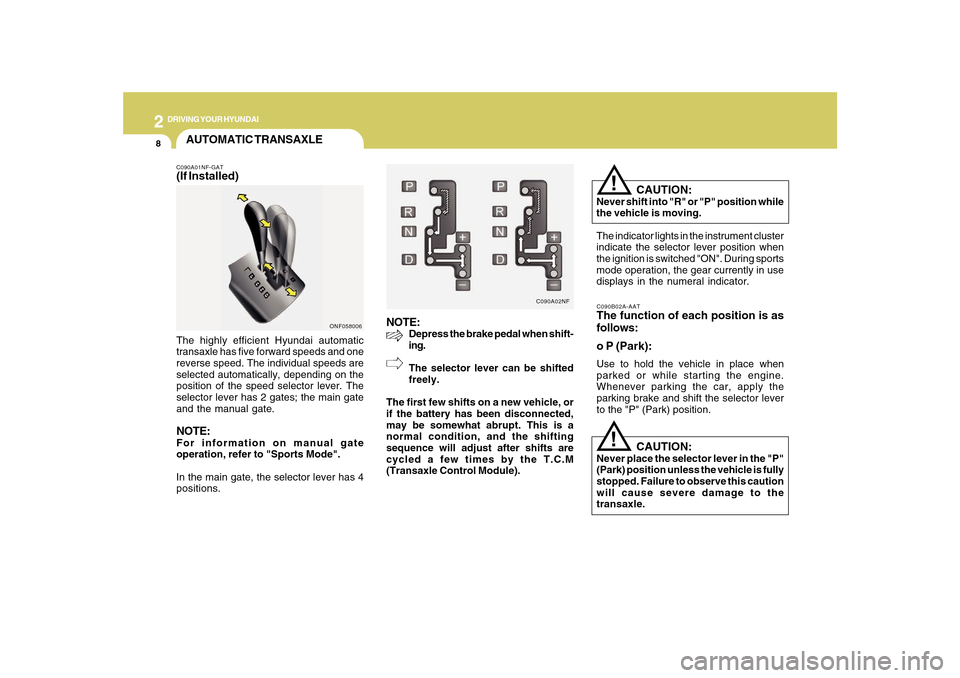
AUTOMATIC TRANSAXLEC090A01NF-GAT(If Installed)The highly efficient Hyundai automatic
transaxle has five forward speeds and one
reverse speed. The individual speeds are
selected automatically, depending on the
position of the speed selector lever. The
selector lever has 2 gates; the main gate
and the manual gate.NOTE:For information on manual gate
operation, refer to "Sports Mode".
In the main gate, the selector lever has 4
positions.
ONF058006
Page 162 of 285
2
DRIVING YOUR HYUNDAI
9
C090E02NF-GATo D (Drive):Use for normal driving. Bring the vehicle to
a complete stop before shifting the selector
to "D" position. The transaxle will automati-
cally shift through a five gear sequence.C090D02A-AATo N (Neutral):In the "N" position, the transaxle is in neutral,
which means that no gears are engaged.
The engine can be started with the shift
lever in "N" position, although this is not
recommended except if the engine stalls
while the car is moving.C090C01A-AATo R (Reverse):Use for backing up the vehicle. Bring the
car to a complete stop before shifting the
selector lever to "R" position.
CAUTION:
o In sports mode, the driver must
execute upward shifts in accordance
with prevailing road conditions, taking
care to keep the engine speed below
the red zone.
o For engine protection, upward shifts
are made automatically when the
engine rpm reaches the red zone.
o By rapidly moving the selector lever
backwards (-) twice it is possible to
skip one gear, i.e., 3rd to 1st, 4th to 2nd
or 5th to 3rd. Since sudden engine
braking and/or rapid acceleration can
cause a loss of traction, however,
downshifts must be made carefully in
accordance with the vehicle's speed.
!
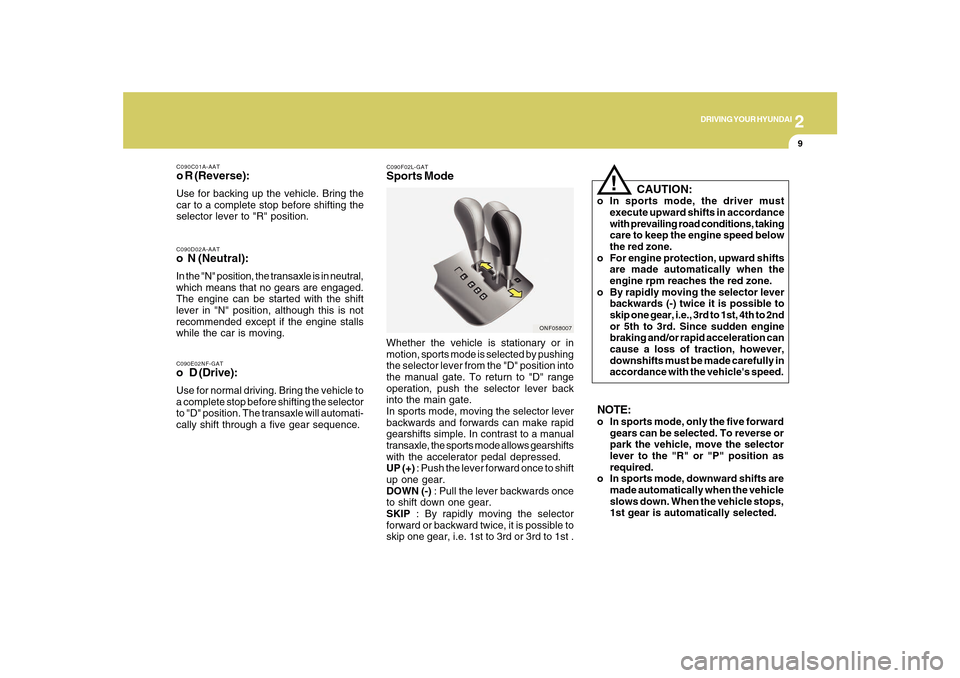
C090F02L-GATSports ModeWhether the vehicle is stationary or in
motion, sports mode is selected by pushing
the selector lever from the "D" position into
the manual gate. To return to "D" range
operation, push the selector lever back
into the main gate.
In sports mode, moving the selector lever
backwards and forwards can make rapid
gearshifts simple. In contrast to a manual
transaxle, the sports mode allows gearshifts
with the accelerator pedal depressed.
UP (+) : Push the lever forward once to shift
up one gear.
DOWN (-) : Pull the lever backwards once
to shift down one gear.
SKIP : By rapidly moving the selector
forward or backward twice, it is possible to
skip one gear, i.e. 1st to 3rd or 3rd to 1st .
ONF058007
NOTE:o In sports mode, only the five forward
gears can be selected. To reverse or
park the vehicle, move the selector
lever to the "R" or "P" position as
required.
o In sports mode, downward shifts are
made automatically when the vehicle
slows down. When the vehicle stops,
1st gear is automatically selected.
Page 165 of 285
2
DRIVING YOUR HYUNDAI
12
!
ANTI-LOCK BRAKE SYSTEM
(ABS)C120A01FC-AATThe Anti-Lock Brake System (ABS) is
designed to prevent wheel lock-up during
sudden braking or on hazardous road
surfaces. The ABS control module monitors
the wheel speed and controls the pressure
applied to each brake. Thus, in emergency
situations or on slick roads, ABS will
increase vehicle control during braking.NOTE:o A click sound may be heard in the
engine compartment when the ve-
hicle begins to move after the engine
is started. These conditions are nor-
mal and indicate that the anti-lock
brake system or Electronic Stability
Control is functioning properly.
o During ABS or ESC operation, a pul-
sation may be felt in the brake pedal
when the brakes are applied. Also, a
noise may be heard in the engine
compartment while braking. These
conditions are normal and indicate
that the anti-lock brake system or
Electronic Stability Control System is
functioning properly.
Setting the driver's position1) Be sure the parking brake is engaged.
2) Move the accelerator and brake pedals
to the front most position by pushing the
" " portion of the switch.
3) Adjust the seat position and the steering
wheel angle properly.
4) Move the pedals toward you until you
can fully depress the brake pedal by
pushing the " " portion of the switch.
5) Depress the pedals a few times to get
used to the feel after adjusting.
WARNING:
o Adjust the pedals after parking the
vehicle on level ground. Never attempt
to adjust the pedals while the vehicle
is moving.
o Never adjust the pedals with your foot
on the accelerator pedal as this may
result in increasing the engine speed
and acceleration.
o Make sure that you can fully depress
the brake pedal before driving.
Otherwise, you may not be able to
hold down the brake pedal firmly in an
emergency stop.
POWER ADJUSTABLE PEDALSC100A01NF-AAT(With Automatic Transaxle) (If
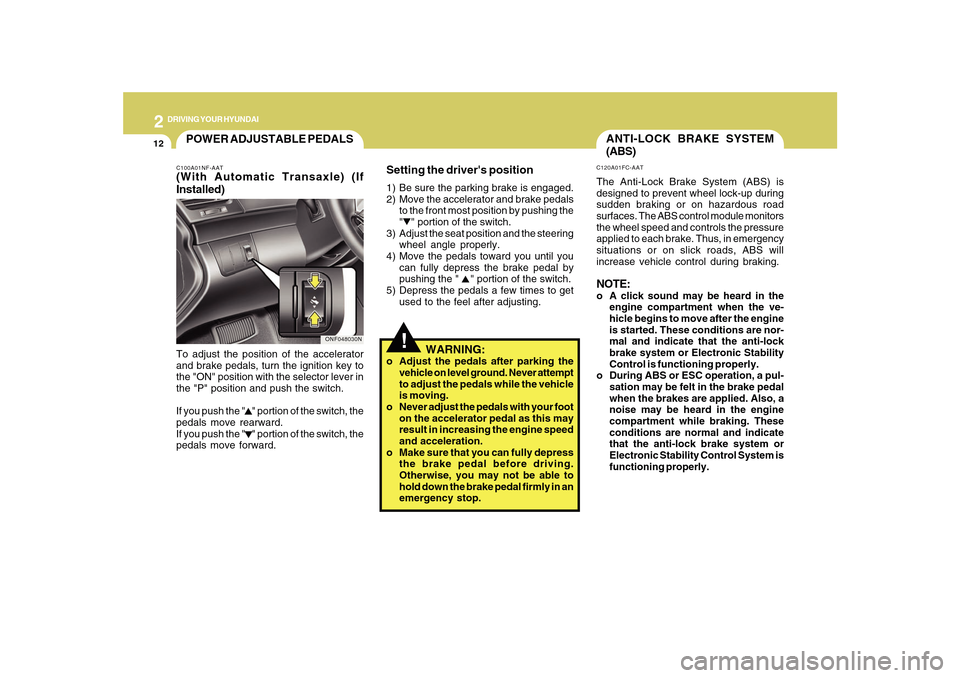
Installed)To adjust the position of the accelerator
and brake pedals, turn the ignition key to
the "ON" position with the selector lever in
the "P" position and push the switch.
If you push the " " portion of the switch, the
pedals move rearward.
If you push the " " portion of the switch, the
pedals move forward.
ONF048030N
Page 167 of 285
2
DRIVING YOUR HYUNDAI
14
C310D01NF-AATIndicators and WarningThe indicators should illuminate when the
ignition key is turned to ON or START but
should go out after three seconds.
If the indicators do not illuminate, or the
ESC or ESC-OFF indicator does not go out
after 3 seconds, have the vehicle checked
by an authorized dealer.
Should there be any unusual operation of
the device while driving, the ESC-OFF
indicator illuminates as a warning.
If the ESC-OFF indicator illuminates, drive
your car to a safe place and stop the
engine.
Then, start the engine again to check if the
ESC-OFF indicator goes out.
If the indicator remains lit even after the
engine has been started, have your car
checked by an authorized Hyundai dealer.
C310B01NF-AATESC ON/OFF ModeWhen the ESC is operating, the ESC indi-
cator in the instrument cluster will blink.
If you turn the system off by pressing the
ESC switch, the ESC-OFF indicator will
come on and stay on. In the ESC-OFF
mode, the stability control will be
deactivated. Adjust your driving accord-
ingly. To turn the system back on, press the
switch again. The ESC-OFF indicator
should go off.NOTE:The ESC mode will automatically be
turned ON after the engine is turned off
and restarted.
CAUTION:
Driving with varying tire or wheel sizes
may cause the ESC system to
malfunction. When replacing tires, make
sure they are the same size as your
original tires.
!
Page 169 of 285
2
DRIVING YOUR HYUNDAI
16
o Travel lightly. Don't carry unnecessary
weight in your car. Weight reduces fuel
economy.
o Don't let the engine idle longer than
necessary. If you are waiting (and not in
traffic), turn off your engine and restart
only when you're ready to go.
o Remember, your Hyundai does not re-
quire extended warm-up. After the en-
gine has started, allow the engine to run
for 10 to 20 seconds prior to placing the
vehicle in gear. In very cold weather,
however, give your engine a slightly
longer warm-up period.
o Don't "lug" or "over-rev" the engine.
Lugging is driving too slowly in too high
a gear resulting in the engine bucking.
If this happens, shift to a lower gear.
Over-revving is racing the engine
beyond its safe limit. This can be avoided
by shifting at the recommended speeds.
o Use your air conditioning sparingly. The
air conditioning system is operated by
engine power so your fuel economy is
reduced when you use it. o Take care of your tires. Keep them
inflated to the recommended pressure.
Incorrect inflation, either too much or
too little, results in unnecessary tire
wear. Check the tire pressures at least
once a month.
o Be sure that the wheels are aligned
correctly. Improper alignment can result
from hitting curbs or driving too fast over
irregular surfaces. Poor alignment
causes faster tire wear and may also
result in other problems as well as
greater fuel consumption.
o Keep your car in good condition. For
better fuel economy and reduced
maintenance costs, maintain your car
in accordance with the maintenance
schedule in Section 5. If you drive your
car in severe conditions, more frequent
maintenance is required (see Section 5
for details).
o Keep your car clean. For maximum
service, your Hyundai should be kept
clean and free of corrosive materials. It
is especially important that mud, dirt,
ice, etc. not be allowed to accumulate
on the underside of the car. This extra
weight can result in increased fuel
consumption and also contribute to cor-
rosion.
DRIVING FOR ECONOMYC140A02A-AATYou can save fuel and get more miles from
your car if you follow these suggestions:
o Drive smoothly. Accelerate at a
moderate rate. Don't make "jack-rabbit"
starts or full-throttle shifts and maintain
a steady cruising speed. Don't race
between stoplights. Try to adjust your
speed to that of the other traffic so you
don't have to change speeds unneces-
sarily. Avoid heavy traffic whenever pos-
sible. Always maintain a safe distance
from other vehicles so you can avoid
unnecessary braking. This also reduces
brake wear.
o Drive at a moderate speed. The faster
you drive, the more fuel your car uses.
Driving at a moderate speed, especially
on the highway, is one of the most
effective ways to reduce fuel
consumption.
o Don't "ride" the brake or clutch pedal.
This can increase fuel consumption and
also increase wear on these
components. In addition, driving with
your foot resting on the brake pedal may
cause the brakes to overheat, which
reduces their effectiveness and may
lead to more serious consequences.
Page 176 of 285
2
DRIVING YOUR HYUNDAI
23
8. When parking your car and trailer, es-
pecially on a hill, be sure to follow all
the normal precautions. Turn your front
wheel into the curb, set the parking
brake firmly, and put the transaxle in 1st
or Reverse (manual) or Park (automatic).
In addition, place wheel chocks at each
of the trailer's tires.
9. If the trailer has electric brakes, start
your vehicle and trailer moving, and
then apply the trailer brake controller by
hand to be sure the brakes are working.
This lets you check your electrical
connection at the same time.
10. During your trip, check occasionally to
be sure that the load is secure, and that
the lights and any trailer brakes are still
working.
11. Avoid jerky starts, sudden acceleration
or sudden stops.
12. Avoid sharp turns and rapid lane
changes.
13. Avoid holding the brake pedal down
too long or too frequently. This could
cause the brakes to overheat, resulting
in reduced braking efficiency.
14. When going down a hill, shift into a
lower gear and use the engine braking
effect.
When ascending a long grade, down-
shift the transaxle to a lower gear and
reduce speed to reduce chances of
engine overloading and/or overheat-
ing.
CAUTION:
If overheating should occur when tow-
ing, (the temperature gauge reads near
red zone), taking the following action
may reduce or eliminate the problem.
1. Turn off the air conditioner.
2. Reduce highway speed.
3. Select a lower gear when going uphill.
4. While in stop and go traffic, place the
gear selector in park or neutral and
idle the engine at a higher speed.
!
15. If you have to stop while going uphill,
do not hold the vehicle in place by
pressing on the accelerator. This can
cause the automatic transaxle to over-
heat. Use the parking brake or
footbrake.NOTE:When towing check transaxle fluid more
frequently.
Page 187 of 285
36WHAT TO DO IN AN EMERGENCY
!
Low tire pressure telltale
When the tire pressure monitoring sys-
tem warning telltale is illuminated, one
or more of your tires is significantly
under-inflated.
Immediately reduce your speed, avoid
hard cornering and anticipate increased
stopping distances. You should stop
and check your tires as soon as pos-
sible. Inflate the tires to the proper
pressure as indicated on the vehicle’s
placard or tire inflation pressure label
located on the driver’s side center pillar
outer panel. If you cannot reach a ser-
vice station or if the tire cannot hold the
newly added air, replace the low pres-
sure tire with the temporary spare tire.
Then the TPMS malfunction indicator
or the Low Tire Pressure telltale may
turn on after restarting and about 20
minutes of continuous driving before
you have the low-pressure tire repaired
and reinstalled on the vehicle. CAUTION:
In winter or cold weather, the low tire
pressure telltale may be illuminated
if the tire pressure was adjusted to
the recommended tire inflation pres-
sure in warm weather. It does not
mean your TPMS is malfunctioning
because the decreased temperature
leads to a proportional lowering of
tire pressure.
When you drive your vehicle from a
warm area to a cold area or from a
cold area to a warm area, or the
outside temperature is greatly higher
or lower, you should check the tire
inflation pressure and adjust the tires
to the recommended tire inflation
pressure.
Always check your tire inflation pres-
sures when the tires are cold, before
you have driven on them.WARNING - Low pressure
Significantly low tire pressure makes
the vehicle unstable and can contrib-
ute to loss of vehicle control and
increased braking distances. Contin-
ued driving on low pressure tires will
cause the tires to overheat and fail.
TPMS (Tire pressure moni-
toring system) malfunction
indicator
The TPMS malfunction indicator turns
on and stays on when there is a problem
with the Tire Pressure Monitoring Sys-
tem. If the system is able to correctly
detect an under-inflation warning at the
same time as system failure then it will
illuminate both the TPMS malfunction
and the low tire pressure telltale, e.g. if
the Front Left sensor fails, the TPMS
malfunction indicator turns on, but if the
Front Right, Rear Left, or Rear Right tire
is under-inflated, the low tire pressure
telltale may turn on at the same time as
the TPMS malfunction indicator.
!
Page 213 of 285
5
VEHICLE MAINTENANCE REQUIREMENTS
9
F070L01A-AATo Suspension Mounting BoltsCheck the suspension connections for
looseness or damage. Retighten to the
specified torque.F070K01A-AATo Exhaust Pipe and MufflerVisually inspect the exhaust pipes, muffler
and
hangers for cracks, deterioration, or
damage. Start the engine and listen
carefully for any exhaust gas leakage.
Tighten connections or replace parts as
necessary.F070J01A-AATo Brake Pads, Calipers and RotorsCheck the pads for excessive wear, discs
for run out and wear, and calipers for fluid
leakage.
F070Q01A-AATo Air Conditioning RefrigerantCheck the air conditioning lines and con-
nections for leakage and damage. Check
air conditioning performance according to
the relevant shop manual if necessary.
F070P01A-AATo Drive Shafts and BootsCheck the drive shafts, boots and clamps
for cracks, deterioration, or damage.
Replace any damaged parts and, if
necessary, repack the grease.F070N01A-AATo Power Steering Pump, Belt and
HosesCheck the power steering pump and hoses
for leakage and damage. Replace any
damaged or leaking parts immediately.
Inspect the power steering belt for evidence
of cuts, cracks, excessive wear, oiliness
and proper tension. Replace or adjust it if
necessary.F070M01Y-AATo Steering Gear Box, Linkage &
Boots/Lower Arm Ball Joint, Upper
Arm Ball JointWith the vehicle stopped and engine off,
check for excessive free-play in the
steering wheel.
Check the linkage for bends or damage.
Check the dust boots and ball joints for
deterioration, cracks, or damage. Replace
any damaged parts.
Page 221 of 285
6
DO-IT-YOURSELF MAINTENANCE
7
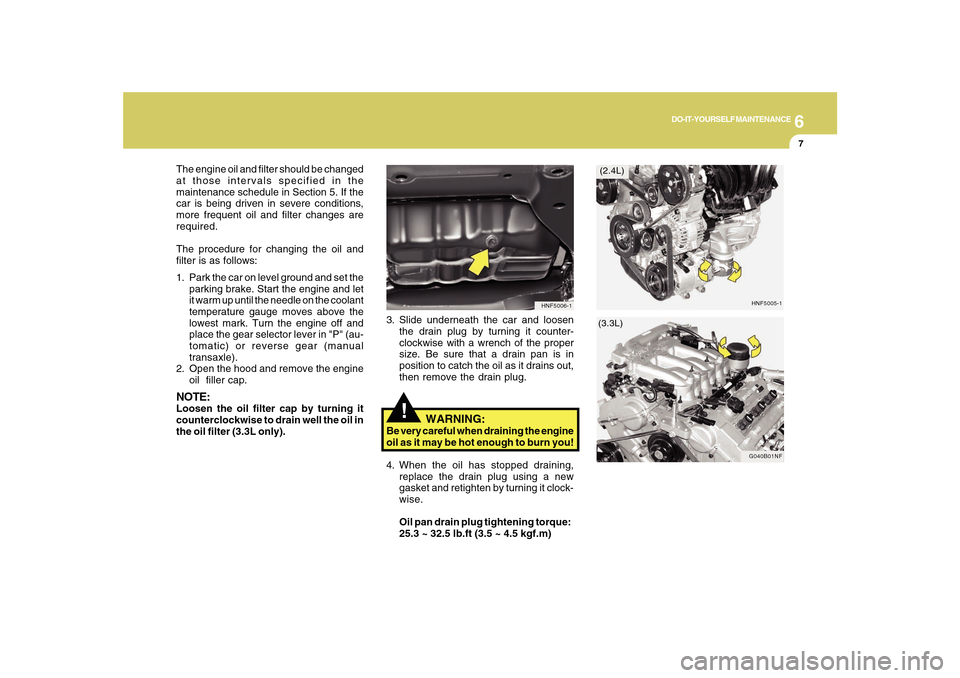
!
3. Slide underneath the car and loosen
the drain plug by turning it counter-
clockwise with a wrench of the proper
size. Be sure that a drain pan is in
position to catch the oil as it drains out,
then remove the drain plug.
4. When the oil has stopped draining,
replace the drain plug using a new
gasket and retighten by turning it clock-
wise.
Oil pan drain plug tightening torque:
25.3 ~ 32.5 lb.ft (3.5 ~ 4.5 kgf.m)
HNF5006-1
(2.4L)
(3.3L)
The engine oil and filter should be changed
at those intervals specified in the
maintenance schedule in Section 5. If the
car is being driven in severe conditions,
more frequent oil and filter changes are
required.
The procedure for changing the oil and
filter is as follows:
1. Park the car on level ground and set the
parking brake. Start the engine and let
it warm up until the needle on the coolant
temperature gauge moves above the
lowest mark. Turn the engine off and
place the gear selector lever in "P" (au-
tomatic) or reverse gear (manual
transaxle).
2. Open the hood and remove the engine
oil filler cap.NOTE:Loosen the oil filter cap by turning it
counterclockwise to drain well the oil in
the oil filter (3.3L only).
WARNING:
Be very careful when draining the engine
oil as it may be hot enough to burn you!
HNF5005-1
G040B01NF
Page 224 of 285
6
DO-IT-YOURSELF MAINTENANCE
10
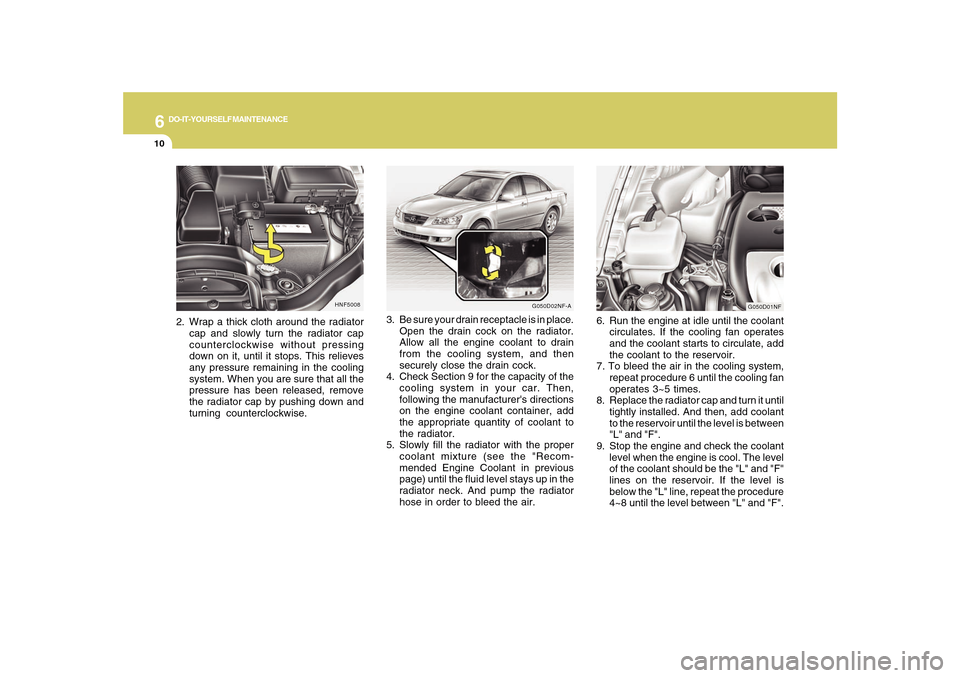
3. Be sure your drain receptacle is in place.
Open the drain cock on the radiator.
Allow all the engine coolant to drain
from the cooling system, and then
securely close the drain cock.
4. Check Section 9 for the capacity of the
cooling system in your car. Then,
following the manufacturer's directions
on the engine coolant container, add
the appropriate quantity of coolant to
the radiator.
5. Slowly fill the radiator with the proper
coolant mixture (see the "Recom-
mended Engine Coolant in previous
page) until the fluid level stays up in the
radiator neck. And pump the radiator
hose in order to bleed the air.
HNF5008
2. Wrap a thick cloth around the radiator
cap and slowly turn the radiator cap
counterclockwise without pressing
down on it, until it stops. This relieves
any pressure remaining in the cooling
system. When you are sure that all the
pressure has been released, remove
the radiator cap by pushing down and
turning counterclockwise.
G050D02NF-A
G050D01NF
6. Run the engine at idle until the coolant
circulates. If the cooling fan operates
and the coolant starts to circulate, add
the coolant to the reservoir.
7. To bleed the air in the cooling system,
repeat procedure 6 until the cooling fan
operates 3~5 times.
8. Replace the radiator cap and turn it until
tightly installed. And then, add coolant
to the reservoir until the level is between
"L" and "F".
9. Stop the engine and check the coolant
level when the engine is cool. The level
of the coolant should be the "L" and "F"
lines on the reservoir. If the level is
below the "L" line, repeat the procedure
4~8 until the level between "L" and "F".