maintenance Hyundai Sonata
[x] Cancel search | Manufacturer: HYUNDAI, Model Year: , Model line: , Model:Pages: 285, PDF Size: 9.38 MB
Page 256 of 285
7
EMISSION CONTROL SYSTEMS2
EMISSION CONTROL
SYSTEMS
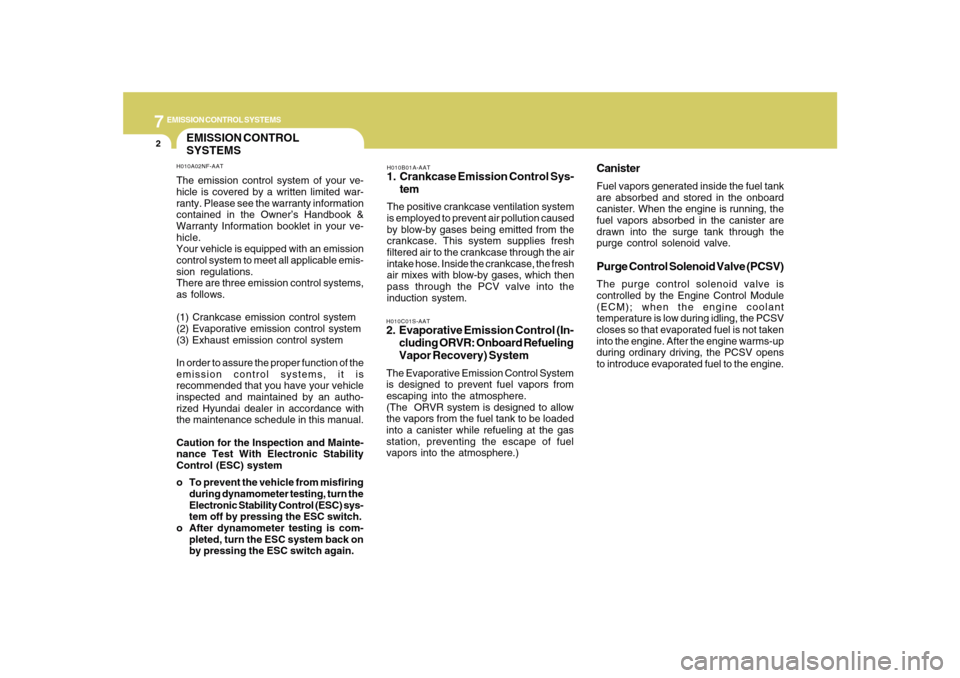
H010B01A-AAT1. Crankcase Emission Control Sys-
temThe positive crankcase ventilation system
is employed to prevent air pollution caused
by blow-by gases being emitted from the
crankcase. This system supplies fresh
filtered air to the crankcase through the air
intake hose. Inside the crankcase, the fresh
air mixes with blow-by gases, which then
pass through the PCV valve into the
induction system.
CanisterFuel vapors generated inside the fuel tank
are absorbed and stored in the onboard
canister. When the engine is running, the
fuel vapors absorbed in the canister are
drawn into the surge tank through the
purge control solenoid valve.Purge Control Solenoid Valve (PCSV)The purge control solenoid valve is
controlled by the Engine Control Module
(ECM); when the engine coolant
temperature is low during idling, the PCSV
closes so that evaporated fuel is not taken
into the engine. After the engine warms-up
during ordinary driving, the PCSV opens
to introduce evaporated fuel to the engine.
H010A02NF-AATThe emission control system of your ve-
hicle is covered by a written limited war-
ranty. Please see the warranty information
contained in the Owner’s Handbook &
Warranty Information booklet in your ve-
hicle.
Your vehicle is equipped with an emission
control system to meet all applicable emis-
sion regulations.
There are three emission control systems,
as follows.
(1) Crankcase emission control system
(2) Evaporative emission control system
(3) Exhaust emission control system
In order to assure the proper function of the
emission control systems, it is
recommended that you have your vehicle
inspected and maintained by an autho-
rized Hyundai dealer in accordance with
the maintenance schedule in this manual.
Caution for the Inspection and Mainte-
nance Test With Electronic Stability
Control (ESC) system
o To prevent the vehicle from misfiring
during dynamometer testing, turn the
Electronic Stability Control (ESC) sys-
tem off by pressing the ESC switch.
o After dynamometer testing is com-
pleted, turn the ESC system back on
by pressing the ESC switch again.
H010C01S-AAT2. Evaporative Emission Control (In-
cluding ORVR: Onboard Refueling
Vapor Recovery) SystemThe Evaporative Emission Control System
is designed to prevent fuel vapors from
escaping into the atmosphere.
(The ORVR system is designed to allow
the vapors from the fuel tank to be loaded
into a canister while refueling at the gas
station, preventing the escape of fuel
vapors into the atmosphere.)
Page 259 of 285
Vehicle Identification Number (VIN) .............................. 8-2
Engine Number ............................................................. 8-2
Tire Information ............................................................. 8-2
Recommended Cold Tire Inflation Pressures ............... 8-3
Checking Tire Inflation Pressure ................................... 8-5
Tire Sidewall Labeling ................................................... 8-5
Tire Terminology and Definitions ................................... 8-7
All Season Tires ............................................................ 8-9
Snow Tires .................................................................... 8-9
Tire Chains .................................................................... 8-9
Tire Rotation................................................................8-10
Tire Balancing.............................................................8-10
Tire Traction................................................................8-11
When to Replace Tires ...............................................8-11
Tire Maintenance........................................................8-12
Spare Tire and Tools ...................................................8-13
Warranties for Your Hyundai Vehicle ..........................8-13
Consumer Information.................................................8-14
Reporting Safety Defects............................................8-16
Binding Arbitration of Warranty Claims .......................8-17
8
8
CONSUMER INFORMATION, REPORTING
SAFETY DEFECTS & BINDING
ARBITRATION OF WARRANTY CLAIMS
Page 270 of 285
8CONSUMER INFORMATION, REPORTING SAFETY DEFECTS & BINDING ARBITRATION OF WARRANTY CLAIMS12
!
!
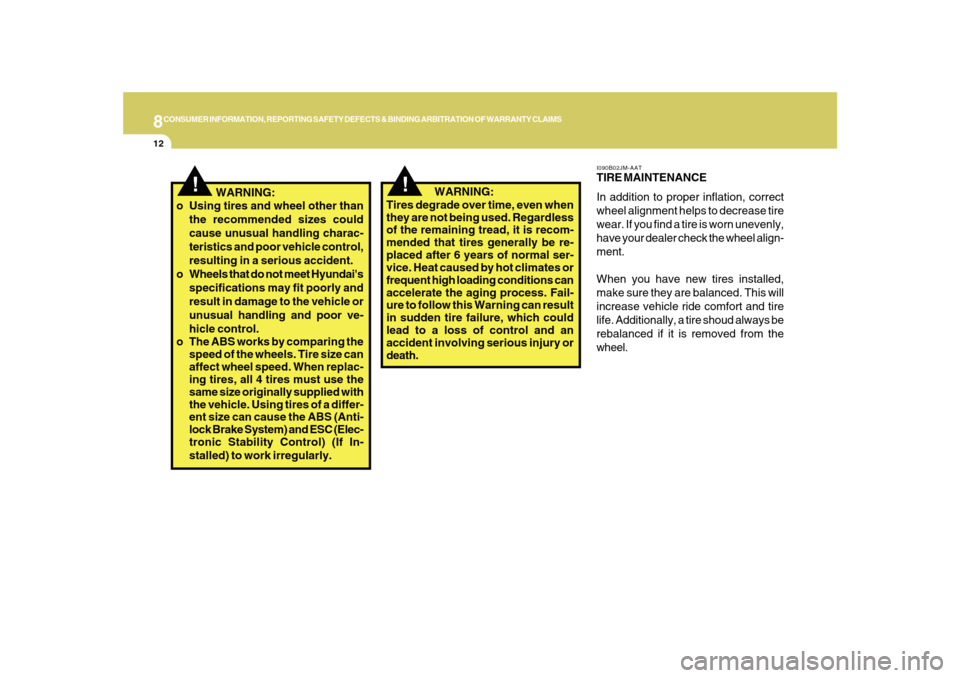
I090B02JM-AATTIRE MAINTENANCE
In addition to proper inflation, correct
wheel alignment helps to decrease tire
wear. If you find a tire is worn unevenly,
have your dealer check the wheel align-
ment.
When you have new tires installed,
make sure they are balanced. This will
increase vehicle ride comfort and tire
life. Additionally, a tire shoud always be
rebalanced if it is removed from the
wheel. o Using tires and wheel other than
the recommended sizes could
cause unusual handling charac-
teristics and poor vehicle control,
resulting in a serious accident.
o Wheels that do not meet Hyundai's
specifications may fit poorly and
result in damage to the vehicle or
unusual handling and poor ve-
hicle control.
o The ABS works by comparing the
speed of the wheels. Tire size can
affect wheel speed. When replac-
ing tires, all 4 tires must use the
same size originally supplied with
the vehicle. Using tires of a differ-
ent size can cause the ABS (Anti-
lock Brake System) and ESC (Elec-
tronic Stability Control) (If In-
stalled) to work irregularly. WARNING: WARNING:
Tires degrade over time, even when
they are not being used. Regardless
of the remaining tread, it is recom-
mended that tires generally be re-
placed after 6 years of normal ser-
vice. Heat caused by hot climates or
frequent high loading conditions can
accelerate the aging process. Fail-
ure to follow this Warning can result
in sudden tire failure, which could
lead to a loss of control and an
accident involving serious injury or
death.
Page 283 of 285
10
INDEX
4
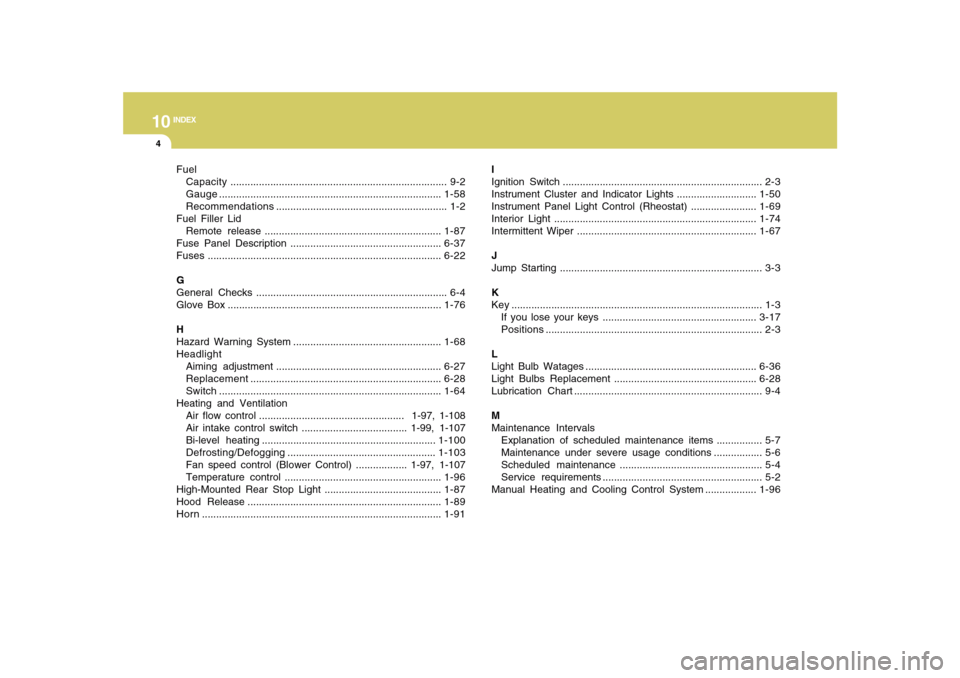
Fuel
Capacity............................................................................ 9-2
Gauge..............................................................................1-58
Recommendations............................................................ 1-2
Fuel Filler Lid
Remote release ..............................................................1-87
Fuse Panel Description .....................................................6-37
Fuses..................................................................................6-22
G
General Checks ................................................................... 6-4
Glove Box ...........................................................................1-76
H
Hazard Warning System ....................................................1-68
Headlight
Aiming adjustment ..........................................................6-27
Replacement...................................................................6-28
Switch..............................................................................1-64
Heating and Ventilation
Air flow control ................................................... 1-97, 1-108
Air intake control switch ..................................... 1-99, 1-107
Bi-level heating .............................................................1-100
Defrosting/Defogging....................................................1-103
Fan speed control (Blower Control) .................. 1-97, 1-107
Temperature control .......................................................1-96
High-Mounted Rear Stop Light .........................................1-87
Hood Release ....................................................................1-89
Horn....................................................................................1-91I
Ignition Switch ...................................................................... 2-3
Instrument Cluster and Indicator Lights ............................1-50
Instrument Panel Light Control (Rheostat) .......................1-69
Interior Light .......................................................................1-74
Intermittent Wiper ...............................................................1-67
J
Jump Starting ....................................................................... 3-3
K
Key ........................................................................................ 1-3
If you lose your keys ......................................................3-17
Positions............................................................................ 2-3
L
Light Bulb Watages ............................................................6-36
Light Bulbs Replacement ..................................................6-28
Lubrication Chart .................................................................. 9-4
M
Maintenance Intervals
Explanation of scheduled maintenance items ................ 5-7
Maintenance under severe usage conditions ................. 5-6
Scheduled maintenance.................................................. 5-4
Service requirements ........................................................ 5-2
Manual Heating and Cooling Control System ..................1-96
Page 285 of 285
10
INDEX
6
Maintenance...................................................................8-12
Pressure............................................................................ 8-3
Replacement...................................................................8-11
Rotation...........................................................................8-10
Sidewall labeling.............................................................. 8-5
Snow tires ......................................................................... 8-9
Spare tire .......................................................................... 3-9
Terminology and definitions ............................................. 8-7
Traction...........................................................................8-11
Towing
A trailer (or vehicle) ........................................................2-20
If your vehicle must be towed ........................................3-15
Transaxle
Automatic.......................................................................... 2-8
Automatic transaxle fluid checking ................................6-15
Manual.............................................................................. 2-6
Manual transaxle oil checking .......................................6-14
Trip Computer ....................................................................1-61
Trip Odometer ....................................................................1-60
Trunk Lid ............................................................................1-86
V
Vehicle Identification Number (VIN) .................................... 8-2
Vehicle Load Limit .............................................................2-24
Vehicle Specifications .......................................................... 9-1W
Warning and Indicator Lights ............................................1-52
Warranties for Your Hyundai Vehicle ...............................8-13
Windows
Power..............................................................................1-12
Windshield Wiper and Washer ..........................................1-66
Intermittent wiper operation ............................................1-67
Mist wiper operation .......................................................1-67
Windshield washer operation ........................................1-67
Windshield Wiper Blades ..................................................6-12