ignition Hyundai Sonata
[x] Cancel search | Manufacturer: HYUNDAI, Model Year: , Model line: , Model:Pages: 286, PDF Size: 9.58 MB
Page 38 of 286
1
FEATURES OF YOUR HYUNDAI
25
B190A02NF-AATSEAT BELTS-Front Passenger and
Rear Seat 3-Point System with
Combination Locking Retractor
To Fasten Your BeltCombination retractor type seat belts are
installed in the rear seat positions to help
accommodate the installation of child
restraint systems. Although a combination
retractor is also installed in the front
passenger seat position, Hyundai strongly
recommends that children always be seated
in the rear seat. NEVER place any infant
restraint system in the front seat of the
vehicle.
This type of seat belt combines the features
of both an emergency locking retractor seat
belt and an automatic locking retractor seat
belt. To fasten your seat belt, pull it out of the
retractor and insert the metal tab into the
buckle. There will be an audible "click"
when the tab locks into the buckle. When
not securing a child restraint, the seat belt
operates in the same way as the driver's
seat belt (Emergency Locking Retractor
Type). It automatically adjusts to the proper
length only after the lap belt portion of the
seat belt is adjusted manually so that it fits
snugly around your hips. When the seat belt
is fully extended from the retractor to allow
the installation of a child restraint system,
the seat belt operation changes to allow the
belt to retract, but not to extend (Automatic
Locking Retractor Type). See page 1-33.
NOTE:o Although the combination retractor
provides the same level of protection
for seated passengers in either
emergency or automatic locking
modes, it is recommended that seated
passengers use the emergency
locking feature for improved
convenience. The automatic locking
function is intended to facilitate child
restraint installation. To convert from
the automatic locking feature to the
emergency locking operation mode,
allow the unbuckled seat belt to fully
retract.
o The front passenger's seat belt
warning light on the center fascia
panel blinks until the front passenger's
seat belt is fastened to remind the
front passenger to fasten the front
passenger's seat belt, when the
ignition key is turned from the "OFF"
position to "the "ON" or "START"
position.
WARNING:
o For maximum restraint system pro-
tection, the seat belts must always be
used whenever the car is moving.
o Seat belts are most effective when
seatbacks are in the upright position.
o Children age 12 and younger must
always be properly restrained in the
rear seat. Never allow children to ride
in the front passenger seat. If a child
over 13 must be seated in the front
seat, he/she must be properly belted
and the seat should be moved as far
back as possible.
o Never wear the shoulder belt under
your arm or behind your back. An
improperly positioned shoulder belt
can cause serious injuries in a crash.
The shoulder belt should be positioned
midway over your shoulder across
your collarbone.
o Avoid wearing twisted seat belts. A
twisted belt can't do its job as well. In a
collision, it could even cut into you. Be
sure the belt webbing is straight and
not twisted.
o Be careful not to damage the belt web-
bing or hardware. If the belt webbing or
hardware is damaged, replace it.
!
Page 46 of 286
1
FEATURES OF YOUR HYUNDAI
33
!
o Be sure you and your passengers
always wear seat belts and wear them
properly.NOTE:o Both the driver's and front
passenger's pre-tensioner seat belts
will be activated in certain frontal col-
lisions. The pre-tensioner seat belts
can be activated alone or, where the
frontal collision is severe enough,
together with the airbags.
The pre-tensioners will not be
activated if the seat belts are not being
worn at the time of the collision.
o When the pre-tensioner seat belts are
activated, a loud noise may be heard
and fine dust, which may appear to be
smoke, may be visible in the
passenger compartment. These are
normal operating conditions and are
not hazardous.
o Although it is harmless, the fine dust
may cause skin irritation and should
not be breathed for prolonged periods.
Wash all exposed skin areas thor-
oughly after an accident in which the
pre-tensioner seat belts were acti-
vated.
WARNING:
!
CAUTION:
o Because the sensor that activates
the SRS airbag is connected with the
pre-tensioner seat belt, the SRS airbag
warning light
on the instrument
panel will illuminate for approximately
6 seconds after the ignition key has
been turned to the "ON" position, and
then it should turn off.
o If the pre-tensioner seat belt is not
working properly, this warning light
will illuminate even if there is no
malfunction of the SRS airbag. If the
SRS airbag warning light does not
illuminate when the ignition key is
turned to "ON", or if it blinks for a
second and remains illuminated after
illuminating for approximately 6 sec-
onds, or if it illuminates while the ve-
hicle is being driven, please have an
authorized Hyundai dealer inspect the
pre-tensioner seat belt or SRS airbag
system as soon as possible.
!
WARNING:
o Pre-tensioners are designed to oper-
ate only one time. After activation,
pre-tensioner seat belts must be re-
placed. All seat belts, of any type,
should always be replaced after they
have been worn during a collision.
o The pre-tensioner seat belt assembly
mechanisms become hot during acti-
vation. Do not touch the pre-tensioner
seat belt assemblies for several min-
utes after they have been activated.
o Do not attempt to inspect or replace
the pre-tensioner seat belts yourself.
This must be done by an authorized
Hyundai dealer.
o Do not strike the pre-tensioner seat
belt assemblies.
o Do not attempt to service or repair the
pre-tensioner seat belt system in any
manner.
o Improper handling of the pre-tensioner
seat belt assemblies, and failure to
heed the warnings not to strike, modify,
inspect, replace, service or repair the
pre-tensioner seat belt assemblies
may lead to improper operation or
inadvertent activation and serious
injury.
o Always wear the seat belts when driv-
ing or riding in a motor vehicle.
Page 48 of 286
1
FEATURES OF YOUR HYUNDAI
35
The SRS uses sensors to gather
information about the driver's and front
passenger's seat position, the driver's and
front passenger's seat belt usage and
impact severity.
The driver's and front passenger's seat
track position sensors, which are installed
on the seat track, determine if the seats are
fore or aft of a reference position. The seat
belt buckle sensors determine if the driver
and front passenger's seat belts are
fastened. These sensors provide the ability
to control the SRS deployment based on
how close the driver's seat is to the steering
wheel, how close the passenger's seat is
to the instrument panel, whether or not the
seat belts are fastened, and how severe
the impact is.
The advanced SRS offers the ability to
control the airbag inflation with two levels.
A first stage level is provided for moderate-
severity impacts. A second stage level is
provided for more severe impacts.
According to the impact severity, seating
position and seat belt usage, the
SRSCM(SRS Control Module) controls the
airbag inflation. Failure to properly wear
seat belts can increase the risk or severity
of injury in an accident.
CAUTION:
If a seat track position sensor or an
occupant classification system is not
working properly, the SRS airbag warning
light
on the instrument panel will
illuminate because the SRS airbag
warning light is connected with the seat
track position sensor and the occupant
classification system. If the SRS airbag
warning light does not illuminate when
the ignition key is turned to the "ON"
position, remains illuminated after
approximately 6 seconds when the igni-
tion key is turned to the "ON" position, or
if it illuminates while the vehicle is being
driven, have an authorized Hyundai
dealer inspect the advanced SRS airbag
system as soon as possible.
!
Additionally, your Hyundai is equipped
with an occupant classification system in
the front passenger's seat. The occupant
classification system detects the presence
of a passenger in the front passenger's
seat and will turn off the front passenger's
airbag under certain conditions. For more
detail, see "Occupant Classification
System" later in this section.
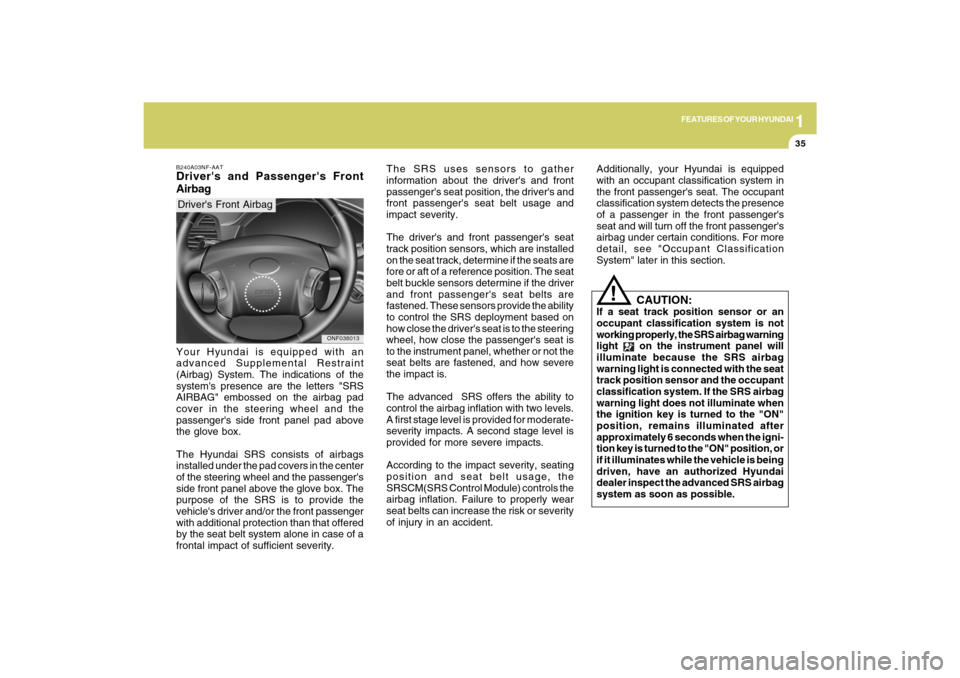
B240A03NF-AATDriver's and Passenger's Front
AirbagYour Hyundai is equipped with an
advanced Supplemental Restraint
(Airbag) System. The indications of the
system's presence are the letters "SRS
AIRBAG" embossed on the airbag pad
cover in the steering wheel and the
passenger's side front panel pad above
the glove box.
The Hyundai SRS consists of airbags
installed under the pad covers in the center
of the steering wheel and the passenger's
side front panel above the glove box. The
purpose of the SRS is to provide the
vehicle's driver and/or the front passenger
with additional protection than that offered
by the seat belt system alone in case of a
frontal impact of sufficient severity.Driver's Front Airbag
ONF038013
Page 51 of 286
1FEATURES OF YOUR HYUNDAI38
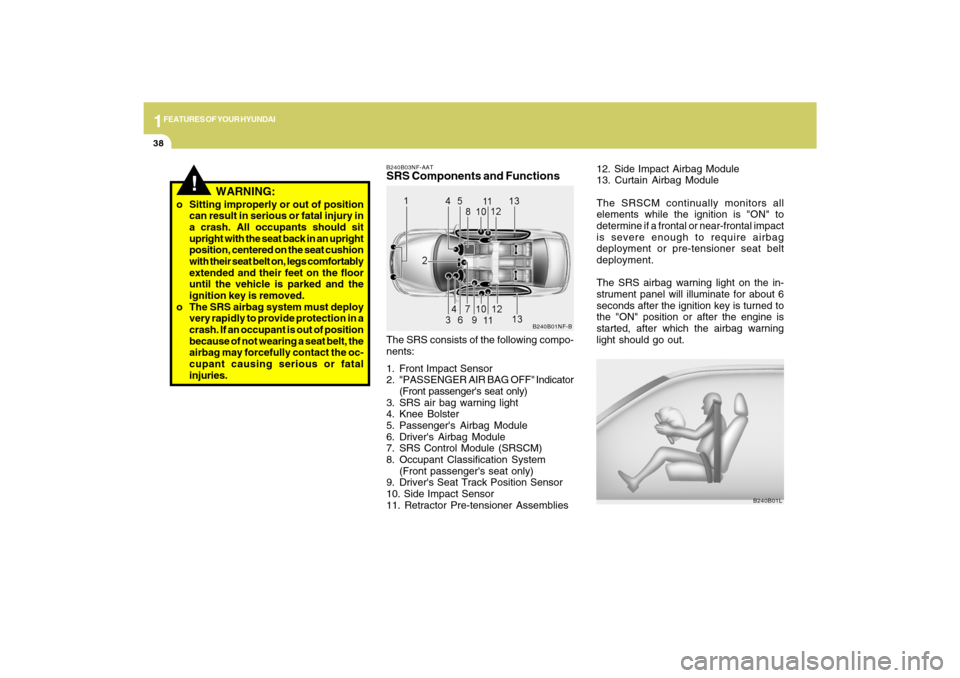
12. Side Impact Airbag Module
13. Curtain Airbag Module
The SRSCM continually monitors all
elements while the ignition is "ON" to
determine if a frontal or near-frontal impact
is severe enough to require airbag
deployment or pre-tensioner seat belt
deployment.
The SRS airbag warning light on the in-
strument panel will illuminate for about 6
seconds after the ignition key is turned to
the "ON" position or after the engine is
started, after which the airbag warning
light should go out.
!
WARNING:
o Sitting improperly or out of position
can result in serious or fatal injury in
a crash. All occupants should sit
upright with the seat back in an upright
position, centered on the seat cushion
with their seat belt on, legs comfortably
extended and their feet on the floor
until the vehicle is parked and the
ignition key is removed.
o The SRS airbag system must deploy
very rapidly to provide protection in a
crash. If an occupant is out of position
because of not wearing a seat belt, the
airbag may forcefully contact the oc-
cupant causing serious or fatal
injuries.
B240B03NF-AATSRS Components and FunctionsThe SRS consists of the following compo-
nents:
1. Front Impact Sensor
2. "PASSENGER AIR BAG OFF" Indicator
(Front passenger's seat only)
3. SRS air bag warning light
4. Knee Bolster
5. Passenger's Airbag Module
6. Driver's Airbag Module
7. SRS Control Module (SRSCM)
8. Occupant Classification System
(Front passenger's seat only)
9. Driver's Seat Track Position Sensor
10. Side Impact Sensor
11. Retractor Pre-tensioner Assemblies
B240B01NF-B
B240B01L
Page 53 of 286
1FEATURES OF YOUR HYUNDAI40
B990A02NF-AATOCCUPANT CLASSIFICATION SYS-
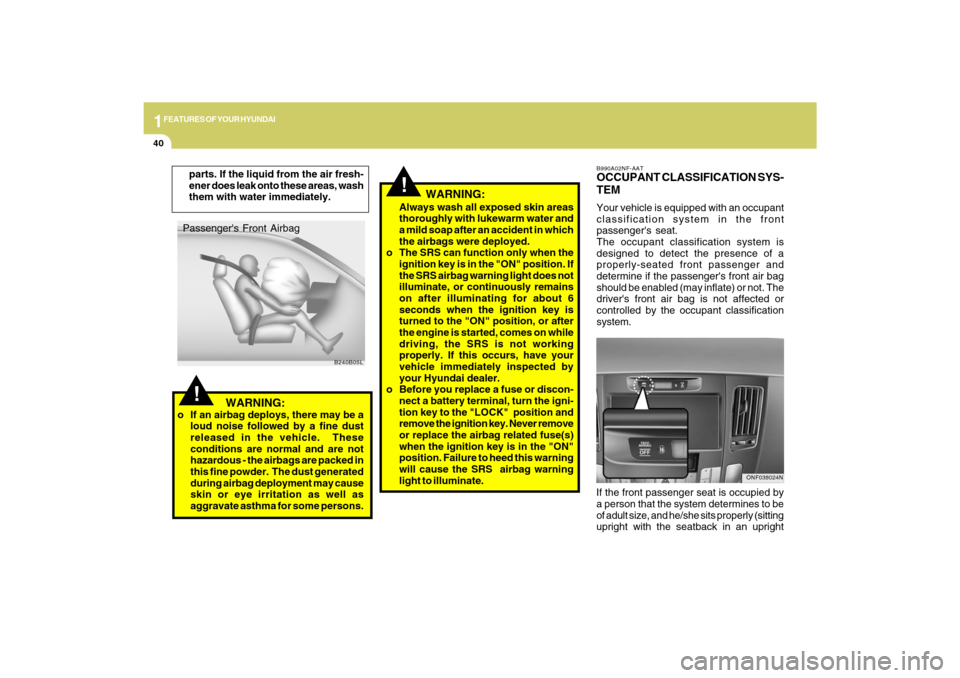
TEMYour vehicle is equipped with an occupant
classification system in the front
passenger's seat.
The occupant classification system is
designed to detect the presence of a
properly-seated front passenger and
determine if the passenger's front air bag
should be enabled (may inflate) or not. The
driver's front air bag is not affected or
controlled by the occupant classification
system.
If the front passenger seat is occupied by
a person that the system determines to be
of adult size, and he/she sits properly (sitting
upright with the seatback in an upright
ONF038024N
!Passenger's Front Airbag
B240B05L
!Always wash all exposed skin areas
thoroughly with lukewarm water and
a mild soap after an accident in which
the airbags were deployed.
o The SRS can function only when the
ignition key is in the "ON" position. If
the SRS airbag warning light does not
illuminate, or continuously remains
on after illuminating for about 6
seconds when the ignition key is
turned to the "ON" position, or after
the engine is started, comes on while
driving, the SRS is not working
properly. If this occurs, have your
vehicle immediately inspected by
your Hyundai dealer.
o Before you replace a fuse or discon-
nect a battery terminal, turn the igni-
tion key to the "LOCK" position and
remove the ignition key. Never remove
or replace the airbag related fuse(s)
when the ignition key is in the "ON"
position. Failure to heed this warning
will cause the SRS airbag warning
light to illuminate. parts. If the liquid from the air fresh-
ener does leak onto these areas, wash
them with water immediately.
WARNING:
o If an airbag deploys, there may be a
loud noise followed by a fine dust
released in the vehicle. These
conditions are normal and are not
hazardous - the airbags are packed in
this fine powder. The dust generated
during airbag deployment may cause
skin or eye irritation as well as
aggravate asthma for some persons.
WARNING:
Page 55 of 286
1FEATURES OF YOUR HYUNDAI42
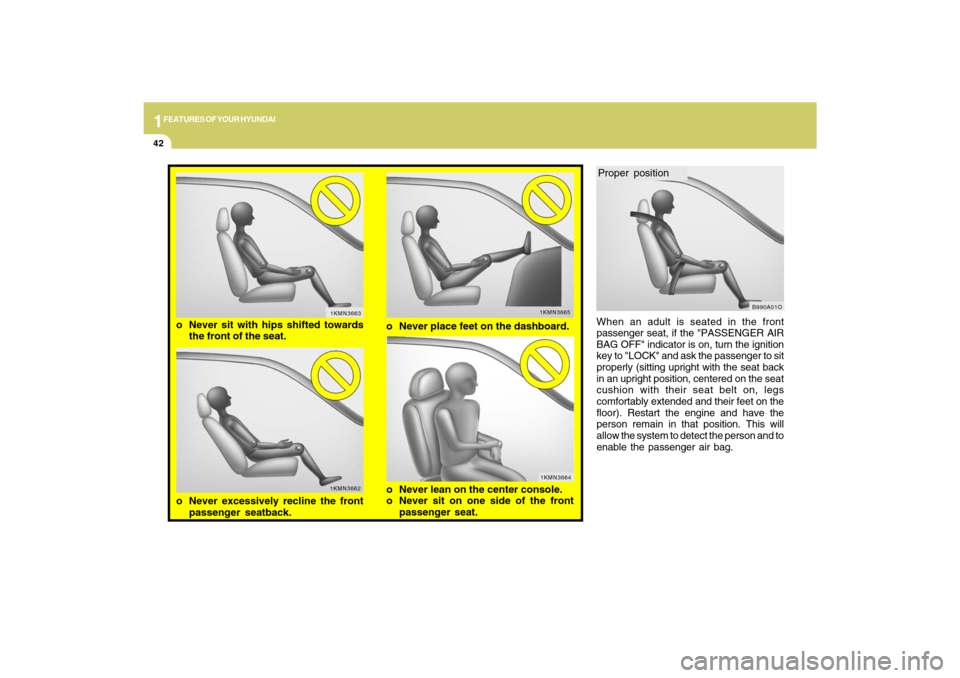
When an adult is seated in the front
passenger seat, if the "PASSENGER AIR
BAG OFF" indicator is on, turn the ignition
key to "LOCK" and ask the passenger to sit
properly (sitting upright with the seat back
in an upright position, centered on the seat
cushion with their seat belt on, legs
comfortably extended and their feet on the
floor). Restart the engine and have the
person remain in that position. This will
allow the system to detect the person and to
enable the passenger air bag.
o Never excessively recline the front
passenger seatback.
1KMN3665
1KMN3662
o Never place feet on the dashboard.
o Never sit with hips shifted towards
the front of the seat.
1KMN3663
1KMN3664
o Never lean on the center console.
o Never sit on one side of the front
passenger seat.
Proper position
B990A01O
Page 56 of 286
1
FEATURES OF YOUR HYUNDAI
43
!
!
NOTE:The "PASSENGER AIR BAG OFF"
indicator illuminates for about 4 seconds
after the ignition key is turned to the
"ON" position or after the engine is
started. If the front passenger seat is
occupied, the occupant classification
sensor will then classify the front
passenger after several more seconds.
!
WARNING:
If the occupant classification system is
not working properly, the SRS air bag
warning light on the instrument panel will
illuminate because the passenger's front
air bag is connected with the occupant
classification system. If there is a mal-
function of the occupant classification
system, the "PASSENGER AIR BAG
OFF" indicator will not illuminate and the
passenger's front air bag will inflate in
frontal impact crashes even if there is no
occupant in the front passenger's seat.
If the SRS air bag warning light does not
illuminate when the ignition key is turned
to the "ON" position, remains illumi-
nated after approximately 6 seconds
when the ignition key is turned to the
"ON" position, or if it illuminates while
the vehicle is being driven, have an au-
thorized Hyundai dealer inspect the oc-
cupant classification system and the
SRS air bag system as soon as possible. If the "PASSENGER AIR BAG OFF" indica-
tor is still on, ask the passenger to move to
the rear seat.
WARNING:
Do not allow an adult passenger to ride
in the front seat when the “PASSENGER
AIRBAG OFF” indicator is illuminated,
because the airbag will not deploy in the
event of a crash. If the "PASSENGER
AIR BAG OFF" indicator remains
illuminated after the passenger reposi-
tions themselves properly and the car is
restarted, Hyundai recommends that
passenger move to the rear seat
because the passenger's front airbag
will not deploy.
The “PASSENGER AIR BAG OFF”
indicator will not change according to
the occupants posture after the vehicle
has been running for 30 seconds. Front
seat passengers must stay properly
seated to avoid serious injury from a
deploying airbag. For more information
see page 1-42.
WARNING:
Do not put a heavy load in the front
passenger seatback pocket or on the
front passenger seat. Do not hang onto
the front passenger seat. Do not hang
any items such as seatback table on the
front passenger seatback. Do not place
feet on the front passenger seatback.
Do not place any items under the front
passenger seat. Any of these could
interfere with proper sensor operation.
Page 58 of 286
1
FEATURES OF YOUR HYUNDAI
45
!
o For best protection from the side im-
pact airbag system and to avoid being
injured by the deploying side impact
airbag, both front seat occupants
should sit in an upright position with
the seat belt properly fastened. The
driver's hands should be placed on
the steering wheel at the 9:00 and
3:00 positions. The passenger's arms
and hands should be placed on their
laps.
o Do not use any accessory seat covers.
o Use of seat covers could reduce or
prevent the effectiveness of the sys-
tem.
o Do not install any accessories on the
side or near the side impact airbag.
o Do not place any objects over the
airbag or between the airbag and
yourself.
o Do not place any objects (an umbrella,
bag, etc.) between the front door and
the front seat. Such objects may be-
come dangerous projectiles and
cause injury if the supplemental side
impact airbag inflates.
o To prevent unexpected deployment
of the side impact airbag that may
result in personal injury, avoid impact
to the side impact sensor when the
ignition key is on.
WARNING:
WARNING:
o The side impact airbag is
supplemental to the driver's and the
passenger's seat belt systems and is
not a substitute for them. Therefore
your seat belts must be worn at all
times while the vehicle is in motion.
The airbags deploy only in certain
side impact conditions severe enough
to cause significant injury to the
vehicle occupants.
!
ONF038022
Side impact
sensor
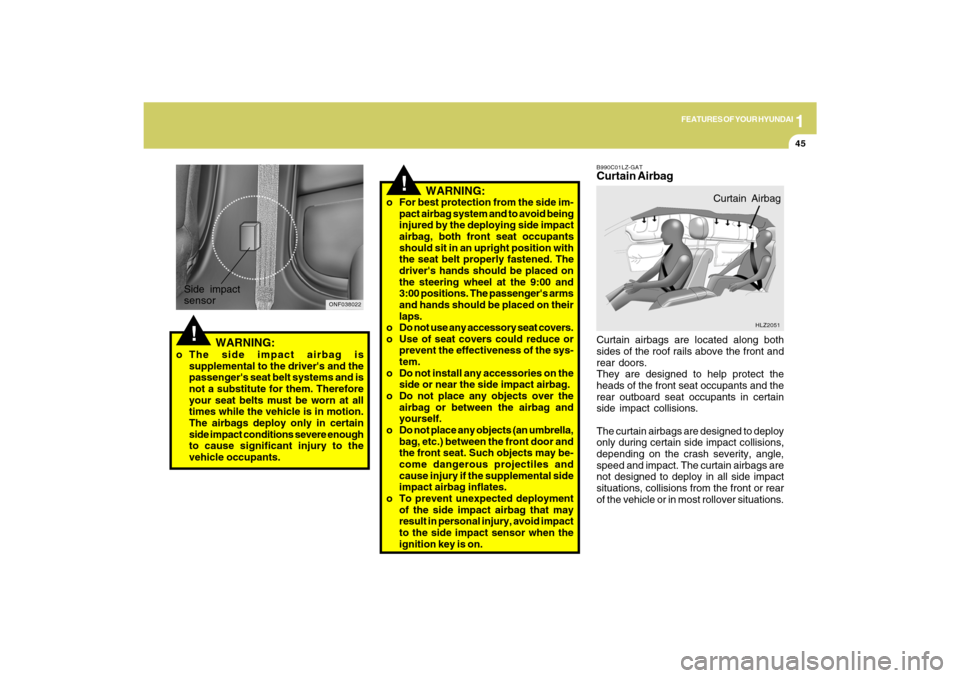
B990C01LZ-GATCurtain AirbagCurtain airbags are located along both
sides of the roof rails above the front and
rear doors.
They are designed to help protect the
heads of the front seat occupants and the
rear outboard seat occupants in certain
side impact collisions.
The curtain airbags are designed to deploy
only during certain side impact collisions,
depending on the crash severity, angle,
speed and impact. The curtain airbags are
not designed to deploy in all side impact
situations, collisions from the front or rear
of the vehicle or in most rollover situations.
HLZ2051
Curtain Airbag
Page 63 of 286
1FEATURES OF YOUR HYUNDAI50
WARNING AND INDICATOR
LIGHTSB260B01JM-AAT
SRS (Airbag) Warning Light
The SRS warning light comes on for about
6 seconds after the key is turned to the "ON"
position or after the engine is started, after
which it will go out.
This light also comes on when the SRS is
not working properly. If the airbag warning
light does not come on, or continuously
remains on after operating for about 6
seconds when you turned the ignition key
to the "ON" position or started the engine,
or if it comes on while driving, have the
SRS inspected by an authorized Hyundai
dealer.B260D01A-AAT
Turn Signal Indicator Lights
The blinking green arrows on the
instrument panel show the direction
indicated by the turn signals. If the arrow
comes on but does not blink, blinks more
rapidly than normal, or does not illuminate
at all, a malfunction in the turn signal system
is indicated. Your dealer should be
consulted for repairs.
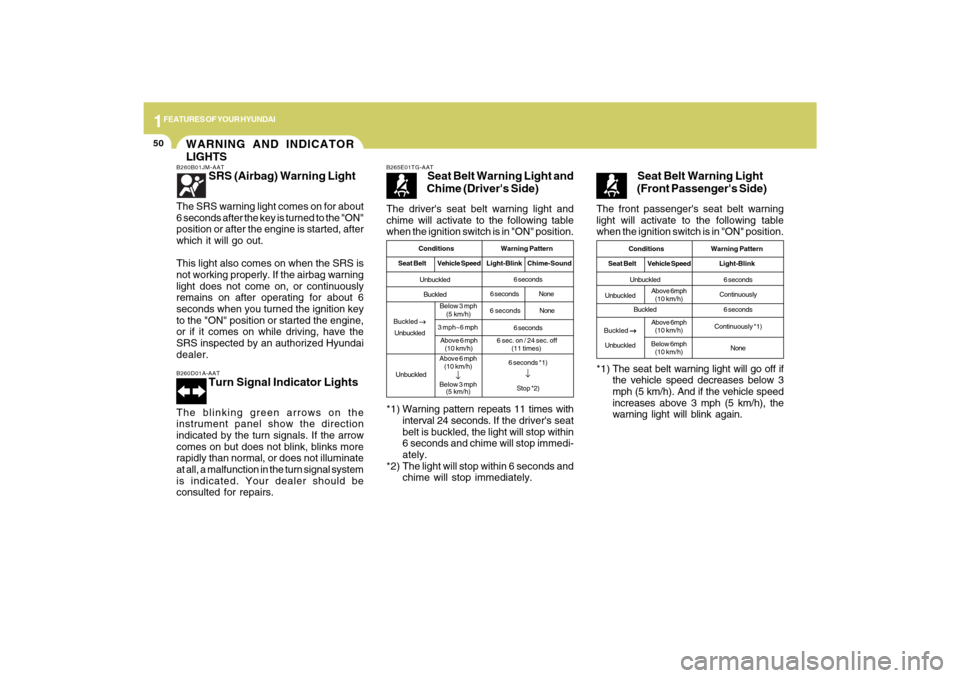
The driver's seat belt warning light and
chime will activate to the following table
when the ignition switch is in "ON" position.B265E01TG-AAT
Seat Belt Warning Light and
Chime (Driver's Side)
*1) Warning pattern repeats 11 times with
interval 24 seconds. If the driver's seat
belt is buckled, the light will stop within
6 seconds and chime will stop immedi-
ately.
*2) The light will stop within 6 seconds and
chime will stop immediately.
Conditions Warning Pattern
Seat BeltVehicle SpeedLight-Blink Chime-SoundUnbuckled
Buckled
UnbuckledAbove 6 mph
(10 km/h)
↓
Below 3 mph
(5 km/h)6 seconds
6 secondsNone
6 seconds
6 seconds *1)
↓Stop *2)
6 secondsNone
The front passenger's seat belt warning
light will activate to the following table
when the ignition switch is in "ON" position.
Seat Belt Warning Light
(Front Passenger's Side)
*1) The seat belt warning light will go off if
the vehicle speed decreases below 3
mph (5 km/h). And if the vehicle speed
increases above 3 mph (5 km/h), the
warning light will blink again.
Conditions Warning Pattern
Seat BeltVehicle SpeedLight-BlinkUnbuckled
Buckled6 seconds
Continuously
6 seconds
Continuously *1)
None
UnbuckledAbove 6mph
(10 km/h)
Buckled
→ →→ →
→
UnbuckledAbove 6mph
(10 km/h)
Below 6mph
(10 km/h)
Buckled
→ →→ →
→
UnbuckledBelow 3 mph
(5 km/h)
3 mph~6 mph
Above 6 mph
(10 km/h)
6 sec. on / 24 sec. off
(11 times)
Page 64 of 286
1
FEATURES OF YOUR HYUNDAI
51
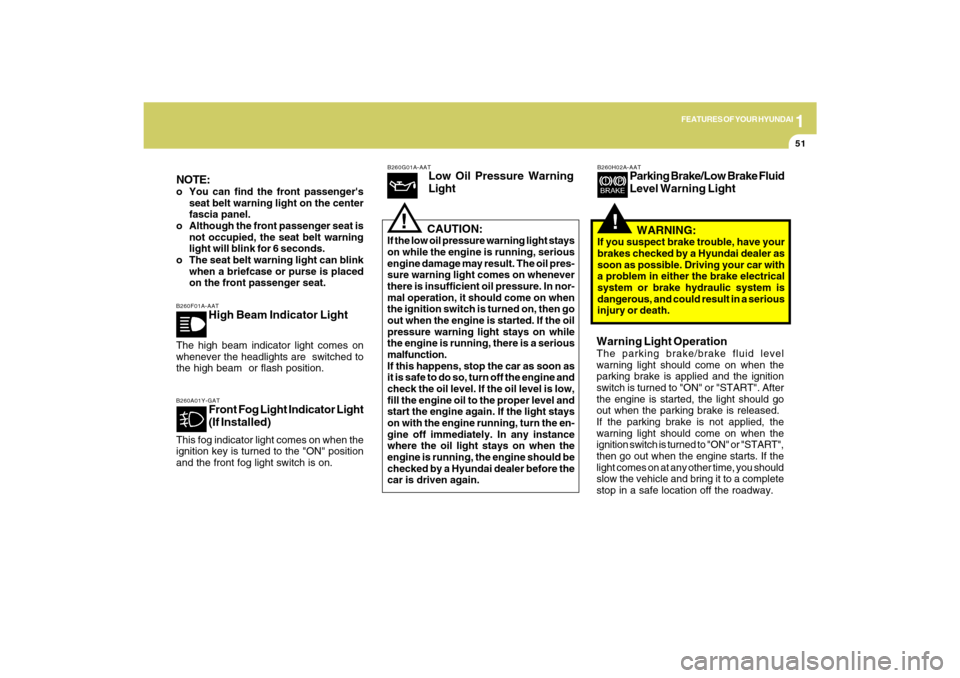
B260F01A-AAT
High Beam Indicator Light
The high beam indicator light comes on
whenever the headlights are switched to
the high beam or flash position.
B260G01A-AAT
Low Oil Pressure Warning
Light
CAUTION:
If the low oil pressure warning light stays
on while the engine is running, serious
engine damage may result. The oil pres-
sure warning light comes on whenever
there is insufficient oil pressure. In nor-
mal operation, it should come on when
the ignition switch is turned on, then go
out when the engine is started. If the oil
pressure warning light stays on while
the engine is running, there is a serious
malfunction.
If this happens, stop the car as soon as
it is safe to do so, turn off the engine and
check the oil level. If the oil level is low,
fill the engine oil to the proper level and
start the engine again. If the light stays
on with the engine running, turn the en-
gine off immediately. In any instance
where the oil light stays on when the
engine is running, the engine should be
checked by a Hyundai dealer before the
car is driven again.
!
B260A01Y-GAT
Front Fog Light Indicator Light
(If Installed)
This fog indicator light comes on when the
ignition key is turned to the "ON" position
and the front fog light switch is on.NOTE:o You can find the front passenger's
seat belt warning light on the center
fascia panel.
o Although the front passenger seat is
not occupied, the seat belt warning
light will blink for 6 seconds.
o The seat belt warning light can blink
when a briefcase or purse is placed
on the front passenger seat.
!
B260H02A-AAT
Parking Brake/Low Brake Fluid
Level Warning Light
WARNING:
If you suspect brake trouble, have your
brakes checked by a Hyundai dealer as
soon as possible. Driving your car with
a problem in either the brake electrical
system or brake hydraulic system is
dangerous, and could result in a serious
injury or death.Warning Light OperationThe parking brake/brake fluid level
warning light should come on when the
parking brake is applied and the ignition
switch is turned to "ON" or "START". After
the engine is started, the light should go
out when the parking brake is released.
If the parking brake is not applied, the
warning light should come on when the
ignition switch is turned to "ON" or "START",
then go out when the engine starts. If the
light comes on at any other time, you should
slow the vehicle and bring it to a complete
stop in a safe location off the roadway.