maintenance schedule Hyundai Sonata
[x] Cancel search | Manufacturer: HYUNDAI, Model Year: , Model line: , Model:Pages: 286, PDF Size: 9.58 MB
Page 224 of 286
6
DO-IT-YOURSELF MAINTENANCE
9
G050B01A-AATRecommended Engine CoolantUse a high quality ethylene-glycol coolant
in a 50/50 mix with water. The engine
coolant should be compatible with
aluminum engine parts. Additional
corrosion inhibitors or additives should
not be used. The cooling system must be
maintained with the correct concentration
and type of engine coolant to prevent
freezing and corrosion. Never allow the
concentration of antifreeze to exceed the
60% level or go below the 35% level, or
damage to the cooling system may result.
For proper concentration when adding or
replacing the engine coolant, refer to the
following table.
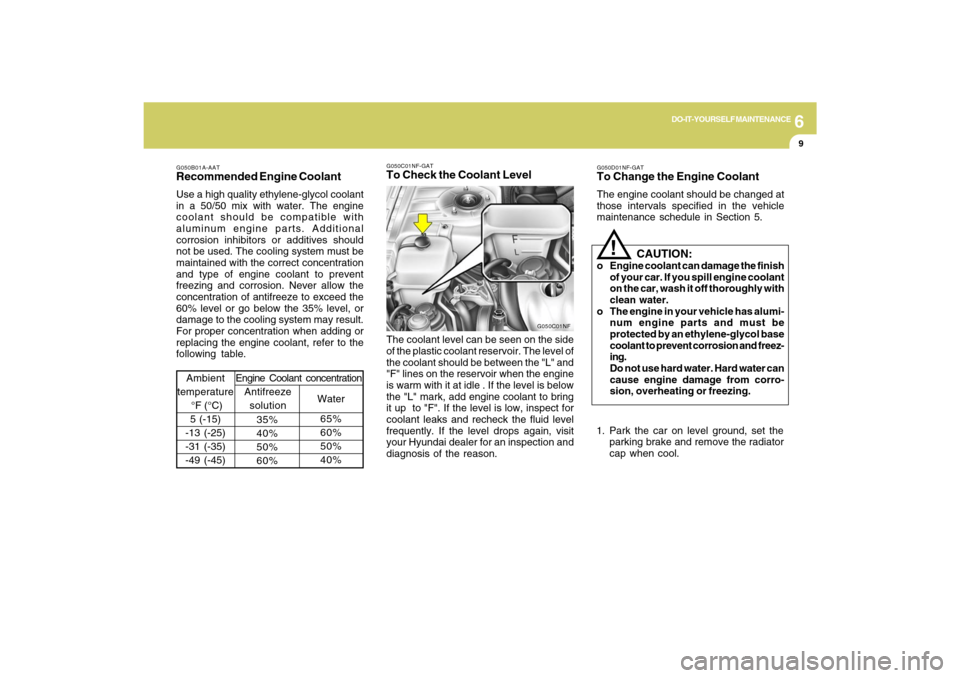
G050C01NF-GATTo Check the Coolant LevelThe coolant level can be seen on the side
of the plastic coolant reservoir. The level of
the coolant should be between the "L" and
"F" lines on the reservoir when the engine
is warm with it at idle . If the level is below
the "L" mark, add engine coolant to bring
it up to "F". If the level is low, inspect for
coolant leaks and recheck the fluid level
frequently. If the level drops again, visit
your Hyundai dealer for an inspection and
diagnosis of the reason.
G050C01NFG050D01NF-GAT
To Change the Engine CoolantThe engine coolant should be changed at
those intervals specified in the vehicle
maintenance schedule in Section 5.
CAUTION:
o Engine coolant can damage the finish
of your car. If you spill engine coolant
on the car, wash it off thoroughly with
clean water.
o The engine in your vehicle has alumi-
num engine parts and must be
protected by an ethylene-glycol base
coolant to prevent corrosion and freez-
ing.
Do not use hard water. Hard water can
cause engine damage from corro-
sion, overheating or freezing.
!
1. Park the car on level ground, set the
parking brake and remove the radiator
cap when cool. Ambient
temperature
°F (°C)
5 (-15)
-13 (-25)
-31 (-35)
-49 (-45)
65%
60%
50%
40% 35%
40%
50%
60%Water Antifreeze
solution Engine Coolant concentration
Page 229 of 286
6
DO-IT-YOURSELF MAINTENANCE
14
CAUTION:
o Radiator antifreeze (engine coolant)
should not be used in the washer
system because it will damage the
car's finish.
o The washer lever should not be pulled
and the washer should not be operated
if the washer reservoir is empty. This
can damage the washer fluid pump.
!
A good quality washer fluid should be
used to fill the washer reservoir. The fluid
level should be checked more frequently
during bad weather or whenever the
washer system is in more frequent use.
The capacity of the washer reservoir is 3.2
U.S. quarts (4.0 liters).
!
WARNING:
It is always better to check the transaxle
oil level when the engine is cool or cold.
If the engine is hot, you should exercise
great caution to avoid burning yourself
on hot engine or exhaust parts.
CHECKING THE TRANSAXLE
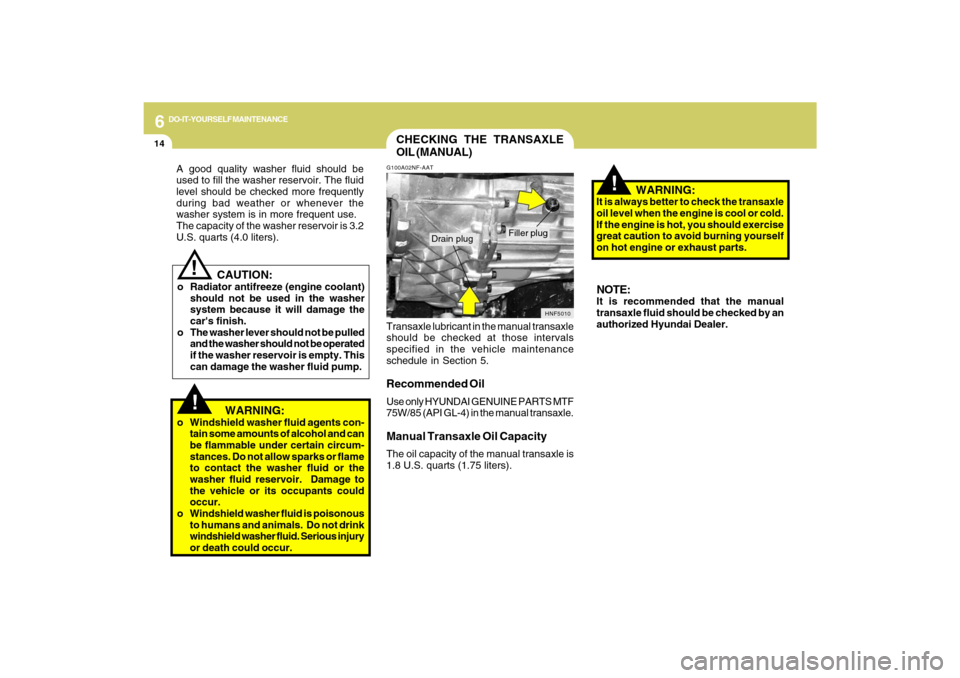
OIL (MANUAL)G100A02NF-AAT
HNF5010
Filler plug
Drain plug
Transaxle lubricant in the manual transaxle
should be checked at those intervals
specified in the vehicle maintenance
schedule in Section 5.Recommended OilUse only HYUNDAI GENUINE PARTS MTF
75W/85 (API GL-4) in the manual transaxle.Manual Transaxle Oil CapacityThe oil capacity of the manual transaxle is
1.8 U.S. quarts (1.75 liters).
!
WARNING:
o Windshield washer fluid agents con-
tain some amounts of alcohol and can
be flammable under certain circum-
stances. Do not allow sparks or flame
to contact the washer fluid or the
washer fluid reservoir. Damage to
the vehicle or its occupants could
occur.
o Windshield washer fluid is poisonous
to humans and animals. Do not drink
windshield washer fluid. Serious injury
or death could occur.
NOTE:It is recommended that the manual
transaxle fluid should be checked by an
authorized Hyundai Dealer.
Page 230 of 286
6
DO-IT-YOURSELF MAINTENANCE
15
CHECKING THE TRANSAXLE
FLUID (AUTOMATIC)G110A01E-AATTransaxle fluid in the automatic transaxle
should be checked at those intervals
specified in the vehicle maintenance
schedule in Section 5.NOTE:Automatic transaxle fluid is basically
red in color. As driving distance in-
creases, the fluid color turns darkish red
gradually. It is a normal condition and
you should not judge the need to replace
based upon the changing color.
You must replace the automatic
transaxle fluid in accordance with
intervals specified in the vehicle
maintenance schedule in section 5.
!
G110B05A-AATRecommended Fluid
Your Hyundai automatic transaxle is
specially designed to operate with
HYUNDAI GENUINE ATF SP III, DIAMOND
ATF SP III, SK ATF SP III or other brands
meeting the SP III specification approved
by Hyundai Motor Co.. Damage caused
by a nonspecified fluid is not covered by
your new vehicle limited warranty.
CAUTION:
Use of aftermarket ATF additives may
cause damage to the automatic
transaxle.
Only use HYUNDAI GENUINE ATF SP III,
DIAMOND ATF SP III, SK ATF SP III or
other brands meeting the SP III specifi-
cation approved by Hyundai Motor Co..
If you are having your vehicle serviced
at a facility other than a Hyundai dealer,
verify that the correct ATF is used for
your vehicle.
!
G110C01NF-AATTransaxle Fluid CapacityThe fluid capacity of the automatic
transaxle is:
WARNING:
The transaxle fluid level should be
checked when the engine is at normal
operating temperature. This means that
the engine, radiator, radiator hose,
exhaust system etc., are very hot.
Exercise great care not to burn yourself
during this procedure.2.4L
3.3L
8.24 U.S. quarts (7.8 liters)
11.52 U.S. quarts (10.9 liters)
Page 232 of 286
6
DO-IT-YOURSELF MAINTENANCE
17
CHECKING THE BRAKES!
G120B01A-AATChecking the Brake Fluid Level
WARNING:Use caution when handling brake fluid. It
can damage your vision if it gets into
your eyes. It will also damage your
vehicle's paint if spilled on it and not
removed immediately.
!
WARNING:
The cooling fan is controlled by engine
coolant temperature and may
sometimes operate even when the
engine is not running. Use extreme
caution when working near the blades of
the cooling fan so that you are not injured
by a rotating fan blade. As the engine
coolant temperature decreases, the fan
will automatically shut off. This is a
normal condition.
G120A01A-AAT
CAUTION:
Because brakes are essential to the
safe operation of the car, it is suggested
that they be checked and inspected by
your Hyundai dealer. The brakes should
be checked and inspected for wear at
those intervals specified in the vehicle
maintenance schedule in Section 5.
!
G120D01A-AATTo Check the Fluid LevelThe fluid level in the brake fluid reservoir
should be checked periodically. The level
should be between the "MIN" and "MAX"
marks on the side of the reservoir. If the
level is at or below the "MIN" mark, carefully
add fluid to bring it up to "MAX". Do not
overfill.G120C02A-AATRecommended Brake FluidUse only hydraulic brake fluid conforming
to DOT 3 or DOT 4 specifications in your
braking system. Follow the instructions
printed on the container.
Page 234 of 286
6
DO-IT-YOURSELF MAINTENANCE
19
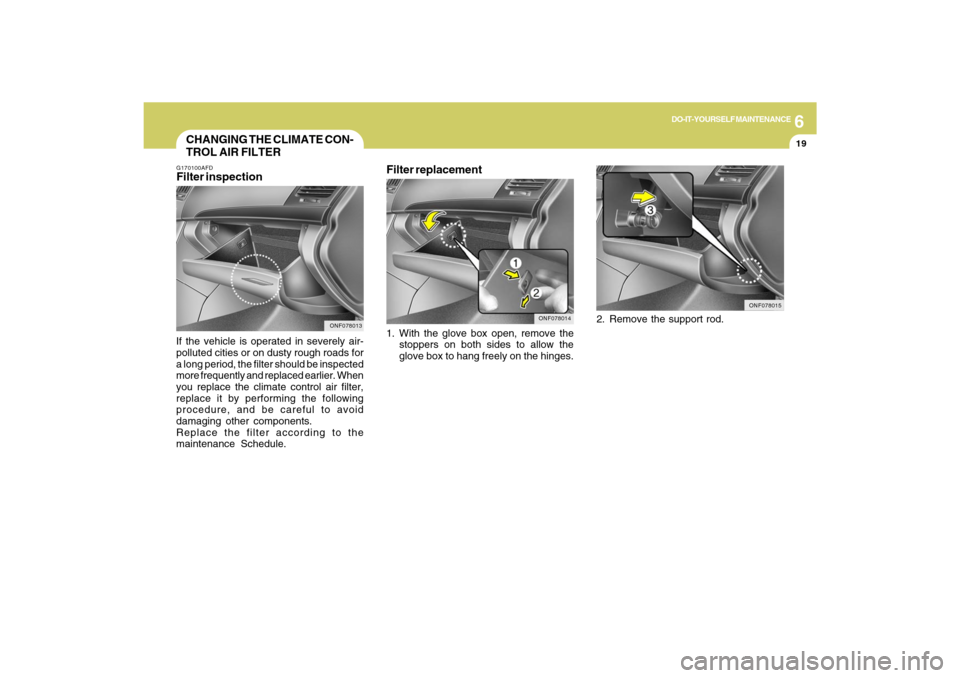
1. With the glove box open, remove the
stoppers on both sides to allow the
glove box to hang freely on the hinges.
ONF078014
CHANGING THE CLIMATE CON-
TROL AIR FILTERG170100AFDFilter inspectionIf the vehicle is operated in severely air-
polluted cities or on dusty rough roads for
a long period, the filter should be inspected
more frequently and replaced earlier. When
you replace the climate control air filter,
replace it by performing the following
procedure, and be careful to avoid
damaging other components.
Replace the filter according to the
maintenance Schedule.
ONF078013
2. Remove the support rod.
ONF078015
Filter replacement
Page 241 of 286
6
DO-IT-YOURSELF MAINTENANCE
26
G240A01A-AATPOWER STEERING HOSESIt is suggested that you check the power
steering hose connections for fluid leakage
at those intervals specified in the vehicle
maintenance schedule in Section 5.
The power steering hoses should be
replaced if there is severe surface crack-
ing, pulling, scuffing or worn spots.
Deterioration of the hose could cause
premature failure.
POWER STEERING FLUID
LEVELG230A01NF-AAT
Recommended FluidUse PSF-4 type fluidNOTE:Do not start the engine when the power
steering oil reservoir is empty.
ONF078007
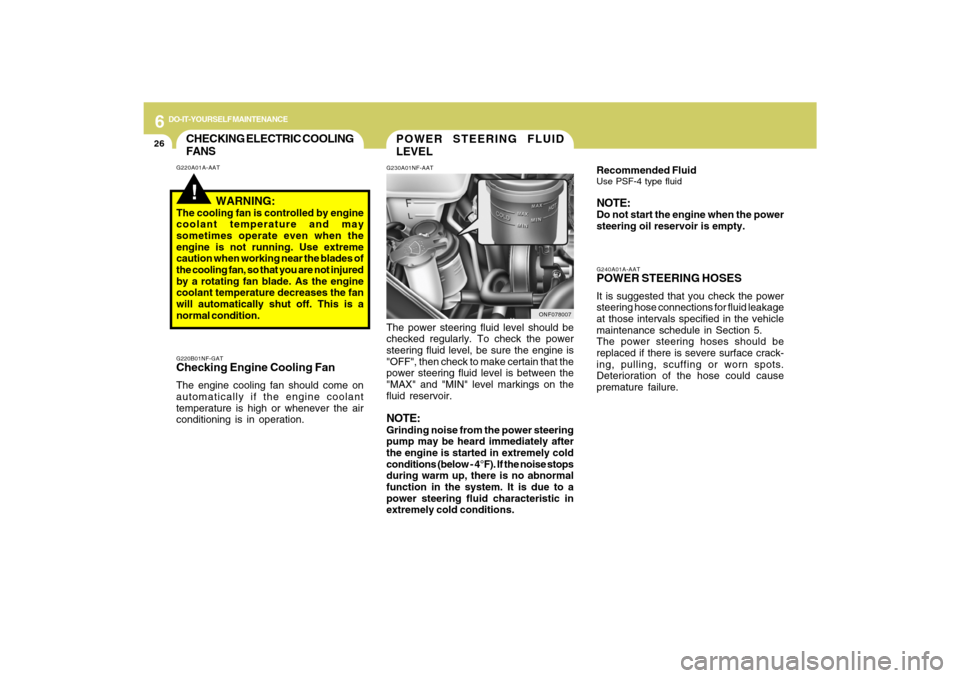
The power steering fluid level should be
checked regularly. To check the power
steering fluid level, be sure the engine is
"OFF", then check to make certain that the
power steering fluid level is between the
"MAX" and "MIN" level markings on the
fluid reservoir.NOTE:Grinding noise from the power steering
pump may be heard immediately after
the engine is started in extremely cold
conditions (below - 4°F). If the noise stops
during warm up, there is no abnormal
function in the system. It is due to a
power steering fluid characteristic in
extremely cold conditions.
CHECKING ELECTRIC COOLING
FANS!
G220A01A-AAT
WARNING:
The cooling fan is controlled by engine
coolant temperature and may
sometimes operate even when the
engine is not running. Use extreme
caution when working near the blades of
the cooling fan, so that you are not injured
by a rotating fan blade. As the engine
coolant temperature decreases the fan
will automatically shut off. This is a
normal condition.G220B01NF-GATChecking Engine Cooling FanThe engine cooling fan should come on
automatically if the engine coolant
temperature is high or whenever the air
conditioning is in operation.
Page 257 of 286
7
EMISSION CONTROL SYSTEMS2
EMISSION CONTROL
SYSTEMS
H010B01A-AAT1. Crankcase Emission Control Sys-
temThe positive crankcase ventilation system
is employed to prevent air pollution caused
by blow-by gases being emitted from the
crankcase. This system supplies fresh
filtered air to the crankcase through the air
intake hose. Inside the crankcase, the fresh
air mixes with blow-by gases, which then
pass through the PCV valve into the
induction system.
CanisterFuel vapors generated inside the fuel tank
are absorbed and stored in the onboard
canister. When the engine is running, the
fuel vapors absorbed in the canister are
drawn into the surge tank through the
purge control solenoid valve.Purge Control Solenoid Valve (PCSV)The purge control solenoid valve is
controlled by the Engine Control Module
(ECM); when the engine coolant
temperature is low during idling, the PCSV
closes so that evaporated fuel is not taken
into the engine. After the engine warms-up
during ordinary driving, the PCSV opens
to introduce evaporated fuel to the engine.H010D01A-AAT3. Exhaust Emission Control
SystemThe Exhaust Emission Control System is a
highly effective system which controls
exhaust emissions while maintaining good
vehicle performance.
H010A01NF-AATYour Hyundai is equipped with an emission
control system to meet all emission
regulations.
There are three emission control systems
which are as follows.
(1) Crankcase emission control system
(2) Evaporative emission control system
(3) Exhaust emission control system
In order to assure the proper function of the
emission control systems, it is
recommended that you have your car
inspected and maintained by an authorized
Hyundai dealer in accordance with the
maintenance schedule in this manual.
Caution for the Inspection and Mainte-
nance Test With Electronic Stability
Control (ESC) system
o To prevent the vehicle from misfiring
during dynamometer testing, turn the
Electronic Stability Control (ESC) sys-
tem off by pressing the ESC switch.
o After dynamometer testing is com-
pleted, turn the ESC system back on
by pressing the ESC switch again.
H010C01S-AAT2. Evaporative Emission Control (In-
cluding ORVR: Onboard Refueling
Vapor Recovery) SystemThe Evaporative Emission Control System
is designed to prevent fuel vapors from
escaping into the atmosphere.
(The ORVR system is designed to allow
the vapors from the fuel tank to be loaded
into a canister while refueling at the gas
station, preventing the escape of fuel
vapors into the atmosphere.)
Page 283 of 286

10
INDEX
4
Fuel
Capacity............................................................................ 9-2
Gauge..............................................................................1-55
Recommendations............................................................ 1-2
Fuel Filler Lid
Remote release ..............................................................1-85
Fuse Panel Description .....................................................6-37
Fuses..................................................................................6-22
G
General Checks ................................................................... 6-4
Glove Box ...........................................................................1-73
H
Hazard Warning System ....................................................1-65
Headlight
Aiming adjustment ..........................................................6-27
Replacement...................................................................6-28
Switch..............................................................................1-61
Heating and Cooling Control ............................................1-96
Heating and Ventilation
Air flow control ................................................... 1-98, 1-108
Air intake control switch ..................................... 1-99, 1-107
Bi-level heating .............................................................1-100
Defrosting/Defogging....................................................1-103
Fan speed control (Blower Control) .................. 1-97, 1-107
Temperature control .......................................................1-97
High-Mounted Rear Stop Light .........................................1-85
Hood Release ....................................................................1-87
Horn....................................................................................1-90I
Ignition Switch ...................................................................... 2-3
Instrument Cluster and Indicator Lights ............................1-48
Instrument Panel Light Control (Rheostat) .......................1-66
Interior Light .......................................................................1-72
Intermittent Wiper ...............................................................1-64
J
Jump Starting ....................................................................... 3-3
K
Key ........................................................................................ 1-3
If you lose your keys ......................................................3-18
Positions............................................................................ 2-3
L
Light Bulb Watages ............................................................6-36
Light Bulbs Replacement ..................................................6-28
Lubrication Chart .................................................................. 9-4
M
Maintenance Intervals
Explanation of scheduled maintenance items ................ 5-7
Maintenance under severe usage conditions ................. 5-6
Scheduled maintenance .................................................. 5-4
Service requirements ........................................................ 5-2
Mirrors
Day/night inside rearview ...............................................1-76
Homelink mirror ..............................................................1-77
Outside rearview .............................................................1-75
Outside rearview mirror heater ......................................1-76