belt Hyundai Sonata
[x] Cancel search | Manufacturer: HYUNDAI, Model Year: , Model line: , Model:Pages: 286, PDF Size: 9.58 MB
Page 63 of 286
1FEATURES OF YOUR HYUNDAI50
WARNING AND INDICATOR
LIGHTSB260B01JM-AAT
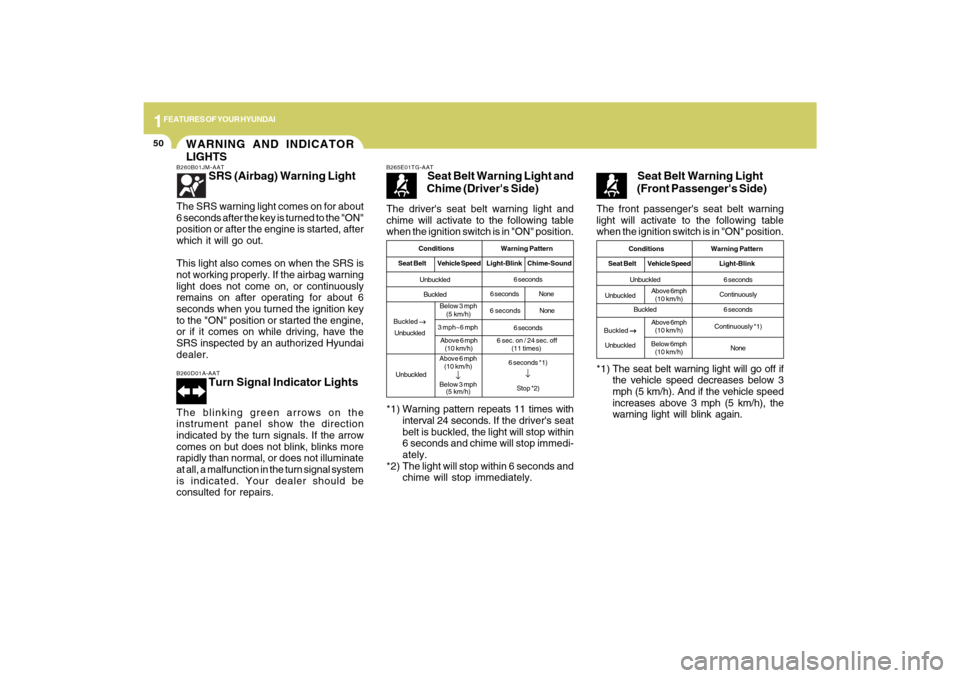
SRS (Airbag) Warning Light
The SRS warning light comes on for about
6 seconds after the key is turned to the "ON"
position or after the engine is started, after
which it will go out.
This light also comes on when the SRS is
not working properly. If the airbag warning
light does not come on, or continuously
remains on after operating for about 6
seconds when you turned the ignition key
to the "ON" position or started the engine,
or if it comes on while driving, have the
SRS inspected by an authorized Hyundai
dealer.B260D01A-AAT
Turn Signal Indicator Lights
The blinking green arrows on the
instrument panel show the direction
indicated by the turn signals. If the arrow
comes on but does not blink, blinks more
rapidly than normal, or does not illuminate
at all, a malfunction in the turn signal system
is indicated. Your dealer should be
consulted for repairs.
The driver's seat belt warning light and
chime will activate to the following table
when the ignition switch is in "ON" position.B265E01TG-AAT
Seat Belt Warning Light and
Chime (Driver's Side)
*1) Warning pattern repeats 11 times with
interval 24 seconds. If the driver's seat
belt is buckled, the light will stop within
6 seconds and chime will stop immedi-
ately.
*2) The light will stop within 6 seconds and
chime will stop immediately.
Conditions Warning Pattern
Seat BeltVehicle SpeedLight-Blink Chime-SoundUnbuckled
Buckled
UnbuckledAbove 6 mph
(10 km/h)
↓
Below 3 mph
(5 km/h)6 seconds
6 secondsNone
6 seconds
6 seconds *1)
↓Stop *2)
6 secondsNone
The front passenger's seat belt warning
light will activate to the following table
when the ignition switch is in "ON" position.
Seat Belt Warning Light
(Front Passenger's Side)
*1) The seat belt warning light will go off if
the vehicle speed decreases below 3
mph (5 km/h). And if the vehicle speed
increases above 3 mph (5 km/h), the
warning light will blink again.
Conditions Warning Pattern
Seat BeltVehicle SpeedLight-BlinkUnbuckled
Buckled6 seconds
Continuously
6 seconds
Continuously *1)
None
UnbuckledAbove 6mph
(10 km/h)
Buckled
→ →→ →
→
UnbuckledAbove 6mph
(10 km/h)
Below 6mph
(10 km/h)
Buckled
→ →→ →
→
UnbuckledBelow 3 mph
(5 km/h)
3 mph~6 mph
Above 6 mph
(10 km/h)
6 sec. on / 24 sec. off
(11 times)
Page 64 of 286
1
FEATURES OF YOUR HYUNDAI
51
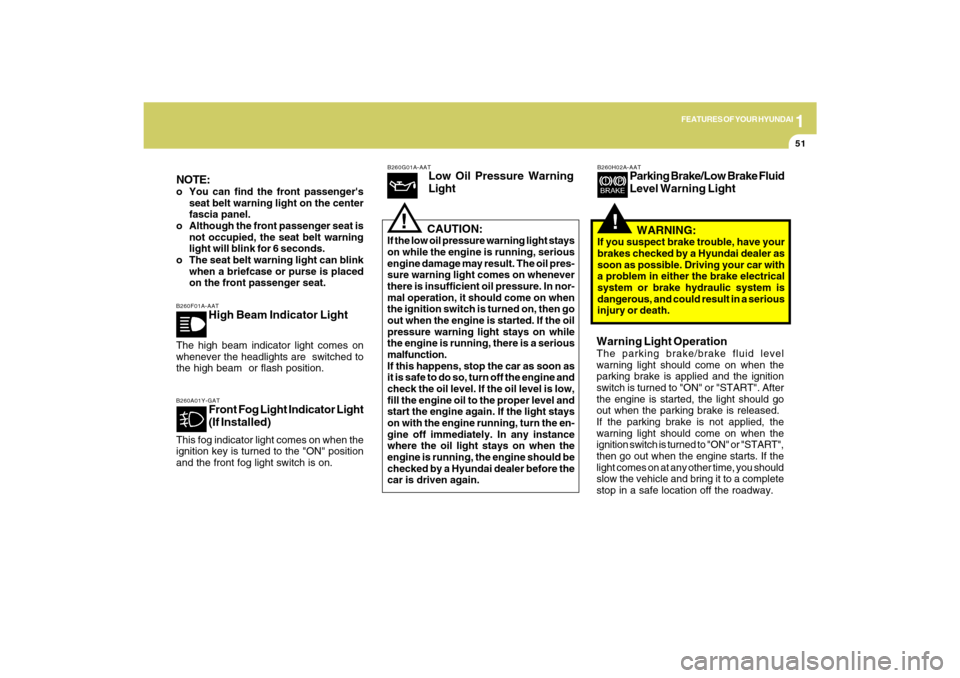
B260F01A-AAT
High Beam Indicator Light
The high beam indicator light comes on
whenever the headlights are switched to
the high beam or flash position.
B260G01A-AAT
Low Oil Pressure Warning
Light
CAUTION:
If the low oil pressure warning light stays
on while the engine is running, serious
engine damage may result. The oil pres-
sure warning light comes on whenever
there is insufficient oil pressure. In nor-
mal operation, it should come on when
the ignition switch is turned on, then go
out when the engine is started. If the oil
pressure warning light stays on while
the engine is running, there is a serious
malfunction.
If this happens, stop the car as soon as
it is safe to do so, turn off the engine and
check the oil level. If the oil level is low,
fill the engine oil to the proper level and
start the engine again. If the light stays
on with the engine running, turn the en-
gine off immediately. In any instance
where the oil light stays on when the
engine is running, the engine should be
checked by a Hyundai dealer before the
car is driven again.
!
B260A01Y-GAT
Front Fog Light Indicator Light
(If Installed)
This fog indicator light comes on when the
ignition key is turned to the "ON" position
and the front fog light switch is on.NOTE:o You can find the front passenger's
seat belt warning light on the center
fascia panel.
o Although the front passenger seat is
not occupied, the seat belt warning
light will blink for 6 seconds.
o The seat belt warning light can blink
when a briefcase or purse is placed
on the front passenger seat.
!
B260H02A-AAT
Parking Brake/Low Brake Fluid
Level Warning Light
WARNING:
If you suspect brake trouble, have your
brakes checked by a Hyundai dealer as
soon as possible. Driving your car with
a problem in either the brake electrical
system or brake hydraulic system is
dangerous, and could result in a serious
injury or death.Warning Light OperationThe parking brake/brake fluid level
warning light should come on when the
parking brake is applied and the ignition
switch is turned to "ON" or "START". After
the engine is started, the light should go
out when the parking brake is released.
If the parking brake is not applied, the
warning light should come on when the
ignition switch is turned to "ON" or "START",
then go out when the engine starts. If the
light comes on at any other time, you should
slow the vehicle and bring it to a complete
stop in a safe location off the roadway.
Page 68 of 286
1
FEATURES OF YOUR HYUNDAI
55
!
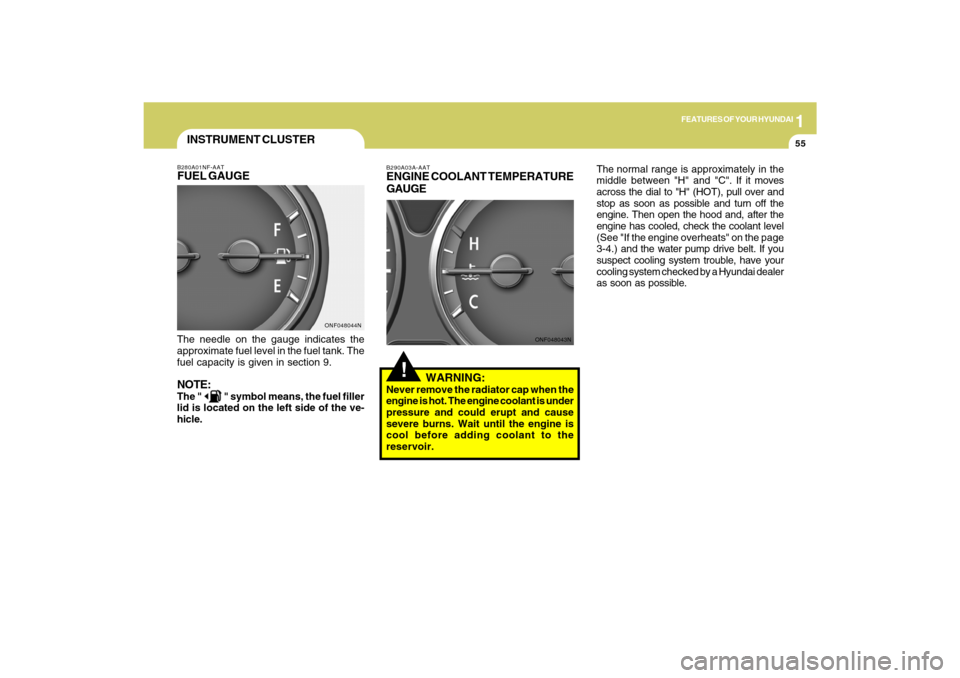
B290A03A-AATENGINE COOLANT TEMPERATURE
GAUGE
WARNING:Never remove the radiator cap when the
engine is hot. The engine coolant is under
pressure and could erupt and cause
severe burns. Wait until the engine is
cool before adding coolant to the
reservoir.The normal range is approximately in the
middle between "H" and "C". If it moves
across the dial to "H" (HOT), pull over and
stop as soon as possible and turn off the
engine. Then open the hood and, after the
engine has cooled, check the coolant level
(See "If the engine overheats" on the page
3-4.) and the water pump drive belt. If you
suspect cooling system trouble, have your
cooling system checked by a Hyundai dealer
as soon as possible.
ONF048043N
INSTRUMENT CLUSTERB280A01NF-AATFUEL GAUGEThe needle on the gauge indicates the
approximate fuel level in the fuel tank. The
fuel capacity is given in section 9.NOTE:The "
" symbol means, the fuel filler
lid is located on the left side of the ve-
hicle.
ONF048044N
Page 156 of 286
2
DRIVING YOUR HYUNDAI
3
!
BEFORE STARTING
THE ENGINEC020A01NF-AATBefore you start the engine, you should
always:
1. Look around the vehicle to be sure
there are no flat tires, puddles of oil,
water or other indications of possible
trouble.
2. After entering the car, check to be sure
the parking brake is engaged.
3. Check that all windows and lights are
clean.
4. Check that the interior and exterior
mirrors are clean and in position.
5. Check your seat, seatback and head-
rest to be sure they are in their proper
positions.
6. Lock all the doors.
7. Fasten your seat belt and be sure that all
other occupants have fastened theirs.
8. Turn off all lights and accessories that
are not needed.
9. When you turn the ignition switch to
"ON", check that all appropriate warning
lights are operating and that you have
sufficient fuel.
10. Check the operation of warning lights
and all bulbs when key is in the "ON"
position.
TO START THE ENGINEC030A01E-AATCOMBINATION IGNITION SWITCHo If your Hyundai is equipped with a
manual transaxle, place the shift lever
in neutral and depress the clutch pedal
fully.
o If your Hyundai has an automatic
transaxle, place the shift lever in "P"
(Park).
o To start the engine, insert the ignition
key and turn it to the "START" position.
Release it as soon as the engine starts.
Do not hold the key in the "START"
position for more than 15 seconds.NOTE:o For safety, the engine will not start if
the clutch pedal is not depressed fully
(Manual Transaxle) or the shift lever
is not in "P" or "N" Position (Automatic
Transaxle).
o The ignition key cannot be turned from
"ACC" position to "LOCK" position
unless the shift lever is in the "P"
(Park) position or the negative battery
terminal is disconnected from the bat-
tery. To remove the key, always
confirm that the shift lever is securely
positioned in "P" (Park) (For Automatic
Transaxle).
o For additional information about start-
ing, see page 2-5.
WARNING:
o All passengers must be properly
belted whenever the vehicle is moving.
Refer to pages: 1-21 through 1-33 for
more information on their proper use.
o Always check the surrounding areas
near your vehicle for people,
especially children, before putting a
car into 'drive'.
!
WARNING:
Always wear appropriate shoes when
operating your vehicle.
Unsuitable shoes (high heels, ski boots,
etc.) may interfere with your ability to
use the brake and accelerator pedal,
and the clutch (if installed).
!
WARNING:
When you intend to park or stop the
vehicle with the engine on, be careful not
to depress the accelerator pedal for a
long period of time. It may overheat the
engine or exhaust system and cause
fire.
Page 158 of 286
2
DRIVING YOUR HYUNDAI
5
!
STARTING!
C050A01A-AAT
WARNING:
Never run the engine in a closed or poorly
ventilated area any longer than is needed
to move your car in or out of the area. The
carbon monoxide gas emitted is odorless
and can cause serious injury or death.
C050A01E
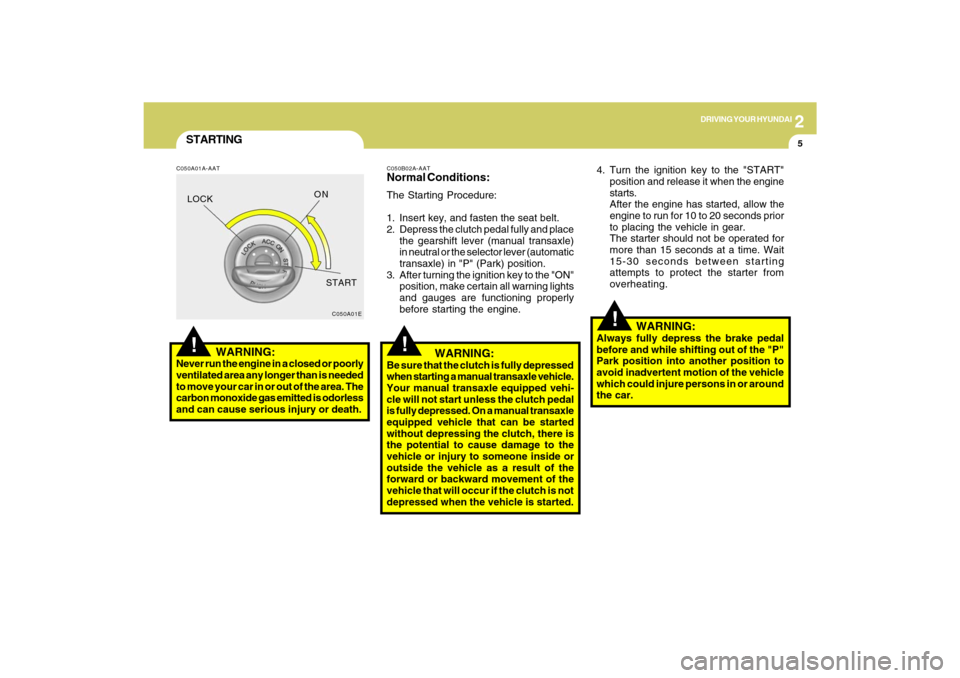
4. Turn the ignition key to the "START"
position and release it when the engine
starts.
After the engine has started, allow the
engine to run for 10 to 20 seconds prior
to placing the vehicle in gear.
The starter should not be operated for
more than 15 seconds at a time. Wait
15-30 seconds between starting
attempts to protect the starter from
overheating.
C050B02A-AATNormal Conditions:The Starting Procedure:
1. Insert key, and fasten the seat belt.
2. Depress the clutch pedal fully and place
the gearshift lever (manual transaxle)
in neutral or the selector lever (automatic
transaxle) in "P" (Park) position.
3. After turning the ignition key to the "ON"
position, make certain all warning lights
and gauges are functioning properly
before starting the engine.
WARNING:
Be sure that the clutch is fully depressed
when starting a manual transaxle vehicle.
Your manual transaxle equipped vehi-
cle will not start unless the clutch pedal
is fully depressed. On a manual transaxle
equipped vehicle that can be started
without depressing the clutch, there is
the potential to cause damage to the
vehicle or injury to someone inside or
outside the vehicle as a result of the
forward or backward movement of the
vehicle that will occur if the clutch is not
depressed when the vehicle is started.
!
WARNING:
Always fully depress the brake pedal
before and while shifting out of the "P"
Park position into another position to
avoid inadvertent motion of the vehicle
which could injure persons in or around
the car.
LOCKON
START
Page 160 of 286
2
DRIVING YOUR HYUNDAI
7
!
C070B02A-AATUsing the ClutchThe clutch should be pressed all the way
to the floor before shifting, then released
slowly. The clutch pedal should always be
fully released while driving. Do not rest
your foot on the clutch pedal while driving.
This can cause unnecessary wear. Do not
partially engage the clutch to hold the car
on an incline. This causes unnecessary
wear. Use the foot brake or parking brake
to hold the car on an incline. Do not operate
the clutch pedal rapidly and repeatedly.
WARNING:
o Always buckle-up! In a collision, an
unbelted occupant is significantly
more likely to be seriously injured or
killed than a properly belted occupant.
o Avoid high speeds when cornering or
turning.
o Do not make quick steering wheel
movements, such as sharp lane
changes or fast, sharp turns.
o The risk of rollover is greatly
increased if you lose control of your
vehicle at highway speeds.
o Loss of control often occurs if two or
more wheels drop off the roadway
and the driver oversteers to reenter
the roadway.
o In the event your vehicle leaves the
roadway, do not steer sharply. Instead,
slow down before pulling back into the
travel lanes.
o Never exceed posted speed limits.
C070D03O-AATGood Driving Practiceso Never take the car out of gear and coast
down a hill. This is extremely hazardous.
Always leave the car in gear.
o Don't "ride" the brakes. This can cause
them to overheat and malfunction.
Instead, when you are driving down a
long hill, slow down and shift to a lower
gear. When you do this, engine braking
will help slow the car.
o Slow down before shifting to a lower
gear. This will help avoid over-revving
the engine, which can cause damage.
o Slow down when you encounter cross
winds. This gives you much better control
of your car.
o Be sure the car is completely stopped
before you attempt to shift into reverse.
The transaxle can be damaged if you do
not. To shift into reverse, depress the
clutch, move the shift lever to neutral,
wait three seconds, then shift to the
reverse position.
o Exercise extreme caution when driving
on a slippery surface. Be especially
careful when braking, accelerating or
shifting gears. On a slippery surface, an
abrupt change in vehicle speed can
cause the drive wheels to lose traction
and the vehicle to go out of control.
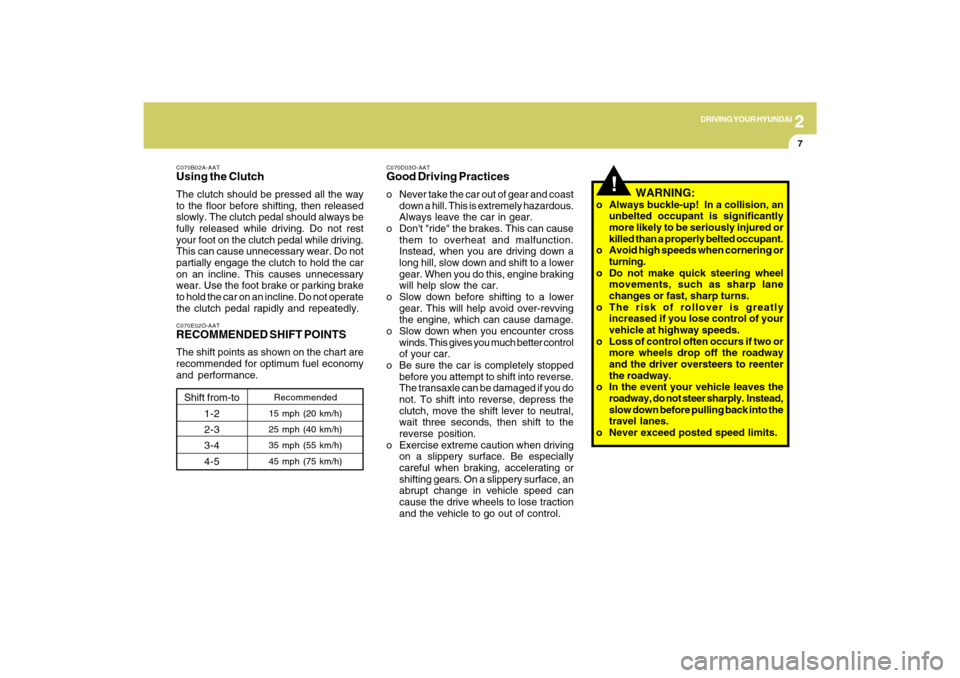
C070E02O-AATRECOMMENDED SHIFT POINTSThe shift points as shown on the chart are
recommended for optimum fuel economy
and performance.
Shift from-to
1-2
2-3
3-4
4-5
Recommended
15 mph (20 km/h)
25 mph (40 km/h)
35 mph (55 km/h)
45 mph (75 km/h)
Page 164 of 286
2
DRIVING YOUR HYUNDAI
11
!
!
C090N05O-AATGood Driving Practiceso Never move the gear selector lever
from "P" or "N" to any other position with
the accelerator pedal depressed.
o Never move the gear selector lever into
"P" when the vehicle is in motion.
o Be sure the vehicle is completely
stopped before you attempt to shift into
"R" or "D".
o Never take the vehicle out of gear and
coast down a hill. This may be extremely
hazardous. Always leave the vehicle in
gear when moving.
o Do not "ride" the brakes. This can cause
them to overheat and malfunction.
Instead, when you are driving down a
long hill, slow down and shift to a lower
gear. When you do this, engine braking
will help slow the car.
o Slow down before shifting to a lower
gear. Otherwise, the lower gear may not
be engaged.
o Always use the parking brake. Do not
depend on placing the transaxle in "P"
to keep the car from moving.
o Exercise extreme caution when driving
on a slippery surface. Be especially
careful when braking, accelerating or
shifting gears. On a slippery surface, an
abrupt change in vehicle speed can
cause the drive wheels to lose traction
and the vehicle to go out of control.
WARNING:
o Always buckle-up! In a collision, an
unbelted occupant is significantly
more likely to be seriously injured or
killed than a properly belted occupant.
o Avoid high speeds when cornering or
turning.
o Do not make quick steering wheel
movements, such as sharp lane
changes or fast, sharp turns.
o The risk of rollover is greatly
increased if you lose control of your
vehicle at highway speeds.
o Loss of control often occurs if two or
more wheels drop off the roadway
and the driver oversteers to reenter
the roadway.
o In the event your vehicle leaves the
roadway, do not steer sharply. Instead,
slow down before pulling back into the
travel lanes.
o Never exceed posted speed limits.
WARNING:
If your vehicle becomes stuck in snow,
mud, sand, etc., then you may attempt to
rock the vehicle free by moving it for-
ward and backward. Do not attempt this
procedure if people or objects are any-
where near the vehicle. During the rock-
ing operation the vehicle may suddenly
move forward or backward as it be-
comes unstuck, causing injury or
damage to nearby people or objects. o Optimum vehicle performance and
economy is obtained by smoothly de-
pressing and releasing the accelerator
pedal.
Page 172 of 286
2
DRIVING YOUR HYUNDAI
19
!
C160K01A-AATCarry Emergency EquipmentDepending on the severity of the weather
where you drive your car, you should carry
appropriate emergency equipment. Some
of the items you may want to carry include
tire chains, tow straps or chains, flashlight,
emergency flares, sand, a shovel, jumper
cables, a window scraper, gloves, ground
cloth, coveralls, a blanket, etc.
HIGHER SPEED MOTORINGC170A02A-AATPre-Trip Inspections1. Tires:
Adjust the tire inflation pressures to speci-
fication. Low tire inflation pressures will
result in overheating and possible failure
of the tires.
Avoid using worn or damaged tires which
may result in reduced traction or tire failure.NOTE:Never exceed the maximum tire inflation
pressure shown on the tires.2. Fuel, engine coolant and engine oil:
High speed travel consumes more fuel
than urban motoring. Do not forget to check
both engine coolant and engine oil.
3. Drive belt:
A loose or damaged drive belt may result
in overheating of the engine.
WARNING:
o Underinflated or overinflated tires
can cause poor handling, loss of
vehicle control, and sudden tire failure
leading to accidents, injuries, and
even death. Always check tires are
properly inflated before driving. Refer
to pages 2-23 and 8-3 for proper tire
pressures and further information.
o Driving on tires with no or insufficient
tread is dangerous. Worn-out tires
can result in loss of vehicle control,
collisions, injury, and even death.
Worn-out tires should be replaced as
soon as possible and should never be
used for driving. Always check tire
tread before driving your car. Refer
to 8-10 for further information and
tread limits.
Page 185 of 286
34WHAT TO DO IN AN EMERGENCY
IF THE ENGINE OVERHEATS
!!
!
WARNING:
While the engine is running, keep hair,
hands and clothing away from moving
parts such as the fan and drive belts to
prevent injury.
5. If the water pump drive belt is broken or
engine coolant is leaking out, stop the
engine immediately and call the nearest
Hyundai dealer for assistance.
WARNING:
Do not remove the radiator cap when the
engine is hot. This can allow coolant to be
blown out of the opening and cause se-
rious burns.6. If you cannot find the cause of the
overheat-ing, wait until the engine
temperature has returned to normal.
Then, if coolant has been lost, carefully
add coolant to the reservoir (page 6-9)
to bring the fluid level in the reservoir up
to the halfway mark.
7. Proceed with caution, keeping alert for
further signs of overheating. If
overheating happens again, call a
Hyundai dealer for assistance.
CAUTION:
Serious loss of coolant indicates there is
a leak in the cooling system and this
should be checked as soon as possible
by a Hyundai dealer.
D030A02A-AATIf your temperature gauge indicates over-
heating, you experience a loss of power, or
hear loud pinging or knocking, the engine
is probably too hot. If this happens, you
should:
1. Pull off the road and stop as soon as it
is safe to do so.
2. Place the gear selector lever in "P"
(automatic) or neutral (manual
transaxle) and set the parking brake. If
the air conditioning is on, turn it off.
3. If engine coolant is running out under
the car or steam is coming out from the
hood, stop the engine. Do not open the
hood until the coolant has stopped
running or the steaming has stopped. If
there is no visible loss of engine coolant
and no steam, leave the engine running
and check to be sure the engine cooling
fan is operating. If the fan is not running,
turn the engine off.
4. Check to see if the water pump drive belt
is missing. If it is not missing, check to
see that it is tight. If the drive belt seems
to be satisfactory, check for coolant
leaking from the radiator, hoses or under
the car. (If the air conditioning had been
in use, it is normal for cold water to be
draining from it when you stop).
Page 205 of 286
4
CORROSION PREVENTION AND APPEARANCE CARE6
ANY QUESTIONS?
E040D01A-AATCleaning the Seat BeltsTo clean the seat belts, use a cloth or
sponge with mild soap or detergent and
warm water. Do not use strong detergents,
dye, bleach or abrasive materials on the
seat belts as this may weaken the fabric.
While cleaning the belts, inspect them for
excessive wear, cuts, fraying or other signs
of damage and replace them if necessary.E040C01A-AATCleaning the CarpetsUse a foam-type carpet cleaner. Cleaners
of this type are available in aerosol cans in
liquid form or powder. Read the instructions
and follow them exactly. Using a vacuum
cleaner with the appropriate attachment,
remove as much dirt from the carpets as
possible. Apply the foam following the
manufacturer's directions, then rub in
overlapping circles. Do not add water.
These cleaners work best when the carpet
is kept as dry as possible.
E050A01A-AATIf you have any questions about the care of
your car, consult your Hyundai dealer.
E040E01A-AATCleaning the WindowsYou may use any household window
cleaner on the windows. However, when
cleaning the inside of the rear window be
careful not to damage the rear window
defroster wiring.
E040B01A-AATTo Clean the Leather Upholstery
(If Installed)In the normal course of use, leather
upholstered surfaces will, like any material,
pick-up dust and dirt. This dust and dirt
must be cleaned off or it may work into the
surface of the leather, causing damage.
Fine leather needs care, and should be
cleaned when necessary. Washing leather
thoroughly with soap and water will keep
your leather lustrous, beautiful and ensure
you have many years of wear.
Take a piece of cheese cloth and using any
mild soap and lukewarm water, work up a
good lather. Thoroughly wash the leather.
Wipe clean with a slightly damp cloth and
dry with soft cloth. Do this as often as the
leather becomes soiled.
During tanning operations, sufficient oils
are incorporated through processing that
none need be applied during the life of the
leather. Oil applied to the finished surface
will in no way help the leather and may do
more harm than good. Varnishes and
furniture polishes should never be used
under any conditions.