fuel cap Hyundai Sonata
[x] Cancel search | Manufacturer: HYUNDAI, Model Year: , Model line: , Model:Pages: 286, PDF Size: 9.58 MB
Page 15 of 286
1FEATURES OF YOUR HYUNDAI2
!
B010A01NF-A
FUEL RECOMMENDATIONS
CAUTION:
Your Hyundai's New Vehicle Limited War-
ranty may not cover damage to the fuel
system and any performance problems
that are caused by the use of fuels con-
taining methanol or fuels containing
MTBE (Methyl Tertiary Butyl Ether) over
15.0% vol. (Oxygen Content 2.7% weight.)
B010B01A-AATWhat About Gasohol?Gasohol (a mixture of 90% unleaded
gasoline and 10% ethanol or grain alcohol)
may be used in your Hyundai. However, if
your engine develops driveability
problems, the use of 100% unleaded
gasoline is recommended. Fuels with
unspecified quantities of alcohol, or
alcohols other than ethanol, should not be
used.
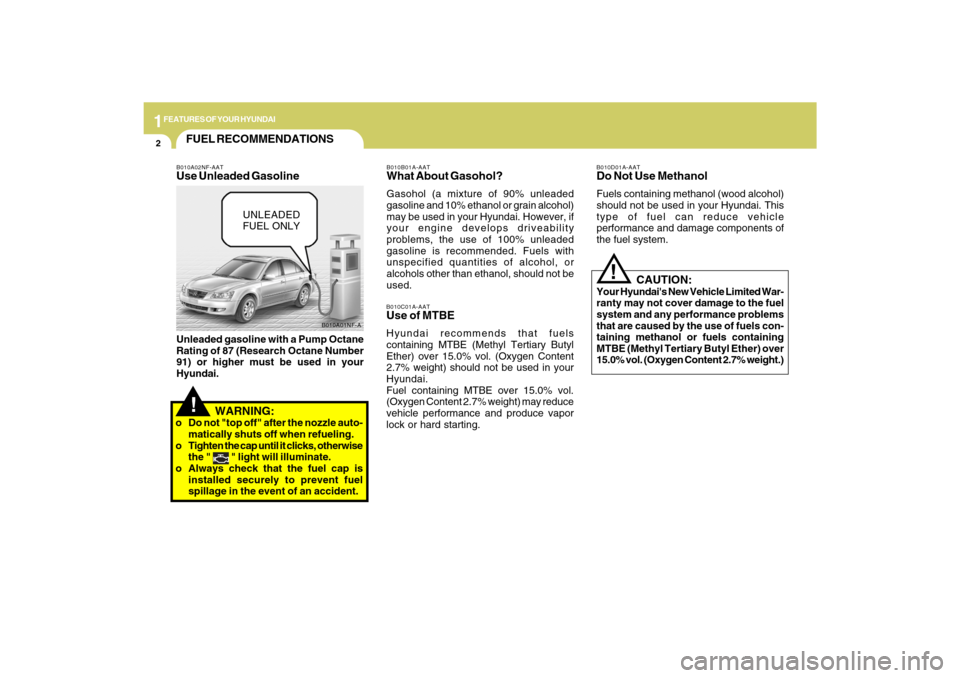
B010A02NF-AATUse Unleaded GasolineUnleaded gasoline with a Pump Octane
Rating of 87 (Research Octane Number
91) or higher must be used in your
Hyundai.
B010C01A-AATUse of MTBEHyundai recommends that fuels
containing MTBE (Methyl Tertiary Butyl
Ether) over 15.0% vol. (Oxygen Content
2.7% weight) should not be used in your
Hyundai.
Fuel containing MTBE over 15.0% vol.
(Oxygen Content 2.7% weight) may reduce
vehicle performance and produce vapor
lock or hard starting.
B010D01A-AATDo Not Use MethanolFuels containing methanol (wood alcohol)
should not be used in your Hyundai. This
type of fuel can reduce vehicle
performance and damage components of
the fuel system.
!
UNLEADED
FUEL ONLY
WARNING:
o Do not "top off" after the nozzle auto-
matically shuts off when refueling.
o Tighten the cap until it clicks, otherwise
the "
" light will illuminate.
o Always check that the fuel cap is
installed securely to prevent fuel
spillage in the event of an accident.
Page 68 of 286
1
FEATURES OF YOUR HYUNDAI
55
!
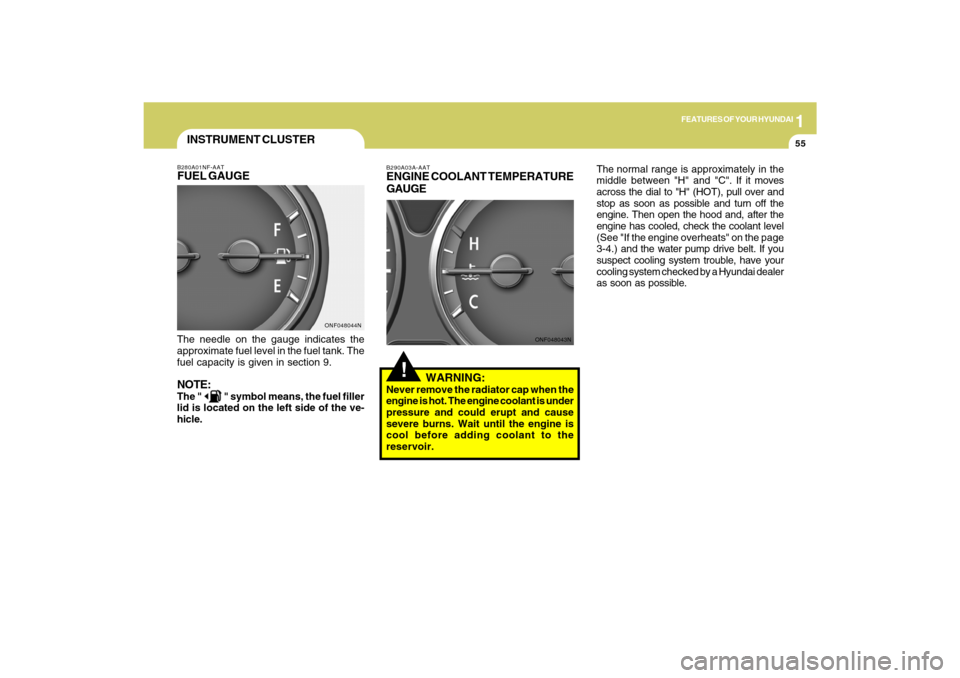
B290A03A-AATENGINE COOLANT TEMPERATURE
GAUGE
WARNING:Never remove the radiator cap when the
engine is hot. The engine coolant is under
pressure and could erupt and cause
severe burns. Wait until the engine is
cool before adding coolant to the
reservoir.The normal range is approximately in the
middle between "H" and "C". If it moves
across the dial to "H" (HOT), pull over and
stop as soon as possible and turn off the
engine. Then open the hood and, after the
engine has cooled, check the coolant level
(See "If the engine overheats" on the page
3-4.) and the water pump drive belt. If you
suspect cooling system trouble, have your
cooling system checked by a Hyundai dealer
as soon as possible.
ONF048043N
INSTRUMENT CLUSTERB280A01NF-AATFUEL GAUGEThe needle on the gauge indicates the
approximate fuel level in the fuel tank. The
fuel capacity is given in section 9.NOTE:The "
" symbol means, the fuel filler
lid is located on the left side of the ve-
hicle.
ONF048044N
Page 99 of 286
1FEATURES OF YOUR HYUNDAI86
!
WARNING:
- When using a portable fuel container,
be sure to place the container on the
ground while refueling. Static elec-
tricity discharge from the container
can ignite fuel vapors causing a fire.
While starting refueling, contact
should be maintained until the filling
is complete.
- Do not use cellular phones around a
gas station. The electric current or
electronic interference from cellular
phones can ignite fuel vapors caus-
ing a fire.
- When refueling, always turn the en-
gine off. Sparks by engine compart-
ment electrical equipment can ignite
fuel vapors causing a fire. After re-
fueling, check to make sure the fuel
filler cap is securely closed, and
then start the engine.
- Do not smoke or try to light cigarettes
around a gas station. Automotive
fuels are flammable.
o After refueling, make sure the fuel
cap is installed securely to prevent
fuel spillage in the event of an accident
o Tighten the cap until it clicks, otherwise
the "
" light will illuminate
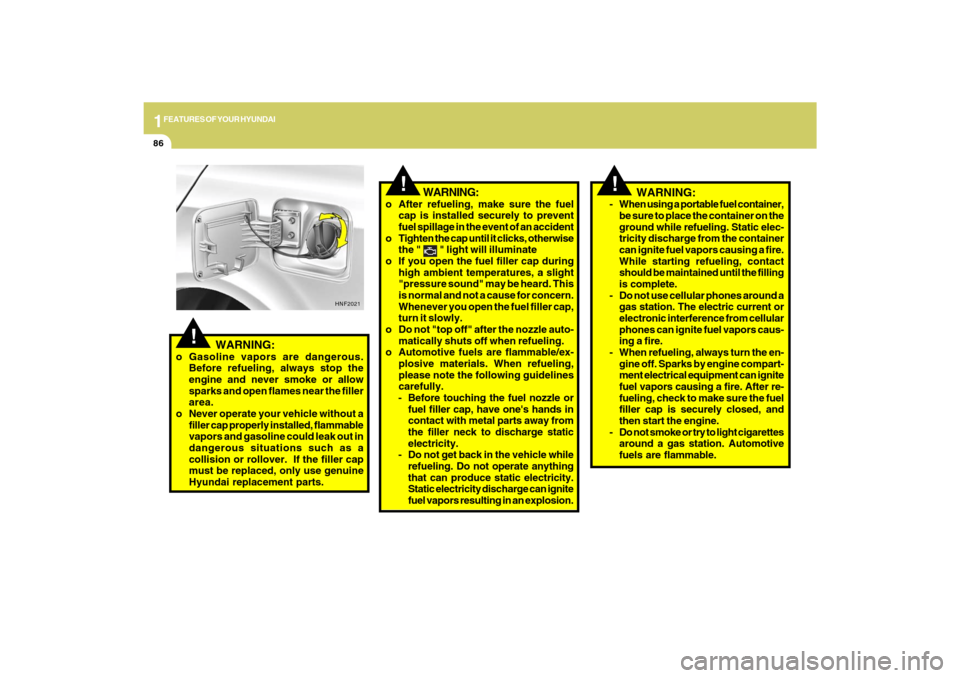
o If you open the fuel filler cap during
high ambient temperatures, a slight
"pressure sound" may be heard. This
is normal and not a cause for concern.
Whenever you open the fuel filler cap,
turn it slowly.
o Do not "top off" after the nozzle auto-
matically shuts off when refueling.
o Automotive fuels are flammable/ex-
plosive materials. When refueling,
please note the following guidelines
carefully.
- Before touching the fuel nozzle or
fuel filler cap, have one's hands in
contact with metal parts away from
the filler neck to discharge static
electricity.
- Do not get back in the vehicle while
refueling. Do not operate anything
that can produce static electricity.
Static electricity discharge can ignite
fuel vapors resulting in an explosion.
!
!
WARNING:
o Gasoline vapors are dangerous.
Before refueling, always stop the
engine and never smoke or allow
sparks and open flames near the filler
area.
o Never operate your vehicle without a
filler cap properly installed, flammable
vapors and gasoline could leak out in
dangerous situations such as a
collision or rollover. If the filler cap
must be replaced, only use genuine
Hyundai replacement parts.
HNF2021
WARNING:
Page 179 of 286
2
DRIVING YOUR HYUNDAI
26
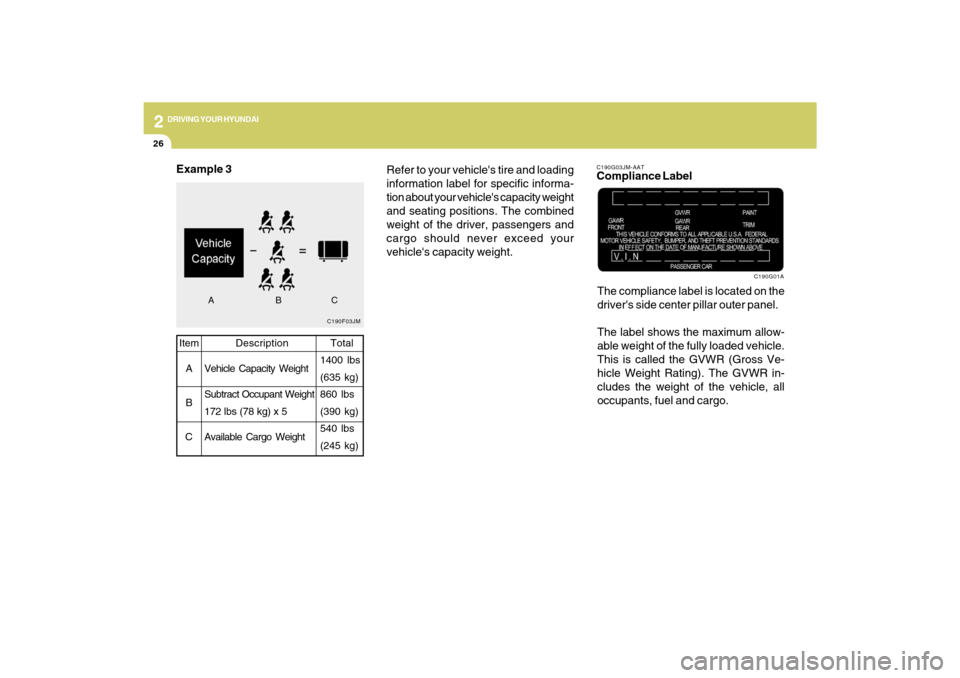
C190F03JMTotal
1400 lbs
(635 kg)
860 lbs
(390 kg)
540 lbs
(245 kg) Item
A
B
CDescription
Vehicle Capacity Weight
Subtract Occupant Weight
172 lbs (78 kg) x 5
Available Cargo Weight
Example 3
ABC
Refer to your vehicle's tire and loading
information label for specific informa-
tion about your vehicle's capacity weight
and seating positions. The combined
weight of the driver, passengers and
cargo should never exceed your
vehicle's capacity weight.
C190G03JM-AATCompliance Label
The compliance label is located on the
driver's side center pillar outer panel.
The label shows the maximum allow-
able weight of the fully loaded vehicle.
This is called the GVWR (Gross Ve-
hicle Weight Rating). The GVWR in-
cludes the weight of the vehicle, all
occupants, fuel and cargo.
C190G01A
Page 209 of 286
5
VEHICLE MAINTENANCE REQUIREMENTS4
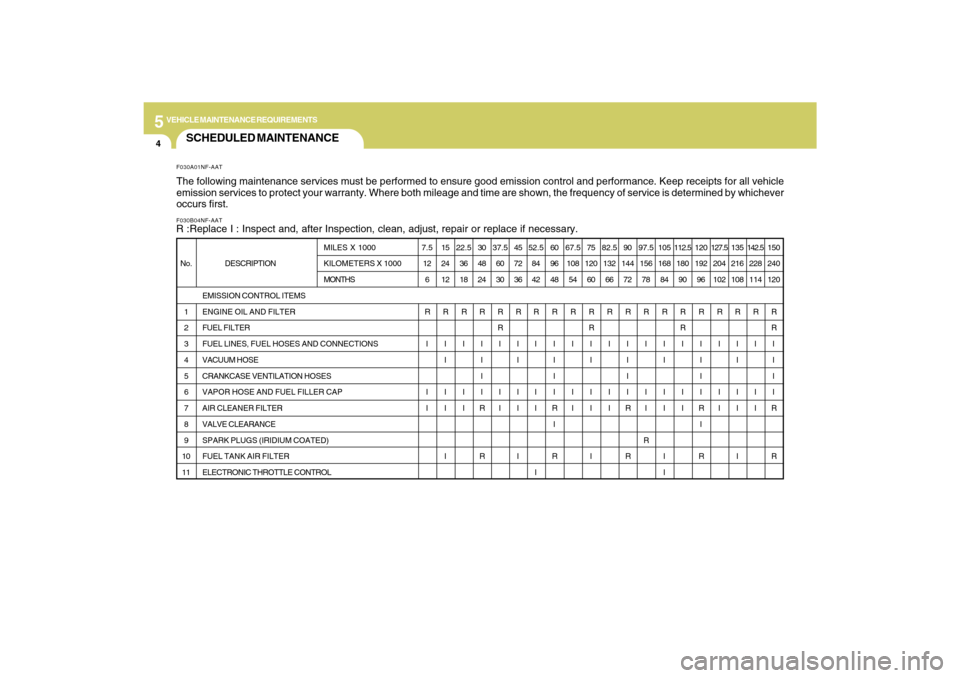
SCHEDULED MAINTENANCEF030B04NF-AATR :Replace I : Inspect and, after Inspection, clean, adjust, repair or replace if necessary.F030A01NF-AATThe following maintenance services must be performed to ensure good emission control and performance. Keep receipts for all vehicle
emission services to protect your warranty. Where both mileage and time are shown, the frequency of service is determined by whichever
occurs first.
DESCRIPTION
EMISSION CONTROL ITEMS
ENGINE OIL AND FILTER
FUEL FILTER
FUEL LINES, FUEL HOSES AND CONNECTIONS
VACUUM HOSE
CRANKCASE VENTILATION HOSES
VAPOR HOSE AND FUEL FILLER CAP
AIR CLEANER FILTER
VALVE CLEARANCE
SPARK PLUGS (IRIDIUM COATED)
FUEL TANK AIR FILTER
ELECTRONIC THROTTLE CONTROL No.
1
2
3
4
5
6
7
8
9
10
11MILES X 1000
KILOMETERS X 1000
MONTHS7.5
12
6
R
I
I
I15
24
12
R
I
I
I
I
I22.5
36
18
R
I
I
I30
48
24
R
I
I
I
I
R
R37.5
60
30
R
R
I
I
I45
72
36
R
I
I
I
I
I52.5
84
42
R
I
I
I
I60
96
48
R
I
I
I
I
R
I
R67.5
108
54
R
I
I
I75
120
60
R
R
I
I
I
I
I82.5
132
66
R
I
I
I90
144
72
R
I
I
I
I
R
R97.5
156
78
R
I
I
I
R105
168
84
R
I
I
I
I
I
I112.5
180
90
R
R
I
I
I120
192
96
R
I
I
I
I
R
I
R127.5
204
102
R
I
I
I135
216
108
R
I
I
I
I
I142.5
228
114
R
I
I
I150
240
120
R
R
I
I
I
I
R
R
Page 213 of 286

5
VEHICLE MAINTENANCE REQUIREMENTS8
F070G02A-AATo Brake FluidCheck brake fluid level in the brake fluid
reservoir. The level should be between
"MIN" and "MAX" marks on the side of the
reservoir. Use only hydraulic brake fluid
conforming to DOT 3 or DOT 4.F070F01A-AATo Brake Hoses and LinesVisually check for proper installation,
chafing, cracks, deterioration and any
leakage. Replace any deteriorated or
damaged parts immediately.
F070E06A-AATo Automatic Transaxle FluidThe fluid level should be in the “HOT”
range of the dipstick, after the engine and
transaxle are at normal operating
temperature. Check the automatic
transaxle fluid level with the engine running
and the transaxle in neutral, with the
parking brake properly applied. Use
HYUNDAI GENUINE ATF SP III, DIAMOND
ATF SP III, SK ATF SP III or other brands
meeting the SP III specification approved
by Hyundai Motor Co. when adding or
changing fluid. Using the wrong ATF may
result in damage to the ATM.
F070H01A-AATo Rear Brake Drums and Linings/
Parking BrakeCheck the rear brake drums and linings for
scoring, burning, leaking fluid, broken parts,
and excessive wear. Inspect the parking
brake system including the parking brake
lever and cables. For detailed service
procedures, refer to the Shop Manual.
F070C01A-AATo CoolantThe coolant should be changed at the
intervals specified in the maintenance
schedule.
F060J01A-AATo Spark PlugsMake sure to install new spark plugs of the
correct heat range.F060H01A-AATo Air Cleaner FilterA Genuine Hyundai air cleaner filter is
recommended when the filter is replaced.F060G01A-AATo Vapor Hose and Fuel Filler CapThe vapor hose and fuel filler cap should
be inspected at those intervals specified in
the maintenance schedule. Make sure that
a new vapor hose or fuel filler cap is correctly
replaced.
F070D01A-AATo Manual Transaxle OilInspect the manual transaxle oil according
to the maintenance schedule.NOTE:If the oil level is low, check for possible
leaks before adding oil. Do not overfill.
F060N02E-AATo Valve ClearanceInspect excessive valve noise and/or
engine vibration and adjust if necessary. A
qualified technician should perform the
operation.
Page 257 of 286
7
EMISSION CONTROL SYSTEMS2
EMISSION CONTROL
SYSTEMS
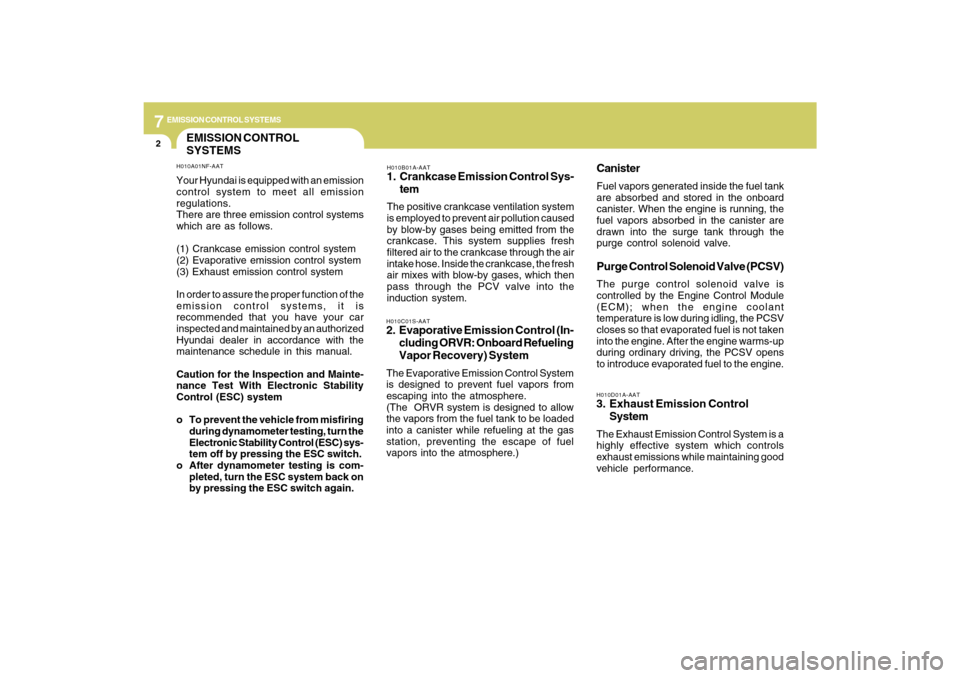
H010B01A-AAT1. Crankcase Emission Control Sys-
temThe positive crankcase ventilation system
is employed to prevent air pollution caused
by blow-by gases being emitted from the
crankcase. This system supplies fresh
filtered air to the crankcase through the air
intake hose. Inside the crankcase, the fresh
air mixes with blow-by gases, which then
pass through the PCV valve into the
induction system.
CanisterFuel vapors generated inside the fuel tank
are absorbed and stored in the onboard
canister. When the engine is running, the
fuel vapors absorbed in the canister are
drawn into the surge tank through the
purge control solenoid valve.Purge Control Solenoid Valve (PCSV)The purge control solenoid valve is
controlled by the Engine Control Module
(ECM); when the engine coolant
temperature is low during idling, the PCSV
closes so that evaporated fuel is not taken
into the engine. After the engine warms-up
during ordinary driving, the PCSV opens
to introduce evaporated fuel to the engine.H010D01A-AAT3. Exhaust Emission Control
SystemThe Exhaust Emission Control System is a
highly effective system which controls
exhaust emissions while maintaining good
vehicle performance.
H010A01NF-AATYour Hyundai is equipped with an emission
control system to meet all emission
regulations.
There are three emission control systems
which are as follows.
(1) Crankcase emission control system
(2) Evaporative emission control system
(3) Exhaust emission control system
In order to assure the proper function of the
emission control systems, it is
recommended that you have your car
inspected and maintained by an authorized
Hyundai dealer in accordance with the
maintenance schedule in this manual.
Caution for the Inspection and Mainte-
nance Test With Electronic Stability
Control (ESC) system
o To prevent the vehicle from misfiring
during dynamometer testing, turn the
Electronic Stability Control (ESC) sys-
tem off by pressing the ESC switch.
o After dynamometer testing is com-
pleted, turn the ESC system back on
by pressing the ESC switch again.
H010C01S-AAT2. Evaporative Emission Control (In-
cluding ORVR: Onboard Refueling
Vapor Recovery) SystemThe Evaporative Emission Control System
is designed to prevent fuel vapors from
escaping into the atmosphere.
(The ORVR system is designed to allow
the vapors from the fuel tank to be loaded
into a canister while refueling at the gas
station, preventing the escape of fuel
vapors into the atmosphere.)
Page 265 of 286

8
CONSUMER INFORMATION, REPORTING SAFETY DEFECTS & BINDING ARBITRATION OF WARRANTY CLAIMS
7
6. Maximum load rating
This number indicates the maximum
load in kilograms and pounds that
can be carried by the tire. When
replacing the tires on the vehicle,
always use a tire that has the same
load rating as the factory installed
tire.
7. Uniform Tire Quality Grading
(UTQG):
Tire manufacturers are required to
grade tires based on three perfor-
mance factors: treadwear, traction
and temperature resistance. For more
information, see Uniform Tire Qual-
ity Grading on page 8-14.
I030D01JM-AATTIRE TERMINOLOGY AND DEFINI-
TIONS
Air Pressure: The amount of air inside
the tire pressing outward on the tire. Air
pressure is expressed in pounds per
square inch (psi) or kilopascal (kPa).
Accessory Weight: This means the
combined weight of optional accesso-
ries. Some examples of optional ac-
cessories are, automatic transmission,
power seats, and air conditioning.
Aspect Ratio: The relationship of a
tire's height to its width.
Belt: A rubber coated layer of cords that
is located between the plies and the
tread. Cords may be made from steel or
other reinforcing materials.
Bead: The tire bead contains steel
wires wrapped by steel cords that hold
the tire onto the rim.
Bias Ply Tire: A pneumatic tire in which
the plies are laid at alternate angles
less than 90 degrees to the centerline of
the tread.Cold Tire Pressure: The amount of air
pressure in a tire, measured in pounds
per square inch (psi) or kilopascals
(kPa) before a tire has built up heat from
driving.
Curb Weight: This means the weight of
a motor vehicle with standard and op-
tional equipment including the maxi-
mum capacity of fuel, oil and coolant,
but without passengers and cargo.
DOT Markings: A code molded into the
sidewall of a tire signifying that the tire
is in compliance with the U.S. Depart-
ment of Transportation motor vehicle
safety standards. The DOT code in-
cludes the Tire Identification Number
(TIN), an alphanumeric designator which
can also identify the tire manufacturer,
production plant, brand and date of
production.
GVWR: Gross Vehicle Weight Rating
GAWR FRT: Gross Axle Weight Rating
for the front Axle.
GAWR RR: Gross Axle Weight Rating
for the rear axle.
Page 277 of 286
9
VEHICLE SPECIFICATIONS2
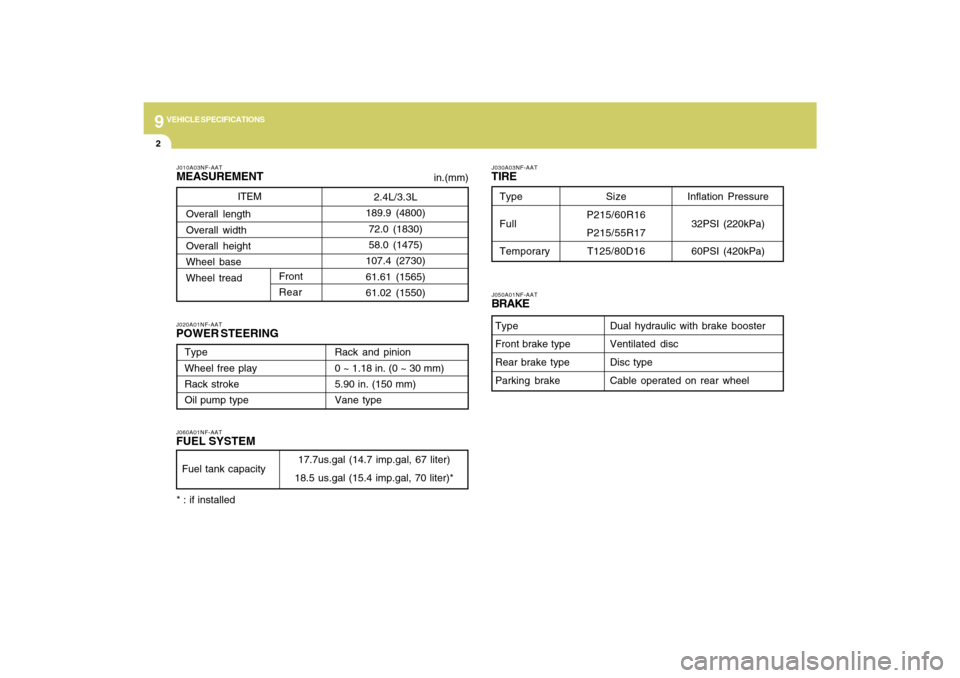
J010A03NF-AATMEASUREMENTJ060A01NF-AATFUEL SYSTEMJ020A01NF-AATPOWER STEERING
J030A03NF-AATTIRE
in.(mm)
Fuel tank capacity
17.7us.gal (14.7 imp.gal, 67 liter)
18.5 us.gal (15.4 imp.gal, 70 liter)* ITEM
J050A01NF-AATBRAKE
Dual hydraulic with brake booster
Ventilated disc
Disc type
Cable operated on rear wheel Type
Front brake type
Rear brake type
Parking brake
Type
Wheel free play
Rack stroke
Oil pump typeRack and pinion
0 ~ 1.18 in. (0 ~ 30 mm)
5.90 in. (150 mm)
Vane type
2.4L/3.3L
189.9 (4800)
72.0 (1830)
58.0 (1475)
107.4 (2730)
61.61 (1565)
61.02 (1550) Overall length
Overall width
Overall height
Wheel base
Wheel tread
Front
Rear
Inflation Pressure
32PSI (220kPa)
60PSI (420kPa)
Type
Full
TemporarySize
P215/60R16
P215/55R17
T125/80D16
* : if installed
Page 283 of 286

10
INDEX
4
Fuel
Capacity............................................................................ 9-2
Gauge..............................................................................1-55
Recommendations............................................................ 1-2
Fuel Filler Lid
Remote release ..............................................................1-85
Fuse Panel Description .....................................................6-37
Fuses..................................................................................6-22
G
General Checks ................................................................... 6-4
Glove Box ...........................................................................1-73
H
Hazard Warning System ....................................................1-65
Headlight
Aiming adjustment ..........................................................6-27
Replacement...................................................................6-28
Switch..............................................................................1-61
Heating and Cooling Control ............................................1-96
Heating and Ventilation
Air flow control ................................................... 1-98, 1-108
Air intake control switch ..................................... 1-99, 1-107
Bi-level heating .............................................................1-100
Defrosting/Defogging....................................................1-103
Fan speed control (Blower Control) .................. 1-97, 1-107
Temperature control .......................................................1-97
High-Mounted Rear Stop Light .........................................1-85
Hood Release ....................................................................1-87
Horn....................................................................................1-90I
Ignition Switch ...................................................................... 2-3
Instrument Cluster and Indicator Lights ............................1-48
Instrument Panel Light Control (Rheostat) .......................1-66
Interior Light .......................................................................1-72
Intermittent Wiper ...............................................................1-64
J
Jump Starting ....................................................................... 3-3
K
Key ........................................................................................ 1-3
If you lose your keys ......................................................3-18
Positions............................................................................ 2-3
L
Light Bulb Watages ............................................................6-36
Light Bulbs Replacement ..................................................6-28
Lubrication Chart .................................................................. 9-4
M
Maintenance Intervals
Explanation of scheduled maintenance items ................ 5-7
Maintenance under severe usage conditions ................. 5-6
Scheduled maintenance .................................................. 5-4
Service requirements ........................................................ 5-2
Mirrors
Day/night inside rearview ...............................................1-76
Homelink mirror ..............................................................1-77
Outside rearview .............................................................1-75
Outside rearview mirror heater ......................................1-76