ESP Hyundai Sonata
[x] Cancel search | Manufacturer: HYUNDAI, Model Year: , Model line: , Model:Pages: 340, PDF Size: 18.45 MB
Page 303 of 340
Maintenance
60
7
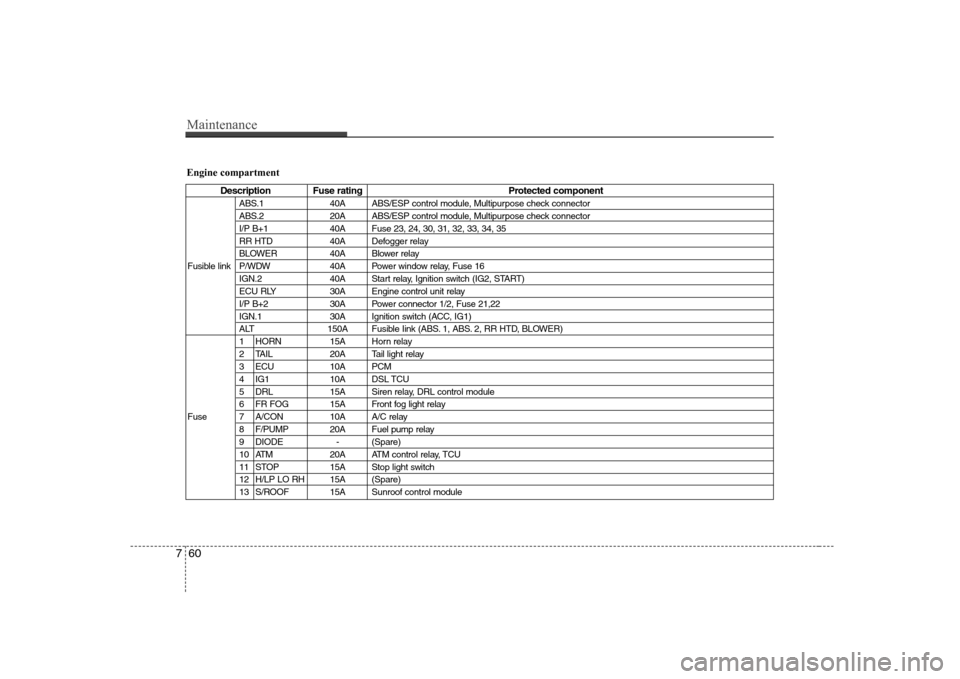
Engine compartment
Description Fuse rating Protected component
ABS.1 40A ABS/ESP control module, Multipurpose check connector
ABS.2 20A ABS/ESP control module, Multipurpose check connector
I/P B+1 40A Fuse 23, 24, 30, 31, 32, 33, 34, 35
RR HTD 40A Defogger relay
BLOWER 40A Blower relay
Fusible link P/WDW 40A Power window relay, Fuse 16 IGN.2 40A Start relay, Ignition switch (IG2, START)
ECU RLY 30A Engine control unit relay
I/P B+2 30A Power connector 1/2, Fuse 21,22
IGN.1 30A Ignition switch (ACC, IG1)
ALT 150A Fusible Iink (ABS. 1, ABS. 2, RR HTD, BLOWER)
1 HORN 15A Horn relay
2 TAIL 20A Tail light relay
3 ECU 10A PCM
4 IG1 10A DSL TCU
5 DRL 15A Siren relay, DRL control module
6 FR FOG 15A Front fog light relay
Fuse 7 A/CON 10A A/C relay 8 F/PUMP 20A Fuel pump relay
9 DIODE - (Spare)
10 ATM 20A ATM control relay, TCU
11 STOP 15A Stop light switch
12 H/LP LO RH 15A (Spare)
13 S/ROOF 15A Sunroof control module
Page 304 of 340
761
Maintenance
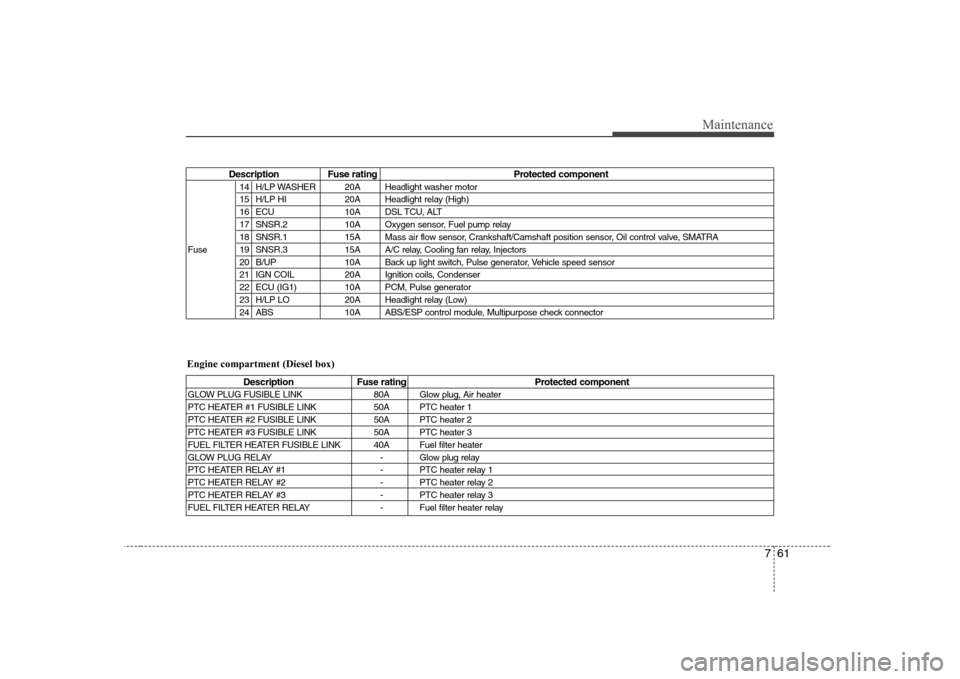
Description Fuse rating Protected component14 H/LP WASHER 20A Headlight washer motor
15 H/LP HI 20A Headlight relay (High)
16 ECU 10A DSL TCU, ALT
17 SNSR.2 10A Oxygen sensor, Fuel pump relay
18 SNSR.1 15A Mass air flow sensor, Crankshaft/Camshaft position sensor, Oil control valve, SMATRA
Fuse 19 SNSR.3 15A A/C relay, Cooling fan relay, Injectors 20 B/UP 10A Back up light switch, Pulse generator, Vehicle speed sensor
21 IGN COIL 20A Ignition coils, Condenser
22 ECU (IG1) 10A PCM, Pulse generator
23 H/LP LO 20A Headlight relay (Low)
24 ABS 10A ABS/ESP control module, Multipurpose check connector
Description Fuse rating Protected component
GLOW PLUG FUSIBLE LINK 80A Glow plug, Air heater
PTC HEATER #1 FUSIBLE LINK 50A PTC heater 1
PTC HEATER #2 FUSIBLE LINK 50A PTC heater 2
PTC HEATER #3 FUSIBLE LINK 50A PTC heater 3
FUEL FILTER HEATER FUSIBLE LINK 40A Fuel filter heater
GLOW PLUG RELAY - Glow plug relay
PTC HEATER RELAY #1 - PTC heater relay 1
PTC HEATER RELAY #2 - PTC heater relay 2
PTC HEATER RELAY #3 - PTC heater relay 3
FUEL FILTER HEATER RELAY - Fuel filter heater relay
Engine compartment (Diesel box)
Page 305 of 340
Maintenance
62
7
LIGHT BULBS
G220000AFD-EA
Use only the bulbs of the specified wattage.
All bulbs are available from yourHYUNDAI dealers Parts Department.
✽✽ NOTICE
After washing or driving through heavy rain, condensation may form in the head
and tail lamp lenses. This condition is
caused by the temperature differencebetween the lamp inside and outside.
This is similar to the condensation on
your windows inside your vehicle during
the rain and doesn’t indicate a problem
with your vehicle. If the water leaks into
the lamp bulb circuitry, have the vehiclechecked by an authorised HYUNDAI
dealer.
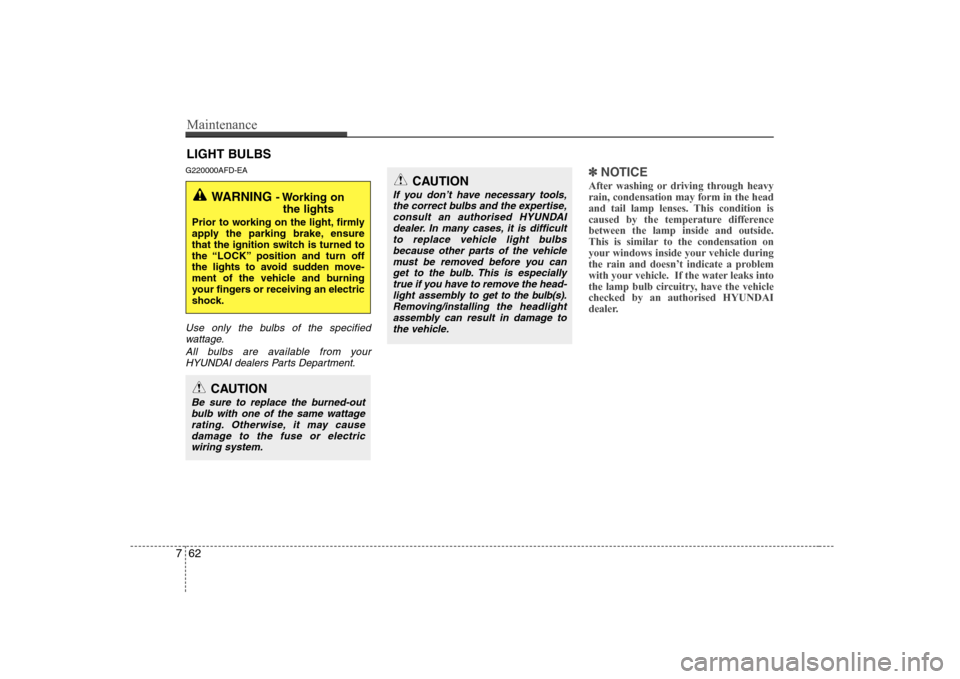
WARNING - Working on
the lights
Prior to working on the light, firmly
apply the parking brake, ensure
that the ignition switch is turned to
the “LOCK” position and turn off
the lights to avoid sudden move-
ment of the vehicle and burning
your fingers or receiving an electric
shock.
CAUTION
Be sure to replace the burned-out bulb with one of the same wattage rating. Otherwise, it may cause damage to the fuse or electricwiring system.
CAUTION
If you don’t have necessary tools,
the correct bulbs and the expertise,consult an authorised HYUNDAI dealer. In many cases, it is difficult
to replace vehicle light bulbsbecause other parts of the vehicle must be removed before you can get to the bulb. This is especially
true if you have to remove the head- light assembly to
get to the bulb(s).
Removing/installingthe headlight
assembly can result in damage to the vehicle.
Page 319 of 340
Maintenance
76
7
EMISSION CONTROL SYSTEM
G270000AFD-EA
The emission control system of your
vehicle is covered by a written limited
warranty. Please see the warranty infor-
mation contained in the Service Passport
in your vehicle.
Your vehicle is equipped with an emis-
sion control system to meet all Australian
Design Rules (ADR) requirements. There are three emission control sys-
tems which are as follows.
(1) Crankcase emission control system
(2) Evaporative emission control system(3) Exhaust emission control system In order to assure the proper function of
the emission control systems, it is rec-
ommended that you have your car
inspected and maintained by an autho-
rised HYUNDAI dealer in accordancewith the maintenance schedule in this
manual. Caution for the Inspection and
Maintenance Test (With Electronic
Stability Program (ESP) system)
To prevent the vehicle from misfir-
ing during dynamometer testing,
turn the Electronic Stability
Program (ESP) system off by press-
ing the ESP switch.
After dynamometer testing is com- pleted, turn the ESP system back on
by pressing the ESP switch again.
G270100AUN
1. Crankcase emission control system
The positive crankcase ventilation sys-
tem is employed to prevent air pollution
caused by blow-by gases being emitted
from the crankcase. This system supplies
fresh filtered air to the crankcase through
the air intake hose. Inside the crankcase,
the fresh air mixes with blow-by gases,
which then pass through the PCV valveinto the induction system. G270200AFD-EA
2. Evaporative emission control
System
The Evaporative Emission Control
System is designed to prevent fuel
vapours from escaping into the atmos-
phere.
G270201AUN-EA
Canister
Fuel vapours generated inside the fuel tank are absorbed and stored in the
onboard canister. When the engine is
running, the fuel vapours absorbed in the
canister are drawn into the surge tank
through the purge control solenoid valve.
Page 329 of 340
95
Specifications
I040100ANF-EA Recommended SAE viscosity
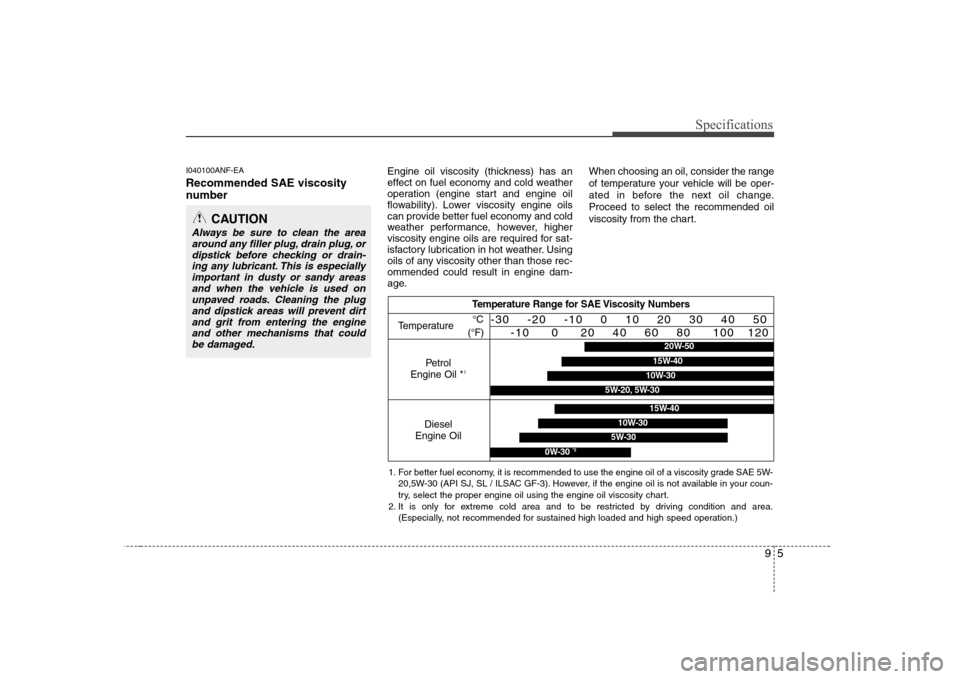
number Engine oil viscosity (thickness) has an
effect on fuel economy and cold weather
operation (engine start and engine oil
flowability). Lower viscosity engine oils
can provide better fuel economy and cold
weather performance, however, higher
viscosity engine oils are required for sat-
isfactory lubrication in hot weather. Using
oils of any viscosity other than those rec-ommended could result in engine dam-
age.When choosing an oil, consider the range
of temperature your vehicle will be oper-
ated in before the next oil change.Proceed to select the recommended oil
viscosity from the chart.
CAUTION
Always be sure to clean the area
around any filler plug, drain plug, ordipstick before checking or drain-
ing any lubricant. This is especiallyimportant in dusty or sandy areas and when the vehicle is used onunpaved roads. Cleaning the plug
and dipstick areas will prevent dirtand grit from entering the engineand other mechanisms that could
be damaged.
Temperature Range for SAE Viscosity Numbers
Temperature
Petrol
Engine Oil *
1
°C
(°F)-30 -20 -10 0 10 20 30 40 50 -10 0 20 40 60 80 100 120
Diesel
Engine Oil
5W-30
15W-40
10W-30
0W-30 *2
1. For better fuel economy, it is recommended to use the engine oil of a viscosity grade SAE 5W-
20,5W-30 (API SJ, SL / ILSAC GF-3). However, if the engine oil is not available in your coun-
try, select the proper engine oil using the engine oil viscosity chart.
2. It is only for extreme cold area and to be restricted by driving condition and area. (Especially, not recommended for sustained high loaded and high speed operation.)
20W-50
10W-30
15W-40
5W-20, 5W-30
Page 330 of 340
OWNER'S MANUAL Operation MaintenanceSpecifications
All information in this Owner's Manual is current at the time of publication.
However, in line with the Hyundai policy of continual product improvement,
the right to amend or change specifications without prior notice or obliga-
tion to incorporate such amendments or changes into vehicles already pro-
duced, is reserved.
This manual applies to all current Hyundai models and includes descrip-
tions and explanations of optional as well as standard equipment. As a
result, you may find material in this manual that does not apply to your spe-
cific vehicle.