belt Hyundai Sonata
[x] Cancel search | Manufacturer: HYUNDAI, Model Year: , Model line: , Model:Pages: 340, PDF Size: 18.45 MB
Page 265 of 340
Maintenance
22
7
G050500AUN Timing belt (if equipped)
Inspect all parts related to the timing belt
for damage and deformation. Replace
any damaged parts immediately.
G050600AUN-EA
Vapour hose and fuel filler cap
The vapour hose and fuel filler cap
should be inspected at those intervals
specified in the maintenance schedule.
Make sure that a new vapour hose or fuelfiller cap is correctly replaced. G050700AUN
Vacuum crankcase ventilation hoses (if equipped)
Inspect the surface of hoses for evidence
of heat and/or mechanical damage. Hard
and brittle rubber, cracking, tears, cuts,
abrasions, and excessive swelling indi-
cate deterioration. Particular attention
should be paid to examine those hose
surfaces nearest to high heat sources,
such as the exhaust manifold. Inspect the hose routing to assure that the hoses do not come in contact with
any heat source, sharp edges or movingcomponent which might cause heat dam-
age or mechanical wear. Inspect all hose
connections, such as clamps and cou-
plings, to make sure they are secure, and
that no leaks are present. Hoses should
be replaced immediately if there is any
evidence of deterioration or damage.G050800AFD
Air cleaner filter
A Genuine HYUNDAI air cleaner filter is recommended when the filter isreplaced.
G050900AUN-EA
Spark plugs (for petrol engine)
Make sure to install new spark plugs of
the correct heat range. G051000AFD-EA
Valve clearance (if equipped)
Inspect excessive valve noise and/or
engine vibration and adjust if necessary.
An authorised HYUNDAI dealer should
perform the operation.
G051100AUN Cooling system
Check the cooling system parts, such as
radiator, coolant reservoir, hoses and
connections for leakage and damage.
Replace any damaged parts.
G051200AUN Coolant The coolant should be changed at the
intervals specified in the maintenance
schedule.
Page 293 of 340
Maintenance
50
7
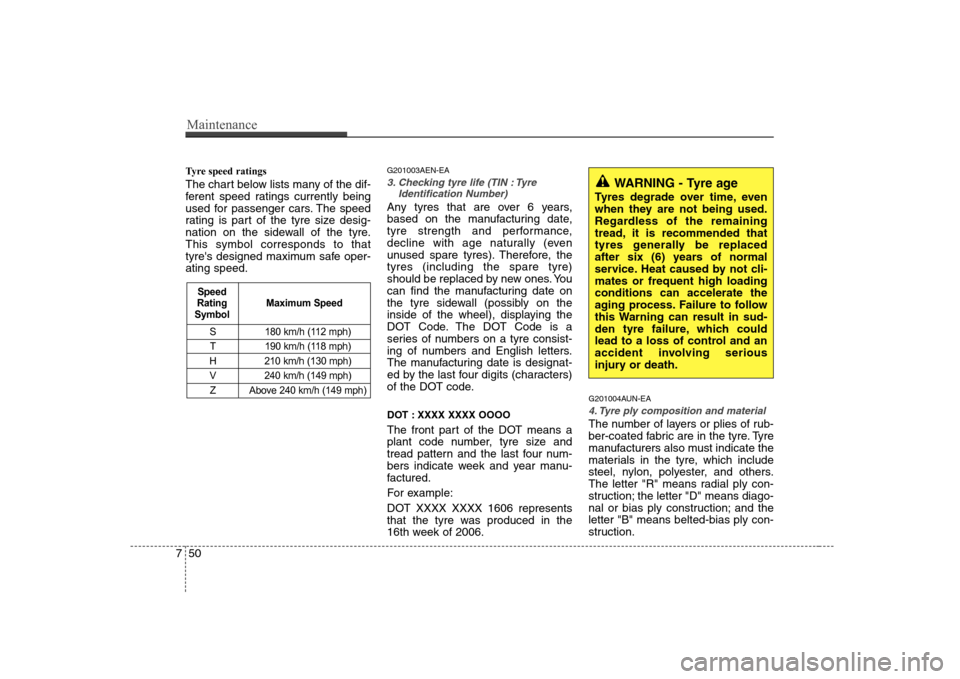
Tyre speed ratings
The chart below lists many of the dif-
ferent speed ratings currently being
used for passenger cars. The speed
rating is part of the tyre size desig-
nation on the sidewall of the tyre.This symbol corresponds to that
tyre's designed maximum safe oper-ating speed. G201003AEN-EA
3. Checking tyre life (TIN : Tyre
Identification Number)
Any tyres that are over 6 years,
based on the manufacturing date,
tyre strength and performance,
decline with age naturally (even
unused spare tyres). Therefore, thetyres (including the spare tyre)
should be replaced by new ones. You
can find the manufacturing date on
the tyre sidewall (possibly on the
inside of the wheel), displaying the
DOT Code. The DOT Code is a
series of numbers on a tyre consist-
ing of numbers and English letters.
The manufacturing date is designat-
ed by the last four digits (characters)
of the DOT code.
DOT : XXXX XXXX OOOO
The front part of the DOT means a
plant code number, tyre size and
tread pattern and the last four num-
bers indicate week and year manu-
factured.
For example:
DOT XXXX XXXX 1606 represents
that the tyre was produced in the
16th week of 2006. G201004AUN-EA
4. Tyre ply composition and material
The number of layers or plies of rub-
ber-coated fabric are in the tyre. Tyre
manufacturers also must indicate the
materials in the tyre, which include
steel, nylon, polyester, and others.
The letter "R" means radial ply con-
struction; the letter "D" means diago-
nal or bias ply construction; and theletter "B" means belted-bias ply con-
struction.
S 180 km/h (112 mph)
T 190 km/h (118 mph)
H 210 km/h (130 mph) V 240 km/h (149 mph) Z Above 240 km/h (149 mph)
Maximum Speed
Speed
Rating
Symbol
WARNING - Tyre age
Tyres degrade over time, even
when they are not being used.
Regardless of the remaining
tread, it is recommended that
tyres generally be replaced
after six (6) years of normal
service. Heat caused by not cli-mates or frequent high loadingconditions can accelerate the
aging process. Failure to follow
this Warning can result in sud-
den tyre failure, which could
lead to a loss of control and an
accident involving serious
injury or death.
Page 318 of 340
775
Maintenance
Interior care
G230201AUN
Interior general precautions
Prevent caustic solutions such as per- fume and cosmetic oil from contacting
the dashboard because they may cause
damage or discoloration. If they do con-tact the dashboard, wipe them off imme-
diately. See the instructions that follow for
the proper way to clean vinyl.G230202AUN-EA
Cleaning the upholstery and interior
trim
Vinyl
Remove dust and loose dirt from vinyl
with a whisk broom or vacuum cleaner.
Clean vinyl surfaces with a vinyl cleaner. Fabric
Remove dust and loose dirt from fabric
with a whisk broom or vacuum cleaner.Clean with a mild soap solution recom-
mended for upholstery or carpets.
Remove fresh spots immediately with a
fabric spot cleaner. If fresh spots do not
receive immediate attention, the fabriccan be stained and its colour can be
affected. Also, its fire-resistant properties
can be reduced if the material is not
properly maintained. G230203AUN
Cleaning the lap/shoulder belt web-
bing
Clean the belt webbing with any mild
soap solution recommended for cleaning
upholstery or carpet. Follow the instruc-
tions provided with the soap. Do not
bleach or re-dye the webbing because
this may weaken it.
G230204AUN
Cleaning the interior window glass
If the interior glass surfaces of the vehi-
cle become fogged (that is, covered with
an oily, greasy or waxy film), they should
be cleaned with glass cleaner. Follow the
directions on the glass cleaner container.CAUTION
Never allow water or other liquidsto come in contact with electrical/electronic components
inside the vehicle as this may dam-age them.
CAUTION
Using anything but recommendedcleaners and procedures may affect
the fabric’s appearance and fire-resistant properties.
CAUTION
Do not scrape or scratch the inside of the rear window. This may resultin damage to the rear window defroster grid.
Page 339 of 340
I3
Index
Hazard warning flasher ··············································· 4-51
How to use this manual ················································· 1-2
If the engine overheats ·················································· 6-6
If the engine will not start ············································· 6-3
If you have a flat tyre ···················································· 6-7
In case of an emergency while driving ························· 6-2
Indicator symbols on the instrument cluster ················· 1-6
Instrument cluster ························································ 4-33
Instrument panel overview ············································ 2-3
Interior features ··························································· 4-82
Interior light ································································· 4-57
Interior overview ··························································· 2-2
Key positions ································································· 5-4
Keys ··············································································· 4-2
Light bulbs ··································································· 7-62
Lighting ······································································· 4-52 Maintenance services ····················································· 7-4
Manual climate control system ··································· 4-61
Manual transaxle ··························································· 5-8
Mirrors ········································································· 4-29
Owner maintenance ······················································· 7-6
Parking brake ······························································· 7-32
Power steering fluid ····················································· 7-29
Rear parking assist system ·········································· 4-48
Recommended lubricants and capacities ······················· 9-4
Remote keyless entry ····················································· 4-4
Road warning ································································· 6-2
Scheduled maintenance service ····································· 7-8
Seat ················································································ 3-2
Seat belts ······································································ 3-12
H
I
K
L
M
O
P
R
S