fuel Hyundai Sonata
[x] Cancel search | Manufacturer: HYUNDAI, Model Year: , Model line: , Model:Pages: 283, PDF Size: 13.5 MB
Page 251 of 283
6
DO-IT-YOURSELF MAINTENANCE
40
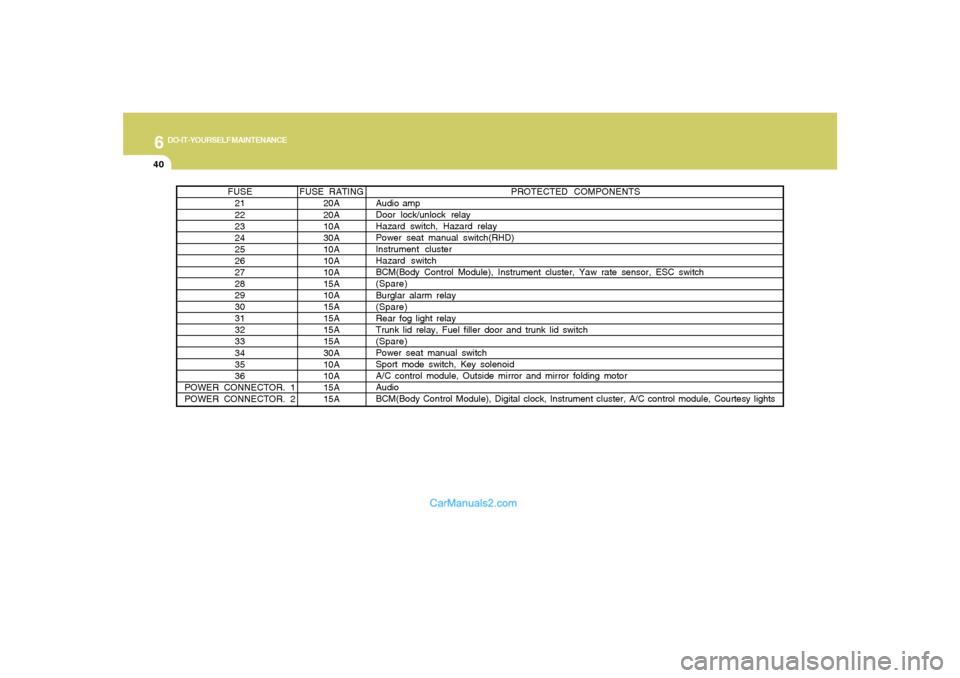
PROTECTED COMPONENTS
Audio amp
Door lock/unlock relay
Hazard switch, Hazard relay
Power seat manual switch(RHD)
Instrument cluster
Hazard switch
BCM(Body Control Module), Instrument cluster, Yaw rate sensor, ESC switch
(Spare)
Burglar alarm relay
(Spare)
Rear fog light relay
Trunk lid relay, Fuel filler door and trunk lid switch
(Spare)
Power seat manual switch
Sport mode switch, Key solenoid
A/C control module, Outside mirror and mirror folding motor
Audio
BCM(Body Control Module), Digital clock, Instrument cluster, A/C control module, Courtesy lights
FUSE RATING
20A
20A
10A
30A
10A
10A
10A
15A
10A
15A
15A
15A
15A
30A
10A
10A
15A
15A FUSE
21
22
23
24
25
26
27
28
29
30
31
32
33
34
35
36
POWER CONNECTOR. 1
POWER CONNECTOR. 2
Page 253 of 283
7
EMISSION CONTROL SYSTEMS2
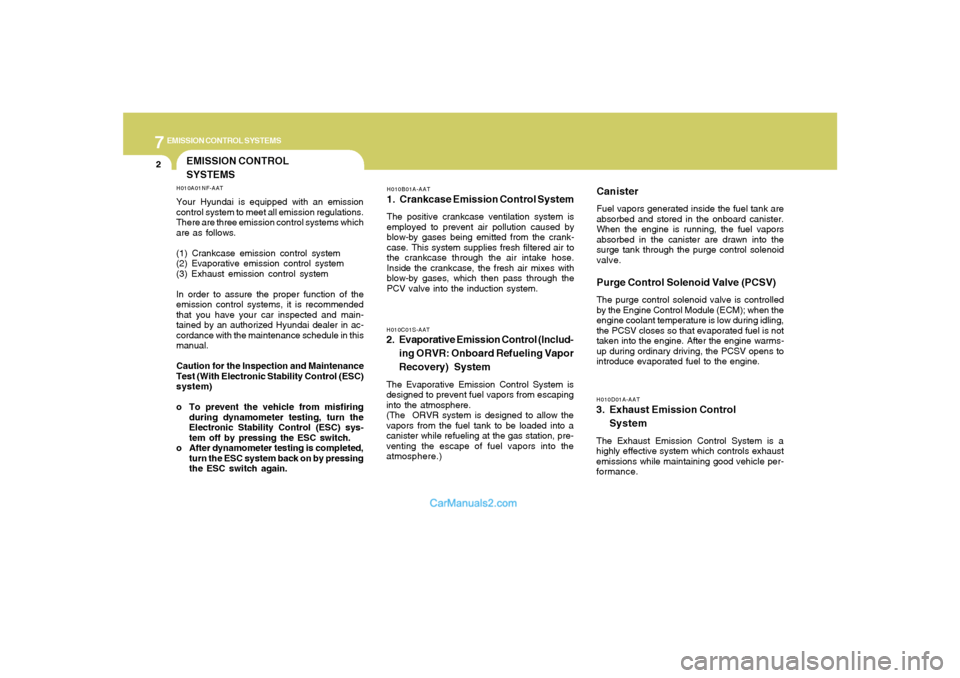
EMISSION CONTROL
SYSTEMS
H010B01A-AAT1. Crankcase Emission Control SystemThe positive crankcase ventilation system is
employed to prevent air pollution caused by
blow-by gases being emitted from the crank-
case. This system supplies fresh filtered air to
the crankcase through the air intake hose.
Inside the crankcase, the fresh air mixes with
blow-by gases, which then pass through the
PCV valve into the induction system.
CanisterFuel vapors generated inside the fuel tank are
absorbed and stored in the onboard canister.
When the engine is running, the fuel vapors
absorbed in the canister are drawn into the
surge tank through the purge control solenoid
valve.Purge Control Solenoid Valve (PCSV)The purge control solenoid valve is controlled
by the Engine Control Module (ECM); when the
engine coolant temperature is low during idling,
the PCSV closes so that evaporated fuel is not
taken into the engine. After the engine warms-
up during ordinary driving, the PCSV opens to
introduce evaporated fuel to the engine.H010D01A-AAT3. Exhaust Emission Control
SystemThe Exhaust Emission Control System is a
highly effective system which controls exhaust
emissions while maintaining good vehicle per-
formance.
H010A01NF-AATYour Hyundai is equipped with an emission
control system to meet all emission regulations.
There are three emission control systems which
are as follows.
(1) Crankcase emission control system
(2) Evaporative emission control system
(3) Exhaust emission control system
In order to assure the proper function of the
emission control systems, it is recommended
that you have your car inspected and main-
tained by an authorized Hyundai dealer in ac-
cordance with the maintenance schedule in this
manual.
Caution for the Inspection and Maintenance
Test (With Electronic Stability Control (ESC)
system)
o To prevent the vehicle from misfiring
during dynamometer testing, turn the
Electronic Stability Control (ESC) sys-
tem off by pressing the ESC switch.
o After dynamometer testing is completed,
turn the ESC system back on by pressing
the ESC switch again.
H010C01S-AAT2. Evaporative Emission Control (Includ-
ing ORVR: Onboard Refueling Vapor
Recovery) SystemThe Evaporative Emission Control System is
designed to prevent fuel vapors from escaping
into the atmosphere.
(The ORVR system is designed to allow the
vapors from the fuel tank to be loaded into a
canister while refueling at the gas station, pre-
venting the escape of fuel vapors into the
atmosphere.)
Page 254 of 283
7
EMISSION CONTROL SYSTEMS
3
!
!
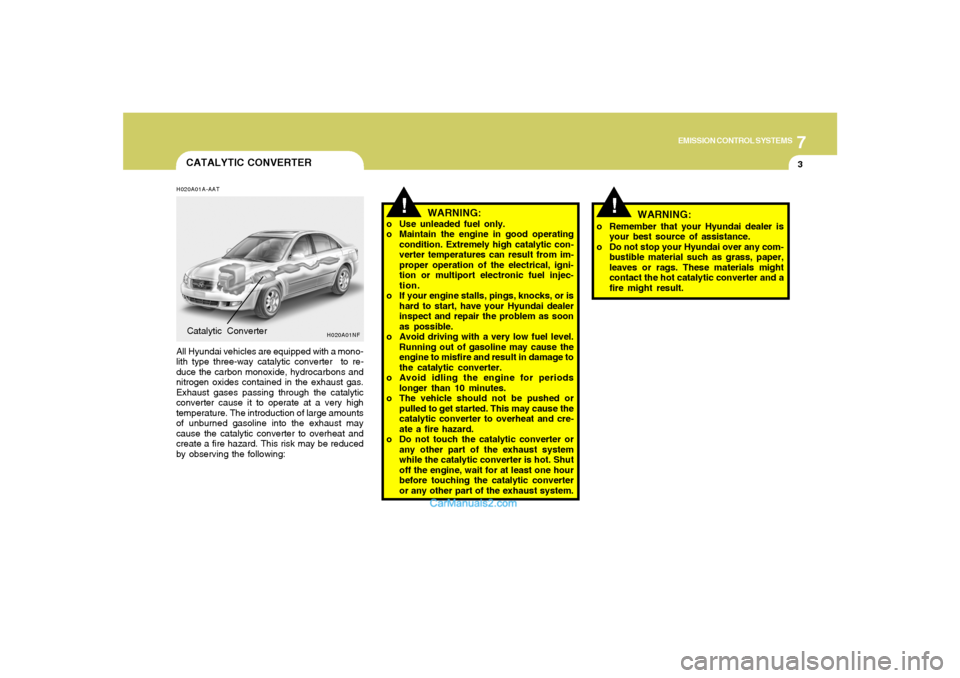
CATALYTIC CONVERTERH020A01A-AATAll Hyundai vehicles are equipped with a mono-
lith type three-way catalytic converter to re-
duce the carbon monoxide, hydrocarbons and
nitrogen oxides contained in the exhaust gas.
Exhaust gases passing through the catalytic
converter cause it to operate at a very high
temperature. The introduction of large amounts
of unburned gasoline into the exhaust may
cause the catalytic converter to overheat and
create a fire hazard. This risk may be reduced
by observing the following:Catalytic Converter
WARNING:
o Use unleaded fuel only.
o Maintain the engine in good operating
condition. Extremely high catalytic con-
verter temperatures can result from im-
proper operation of the electrical, igni-
tion or multiport electronic fuel injec-
tion.
o If your engine stalls, pings, knocks, or is
hard to start, have your Hyundai dealer
inspect and repair the problem as soon
as possible.
o Avoid driving with a very low fuel level.
Running out of gasoline may cause the
engine to misfire and result in damage to
the catalytic converter.
o Avoid idling the engine for periods
longer than 10 minutes.
o The vehicle should not be pushed or
pulled to get started. This may cause the
catalytic converter to overheat and cre-
ate a fire hazard.
o Do not touch the catalytic converter or
any other part of the exhaust system
while the catalytic converter is hot. Shut
off the engine, wait for at least one hour
before touching the catalytic converter
or any other part of the exhaust system.
H020A01NF
o Remember that your Hyundai dealer is
your best source of assistance.
o Do not stop your Hyundai over any com-
bustible material such as grass, paper,
leaves or rags. These materials might
contact the hot catalytic converter and a
fire might result.
WARNING:
Page 258 of 283
8
CONSUMER INFORMATION, REPORTING SAFETY DEFECTS & BINDING ARBITRATION OF WARRANTY CLAIMS4
!
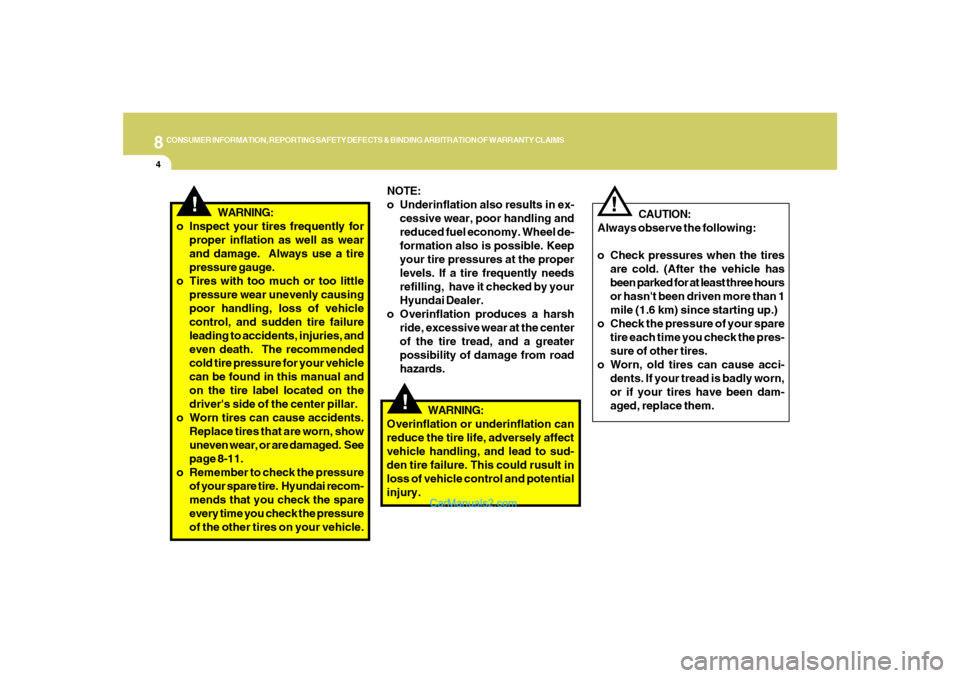
CAUTION:
Always observe the following:
o Check pressures when the tires
are cold. (After the vehicle has
been parked for at least three hours
or hasn't been driven more than 1
mile (1.6 km) since starting up.)
o Check the pressure of your spare
tire each time you check the pres-
sure of other tires.
o Worn, old tires can cause acci-
dents. If your tread is badly worn,
or if your tires have been dam-
aged, replace them.
!
NOTE:
o Underinflation also results in ex-
cessive wear, poor handling and
reduced fuel economy. Wheel de-
formation also is possible. Keep
your tire pressures at the proper
levels. If a tire frequently needs
refilling, have it checked by your
Hyundai Dealer.
o Overinflation produces a harsh
ride, excessive wear at the center
of the tire tread, and a greater
possibility of damage from road
hazards.
WARNING:
Overinflation or underinflation can
reduce the tire life, adversely affect
vehicle handling, and lead to sud-
den tire failure. This could rusult in
loss of vehicle control and potential
injury.
!
WARNING:
o Inspect your tires frequently for
proper inflation as well as wear
and damage. Always use a tire
pressure gauge.
o Tires with too much or too little
pressure wear unevenly causing
poor handling, loss of vehicle
control, and sudden tire failure
leading to accidents, injuries, and
even death. The recommended
cold tire pressure for your vehicle
can be found in this manual and
on the tire label located on the
driver's side of the center pillar.
o Worn tires can cause accidents.
Replace tires that are worn, show
uneven wear, or are damaged. See
page 8-11.
o Remember to check the pressure
of your spare tire. Hyundai recom-
mends that you check the spare
every time you check the pressure
of the other tires on your vehicle.
Page 261 of 283
8
CONSUMER INFORMATION, REPORTING SAFETY DEFECTS & BINDING ARBITRATION OF WARRANTY CLAIMS
7
6. Maximum load rating
This number indicates the maximum
load in kilograms and pounds that
can be carried by the tire. When
replacing the tires on the vehicle,
always use a tire that has the same
load rating as the factory installed
tire.
7. Uniform Tire Quality Grading
(UTQG):
Tire manufacturers are required to
grade tires based on three perfor-
mance factors: treadwear, traction
and temperature resistance. For more
information, see Uniform Tire Qual-
ity Grading on page 8-14.
I030D01JM-AATTIRE TERMINOLOGY AND DEFINI-
TIONS
Air Pressure: The amount of air inside
the tire pressing outward on the tire. Air
pressure is expressed in pounds per
square inch (psi) or kilopascal (kPa).
Accessory Weight: This means the
combined weight of optional accesso-
ries. Some examples of optional ac-
cessories are, automatic transmission,
power seats, and air conditioning.
Aspect Ratio: The relationship of a
tire's height to its width.
Belt: A rubber coated layer of cords that
is located between the plies and the
tread. Cords may be made from steel or
other reinforcing materials.
Bead: The tire bead contains steel
wires wrapped by steel cords that hold
the tire onto the rim.
Bias Ply Tire: A pneumatic tire in which
the plies are laid at alternate angles
less than 90 degrees to the centerline of
the tread.Cold Tire Pressure: The amount of air
pressure in a tire, measured in pounds
per square inch (psi) or kilopascals
(kPa) before a tire has built up heat from
driving.
Curb Weight: This means the weight of
a motor vehicle with standard and op-
tional equipment including the maxi-
mum capacity of fuel, oil and coolant,
but without passengers and cargo.
DOT Markings: A code molded into the
sidewall of a tire signifying that the tire
is in compliance with the U.S. Depart-
ment of Transportation motor vehicle
safety standards. The DOT code in-
cludes the Tire Identification Number
(TIN), an alphanumeric designator which
can also identify the tire manufacturer,
production plant, brand and date of
production.
GVWR: Gross Vehicle Weight Rating
GAWR FRT: Gross Axle Weight Rating
for the front Axle.
GAWR RR: Gross Axle Weight Rating
for the rear axle.
Page 273 of 283
9
VEHICLE SPECIFICATIONS2
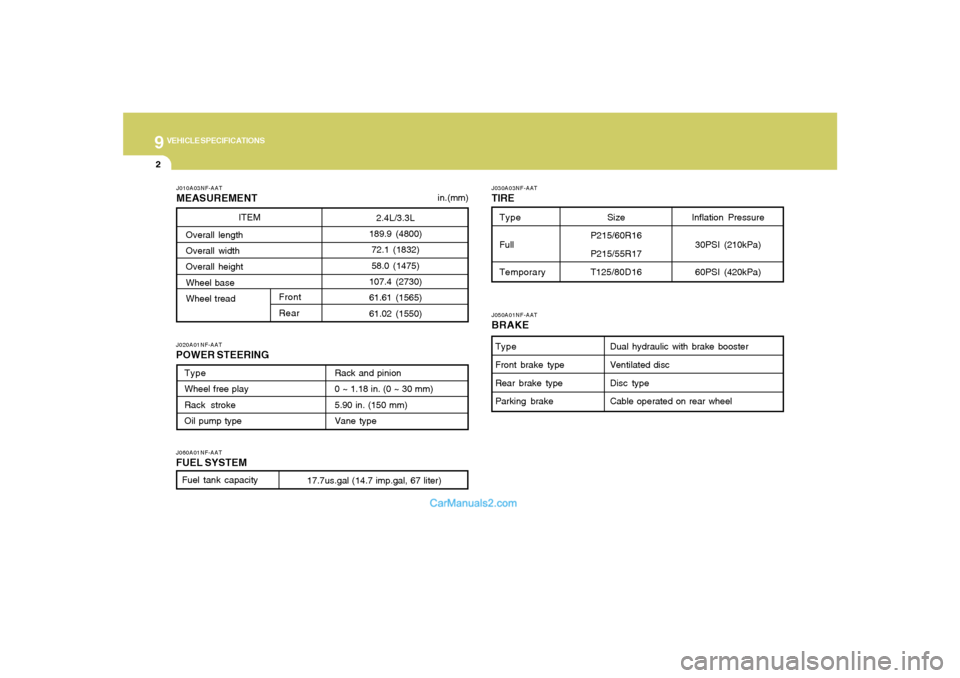
J010A03NF-AATMEASUREMENTJ060A01NF-AATFUEL SYSTEMJ020A01NF-AATPOWER STEERING
J030A03NF-AATTIRE
in.(mm)
Fuel tank capacity
17.7us.gal (14.7 imp.gal, 67 liter) ITEM
J050A01NF-AATBRAKE
Dual hydraulic with brake booster
Ventilated disc
Disc type
Cable operated on rear wheel Type
Front brake type
Rear brake type
Parking brake
Type
Wheel free play
Rack stroke
Oil pump typeRack and pinion
0 ~ 1.18 in. (0 ~ 30 mm)
5.90 in. (150 mm)
Vane type
2.4L/3.3L
189.9 (4800)
72.1 (1832)
58.0 (1475)
107.4 (2730)
61.61 (1565)
61.02 (1550) Overall length
Overall width
Overall height
Wheel base
Wheel tread
Front
Rear
Inflation Pressure
30PSI (210kPa)
60PSI (420kPa)
Type
Full
TemporarySize
P215/60R16
P215/55R17
T125/80D16
Page 279 of 283
10
INDEX
4
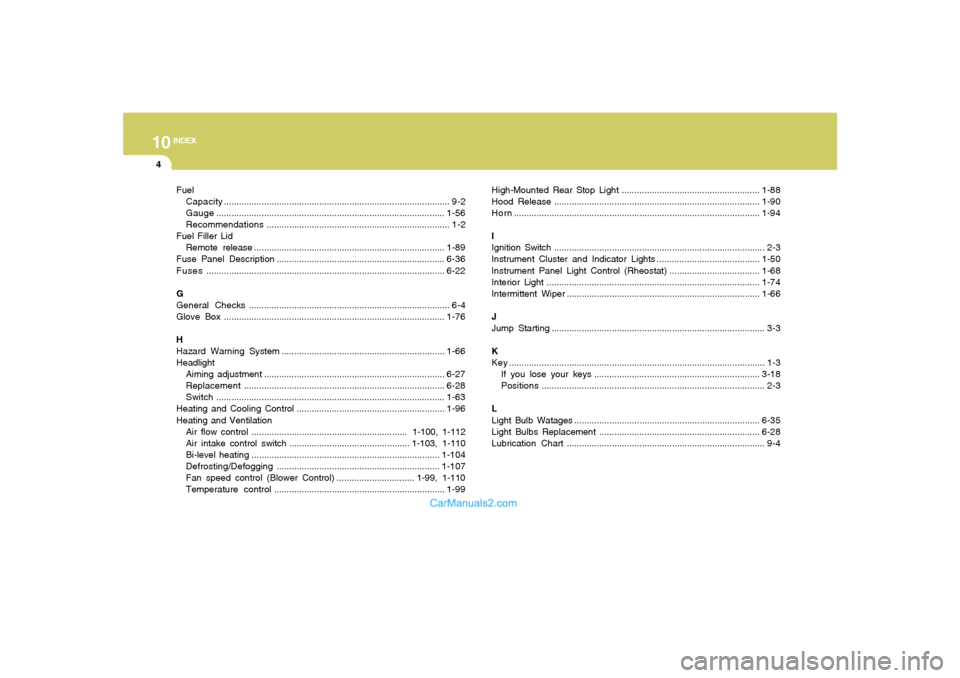
Fuel
Capacity.......................................................................................... 9-2
Gauge...........................................................................................1-56
Recommendations......................................................................... 1-2
Fuel Filler Lid
Remote release............................................................................1-89
Fuse Panel Description...................................................................6-36
Fuses ...............................................................................................6-22
G
General Checks................................................................................ 6-4
Glove Box........................................................................................1-76
H
Hazard Warning System .................................................................1-66
Headlight
Aiming adjustment........................................................................6-27
Replacement................................................................................6-28
Switch...........................................................................................1-63
Heating and Cooling Control ...........................................................1-96
Heating and Ventilation
Air flow control.............................................................. 1-100, 1-112
Air intake control switch................................................ 1-103, 1-110
Bi-level heating...........................................................................1-104
Defrosting/Defogging.................................................................1-107
Fan speed control (Blower Control) ............................... 1-99, 1-110
Temperature control....................................................................1-99High-Mounted Rear Stop Light .......................................................1-88
Hood Release..................................................................................1-90
Horn..................................................................................................1-94
I
Ignition Switch.................................................................................... 2-3
Instrument Cluster and Indicator Lights .........................................1-50
Instrument Panel Light Control (Rheostat)....................................1-68
Interior Light.....................................................................................1-74
Intermittent Wiper.............................................................................1-66
J
Jump Starting..................................................................................... 3-3
K
Key ...................................................................................................... 1-3
If you lose your keys ..................................................................3-18
Positions......................................................................................... 2-3
L
Light Bulb Watages..........................................................................6-35
Light Bulbs Replacement................................................................
6-28
Lubrication Chart............................................................................... 9-4