ABS Hyundai Sonata
[x] Cancel search | Manufacturer: HYUNDAI, Model Year: , Model line: , Model:Pages: 363, PDF Size: 30.3 MB
Page 249 of 363
551
Driving your vehicle
Towbars
It's important to have the correct towbar
equipment. Crosswinds, large trucks
going by, and rough roads are a few rea-
sons why you’ll need the right towbar.
Here are some rules to follow:
Will you have to make any holes in thebody of your vehicle when you install a
trailer towbar? If you do, then be sure
to seal the holes later when you
remove the towbar.
If you don’t seal them, deadly carbon
monoxide (CO) from your exhaust can
get into your vehicle, as well as dirt and
water.
The bumpers on your vehicle are not intended for towbars. Do not attach
rental towbars or other bumper-type
towbars to them. Use only a frame-
mounted towbar that does not attach to
the bumper.
HYUNDAI trailer towbar accessory is available at an authorised HYUNDAI
dealer.
✽✽ NOTICE
We recommend only genuine
HYUNDAI towbars (the towbars are
made and tested in Australia/NZ for
local conditions).
Safety chains
You should always attach chains
between your vehicle and your trailer.
Cross the safety chains under the tongue
of the trailer so that the tongue will not
drop to the road if it becomes separated
from the towbar.
Instructions about safety chains may be
provided by the towbar manufacturer or
by the trailer manufacturer. Follow the
manufacturer’s recommendation for
attaching safety chains. Always leave just
enough slack so you can turn with your
trailer. And, never allow safety chains to
drag on the ground. Trailer brakes
If your trailer is equipped with a braking
system, make sure it conforms to your
country’s regulations and that it is prop-
erly installed and operating correctly.
If your trailer weight exceeds the maxi-
mum allowed weight without trailer
brakes, then the trailer will also require its
own brakes as well. Be sure to read and
follow the instructions for the trailer
brakes so you’ll be able to install, adjust
and maintain them properly.
Don’t tap into or modify your vehicle's
brake system.
WARNING - Trailer brakes
Do not use a trailer with its own
brakes unless you are absolutely
certain that you have properly set
up the brake system. This is not a
task for amateurs. Use an experi-
enced, competent trailer shop for
this work.
Page 252 of 363
Driving your vehicle
54
5
Parking on hills
Generally, if you have a trailer attached to
your vehicle, you should not park your
vehicle on a hill. People can be seriously
or fatally injured, and both your vehicle
and the trailer can be damaged if unex-
pectedly roll down hill. However, if you ever have to park your
trailer on a hill, here's how to do it:
1. Pull the vehicle into the parking space.
Turn the steering wheel in the direction
of the kerb (left if headed down hill,
right if headed up hill).
2. If the vehicle has a manual transaxle, place the car in neutral. If the vehicle
has an automatic transaxle, place the
car in P (Park).
3. Set the parking brake and shut off the vehicle.
4. Place chocks under the trailer wheels on the down hill side of the wheels.
5. Start the vehicle, hold the brakes, shift to neutral, release the parking brake
and slowly release the brakes until the
trailer chocks absorb the load.
6. Reapply the brakes, reapply the park- ing brake and shift the vehicle to R
(Reverse) for manual transaxle or P
(Park) for automatic transaxle.
7. Shut off the vehicle and release the vehicle brakes but leave the parking
brake set.CAUTION
When towing a trailer on steep
grades (in excess of 6%) pay
close attention to the enginecoolant temperature gauge toensure the engine does not over- heat.
If the needle of the coolant tem-perature gauge moves across thedial towards “H” (HOT), pull overand stop as soon as it is safe to
do so, and allow the engine to idleuntil it cools down. You may pro-ceed once the engine has cooledsufficiently.
You must decide driving speed depending on trailer weight anduphill grade to reduce the possi-bility of engine and transaxle overheating.
WARNING - Parking on a
hill
Parking your vehicle on a hill with a
trailer attached could cause seri-
ous injury or death, should the trail-
er break loose.
Page 266 of 363
What to do in an emergency
10
6
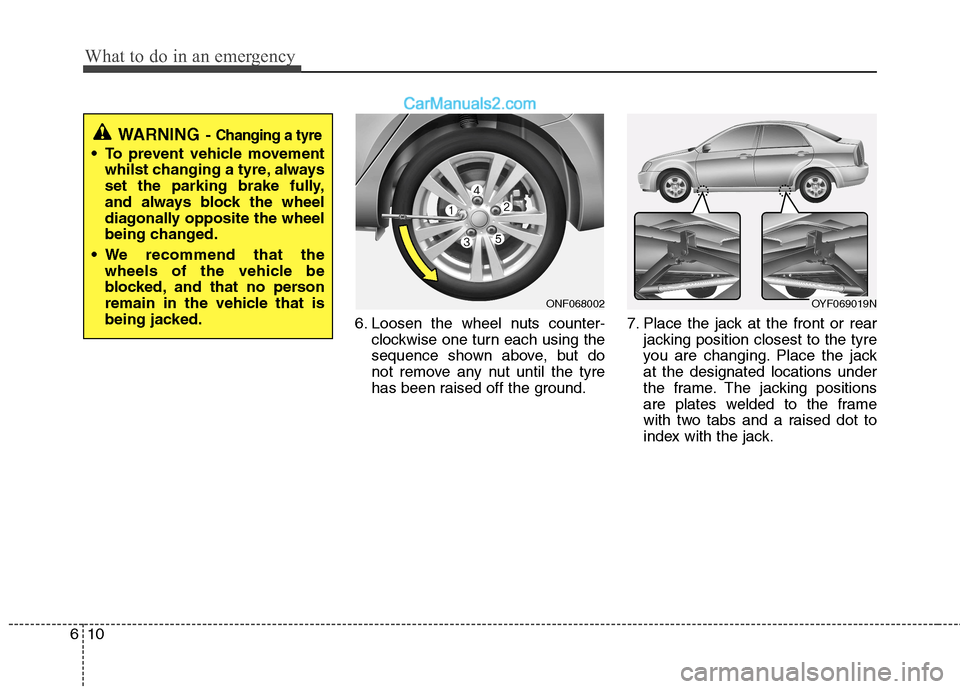
6. Loosen the wheel nuts counter-
clockwise one turn each using the
sequence shown above, but do
not remove any nut until the tyre
has been raised off the ground. 7. Place the jack at the front or rear
jacking position closest to the tyre
you are changing. Place the jackat the designated locations under
the frame. The jacking positions
are plates welded to the frame
with two tabs and a raised dot to
index with the jack.
WARNING - Changing a tyre
To prevent vehicle movement
whilst changing a tyre, always
set the parking brake fully,
and always block the wheel
diagonally opposite the wheel
being changed.
We recommend that the wheels of the vehicle be
blocked, and that no person
remain in the vehicle that is
being jacked.
ONF068002OYF069019N
Page 314 of 363
Maintenance
38
7
Tyre replacement
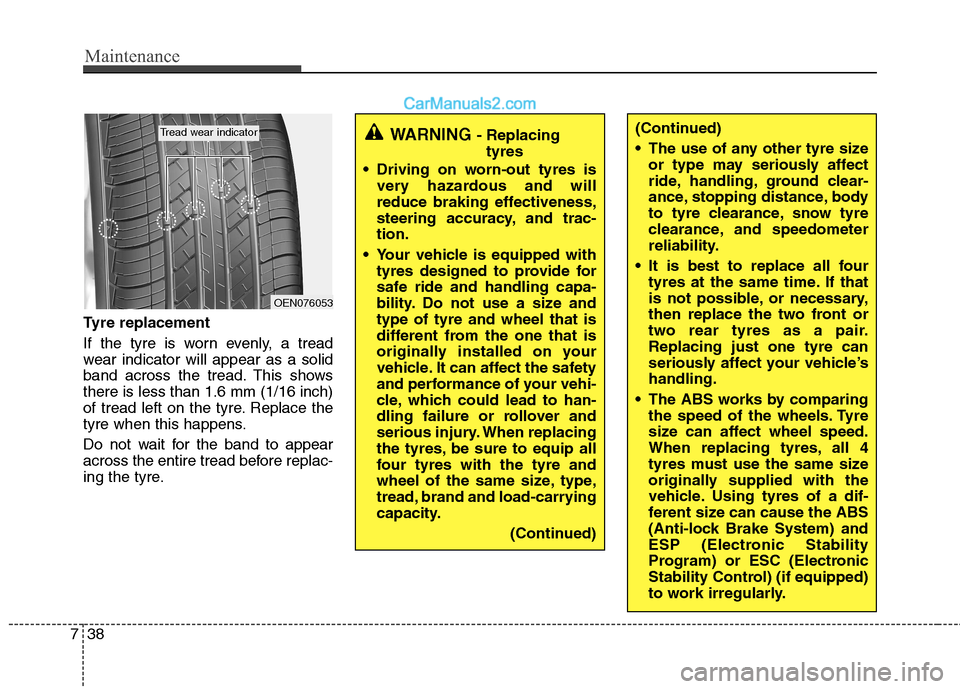
If the tyre is worn evenly, a tread
wear indicator will appear as a solid
band across the tread. This showsthere is less than 1.6 mm (1/16 inch)
of tread left on the tyre. Replace the
tyre when this happens.
Do not wait for the band to appear
across the entire tread before replac-
ing the tyre.
OEN076053
Tread wear indicator(Continued)
The use of any other tyre size
or type may seriously affect
ride, handling, ground clear-
ance, stopping distance, body
to tyre clearance, snow tyre
clearance, and speedometer
reliability.
It is best to replace all four tyres at the same time. If that
is not possible, or necessary,
then replace the two front or
two rear tyres as a pair.Replacing just one tyre can
seriously affect your vehicle’shandling.
The ABS works by comparing the speed of the wheels. Tyre
size can affect wheel speed.
When replacing tyres, all 4
tyres must use the same size
originally supplied with the
vehicle. Using tyres of a dif-
ferent size can cause the ABS
(Anti-lock Brake System) and
ESP (Electronic Stability
Program) or ESC (Electronic
Stability Control) (if equipped)
to work irregularly.WARNING - Replacing
tyres
Driving on worn-out tyres is very hazardous and will
reduce braking effectiveness,
steering accuracy, and trac-tion.
Your vehicle is equipped with tyres designed to provide for
safe ride and handling capa-
bility. Do not use a size andtype of tyre and wheel that is
different from the one that is
originally installed on your
vehicle. It can affect the safety
and performance of your vehi-
cle, which could lead to han-
dling failure or rollover and
serious injury. When replacing
the tyres, be sure to equip all
four tyres with the tyre and
wheel of the same size, type,
tread, brand and load-carrying
capacity.
(Continued)
Page 328 of 363
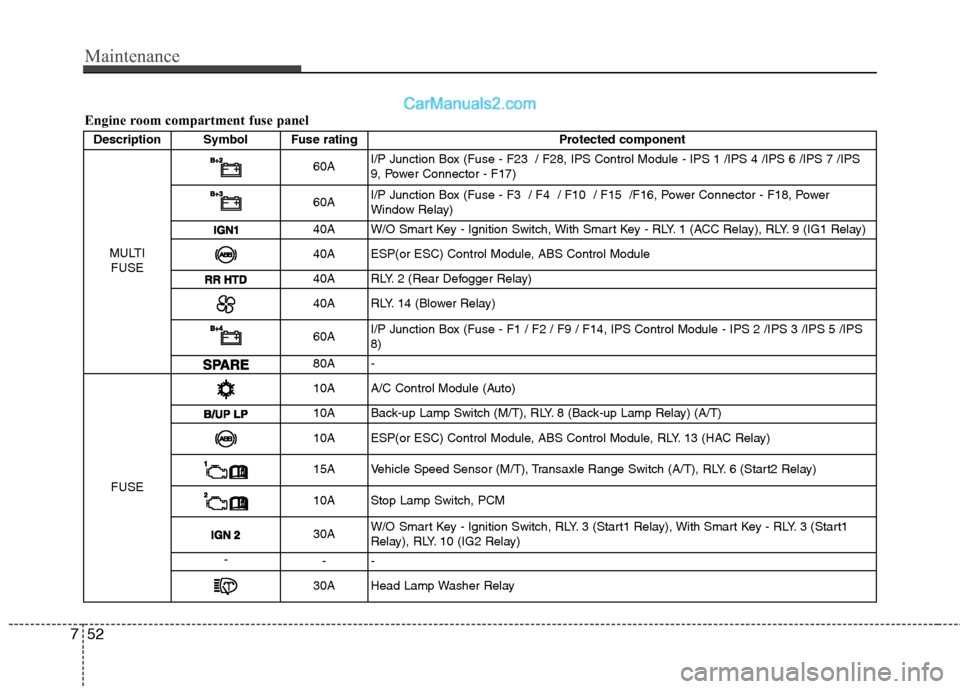
Maintenance
52
7
Description Symbol Fuse rating Protected component
MULTI FUSE
60A I/P Junction Box (Fuse - F23 / F28, IPS Control Module - IPS 1 /IPS 4 /IPS 6 /IPS 7 /IPS
9, Power Connector - F17)
60AI/P Junction Box (Fuse - F3 / F4 / F10 / F15 /F16, Power Connector - F18, Power
Window Relay)
40A W/O Smart Key - Ignition Switch, With Smart Key - RLY. 1 (ACC Relay), RLY. 9 (IG1 Relay)
40A ESP(or ESC) Control Module, ABS Control Module
40A RLY. 2 (Rear Defogger Relay)
40A RLY. 14 (Blower Relay)
60AI/P Junction Box (Fuse - F1 / F2 / F9 / F14, IPS Control Module - IPS 2 /IPS 3 /IPS 5 /IPS 8)
80A -
FUSE
10A A/C Control Module (Auto)
10A Back-up Lamp Switch (M/T), RLY. 8 (Back-up Lamp Relay) (A/T)
10A ESP(or ESC) Control Module, ABS Control Module, RLY. 13 (HAC Relay)
15A Vehicle Speed Sensor (M/T), Transaxle Range Switch (A/T), RLY. 6 (Start2 Relay)
10A Stop Lamp Switch, PCM
30A W/O Smart Key - Ignition Switch, RLY. 3 (Start1 Relay), With Smart Key - RLY. 3 (Start1
Relay), RLY. 10 (IG2 Relay)
- --
30A Head Lamp Washer Relay
Engine room compartment fuse panel
Page 329 of 363
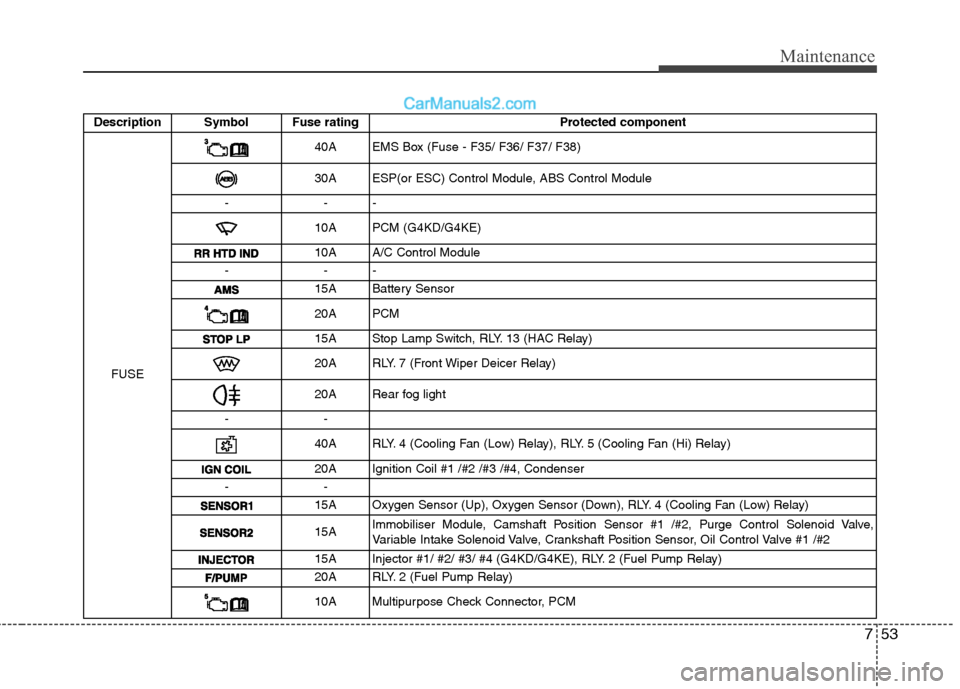
753
Maintenance
Description Symbol Fuse ratingProtected component
FUSE
40AEMS Box (Fuse - F35/ F36/ F37/ F38)
30A ESP(or ESC) Control Module, ABS Control Module
-- -
10A PCM (G4KD/G4KE)
10A A/C Control Module
-- -
15A Battery Sensor
20A PCM
15A Stop Lamp Switch, RLY. 13 (HAC Relay)
20A RLY. 7 (Front Wiper Deicer Relay)
20A Rear fog light
--
40A RLY. 4 (Cooling Fan (Low) Relay), RLY. 5 (Cooling Fan (Hi) Relay)
20A Ignition Coil #1 /#2 /#3 /#4, Condenser
--
15A Oxygen Sensor (Up), Oxygen Sensor (Down), RLY. 4 (Cooling Fan (Low) Relay)
15A Immobiliser Module, Camshaft Position Sensor #1 /#2, Purge Control Solenoid Valve,
Variable Intake Solenoid Valve, Crankshaft Position Sensor, Oil Control Valve #1 /#2
15A Injector #1/ #2/ #3/ #4 (G4KD/G4KE), RLY. 2 (Fuel Pump Relay)
20A RLY. 2 (Fuel Pump Relay)
10A Multipurpose Check Connector, PCM
Page 335 of 363
759
Maintenance
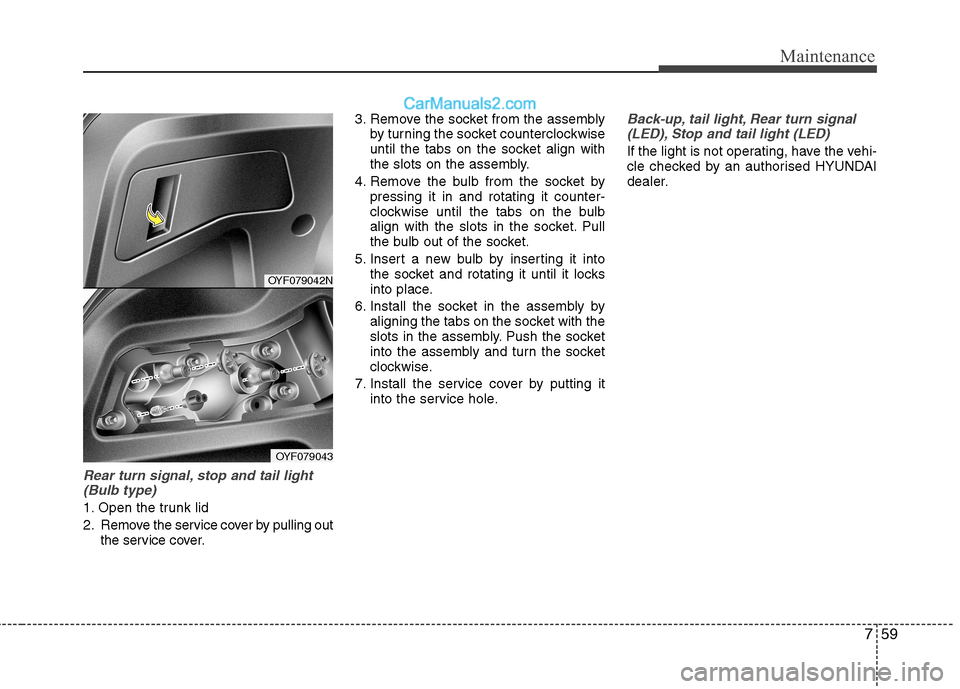
Rear turn signal, stop and tail light(Bulb type)
1. Open the trunk lid
2. Remove the service cover by pulling out the service cover. 3. Remove the socket from the assembly
by turning the socket counterclockwise
until the tabs on the socket align with
the slots on the assembly.
4. Remove the bulb from the socket by pressing it in and rotating it counter-
clockwise until the tabs on the bulb
align with the slots in the socket. Pull
the bulb out of the socket.
5. Insert a new bulb by inserting it into the socket and rotating it until it locks
into place.
6. Install the socket in the assembly by aligning the tabs on the socket with the
slots in the assembly. Push the socket
into the assembly and turn the socket
clockwise.
7. Install the service cover by putting it into the service hole.
Back-up, tail light, Rear turn signal
(LED), Stop and tail light (LED)
If the light is not operating, have the vehi-
cle checked by an authorised HYUNDAI
dealer.
OYF079042N
OYF079043
Page 337 of 363
761
Maintenance
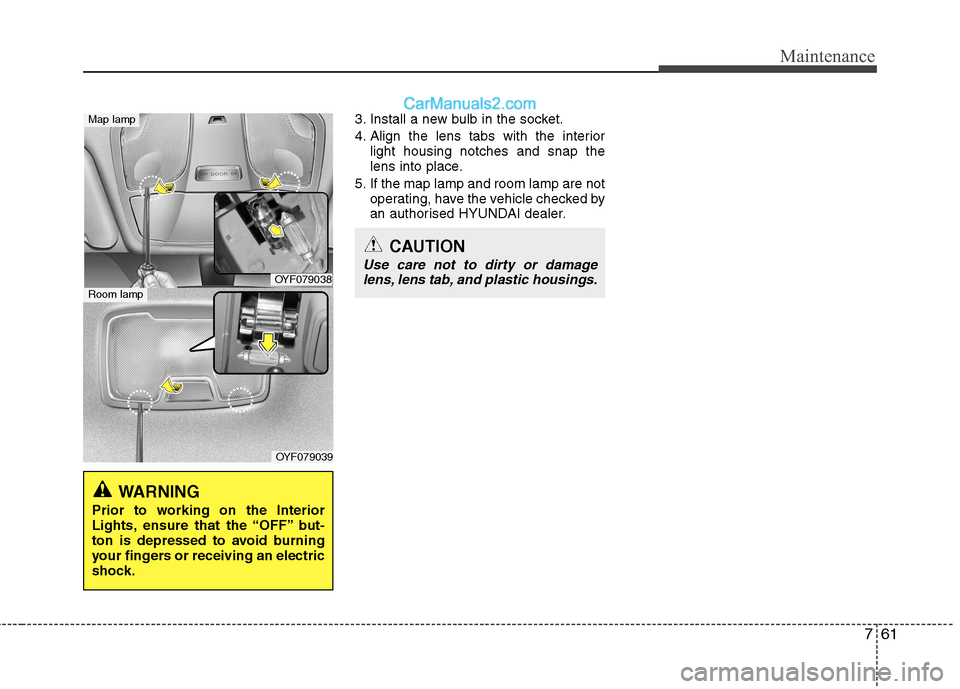
3. Install a new bulb in the socket.
4. Align the lens tabs with the interiorlight housing notches and snap the
lens into place.
5. If the map lamp and room lamp are not operating, have the vehicle checked by
an authorised HYUNDAI dealer.
CAUTION
Use care not to dirty or damage
lens, lens tab, and plastic housings.
Map lamp
OYF079038Room lamp
WARNING
Prior to working on the Interior
Lights, ensure that the “OFF” but-
ton is depressed to avoid burning
your fingers or receiving an electric
shock.
OYF079039
Page 345 of 363
769
Maintenance
Canister
Fuel vapours generated inside the fuel tank are absorbed and stored in the
onboard canister. When the engine is
running, the fuel vapours absorbed in the
canister are drawn into the surge tank
through the purge control solenoid valve.
Purge Control Solenoid Valve (PCSV)
The purge control solenoid valve is con-
trolled by the Engine Control Module
(ECM); when the engine coolant temper-
ature is low during idling, the PCSV clos-
es so that evaporated fuel is not taken
into the engine. After the engine warms-
up during ordinary driving, the PCSV
opens to introduce evaporated fuel to the
engine.3. Exhaust emission control
system
The Exhaust Emission Control System is
a highly effective system which controls
exhaust emissions whilst maintaining
good vehicle performance.
Vehicle modifications
This vehicle should not be modified. Modification of your vehicle could
affect its performance, safety or dura-
bility and may even violate governmen-
tal safety and emissions regulations.
In addition, damage or performance
problems resulting from any modifica-
tion may not be covered under warran-
ty.
If you use unauthorised electronic devices, it may cause the vehicle to
operate abnormally, wire damage, bat-
tery discharge and fire. For your safety,
do not use unauthorized electronic
devices.
Engine exhaust gas precautions
(carbon monoxide)
Carbon monoxide can be present with other exhaust fumes. Therefore, if you
smell exhaust fumes of any kind inside
your vehicle, have it inspected and
repaired immediately. If you ever sus-
pect exhaust fumes are coming into
your vehicle, drive it only with all the
windows fully open. Have your vehicle
checked and repaired immediately.
WARNING - Exhaust
Engine exhaust gases contain car-
bon monoxide (CO). Though
colourless and odourless, it is dan-
gerous and could be lethal if
inhaled. Follow the instructions on
this page to avoid CO poisoning.
Page 355 of 363
Index
2
I
Air bags..........................................................................3-36
Air bag warning label ..............................................3-56
Air bag warning light ..............................................3-39
Curtain air bag..........................................................3-46
Driver's and passenger's front air bag ......................3-42
Side impact air bag ..................................................3-45
Air cleaner ....................................................................7-25
Alarm system ................................................................4-13
Antenna (glass) ............................................................4-107
Anti-lock brake system (ABS) ......................................5-26
Appearance care ............................................................7-62 Exterior care ............................................................7-62
Interior care ..............................................................7-67
Armrest ..........................................................................3-13
Ashtray ........................................................................4-102
Audio system ..............................................................4-107 Glass antenna ........................................................4-107
Steering wheel audio control ................................4-107
Automatic climate control system ................................4-90 Air conditioning ......................................................4-95
Automatic heating and air conditioning ..................4-91
Manual heating and air conditioning ......................4-92
Automatic transaxle ......................................................5-15 Ignition key interlock system ..................................5-20
Paddle shifter............................................................5-18 Shift lock system ......................................................5-19
Sports mode..............................................................5-18
Base kerb weight ..........................................................5-58
Battery............................................................................7-31
Battery saver function ....................................................4-69
Before driving ..................................................................5-3
Bonnet ............................................................................4-26
Bottle holders, see cup holders ....................................4-103
Brake system..................................................................5-22 Anti-lock brake system (ABS) ................................5-26
Electronic stability control (ESC) ............................5-31
Electronic stability program (ESP) ..........................5-28
Parking brake ..........................................................5-23
Power brakes ............................................................5-22
Brake/clutch fluid ..........................................................7-21
Bulb replacement ..........................................................7-55
Bulb wattage ....................................................................8-2
Button start/stop, see engine start/stop button ................5-8
A
B