engine oil Hyundai Sonata
[x] Cancel search | Manufacturer: HYUNDAI, Model Year: , Model line: , Model:Pages: 363, PDF Size: 30.3 MB
Page 309 of 363
733
Maintenance
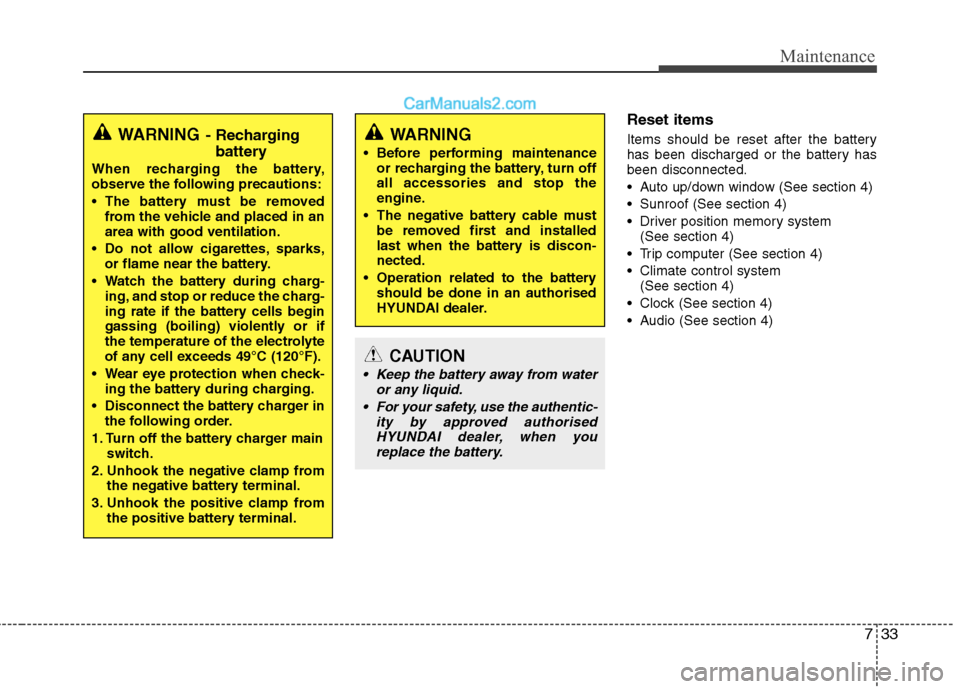
Reset items
Items should be reset after the battery
has been discharged or the battery hasbeen disconnected.
Auto up/down window (See section 4)
Sunroof (See section 4)
Driver position memory system (See section 4)
Trip computer (See section 4)
Climate control system (See section 4)
Clock (See section 4)
Audio (See section 4)
WARNING
Before performing maintenance or recharging the battery, turn off all accessories and stop the
engine.
The negative battery cable must be removed first and installed
last when the battery is discon-nected.
Operation related to the battery should be done in an authorised
HYUNDAI dealer.
CAUTION
Keep the battery away from water
or any liquid.
For your safety, use the authentic- ity by approved authorisedHYUNDAI dealer, when youreplace the battery.
WARNING - Recharging
battery
When recharging the battery,
observe the following precautions:
The battery must be removed from the vehicle and placed in an area with good ventilation.
Do not allow cigarettes, sparks, or flame near the battery.
Watch the battery during charg- ing, and stop or reduce the charg-
ing rate if the battery cells begin
gassing (boiling) violently or if
the temperature of the electrolyte
of any cell exceeds 49°C (120°F).
Wear eye protection when check- ing the battery during charging.
Disconnect the battery charger in the following order.
1. Turn off the battery charger main switch.
2. Unhook the negative clamp from the negative battery terminal.
3. Unhook the positive clamp from the positive battery terminal.
Page 320 of 363
Maintenance
44
7
FUSES
A vehicle’s electrical system is protected
from electrical overload damage by
fuses. This vehicle has 2 fuse panels, one locat-
ed in the driver’s side panel bolster,
another is in the engine compartment.
If any of your vehicle’s lights, acces-
sories, or controls do not work, check the
appropriate circuit fuse. If a fuse has
blown, the element inside the fuse will bemelted.
If the electrical system does not work,
first check the driver’s side fuse panel.
Always replace a blown fuse with one of
the same rating.
If the replacement fuse blows, this indi-
cates an electrical problem. Avoid using
the system involved and immediately
consult an authorised HYUNDAI dealer.
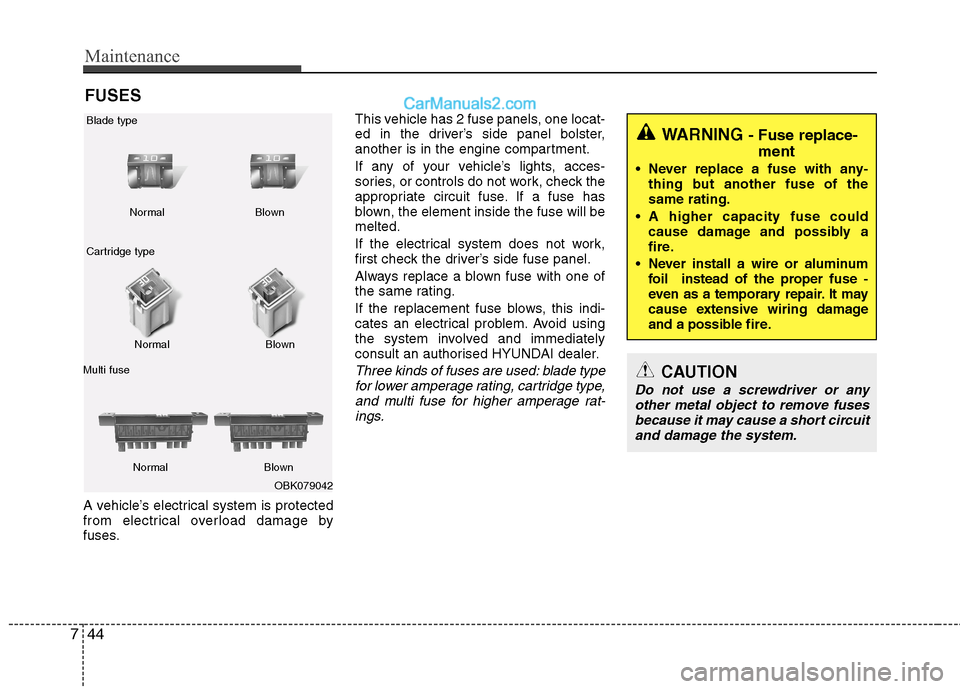
Three kinds of fuses are used: blade type
for lower amperage rating, cartridge type,
and multi fuse for higher amperage rat- ings.
WARNING - Fuse replace-
ment
Never replace a fuse with any- thing but another fuse of the same rating.
A higher capacity fuse could cause damage and possibly a
fire.
Never install a wire or aluminum foil instead of the proper fuse -
even as a temporary repair. It may
cause extensive wiring damage
and a possible fire.
CAUTION
Do not use a screwdriver or any
other metal object to remove fuses because it may cause a short circuit
and damage the system.
OBK079042
Normal
Normal
Blade type
Cartridge type
Multi fuse Blown
Blown
Normal Blown
Page 339 of 363
763
Maintenance
Waxing
Wax the vehicle when water will no longer bead on the paint.
Always wash and dry the vehicle before
waxing. Use a good quality liquid or
paste wax, and follow the manufacturer’s
instructions. Wax all metal trim to protect
it and to maintain its luster.
Removing oil, tar, and similar materials
with a spot remover will usually strip the
wax from the finish. Be sure to re-wax
these areas even if the rest of the vehicle
does not yet need waxing.Finish damage repair
Deep scratches or stone chips in the
painted surface must be repaired
promptly. Exposed metal will quickly rust
and may develop into a major repair
expense.
✽✽NOTICE
If your vehicle is damaged and requires
any metal repair or replacement, be sure
the body shop applies anti-corrosion
materials to the parts repaired or
replaced.
CAUTION
Wiping dust or dirt off the body with a dry cloth will scratch the
finish.
Do not use steel wool, abrasive cleaners, or strong detergentscontaining highly alkaline orcaustic agents on chrome-plated
or anodized aluminum parts. Thismay result in damage to the pro-tective coating and cause discol-oration or paint deterioration.
CAUTION
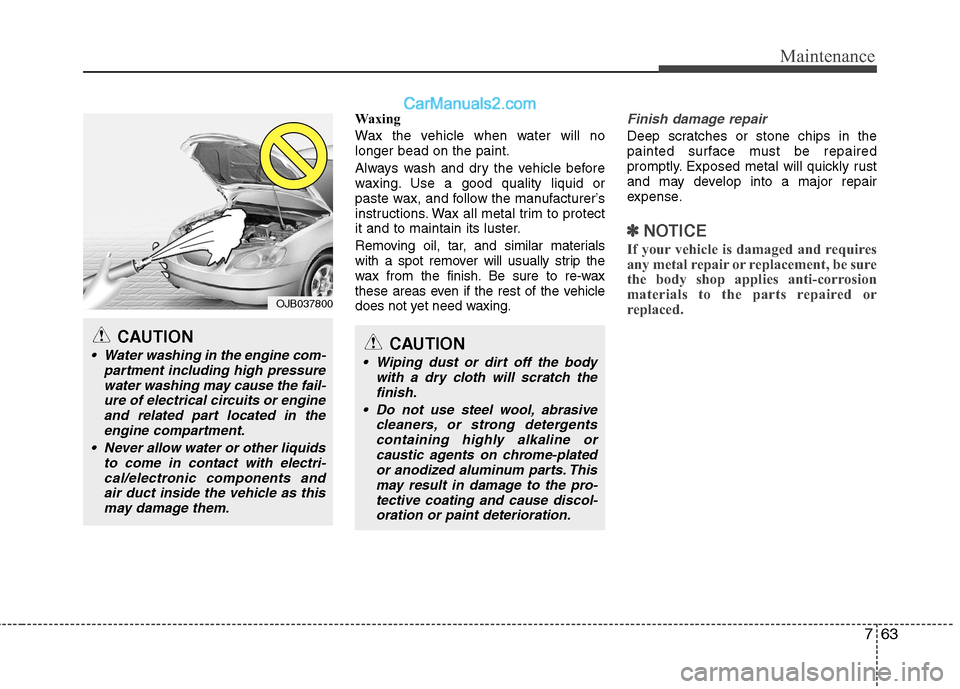
Water washing in the engine com-
partment including high pressurewater washing may cause the fail- ure of electrical circuits or engineand related part located in the
engine compartment.
Never allow water or other liquids to come in contact with electri-cal/electronic components and
air duct inside the vehicle as thismay damage them.
OJB037800
Page 350 of 363
Specifications & Consumer information
4
8
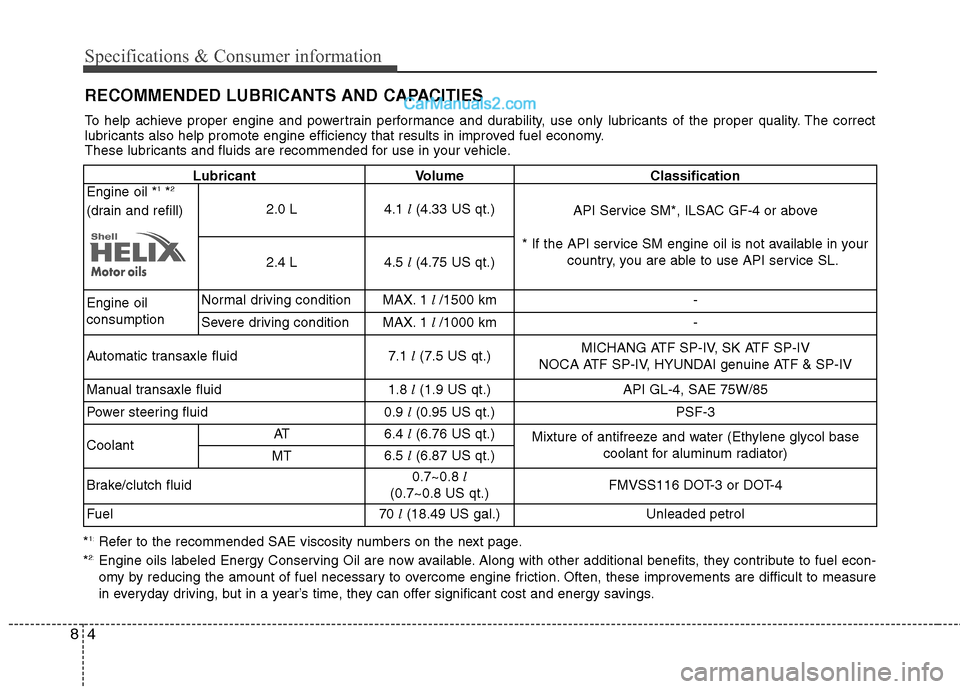
RECOMMENDED LUBRICANTS AND CAPACITIES
* 1:
Refer to the recommended SAE viscosity numbers on the next page.
* 2:
Engine oils labeled Energy Conserving Oil are now available. Along with other additional benefits, they contribute to fuel econ-
omy by reducing the amount of fuel necessary to overcome engine friction. Often, these improvements are difficult to measure
in everyday driving, but in a year’s time, they can offer significant cost and energy savings.
To help achieve proper engine and powertrain performance and durability, use only lubricants of the proper quality. The correct
lubricants also help promote engine efficiency that results in improved fuel economy.
These lubricants and fluids are recommended for use in your vehicle.
Lubricant Volume Classification
Engine oil * 1
*2
(drain and refill)
2.0 L 4.1
l(4.33 US qt.)
API Service SM*, ILSAC GF-4 or above
* If the API service SM engine oil is not available in your country, you are able to use API service SL.
2.4 L4.5 l(4.75 US qt.)
Engine oil consumptionNormal driving conditionMAX. 1 l /1500 km-
Severe driving conditionMAX. 1 l /1000 km-
Automatic transaxle fluid 7.1
l(7.5 US qt.) MICHANG ATF SP-IV, SK ATF SP-IV
NOCA ATF SP-IV, HYUNDAI genuine ATF & SP-IV
Manual transaxle fluid 1.8
l(1.9 US qt.)
API GL-4, SAE 75W/85
Power steering fluid 0.9
l(0.95 US qt.)
PSF-3
Coolant
AT 6.4
l(6.76 US qt.)
Mixture of antifreeze and water (Ethylene glycol base
coolant for aluminum radiator)
MT6.5 l(6.87 US qt.)
Brake/clutch fluid 0.7~0.8
l
(0.7~0.8 US qt.) FMVSS116 DOT-3 or DOT-4
Fuel 70
l(18.49 US gal.)
Unleaded petrol
Page 351 of 363
85
Specifications & Consumer information
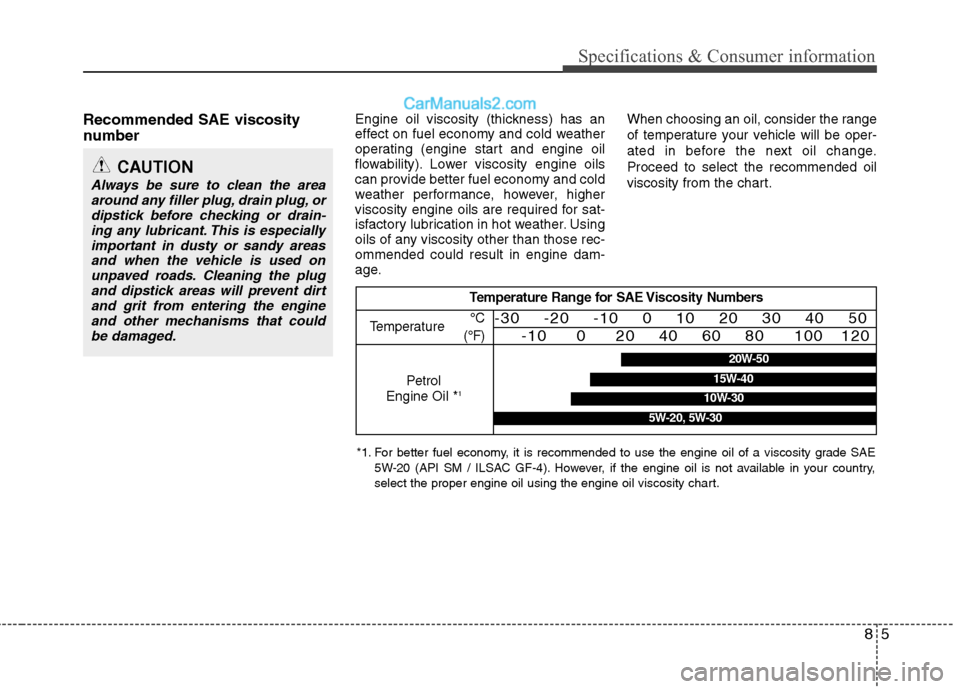
Recommended SAE viscosity
number Engine oil viscosity (thickness) has an
effect on fuel economy and cold weather
operating (engine start and engine oil
flowability). Lower viscosity engine oils
can provide better fuel economy and cold
weather performance, however, higher
viscosity engine oils are required for sat-
isfactory lubrication in hot weather. Using
oils of any viscosity other than those rec-ommended could result in engine dam-
age.When choosing an oil, consider the range
of temperature your vehicle will be oper-
ated in before the next oil change.Proceed to select the recommended oil
viscosity from the chart.
CAUTION
Always be sure to clean the area
around any filler plug, drain plug, ordipstick before checking or drain-ing any lubricant. This is especially
important in dusty or sandy areasand when the vehicle is used onunpaved roads. Cleaning the plugand dipstick areas will prevent dirt
and grit from entering the engine and other mechanisms that couldbe damaged.
Temperature Range for SAE Viscosity Numbers
Temperature
Petrol
Engine Oil * 1°C
(°F)-30 -20 -10 0 10 20 30 40 50 -10 0 20 40 60 80 100 120
*1. For better fuel economy, it is recommended to use the engine oil of a viscosity grade SAE5W-20 (API SM / ILSAC GF-4). However, if the engine oil is not available in your country,
select the proper engine oil using the engine oil viscosity chart.
20W-50
10W-30
15W-40
5W-20, 5W-30
Page 357 of 363
Index
4
I
Central door lock switch ..........................................4-17
Child-protector rear door lock ..................................4-19
Drink holders, see cup holders ....................................4-103
Driver position memory system......................................4-35
Driver's air bag ................................................................3-42
Driving at night ..............................................................5-43
Driving in flooded areas ................................................5-44
Driving in the rain ..........................................................5-44
Easy access function ......................................................4-36
Economical operation ....................................................5-40
Electronic stability control (ESC) ..................................5-31
Electronic stability program (ESP) ................................5-28
Electric chromic mirror (ECM) ......................................4-39
Emergency starting ..........................................................6-5 Jump starting ..............................................................6-5
Push starting ................................................................6-6
Emergency towing ..........................................................6-17
Emergency whilst driving ................................................6-3
Emission control system ................................................7-68 Crankcase emission control system ..........................7-68
Evaporative emission control System ......................7-68
Exhaust emission control system ..............................7-69
Engine compartment..................................................2-4, 7-2
Engine coolant ................................................................7-18
Engine number ..................................................................8-7 Engine oil ........................................................................7-16
Engine overheats ..............................................................6-8
Engine start/stop button ....................................................5-8
Engine temperature gauge ..............................................4-45
Engine will not start..........................................................6-4
Evaporative emission control System ............................7-68
Exhaust emission control system ....................................7-69
Explanation of scheduled maintenance items ................7-13
Exterior care....................................................................7-62
Flat tyre ............................................................................6-8
Changing tyres ............................................................6-9
Compact spare tyre....................................................6-14
Jack and tools ..............................................................6-8
Removing and storing the spare tyre ..........................6-9
Fluid Washer fluid ..............................................................7-23
Brake/clutch fluid ......................................................7-21
Power steering fluid ..................................................7-22
Folding the rear seat........................................................3-14
Front seat adjustment - manual ........................................3-4
Front seat adjustment - power ..........................................3-5
Fuel filler lid ..................................................................4-28
Fuel gauge ......................................................................4-46
Fuel requirements ............................................................1-2
Fuses ..............................................................................7-44
F
E
Page 360 of 363
I7
Index
Neck restraints, see headrest ..................................3-7, 3-11
Odometer ........................................................................4-47
Oil (Engine) ....................................................................7-16
Outside rearview mirror ..................................................4-40
Overheats ..........................................................................6-7
Owner maintenance ..........................................................7-4
Paddle shifter ..................................................................5-18
Panorama sunroof ..........................................................4-31
Parking brake inspect ......................................................7-24
Parking brake ..................................................................5-23
Passenger's front air bag ................................................3-42
Power brakes ..................................................................5-22
Power outlet ..................................................................4-104
Power steering ................................................................4-37
Power steering fluid ........................................................7-22
Power window lock button ............................................4-25
Pre-tensioner seat belt ....................................................3-23
Push starting......................................................................6-6 Rear seat..........................................................................3-11
Rear parking assist system ..............................................4-65
Rearview camera ............................................................4-68
Recommended cold tyre inflation pressures ..................7-34
Recommended lubricants and capacities ..........................8-4
Recommended SAE viscosity number........................8-5
Remote keyless entry ......................................................4-10
Road warning ....................................................................6-2
Rocking the vehicle ........................................................5-42
Scheduled maintenance service ........................................7-6 Normal maintenance schedule ....................................7-7
Maintenance under severe usage conditions ............7-11
Seat belts ........................................................................3-17 Pre-tensioner seat belt ..............................................3-23
Lap belt......................................................................3-22
Lap/shoulder belt ......................................................3-19
Seat belt warning ......................................................3-18
Seat warmer ............................................................3-9, 3-12
Seatback pocket ..............................................................3-11
Seats ..................................................................................3-2 Armrest ......................................................................3-13
Headrest ............................................................3-7, 3-11
Folding the rear seat ..................................................3-14
O
P
NR
S