air conditioning Hyundai Sonata 2003 User Guide
[x] Cancel search | Manufacturer: HYUNDAI, Model Year: 2003, Model line: Sonata, Model: Hyundai Sonata 2003Pages: 205, PDF Size: 19.98 MB
Page 133 of 205

WHAT TO DO IN AN EMERGENCY 3- 3
o If you should accidentally get acid on your
skin or in your eyes, immediately remove
any contaminated clothing and flush the area
with clear water for at least 15 minutes. Then
promptly obtain medical attention. If you
must be transported to an emergency facil-
ity, continue to apply water to the affected
area with a sponge or cloth.
o The gas produced by the battery during the
jump-start operation is highly explosive. Do
not smoke or allow a spark or an open flame
in the vicinity.
o The battery being used to provide the jump
start must be 12-volt. If you cannot deter-
mine that it is a 12-volt battery, do not attempt
to use it for the jump start.
o To jump start a car with a discharged battery,
follow this procedure exactly:
1. If the booster battery is installed in another
vehicle, be sure the two vehicles are not
touching.
2. Turn off all unnecessary lights and acces-
sories in both vehicles.
3. Attach the clamps of the jumper cable in the
exact location shown on the illustration. First,
attach one clamp of the jumper cable to the
positive (+) post or cable of the discharged
battery. Then attach the other end of the
same cable to the positive (+) post or cable
of the booster battery. Next, using the other
cable, attach one clamp to the negative (-)
post or cable of the booster battery. Then
attach the other end of that cable to a solidmetal part of the engine away from the
battery. Do not connect the cable to any
moving part.
4. Start the engine in the car with the booster
battery and let it run for a few minutes. This
will help to assure that the booster battery is
fully charged. During the jumping operation,
run the engine in this vehicle at about 2,000
rpm.
5. Start your engine using the normal starting
procedure. After the engine starts, leave the
jumper cables connected and let the engine
run at fast idle or about 2,000 rpm for several
minutes.
6. Carefully remove the jumper cables in the
reverse order of attachment.
If you do not know why your battery became
discharged (because the lights were left on,
etc.), have the charging system checked by
your Hyundai dealer.D030A01A-AATIF THE ENGINE OVERHEATS
If your temperature gauge indicates overheat-
ing, you experience a loss of power, or hear loud
pinging or knocking, the engine is probably too
hot. If this happens, you should:
1. Pull off the road and stop as soon as it is safe
to do so.
2. Place the gear selector lever in "P" (auto-
matic), or neutral (manual transaxle) and set
the parking brake. If the air conditioning is on,
turn it off.
3. If engine coolant is running out under the car
or steam is coming out from the hood, stop
the engine. Do not open the hood until the
coolant has stopped running or the steaming
has stopped. If there is no visible loss of
engine coolant and no steam, leave the
engine running and check to be sure the
engine cooling fan is operating. If the fan is
not running, turn the engine off.
4. Check to see if the water pump drive belt is
missing. If it is not missing, check to see that
it is tight. If the drive belt seems to be
satisfactory, check for coolant leaking from
the radiator, hoses or under the car. (If the
air conditioning had been in use, it is normal
for cold water to be draining from it when you
stop).
Page 151 of 205
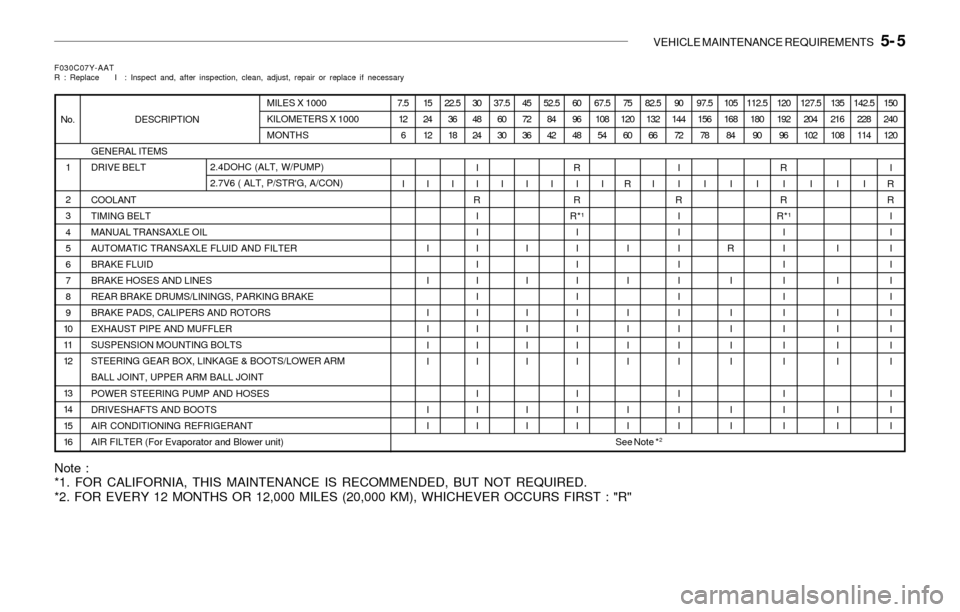
VEHICLE MAINTENANCE REQUIREMENTS 5- 5
Note :
*1. FOR CALIFORNIA, THIS MAINTENANCE IS RECOMMENDED, BUT NOT REQUIRED.
*2. FOR EVERY 12 MONTHS OR 12,000 MILES (20,000 KM), WHICHEVER OCCURS FIRST : "R"
F030C07Y-AAT
R : Replace I : Inspect and, after inspection, clean, adjust, repair or replace if necessary
GENERAL ITEMS
DRIVE BELT
COOLANT
TIMING BELT
MANUAL TRANSAXLE OIL
AUTOMATIC TRANSAXLE FLUID AND FILTER
BRAKE FLUID
BRAKE HOSES AND LINES
REAR BRAKE DRUMS/LININGS, PARKING BRAKE
BRAKE PADS, CALIPERS AND ROTORS
EXHAUST PIPE AND MUFFLER
SUSPENSION MOUNTING BOLTS
STEERING GEAR BOX, LINKAGE & BOOTS/LOWER ARM
BALL JOINT, UPPER ARM BALL JOINT
POWER STEERING PUMP AND HOSES
DRIVESHAFTS AND BOOTS
AIR CONDITIONING REFRIGERANT
AIR FILTER (For Evaporator and Blower unit) 1
2
3
4
5
6
7
8
9
10
11
12
13
14
15
16 No. DESCRIPTIONMILES X 1000
KILOMETERS X 1000
MONTHS
2.4DOHC (ALT, W/PUMP)
2.7V6 ( ALT, P/STR'G, A/CON)7.5
12
6
I15
24
12
I
I
I
I
I
I
I
I
I22.5
36
18
I30
48
24
I
I
R
I
I
I
I
I
I
I
I
I
I
I
I
I37.5
60
30
I45
72
36
I
I
I
I
I
I
I
I
I52.5
84
42
I60
96
48
R
I
R
R*¹
I
I
I
I
I
I
I
I
I
I
I
I67.5
108
54
I75
120
60
R
I
I
I
I
I
I
I
I82.5
132
66
I90
144
72
I
I
R
I
I
I
I
I
I
I
I
I
I
I
I
I97.5
156
78
I105
168
84
I
R
I
I
I
I
I
I
I112.5
180
90
I120
192
96
R
I
R
R*¹
I
I
I
I
I
I
I
I
I
I
I
I127.5
204
102
I135
216
108
I
I
I
I
I
I
I
I
I142.5
228
114
I150
240
120
I
R
R
I
I
I
I
I
I
I
I
I
I
I
I
I
See Note *
2
Page 155 of 205

VEHICLE MAINTENANCE REQUIREMENTS 5- 9
F070Q01A-AAT
o Air Conditioning Refrigerant
Check the air conditioning lines and connec-
tions for leakage and damage. Check air con-
ditioning performance according to the relevant
shop manual if necessary.
F070P01A-AAT
o Driveshafts and Boots
Check the drive shafts, boots and clamps for
cracks, deterioration, or damage. Replace any
damaged parts and, if necessary, repack the
grease.
F070N01A-AATo Power Steering Pump, Belt and Hoses
Check the power steering pump and hoses for
leakage and damage. Replace any damaged or
leaking parts immediately. Inspect the power
steering belt for evidence of cuts, cracks, ex-
cessive wear, oiliness and proper tension.
Replace or adjust it if necessary.
Page 156 of 205

6. Do-It-Yourself Maintenance
Engine compartment ........................................................................ 6-2
General checks ................................................................................ 6-4
Checking the engine oil .................................................................... 6-5
Changing the oil and filter ................................................................. 6-6
Checking and changing the engine coolant ...................................... 6-7
Spark plugs ...................................................................................... 6-9
Changing the air cleaner filter ......................................................... 6-11
Checking the transaxle oil (Manual) ............................................... 6-12
Checking the transaxle fluid (Automatic) ....................................... 6-13
Checking the brakes ...................................................................... 6-14
Air conditioning care ....................................................................... 6-15
Checking drive belts ...................................................................... 6-18
Checking and replacing fuses ........................................................ 6-18
Replacement of bulbs .................................................................... 6-21
Junction Box description ................................................................ 6-29
6
Page 159 of 205

6- 4 DO-IT-YOURSELF MAINTENANCE
G020C01A-AATVehicle Interior
The following should be checked each time
when the vehicle is driven:
o Lights operation
o Windshield wiper operation
o Horn operation
o Defroster, heating system operation (and air
conditioning, if installed)
o Steering operation and condition
o Mirror condition and operation
o Turn signal operation
o Accelerator pedal operation
o Brake operation, including parking brake
o Manual transaxle operation, including clutch
operation
o Automatic transaxle operation, including
"Park" mechanism operation
o Seat control condition and operation
o Seat belt condition and operation
o Sunvisor operation
If you notice anything that does not operate
correctly or appears to be functioning incor-
rectly, inspect it carefully and seek assistance
from your Hyundai dealer if service is needed.
G020B01A-AATVehicle Exterior
The following should be checked monthly:
o Overall appearance and condition
o Air filter condition
o Wheel condition and wheel nut torque
o Exhaust system condition
o Light condition and operation
o Windshield glass condition
o Wiper blade condition
o Paint condition and body corrosion
o Fluid leaks
o Door and hood lock condition
o Tire pressure and condition (including spare
tire)
G020A01A-AATGENERAL CHECKS
Engine Compartment
The following should be checked regularly:
o Engine oil level and condition
o Transaxle fluid level and condition
o Brake fluid level
o Clutch fluid level
o Engine coolant level
o Windshield washer fluid level
o Accessory drive belt condition
o Engine Coolant hose condition
o Fluid leaks (on or below components)
o Power steering fluid level
o Battery condition
Page 170 of 205
DO-IT-YOURSELF MAINTENANCE 6- 15
!
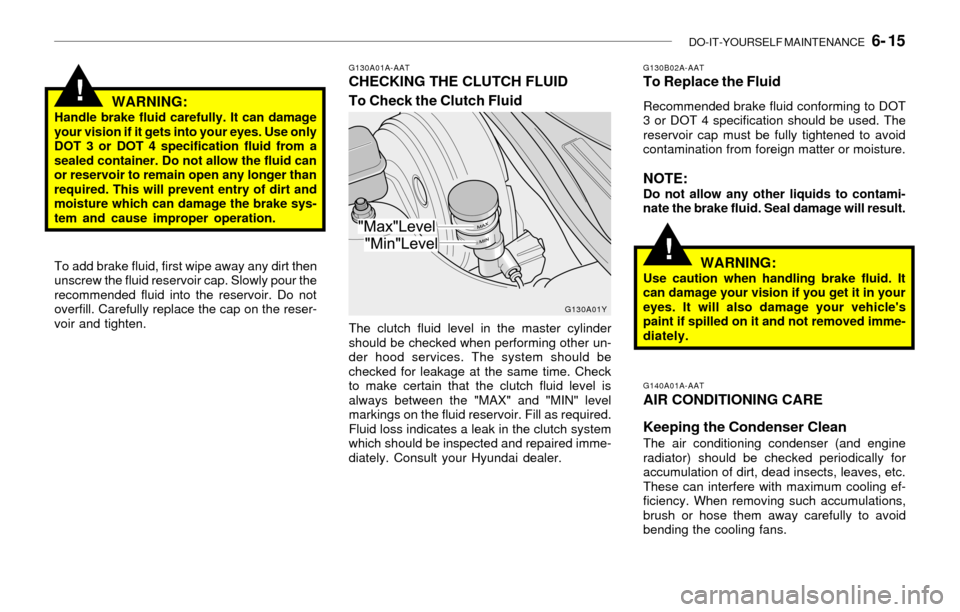
G130A01A-AATCHECKING THE CLUTCH FLUID
To Check the Clutch FluidG130B02A-AATTo Replace the Fluid
Recommended brake fluid conforming to DOT
3 or DOT 4 specification should be used. The
reservoir cap must be fully tightened to avoid
contamination from foreign matter or moisture.
NOTE:Do not allow any other liquids to contami-
nate the brake fluid. Seal damage will result.
WARNING:Handle brake fluid carefully. It can damage
your vision if it gets into your eyes. Use only
DOT 3 or DOT 4 specification fluid from a
sealed container. Do not allow the fluid can
or reservoir to remain open any longer than
required. This will prevent entry of dirt and
moisture which can damage the brake sys-
tem and cause improper operation.
To add brake fluid, first wipe away any dirt then
unscrew the fluid reservoir cap. Slowly pour the
recommended fluid into the reservoir. Do not
overfill. Carefully replace the cap on the reser-
voir and tighten.
!
The clutch fluid level in the master cylinder
should be checked when performing other un-
der hood services. The system should be
checked for leakage at the same time. Check
to make certain that the clutch fluid level is
always between the "MAX" and "MIN" level
markings on the fluid reservoir. Fill as required.
Fluid loss indicates a leak in the clutch system
which should be inspected and repaired imme-
diately. Consult your Hyundai dealer.
WARNING:Use caution when handling brake fluid. It
can damage your vision if you get it in your
eyes. It will also damage your vehicle's
paint if spilled on it and not removed imme-
diately.
G140A01A-AATAIR CONDITIONING CARE
Keeping the Condenser Clean
The air conditioning condenser (and engine
radiator) should be checked periodically for
accumulation of dirt, dead insects, leaves, etc.
These can interfere with maximum cooling ef-
ficiency. When removing such accumulations,
brush or hose them away carefully to avoid
bending the cooling fans.
G130A01Y
!
Page 171 of 205
6- 16 DO-IT-YOURSELF MAINTENANCE
G150A01A-AATCHECKING STEERING WHEEL
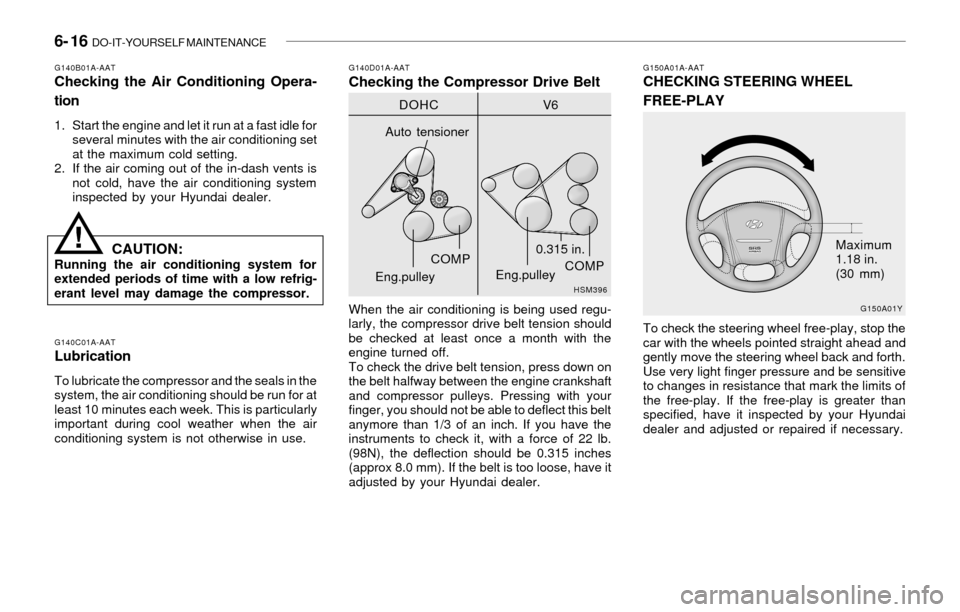
FREE-PLAYG140D01A-AATChecking the Compressor Drive Belt
G140C01A-AATLubrication
To lubricate the compressor and the seals in the
system, the air conditioning should be run for at
least 10 minutes each week. This is particularly
important during cool weather when the air
conditioning system is not otherwise in use.
G140B01A-AATChecking the Air Conditioning Opera-
tion
1. Start the engine and let it run at a fast idle for
several minutes with the air conditioning set
at the maximum cold setting.
2. If the air coming out of the in-dash vents is
not cold, have the air conditioning system
inspected by your Hyundai dealer.
CAUTION:Running the air conditioning system for
extended periods of time with a low refrig-
erant level may damage the compressor.
!
When the air conditioning is being used regu-
larly, the compressor drive belt tension should
be checked at least once a month with the
engine turned off.
To check the drive belt tension, press down on
the belt halfway between the engine crankshaft
and compressor pulleys. Pressing with your
finger, you should not be able to deflect this belt
anymore than 1/3 of an inch. If you have the
instruments to check it, with a force of 22 lb.
(98N), the deflection should be 0.315 inches
(approx 8.0 mm). If the belt is too loose, have it
adjusted by your Hyundai dealer.To check the steering wheel free-play, stop the
car with the wheels pointed straight ahead and
gently move the steering wheel back and forth.
Use very light finger pressure and be sensitive
to changes in resistance that mark the limits of
the free-play. If the free-play is greater than
specified, have it inspected by your Hyundai
dealer and adjusted or repaired if necessary.
HSM396
G150A01Y
Maximum
1.18 in.
(30 mm)
DOHC V6
Eng.pulleyCOMP
Eng.pulleyCOMP 0.315 in.
Auto tensioner
Page 175 of 205
6- 20 DO-IT-YOURSELF MAINTENANCE
!
!
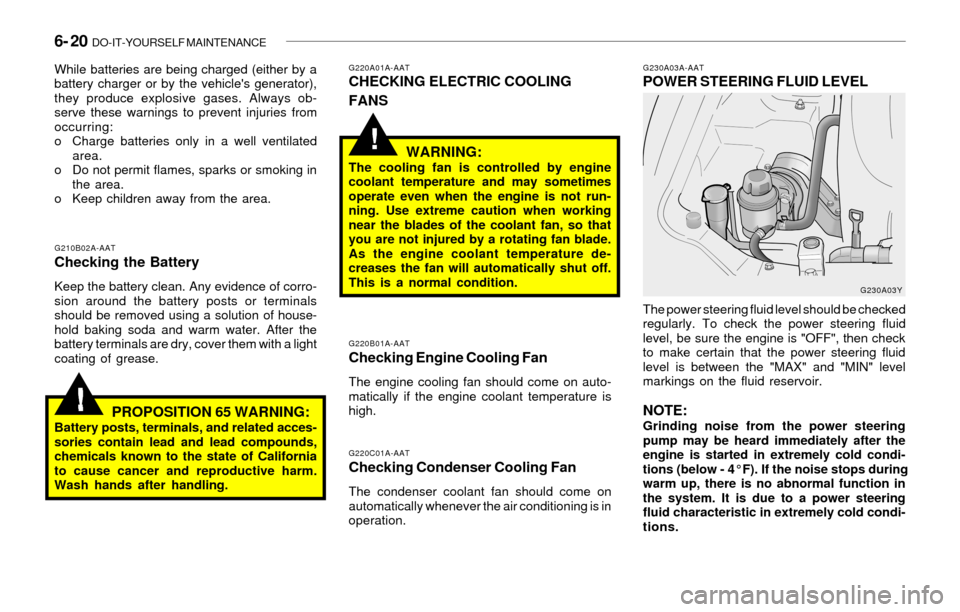
G230A03A-AATPOWER STEERING FLUID LEVEL
G220B01A-AATChecking Engine Cooling Fan
The engine cooling fan should come on auto-
matically if the engine coolant temperature is
high.
G220A01A-AATCHECKING ELECTRIC COOLING
FANS
G220C01A-AATChecking Condenser Cooling Fan
The condenser coolant fan should come on
automatically whenever the air conditioning is in
operation.
G210B02A-AATChecking the Battery
Keep the battery clean. Any evidence of corro-
sion around the battery posts or terminals
should be removed using a solution of house-
hold baking soda and warm water. After the
battery terminals are dry, cover them with a light
coating of grease. While batteries are being charged (either by a
battery charger or by the vehicle's generator),
they produce explosive gases. Always ob-
serve these warnings to prevent injuries from
occurring:
o Charge batteries only in a well ventilated
area.
o Do not permit flames, sparks or smoking in
the area.
o Keep children away from the area.
WARNING:The cooling fan is controlled by engine
coolant temperature and may sometimes
operate even when the engine is not run-
ning. Use extreme caution when working
near the blades of the coolant fan, so that
you are not injured by a rotating fan blade.
As the engine coolant temperature de-
creases the fan will automatically shut off.
This is a normal condition.
The power steering fluid level should be checked
regularly. To check the power steering fluid
level, be sure the engine is "OFF", then check
to make certain that the power steering fluid
level is between the "MAX" and "MIN" level
markings on the fluid reservoir.
NOTE:Grinding noise from the power steering
pump may be heard immediately after the
engine is started in extremely cold condi-
tions (below - 4°F). If the noise stops during
warm up, there is no abnormal function in
the system. It is due to a power steering
fluid characteristic in extremely cold condi-
tions.
G230A03Y
PROPOSITION 65 WARNING:Battery posts, terminals, and related acces-
sories contain lead and lead compounds,
chemicals known to the state of California
to cause cancer and reproductive harm.
Wash hands after handling.
!
Page 185 of 205
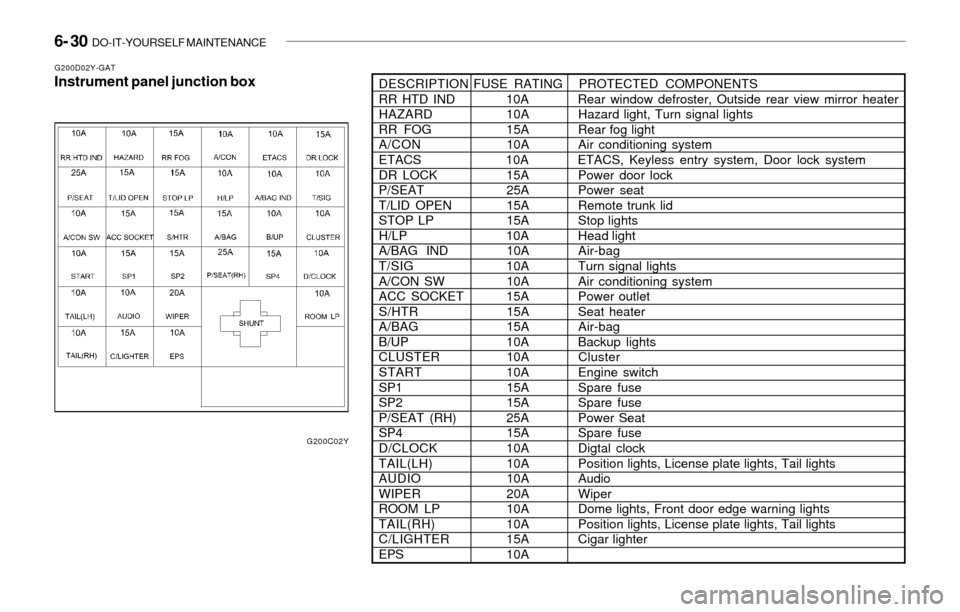
6- 30 DO-IT-YOURSELF MAINTENANCE
G200D02Y-GATInstrument panel junction boxDESCRIPTIONFUSE RATING PROTECTED COMPONENTS
RR HTD IND 10A Rear window defroster, Outside rear view mirror heater
HAZARD 10AHazard light, Turn signal lights
RR FOG 15A Rear fog light
A/CON 10AAir conditioning system
ETACS 10A ETACS, Keyless entry system, Door lock system
DR LOCK 15A Power door lock
P/SEAT 25A Power seat
T/LID OPEN 15A Remote trunk lid
STOP LP 15A Stop lights
H/LP 10A Head light
A/BAG IND 10AAir-bag
T/SIG 10ATurn signal lights
A/CON SW 10A Air conditioning system
ACC SOCKET 15A Power outlet
S/HTR 15ASeat heater
A/BAG 15A Air-bag
B/UP 10A Backup lights
CLUSTER 10A Cluster
START 10AEngine switch
SP1 15A Spare fuse
SP2 15A Spare fuse
P/SEAT (RH) 25A Power Seat
SP4 15A Spare fuse
D/CLOCK 10ADigtal clock
TAIL(LH) 10APosition lights, License plate lights, Tail lights
AUDIO 10A Audio
WIPER 20A Wiper
ROOM LP 10A Dome lights, Front door edge warning lights
TAIL(RH) 10APosition lights, License plate lights, Tail lights
C/LIGHTER 15ACigar lighter
EPS 10A
G200C02Y
Page 201 of 205

10- 2 INDEX
A
Air bag ...............................................................................................1-28
Air Cleaner Filter ...............................................................................6-11
Air Conditioning
Care..............................................................................................6-15
Operation............................................................................ 1-70, 6-16
Switch...........................................................................................1-70
Antenna ..........................................................................................1-100
Ashtray..............................................................................................1-46
Audio (H240, H260, H290) ........................................... 1-80, 1-85, 1-90
B
Battery..................................................................................... 2-14, 6-19
Brake
Anti-lock system ..........................................................................2-10
Checking the brakes ....................................................................6-14
Fluid ..............................................................................................6-14
Pedal clearance ...........................................................................6-17
Pedal free-play .............................................................................6-17
Practices......................................................................................2-12
Breaking-In your New Hyundai .......................................................... 1-3
Bulb Replacement .............................................................................6-21
C
Care of Cassette Tapes ...................................................................1-98
Cassette Tape Player Operation (H240, H290) .................... 1-83, 1-93
Catalytic Converter ............................................................................. 7-3
Child Restraint System .....................................................................1-22
Child-Protector Rear Door Lock ......................................................... 1-6
Cigarette Lighter ................................................................................1-45
Clock.................................................................................................1-45Clutch
Checking fluid ...............................................................................6-15
Pedal free-play .............................................................................6-17
Combination Light
Headlight flasher ..........................................................................1-42
Headlight switch ...........................................................................1-41
High-beam switch ........................................................................1-42
Lane change signal ......................................................................1-41
Turn signal operation ...................................................................1-41
Compact Disk Player Operation (H260, H290) ..................... 1-88, 1-95
Consumer Information ........................................................................ 8-5
Cooling Fans .....................................................................................6-20
Corrosion protection
Cleaning the interior ....................................................................... 4-4
Protecting your Hyundai from corrosion ....................................... 4-2
Washing and waxing ...................................................................... 4-3
Cruise Control ...................................................................................1-62
D
Defrosting/Defogging........................................................................1-71
Door
Door locks ...................................................................................... 1-4
Front door edge warning light ......................................................1-60
Locking, unlocking front door with a key ...................................... 1-4
Drink Holder ......................................................................................1-47
Drive Belts .........................................................................................6-18
Driving
Economical driving .......................................................................2-13
Smooth cornering .........................................................................2-13
Winter driving ...............................................................................2-13