airbag Hyundai Sonata 2005 Owner's Manual
[x] Cancel search | Manufacturer: HYUNDAI, Model Year: 2005, Model line: Sonata, Model: Hyundai Sonata 2005Pages: 271, PDF Size: 12.44 MB
Page 11 of 271
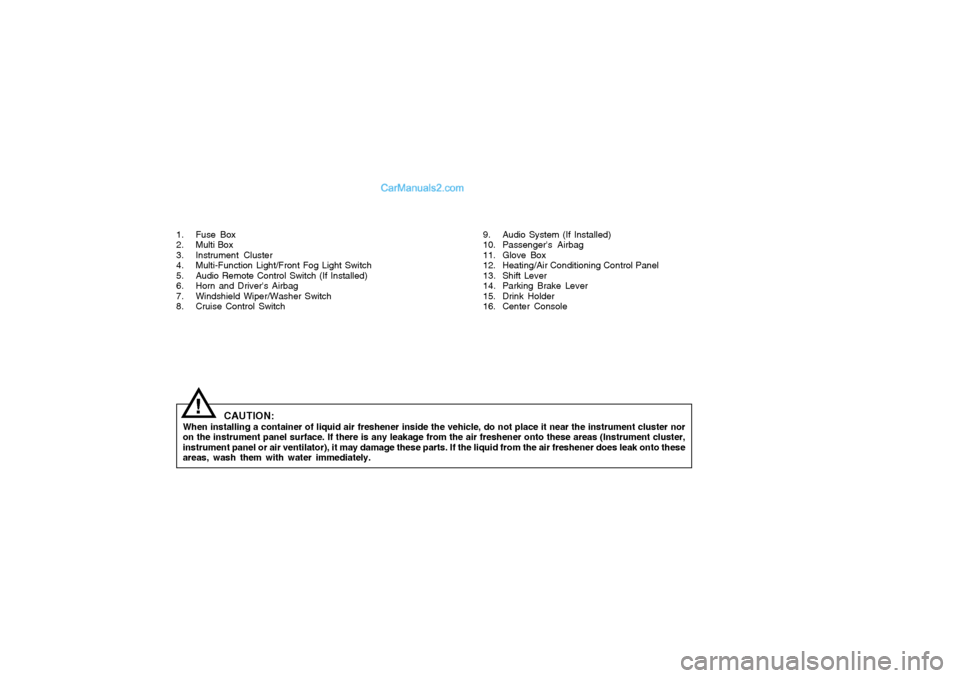
1. Fuse Box
2. Multi Box
3. Instrument Cluster
4. Multi-Function Light/Front Fog Light Switch
5. Audio Remote Control Switch (If Installed)
6. Horn and Driver's Airbag
7. Windshield Wiper/Washer Switch
8. Cruise Control Switch
CAUTION:
When installing a container of liquid air freshener inside the vehicle, do not place it near the instrument cluster nor
on the instrument panel surface. If there is any leakage from the air freshener onto these areas (Instrument cluster,
instrument panel or air ventilator), it may damage these parts. If the liquid from the air freshener does leak onto these
areas, wash them with water immediately.
!
9. Audio System (If Installed)
10. Passenger's Airbag
11. Glove Box
12. Heating/Air Conditioning Control Panel
13. Shift Lever
14. Parking Brake Lever
15. Drink Holder
16. Center Console
Page 12 of 271
YOUR VEHICLE AT A GLANCE
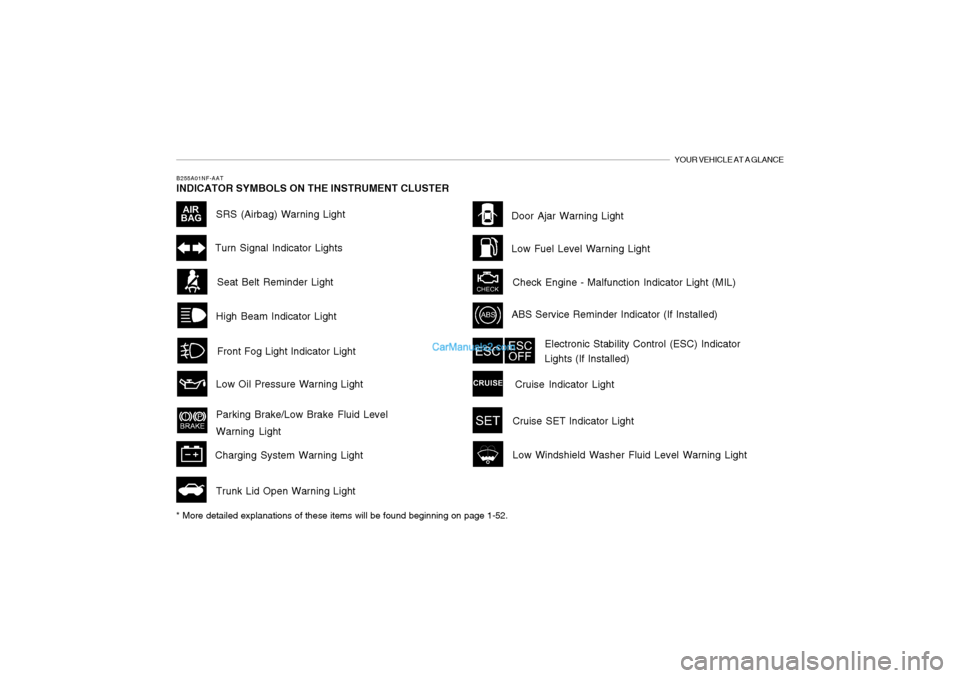
B255A01NF-AATINDICATOR SYMBOLS ON THE INSTRUMENT CLUSTER
High Beam Indicator LightDoor Ajar Warning LightSeat Belt Reminder LightTurn Signal Indicator Lights
ABS Service Reminder Indicator (If Installed)
Low Oil Pressure Warning Light
Parking Brake/Low Brake Fluid Level
Warning Light
Charging System Warning Light
SRS (Airbag) Warning Light
Cruise Indicator Light Check Engine - Malfunction Indicator Light (MIL)
Electronic Stability Control (ESC) Indicator
Lights (If Installed)
Low Windshield Washer Fluid Level Warning LightFront Fog Light Indicator Light
Cruise SET Indicator LightLow Fuel Level Warning Light
Trunk Lid Open Warning Light
* More detailed explanations of these items will be found beginning on page 1-52.
Page 14 of 271
1
Fuel Recommendations.................................................... 1-2
Breaking in Your New Hyundai......................................... 1-3
Keys ................................................................................... 1-3
Door Locks ........................................................................ 1-4
Theft-Alarm System .......................................................... 1-8
Windows..........................................................................1-11
Seats................................................................................1-14
Seat Belts ........................................................................1-21
Child Restraint System ....................................................1-28
Advanced Supplemental Restraint (AIRBAG)
System (SRS) ................................................................1-36
Instrument Cluster and Indicator Lights .........................1-50
Warning and Indicator Lights..........................................1-52
Trip Computer .................................................................1-58
Multi-Function Light Switch .............................................1-61
Windshield Wiper and Washer Switch ............................1-64
Sunroof............................................................................1-70
Mirror...............................................................................1-77
Homelink Mirror ...............................................................1-79
Hood Release ..................................................................1-89
Cruise Control..................................................................1-93
Heating and Cooling Control ...........................................1-96
Stereo Sound System ..................................................1-113
Audio System................................................................1-115
Antenna ........................................................................1-130
FEATURES OF YOUR HYUNDAI
1
Page 28 of 271
1
FEATURES OF YOUR HYUNDAI
15
!
WARNING:
To minimize risk of severe injury in the
event of a collision or a sudden stop, both
the driver and passenger seatbacks should
always be in an upright position while the
vehicle is in motion. The protection pro-
vided by the seat belts and airbags may be
reduced significantly when the seatbacks
are reclined. There is greater risk that the
driver and passenger will slide under the
seat belt which may result in serious injury
if a crash occurs when the seatbacks are
reclined.
The seat belt cannot provide full protection
to an occupant if the seat back is reclined.
!
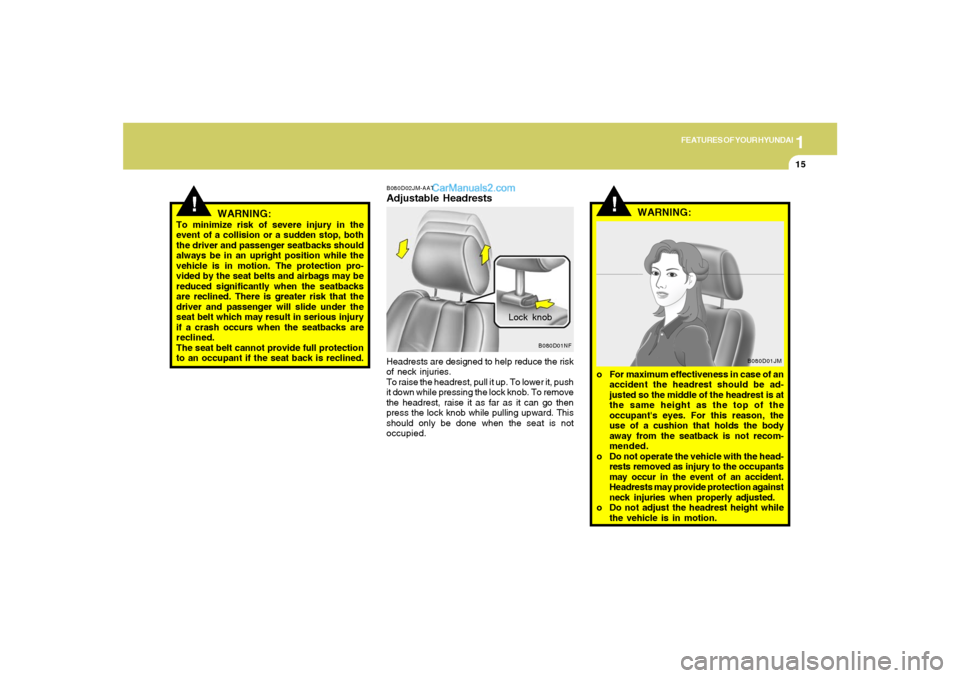
B080D02JM-AATAdjustable HeadrestsHeadrests are designed to help reduce the risk
of neck injuries.
To raise the headrest, pull it up. To lower it, push
it down while pressing the lock knob. To remove
the headrest, raise it as far as it can go then
press the lock knob while pulling upward. This
should only be done when the seat is not
occupied.
WARNING:
o For maximum effectiveness in case of an
accident the headrest should be ad-
justed so the middle of the headrest is at
the same height as the top of the
occupant's eyes. For this reason, the
use of a cushion that holds the body
away from the seatback is not recom-
mended.
o Do not operate the vehicle with the head-
rests removed as injury to the occupants
may occur in the event of an accident.
Headrests may provide protection against
neck injuries when properly adjusted.
o Do not adjust the headrest height while
the vehicle is in motion.
B080D01JM
B080D01NF
Lock knob
Page 30 of 271
1
FEATURES OF YOUR HYUNDAI
17
!
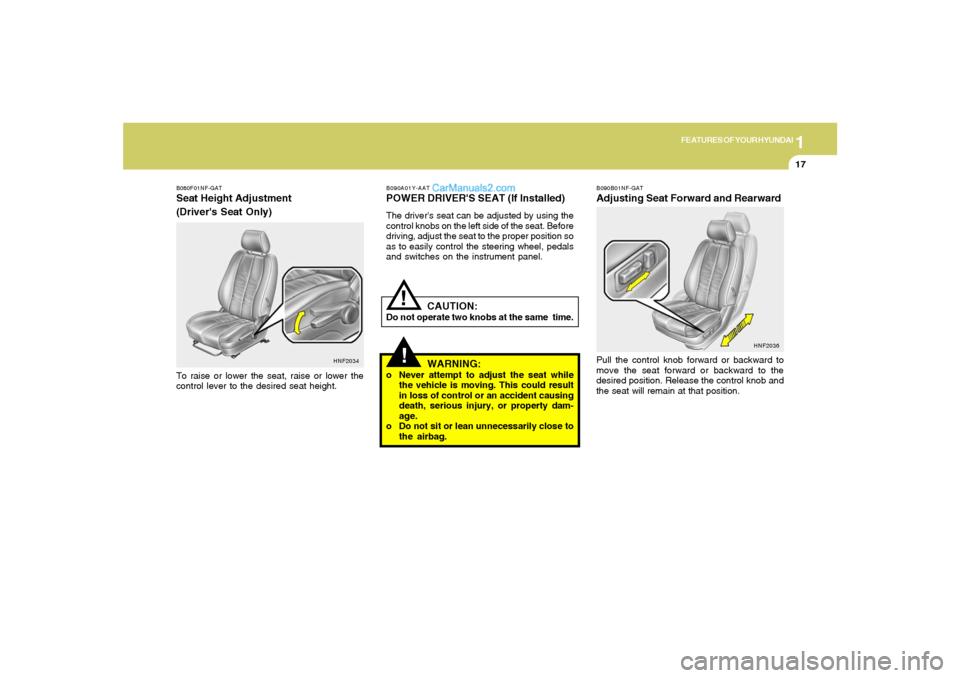
B090A01Y-AATPOWER DRIVER'S SEAT (If Installed)The driver's seat can be adjusted by using the
control knobs on the left side of the seat. Before
driving, adjust the seat to the proper position so
as to easily control the steering wheel, pedals
and switches on the instrument panel.
CAUTION:
Do not operate two knobs at the same time.
WARNING:
o Never attempt to adjust the seat while
the vehicle is moving. This could result
in loss of control or an accident causing
death, serious injury, or property dam-
age.
o Do not sit or lean unnecessarily close to
the airbag.
!
B080F01NF-GATSeat Height Adjustment
(Driver's Seat Only)To raise or lower the seat, raise or lower the
control lever to the desired seat height.
HNF2034
B090B01NF-GATAdjusting Seat Forward and RearwardPull the control knob forward or backward to
move the seat forward or backward to the
desired position. Release the control knob and
the seat will remain at that position.
HNF2036
Page 31 of 271
1FEATURES OF YOUR HYUNDAI18
!
WARNING:
To minimize the risk of personal injury in
the event of a collision or a sudden stop,
both the driver's and passenger's seatback
should remain in an upright position while
the car is in motion. The protection pro-
vided by the seat belts and airbags may be
reduced significantly when the seatbacks
are reclined. There is a greater risk that the
seat occupants will slide under the belt
resulting in serious injury if a crash occurs
when the seatbacks are reclined. The seat
belt cannot provide full protection to an
occupant if the seatback is reclined.
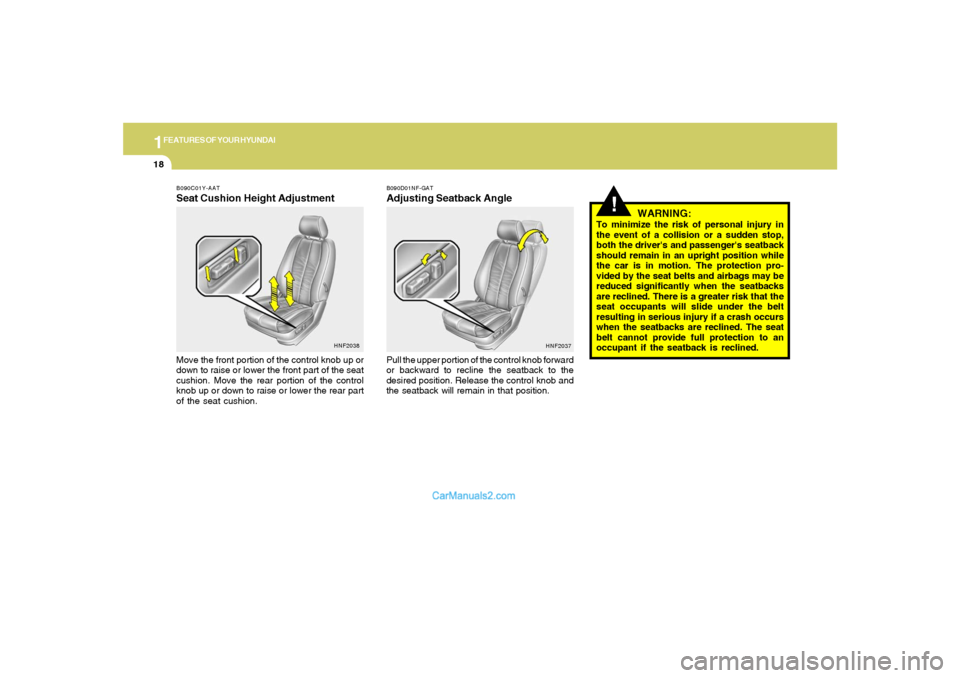
B090D01NF-GATAdjusting Seatback AnglePull the upper portion of the control knob forward
or backward to recline the seatback to the
desired position. Release the control knob and
the seatback will remain in that position.
B090C01Y-AATSeat Cushion Height AdjustmentMove the front portion of the control knob up or
down to raise or lower the front part of the seat
cushion. Move the rear portion of the control
knob up or down to raise or lower the rear part
of the seat cushion.
HNF2038
HNF2037
Page 34 of 271
1
FEATURES OF YOUR HYUNDAI
21
SEAT BELTSB150B03Y-AATInfant or Small ChildAll 50 states have child restraint laws. You
should be aware of the specific requirements in
your state. Child and/or infant safety seats must
be properly placed and installed in the rear seat.
Information about the use of these restraints
begins on page 1-28.
!
B150A01S-AATSEAT BELT PRECAUTIONS
WARNING:All occupants of the vehicle must wear their
seat belts at all times. Note that this vehicle
is equipped with a Supplemental Restraint
(Airbag) System as discussed beginning
on page 1-36. The seat belts must be used
in conjunction with the supplemental
airbag system. State laws require that some
or all occupants of the vehicle use seat
belts. The possibility of increased injury or
severity of injury in an accident will be
increased if this elementary safety precau-
tion is not observed. In addition, follow the
other instructions provided in this section.
!
WARNING:
Every person in your vehicle needs to be
properly restrained at all times, including
infants and children. In a collision, an unre-
strained child can become a "missile" in-
side the car. The force required to hold a
child on your lap could be so great that you
could not hold the child. Any child riding in
the vehicle should always be in a proper
restraint in the rear seat of the vehicle.NOTE:Small children are best protected from in-
jury in an accident when properly restrained
in the rear seat by a child restraint system
that meets the requirements of the Federal
Motor Vehicle Safety Standards. Before
buying any child restraint system, make
sure that it has a label certifying that it
meets Federal Motor Vehicle Safety Stan-
dard 213. The restraint must be appropriate
for your child's height and weight. Check
the label on the child restraint for this
information. See page 1-28.
B150C02A-AATLarger ChildrenChildren who are too large for child restraint
systems should always occupy the rear seat
and use the available lap/shoulder belts. The lap
portion should be fastened snug on the hips and
as low as possible. Check belt fit periodically. A
child's squirming could put the belt out of posi-
tion. Children are afforded the most safety in the
event of an accident when they are restrained
by a proper restraint system in the rear seat. If
a larger child (over age 13) must be seated in
the front seat, the child should be securely
restrained by the available lap/shoulder belt and
the seat should be placed in the rearmost
position. Children under the age of 13 should be
restrained securely in the rear seat. NEVER
place a child under the age of 13 in the front seat.
NEVER place a rear facing child seat in the front
seat of a vehicle.B150D01A-AATPregnant WomenThe use of a seat belt is recommended for
pregnant women to lessen the chance of injury
in an accident. When a seat belt is used, the lap
belt portion should be placed as low and snugly
as possible on the hips, not across the abdo-
men. For specific recommendations, consult a
physician.
Page 41 of 271
1FEATURES OF YOUR HYUNDAI28
!
WARNING:
o A child restraint system must be placed
in the rear seat. Never install a child or
infant seat on the front passenger's seat.
Should an accident occur and cause the
passenger side airbag to deploy, it could
severely injure or kill an infant or child
seated in an infant or child seat. Thus
only use a child restraint in the rear seat
of your vehicle.
o A safety belt or child restraint system
can become very hot if it is left in a closed
vehicle on a sunny day, even if the out-
side temperature does not feel hot. Be
sure to check the seat cover and buckles
before placing a child there.
o When the child restraint system is not in
use, store it in the trunk or fasten it with
a safety belt so that it will not be thrown
forward in the case of a sudden stop or
an accident.
o Children who are too large to be in a child
restraint should sit in the rear seat and be
restrained with the available lap/shoul-
der belts. Never allow children to ride in
the front passenger seat.
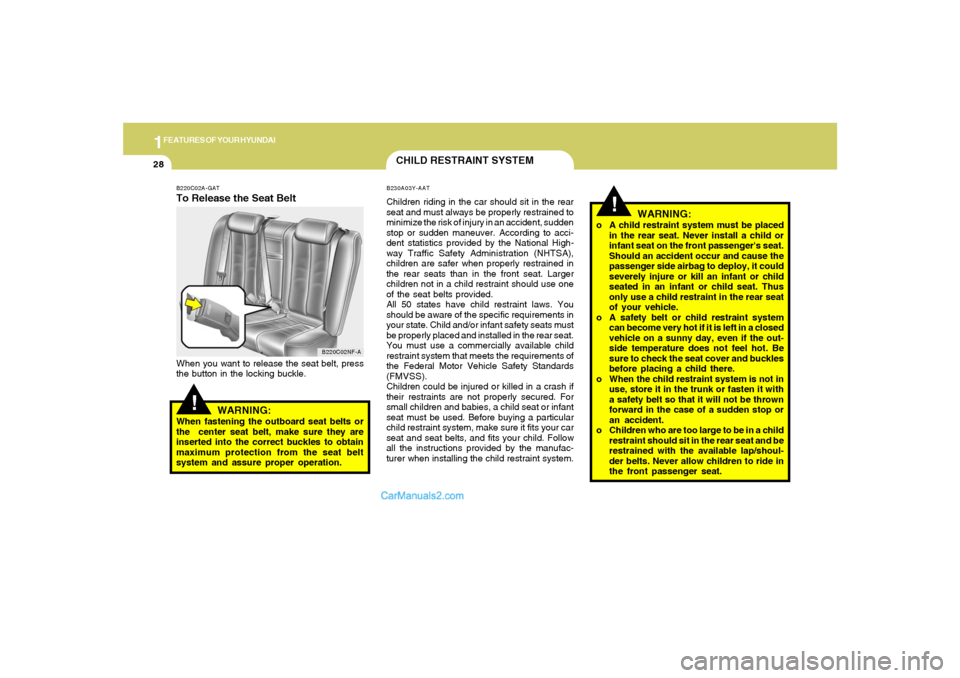
B220C02A-GATTo Release the Seat BeltWhen you want to release the seat belt, press
the button in the locking buckle.
!
WARNING:
When fastening the outboard seat belts or
the center seat belt, make sure they are
inserted into the correct buckles to obtain
maximum protection from the seat belt
system and assure proper operation.
CHILD RESTRAINT SYSTEMB230A03Y-AATChildren riding in the car should sit in the rear
seat and must always be properly restrained to
minimize the risk of injury in an accident, sudden
stop or sudden maneuver. According to acci-
dent statistics provided by the National High-
way Traffic Safety Administration (NHTSA),
children are safer when properly restrained in
the rear seats than in the front seat. Larger
children not in a child restraint should use one
of the seat belts provided.
All 50 states have child restraint laws. You
should be aware of the specific requirements in
your state. Child and/or infant safety seats must
be properly placed and installed in the rear seat.
You must use a commercially available child
restraint system that meets the requirements of
the Federal Motor Vehicle Safety Standards
(FMVSS).
Children could be injured or killed in a crash if
their restraints are not properly secured. For
small children and babies, a child seat or infant
seat must be used. Before buying a particular
child restraint system, make sure it fits your car
seat and seat belts, and fits your child. Follow
all the instructions provided by the manufac-
turer when installing the child restraint system.
B220C02NF-A
Page 46 of 271
1
FEATURES OF YOUR HYUNDAI
33
!
WARNING:
o If the retractor is not in the Automatic
Locking mode, the child restraint sys-
tem can move when your vehicle turns or
stops abruptly.
o Do not install any child restraint system
in the front passenger seat. Should an
accident occur and cause the passenger
side airbag to deploy, it could severely
injure or kill an infant or child seated in
an infant or child seat. Therefore, only
use a child restraint system in the rear
seat of your vehicle.NOTE:o Before installing the child restraint sys-
tem in any seating position, read the
instructions supplied by the child re-
straint system manufacturer.
o If the seat belt does not operate as de-
scribed, have the system checked imme-
diately by your authorized Hyundai dealer.
!
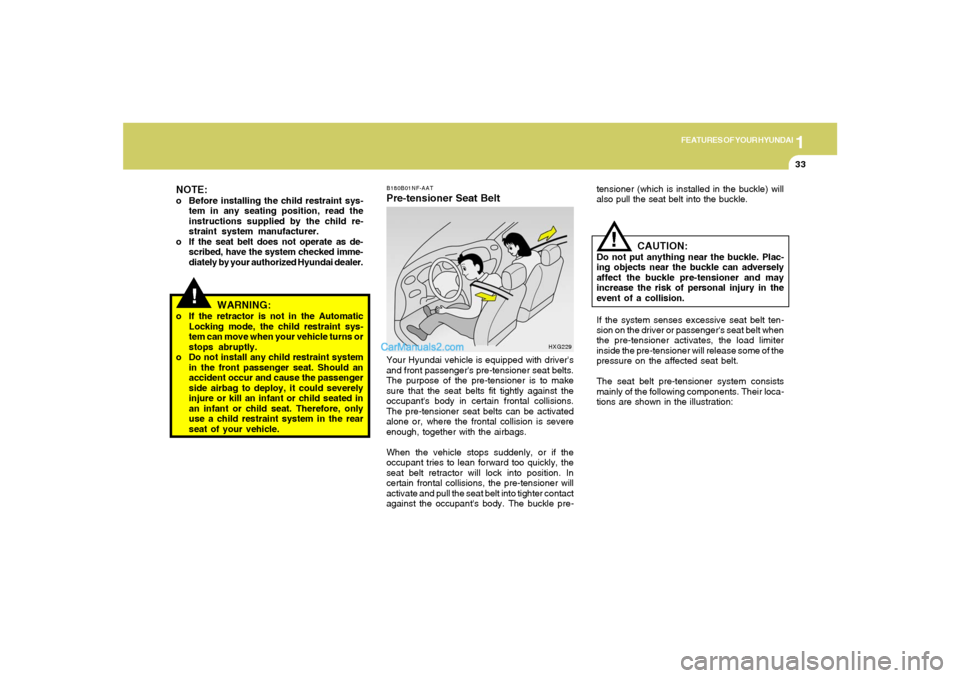
B180B01NF-AATPre-tensioner Seat BeltYour Hyundai vehicle is equipped with driver's
and front passenger's pre-tensioner seat belts.
The purpose of the pre-tensioner is to make
sure that the seat belts fit tightly against the
occupant's body in certain frontal collisions.
The pre-tensioner seat belts can be activated
alone or, where the frontal collision is severe
enough, together with the airbags.
When the vehicle stops suddenly, or if the
occupant tries to lean forward too quickly, the
seat belt retractor will lock into position. In
certain frontal collisions, the pre-tensioner will
activate and pull the seat belt into tighter contact
against the occupant's body. The buckle pre-
HXG229
CAUTION:
Do not put anything near the buckle. Plac-
ing objects near the buckle can adversely
affect the buckle pre-tensioner and may
increase the risk of personal injury in the
event of a collision.
If the system senses excessive seat belt ten-
sion on the driver or passenger's seat belt when
the pre-tensioner activates, the load limiter
inside the pre-tensioner will release some of the
pressure on the affected seat belt.
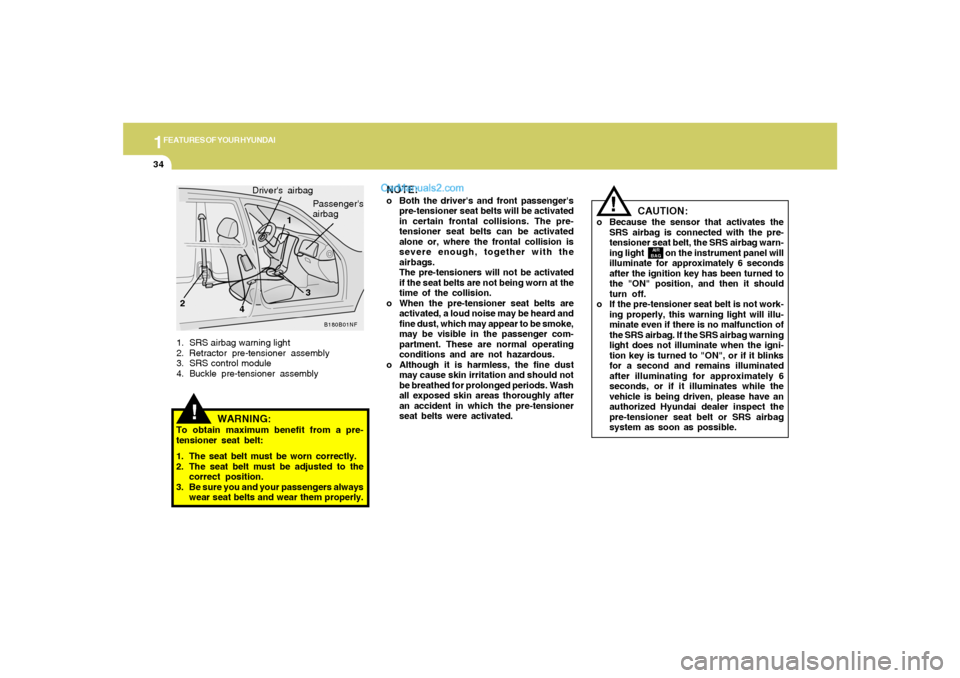
The seat belt pre-tensioner system consists
mainly of the following components. Their loca-
tions are shown in the illustration: tensioner (which is installed in the buckle) will
also pull the seat belt into the buckle.
Page 47 of 271
1FEATURES OF YOUR HYUNDAI34
!
!
AIR
BAG
1. SRS airbag warning light
2. Retractor pre-tensioner assembly
3. SRS control module
4. Buckle pre-tensioner assembly
B180B01NF
1
23 Driver's airbag
Passenger's
airbag
WARNING:
To obtain maximum benefit from a pre-
tensioner seat belt:
1. The seat belt must be worn correctly.
2. The seat belt must be adjusted to the
correct position.
3. Be sure you and your passengers always
wear seat belts and wear them properly.
NOTE:o Both the driver's and front passenger's
pre-tensioner seat belts will be activated
in certain frontal collisions. The pre-
tensioner seat belts can be activated
alone or, where the frontal collision is
severe enough, together with the
airbags.
The pre-tensioners will not be activated
if the seat belts are not being worn at the
time of the collision.
o When the pre-tensioner seat belts are
activated, a loud noise may be heard and
fine dust, which may appear to be smoke,
may be visible in the passenger com-
partment. These are normal operating
conditions and are not hazardous.
o Although it is harmless, the fine dust
may cause skin irritation and should not
be breathed for prolonged periods. Wash
all exposed skin areas thoroughly after
an accident in which the pre-tensioner
seat belts were activated.
CAUTION:
o Because the sensor that activates the
SRS airbag is connected with the pre-
tensioner seat belt, the SRS airbag warn-
ing light on the instrument panel will
illuminate for approximately 6 seconds
after the ignition key has been turned to
the "ON" position, and then it should
turn off.
o If the pre-tensioner seat belt is not work-
ing properly, this warning light will illu-
minate even if there is no malfunction of
the SRS airbag. If the SRS airbag warning
light does not illuminate when the igni-
tion key is turned to "ON", or if it blinks
for a second and remains illuminated
after illuminating for approximately 6
seconds, or if it illuminates while the
vehicle is being driven, please have an
authorized Hyundai dealer inspect the
pre-tensioner seat belt or SRS airbag
system as soon as possible. 4