engine Hyundai Sonata 2005 Owner's Manual
[x] Cancel search | Manufacturer: HYUNDAI, Model Year: 2005, Model line: Sonata, Model: Hyundai Sonata 2005Pages: 271, PDF Size: 12.44 MB
Page 5 of 271
A040A01A-AAT
FOREWORD
Thank you for choosing Hyundai. We are pleased to welcome you to the growing number of discriminating people who
drive Hyundais. The advanced engineering and high-quality construction of each Hyundai we build is something of which
we're very proud.
Your Owner's Manual will introduce you to the features and operation of your new Hyundai. It is suggested that you read
it carefully because the information it contains can contribute greatly to the satisfaction you receive from your new car.
The manufacturer also recommends that all service and maintenance on your car be performed by an authorized Hyundai
dealer. Hyundai dealers are prepared to provide high-quality service, maintenance and any other assistance that may
be required.A050A04A-AAT
HYUNDAI MOTOR COMPANY
Note: Because future owners will also need the information included in this manual, if you sell this Hyundai, please leave
the manual in the vehicle for their use. Thank you.
CAUTION:
Severe engine and transaxle damage may result from the use of poor quality fuels and lubricants that do not
meet Hyundai specifications. You must always use high quality fuels and lubricants that meet the specifica-
tions listed on Page 9-4 in the Vehicle Specifications section of the Owner's Manual and which also appear
in the Service Station Information on the back cover of the Owner's Manual.
Copyright 2005 Hyundai Motor Company. All rights reserved. No part of this publication may be reproduced, stored in
any retrieval system or transmitted in any form or by any means without the prior written permission of Hyundai Motor
Company.
!
Page 12 of 271
YOUR VEHICLE AT A GLANCE
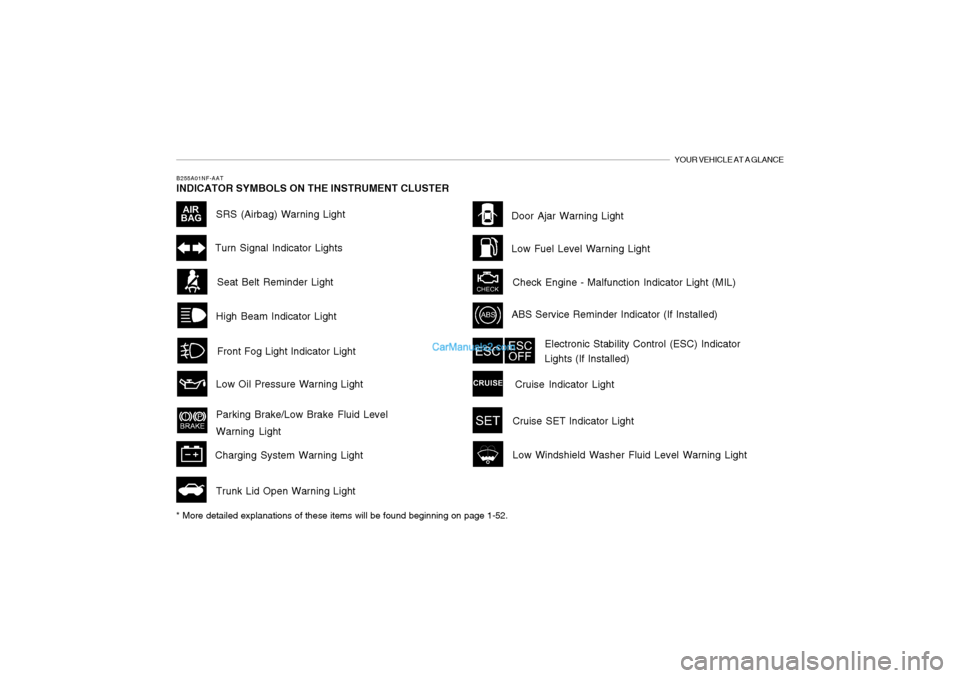
B255A01NF-AATINDICATOR SYMBOLS ON THE INSTRUMENT CLUSTER
High Beam Indicator LightDoor Ajar Warning LightSeat Belt Reminder LightTurn Signal Indicator Lights
ABS Service Reminder Indicator (If Installed)
Low Oil Pressure Warning Light
Parking Brake/Low Brake Fluid Level
Warning Light
Charging System Warning Light
SRS (Airbag) Warning Light
Cruise Indicator Light Check Engine - Malfunction Indicator Light (MIL)
Electronic Stability Control (ESC) Indicator
Lights (If Installed)
Low Windshield Washer Fluid Level Warning LightFront Fog Light Indicator Light
Cruise SET Indicator LightLow Fuel Level Warning Light
Trunk Lid Open Warning Light
* More detailed explanations of these items will be found beginning on page 1-52.
Page 13 of 271
A100A03A-AATGuide to Hyundai Genuine Parts1. What are Hyundai Genuine Parts?
Hyundai Genuine Parts are the same parts
used by Hyundai Motor Company to manu-
facture vehicles. They are designed and
tested for the optimum safety, performance,
and reliability to our customers.
2. Why should you use genuine parts?
Hyundai Genuine Parts are engineered and
built to meet rigid manufacturing require-
ments. Using imitation, counterfeit or used
salvage parts is not covered under the
Hyundai New Vehicle Limited Warranty or
any other Hyundai warranty. In addition, any
damage to or failure of Hyundai Genuine
Parts caused by the installation or failure ofan imitation, counterfeit or used salvage part
is not covered by any Hyundai Warranty.
3. How can you tell if you are purchasing
Hyundai Genuine Parts?
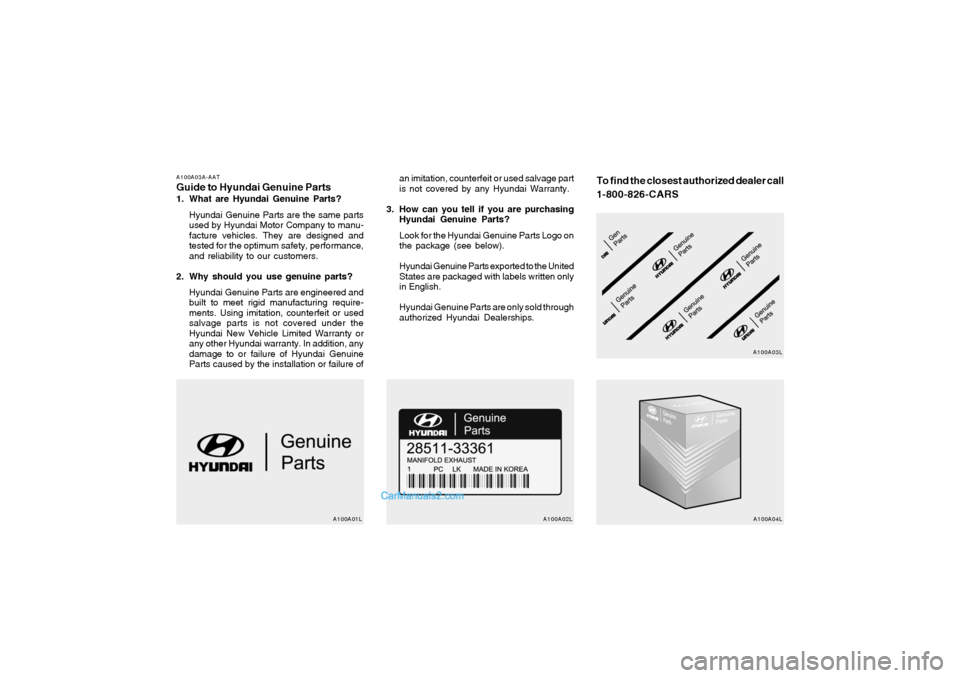
Look for the Hyundai Genuine Parts Logo on
the package (see below).
Hyundai Genuine Parts exported to the United
States are packaged with labels written only
in English.
Hyundai Genuine Parts are only sold through
authorized Hyundai Dealerships.
To find the closest authorized dealer call
1-800-826-CARS
A100A01L A100A02L A100A04LA100A03L
Page 15 of 271
1FEATURES OF YOUR HYUNDAI2
B010A01NF-A
FUEL RECOMMENDATIONS
CAUTION:
Your Hyundai's New Vehicle Limited War-
ranty may not cover damage to the fuel
system and any performance problems that
are caused by the use of fuels containing
methanol or fuels containing MTBE (Methyl
Tertiary Butyl Ether) over 15.0% vol. (Oxy-
gen Content 2.7% weight.)
B010B01A-AATWhat About Gasohol?Gasohol (a mixture of 90% unleaded gasoline
and 10% ethanol or grain alcohol) may be used
in your Hyundai. However, if your engine devel-
ops driveability problems, the use of 100%
unleaded gasoline is recommended. Fuels with
unspecified quantities of alcohol, or alcohols
other than ethanol, should not be used.
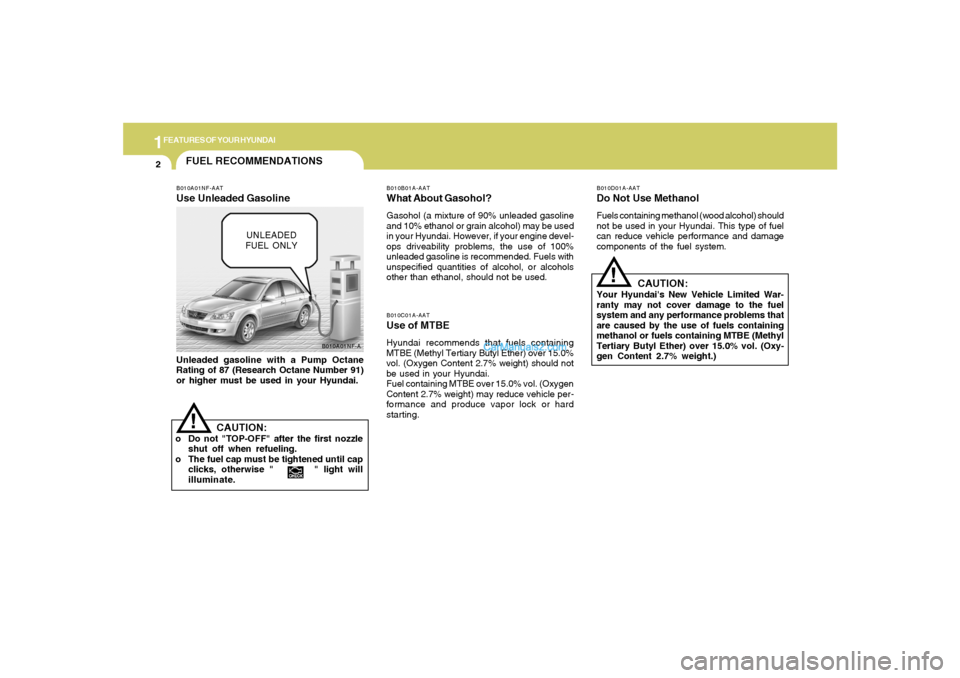
B010A01NF-AATUse Unleaded GasolineUnleaded gasoline with a Pump Octane
Rating of 87 (Research Octane Number 91)
or higher must be used in your Hyundai.
B010C01A-AATUse of MTBEHyundai recommends that fuels containing
MTBE (Methyl Tertiary Butyl Ether) over 15.0%
vol. (Oxygen Content 2.7% weight) should not
be used in your Hyundai.
Fuel containing MTBE over 15.0% vol. (Oxygen
Content 2.7% weight) may reduce vehicle per-
formance and produce vapor lock or hard
starting.
B010D01A-AATDo Not Use MethanolFuels containing methanol (wood alcohol) should
not be used in your Hyundai. This type of fuel
can reduce vehicle performance and damage
components of the fuel system.
!
!
UNLEADED
FUEL ONLY
CAUTION:
o Do not "TOP-OFF" after the first nozzle
shut off when refueling.
o The fuel cap must be tightened until cap
clicks, otherwise " " light will
illuminate.
Page 16 of 271
1
FEATURES OF YOUR HYUNDAI
3
KEYS
BREAKING IN YOUR NEW HYUNDAI
B010F01A-AATOperation in Foreign CountriesIf you are going to drive your Hyundai in another
country, be sure to:
o Observe all regulations regarding registra-
tion and insurance.
o Determine that acceptable fuel is available.B010E01A-AATGasolines for Cleaner AirTo help contribute to cleaner air, Hyundai rec-
ommends that you use gasolines treated with
detergent additives, which help prevent deposit
formation in the engine. These gasolines will
help the engine run cleaner and enhance per-
formance of the Emission Control System.
B020A01S-AATDuring the First 1,200 Miles (2,000 Km)No formal "break-in" procedure is required with
your new Hyundai. However, you can contrib-
ute to the economical operation and durability of
your Hyundai by observing the following recom-
mendations during the first 1,200 miles (2,000
km).
o Don't drive faster than 55 MPH (88 km/h).
o While driving, keep your engine speed (rpm,
or revolutions per minute) between 2,000
rpm and 4,000 rpm.
o Use moderate acceleration. Don't start
quickly or depress the accelerator pedal
fully.
o For the first 200 miles (300 km), try to avoid
hard stops.
o Don't lug the engine (in other words, don't
drive so slowly in too high a gear that the
engine "bucks":shift to a lower gear).
o Whether going fast or slow, vary your speed
from time to time.
o Don't let the engine idle longer than 3 minutes
at one time.
o Don't tow a trailer during the first 1,200 miles
(2,000 km) of operation.
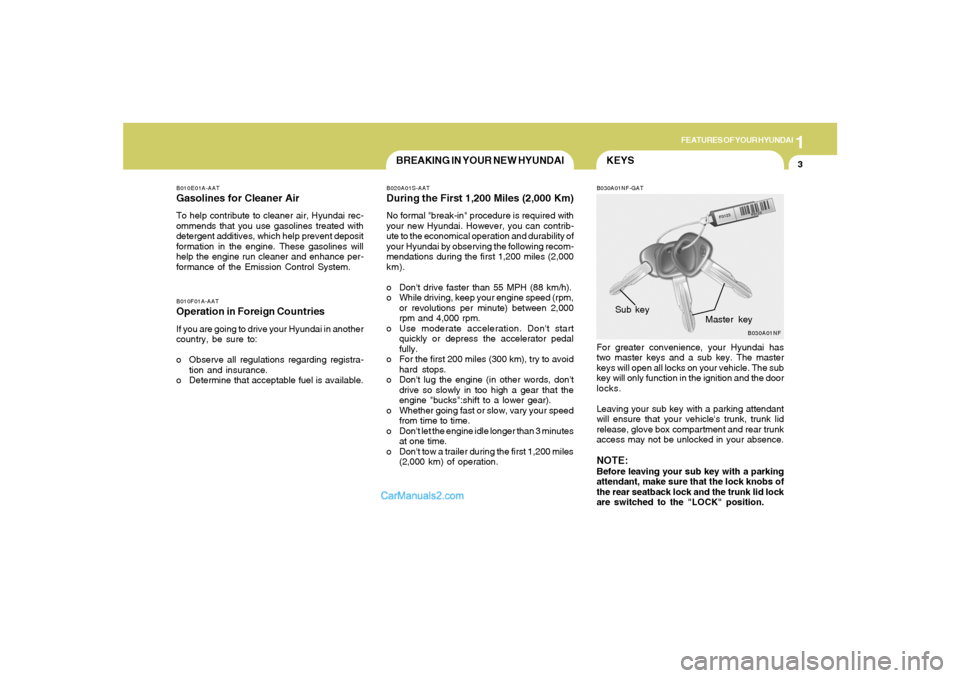
B030A01NF-GATFor greater convenience, your Hyundai has
two master keys and a sub key. The master
keys will open all locks on your vehicle. The sub
key will only function in the ignition and the door
locks.
Leaving your sub key with a parking attendant
will ensure that your vehicle's trunk, trunk lid
release, glove box compartment and rear trunk
access may not be unlocked in your absence.NOTE:Before leaving your sub key with a parking
attendant, make sure that the lock knobs of
the rear seatback lock and the trunk lid lock
are switched to the "LOCK" position.
B030A01NF
Master key Sub key
Page 21 of 271
1FEATURES OF YOUR HYUNDAI8
2) Make sure that the engine hood and trunk lid
are closed and latched.
3) Lock the doors using the transmitter of the
keyless entry system.
After completion of the steps above, the turn
signal lights will blink once to indicate that the
system is armed.NOTE:1) If any door, trunk lid or engine hood
remains open, the system will not be
armed.
2) If this happens, rearm the system as
previously described.NOTE:Do not arm the system until all passengers
have left the car. If the system is armed while
a passenger(s) remains in the car, the alarm
may be activated when the remaining
passenger(s) leaves the car.
B070C01NF-AATAlarm StageThe alarm will be activated if any of the following
occurs while the car is parked and the system
is armed.
1) A front or rear door is opened without using
the transmitter or the ignition key.
2) The trunk lid is opened without using the
transmitter or the ignition key.
3) The engine hood is opened.
The alarming horn will sound and the turn signal
lights will blink continuously for 27 seconds
(This will repeat 3 times). To turn off the system,
unlock the door or trunk lid with the transmitter
or the ignition key.
B070C01NF-A
THEFT-ALARM SYSTEMB070A01A-AATThis system is designed to provide protection
from unauthorized entry into the car. This sys-
tem is operated in three stages : the first is the
"Armed" stage, the second is the "Alarm" stage
and the third is the "Disarmed" stage. If trig-
gered, the system provides an audible alarm
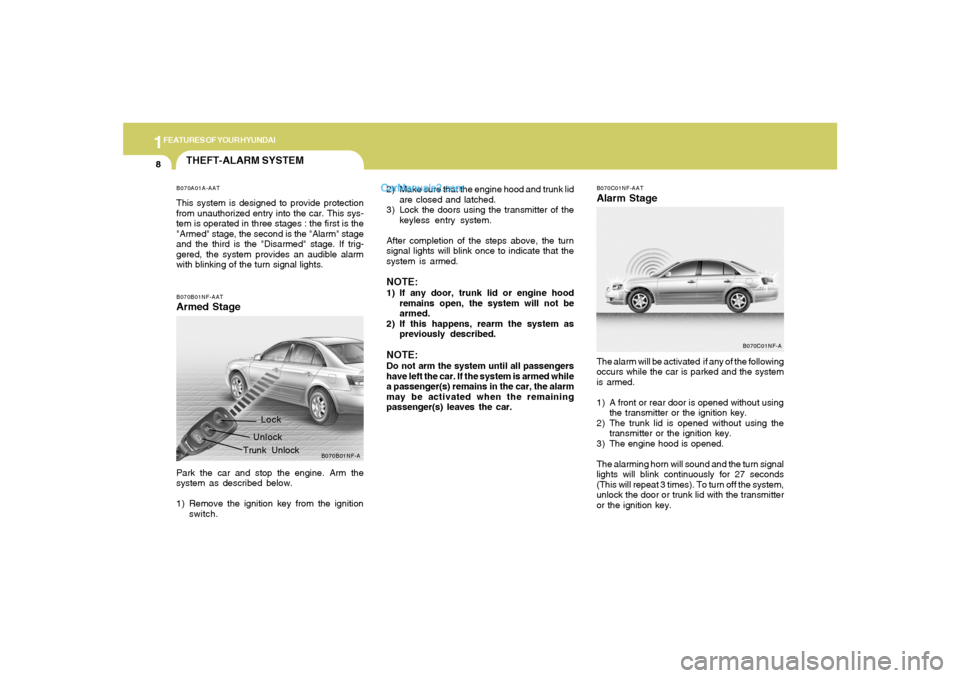
with blinking of the turn signal lights.B070B01NF-AATArmed Stage
B070B01NF-A
Lock
Unlock
Trunk Unlock
Park the car and stop the engine. Arm the
system as described below.
1) Remove the ignition key from the ignition
switch.
Page 22 of 271
1
FEATURES OF YOUR HYUNDAI
9
B070D01NF-AATDisarmed StageThe system will be disarmed by using the
transmitter or the ignition key.
Only the driver's door is unlocked by depress-
ing once the "UNLOCK ( )" button on the
transmitter. If you wish to unlock all doors, press
the "UNLOCK ( )" button on the transmitter
again within 4 seconds.
Whenever the step above is completed, the turn
signal lights will blink twice to indicate that the
system is disarmed.
If any door, trunk lid or engine hood is not opened
or the ignition key is not inserted in the ignition
switch within 30 seconds, the system will be
rearmed.NOTE:When the system is disarmed while the
"DOOR" button of the interior light is de-
pressed, the interior light will illuminate for
30 seconds.
CAUTION:
Avoid trying to start the engine while the
system is armed.
!
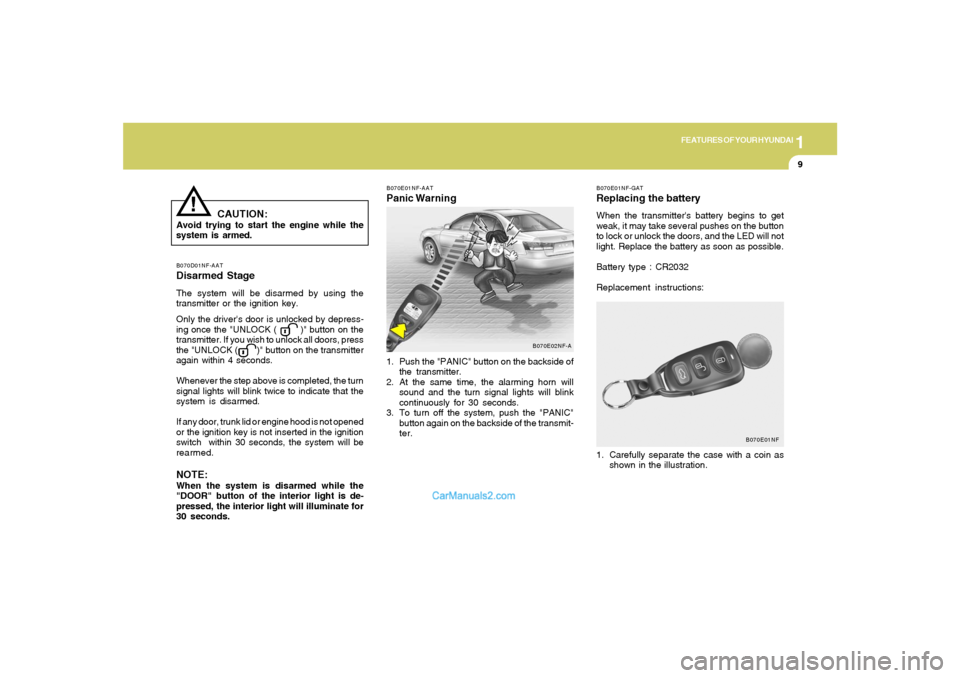
B070E01NF-AATPanic Warning1. Push the "PANIC" button on the backside of
the transmitter.
2. At the same time, the alarming horn will
sound and the turn signal lights will blink
continuously for 30 seconds.
3. To turn off the system, push the "PANIC"
button again on the backside of the transmit-
ter.
B070E02NF-A
B070E01NF-GATReplacing the batteryWhen the transmitter's battery begins to get
weak, it may take several pushes on the button
to lock or unlock the doors, and the LED will not
light. Replace the battery as soon as possible.
Battery type : CR2032
Replacement instructions:
1. Carefully separate the case with a coin as
shown in the illustration.
B070E01NF
Page 53 of 271
1FEATURES OF YOUR HYUNDAI40
B240B02L
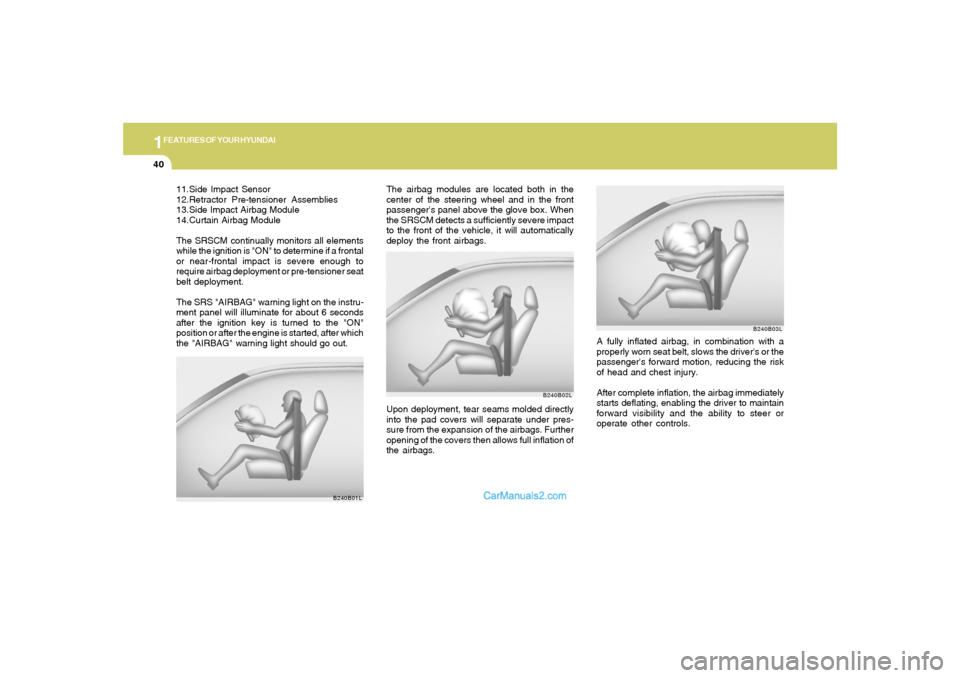
Upon deployment, tear seams molded directly
into the pad covers will separate under pres-
sure from the expansion of the airbags. Further
opening of the covers then allows full inflation of
the airbags.A fully inflated airbag, in combination with a
properly worn seat belt, slows the driver's or the
passenger's forward motion, reducing the risk
of head and chest injury.
After complete inflation, the airbag immediately
starts deflating, enabling the driver to maintain
forward visibility and the ability to steer or
operate other controls.
B240B03L
11.Side Impact Sensor
12.Retractor Pre-tensioner Assemblies
13.Side Impact Airbag Module
14.Curtain Airbag Module
The SRSCM continually monitors all elements
while the ignition is "ON" to determine if a frontal
or near-frontal impact is severe enough to
require airbag deployment or pre-tensioner seat
belt deployment.
The SRS "AIRBAG" warning light on the instru-
ment panel will illuminate for about 6 seconds
after the ignition key is turned to the "ON"
position or after the engine is started, after which
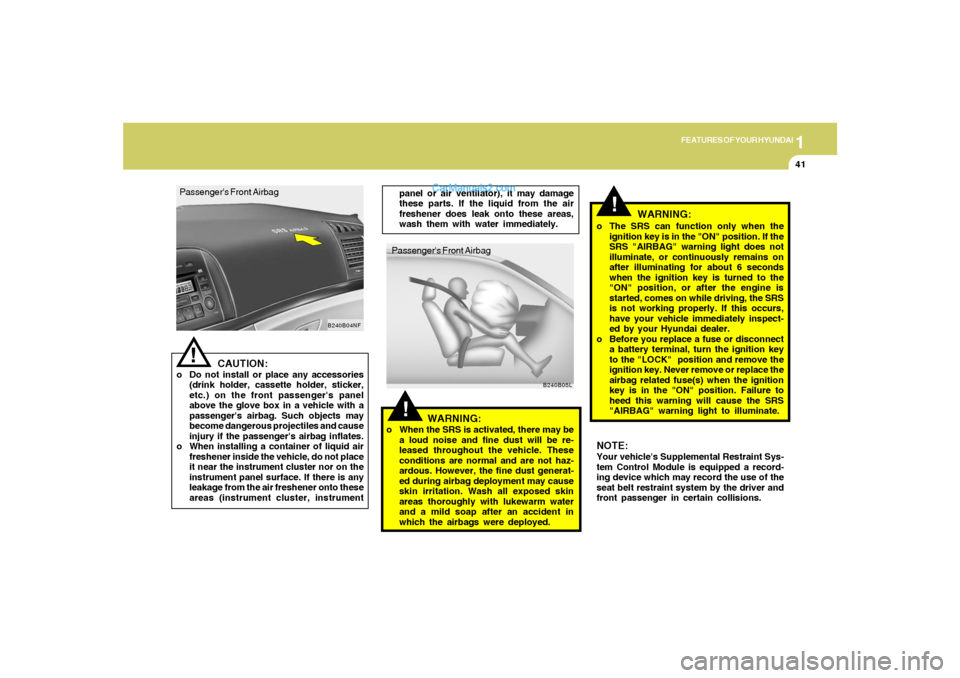
the "AIRBAG" warning light should go out.The airbag modules are located both in the
center of the steering wheel and in the front
passenger's panel above the glove box. When
the SRSCM detects a sufficiently severe impact
to the front of the vehicle, it will automatically
deploy the front airbags.
B240B01L
Page 54 of 271
1
FEATURES OF YOUR HYUNDAI
41
!Passenger's Front Airbag
B240B05L
!
o The SRS can function only when the
ignition key is in the "ON" position. If the
SRS "AIRBAG" warning light does not
illuminate, or continuously remains on
after illuminating for about 6 seconds
when the ignition key is turned to the
"ON" position, or after the engine is
started, comes on while driving, the SRS
is not working properly. If this occurs,
have your vehicle immediately inspect-
ed by your Hyundai dealer.
o Before you replace a fuse or disconnect
a battery terminal, turn the ignition key
to the "LOCK" position and remove the
ignition key. Never remove or replace the
airbag related fuse(s) when the ignition
key is in the "ON" position. Failure to
heed this warning will cause the SRS
"AIRBAG" warning light to illuminate. Passenger's Front Airbag
CAUTION:
o Do not install or place any accessories
(drink holder, cassette holder, sticker,
etc.) on the front passenger's panel
above the glove box in a vehicle with a
passenger's airbag. Such objects may
become dangerous projectiles and cause
injury if the passenger's airbag inflates.
o When installing a container of liquid air
freshener inside the vehicle, do not place
it near the instrument cluster nor on the
instrument panel surface. If there is any
leakage from the air freshener onto these
areas (instrument cluster, instrument
!
B240B04NF
panel or air ventilator), it may damage
these parts. If the liquid from the air
freshener does leak onto these areas,
wash them with water immediately.
WARNING:
o When the SRS is activated, there may be
a loud noise and fine dust will be re-
leased throughout the vehicle. These
conditions are normal and are not haz-
ardous. However, the fine dust generat-
ed during airbag deployment may cause
skin irritation. Wash all exposed skin
areas thoroughly with lukewarm water
and a mild soap after an accident in
which the airbags were deployed.
WARNING:
NOTE:
Your vehicle's Supplemental Restraint Sys-
tem Control Module is equipped a record-
ing device which may record the use of the
seat belt restraint system by the driver and
front passenger in certain collisions.
Page 57 of 271
1FEATURES OF YOUR HYUNDAI44
!
NOTE:The "PASSENGER AIR BAG OFF" indicator
illuminates for about 6 seconds after the
ignition key is turned to the "ON" position
or after the engine is started. If the front
passenger seat is occupied, the occupant
classification sensor will then classify the
front passenger within approximately 10
seconds after the ignition is turned on.
CAUTION:
If the occupant classification system is not
working properly, the SRS airbag warning
light on the instrument panel will
illuminate because the passenger's front
airbags are connected with the occupant
classification system. If there is a malfunc-
tion of the occupant classification system,
the "PASSENGER AIR BAG OFF" indicator
will not illuminate and the passenger's front
airbags will inflate in frontal impact crashes
even if there is no occupant in the front
passenger's seat. If the SRS airbag warning
light does not illuminate when the ignition
key is turned to the "ON" position, remains
illuminated after approximately 6 seconds
when the ignition key is turned to the "ON"
position, or if it illuminates while the vehicle
is being driven, have an authorized Hyundai
dealer inspect the occupant classification
system and the SRS airbag system as soon
as possible.
!
WARNING:
o Even though your vehicle is equipped
with the occupant classification sys-
tem, do not install a child restraint sys-
tem in the front passenger's seat. A child
restraint system must never be placed in
the front seat. Children who are too large
for child restraint systems should al-
ways occupy the rear seat and use the
available lap/shoulder belts. Children are
afforded the most safety in the event of
an accident when they are restrained by
a proper restraint system in the rear seat.
o If the "PASSENGER AIR BAG OFF" indi-
cator is illuminated when the front
passenger's seat is occupied by an adult
and he/she sits properly (sitting upright
with the seatback in an upright position,
centered on the seat cushion with their
seat belt on, legs comfortably extended
and their feet on the floor), have that
person sit in the rear seat.
o If you change the weight on the front
passenger seat just after sit-in or restart
of the engine, the "PASSENGER AIR
BAG OFF" indicator may be turned on or
off for a few seconds, disabling or en-
abling the passenger airbags. After the
initial stage of about 30 seconds, the
"PASSENGER AIR BAG OFF" indicator
will not toggle.
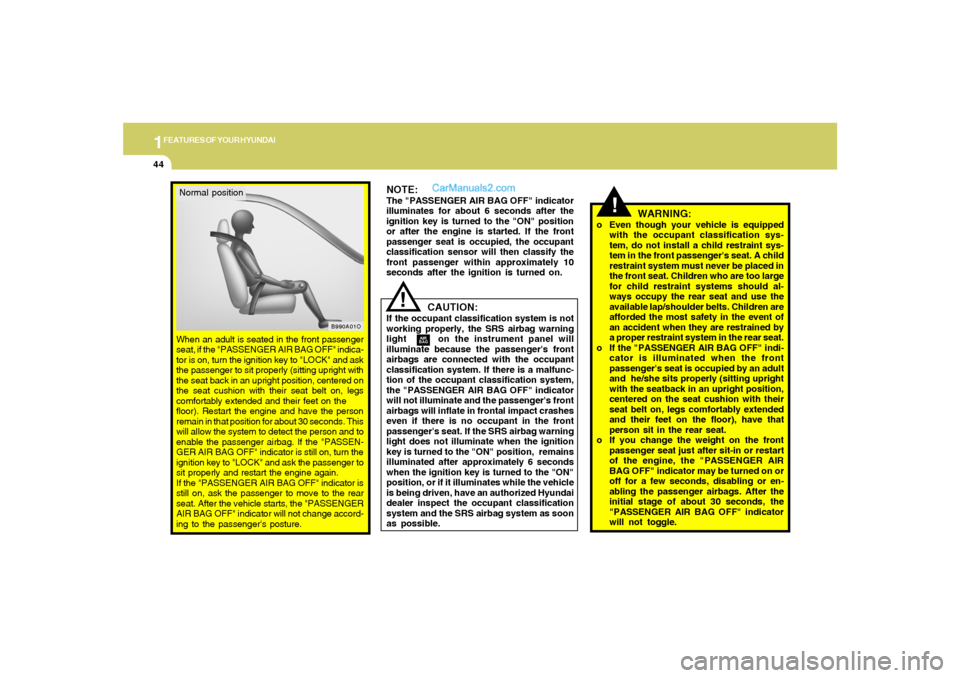
When an adult is seated in the front passenger
seat, if the "PASSENGER AIR BAG OFF" indica-
tor is on, turn the ignition key to "LOCK" and ask
the passenger to sit properly (sitting upright with
the seat back in an upright position, centered on
the seat cushion with their seat belt on, legs
comfortably extended and their feet on the
floor). Restart the engine and have the person
remain in that position for about 30 seconds. This
will allow the system to detect the person and to
enable the passenger airbag. If the "PASSEN-
GER AIR BAG OFF" indicator is still on, turn the
ignition key to "LOCK" and ask the passenger to
sit properly and restart the engine again.
If the "PASSENGER AIR BAG OFF" indicator is
still on, ask the passenger to move to the rear
seat. After the vehicle starts, the "PASSENGER
AIR BAG OFF" indicator will not change accord-
ing to the passenger's posture.Normal position
B990A01O