shifting Hyundai Sonata 2010 Owner's Manual
[x] Cancel search | Manufacturer: HYUNDAI, Model Year: 2010, Model line: Sonata, Model: Hyundai Sonata 2010Pages: 285, PDF Size: 9.38 MB
Page 20 of 285
1
FEATURES OF YOUR HYUNDAI
7
!
WARNING:
Be careful not to pull the inside door
handle while driving. If you pull the inside
door handle, the door can be opened and
you may be ejected from the vehicle and
can be injured or killed. o The driver's and front passenger's
doors can be opened by pulling the
inside door handle even if the front
portion of the driver's or front
passenger's central door locking
switch has been depressed to lock
the doors.
o If the door is locked/unlocked mul-
tiple times in rapid succession with
either the vehicle key or door lock
switch, the system may stop operat-
ing temporarily in order to protect the
circuit and prevent damage to sys-
tem components.
D050400ANFAuto door lock/unlock feature
(If Installed)o All doors will be automatically locked
when shifting the transaxle shift lever
out of P(Park).
o All doors will be automatically unlocked
when shifting the transaxle shift lever
into P(Park).NOTE:An authorized Hyundai dealer can acti-
vate or deactivate the auto door lock/
unlock features.
If you want to activate or deactivate the
auto door lock/unlock features, consult
an authorized Hyundai dealer.
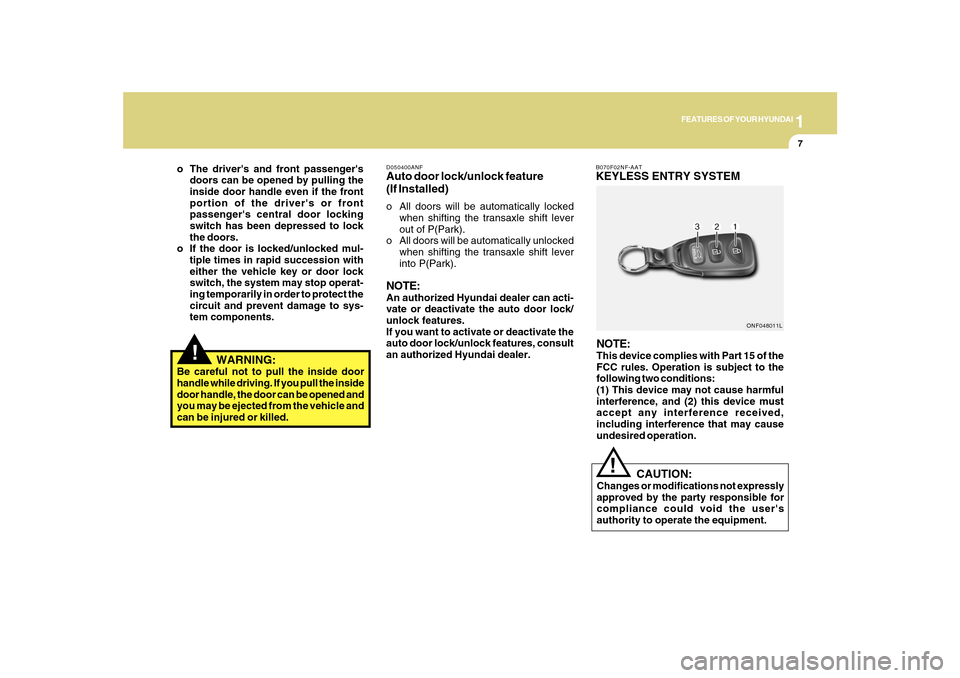
B070F02NF-AATKEYLESS ENTRY SYSTEM
CAUTION:Changes or modifications not expressly
approved by the party responsible for
compliance could void the user's
authority to operate the equipment.
!
ONF048011L
NOTE:This device complies with Part 15 of the
FCC rules. Operation is subject to the
following two conditions:
(1) This device may not cause harmful
interference, and (2) this device must
accept any interference received,
including interference that may cause
undesired operation.
Page 158 of 285
2
DRIVING YOUR HYUNDAI
5
!
STARTING!
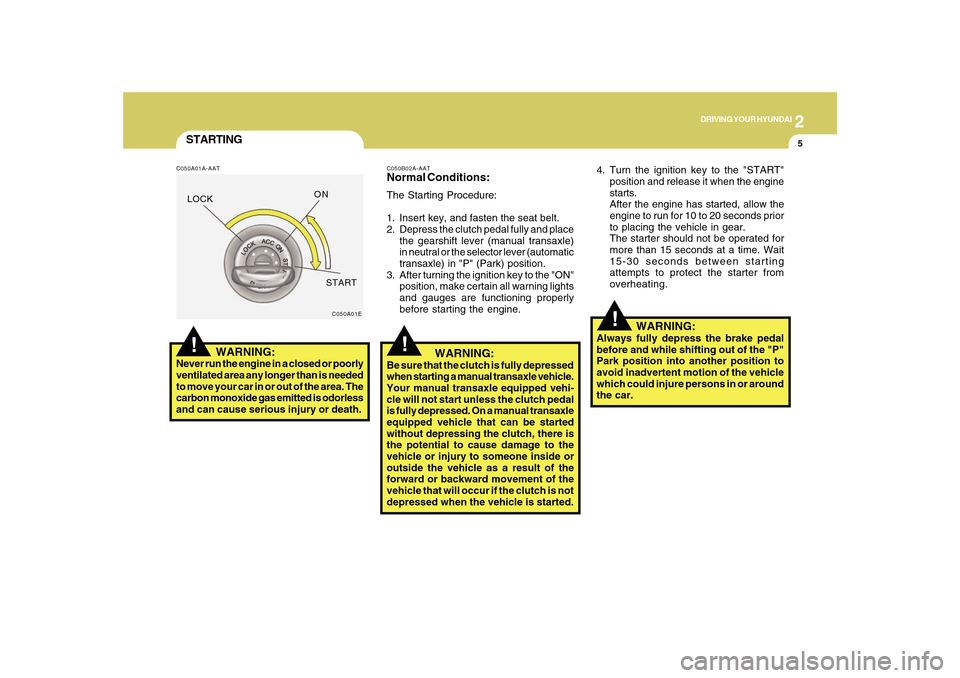
C050A01A-AAT
WARNING:
Never run the engine in a closed or poorly
ventilated area any longer than is needed
to move your car in or out of the area. The
carbon monoxide gas emitted is odorless
and can cause serious injury or death.
C050A01E
4. Turn the ignition key to the "START"
position and release it when the engine
starts.
After the engine has started, allow the
engine to run for 10 to 20 seconds prior
to placing the vehicle in gear.
The starter should not be operated for
more than 15 seconds at a time. Wait
15-30 seconds between starting
attempts to protect the starter from
overheating.
C050B02A-AATNormal Conditions:The Starting Procedure:
1. Insert key, and fasten the seat belt.
2. Depress the clutch pedal fully and place
the gearshift lever (manual transaxle)
in neutral or the selector lever (automatic
transaxle) in "P" (Park) position.
3. After turning the ignition key to the "ON"
position, make certain all warning lights
and gauges are functioning properly
before starting the engine.
WARNING:
Be sure that the clutch is fully depressed
when starting a manual transaxle vehicle.
Your manual transaxle equipped vehi-
cle will not start unless the clutch pedal
is fully depressed. On a manual transaxle
equipped vehicle that can be started
without depressing the clutch, there is
the potential to cause damage to the
vehicle or injury to someone inside or
outside the vehicle as a result of the
forward or backward movement of the
vehicle that will occur if the clutch is not
depressed when the vehicle is started.
!
WARNING:
Always fully depress the brake pedal
before and while shifting out of the "P"
Park position into another position to
avoid inadvertent motion of the vehicle
which could injure persons in or around
the car.
LOCKON
START
Page 159 of 285
2
DRIVING YOUR HYUNDAI
6
CAUTION:
o Do not downshift more than 2 gears or
downshift the gear when the engine is
running at high speed (5,000 RPM or
higher). Such a downshifting may
damage the engine.
o When downshifting from fifth gear to
fourth gear, caution should be taken
not to inadvertently press the gear
shift lever sideways in such a manner
that second gear is engaged. Such a
drastic downshift may cause the
engine speed to increase to the point
that the tachometer will enter the red-
zone. Such over-revving of the engine
may possibly cause engine damage. o Do not use the shift lever as a handrest
during driving, as this can result in
premature wear of the transaxle shift
forks.
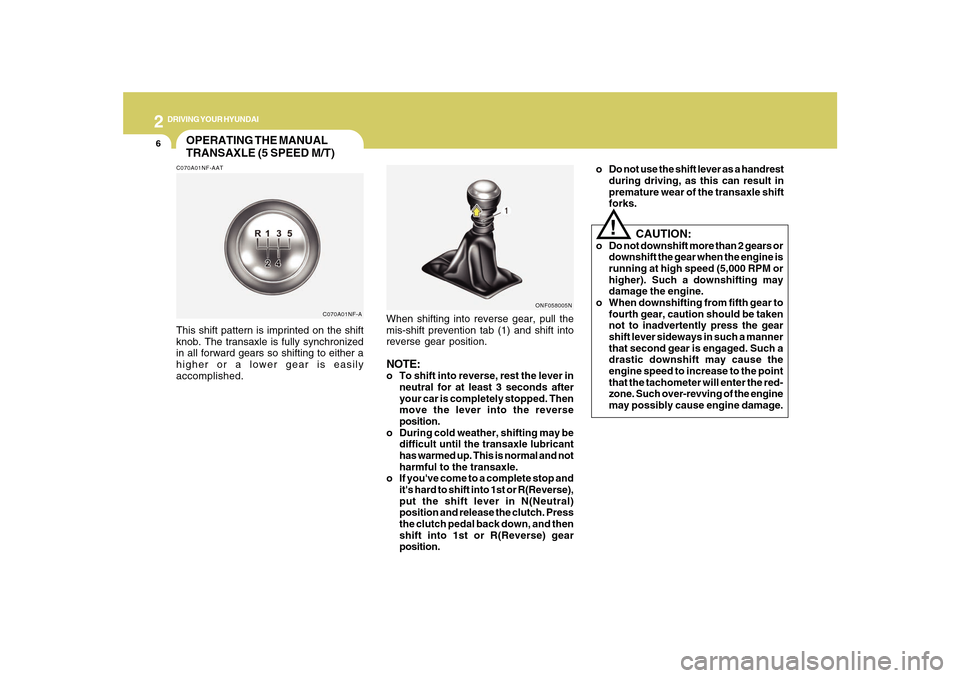
When shifting into reverse gear, pull the
mis-shift prevention tab (1) and shift into
reverse gear position.NOTE:o To shift into reverse, rest the lever in
neutral for at least 3 seconds after
your car is completely stopped. Then
move the lever into the reverse
position.
o During cold weather, shifting may be
difficult until the transaxle lubricant
has warmed up. This is normal and not
harmful to the transaxle.
o If you've come to a complete stop and
it's hard to shift into 1st or R(Reverse),
put the shift lever in N(Neutral)
position and release the clutch. Press
the clutch pedal back down, and then
shift into 1st or R(Reverse) gear
position.
ONF058005N
!
OPERATING THE MANUAL
TRANSAXLE (5 SPEED M/T)C070A01NF-AATThis shift pattern is imprinted on the shift
knob. The transaxle is fully synchronized
in all forward gears so shifting to either a
higher or a lower gear is easily
accomplished.
C070A01NF-A
Page 160 of 285
2
DRIVING YOUR HYUNDAI
7
!
C070B02A-AATUsing the ClutchThe clutch should be pressed all the way
to the floor before shifting, then released
slowly. The clutch pedal should always be
fully released while driving. Do not rest
your foot on the clutch pedal while driving.
This can cause unnecessary wear. Do not
partially engage the clutch to hold the car
on an incline. This causes unnecessary
wear. Use the foot brake or parking brake
to hold the car on an incline. Do not operate
the clutch pedal rapidly and repeatedly.
WARNING:
o Always buckle-up! In a collision, an
unbelted occupant is significantly
more likely to be seriously injured or
killed than a properly belted occupant.
o Avoid high speeds when cornering or
turning.
o Do not make quick steering wheel
movements, such as sharp lane
changes or fast, sharp turns.
o The risk of rollover is greatly
increased if you lose control of your
vehicle at highway speeds.
o Loss of control often occurs if two or
more wheels drop off the roadway
and the driver oversteers to reenter
the roadway.
o In the event your vehicle leaves the
roadway, do not steer sharply. Instead,
slow down before pulling back into the
travel lanes.
o Never exceed posted speed limits.
C070D03O-AATGood Driving Practiceso Never take the car out of gear and coast
down a hill. This is extremely hazardous.
Always leave the car in gear.
o Don't "ride" the brakes. This can cause
them to overheat and malfunction.
Instead, when you are driving down a
long hill, slow down and shift to a lower
gear. When you do this, engine braking
will help slow the car.
o Slow down before shifting to a lower
gear. This will help avoid over-revving
the engine, which can cause damage.
o Slow down when you encounter cross
winds. This gives you much better control
of your car.
o Be sure the car is completely stopped
before you attempt to shift into reverse.
The transaxle can be damaged if you do
not. To shift into reverse, depress the
clutch, move the shift lever to neutral,
wait three seconds, then shift to the
reverse position.
o Exercise extreme caution when driving
on a slippery surface. Be especially
careful when braking, accelerating or
shifting gears. On a slippery surface, an
abrupt change in vehicle speed can
cause the drive wheels to lose traction
and the vehicle to go out of control.
C070E02O-AATRECOMMENDED SHIFT POINTSThe shift points as shown on the chart are
recommended for optimum fuel economy
and performance.
Shift from-to
1-2
2-3
3-4
4-5
Recommended
15 mph (20 km/h)
25 mph (40 km/h)
35 mph (55 km/h)
45 mph (75 km/h)
Page 161 of 285
2
DRIVING YOUR HYUNDAI
8
NOTE:
Depress the brake pedal when shift-
ing.
The selector lever can be shifted
freely.
The first few shifts on a new vehicle, or
if the battery has been disconnected,
may be somewhat abrupt. This is a
normal condition, and the shifting
sequence will adjust after shifts are
cycled a few times by the T.C.M
(Transaxle Control Module).
!
C090A02NF
CAUTION:
Never shift into "R" or "P" position while
the vehicle is moving.
The indicator lights in the instrument cluster
indicate the selector lever position when
the ignition is switched "ON". During sports
mode operation, the gear currently in use
displays in the numeral indicator.C090B02A-AATThe function of each position is as
follows:
o P (Park):Use to hold the vehicle in place when
parked or while starting the engine.
Whenever parking the car, apply the
parking brake and shift the selector lever
to the "P" (Park) position.
CAUTION:
Never place the selector lever in the "P"
(Park) position unless the vehicle is fully
stopped. Failure to observe this caution
will cause severe damage to the
transaxle.
!
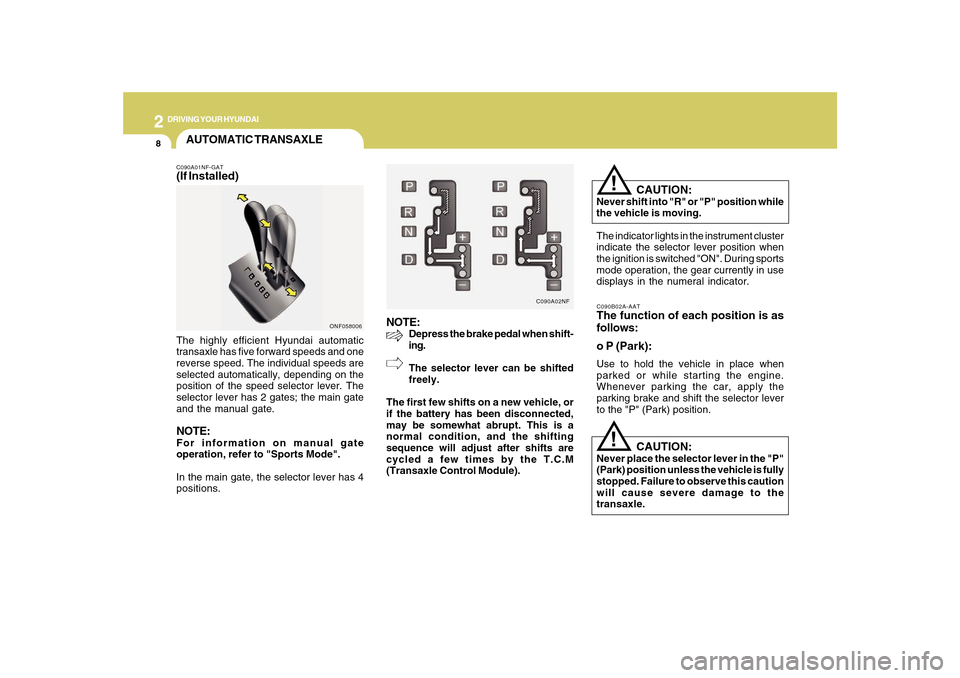
AUTOMATIC TRANSAXLEC090A01NF-GAT(If Installed)The highly efficient Hyundai automatic
transaxle has five forward speeds and one
reverse speed. The individual speeds are
selected automatically, depending on the
position of the speed selector lever. The
selector lever has 2 gates; the main gate
and the manual gate.NOTE:For information on manual gate
operation, refer to "Sports Mode".
In the main gate, the selector lever has 4
positions.
ONF058006
Page 162 of 285
2
DRIVING YOUR HYUNDAI
9
C090E02NF-GATo D (Drive):Use for normal driving. Bring the vehicle to
a complete stop before shifting the selector
to "D" position. The transaxle will automati-
cally shift through a five gear sequence.C090D02A-AATo N (Neutral):In the "N" position, the transaxle is in neutral,
which means that no gears are engaged.
The engine can be started with the shift
lever in "N" position, although this is not
recommended except if the engine stalls
while the car is moving.C090C01A-AATo R (Reverse):Use for backing up the vehicle. Bring the
car to a complete stop before shifting the
selector lever to "R" position.
CAUTION:
o In sports mode, the driver must
execute upward shifts in accordance
with prevailing road conditions, taking
care to keep the engine speed below
the red zone.
o For engine protection, upward shifts
are made automatically when the
engine rpm reaches the red zone.
o By rapidly moving the selector lever
backwards (-) twice it is possible to
skip one gear, i.e., 3rd to 1st, 4th to 2nd
or 5th to 3rd. Since sudden engine
braking and/or rapid acceleration can
cause a loss of traction, however,
downshifts must be made carefully in
accordance with the vehicle's speed.
!
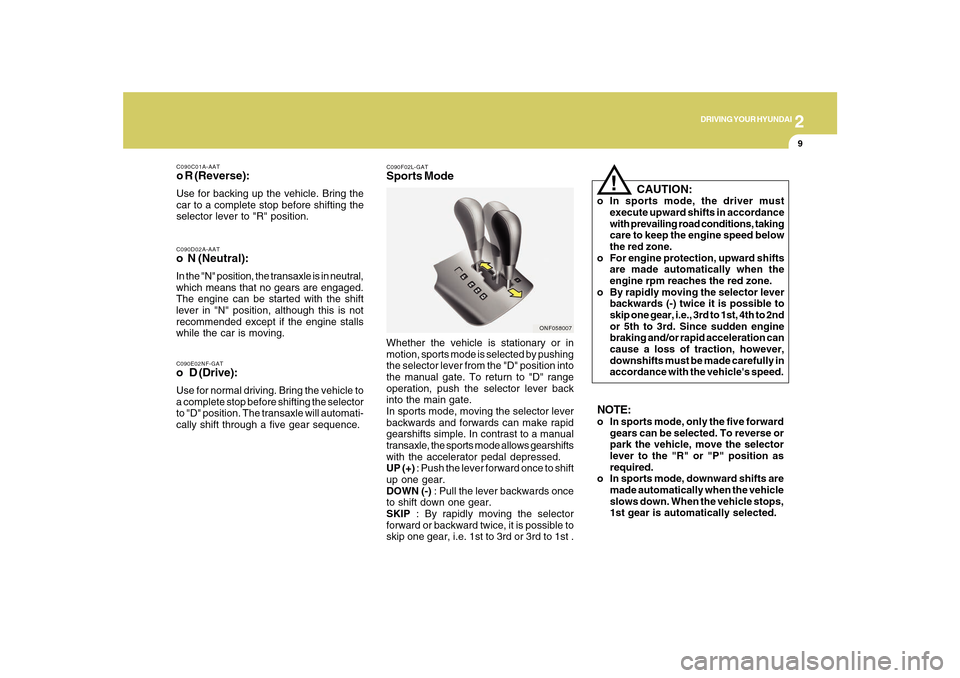
C090F02L-GATSports ModeWhether the vehicle is stationary or in
motion, sports mode is selected by pushing
the selector lever from the "D" position into
the manual gate. To return to "D" range
operation, push the selector lever back
into the main gate.
In sports mode, moving the selector lever
backwards and forwards can make rapid
gearshifts simple. In contrast to a manual
transaxle, the sports mode allows gearshifts
with the accelerator pedal depressed.
UP (+) : Push the lever forward once to shift
up one gear.
DOWN (-) : Pull the lever backwards once
to shift down one gear.
SKIP : By rapidly moving the selector
forward or backward twice, it is possible to
skip one gear, i.e. 1st to 3rd or 3rd to 1st .
ONF058007
NOTE:o In sports mode, only the five forward
gears can be selected. To reverse or
park the vehicle, move the selector
lever to the "R" or "P" position as
required.
o In sports mode, downward shifts are
made automatically when the vehicle
slows down. When the vehicle stops,
1st gear is automatically selected.
Page 163 of 285
2
DRIVING YOUR HYUNDAI
10
!
C090I03L-GAT
CAUTION:
o Shift into "R", "D" and "P" position
only when the vehicle has completely
stopped.
o Do not accelerate the engine in
reverse or any of the forward positions
with the brakes applied.
o Always apply the footbrake when shift-
ing from "P" or "N", to "R" or
"D"position.
o Do not use the "P" (Park) position in
place of the parking brake. Always
set the parking brake, shift the
transaxle into "P" (Park) position and
turn off the ignition when you leave the
vehicle, even momentarily. Never
leave the vehicle unattended while
the engine is running.
o When accelerating from a stop on a
steep hill, the vehicle may have a
tendency to roll backwards. Shifting
the shift lever into 2nd gear while in
Sport mode will help prevent the
vehicle from rolling backwards.
o Check the automatic transaxle fluid
level regularly, and add fluid as
necessary.
o See the maintenance schedule for
the proper fluid recommendation.
C090H01L-GATNOTE:o For smooth and safe operation,
depress the brake pedal when shifting
from "Neutral" position or "Park"
position to a forward or reverse gear.
o The ignition key must be in the "ON"
position and the brake pedal fully de-
pressed in order to move the shift
lever from the "P" (Park) position to
any of the other positions.
o It is always possible to shift from "R",
"N", or "D" position to "P" position.
The vehicle must be fully stopped to
avoid transaxle damage. o To maintain the required levels of ve-
hicle performance and safety, the sys-
tem may not execute certain
gearshifts when the selector lever is
operated.
o Before driving away from a stop on a
slippery road, push the selector lever
forward into the +(UP) position. This
causes the transaxle to shift into 2nd
gear which is better for smooth driv-
ing away on a slippery road. Push the
selector lever to the -(DOWN) side to
shift back to 1st gear.
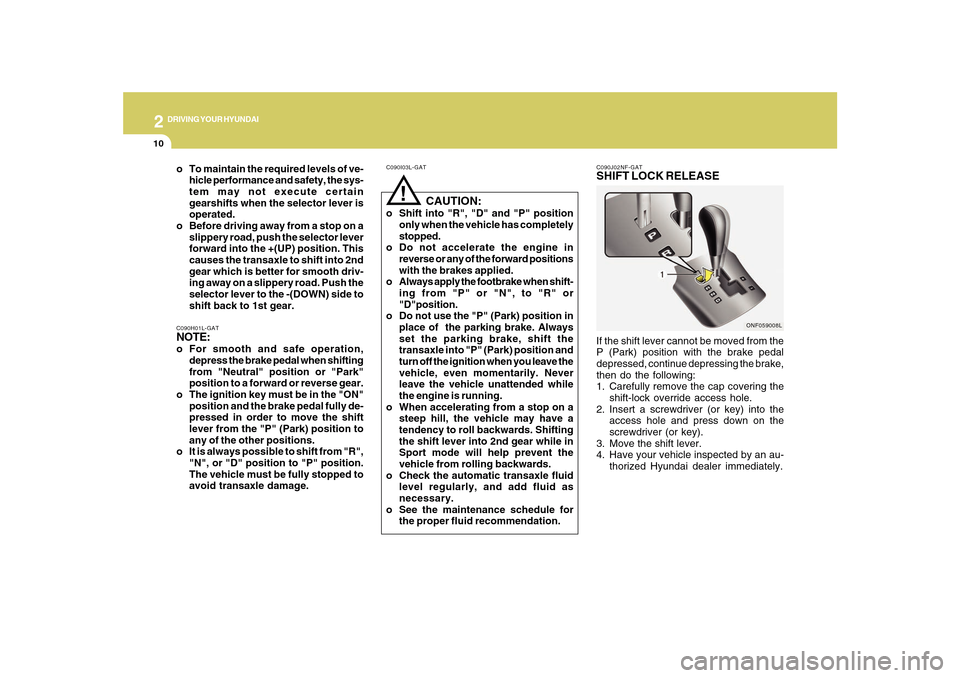
C090J02NF-GATSHIFT LOCK RELEASEIf the shift lever cannot be moved from the
P (Park) position with the brake pedal
depressed, continue depressing the brake,
then do the following:
1. Carefully remove the cap covering the
shift-lock override access hole.
2. Insert a screwdriver (or key) into the
access hole and press down on the
screwdriver (or key).
3. Move the shift lever.
4. Have your vehicle inspected by an au-
thorized Hyundai dealer immediately.
ONF059008L
Page 164 of 285
2
DRIVING YOUR HYUNDAI
11
!
!
C090N05O-AATGood Driving Practiceso Never move the gear selector lever
from "P" or "N" to any other position with
the accelerator pedal depressed.
o Never move the gear selector lever into
"P" when the vehicle is in motion.
o Be sure the vehicle is completely
stopped before you attempt to shift into
"R" or "D".
o Never take the vehicle out of gear and
coast down a hill. This may be extremely
hazardous. Always leave the vehicle in
gear when moving.
o Do not "ride" the brakes. This can cause
them to overheat and malfunction.
Instead, when you are driving down a
long hill, slow down and shift to a lower
gear. When you do this, engine braking
will help slow the car.
o Slow down before shifting to a lower
gear. Otherwise, the lower gear may not
be engaged.
o Always use the parking brake. Do not
depend on placing the transaxle in "P"
to keep the car from moving.
o Exercise extreme caution when driving
on a slippery surface. Be especially
careful when braking, accelerating or
shifting gears. On a slippery surface, an
abrupt change in vehicle speed can
cause the drive wheels to lose traction
and the vehicle to go out of control.
WARNING:
o Always buckle-up! In a collision, an
unbelted occupant is significantly
more likely to be seriously injured or
killed than a properly belted occupant.
o Avoid high speeds when cornering or
turning.
o Do not make quick steering wheel
movements, such as sharp lane
changes or fast, sharp turns.
o The risk of rollover is greatly
increased if you lose control of your
vehicle at highway speeds.
o Loss of control often occurs if two or
more wheels drop off the roadway
and the driver oversteers to reenter
the roadway.
o In the event your vehicle leaves the
roadway, do not steer sharply. Instead,
slow down before pulling back into the
travel lanes.
o Never exceed posted speed limits.
WARNING:
If your vehicle becomes stuck in snow,
mud, sand, etc., then you may attempt to
rock the vehicle free by moving it for-
ward and backward. Do not attempt this
procedure if people or objects are any-
where near the vehicle. During the rock-
ing operation the vehicle may suddenly
move forward or backward as it be-
comes unstuck, causing injury or
damage to nearby people or objects. o Optimum vehicle performance and
economy is obtained by smoothly de-
pressing and releasing the accelerator
pedal.
Page 169 of 285
2
DRIVING YOUR HYUNDAI
16
o Travel lightly. Don't carry unnecessary
weight in your car. Weight reduces fuel
economy.
o Don't let the engine idle longer than
necessary. If you are waiting (and not in
traffic), turn off your engine and restart
only when you're ready to go.
o Remember, your Hyundai does not re-
quire extended warm-up. After the en-
gine has started, allow the engine to run
for 10 to 20 seconds prior to placing the
vehicle in gear. In very cold weather,
however, give your engine a slightly
longer warm-up period.
o Don't "lug" or "over-rev" the engine.
Lugging is driving too slowly in too high
a gear resulting in the engine bucking.
If this happens, shift to a lower gear.
Over-revving is racing the engine
beyond its safe limit. This can be avoided
by shifting at the recommended speeds.
o Use your air conditioning sparingly. The
air conditioning system is operated by
engine power so your fuel economy is
reduced when you use it. o Take care of your tires. Keep them
inflated to the recommended pressure.
Incorrect inflation, either too much or
too little, results in unnecessary tire
wear. Check the tire pressures at least
once a month.
o Be sure that the wheels are aligned
correctly. Improper alignment can result
from hitting curbs or driving too fast over
irregular surfaces. Poor alignment
causes faster tire wear and may also
result in other problems as well as
greater fuel consumption.
o Keep your car in good condition. For
better fuel economy and reduced
maintenance costs, maintain your car
in accordance with the maintenance
schedule in Section 5. If you drive your
car in severe conditions, more frequent
maintenance is required (see Section 5
for details).
o Keep your car clean. For maximum
service, your Hyundai should be kept
clean and free of corrosive materials. It
is especially important that mud, dirt,
ice, etc. not be allowed to accumulate
on the underside of the car. This extra
weight can result in increased fuel
consumption and also contribute to cor-
rosion.
DRIVING FOR ECONOMYC140A02A-AATYou can save fuel and get more miles from
your car if you follow these suggestions:
o Drive smoothly. Accelerate at a
moderate rate. Don't make "jack-rabbit"
starts or full-throttle shifts and maintain
a steady cruising speed. Don't race
between stoplights. Try to adjust your
speed to that of the other traffic so you
don't have to change speeds unneces-
sarily. Avoid heavy traffic whenever pos-
sible. Always maintain a safe distance
from other vehicles so you can avoid
unnecessary braking. This also reduces
brake wear.
o Drive at a moderate speed. The faster
you drive, the more fuel your car uses.
Driving at a moderate speed, especially
on the highway, is one of the most
effective ways to reduce fuel
consumption.
o Don't "ride" the brake or clutch pedal.
This can increase fuel consumption and
also increase wear on these
components. In addition, driving with
your foot resting on the brake pedal may
cause the brakes to overheat, which
reduces their effectiveness and may
lead to more serious consequences.