lock Hyundai Sonata 2014 Owner's Manual
[x] Cancel search | Manufacturer: HYUNDAI, Model Year: 2014, Model line: Sonata, Model: Hyundai Sonata 2014Pages: 665, PDF Size: 17.43 MB
Page 548 of 665
6-14
What to do in an emergency
10. Loosen the lug nuts with the
wheel lug nut wrench and
remove them with your fingers.
Remove the wheel from the
studs and lay it flat on the ground
out of the way. Remove any dirt
or debris from the studs, mount-
ing surfaces, and wheel.
11. Install the spare tire onto the
studs of the hub.
12. Tighten the lug nuts with your fin-
gers onto the studs with the
smaller end of the lug nuts clos-
est to the wheel.
13. Lower the vehicle to the ground
by turning the jack handle coun-
terclockwise.
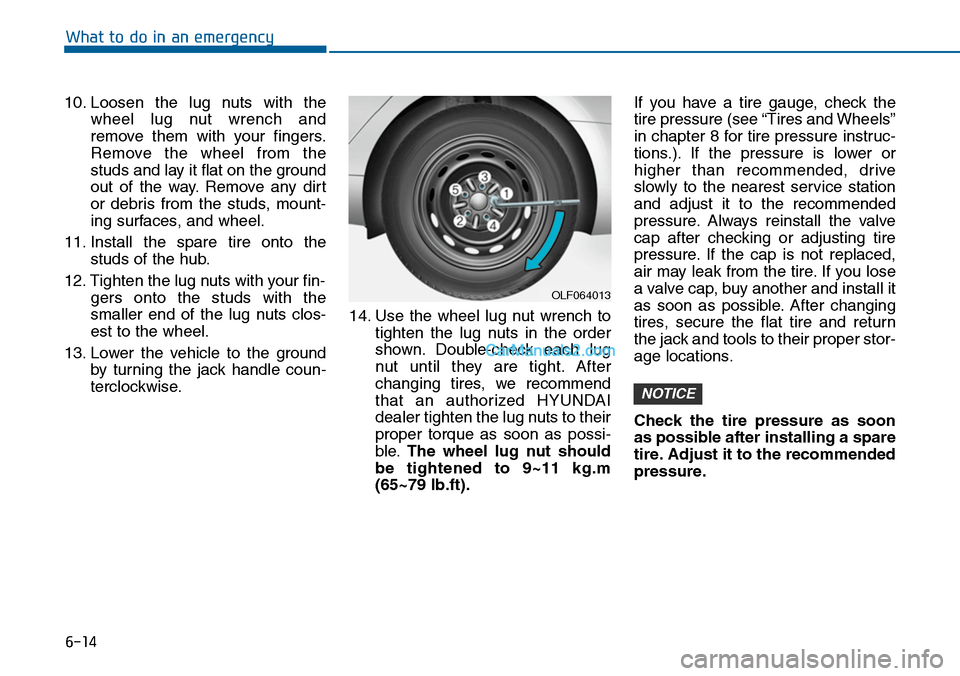
14. Use the wheel lug nut wrench to
tighten the lug nuts in the order
shown. Double-check each lug
nut until they are tight. After
changing tires, we recommend
that an authorized HYUNDAI
dealer tighten the lug nuts to their
proper torque as soon as possi-
ble.The wheel lug nut should
be tightened to 9~11 kg.m
(65~79 lb.ft).
If you have a tire gauge, check the
tire pressure (see “Tires and Wheels”
in chapter 8 for tire pressure instruc-
tions.). If the pressure is lower or
higher than recommended, drive
slowly to the nearest service station
and adjust it to the recommended
pressure. Always reinstall the valve
cap after checking or adjusting tire
pressure. If the cap is not replaced,
air may leak from the tire. If you lose
a valve cap, buy another and install it
as soon as possible. After changing
tires, secure the flat tire and return
the jack and tools to their proper stor-
age locations.
Check the tire pressure as soon
as possible after installing a spare
tire. Adjust it to the recommended
pressure.
NOTICE
OLF064013
Page 554 of 665
6-20
What to do in an emergency
When towing your vehicle in an
emergency without wheel dollies:
1. Place the ignition switch in the
ACC position.
2. Place the shift lever in N (Neutral).
3. Release the parking brake.
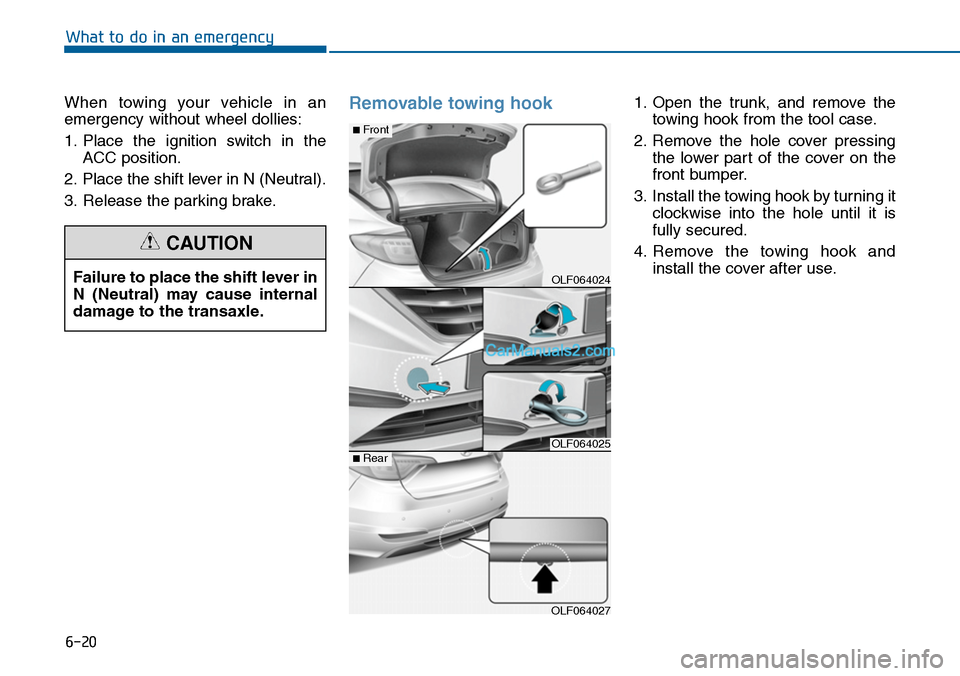
Removable towing hook 1. Open the trunk, and remove the
towing hook from the tool case.
2. Remove the hole cover pressing
the lower part of the cover on the
front bumper.
3. Install the towing hook by turning it
clockwise into the hole until it is
fully secured.
4. Remove the towing hook and
install the cover after use.Failure to place the shift lever in
N (Neutral) may cause internal
damage to the transaxle.
CAUTION
OLF064024
OLF064025
OLF064027
■Front
■Rear
Page 555 of 665
6-21
What to do in an emergency
6
Emergency towing
If towing is necessary, we recom-
mend you have it done by an author-
ized HYUNDAI dealer or a commer-
cial tow truck service.
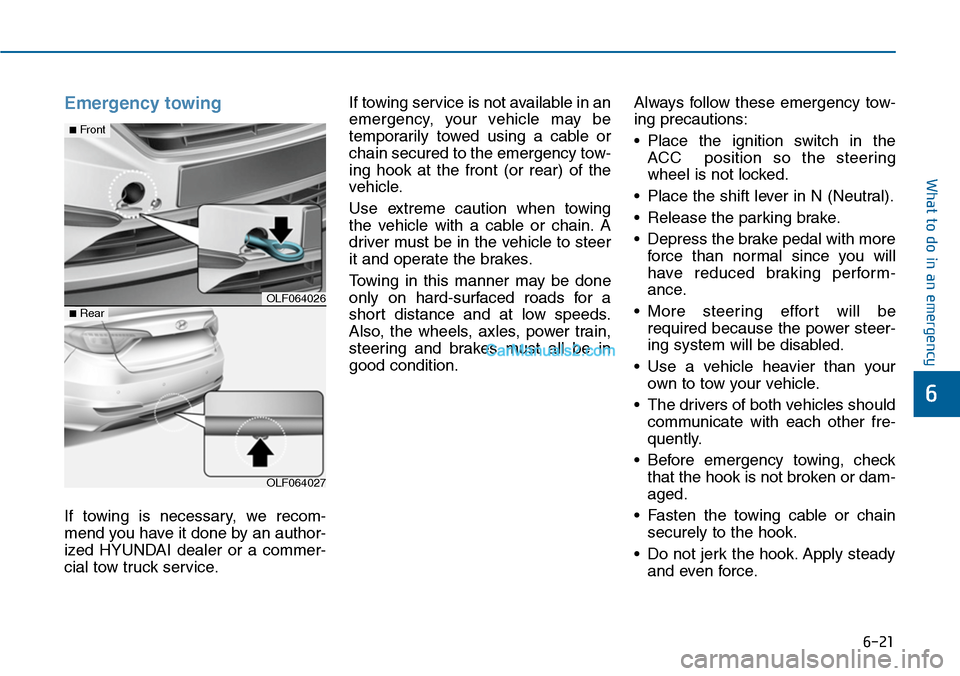
If towing service is not available in an
emergency, your vehicle may be
temporarily towed using a cable or
chain secured to the emergency tow-
ing hook at the front (or rear) of the
vehicle.
Use extreme caution when towing
the vehicle with a cable or chain. A
driver must be in the vehicle to steer
it and operate the brakes.
Towing in this manner may be done
only on hard-surfaced roads for a
short distance and at low speeds.
Also, the wheels, axles, power train,
steering and brakes must all be in
good condition.
Always follow these emergency tow-
ing precautions:
•Place the ignition switch in the
ACC position so the steering
wheel is not locked.
•Place the shift lever in N (Neutral).
•Release the parking brake.
•Depress the brake pedal with more
force than normal since you will
have reduced braking perform-
ance.
•More steering effort will be
required because the power steer-
ing system will be disabled.
•Use a vehicle heavier than your
own to tow your vehicle.
•The drivers of both vehicles should
communicate with each other fre-
quently.
•Before emergency towing, check
that the hook is not broken or dam-
aged.
•Fasten the towing cable or chain
securely to the hook.
•Do not jerk the hook.Apply steady
and even force.
OLF064026
OLF064027
■Front
■Rear
Page 564 of 665
7-7
7
Maintenance
OWNER MAINTENANCE
The following lists are vehicle checks
and inspections that should be per-
for med by the owner or an authorized
HYUNDAI dealer at the frequencies
indicated to help ensure safe,
dependable operation of your vehicle.
Any adverse conditions should be
brought to the attention of your deal-
er as soon as possible.
These Owner Maintenance vehicle
checks are generally not covered by
warranties and you may be charged
for labor, par ts and lubricants used.
Performing maintenance work
on a vehicle can be dangerous.
If you lack sufficient knowledge
and experience or the proper
tools and equipment to do the
work, we recommend that the
system be serviced by an author-
ized HYUNDAI dealer. ALWAYS
follow these precautions for
performing maintenance work:
•Park your vehicle on level
ground, move the shift lever
into the P (Park, for automatic
transaxle vehicle) position,
apply the parking brake, place
the ignition switch in the
LOCK/OFF position.
•Block the tires (front and back)
to prevent the vehicle from
moving.
Remove loose clothing or jew-
elry that can become entan-
gled in moving parts.
(Continued)
WARNING (Continued)
•If you must run the engine
during maintenance, do so
out doors or in an area with
plenty of ventilation.
•Keep flames, sparks, or smok-
ing materials away from the
battery and fuel-related parts.
Page 566 of 665
7-9
7
Maintenance
At least twice a year:
(i.e., every Spring and Fall)
•Check radiator, heater and air condi-
tioning hoses for leaks or damage.
•Check windshield washer spray
and wiper operation. Clean wiper
blades with clean cloth dampened
with washer fluid.
•Check headlamp alignment.
•Check muffler, exhaust pipes,
shields and clamps.
•Check the seat belts for wear and
function.
At least once a year:
•Clean body and door drain holes.
•Lubricate door hinges and hood
hinges.
•Lubricate door and hood locks and
latches.
•Lubricate door rubber weather
strips.
•Check the air conditioning system.
•Inspect and lubricate automatic
transaxle linkage and controls.
•Clean the battery and terminals.
•Check the brake fluid level.
Page 580 of 665
7-23
7
Maintenance
EXPLANATION OF SCHEDULED MAINTENANCE ITEMS
Engine oil and filter
The engine oil and filter should be
changed at the intervals specified in
the maintenance schedule. If the car
is being driven in severe conditions,
more frequent oil and filter changes
are required.
Drive belts
Inspect all drive belts for evidence of
cuts, cracks, excessive wear or oil
saturation and replace if necessary.
Drive belts should be checked peri-
odically for proper tension and
adjusted as necessary.
Fuel filter (cartridge)
A clogged filter can limit the speed at
which the vehicle may be driven,
damage the emission system and
cause multiple issues such as hard
starting. If an excessive amount of
foreign matter accumulates in the
fuel tank, the filter may require
replacement more frequently.
After installing a new filter, run the
engine for several minutes, and
check for leaks at the connections.
We recommend that the fuel filter be
replaced by an authorized HYUNDAI
dealer.
Fuel lines, fuel hoses and con-
nections
Check the fuel lines, fuel hoses and
connections for leakage and dam-
age. We recommend that the fuel
lines, fuel hoses and connections be
replaced by an authorized HYUNDAI
dealer.
Va p o r h o s e a n d f u e l f i l l e r c a p
The vapor hose and fuel filler cap
should be inspected at those inter-
vals specified in the maintenance
schedule. Make sure that a new
vapor hose or fuel filler cap is cor-
rectly replaced.
When you are inspecting the
belt, place the ignition switch to
the LOCK/OFF or ACC position.
CAUTION
Page 587 of 665
7-30
Maintenance
ENGINE COOLANT
The high-pressure cooling system
has a reservoir filled with year-round
antifreeze coolant. The reservoir is
filled at the factory.
Check the antifreeze protection and
coolant concentration level at least
once a year, at the beginning of the
winter season, and before traveling
to a colder climate.
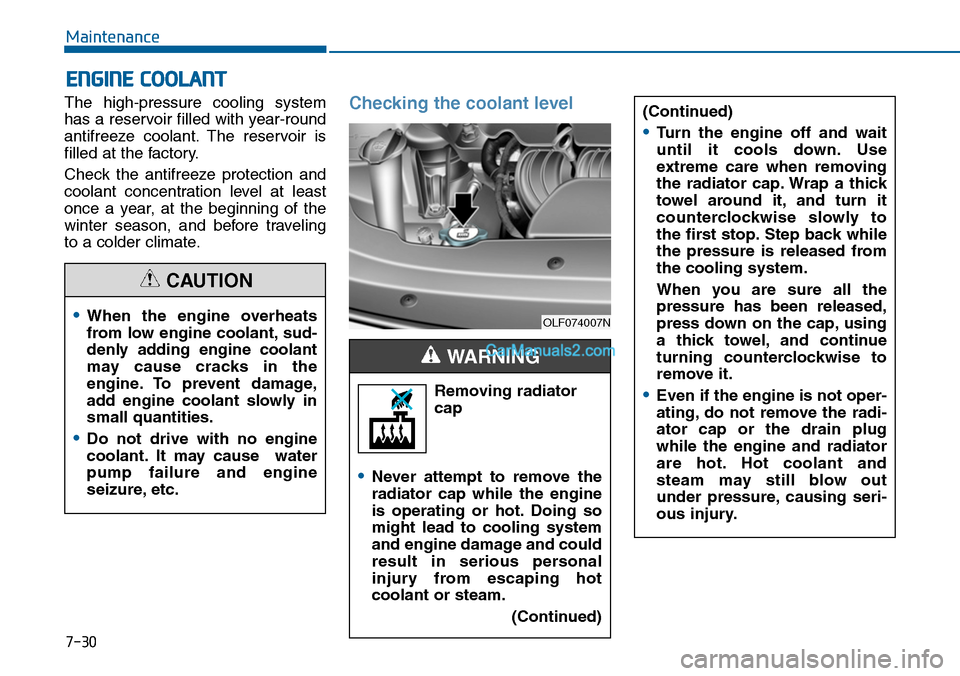
Checking the coolant level
Removing radiator
cap
•Never attempt to remove the
radiator cap while the engine
is operating or hot. Doing so
might lead to cooling system
and engine damage and could
result in serious personal
injury from escaping hot
coolant or steam.
(Continued)
WARNING
(Continued)
•Turn the engine off and wait
until it cools down. Use
extreme care when removing
the radiator cap. Wrap a thick
towel around it, and turn it
counterclockwise slowly to
the first stop. Step back while
the pressure is released from
the cooling system.
When you are sure all the
pressure has been released,
press down on the cap, using
a thick towel, and continue
turning counterclockwise to
remove it.
•Even if the engine is not oper-
ating, do not remove the radi-
ator cap or the drain plug
while the engine and radiator
are hot. Hot coolant and
steam may still blow out
under pressure, causing seri-
ous injury.
•When the engine overheats
from low engine coolant, sud-
denly adding engine coolant
may cause cracks in the
engine. To prevent damage,
add engine coolant slowly in
small quantities.
•Do not drive with no engine
coolant. It may cause water
pump failure and engine
seizure, etc.
CAUTION
OLF074007N
Page 594 of 665
7-37
7
Maintenance
AIR CLEANER
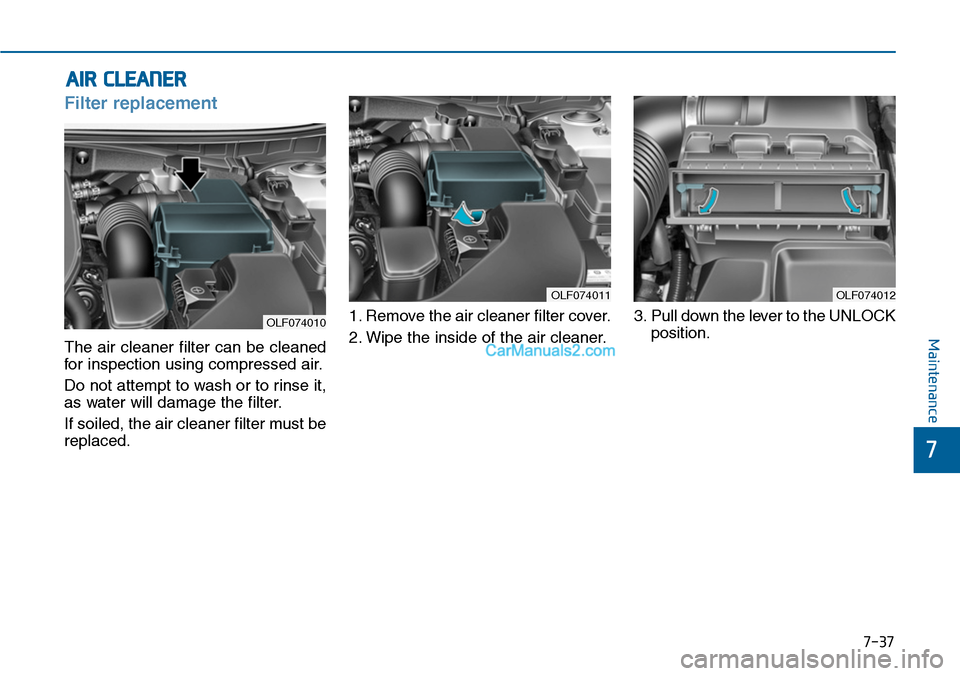
Filter replacement
The air cleaner filter can be cleaned
for inspection using compressed air.
Do not attempt to wash or to rinse it,
as water will damage the filter.
If soiled, the air cleaner filter must be
replaced.
1. Remove the air cleaner filter cover.
2. Wipe the inside of the air cleaner.
3. Pull down the lever to the UNLOCK
position.OLF074010
OLF074011OLF074012
Page 595 of 665
7-38
Maintenance
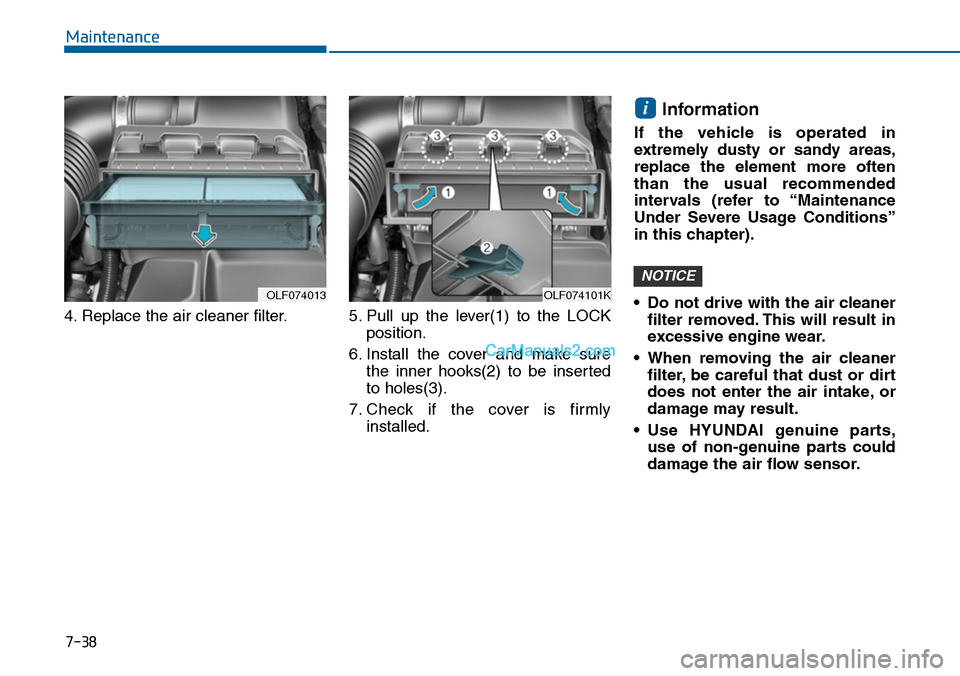
4. Replace the air cleaner filter. 5. Pull up the lever(1) to the LOCK
position.
6. Install the cover and make sure
the inner hooks(2) to be inserted
to holes(3).
7. Check if the cover is firmly
installed.
Information
If the vehicle is operated in
extremely dusty or sandy areas,
replace the element more often
than the usual recommended
intervals (refer to “Maintenance
Under Severe Usage Conditions”
in this chapter).
•Do not drive with the air cleaner
filter removed. This will result in
excessive engine wear.
•When removing the air cleaner
filter, be careful that dust or dirt
does not enter the air intake, or
damage may result.
•Use HYUNDAI genuine parts,
use of non-genuine parts could
damage the air flow sensor.
NOTICE
i
OLF074013OLF074101K
Page 596 of 665
7-39
7
Maintenance
CLIMATE CONTROL AIR FILTER
Filter inspection
If the vehicle is operated in the
severely air-polluted cities or on
dusty rough roads for a long period,
it should be inspected more fre-
quently and replaced earlier. When
you, the owner, replace the climate
control air filter, replace it performing
the following procedure, and be care-
ful to avoid damaging other compo-
nents.
Replace the filter according to the
Maintenance Schedule.
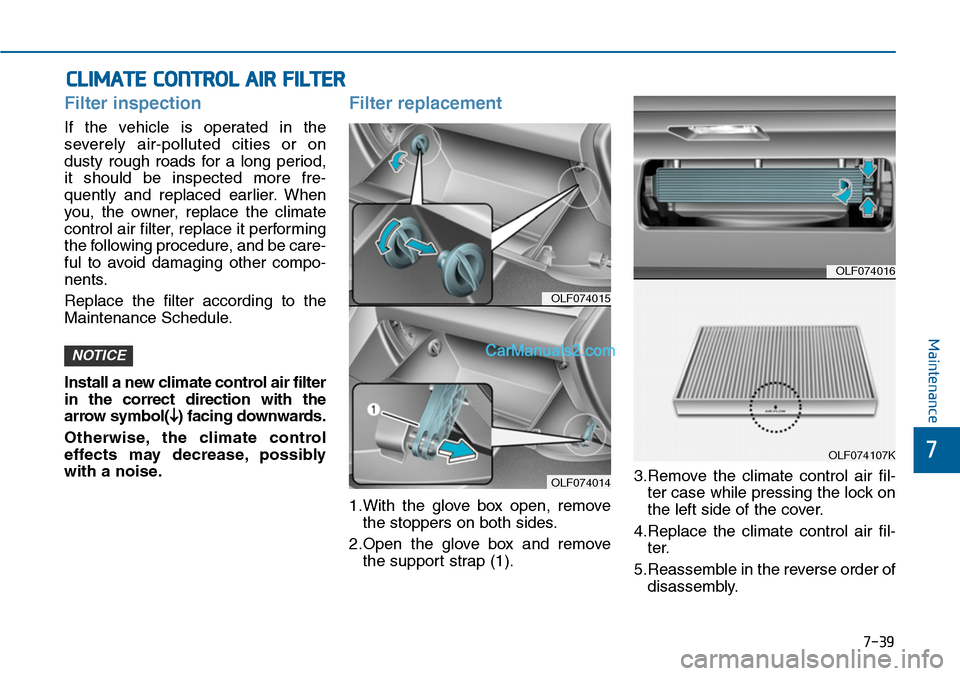
Install a new climate control air filter
in the correct direction with the
arrow symbol(↓) facing downwards.
Otherwise, the climate control
effects may decrease, possibly
with a noise.
Filter replacement
1.With the glove box open, remove
the stoppers on both sides.
2.Open the glove box and remove
the support strap (1).
3.Remove the climate control air fil-
ter case while pressing the lock on
the left side of the cover.
4.Replace the climate control air fil-
ter.
5.Reassemble in the reverse order of
disassembly.
NOTICE
OLF074015
OLF074014
OLF074016
OLF074107K