light Hyundai Sonata 2014 Owner's Manual
[x] Cancel search | Manufacturer: HYUNDAI, Model Year: 2014, Model line: Sonata, Model: Hyundai Sonata 2014Pages: 665, PDF Size: 17.43 MB
Page 538 of 665
6-4
IF THE ENGINE WILL NOT START
What to do in an emergency
If the engine doesn't turn over
or turns over slowly
•Be sure the shift lever is in N
(Neutral) or P (Park) if it is an auto-
matic transaxle vehicle. The engine
starts only when the shift lever is in
N (Neutral) or P (Park).
•Check the battery connections to
be sure they are clean and tight.
•Turn on the interior light.If the light
dims or goes out when you operate
the starter, the battery is drained.
Do not push or pull the vehicle to
start it. This could cause damage to
your vehicle. See instructions for
"Jump Starting" provided in this
chapter.
If the engine turns over nor-
mally but doesn’t start
•Check the fuel level and add fuel if
necessary.
If the engine still does not start, we
recommend that you call an author-
ized HYUNDAI dealer for assistance.
Jump star ting can be dangerous if
done incorrectly. Follow the jump
starting procedure in this section to
avoid serious injury or damage to
your vehicle. If in doubt about how to
properly jump start your vehicle, we
strongly recommend that you have a
service technician or towing service
do it for you.
Push or pull starting the vehicle
may cause the catalytic con-
verter to overload which can
lead to damage to the emission
control system.
CAUTION
JUMP STARTING
Page 540 of 665
6-6
What to do in an emergency
To prevent damage to your vehi-
cle:
•Only use a 12-volt power supply
(battery or jumper system) to
jump start your vehicle.
•Do not attempt to jump start
your vehicle by push-starting.
Information
An inappropriately disposed
battery can be harmful to the
environment and human
health. Dispose the battery
according to your local law(s)
or regulations.
Jump starting procedure
1. Position the vehicles close enough
that the jumper cables will reach,
but do not allow the vehicles to
touch.
2. Avoid fans or any moving parts in
the engine compartment at all
times, even when the vehicles are
turned off.
3. Turn off all electrical devices such
as radios, lights, air conditioning,
etc. Put the vehicles in P (Park, for
automatic transaxle vehicle) or
neutral (for manual transaxle vehi-
cle), and set the parking brakes.
Turn both vehicles OFF.
iNOTICE
Pb
Page 559 of 665
7
Tire sidewall labeling ......................................................7-52
Low aspect ratio tire ......................................................7-57
Fuses ......................................................................7-58
Fuse/Relay panel description ......................................7-64
Light bulbs.............................................................7-72
Headlamp, position lamp, turn signal lamp and
side marker light bulb replacement ............................7-73
Side repeater lamp replacement .................................7-75
Headlamp and front fog lamp aiming (for Europe) ...7-76
Rear combination light bulb replacement .................7-81
High mounted stop lamp replacement .......................7-85
License plate light bulb replacement ........................7-85
Interior light bulb replacement ....................................7-85
Appearance care ..................................................7-87
Exterior care ....................................................................7-87
Interior care......................................................................7-93
Emission control system .....................................7-95
Crankcase emission control system ...........................7-95
Evaporative emission control system.........................7-95
Exhaust emission control system ...............................7-96
Page 565 of 665
7-8
Maintenance
Owner maintenance schedule
When you stop for fuel:
•Check the engine oil level.
•Check coolant level in the engine
coolant reservoir.
•Check the windshield washer fluid
level.
•Check for low or under-inflated
tires.
While operating your vehicle:
•Note any changes in the sound of
the exhaust or any smell of exhaust
fumes in the vehicle.
•Check for vibrations in the steering
wheel. Notice if there is any
increased steering effort or loose-
ness in the steering wheel, or
change in its straight-ahead position.
•Notice if your vehicle constantly
turns slightly or “pulls” to one side
when traveling on smooth, level
road.
•When stopping, listen and check for
unusual sounds, pulling to one side,
increased brake pedal travel or
“hard-to-push” brake pedal.
•If any slipping or changes in the
operation of your transaxle occurs,
check the transaxle fluid level.
•Check the automatic transaxle
P (Park) function.
•Check the parking brake.
•Check for fluid leaks under your vehi-
cle (water dripping from the air con-
ditioning system during or after use
is normal).
At least monthly:
•Check coolant level in the engine
coolant reservoir.
•Check the operation of all exterior
lights, including the stoplights, turn
signals and hazard warning flashers.
•Check the inflation pressures of all
tires including the spare for tires
that are worn, show uneven wear,
or are damaged.
•Check for loose wheel lug nuts.
Be careful when checking your
engine coolant level when the
engine is hot. This may result in
coolant being blown out of the
opening and cause serious
burns and other injuries.
WARNING
Page 599 of 665
7-42
Maintenance
BATTERY
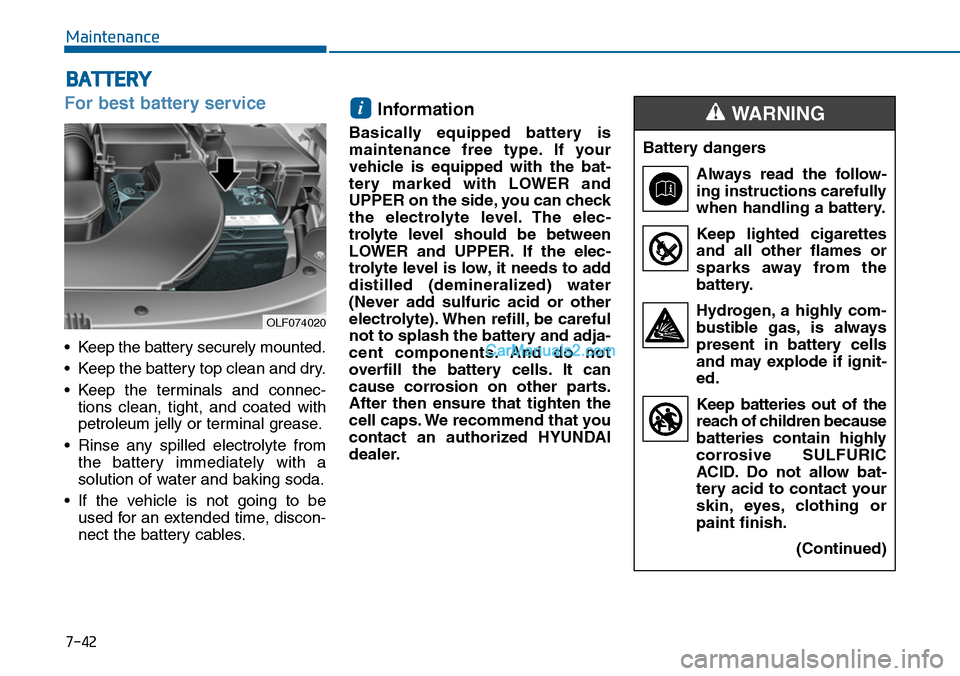
For best battery service
•Keep the battery securely mounted.
•Keep the battery top clean and dry.
•Keep the terminals and connec-
tions clean, tight, and coated with
petroleum jelly or terminal grease.
•Rinse any spilled electrolyte from
the battery immediately with a
solution of water and baking soda.
•If the vehicle is not going to be
used for an extended time, discon-
nect the battery cables.
Information
Basically equipped battery is
maintenance free type. If your
vehicle is equipped with the bat-
tery marked with LOWER and
UPPER on the side, you can check
the electrolyte level. The elec-
trolyte level should be between
LOWER and UPPER. If the elec-
trolyte level is low, it needs to add
distilled (demineralized) water
(Never add sulfuric acid or other
electrolyte). When refill, be careful
not to splash the battery and adja-
cent components. And do not
overfill the battery cells. It can
cause corrosion on other parts.
After then ensure that tighten the
cell caps. We recommend that you
contact an authorized HYUNDAI
dealer.
i
Battery dangers
Always read the follow-
ing instructions carefully
when handling a battery.
Keep lighted cigarettes
and all other flames or
sparks away from the
battery.
Hydrogen, a highly com-
bustible gas, is always
present in battery cells
and may explode if ignit-
ed.
Keep batteries out of the
reach of children because
batteries contain highly
corrosive SULFURIC
ACID. Do not allow bat-
tery acid to contact your
skin, eyes, clothing or
paint finish.
(Continued)
WARNING
OLF074020
Page 601 of 665
7-44
Maintenance
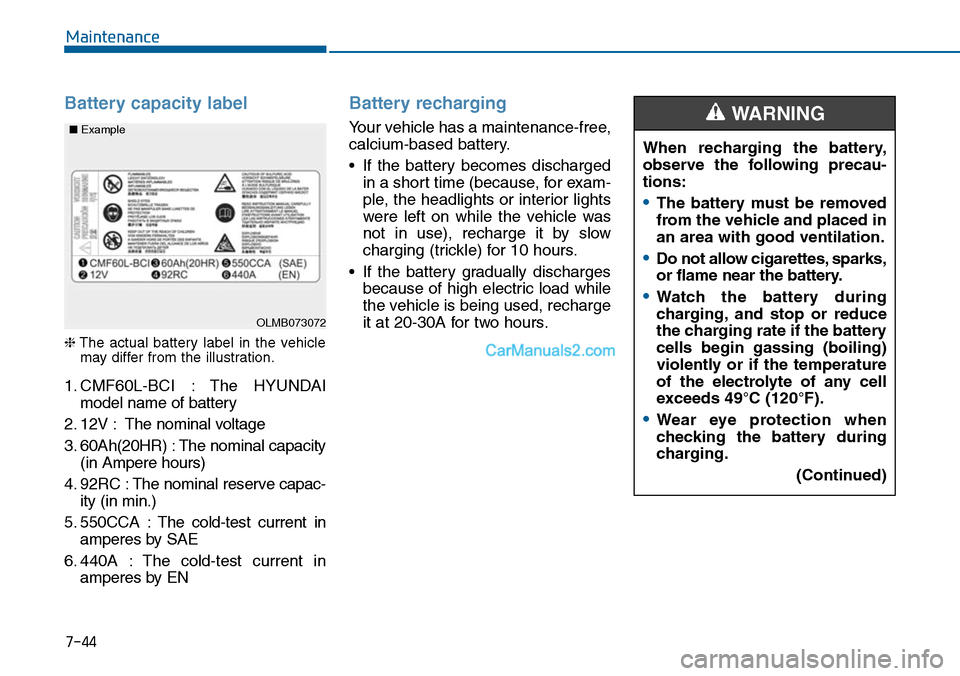
Battery capacity label
❈The actual battery label in the vehiclemay differ from the illustration.
1. CMF60L-BCI : The HYUNDAI
model name of battery
2. 12V : The nominal voltage
3. 60Ah(20HR) : The nominal capacity
(in Ampere hours)
4. 92RC : The nominal reserve capac-
ity (in min.)
5. 550CCA : The cold-test current in
amperes by SAE
6. 440A : The cold-test current in
amperes by EN
Battery recharging
Yo u r v e h i c l e h a s a m a i n t e n a n c e - f r e e ,
calcium-based battery.
•If the battery becomes discharged
in a short time (because, for exam-
ple, the headlights or interior lights
were left on while the vehicle was
not in use), recharge it by slow
charging (trickle) for 10 hours.
•If the battery gradually discharges
because of high electric load while
the vehicle is being used, recharge
it at 20-30A for two hours.OLMB073072
■Example
When recharging the battery,
observe the following precau-
tions:
•The battery must be removed
from the vehicle and placed in
an area with good ventilation.
•Do not allow cigarettes, sparks,
or flame near the battery.
•Watch the battery during
charging, and stop or reduce
the charging rate if the battery
cells begin gassing (boiling)
violently or if the temperature
of the electrolyte of any cell
exceeds 49°C (120°F).
•Wear eye protection when
checking the battery during
charging.
(Continued)
WARNING
Page 614 of 665
7-57
7
Maintenance
Low aspect ratio tire
(if equipped)
Low aspect ratio tires, whose aspect
ratio is lower than 50, are provided
for spor ty looks.
Because the low aspect ratio tires
are optimized for handling and brak-
ing, it may be more uncomfortable to
ride in and there is more noise com-
pare with normal tires.
Because the sidewall of the low
aspect ratio tire is shorter than
the normal, the wheel and tire of
the low aspect ratio tire is easi-
er to be damaged. So, follow the
instructions below.
- When driving on a rough road
or off road, drive cautiously
because tires and wheels may
be damaged. And after driving,
inspect tires and wheels.
- When passing over a pothole,
speed bump, manhole, or curb
stone, drive slowly so that the
tires and wheels are not dam-
aged.
- If the tire is impacted, we rec-
ommend that you inspect the
tire condition or contact an
authorized HYUNDAI dealer.
- To prevent damage to the tire,
inspect the tire condition and
pressure every 3,000km.
CAUTION
•It is not easy to recognize the
tire damage with your own
eyes. But if there is the slight-
est hint of tire damage, even
though you cannot see the
tire damage with your own
eyes, have the tire checked or
replaced because the tire
damage may cause air leak-
age from the tire.
•If the tire is damaged by driv-
ing on a rough road, off road,
pothole, manhole, or curb
stone, it will not be covered by
the warranty.
•Yo u c a n f i n d o u t t h e t i r e i n f o r -
mation on the tire sidewall.
CAUTION
Page 615 of 665
7-58
Maintenance
FUSES
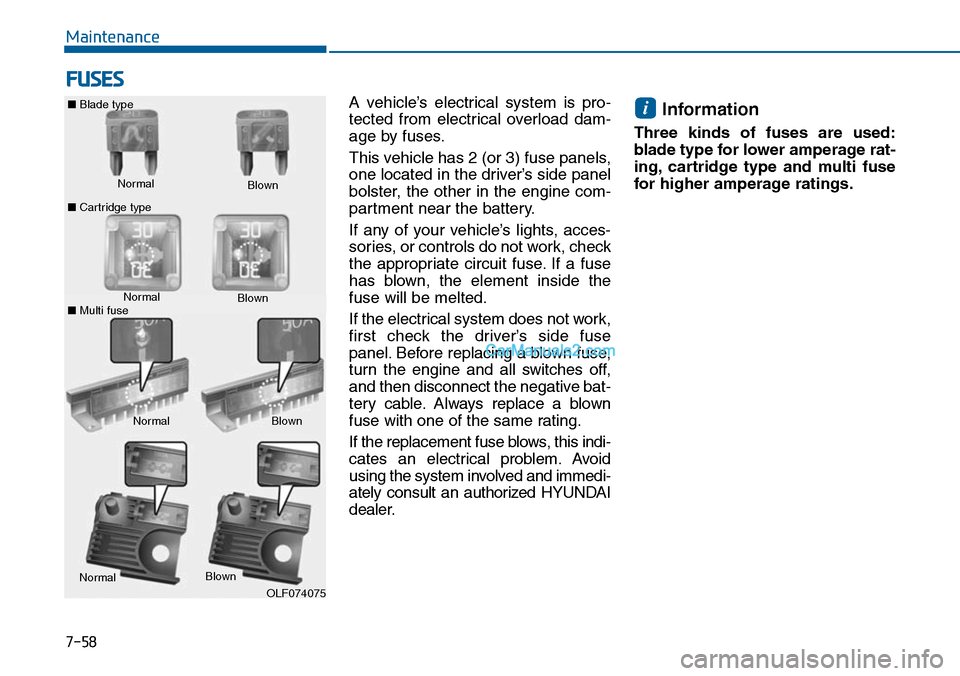
A vehicle’s electrical system is pro-
tected from electrical overload dam-
age by fuses.
This vehicle has 2 (or 3) fuse panels,
one located in the driver’s side panel
bolster, the other in the engine com-
partment near the battery.
If any of your vehicle’s lights, acces-
sories, or controls do not work, check
the appropriate circuit fuse. If a fuse
has blown, the element inside the
fuse will be melted.
If the electrical system does not work,
first check the driver’s side fuse
panel. Before replacing a blown fuse,
turn the engine and all switches off,
and then disconnect the negative bat-
tery cable. Always replace a blown
fuse with one of the same rating.
If the replacement fuse blows, this indi-
cates an electrical problem. Avoid
using the system involved and immedi-
ately consult an authorized HYUNDAI
dealer.
Information
Three kinds of fuses are used:
blade type for lower amperage rat-
ing, cartridge type and multi fuse
for higher amperage ratings.
i
Normal
■Blade type
■Cartridge type
Blown
NormalBlown
NormalBlown
OLF074075
NormalBlown■Multi fuse
Page 617 of 665
7-60
Maintenance
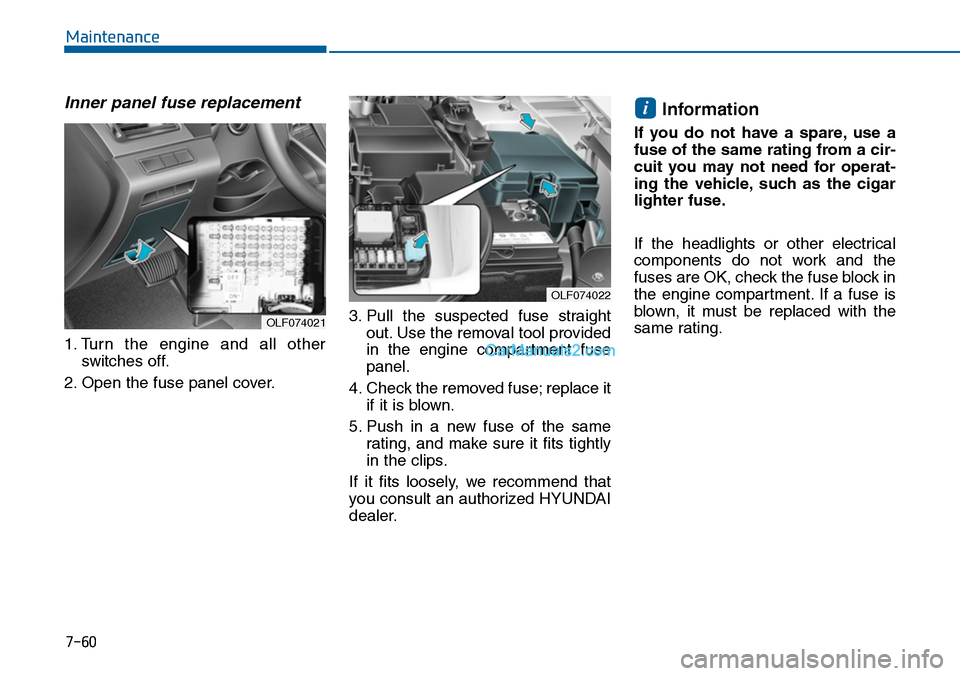
Inner panel fuse replacement
1. Turn the engine and all other
switches off.
2. Open the fuse panel cover.
3. Pull the suspected fuse straight
out. Use the removal tool provided
in the engine compartment fuse
panel.
4. Check the removed fuse; replace it
if it is blown.
5. Push in a new fuse of the same
rating, and make sure it fits tightly
in the clips.
If it fits loosely, we recommend that
you consult an authorized HYUNDAI
dealer.
Information
If you do not have a spare, use a
fuse of the same rating from a cir-
cuit you may not need for operat-
ing the vehicle, such as the cigar
lighter fuse.
If the headlights or other electrical
components do not work and the
fuses are OK, check the fuse block in
the engine compartment. If a fuse is
blown, it must be replaced with the
same rating.
i
OLF074022
OLF074021
Page 623 of 665
7-66
Maintenance
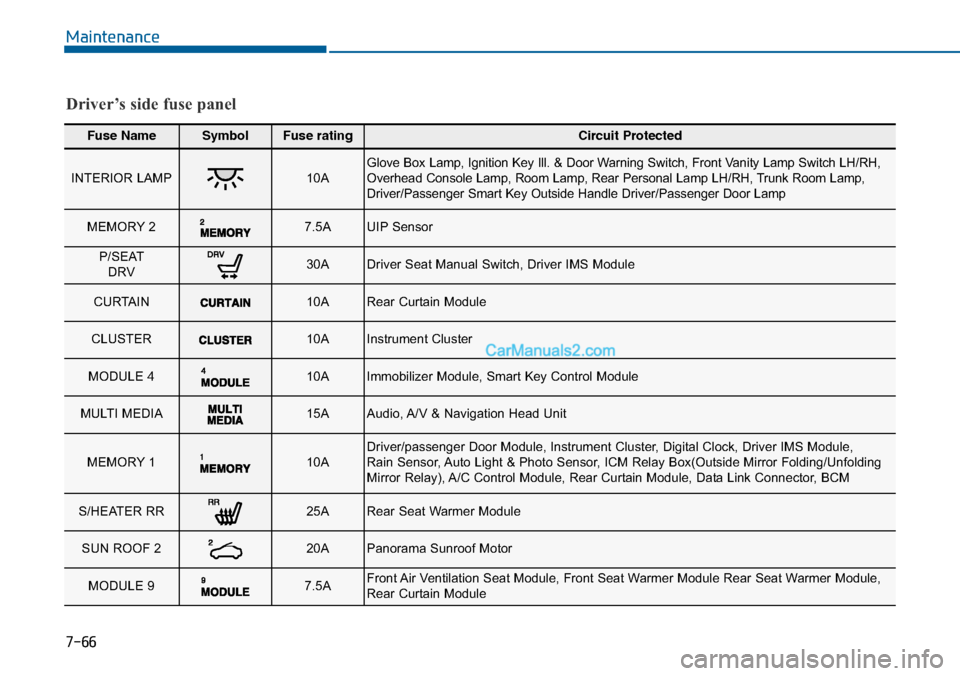
Fuse NameSymbolFuse ratingCircuit Protected
INTERIOR LAMP10AGlove Box Lamp, Ignition Key Ill. & Door Warning Switch, Front Vanity Lamp Switch LH/RH,Overhead Console Lamp, Room Lamp, Rear Personal Lamp LH/RH, Trunk Room Lamp,Driver/Passenger Smart Key Outside Handle Driver/Passenger Door Lamp
MEMORY 2 7.5AUIP Sensor
P/SEATDRV 30ADriver Seat Manual Switch, Driver IMS Module
CURTAIN 10ARear Curtain Module
CLUSTER 10AInstrument Cluster
MODULE 4 10AImmobilizer Module, Smart Key Control Module
MULTI MEDIA15AAudio, A/V & Navigation Head Unit
MEMORY 1 10ADriver/passenger Door Module, Instrument Cluster, Digital Clock, Driver IMS Module,Rain Sensor, Auto Light & Photo Sensor, ICM Relay Box(Outside Mirror Folding/UnfoldingMirror Relay), A/C Control Module, Rear Curtain Module, Data Link Connector, BCM
S/HEATER RR 25ARear Seat Warmer Module
SUN ROOF 2 20APanorama Sunroof Motor
MODULE 9 7.5AFront Air Ventilation Seat Module, Front Seat Warmer Module Rear Seat Warmer Module,Rear Curtain Module
Driver’s side fuse panel