clutch Hyundai Sonata 2014 User Guide
[x] Cancel search | Manufacturer: HYUNDAI, Model Year: 2014, Model line: Sonata, Model: Hyundai Sonata 2014Pages: 665, PDF Size: 17.43 MB
Page 468 of 665
5-19
Driving your vehicle
5
To prevent damage to the engine,
clutch and transaxle:
•When downshifting from 5th
gear to 4th gear, be careful not
to inadvertently push the shift
lever sideways engaging the 2nd
gear. A drastic downshift may
cause the engine speed to
increase to the point the
tachometer will enter the red-
zone.
•Do not downshift more than two
gear at a time or downshift the
gear when the engine is running
at high speed (5,000 RPM or
higher). Such a downshifting
may damage the engine, clutch
and the transaxle.
Good driving practices
•Never take the vehicle out of gear
and coast down a hill. This is
extremely dangerous.
•Don't "ride" the brakes.This can
cause the brakes and related parts
to overheat and malfunction.
When you are driving down a long
hill, slow down and shift to a lower
gear. Engine braking will help slow
down the vehicle.
•Slow down before shifting to a
lower gear. This will help avoid
over-revving the engine, which can
cause damage.
•Slow down when you encounter
cross winds. This gives you much
better control of your vehicle.
•Be sure the vehicle is completely
stopped before you shift into R
(Reverse) to prevent damage to
the transaxle.
•Exercise extreme caution when
driving on a slippery surface. Be
especially careful when braking,
accelerating or shifting gears. On a
slippery surface, an abrupt change
in vehicle speed can cause the
drive wheels to lose traction and
may cause loss of vehicle control
resulting in an accident
NOTICE
Do not use the engine brake
(shifting from a higher gear to
lower gear) rapidly on slippery
roads. The vehicle may slip
causing an accident.
WARNING
Page 482 of 665
5-33
Driving your vehicle
5
To release EPB (Electric Parking
Brake) automatically:
•Shift lever in P (Park)
With the engine running depress
the brake pedal and shift out of P
(Park) to R (Rear) or D (Drive).
•Shift lever in N (Neutral)
With the engine running depress
the brake pedal and shift out of N
(Neutral) to R (Rear) or D (Drive).
•Manual transaxle vehicle
1. Start the engine.
2. Fasten the driver's seat belt.
3. Close the driver's door, engine
hood and tailgate/trunk.
4. Depress the clutch pedal with
the gear engaged.
5. Depress the accelerator pedal
while releasing the clutch pedal.
•Automatic transaxle vehicle
1. Start the engine.
2. Fasten the driver's seat belt.
3. Close the driver's door, engine
hood and tailgate/trunk.
4. Depress the accelerator pedal
while the shift lever is in R
(Rear), D (Drive) or Sports
mode.
Make sure the Parking Brake
War ning light goes off.
Information
• For your safety, you can engage the
EPB even though the Engine
Stop/Start button is in the OFF posi-
tion, but you cannot release it.
•Foryoursafety, depress the brake
pedal and release the parking brake
manually with the EPB switch when
you drive downhill or when backing
up the vehicle.
Information - Manual
transaxle
A vehicle towing a trailer on a hill or
on an incline may slightly roll back-
wards when starting the vehicle. To
prevent the situation follow the below
instructions.
1. Depress the clutch pedal and select
a gear.
2. Keep pulling up the EPB switch.
3. Depress the accelerator pedal and
slowly release the clutch pedal.
4. If the vehicle starts off with enough
driving power release the EPB
switch.
Do not follow the above procedure
when driving on a flat level ground.
The vehicle may suddenly move for-
ward.
i
i
Page 503 of 665
5-54
Driving your vehicle
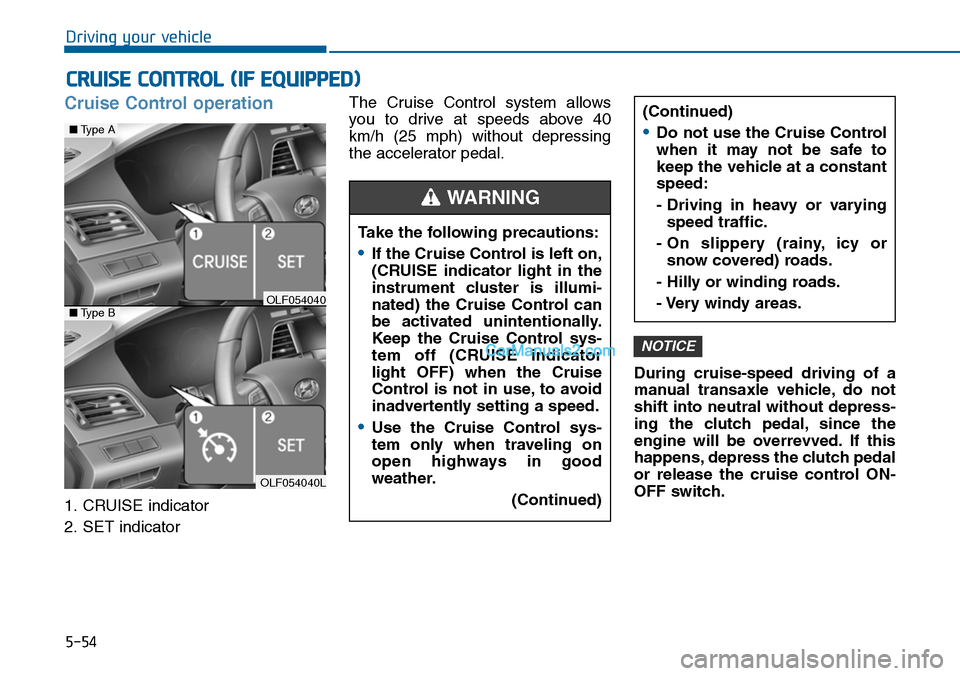
Cruise Control operation
1. CRUISE indicator
2. SET indicator
The Cruise Control system allows
you to drive at speeds above 40
km/h (25 mph) without depressing
the accelerator pedal.
During cruise-speed driving of a
manual transaxle vehicle, do not
shift into neutral without depress-
ing the clutch pedal, since the
engine will be overrevved. If this
happens, depress the clutch pedal
or release the cruise control ON-
OFF switch.
NOTICE
CRUISE CONTROL (IF EQUIPPED)
Take the following precautions:
•If the Cruise Control is left on,
(CRUISE indicator light in the
instrument cluster is illumi-
nated) the Cruise Control can
be activated unintentionally.
Keep the Cruise Control sys-
tem off (CRUISE indicator
light OFF) when the Cruise
Control is not in use, to avoid
inadvertently setting a speed.
•Use the Cruise Control sys-
tem only when traveling on
open highways in good
weather.
(Continued)
(Continued)
•Do not use the Cruise Control
when it may not be safe to
keep the vehicle at a constant
speed:
- Driving in heavy or varying
speed traffic.
- On slippery (rainy, icy or
snow covered) roads.
- Hilly or winding roads.
- Very windy areas.
WARNING
OLF054040L
■Type A
■Type BOLF054040
Page 507 of 665
5-58
Driving your vehicle
To temporarily accelerate with
the Cruise Control ON
Depress the accelerator pedal. When
you take your foot off the accelerator,
the vehicle will return to the previ-
ously set speed.
If you push the lever down (SET-) at
the increased speed, the Cruise
Control will maintain the increased
speed.
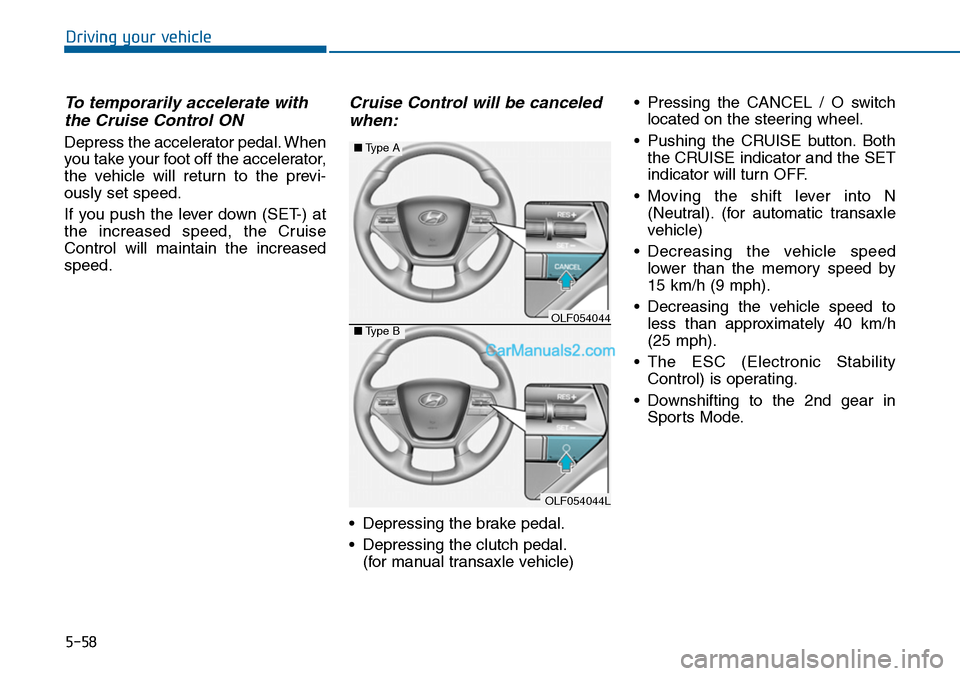
Cruise Control will be canceled
when:
•Depressing the brake pedal.
•Depressing the clutch pedal.
(for manual transaxle vehicle)
•Pressing the CANCEL / O switch
located on the steering wheel.
•Pushing the CRUISE button.Both
the CRUISE indicator and the SET
indicator will turn OFF.
•Moving the shift lever into N
(Neutral). (for automatic transaxle
vehicle)
•Decreasing the vehicle speed
lower than the memory speed by
15 km/h (9 mph).
•Decreasing the vehicle speed to
less than approximately 40 km/h
(25 mph).
•The ESC (Electronic Stability
Control) is operating.
•Downshifting to the 2nd gear in
Sports Mode.
OLF054044L
■Type A
■Type BOLF054044
Page 558 of 665
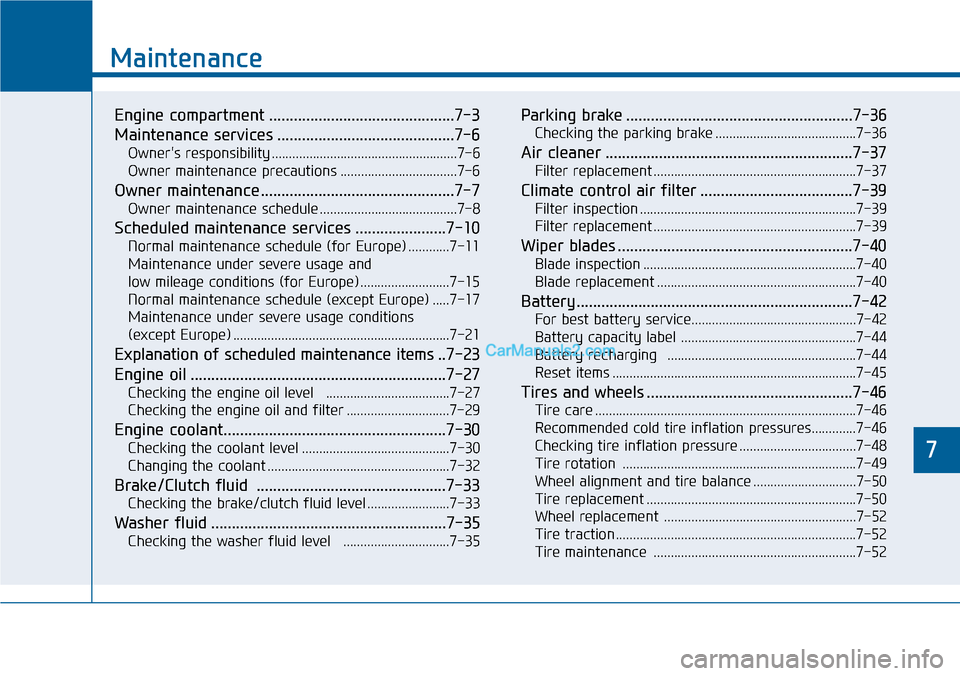
7
Maintenance
7
Maintenance
Engine compartment .............................................7-3
Maintenance services ...........................................7-6
Owner's responsibility ......................................................7-6
Owner maintenance precautions ..................................7-6
Owner maintenance ...............................................7-7
Owner maintenance schedule ........................................7-8
Scheduled maintenance services ......................7-10
Normal maintenance schedule (for Europe) ............7-11
Maintenance under severe usage and
low mileage conditions (for Europe) ..........................7-15
Normal maintenance schedule (except Europe) .....7-17
Maintenance under severe usage conditions
(except Europe) ...............................................................7-21
Explanation of scheduled maintenance items ..7-23
Engine oil ..............................................................7-27
Checking the engine oil level ....................................7-27
Checking the engine oil and filter ..............................7-29
Engine coolant......................................................7-30
Checking the coolant level ...........................................7-30
Changing the coolant .....................................................7-32
Brake/Clutch fluid ..............................................7-33
Checking the brake/clutch fluid level ........................7-33
Washer fluid .........................................................7-35
Checking the washer fluid level ...............................7-35
Parking brake .......................................................7-36
Checking the parking brake .........................................7-36
Air cleaner ............................................................7-37
Filter replacement ...........................................................7-37
Climate control air filter .....................................7-39
Filter inspection ...............................................................7-39
Filter replacement ...........................................................7-39
Wiper blades .........................................................7-40
Blade inspection ..............................................................7-40
Blade replacement ..........................................................7-40
Battery...................................................................7-42
For best battery service................................................7-42
Battery capacity label ...................................................7-44
Battery recharging .......................................................7-44
Reset items .......................................................................7-45
Tires and wheels ..................................................7-46
Tire care ............................................................................7-46
Recommended cold tire inflation pressures.............7-46
Checking tire inflation pressure ..................................7-48
Tire rotation ....................................................................7-49
Wheel alignment and tire balance ..............................7-50
Tire replacement .............................................................7-50
Wheel replacement ........................................................7-52
Tire traction ......................................................................7-52
Tire maintenance ...........................................................7-52
7
Page 560 of 665
7-3
7
Maintenance
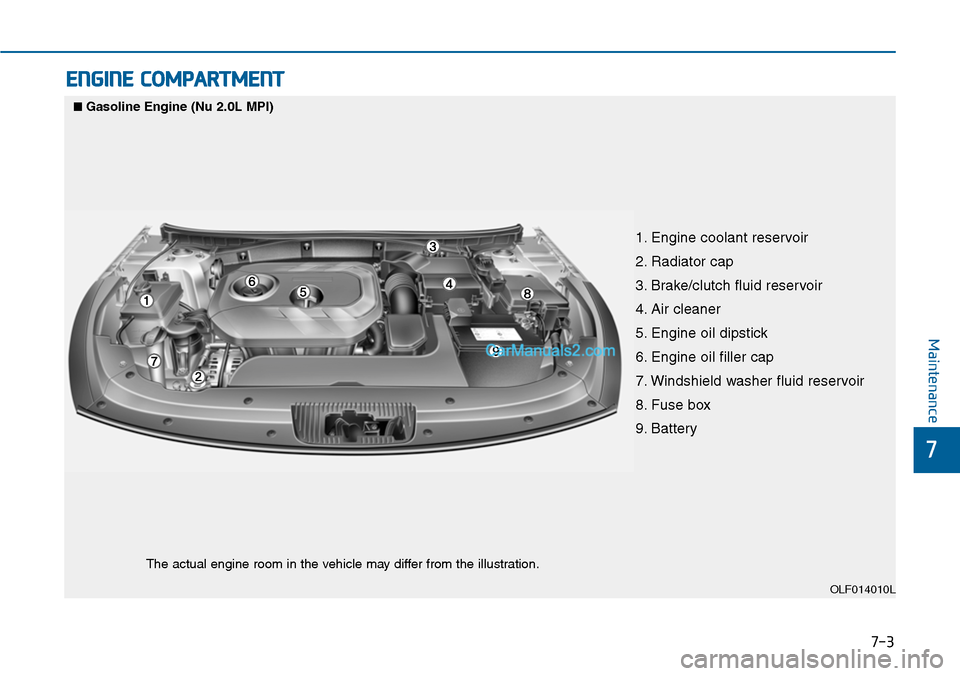
ENGINE COMPARTMENT
1. Engine coolant reservoir
2. Radiator cap
3. Brake/clutch fluid reservoir
4. Air cleaner
5. Engine oil dipstick
6. Engine oil filler cap
7. Windshield washer fluid reservoir
8. Fuse box
9. Battery
OLF014010L
■Gasoline Engine (Nu 2.0L MPI)
The actual engine room in the vehicle may differ from the illustration.
Page 561 of 665
7-4
Maintenance
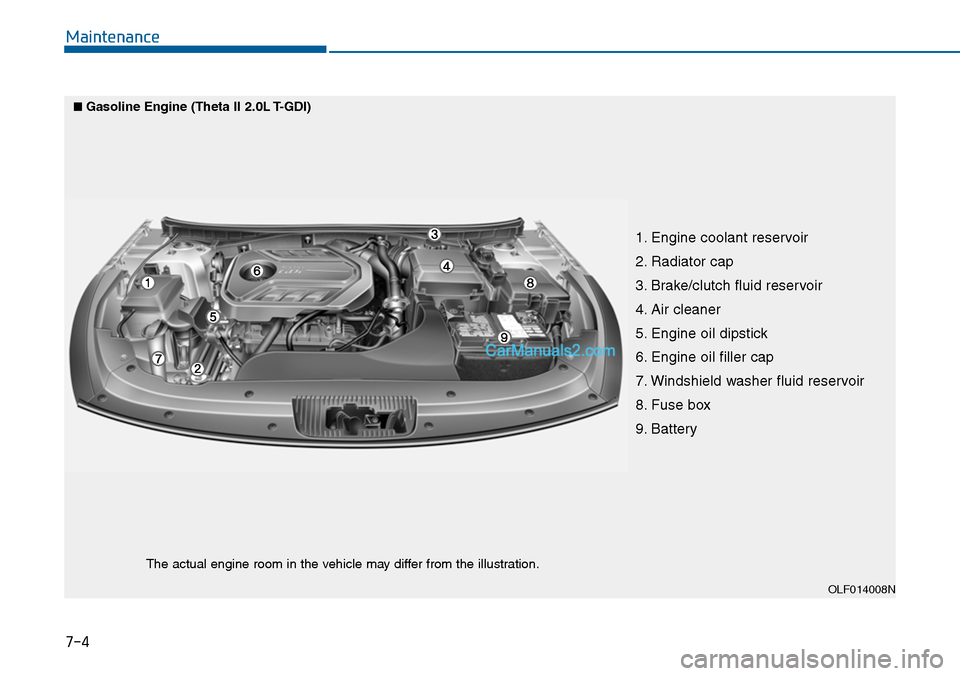
1. Engine coolant reservoir
2. Radiator cap
3. Brake/clutch fluid reservoir
4. Air cleaner
5. Engine oil dipstick
6. Engine oil filler cap
7. Windshield washer fluid reservoir
8. Fuse box
9. Battery
OLF014008N
■Gasoline Engine (Theta II 2.0L T-GDI)
The actual engine room in the vehicle may differ from the illustration.
Page 562 of 665
7-5
7
Maintenance
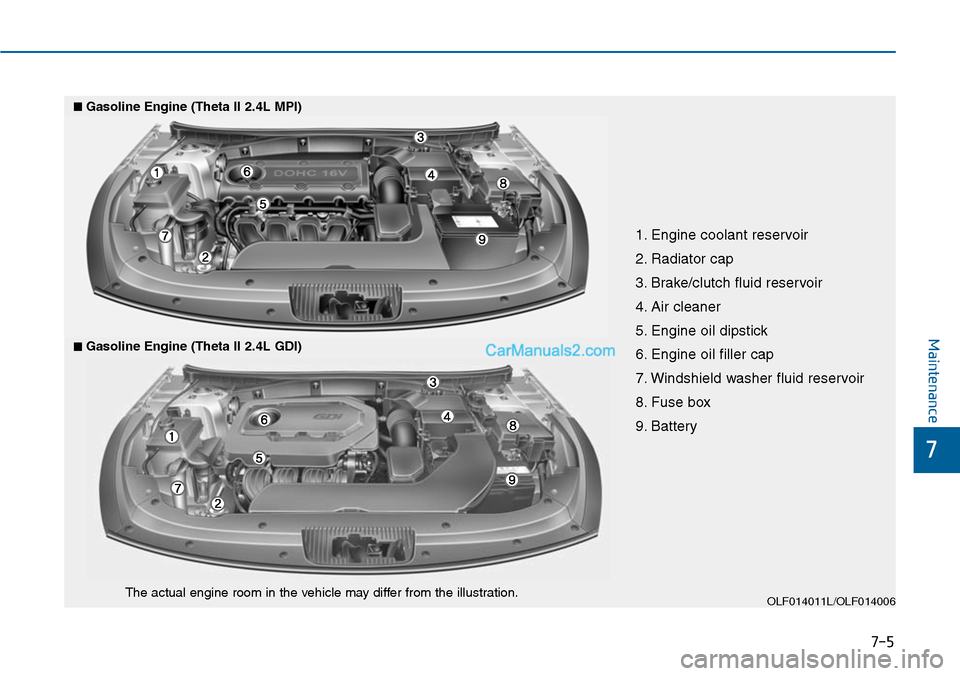
1. Engine coolant reservoir
2. Radiator cap
3. Brake/clutch fluid reservoir
4. Air cleaner
5. Engine oil dipstick
6. Engine oil filler cap
7. Windshield washer fluid reservoir
8. Fuse box
9. Battery
OLF014011L/OLF014006
■Gasoline Engine (Theta II 2.4L MPI)
The actual engine room in the vehicle may differ from the illustration.
■Gasoline Engine (Theta II 2.4L GDI)
Page 570 of 665
7-13
7
Maintenance
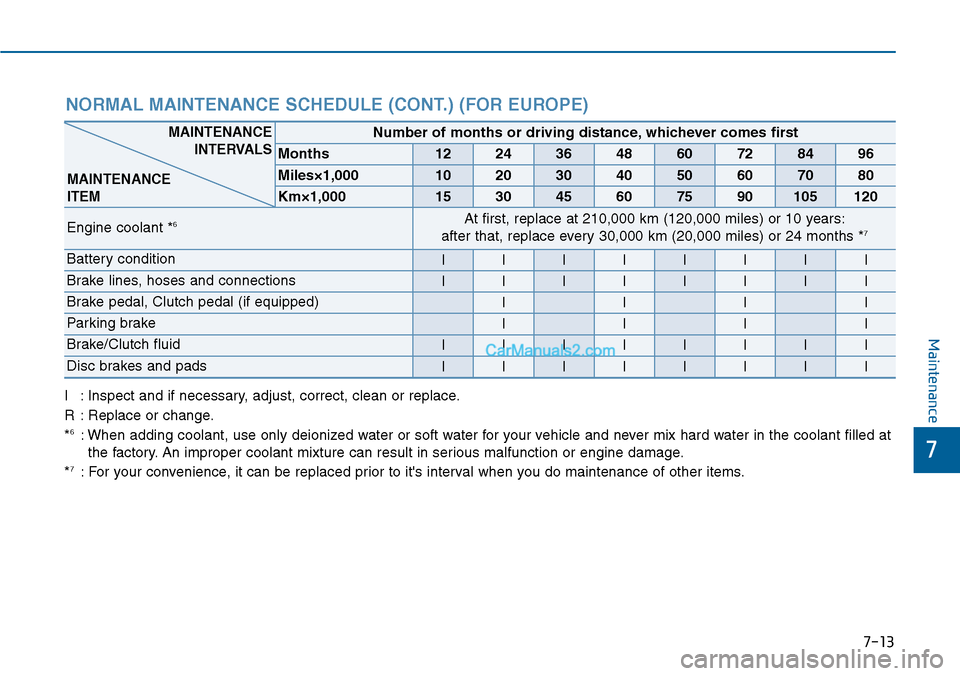
NORMAL MAINTENANCE SCHEDULE (CONT.) (FOR EUROPE)
I:Inspect and if necessary, adjust, correct, clean or replace.
R:Replace or change.
*6:When adding coolant, use only deionized water or soft water for your vehicle and never mix hard water in the coolant filled at
the factory. An improper coolant mixture can result in serious malfunction or engine damage.
*7:For your convenience, it can be replaced prior to it's interval when you do maintenance of other items.
Number of months or driving distance, whichever comes first
Months1224364860728496
Miles×1,0001020304050607080
Km×1,000153045607590105120
Engine coolant *6At first, replace at 210,000 km (120,000 miles) or 10 years:
after that, replace every 30,000 km (20,000 miles) or 24 months *7
Battery conditionIIIIIIII
Brake lines, hoses and connectionsIIIIIIII
Brake pedal, Clutch pedal (if equipped)IIII
Par king brakeIIII
Brake/Clutch fluidIIIIIIII
Disc brakes and padsIIIIIIII
MAINTENANCE
INTERVALS
MAINTENANCE
ITEM
Page 576 of 665
7-19
7
Maintenance
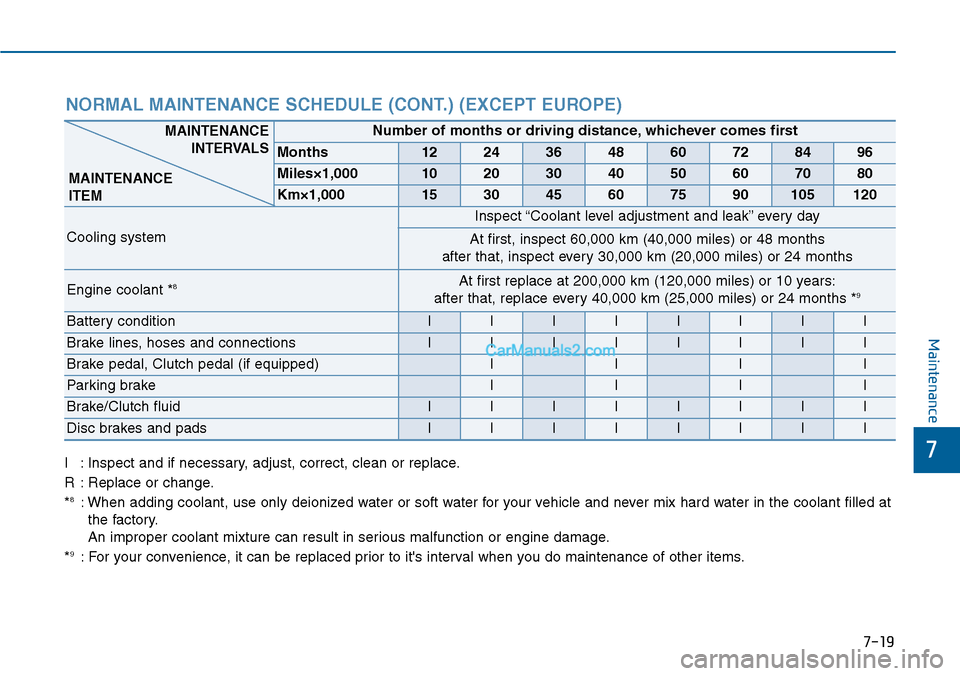
NORMAL MAINTENANCE SCHEDULE (CONT.) (EXCEPT EUROPE)
I:Inspect and if necessary, adjust, correct, clean or replace.
R:Replace or change.
*8:When adding coolant, use only deionized water or soft water for your vehicle and never mix hard water in the coolant filled at
the factory.
An improper coolant mixture can result in serious malfunction or engine damage.
*9:For your convenience, it can be replaced prior to it's interval when you do maintenance of other items.
Number of months or driving distance, whichever comes first
Months1224364860728496
Miles×1,0001020304050607080
Km×1,000153045607590105120
Cooling system
Inspect “Coolant level adjustment and leak” every day
At first, inspect 60,000 km (40,000 miles) or 48 months
after that, inspect every 30,000 km (20,000 miles) or 24 months
Engine coolant *8At first replace at 200,000 km (120,000 miles) or 10 years:
after that, replace every 40,000 km (25,000 miles) or 24 months *9
Battery conditionIIIIIIII
Brake lines, hoses and connectionsIIIIIIII
Brake pedal, Clutch pedal (if equipped)IIII
Par king brakeIIII
Brake/Clutch fluidIIIIIIII
Disc brakes and padsIIIIIIII
MAINTENANCE
INTERVALS
MAINTENANCE
ITEM