maintenance schedule Hyundai Sonata 2014 Owner's Guide
[x] Cancel search | Manufacturer: HYUNDAI, Model Year: 2014, Model line: Sonata, Model: Hyundai Sonata 2014Pages: 665, PDF Size: 17.43 MB
Page 582 of 665
7-25
7
Maintenance
Automatic transaxle fluid
Automatic transaxle fluid should not
be checked under normal usage
conditions.
We recommend that the automatic
transaxle fluid changed by an author-
ized HYUNDAI dealer according to
the maintenance schedule.
Automatic transaxle fluid color is
basically red.
As the vehicle is driven, the auto-
matic transaxle fluid will begin to
look darker.
It is normal condition and you
should not judge the need to
replace the fluid based upon the
changed color.
Manual transaxle fluid
(if equipped)
Inspect the manual transaxle fluid
according to the maintenance sched-
ule.
Brake hoses and lines
Visually check for proper installation,
chafing, cracks, deterioration and
any leakage. Replace any deteriorat-
ed or damaged parts immediately.
Brake fluid
Check brake fluid level in the brake
fluid reservoir. The level should be
between “MIN” and “MAX” marks on
the side of the reservoir. Use only
hydraulic brake fluid confor ming to
DOT 3 or DOT 4 specification.
Parking brake
Inspect the parking brake system
including the parking brake lever (or
pedal) and cables.
NOTICE
The use of a non-specified fluid
could result in transaxle mal-
function and failure.
Use only specified automatic
transaxle fluid. (Refer to
“Recommended lubricants and
capacities” in section 8.)
CAUTION
Page 596 of 665
7-39
7
Maintenance
CLIMATE CONTROL AIR FILTER
Filter inspection
If the vehicle is operated in the
severely air-polluted cities or on
dusty rough roads for a long period,
it should be inspected more fre-
quently and replaced earlier. When
you, the owner, replace the climate
control air filter, replace it performing
the following procedure, and be care-
ful to avoid damaging other compo-
nents.
Replace the filter according to the
Maintenance Schedule.
Install a new climate control air filter
in the correct direction with the
arrow symbol(↓) facing downwards.
Otherwise, the climate control
effects may decrease, possibly
with a noise.
Filter replacement
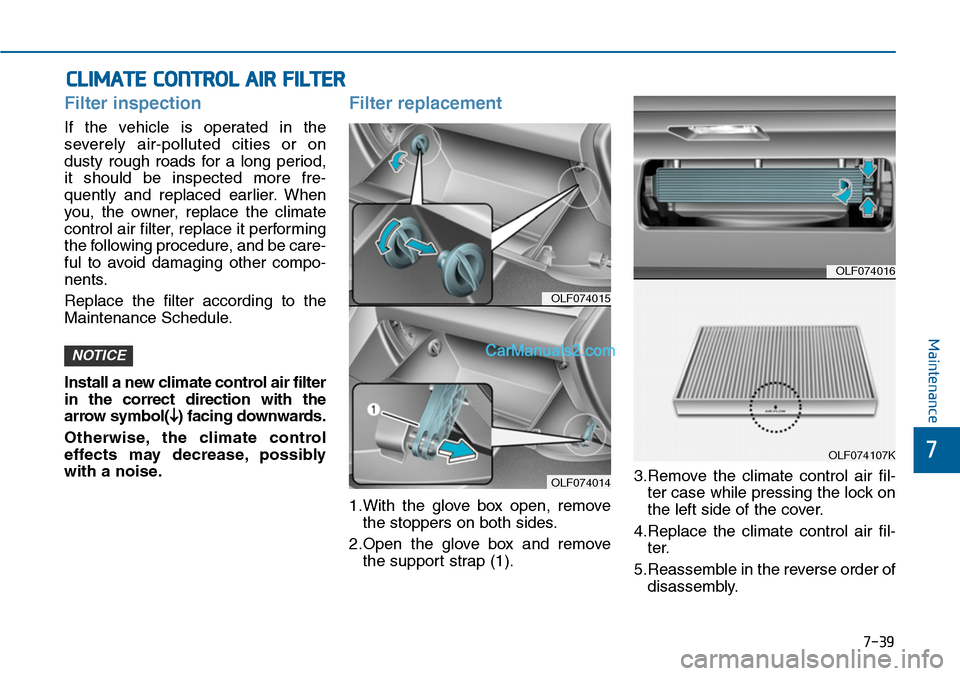
1.With the glove box open, remove
the stoppers on both sides.
2.Open the glove box and remove
the support strap (1).
3.Remove the climate control air fil-
ter case while pressing the lock on
the left side of the cover.
4.Replace the climate control air fil-
ter.
5.Reassemble in the reverse order of
disassembly.
NOTICE
OLF074015
OLF074014
OLF074016
OLF074107K
Page 652 of 665
7-95
7
Maintenance
EMISSION CONTROL SYSTEM
The emission control system of your
vehicle is covered by a written limited
warranty. Please see the warranty
information contained in the Service
Passpor t in your vehicle.
Yo u r v e h i c l e i s e q u i p p e d w i t h a n
emission control system to meet all
emission regulations.
There are three emission control
systems which are as follows.
(1) Crankcase emission control sys-
tem
(2) Evaporative emission control sys-
tem
(3) Exhaust emission control system
In order to assure the proper function
of the emission control systems, it is
recommended that you have your
car inspected and maintained by an
authorized HYUNDAI dealer in
accordance with the maintenance
schedule in this manual.
1. Crankcase emission control
system
The positive crankcase ventilation
system is employed to prevent air
pollution caused by blow-by gases
being emitted from the crankcase.
This system supplies fresh filtered air
to the crankcase through the air
intake hose. Inside the crankcase,
the fresh air mixes with blow-by
gases, which then pass through the
PCV valve into the induction system.
2. Evaporative emission con-
trol system
The Evaporative Emission Control
System is designed to prevent fuel
vapors from escaping into the atmos-
phere.
For the Inspection and
Maintenance Test (With Electronic
Stability Control (ESC) system)
•To prevent the vehicle from
misfiring during dynamome-
ter testing, turn the Electronic
Stability Control (ESC) sys-
tem off by pressing the ESC
switch.
•After dynamometer testing is
completed, turn the ESC sys-
tem back on by pressing the
ESC switch again.
CAUTION