1.6 Hyundai Sonata 2018 Owner's Guide
[x] Cancel search | Manufacturer: HYUNDAI, Model Year: 2018, Model line: Sonata, Model: Hyundai Sonata 2018Pages: 522, PDF Size: 14.52 MB
Page 508 of 522
8-9
88
Specifications, Consumer information and Reporting safety defects
Recommended SAE viscosity
number
Engine oil viscosity (thickness) has
an effect on fuel economy and cold
weather operating (engine start and
engine oil flowability). Lower viscosi-
ty engine oils can provide better fuel
economy and cold weather perform-
ance, however, higher viscosity
engine oils are required for satisfac-
tory lubrication in hot weather. Using
oils of any viscosity other than those
recommended could result in engine
damage.Always be sure to clean the area
around any filler plug, drain
plug, or dipstick before check-
ing or draining any lubricant.
This is especially important in
dusty or sandy areas and when
the vehicle is used on unpaved
roads. Cleaning the plug and
dipstick areas will prevent dirt
and grit from entering the
engine and other mechanisms
that could be damaged.
CAUTION
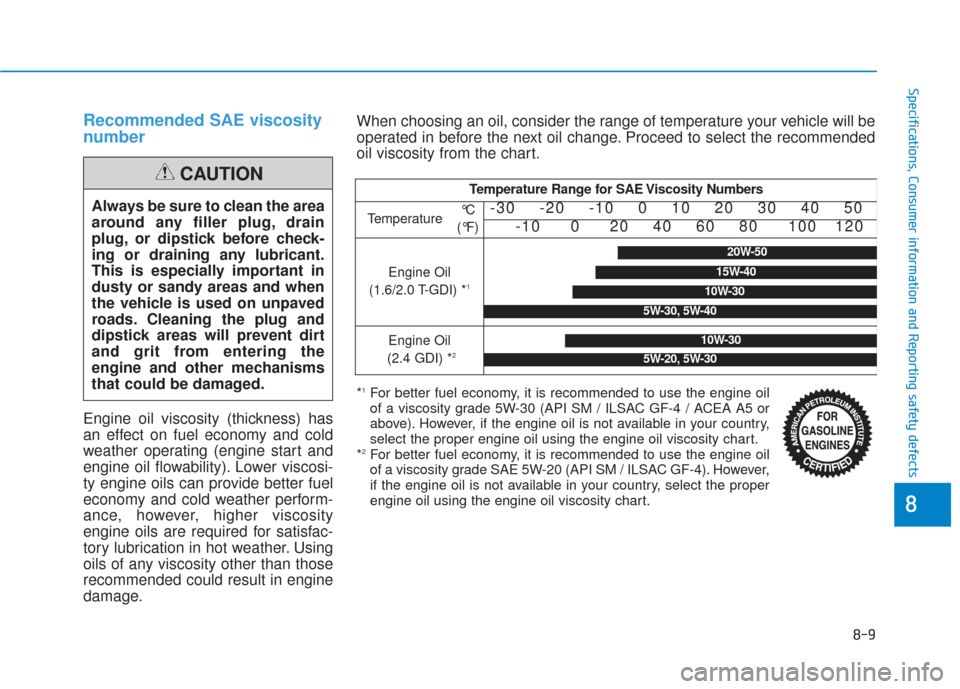
When choosing an oil, consider the range of temperature your vehicle will be
operated in before the next oil change. Proceed to select the recommended
oil viscosity from the chart.
Temperature Range for SAE Viscosity Numbers
Temperature -30 -20 -10 0 10 20 30 40 50
-10 0 20 40 60 80 100 120
Engine Oil
(1.6/2.0 T-GDI) *1
Engine Oil
(2.4 GDI) *210W-30
5W-20, 5W-30
°C
(°F)
5W-30, 5W-40
10W-30
15W-40
20W-50
*1For better fuel economy, it is recommended to use the engine oil
of a viscosity grade 5W-30 (API SM / ILSAC GF-4 / ACEA A5 or
above). However, if the engine oil is not available in your country,
select the proper engine oil using the engine oil viscosity chart.
*
2For better fuel economy, it is recommended to use the engine oil
of a viscosity grade SAE 5W-20 (API SM / ILSAC GF-4). However,
if the engine oil is not available in your country, select the proper
engine oil using the engine oil viscosity chart.
Page 510 of 522
8-11
88
Specifications, Consumer information and Reporting safety defects
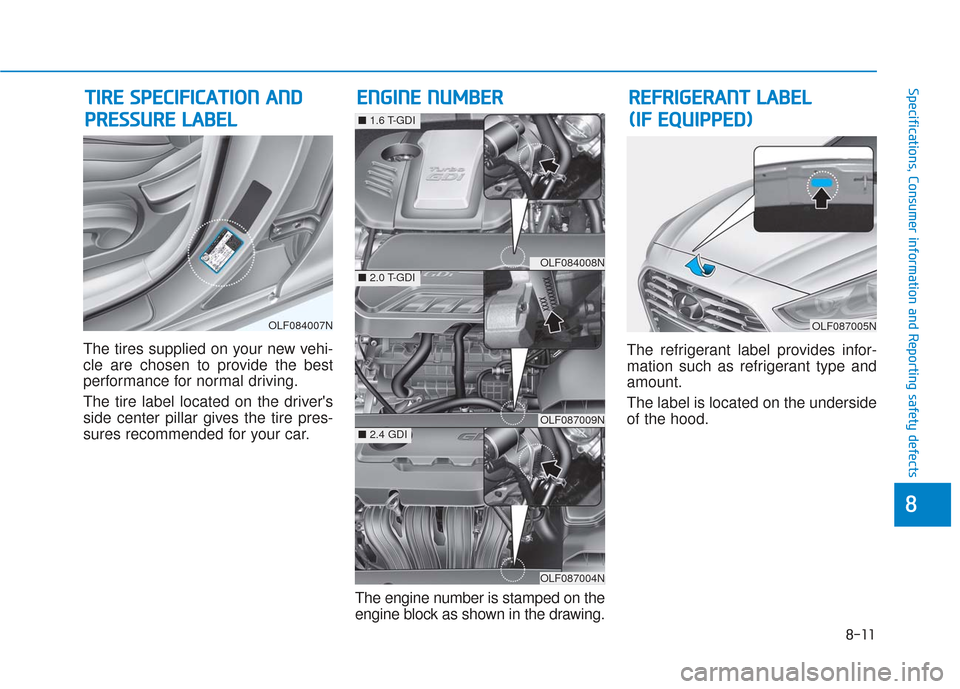
The tires supplied on your new vehi-
cle are chosen to provide the best
performance for normal driving.
The tire label located on the driver's
side center pillar gives the tire pres-
sures recommended for your car.The engine number is stamped on the
engine block as shown in the drawing.The refrigerant label provides infor-
mation such as refrigerant type and
amount.
The label is located on the underside
of the hood.
E E
N
N G
GI
IN
N E
E
N
N U
U M
M B
BE
ER
R R
RE
EF
FR
R I
IG
G E
ER
R A
A N
N T
T
L
L A
A B
BE
EL
L
(
( I
IF
F
E
E Q
Q U
UI
IP
P P
PE
ED
D )
)
T
T
I
IR
R E
E
S
S P
P E
EC
CI
IF
F I
IC
C A
A T
TI
IO
O N
N
A
A N
N D
D
P
P R
R E
ES
SS
SU
U R
RE
E
L
L A
A B
BE
EL
L
OLF084007NOLF087005N
OLF084008N
OLF087009N
OLF087004N
■ 1.6 T-GDI
■2.4 GDI
■2.0 T-GDI
Page 519 of 522
I-7
Owner Maintenance ..........................................................7-7Owner Maintenance Schedule......................................7-8
Parking Brake .................................................................7-30 Checking the Parking Brake ......................................7-30
Recommended Lubricants and Capacities ........................8-7 Recommended SAE Viscosity Number .......................8-9
Refrigerant Label ............................................................8-11
Reporting Safety Defects ................................................8-13 Scheduled Maintenance Services .....................................7-9
Maintenance Under Severe Usage Conditions (Gamma 1.6 T-GDI/Theta 2.0 T-GDI) ....................7-13
Maintenance Under Severe Usage Conditions (Theta 2.4 GDI).......................................................7-18
Normal Maintenance Schedule (Gamma 1.6 T-GDI/Theta 2.0 T-GDI) ....................7-10
Normal Maintenance Schedule (Theta 2.4 GDI) .......7-15
Seat Belts ........................................................................\
2-22 Additional Seat Belt Safety Precautions ....................2-30
Care of Seat Belts .......................................................2-33
Seat Belt Restraint System .........................................2-24
Seat Belt Safety Precautions ......................................2-22
Seat Belt Warning Light .............................................2-23
Seats ........................................................................\
..........2-4 Front Seats ....................................................................2-6
Head Restraints ..........................................................2-15
Rear Seats ...................................................................2-12
Safety Precautions ........................................................2-5
Seat Warmers and Air Ventilation Seats.....................2-19
I
Index
O
P
S
R