engine oil Hyundai Sonata 2018 Owner's Guide
[x] Cancel search | Manufacturer: HYUNDAI, Model Year: 2018, Model line: Sonata, Model: Hyundai Sonata 2018Pages: 522, PDF Size: 14.52 MB
Page 477 of 522
![Hyundai Sonata 2018 Owners Guide 7-67
7
Maintenance
Engine compartment main fuse panel - PCB Block
Fuse Name Fuse rating Protected Component
FUSE
2 VACUUM PUMP10A[G4KH/G4FJ] Vacuum Pump, Vacuum Switch
3 ECU10APCM/ECM
1 POWER OUTLET20](/img/35/16776/w960_16776-476.png "Hyundai Sonata 2018 Owners Guide 7-67
7
Maintenance
Engine compartment main fuse panel - PCB Block
Fuse Name Fuse rating Protected Component
FUSE
2 VACUUM PUMP10A[G4KH/G4FJ] Vacuum Pump, Vacuum Switch
3 ECU10APCM/ECM
1 POWER OUTLET20")
7-67
7
Maintenance
Engine compartment main fuse panel - PCB Block
Fuse Name Fuse rating Protected Component
FUSE
2 VACUUM PUMP10A[G4KH/G4FJ] Vacuum Pump, Vacuum Switch
3 ECU10APCM/ECM
1 POWER OUTLET20AFront Cigarette Lighter & Power Outlet #2
FUEL PUMP20AFuel Pump Relay
HORN20AHorn Relay, ICM Relay Box (Burglar Alarm Horn Relay)
WIPER30AFront Wiper (Low) Relay, Front Wiper (High) Relay
2 TCU15ATransmission Range Switch, TCM (G4FJ-DCT)
3 ABS10AESC Module
2 POWER OUTLET20ARear Power Outlet
B/UP LAMP10ATransmission Range Switch, PCM (G4KJ/G4KH-A/T), TCM (G4FJ-DCT),
Electro Chromic Mirror, Rear Combination Lamp (IN) LH/RH
1 SENSOR15AOxygen Sensor (Up/Down)
2 SENSOR15A
Purge Control Solenoid Valve, Canister Close Valve, RCV Control Solenoid Valve,
Fuel Pump Relay, E/R Junction Block (Cooling Fan High Relay, Fuel Pump Relay),
[G4KJ/G4KH] Variable Intake Solenoid Valve, Oil Control Valve (Exhaust),
[G4FJ] Oil Control Valve #1/#2 (Intake/Exhaust)
1 ECU10APCM/ECM
1 TCU10APCM (G4KJ/G4KH-A/T), TCM (G4FJ-DCT)
1 ECU10APCM/ECM
IGN COIL20AIgnition Coil #1/#2/#3/#4
INJECTOR15ANot Used
AMS10ABattery Sensor
Page 488 of 522
7-78
Maintenance
Waxing
A good coat of wax is a barrier
between your paint and contaminate.
Keeping a good coat of wax on your
vehicle will help protect it.
Wax the vehicle when water will no
longer bead on the paint.
Always wash and dry the vehicle
before waxing. Use a good quality
liquid or paste wax, and follow the
manufacturer’s instructions. Wax all
metal trim to protect it and to main-
tain its luster.
Removing oil, tar, and similar materi-
als with a spot remover will usually
strip the wax from the finish. Be sure
to re-wax these areas even if the rest
of the vehicle does not yet need wax-
ing.
OLMB073082
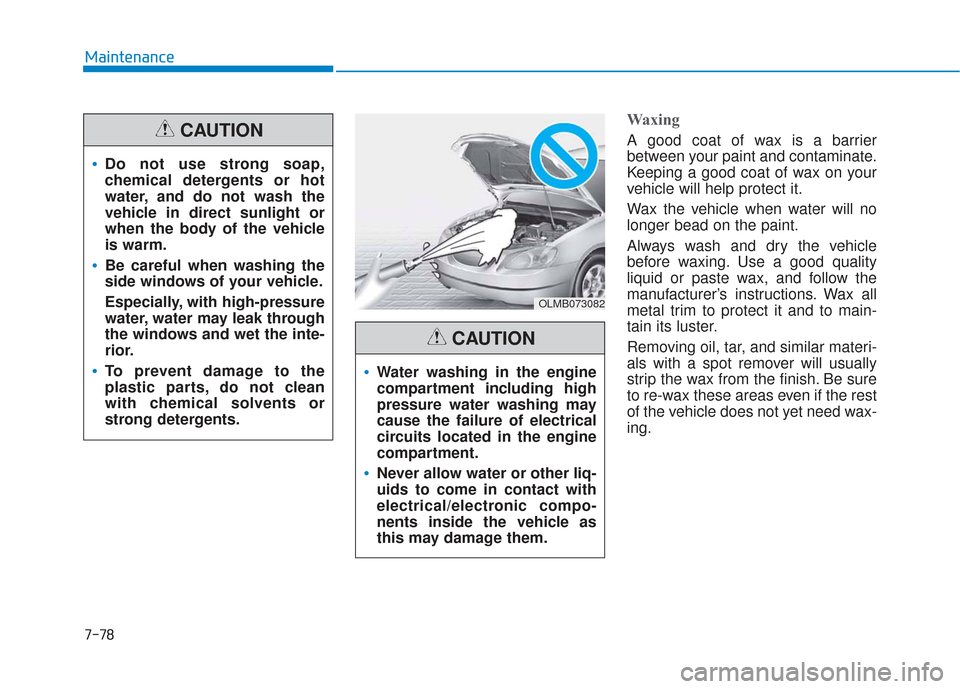
Water washing in the engine
compartment including high
pressure water washing may
cause the failure of electrical
circuits located in the engine
compartment.
Never allow water or other liq-
uids to come in contact with
electrical/electronic compo-
nents inside the vehicle as
this may damage them.
CAUTION
Do not use strong soap,
chemical detergents or hot
water, and do not wash the
vehicle in direct sunlight or
when the body of the vehicle
is warm.
Be careful when washing the
side windows of your vehicle.
Especially, with high-pressure
water, water may leak through
the windows and wet the inte-
rior.
To prevent damage to the
plastic parts, do not clean
with chemical solvents or
strong detergents.
CAUTION
Page 506 of 522
8-7
88
Specifications, Consumer information and Reporting safety defects
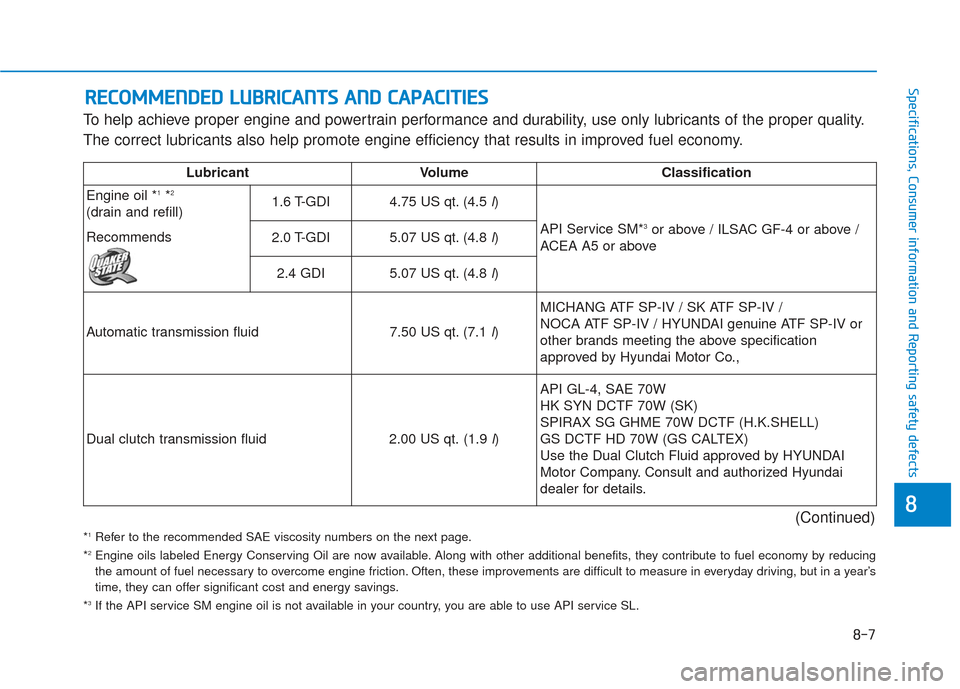
To help achieve proper engine and powertrain performance and durability, use only lubricants of the proper quality.
The correct lubricants also help promote engine efficiency that results in improved fuel economy.
R RE
EC
CO
O M
M M
ME
EN
N D
DE
ED
D
L
L U
U B
BR
RI
IC
C A
A N
N T
TS
S
A
A N
N D
D
C
C A
A P
PA
A C
CI
IT
T I
IE
E S
S
*1Refer to the recommended SAE viscosity numbers on the next page.
*2Engine oils labeled Energy Conserving Oil are now available. Along with other additional benefits, they contribute to fuel econo my by reducing
the amount of fuel necessary to overcome engine friction. Often, these improvements are difficult to measure in everyday driving, but in a year’s
time, they can offer significant cost and energy savings.
*
3If the API service SM engine oil is not available in your country, you are able to use API service SL.
LubricantVolume Classification
Engine oil *
1*2
(drain and refill)
Recommends 1.6 T-GDI4.75 US qt. (4.5l)
API Service SM*
3or above / ILSAC GF-4 or above /
ACEA A5 or above
2.0 T-GDI5.07 US qt. (4.8l)
2.4 GDI5.07 US qt. (4.8l)
Automatic transmission fluid
7.50 US qt. (7.1l) MICHANG ATF SP-IV / SK ATF SP-IV /
NOCA ATF SP-IV / HYUNDAI genuine ATF SP-IV or
other brands meeting the above specification
approved by Hyundai Motor Co.,
Dual clutch transmission fluid
2.00 US qt. (1.9l) API GL-4, SAE 70W
HK SYN DCTF 70W (SK)
SPIRAX SG GHME 70W DCTF (H.K.SHELL)
GS DCTF HD 70W (GS CALTEX)
Use the Dual Clutch Fluid approved by HYUNDAI
Motor Company. Consult and authorized Hyundai
dealer for details.
(Continued)
Page 508 of 522
8-9
88
Specifications, Consumer information and Reporting safety defects
Recommended SAE viscosity
number
Engine oil viscosity (thickness) has
an effect on fuel economy and cold
weather operating (engine start and
engine oil flowability). Lower viscosi-
ty engine oils can provide better fuel
economy and cold weather perform-
ance, however, higher viscosity
engine oils are required for satisfac-
tory lubrication in hot weather. Using
oils of any viscosity other than those
recommended could result in engine
damage.Always be sure to clean the area
around any filler plug, drain
plug, or dipstick before check-
ing or draining any lubricant.
This is especially important in
dusty or sandy areas and when
the vehicle is used on unpaved
roads. Cleaning the plug and
dipstick areas will prevent dirt
and grit from entering the
engine and other mechanisms
that could be damaged.
CAUTION
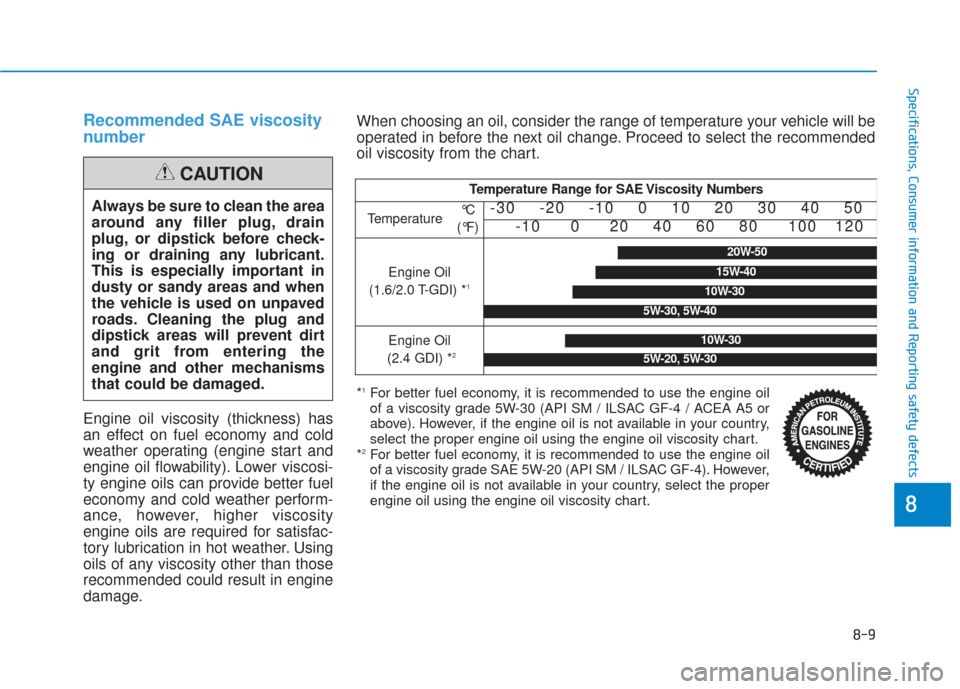
When choosing an oil, consider the range of temperature your vehicle will be
operated in before the next oil change. Proceed to select the recommended
oil viscosity from the chart.
Temperature Range for SAE Viscosity Numbers
Temperature -30 -20 -10 0 10 20 30 40 50
-10 0 20 40 60 80 100 120
Engine Oil
(1.6/2.0 T-GDI) *1
Engine Oil
(2.4 GDI) *210W-30
5W-20, 5W-30
°C
(°F)
5W-30, 5W-40
10W-30
15W-40
20W-50
*1For better fuel economy, it is recommended to use the engine oil
of a viscosity grade 5W-30 (API SM / ILSAC GF-4 / ACEA A5 or
above). However, if the engine oil is not available in your country,
select the proper engine oil using the engine oil viscosity chart.
*
2For better fuel economy, it is recommended to use the engine oil
of a viscosity grade SAE 5W-20 (API SM / ILSAC GF-4). However,
if the engine oil is not available in your country, select the proper
engine oil using the engine oil viscosity chart.
Page 516 of 522
I-4
Emission Control System ...............................................7-85Crankcase Emission Control System .........................7-85
\Evaporative Emission Control System Including
Onboard Refueling Vapor Recovery (ORVR) .............7-85
Exhaust Emission Control System .............................7-86
Engine ........................................................................\
.......8-2
Engine compartment..................................................1-6, 7-3
Engine Coolant ...............................................................7-26 Changing Engine Coolant ..........................................7-28
Checking the Engine Coolant Level ..........................7-26
Engine Number ...............................................................8-11
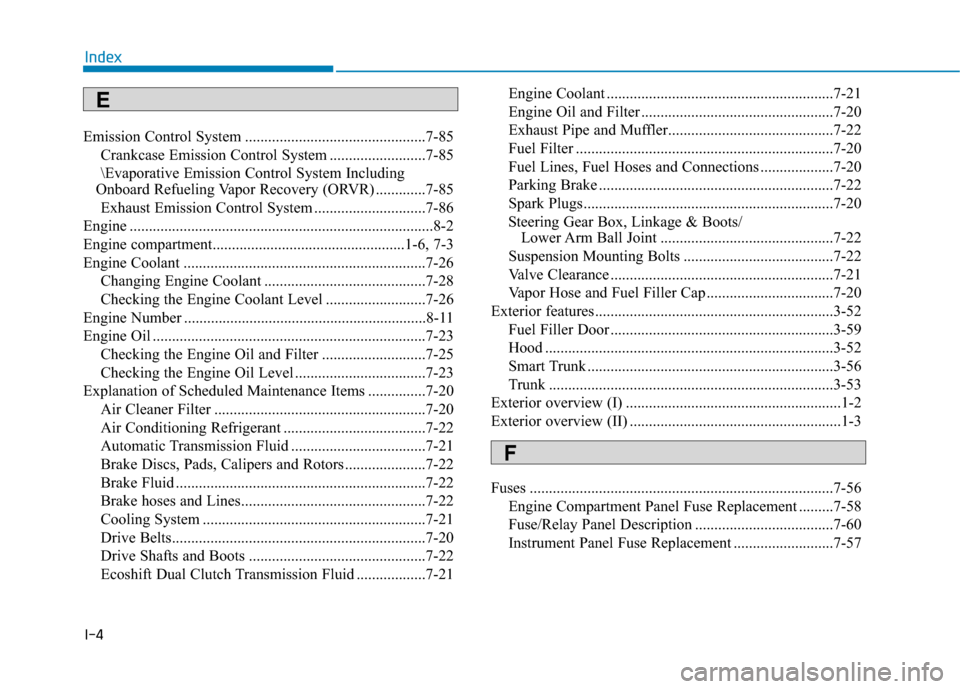
Engine Oil .......................................................................7\
-23 Checking the Engine Oil and Filter ...........................7-25
Checking the Engine Oil Level ..................................7-23
Explanation of Scheduled Maintenance Items ...............7-20 Air Cleaner Filter .......................................................7-20
Air Conditioning Refrigerant .....................................7-22
Automatic Transmission Fluid ...................................7-21
Brake Discs, Pads, Calipers and Rotors .....................7-22
Brake Fluid .................................................................7-22
Brake hoses and Lines................................................7-22
Cooling System ..........................................................7-21
Drive Belts..................................................................7-20
Drive Shafts and Boots ..............................................7-22
Ecoshift Dual Clutch Transmission Fluid ..................7-21 Engine Coolant ...........................................................7-21
Engine Oil and Filter ..................................................7-20
Exhaust Pipe and Muffler...........................................7-22
Fuel Filter ...................................................................7-20
Fuel Lines, Fuel Hoses and Connections ...................7-20
Parking Brake .............................................................7-22
Spark Plugs.................................................................7-20
Steering Gear Box, Linkage & Boots/ Lower Arm Ball Joint .............................................7-22
Suspension Mounting Bolts .......................................7-22
Valve Clearance ..........................................................7-21
Vapor Hose and Fuel Filler Cap .................................7-20
Exterior features..............................................................3-52 Fuel Filler Door ..........................................................3-59
Hood ........................................................................\
...3-52
Smart Trunk ................................................................3-56
Trunk ........................................................................\
..3-53
Exterior overview (I) ........................................................1-2
Exterior overview (II) .......................................................1-3
Fuses ........................................................................\
.......7-56 Engine Compartment Panel Fuse Replacement .........7-58
Fuse/Relay Panel Description ....................................7-60
Instrument Panel Fuse Replacement ..........................7-57
Index
E
F