Mount Hyundai Sonata 2018 Owner's Guide
[x] Cancel search | Manufacturer: HYUNDAI, Model Year: 2018, Model line: Sonata, Model: Hyundai Sonata 2018Pages: 522, PDF Size: 14.52 MB
Page 460 of 522
7-50
Maintenance
Tire Terminology and
Definitions
Air Pressure
The amount of air inside the tire
pressing outward on the tire. Air
pressure is expressed in pounds per
square inch (psi) or kilopascal (kPa).
Accessory Weight
This means the combined weight of
optional accessories. Some exam-
ples of optional accessories are
automatic transmission, power
seats, and air conditioning.
Aspect Ratio
The relationship of a tire’s height to
its width.
Belt
A rubber coated layer of cords that is
located between the plies and the
tread. Cords may be made from steel
or other reinforcing materials.
Bead
The tire bead contains steel wires
wrapped by steel cords that hold the
tire onto the rim.
Bias Ply Tire
A pneumatic tire in which the plies
are laid at alternate angles less than
90 degrees to the centerline of the
tread.
Cold Tire Pressure
The amount of air pressure in a tire,
measured in pounds per square inch
(psi) or kilopascals (kPa) before a tire
has built up heat from driving.
Curb Weight
This means the weight of a motor
vehicle with standard and optional
equipment including the maximum
capacity of fuel, oil and coolant, but
without passengers and cargo.
DOT Markings
A code molded into the sidewall of a
tire signifying that the tire is in com-
pliance with the U.S. Department of
Transportation motor vehicle safety
standards. The DOT code includes
the Tire Identification Number (TIN),
an alphanumeric designator which
can also identify the tire manufactur-
er, production plant, brand and date
of production.
Page 461 of 522
7-51
7
Maintenance
GVWR
Gross Vehicle Weight Rating
GAWR FRT
Gross Axle Weight Rating for the
Front Axle.
GAWR RR
Gross Axle Weight Rating for the
Rear axle.
Intended Outboard Sidewall
The side of an asymmetrical tire, that
must always face outward when
mounted on a vehicle.
Kilopascal (kPa)
The metric unit for air pressure.
Light truck(LT) tire
A tire designated by its manufacturer
as primarily intended for use on light-
weight trucks or multipurpose pas-
senger vehicles.
Load ratings
The maximum load that a tire is rated
to carry for a given inflation pressure.
Load Index
An assigned number ranging from 1
to 279 that corresponds to the load
carrying capacity of a tire.
Maximum Inflation Pressure
The maximum air pressure to which
a cold tire may be inflated. The max-
imum air pressure is molded onto the
sidewall.
Maximum Load Rating
The load rating for a tire at the maxi-
mum permissible inflation pressure
for that tire.
Maximum Loaded VehicleWeight
The sum of curb weight; accessory
weight; vehicle capacity weight; and
production options weight.
Normal Occupant Weight
The number of occupants a vehicle
is designed to seat multiplied by 150
pounds (68 kg).
Occupant Distribution
Designated seating positions.
Outward Facing Sidewall
An asymmetrical tire has a particular
side that faces outward when mount-
ed on a vehicle. The outward facing
sidewall bears white lettering or
bears manufacturer, brand, and/or
model name molding that is higher or
deeper than the same moldings on
the inner facing sidewall.
Passenger (P-Metric) tire
A tire used on passenger cars and
some light duty trucks and multipur-
pose vehicles.
Ply
A layer of rubber-coated parallel
cords
Page 462 of 522
7-52
Maintenance
Pneumatic tire
A mechanical device made of rubber,
chemicals, fabric and steel or other
materials, that, when mounted on an
automotive wheel provides the trac-
tion and contains the gas or fluid that
sustains the load.
Pneumatic options weight
The combined weight of installed
regular production options weighing
over 5lb. (2.3kg) in excess of the
standard items which they replace,
not previously considered in curb
weight or accessory weight, includ-
ing heavy duty breaks, ride levelers,
roof rack, heavy duty battery, and
special trim.
Recommended InflationPressure
Vehicle manufacturer’s recommend-
ed tire inflation pressure as shown
on the tire placard.
Radial Ply Tire
A pneumatic tire in which the ply
cords that extend to the beads are
laid at 90 degrees to the centerline of
the tread.
Rim
A metal support for a tire and upon
which the tire beads are seated.
Sidewall
The portion of a tire between the
tread and the bead.
Speed Rating
An alphanumeric code assigned to a
tire indicating the maximum speed at
which a tire can operate.
Traction
The friction between the tire and the
road surface. The amount of grip pro-
vided.
Tread
The portion of a tire that comes into
contact with the road.
Treadwear Indicators
Narrow bands, sometimes called
"wear bars", that show across the
tread of a tire when only 1/16 inch of
tread remains.
UTQGS
Uniform Tire Quality Grading
Standards is a tire information sys-
tem that provides consumers with
ratings for a tire’s traction, tempera-
ture and treadwear. Ratings are
determined by tire manufacturers
using government testing proce-
dures. The ratings are molded into
the sidewall of the tire.
Vehicle Capacity Weight
The number of designated seating
positions multiplied by 150 lbs. (68
kg) plus the rated cargo and luggage
load.
Page 484 of 522
7-74
Maintenance
Backup lamp and Tail lamp
1. Open the trunk.
2. Loosen the retaining screw of thetrunk lid cover and then remove
the cover.
3. Disconnect the connector and then remove the screws by turning
the screws counterclockwise. 4. Remove the bulb by pulling it
straight out.
5. Insert a new bulb by inserting it into the socket and rotating it until
it locks into place.
6. Install the socket into the assem- bly by aligning the tabs on the
socket with the slots in the assem-
bly. Push the socket into the
assembly and turn the socket
clockwise.
7. Reinstall the trunk lid cover by pushing in the screw.
High Mounted Stop Lamp
1. Remove the rear seat cushionassembly.
2. Remove the rear seat back assembly.
3. Slightly remove the rear door weather-strip.
4. Remove the rear door scuff trim.
5. Remove the rear pillar trim.
6. Remove the rear seat belt lower anchor.
OLF077065OLF077064N
OLF077055
Page 485 of 522
7-75
7
Maintenance
7. Remove the rear package traytrim.
8. Remove the high mounted stop lamp after disengaging the mount-
ing clip.
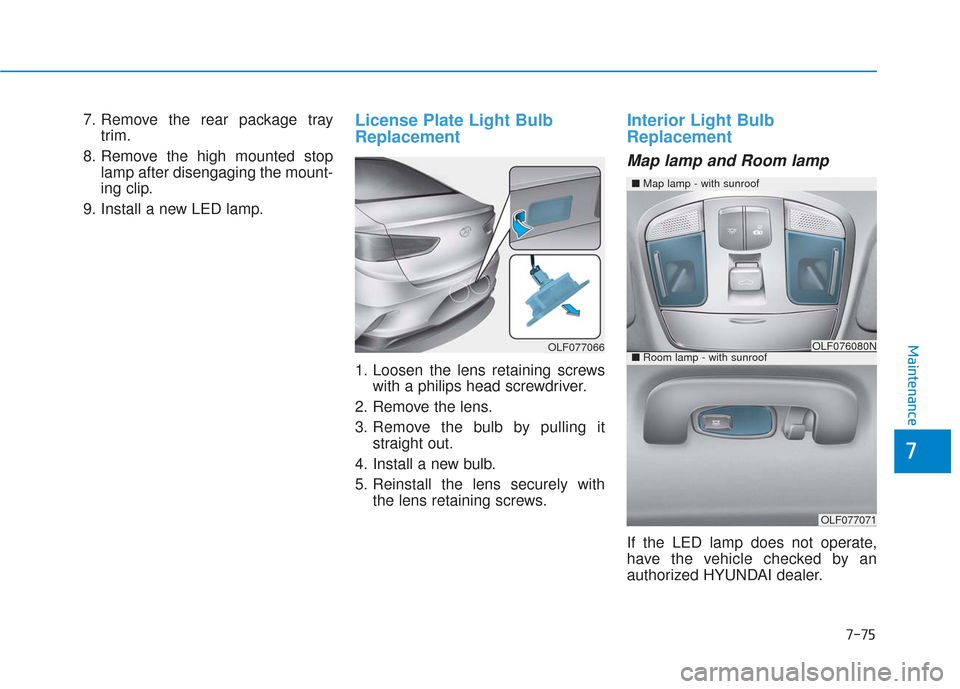
9. Install a new LED lamp.License Plate Light Bulb
Replacement
1. Loosen the lens retaining screws with a philips head screwdriver.
2. Remove the lens.
3. Remove the bulb by pulling it straight out.
4. Install a new bulb.
5. Reinstall the lens securely with the lens retaining screws.
Interior Light Bulb
Replacement
Map lamp and Room lamp
If the LED lamp does not operate,
have the vehicle checked by an
authorized HYUNDAI dealer.
■Map lamp - with sunroof
OLF076080N
OLF077071
■Room lamp - with sunroofOLF077066
Page 494 of 522
7-84
Maintenance
Caring for the leather seats - Vacuum the seat periodically toremove dust and sand on the
seat. It will prevent abrasion or
damage of the leather and main-
tain its quality.
- Wipe the natural leather seat cover often with dry or soft cloth.
- Use of proper leather protective may prevent abrasion of the
cover and helps maintain the
color. Be sure to read the instruc-
tions and consult a specialist
when using leather coating or
protective agents.
- Light colored (beige, cream beige) leather is easily contami-
nated and the stain is noticeable.
Clean the seats frequently.
- Avoid wiping with wet cloth. It may cause the surface to crack. Cleaning the leather seats
- Remove all contaminationsinstantly. Refer to instructions
below for removal of each con-
taminant.
- Cosmetic products (sunscreen, foundation, etc.)
Apply cleansing cream on a cloth
and wipe the contaminated spot.
Wipe off the cream with a wet
cloth and remove water with a dry
cloth.
- Beverages(coffee, soft drink, etc.) Apply a small amount of neutral
detergent and wipe until contami-
nations do not smear.
- Oil Remove oil instantly with
absorbable cloth and wipe with
stain remover used only for natu-
ral leather.
- Chewing gum Harden the gum with ice and
remove gradually.
Cleaning the seat belt webbing
Clean the belt webbing with any mild
soap solution recommended for
cleaning upholstery or carpet. Follow
the instructions provided with the
soap. Do not bleach or re-dye the
webbing because this may weaken
the seat belt.
Cleaning the interior windowglass
If the interior glass surfaces of the
vehicle become fogged (that is, cov-
ered with an oily, greasy or waxy
film), they should be cleaned with
glass cleaner. Follow the directions
on the glass cleaner container.
Do not scrape or scratch the
inside of the rear window. This
may result in damage to the rear
window defroster grid.
CAUTION
Page 502 of 522
B
BU
U L
LB
B
W
W A
AT
TT
TA
A G
G E
E
88
Specifications, Consumer information and Reporting safety defects
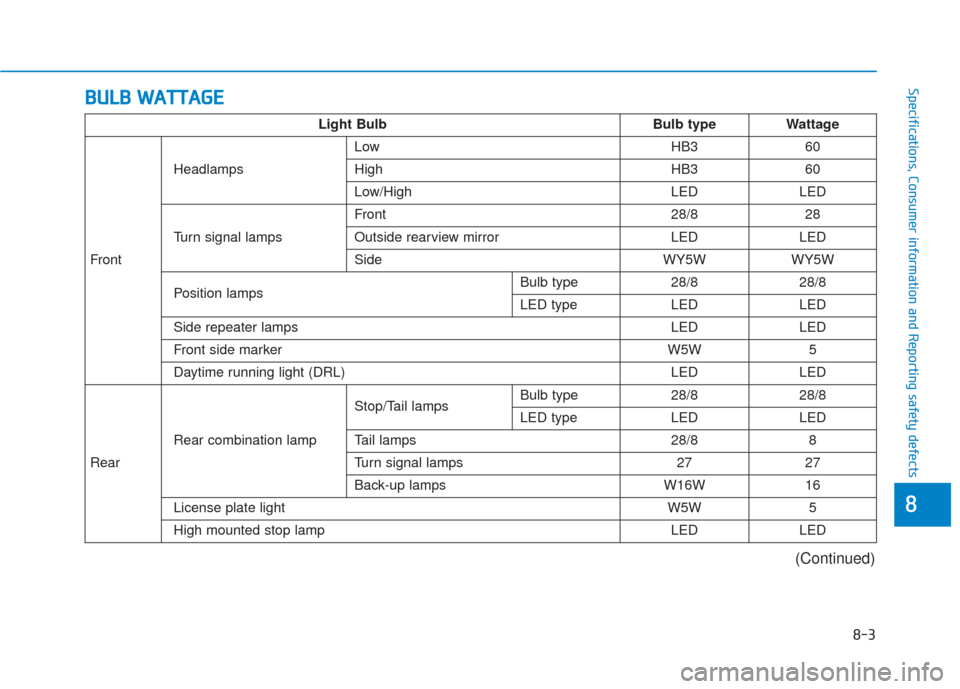
Light BulbBulb typeWattage
Front
Headlamps
Low HB360
HighHB360
Low/HighLEDLED
Turn signal lamps
Front28/828
Outside rearview mirrorLEDLED
SideWY5WWY5W
Position lampsBulb type28/828/8
LED typeLEDLED
Side repeater lampsLEDLED
Front side markerW5W5
Daytime running light (DRL)LEDLED
Rear
Rear combination lamp
Stop/Tail lampsBulb type28/828/8
LED typeLEDLED
Tail lamps28/88
Turn signal lamps2727
Back-up lampsW16W16
License plate lightW5W5
High mounted stop lampLEDLED
8-3
(Continued)
Page 506 of 522
8-7
88
Specifications, Consumer information and Reporting safety defects
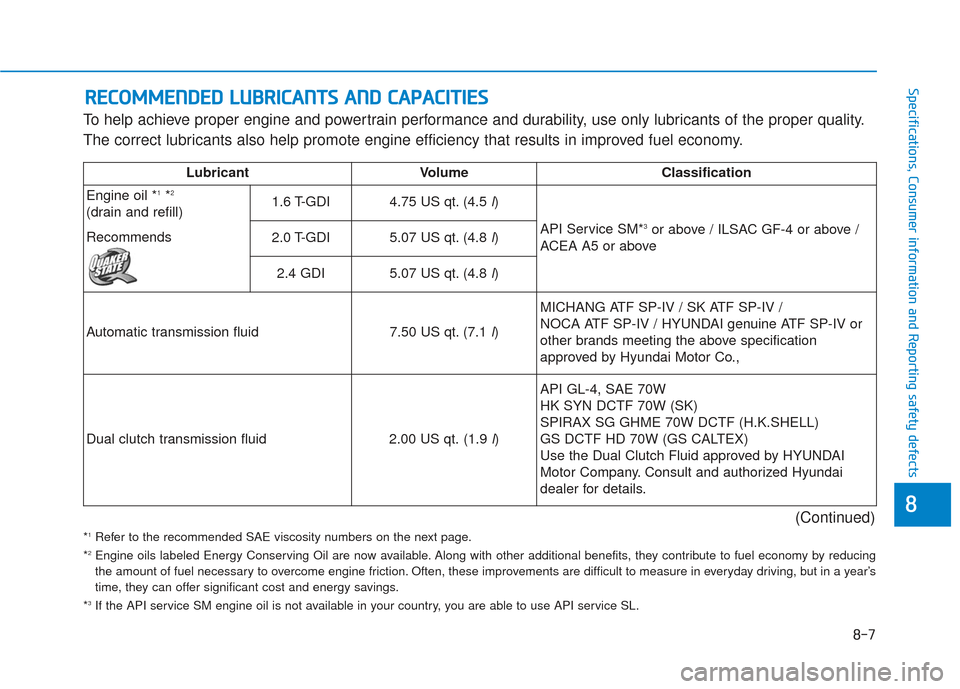
To help achieve proper engine and powertrain performance and durability, use only lubricants of the proper quality.
The correct lubricants also help promote engine efficiency that results in improved fuel economy.
R RE
EC
CO
O M
M M
ME
EN
N D
DE
ED
D
L
L U
U B
BR
RI
IC
C A
A N
N T
TS
S
A
A N
N D
D
C
C A
A P
PA
A C
CI
IT
T I
IE
E S
S
*1Refer to the recommended SAE viscosity numbers on the next page.
*2Engine oils labeled Energy Conserving Oil are now available. Along with other additional benefits, they contribute to fuel econo my by reducing
the amount of fuel necessary to overcome engine friction. Often, these improvements are difficult to measure in everyday driving, but in a year’s
time, they can offer significant cost and energy savings.
*
3If the API service SM engine oil is not available in your country, you are able to use API service SL.
LubricantVolume Classification
Engine oil *
1*2
(drain and refill)
Recommends 1.6 T-GDI4.75 US qt. (4.5l)
API Service SM*
3or above / ILSAC GF-4 or above /
ACEA A5 or above
2.0 T-GDI5.07 US qt. (4.8l)
2.4 GDI5.07 US qt. (4.8l)
Automatic transmission fluid
7.50 US qt. (7.1l) MICHANG ATF SP-IV / SK ATF SP-IV /
NOCA ATF SP-IV / HYUNDAI genuine ATF SP-IV or
other brands meeting the above specification
approved by Hyundai Motor Co.,
Dual clutch transmission fluid
2.00 US qt. (1.9l) API GL-4, SAE 70W
HK SYN DCTF 70W (SK)
SPIRAX SG GHME 70W DCTF (H.K.SHELL)
GS DCTF HD 70W (GS CALTEX)
Use the Dual Clutch Fluid approved by HYUNDAI
Motor Company. Consult and authorized Hyundai
dealer for details.
(Continued)
Page 510 of 522
8-11
88
Specifications, Consumer information and Reporting safety defects
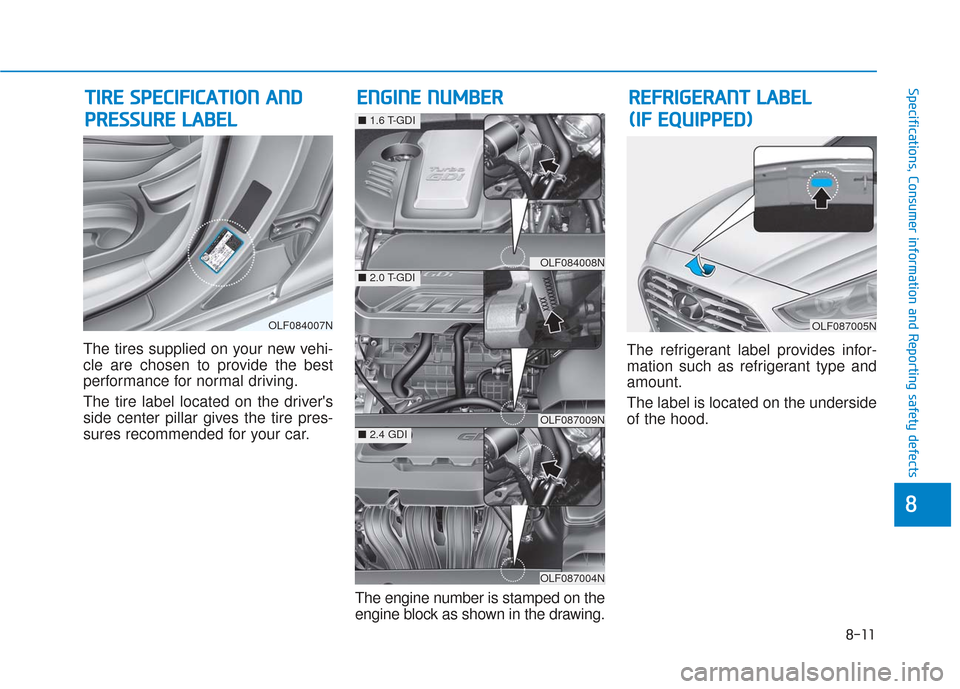
The tires supplied on your new vehi-
cle are chosen to provide the best
performance for normal driving.
The tire label located on the driver's
side center pillar gives the tire pres-
sures recommended for your car.The engine number is stamped on the
engine block as shown in the drawing.The refrigerant label provides infor-
mation such as refrigerant type and
amount.
The label is located on the underside
of the hood.
E E
N
N G
GI
IN
N E
E
N
N U
U M
M B
BE
ER
R R
RE
EF
FR
R I
IG
G E
ER
R A
A N
N T
T
L
L A
A B
BE
EL
L
(
( I
IF
F
E
E Q
Q U
UI
IP
P P
PE
ED
D )
)
T
T
I
IR
R E
E
S
S P
P E
EC
CI
IF
F I
IC
C A
A T
TI
IO
O N
N
A
A N
N D
D
P
P R
R E
ES
SS
SU
U R
RE
E
L
L A
A B
BE
EL
L
OLF084007NOLF087005N
OLF084008N
OLF087009N
OLF087004N
■ 1.6 T-GDI
■2.4 GDI
■2.0 T-GDI
Page 516 of 522
I-4
Emission Control System ...............................................7-85Crankcase Emission Control System .........................7-85
\Evaporative Emission Control System Including
Onboard Refueling Vapor Recovery (ORVR) .............7-85
Exhaust Emission Control System .............................7-86
Engine ........................................................................\
.......8-2
Engine compartment..................................................1-6, 7-3
Engine Coolant ...............................................................7-26 Changing Engine Coolant ..........................................7-28
Checking the Engine Coolant Level ..........................7-26
Engine Number ...............................................................8-11
Engine Oil .......................................................................7\
-23 Checking the Engine Oil and Filter ...........................7-25
Checking the Engine Oil Level ..................................7-23
Explanation of Scheduled Maintenance Items ...............7-20 Air Cleaner Filter .......................................................7-20
Air Conditioning Refrigerant .....................................7-22
Automatic Transmission Fluid ...................................7-21
Brake Discs, Pads, Calipers and Rotors .....................7-22
Brake Fluid .................................................................7-22
Brake hoses and Lines................................................7-22
Cooling System ..........................................................7-21
Drive Belts..................................................................7-20
Drive Shafts and Boots ..............................................7-22
Ecoshift Dual Clutch Transmission Fluid ..................7-21 Engine Coolant ...........................................................7-21
Engine Oil and Filter ..................................................7-20
Exhaust Pipe and Muffler...........................................7-22
Fuel Filter ...................................................................7-20
Fuel Lines, Fuel Hoses and Connections ...................7-20
Parking Brake .............................................................7-22
Spark Plugs.................................................................7-20
Steering Gear Box, Linkage & Boots/ Lower Arm Ball Joint .............................................7-22
Suspension Mounting Bolts .......................................7-22
Valve Clearance ..........................................................7-21
Vapor Hose and Fuel Filler Cap .................................7-20
Exterior features..............................................................3-52 Fuel Filler Door ..........................................................3-59
Hood ........................................................................\
...3-52
Smart Trunk ................................................................3-56
Trunk ........................................................................\
..3-53
Exterior overview (I) ........................................................1-2
Exterior overview (II) .......................................................1-3
Fuses ........................................................................\
.......7-56 Engine Compartment Panel Fuse Replacement .........7-58
Fuse/Relay Panel Description ....................................7-60
Instrument Panel Fuse Replacement ..........................7-57
Index
E
F