trailer Hyundai Sonata 2020 User Guide
[x] Cancel search | Manufacturer: HYUNDAI, Model Year: 2020, Model line: Sonata, Model: Hyundai Sonata 2020Pages: 537, PDF Size: 14.54 MB
Page 413 of 537
06
6-129
• The vehicle height gets lower or higher due to heavy loading in a trunk,
abnormal tire pressure, etc.
• When the temperature of the rear bumper is high.
• When the sensors are blocked by other vehicles, walls or parking-lot
pillars.
• The vehicle drives on a curved road.
• The road pavement (or the peripheral ground) abnormally contains metallic
components (i.e. possibly due to
subway construction).
• There is a fixed object near the vehicle, such as a guardrail.
• While going down or up a steep road where the height of the lane is
different.
• Driving on a narrow road where trees or grass or overgrown.
• Driving in rural areas where the sensor does not detect another vehicle for an
extended period of time.
• Driving on a wet road.
• Driving on a road where the guardrail or wall is in double structure.
• A big vehicle is near such as a bus or truck.
• When the other vehicle approaches very close.
• When the other vehicle passes at a very fast speed.
• While changing lanes. • If the vehicle has started at the same
time as the vehicle next to you and
has accelerated.
• When the vehicle in the next lane moves two lanes away from you or
when the vehicle two lanes away
moves to the next lane from you.
• A motorcycle or bicycle is near.
• A flat trailer is near.
• If there are small objects in the detecting area such as a shopping
cart or a baby stroller.
• If there is a low height vehicle such as a sports car.
• The brake pedal is depressed.
• ESC (Electronic Stability Control) is activated.
• ESC (Electronic Stability Control) malfunctions.
• The tire pressure is low or a tire is damaged.
• The brake is reworked.
• The vehicle sharply stops.
• Temperature is extremely low around the vehicle.
• The vehicle severely vibrates while driving over a bumpy road, uneven/
bumpy road, or concrete patch.
• The vehicle drives on a slippery surface due to snow, water puddle,
or ice.
• If the vehicle moves backward after the vehicle is parked with a diagonal
line
Page 424 of 537
While Driving6-140
ODN8A069208ODN8A069208
Type DType D
Type EType E
ODN8A069209ODN8A069209
Type FType F
ODN8A069210ODN8A069210
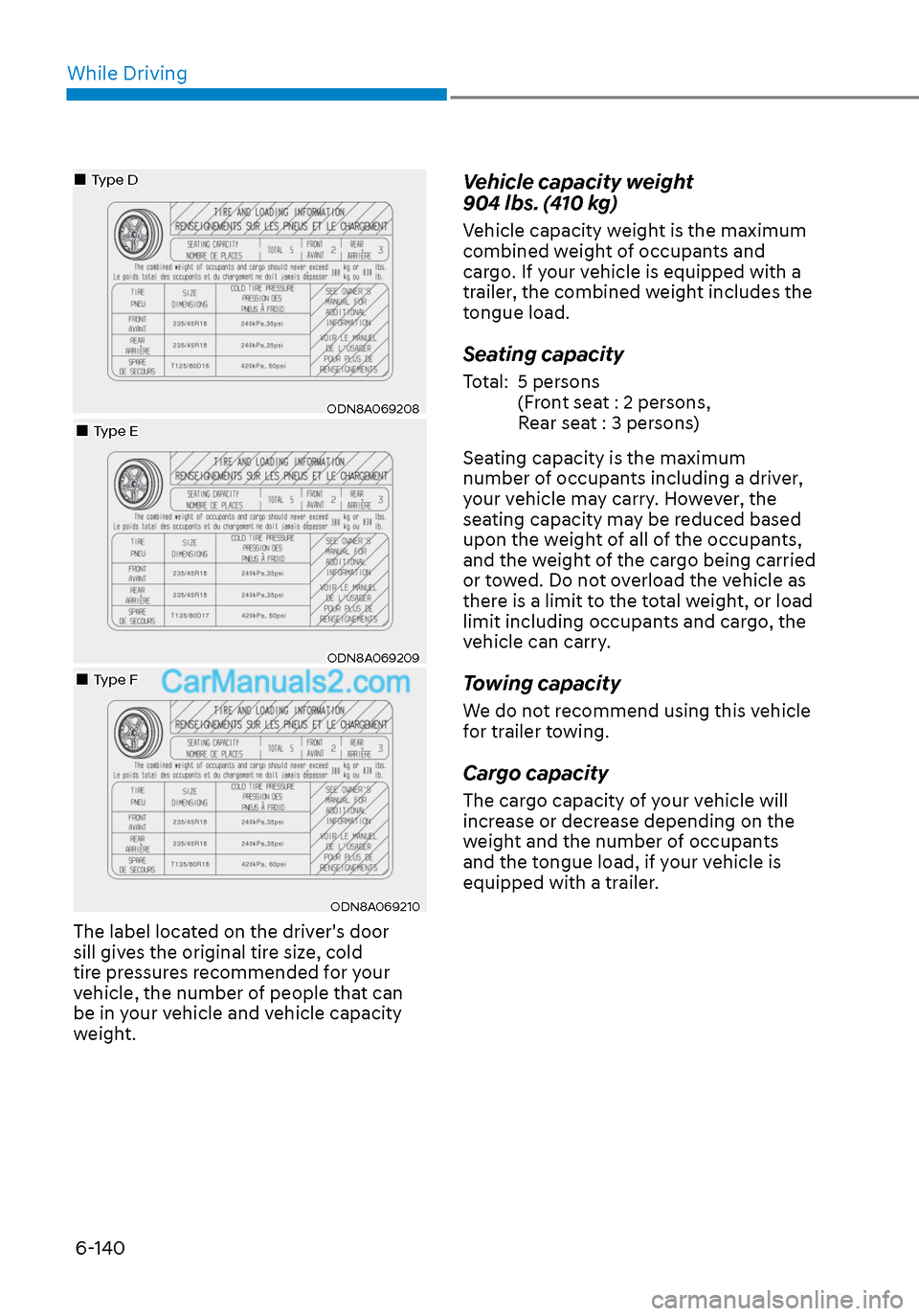
The label located on the driver's door
sill gives the original tire size, cold
tire pressures recommended for your
vehicle, the number of people that can
be in your vehicle and vehicle capacity
weight.
Vehicle capacity weight
904 lbs. (410 kg)
Vehicle capacity weight is the maximum
combined weight of occupants and
cargo. If your vehicle is equipped with a
trailer, the combined weight includes the
tongue load.
Seating capacity
Total: 5 persons (Front seat : 2 persons,
Rear seat : 3 persons)
Seating capacity is the maximum
number of occupants including a driver,
your vehicle may carry. However, the
seating capacity may be reduced based
upon the weight of all of the occupants,
and the weight of the cargo being carried
or towed. Do not overload the vehicle as
there is a limit to the total weight, or load
limit including occupants and cargo, the
vehicle can carry.
Towing capacity
We do not recommend using this vehicle
for trailer towing.
Cargo capacity
The cargo capacity of your vehicle will
increase or decrease depending on the
weight and the number of occupants
and the tongue load, if your vehicle is
equipped with a trailer.
Page 425 of 537
06
6-141
Steps for determining correct load
limit
1. Locate the statement "The combined weight of occupants and cargo should
never exceed XXX kg or XXX lbs." on
your vehicle's placard.
2. Determine the combined weight of the driver and passengers that will be
riding in your vehicle.
3. Subtract the combined weight of the driver and passengers from XXX kg or
XXX lbs.
4. The resulting figure equals the available amount of cargo and
luggage load capacity. For example,
if the "XXX" amount equals 1400
lbs. and there will be five 150 lb.
passengers in your vehicle, the
amount of available cargo and
luggage load capacity is 650 lbs.
(1400 - 750 (5 x 150) = 650 lbs.)
5. Determine the combined weight of luggage and cargo being loaded on
the vehicle. That weight may not
safely exceed the available cargo and
luggage load capacity calculated in
Step 4.
6. If your vehicle will be towing a trailer, load from your trailer will be
transferred to your vehicle. Consult
this manual to determine how this
reduces the available cargo and
luggage load capacity of your vehicle.
WARNING
Do not overload the vehicle as there
is a limit to the total weight, or load
limit, including occupants and cargo,
the vehicle can carry. Overloading can
shorten the life of the vehicle. If the
GVWR or the GAWR is exceeded, parts
on the vehicle can break, and it can
change the handling of your vehicle.
These could cause you to lose control
and result in an accident.
Page 427 of 537
06
6-143
Certification label
OBH059070OBH059070
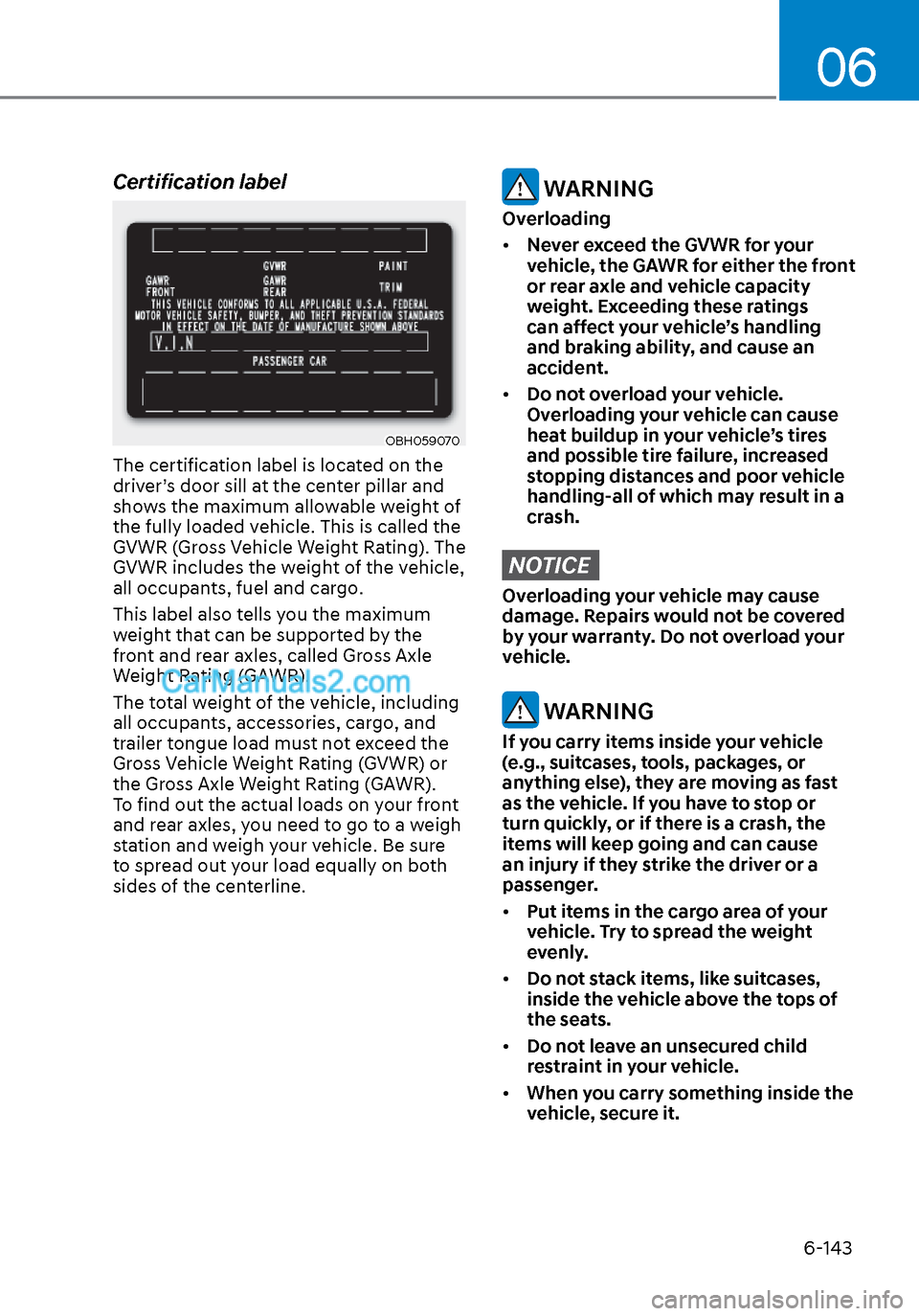
The certification label is located on the
driver’s door sill at the center pillar and
shows the maximum allowable weight of
the fully loaded vehicle. This is called the
GVWR (Gross Vehicle Weight Rating). The
GVWR includes the weight of the vehicle,
all occupants, fuel and cargo.
This label also tells you the maximum
weight that can be supported by the
front and rear axles, called Gross Axle
Weight Rating (GAWR).
The total weight of the vehicle, including
all occupants, accessories, cargo, and
trailer tongue load must not exceed the
Gross Vehicle Weight Rating (GVWR) or
the Gross Axle Weight Rating (GAWR).
To find out the actual loads on your front
and rear axles, you need to go to a weigh
station and weigh your vehicle. Be sure
to spread out your load equally on both
sides of the centerline.
WARNING
Overloading
• Never exceed the GVWR for your
vehicle, the GAWR for either the front
or rear axle and vehicle capacity
weight. Exceeding these ratings
can affect your vehicle’s handling
and braking ability, and cause an
accident.
• Do not overload your vehicle.
Overloading your vehicle can cause
heat buildup in your vehicle’s tires
and possible tire failure, increased
stopping distances and poor vehicle
handling-all of which may result in a
crash.
NOTICE
Overloading your vehicle may cause
damage. Repairs would not be covered
by your warranty. Do not overload your
vehicle.
WARNING
If you carry items inside your vehicle
(e.g., suitcases, tools, packages, or
anything else), they are moving as fast
as the vehicle. If you have to stop or
turn quickly, or if there is a crash, the
items will keep going and can cause
an injury if they strike the driver or a
passenger.
• Put items in the cargo area of your
vehicle. Try to spread the weight
evenly.
• Do not stack items, like suitcases,
inside the vehicle above the tops of
the seats.
• Do not leave an unsecured child
restraint in your vehicle.
• When you carry something inside the
vehicle, secure it.
Page 428 of 537
While Driving6-144
We do not recommend using this vehicle
for trailer towing.
TRAILER TOWING
Page 458 of 537
08
8-11
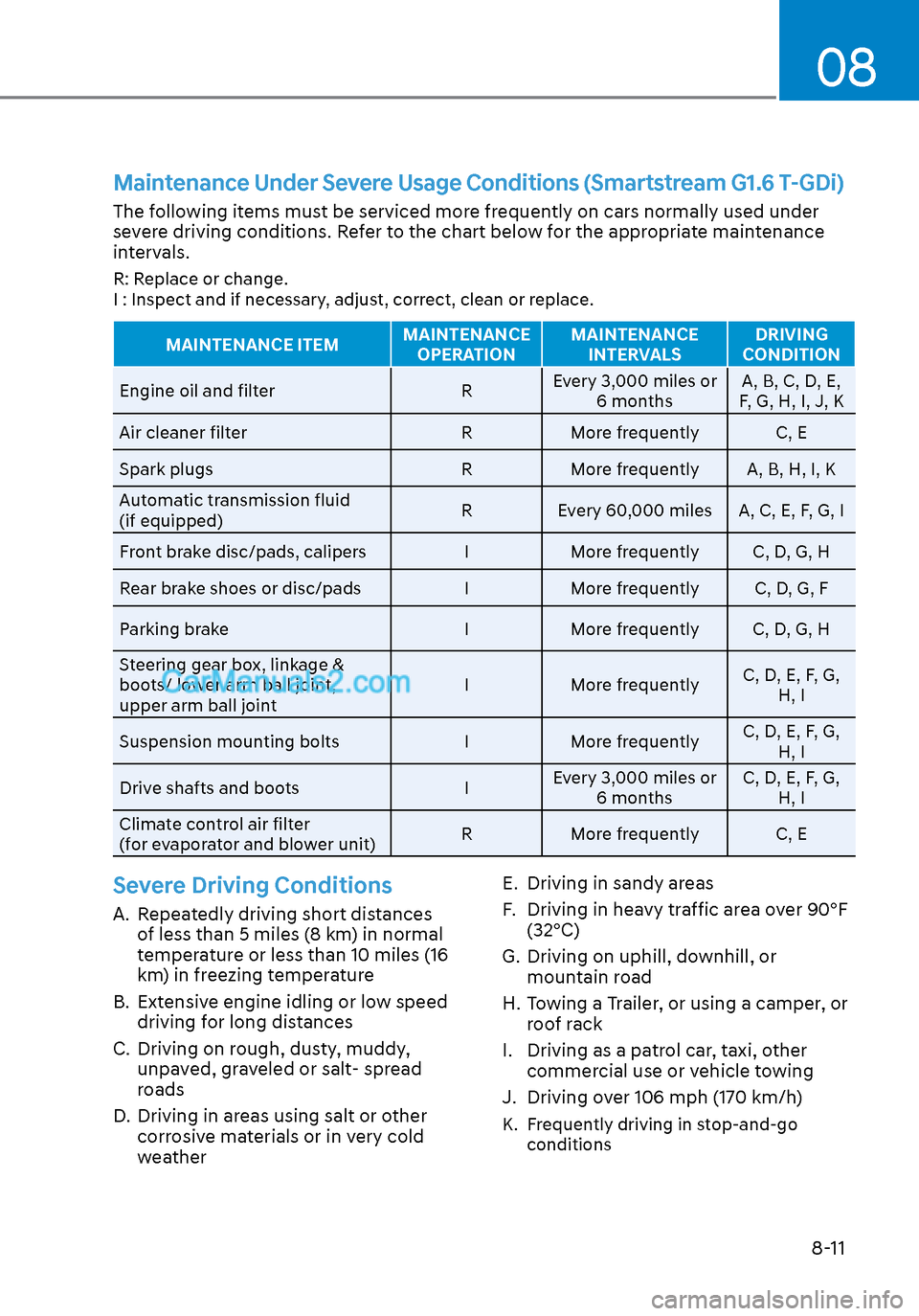
Maintenance Under Severe Usage Conditions (Smartstream G1.6 T-GDi)
The following items must be serviced more frequently on cars normally used under
severe driving conditions. Refer to the chart below for the appropriate maintenance
intervals.
R: Replace or change.
I : Inspect and if necessary, adjust, correct, clean or replace.
MAINTENANCE ITEMMAINTENANCE
OPERATION MAINTENANCE
INTERVALS DRIVING
CONDITION
Engine oil and filter RE
very 3,000 miles or
6 months A, B, C, D, E,
F, G, H, I, J, K
Air cleaner filter RMore frequently C, E
Spark plugs RMore frequently A, B, H, I, K
Automatic transmission fluid
(if equipped) R Every 60,000 miles A, C, E, F, G, I
Front brake disc/pads, calipers IMore frequently C, D, G, H
Rear brake shoes or disc/pads IMore frequently C, D, G, F
Parking brake IMore frequently C, D, G, H
Steering gear box, linkage &
boots/ lower arm ball joint,
upper arm ball joint I
More frequently C, D, E, F, G,
H, I
Suspension mounting bolts IMore frequently C, D, E, F, G,
H, I
Drive shafts and boots IEvery 3,000 miles or
6 months C, D, E, F, G,
H, I
Climate control air filter
(for evaporator and blower unit) R
More frequently C, E
Severe Driving Conditions
A. Repeatedly driving short distances
of less than 5 miles (8 km) in normal
temperature or less than 10 miles (16
km) in freezing temperature
B. Extensive engine idling or low speed driving for long distances
C. Driving on rough, dusty, muddy, unpaved, graveled or salt- spread
roads
D. Driving in areas using salt or other corrosive materials or in very cold
weather E. Driving in sandy areas
F. Driving in heavy traffic area over 90°F
(32°C)
G. Driving on uphill, downhill, or mountain road
H. Towing a Trailer, or using a camper, or roof rack
I. Driving as a patrol car, taxi, other commercial use or vehicle towing
J. Driving over 106 mph (170 km/h)
K. Frequently driving in stop-and-go conditions
Page 462 of 537
08
8-15
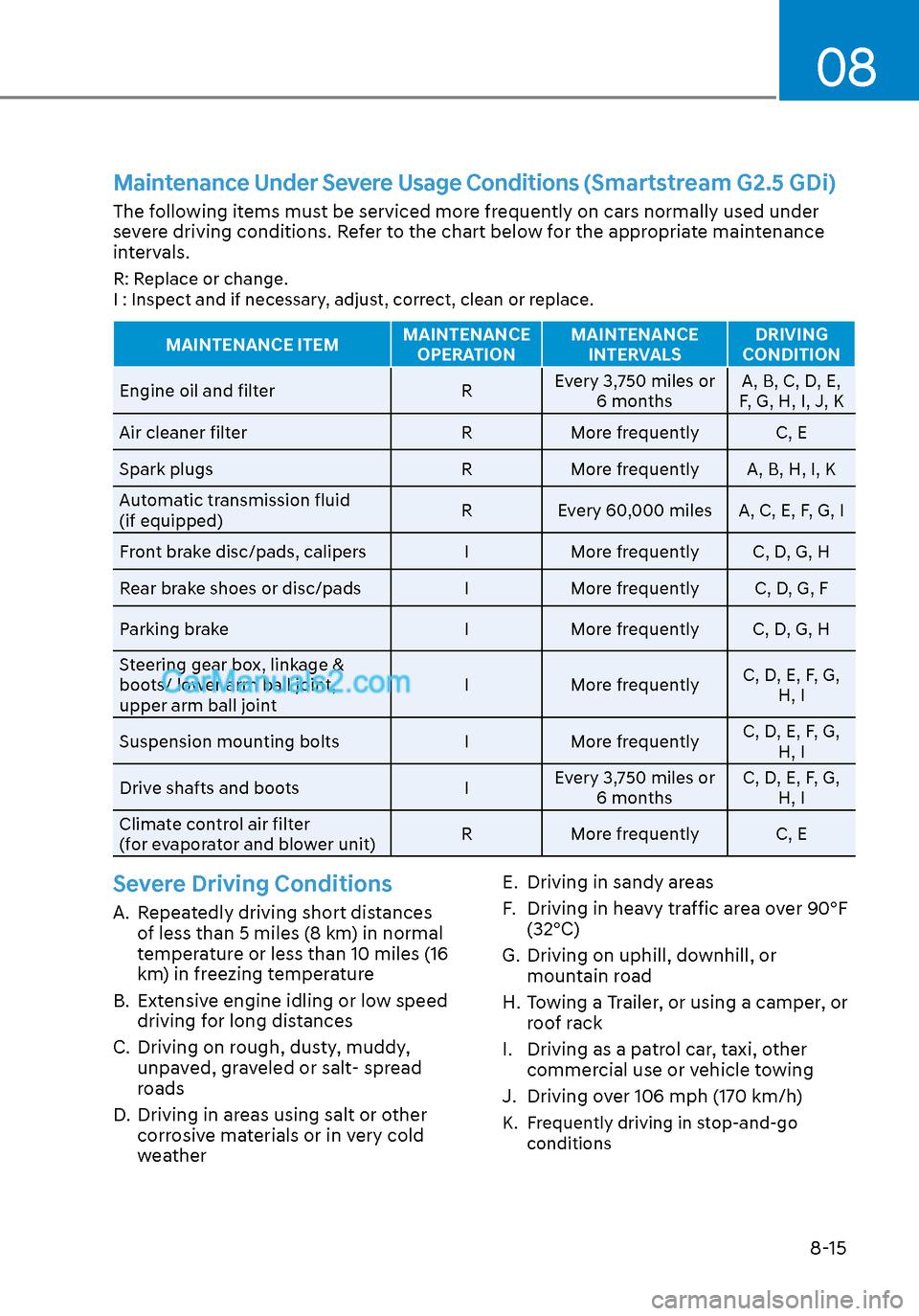
Maintenance Under Severe Usage Conditions (Smartstream G2.5 GDi)
The following items must be serviced more frequently on cars normally used under
severe driving conditions. Refer to the chart below for the appropriate maintenance
intervals.
R: Replace or change.
I : Inspect and if necessary, adjust, correct, clean or replace.
MAINTENANCE ITEMMAINTENANCE
OPERATION MAINTENANCE
INTERVALS DRIVING
CONDITION
Engine oil and filter RE
very 3,750 miles or
6 months A, B, C, D, E,
F, G, H, I, J, K
Air cleaner filter RMore frequently C, E
Spark plugs RMore frequently A, B, H, I, K
Automatic transmission fluid
(if equipped) R Every 60,000 miles A, C, E, F, G, I
Front brake disc/pads, calipers IMore frequently C, D, G, H
Rear brake shoes or disc/pads IMore frequently C, D, G, F
Parking brake IMore frequently C, D, G, H
Steering gear box, linkage &
boots/ lower arm ball joint,
upper arm ball joint I
More frequently C, D, E, F, G,
H, I
Suspension mounting bolts IMore frequently C, D, E, F, G,
H, I
Drive shafts and boots IEvery 3,750 miles or
6 months C, D, E, F, G,
H, I
Climate control air filter
(for evaporator and blower unit) R
More frequently C, E
Severe Driving Conditions
A. Repeatedly driving short distances
of less than 5 miles (8 km) in normal
temperature or less than 10 miles (16
km) in freezing temperature
B. Extensive engine idling or low speed driving for long distances
C. Driving on rough, dusty, muddy, unpaved, graveled or salt- spread
roads
D. Driving in areas using salt or other corrosive materials or in very cold
weather E. Driving in sandy areas
F. Driving in heavy traffic area over 90°F
(32°C)
G. Driving on uphill, downhill, or mountain road
H. Towing a Trailer, or using a camper, or roof rack
I. Driving as a patrol car, taxi, other commercial use or vehicle towing
J. Driving over 106 mph (170 km/h)
K. Frequently driving in stop-and-go conditions
Page 535 of 537

IndexI-16
Tires and wheels ........................................................................\
.................. 2-9, 8-34 Tire care ........................................................................\
................................... 8-34
Recommended cold tire inflation pressures .................................................... 8-34
Check tire inflation pressure ........................................................................\
... 8-35
Tire rotation ........................................................................\
............................. 8-36
Wheel alignment and tire balance ................................................................... 8-36
Tire replacement ........................................................................\
...................... 8-37
Wheel replacement ........................................................................\
.................. 8-38
Tire maintenance ........................................................................\
..................... 8-38
Tire traction ........................................................................\
............................. 8-38
Tire sidewall labeling ........................................................................\
.............. 8-38
Tire terminology and definitions ..................................................................... 8-42
All Season Tires ........................................................................\
...................... 8-44
Summer Tires ........................................................................\
.......................... 8-44
Snow Tires ........................................................................\
............................... 8-44
Radial-Ply Tires ........................................................................\
....................... 8-45
Low Aspect Ratio Tires ........................................................................\
........... 8-45
Towing ..................................................................\
............................................... 7-18
Trailer towing ........................................................................\
............................ 6-144
Trip computer ........................................................................\
.............................. 4-31 Average fuel economy ........................................................................\
............. 4-31
Instant fuel economy ........................................................................\
............... 4-31
Accumulated Info display ........................................................................\
....... 4-32
Driving Info display ........................................................................\
................ 4-32
Digital speedometer ........................................................................\
................ 4-33
Auto Stop accumulated time ........................................................................\
... 4-33
Smart shift ........................................................................\
............................... 4-33
Trunk ...................................................................\
................................................. 5-65
Turn signals.............................................................\
............................................. 5-79
U
USB charger ........................................................................\
............................... 5-147