climate control Hyundai Sonata 2020 Owner's Guide
[x] Cancel search | Manufacturer: HYUNDAI, Model Year: 2020, Model line: Sonata, Model: Hyundai Sonata 2020Pages: 537, PDF Size: 14.54 MB
Page 296 of 537
While Driving6-12
NOTICE
To prevent damage to the vehicle:
When the stop lamp switch fuse is
blown, you can't start the engine
normally. Replace the fuse with a new
one. If you are not able to replace
the fuse, you can start the engine by
pressing and holding the Engine Start/
Stop button for 10 seconds with the
Engine Start/Stop button in the ACC
position.
Do not press the Engine Start/Stop
button for more than 10 seconds except
when the stop lamp switch fuse is
blown.
For your safety always depress the
brake pedal before starting the engine.
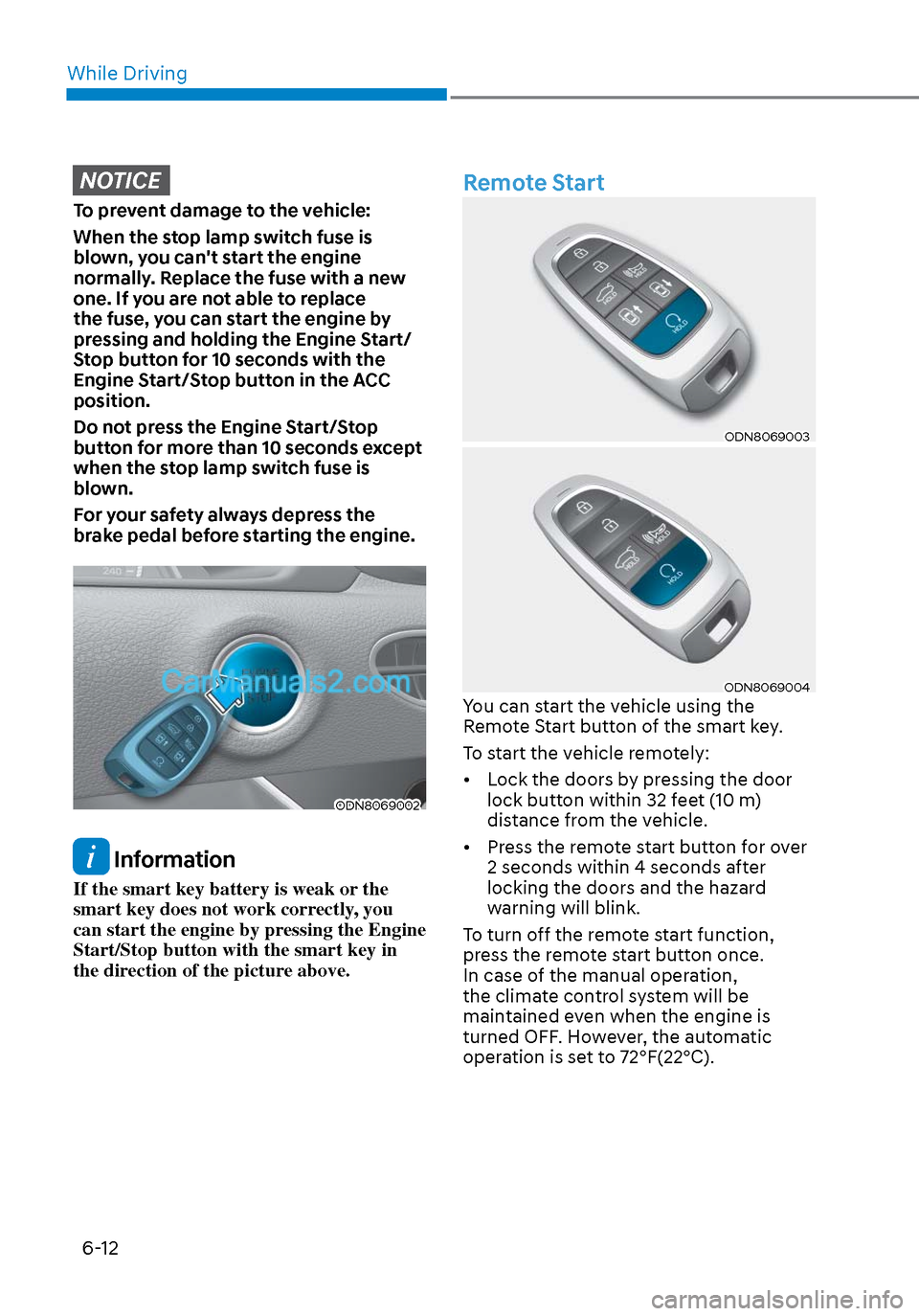
ODN8069002ODN8069002
Information
If the smart key battery is weak or the
smart key does not work correctly, you
can start the engine by pressing the Engine
Start/Stop button with the smart key in
the direction of the picture above.
Remote Start
ODN8069003ODN8069003
ODN8069004ODN8069004You can start the vehicle using the
Remote Start button of the smart key.
To start the vehicle remotely:
• Lock the doors by pressing the door lock button within 32 feet (10 m)
distance from the vehicle.
• Press the remote start button for over 2 seconds within 4 seconds after
locking the doors and the hazard
warning will blink.
To turn off the remote start function,
press the remote start button once.
In case of the manual operation,
the climate control system will be
maintained even when the engine is
turned OFF. However, the automatic
operation is set to 72°F(22°C).
Page 304 of 537
While Driving6-20
BRAKE SYSTEM
Power Brakes
Your vehicle has power-assisted brakes
that adjust automatically through normal
usage.
If the engine is not running or is turned
off while driving, the power assist for
the brakes will not work. You can still
stop your vehicle by applying greater
force to the brake pedal than typical.
The stopping distance, however, will be
longer than with power brakes.
When the engine is not running, the
reserve brake power is partially depleted
each time the brake pedal is applied.
Do not pump the brake pedal when the
power assist has been interrupted.
Only pump the brakes on slippery
surfaces if the power assist has been
interrupted to maintain steering control.
Do not pump the brakes on slippery
surfaces if the brakes are operating
normally.
WARNING
Take the following precautions:
• Do not drive with your foot resting
on the brake pedal. This will create
abnormal high brake temperatures,
excessive brake lining and pad wear,
and increased stopping distances.
• When descending down a long or
steep hill, move the gear shift button
to Manual Shift Mode and manually
downshift to a lower gear in order
to control your speed without using
the brake pedal excessively. Applying
the brakes continuously will cause
the brakes to overheat and could
result in a temporary loss of braking
performance.
• Wet brakes may impair the vehicle's
ability to safely slow down; the
vehicle may also pull to one side
when the brakes are applied.
Applying the brakes lightly will
indicate whether they have been
affected in this way. Always test your
brakes in this fashion after driving
through deep water. To dry the
brakes, lightly tap the brake pedal to
heat up the brakes while maintaining
a safe forward speed until brake
performance returns to normal.
Avoid driving at high speeds until the
brakes function correctly.
Disc Brakes Wear Indicator
When your brake pads are worn and new
pads are required, you will hear a high
pitched warning sound from your front
or rear brakes. You may hear this sound
come and go or it may occur whenever
you depress the brake pedal.
Note that some driving conditions or
climates may cause a brake squeal
when you first apply (or lightly apply)
the brakes. This is normal and does not
indicate a problem with your brakes.
NOTICE
To avoid costly brake repairs, do not
continue to drive with worn brake pads.
Information
Always replace brake pads as complete
front or rear axle sets.
Page 317 of 537
06
6-33
The Idle Stop and Go (ISG) system
automatically and temporarily shuts
down the engine when the vehicle
is stopped and idling to improve fuel
efficiency and reduce exhaust gas
emissions. (i.e. red stop light, stop sign,
and traffic jam).
The engine is automatically started upon
satisfying the starting conditions.
The ISG system is always active, when
the engine is running.
Information
When the engine is automatically started
by the ISG system, some warning
lights (i.e. ABS, ESC, ESC OFF, EPS,
and parking brake warning light) may
illuminate for a few seconds due to the
low battery voltage. However, it does
not indicate a malfunction with the ISG
system.
To Activate the ISG System
Prerequisite for activation
The ISG system operates in the following
situations.
• The driver's seatbelt is fastened
• The driver's door and hood are closed
• The brake vacuum pressure is adequate
• The battery sensor is activated and the battery is sufficiently charged
• Outside temperature is not too low or too high
• The vehicle is driven over a constant speed and stops
• The climate control system satisfies the conditions
• The vehicle is sufficiently warmed up
• The incline is gradual
• The steering wheel is turned less than 180 degrees and then the vehicle
stops
Information
• The ISG system is not
activated, when the
prerequisites to activate
the ISG system are
unsatisfied. In this case,
the ISG OFF button indicator
illuminates, and the auto stop indicator
(
) illuminates in yellow on the
instrument cluster.
• When the above indicator remains
illuminated on the instrument cluster,
have the IGS system checked by an
authorized HYUNDAI dealer.
Auto stop
To stop the engine in idle stop mode
1. Decrease the vehicle speed to 0 mph.
2. Depress the brake pedal with the shift
button in D (Drive) or N (Neutral).
The auto stop indicator (
) illuminates
in green on the instrument cluster, when
the engine stops.
Information
The driving speed must reach at least 3
mph (5 km/h) after an idle stop to stop the
engine in idle stop mode again.
In auto stop mode, when the driver
opens the hood, the ISG system will be
deactivated.
ISG (IDLE STOP AND GO) SYSTEM (IF EQUIPPED)
Page 318 of 537
While Driving6-34
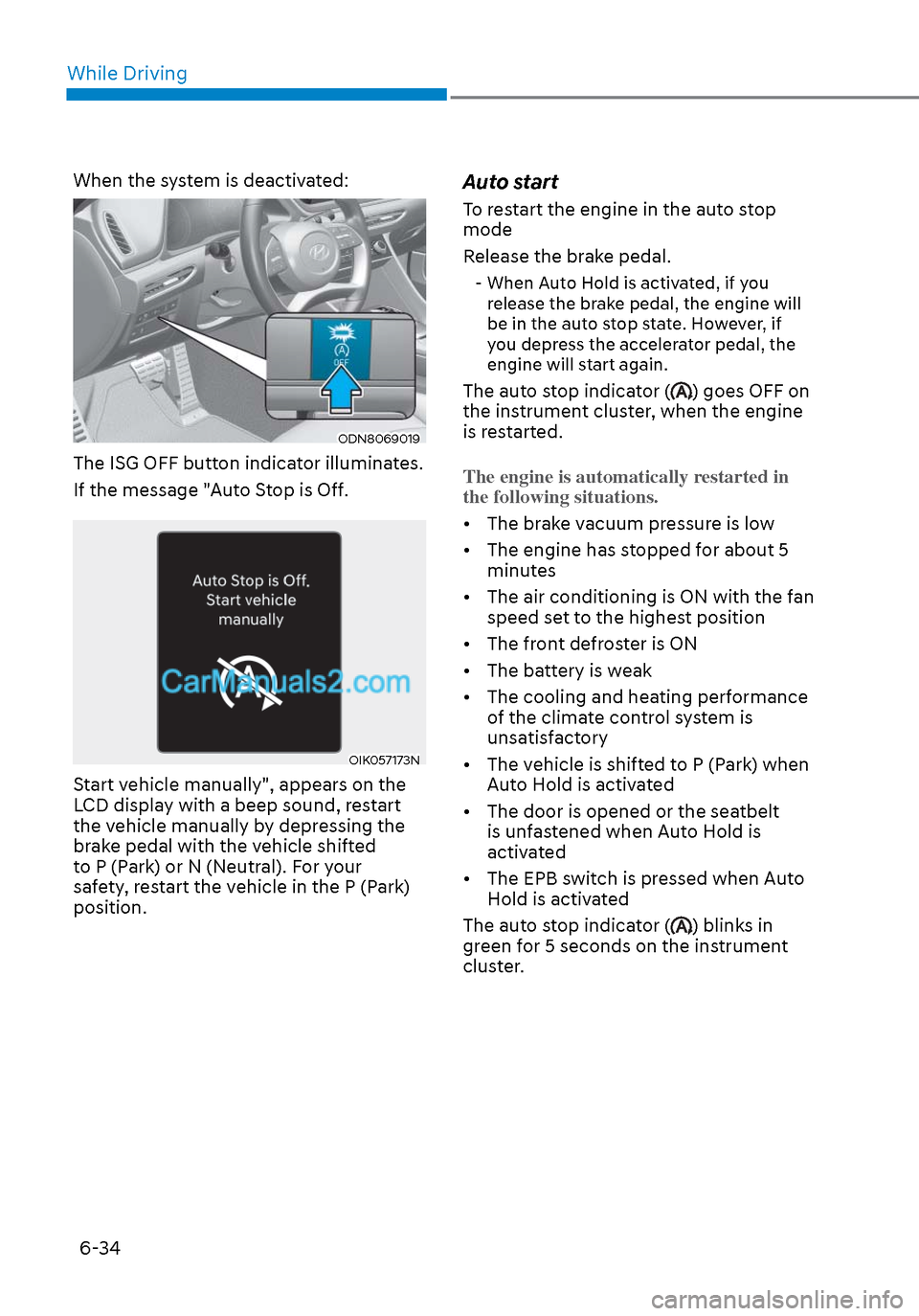
When the system is deactivated:
ODN8069019ODN8069019
The ISG OFF button indicator illuminates.
If the message "Auto Stop is Off.
OIK057173NOIK057173N
Start vehicle manually", appears on the
LCD display with a beep sound, restart
the vehicle manually by depressing the
brake pedal with the vehicle shifted
to P (Park) or N (Neutral). For your
safety, restart the vehicle in the P (Park)
position.
Auto start
To restart the engine in the auto stop
mode
Release the brake pedal.
- When Auto Hold is activated, if you release the brake pedal, the engine will
be in the auto stop state. However, if
you depress the accelerator pedal, the
engine will start again.
The auto stop indicator () goes OFF on
the instrument cluster, when the engine
is restarted.
The engine is automatically restarted in
the following situations.
• The brake vacuum pressure is low
•
The engine has stopped for about 5
minutes
• The air conditioning is ON with the fan speed set to the highest position
• The front defroster is ON
• The battery is weak
• The cooling and heating performance of the climate control system is
unsatisfactory
• The vehicle is shifted to P (Park) when Auto Hold is activated
• The door is opened or the seatbelt is unfastened when Auto Hold is
activated
• The EPB switch is pressed when Auto Hold is activated
The auto stop indicator (
) blinks in
green for 5 seconds on the instrument
cluster.
Page 448 of 537

Engine Compartment ........................................................................\
............ 8-3
Maintenance Services ........................................................................\
...........8-4
Owner’s Responsibility ........................................................................\
.................... 8-4
Owner Maintenance Precautions ........................................................................\
.... 8-4
Owner Maintenance ........................................................................\
.............. 8-5Owner Maintenance Schedule ........................................................................\
........ 8-5
Scheduled Maintenance Services ................................................................ 8-7Normal Maintenance Schedule (Smartstream G1.6 T-GDi) ...................................8-8
Maintenance Under Severe Usage Conditions (Smartstream G1.6 T-GDi) ......... 8-11
Severe Driving Conditions ........................................................................\
.............. 8-11
Normal Maintenance Schedule (Smartstream G2.5 GDi) ..................................... 8-12
Maintenance Under Severe Usage Conditions (Smartstream G2.5 GDi) ................8-15
Severe Driving Conditions ........................................................................\
..............8-15
Explanation of Scheduled Maintenance Items .......................................... 8-16
Engine Oil ........................................................................\
............................. 8-19
Checking the Engine Oil Level ........................................................................\
........8-19
Checking the Engine Oil and Filter ....................................................................... 8-20
Engine Coolant ........................................................................\
......................8-21Checking the Engine Coolant Level ....................................................................... 8-21
Engine Coolant ........................................................................\
................................ 8-21
Changing Engine Coolant ........................................................................\
.............. 8-23
Brake fluid ........................................................................\
............................ 8-24Checking the Brake Fluid Level ........................................................................\
..... 8-24
Washer Fluid ........................................................................\
......................... 8-25Checking the Washer Fluid Level ........................................................................\
.. 8-25
Air Cleaner ........................................................................\
............................ 8-26Filter Replacement ........................................................................\
......................... 8-26
Climate Control Air Filter ........................................................................\
..... 8-28
Filter Inspection........................................................................\
.............................. 8-28
Filter Replacement ........................................................................\
......................... 8-28
Wiper Blades ........................................................................\
........................ 8-29Blade Inspection ........................................................................\
............................ 8-29
Blade Replacement ........................................................................\
........................ 8-29
Battery ....................................................................\
.......................................8-31For Best Battery Service ........................................................................\
................ 8-32
Battery Recharging ........................................................................\
........................ 8-32
Reset Features ........................................................................\
................................ 8-33
8. Maintenance
8
Page 455 of 537
Maintenance8-8
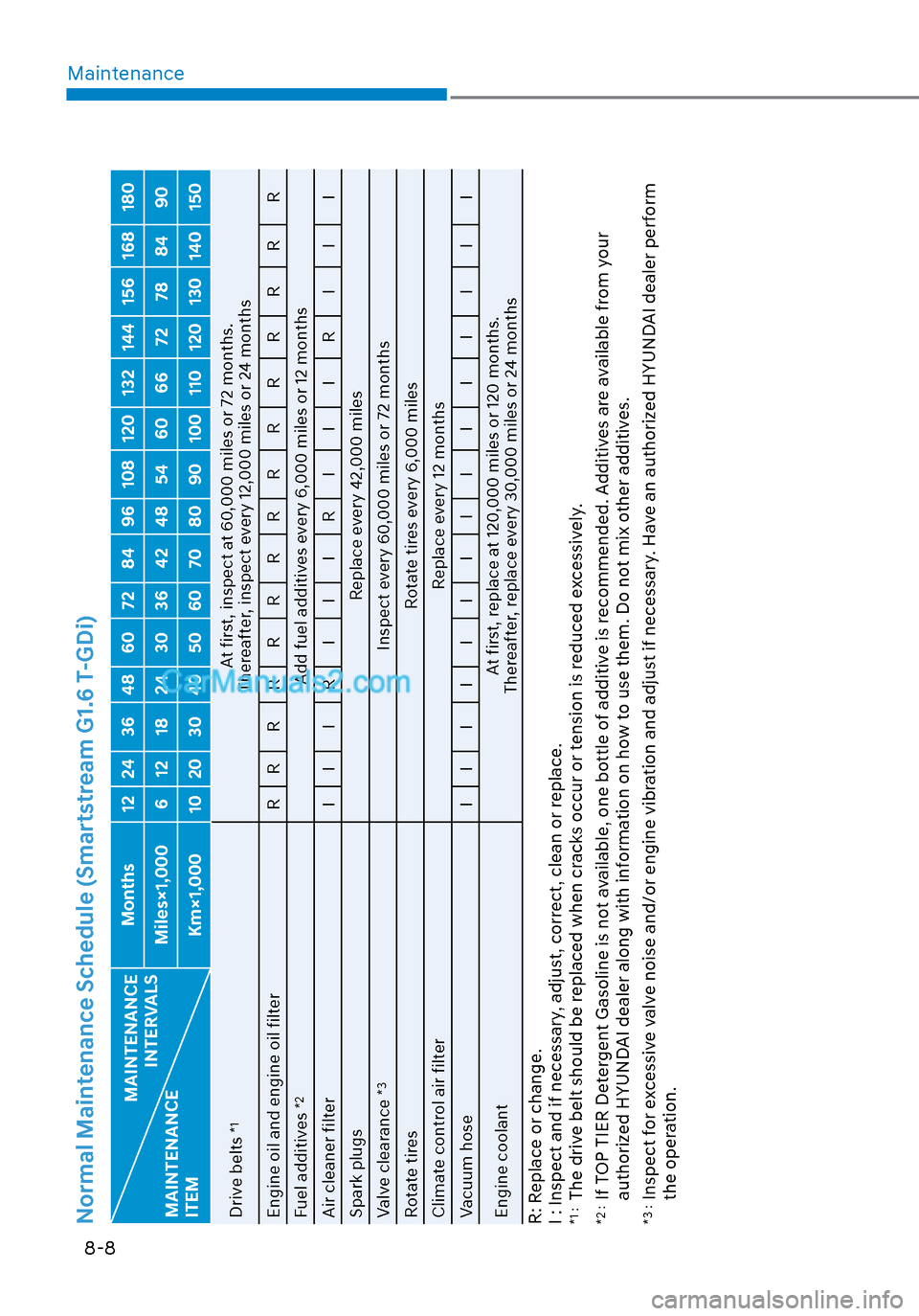
Normal Maintenance Schedule (Smartstream G1.6 T-GDi)
MAINTENANCE INTERVALS
MAINTENANCE
ITEM Months 12 24 36 48 60 72 84 96 108 120 132 144 156 168 180
Miles×1,000 6 12 18 24 30 36 42 48 54 60 66 72 78 84 90 Km×1,000 10 20 30 40 50 60 70 80 90 100 110 120 130 140 150
Drive belts
*1
At first, inspect at 60,000 miles or 72 months.
Thereafter, inspect every 12,000 miles or 24 months
Engine oil and engine oil filter R R R R R R R R R RRRRR R
Fuel additives
*2
Add fuel additives every 6,000 miles or 12 months
Air cleaner filter I I I R I I I R I I I R I I I
Spark plugs Replace every 42,000 miles
Valve clearance
*3
Inspect every 60,000 miles or 72 months
Rotate tires Rotate tires every 6,000 miles
Climate control air filter Replace every 12 months
Vacuum hose I I I I I I I I I IIIII I
Engine coolant At first, replace at 120,000 miles or 120 months.
Thereafter, replace every 30,000 miles or 24 months
R: Replace or change.
I : Inspect and if necessary, adjust, correct, clean or replace.*1 :
The drive belt should be replaced when cracks occur or tension is reduced excessively.
*2 :
If TOP TIER Detergent Gasoline is not available, one bottle of additive is recommended. Additives are available from your
authorized HYUNDAI dealer along with information on how to use them. Do not mix other additives.
*3 :
Inspect for excessive valve noise and/or engine vibration and adjust if necessary. Have an authorized HYUNDAI dealer perform
the operation.
Page 458 of 537
08
8-11
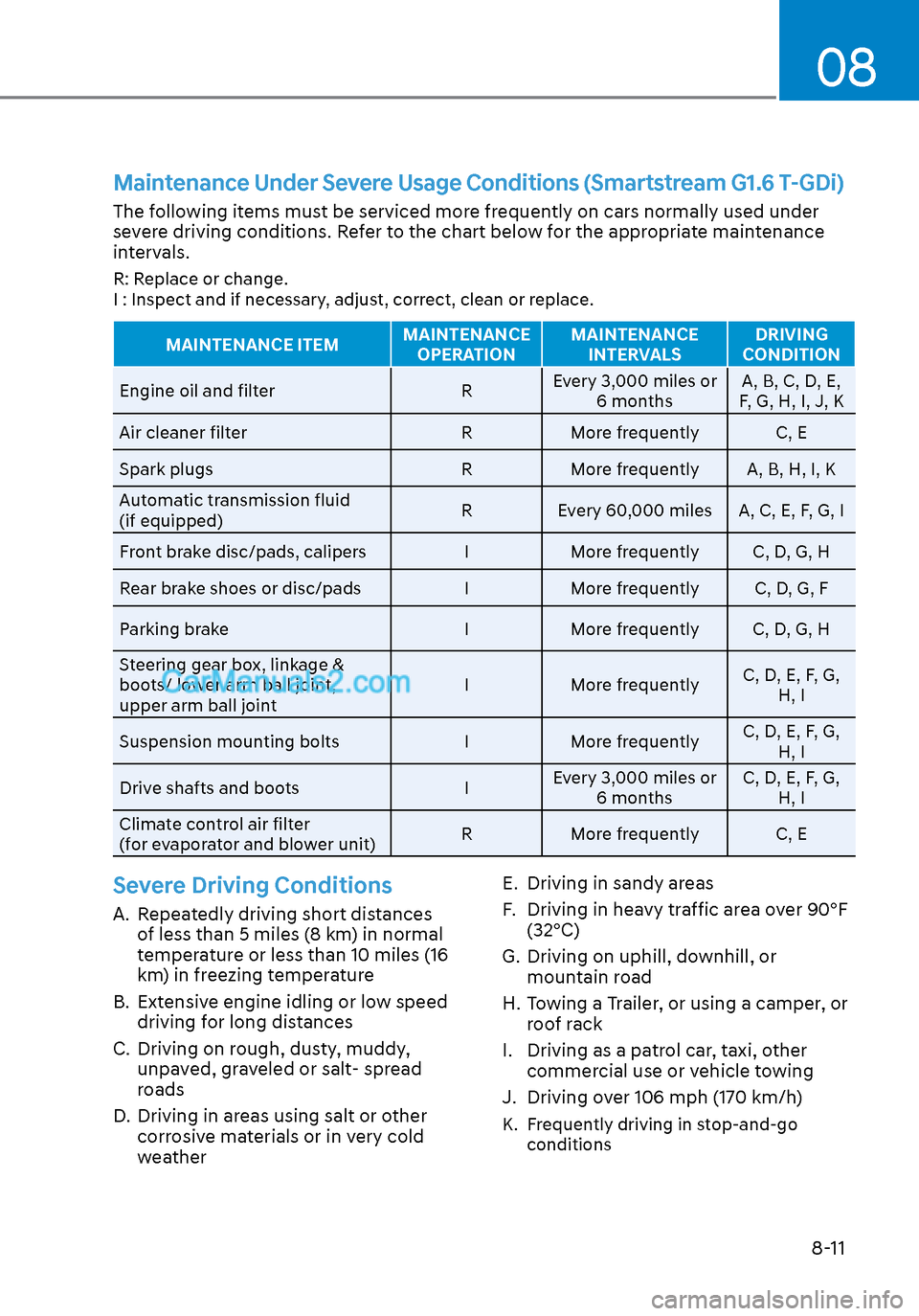
Maintenance Under Severe Usage Conditions (Smartstream G1.6 T-GDi)
The following items must be serviced more frequently on cars normally used under
severe driving conditions. Refer to the chart below for the appropriate maintenance
intervals.
R: Replace or change.
I : Inspect and if necessary, adjust, correct, clean or replace.
MAINTENANCE ITEMMAINTENANCE
OPERATION MAINTENANCE
INTERVALS DRIVING
CONDITION
Engine oil and filter RE
very 3,000 miles or
6 months A, B, C, D, E,
F, G, H, I, J, K
Air cleaner filter RMore frequently C, E
Spark plugs RMore frequently A, B, H, I, K
Automatic transmission fluid
(if equipped) R Every 60,000 miles A, C, E, F, G, I
Front brake disc/pads, calipers IMore frequently C, D, G, H
Rear brake shoes or disc/pads IMore frequently C, D, G, F
Parking brake IMore frequently C, D, G, H
Steering gear box, linkage &
boots/ lower arm ball joint,
upper arm ball joint I
More frequently C, D, E, F, G,
H, I
Suspension mounting bolts IMore frequently C, D, E, F, G,
H, I
Drive shafts and boots IEvery 3,000 miles or
6 months C, D, E, F, G,
H, I
Climate control air filter
(for evaporator and blower unit) R
More frequently C, E
Severe Driving Conditions
A. Repeatedly driving short distances
of less than 5 miles (8 km) in normal
temperature or less than 10 miles (16
km) in freezing temperature
B. Extensive engine idling or low speed driving for long distances
C. Driving on rough, dusty, muddy, unpaved, graveled or salt- spread
roads
D. Driving in areas using salt or other corrosive materials or in very cold
weather E. Driving in sandy areas
F. Driving in heavy traffic area over 90°F
(32°C)
G. Driving on uphill, downhill, or mountain road
H. Towing a Trailer, or using a camper, or roof rack
I. Driving as a patrol car, taxi, other commercial use or vehicle towing
J. Driving over 106 mph (170 km/h)
K. Frequently driving in stop-and-go conditions
Page 459 of 537
Maintenance8-12
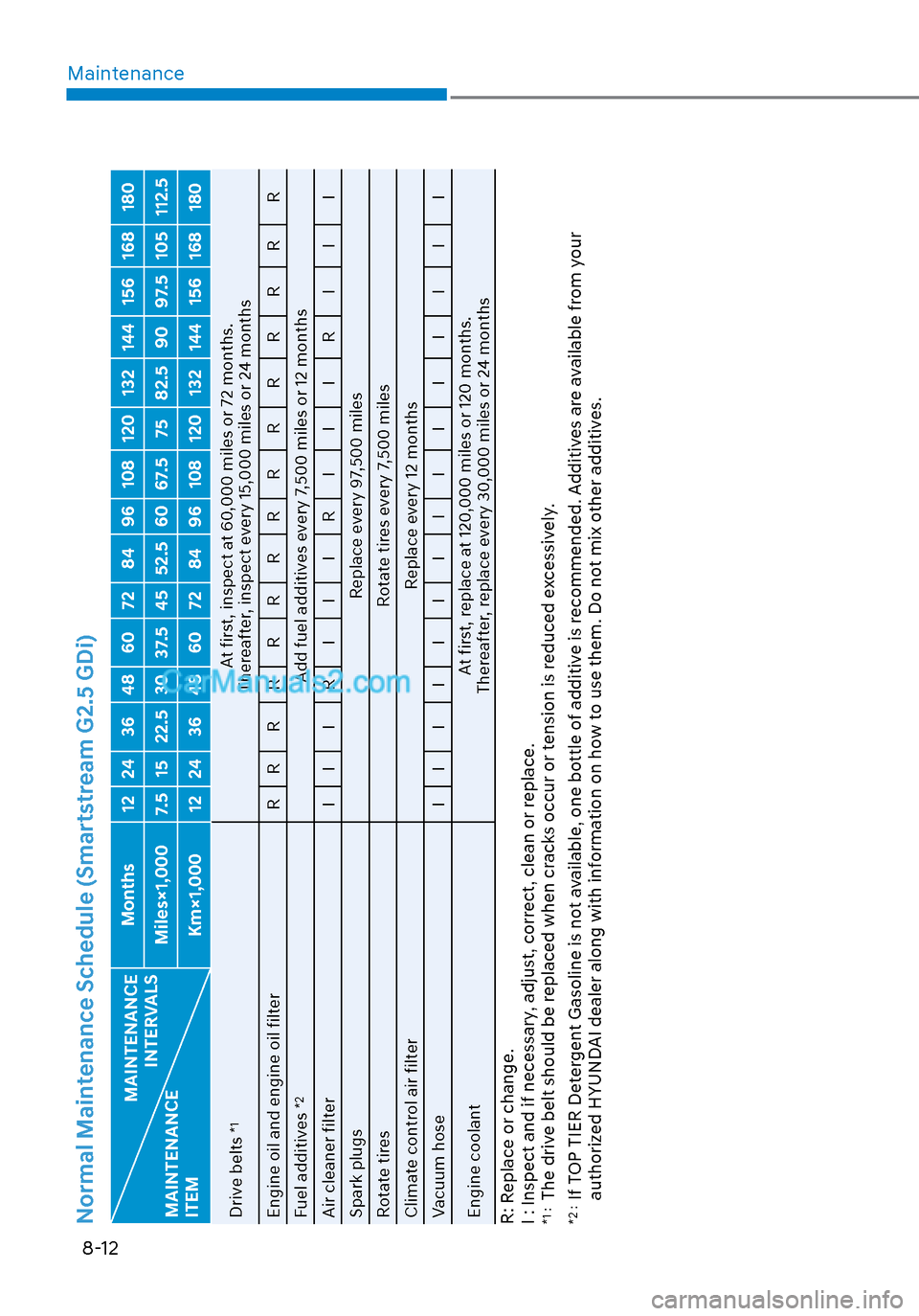
Normal Maintenance Schedule (Smartstream G2.5 GDi)
MAINTENANCE INTERVALS
MAINTENANCE
ITEM Months 12 24 36 48 60 72 84 96 108 120 132 144 156 168 180
Miles×1,000 7.5 15 22.5 30 37.5 45 52.5 60 67.5 75 82.5 90 97.5 105 112.5 Km×1,000 12 24 36 48 60 72 84 96 108 120 132 144 156 168 180
Drive belts
*1
At first, inspect at 60,000 miles or 72 months.
Thereafter, inspect every 15,000 miles or 24 months
Engine oil and engine oil filter R R R R R R R R R RRRRR R
Fuel additives
*2
Add fuel additives every 7,500 miles or 12 months
Air cleaner filter I I I R I I I R I I I R I I I
Spark plugs Replace every 97,500 miles
Rotate tires Rotate tires every 7,500 miles
Climate control air filter Replace every 12 months
Vacuum hose I I I I I I I I I IIIII I
Engine coolant At first, replace at 120,000 miles or 120 months.
Thereafter, replace every 30,000 miles or 24 months
R: Replace or change.
I : Inspect and if necessary, adjust, correct, clean or replace.*1 :
The drive belt should be replaced when cracks occur or tension is reduced excessively.
*2 :
If TOP TIER Detergent Gasoline is not available, one bottle of additive is recommended. Additives are available from your
authorized HYUNDAI dealer along with information on how to use them. Do not mix other additives.
Page 462 of 537
08
8-15
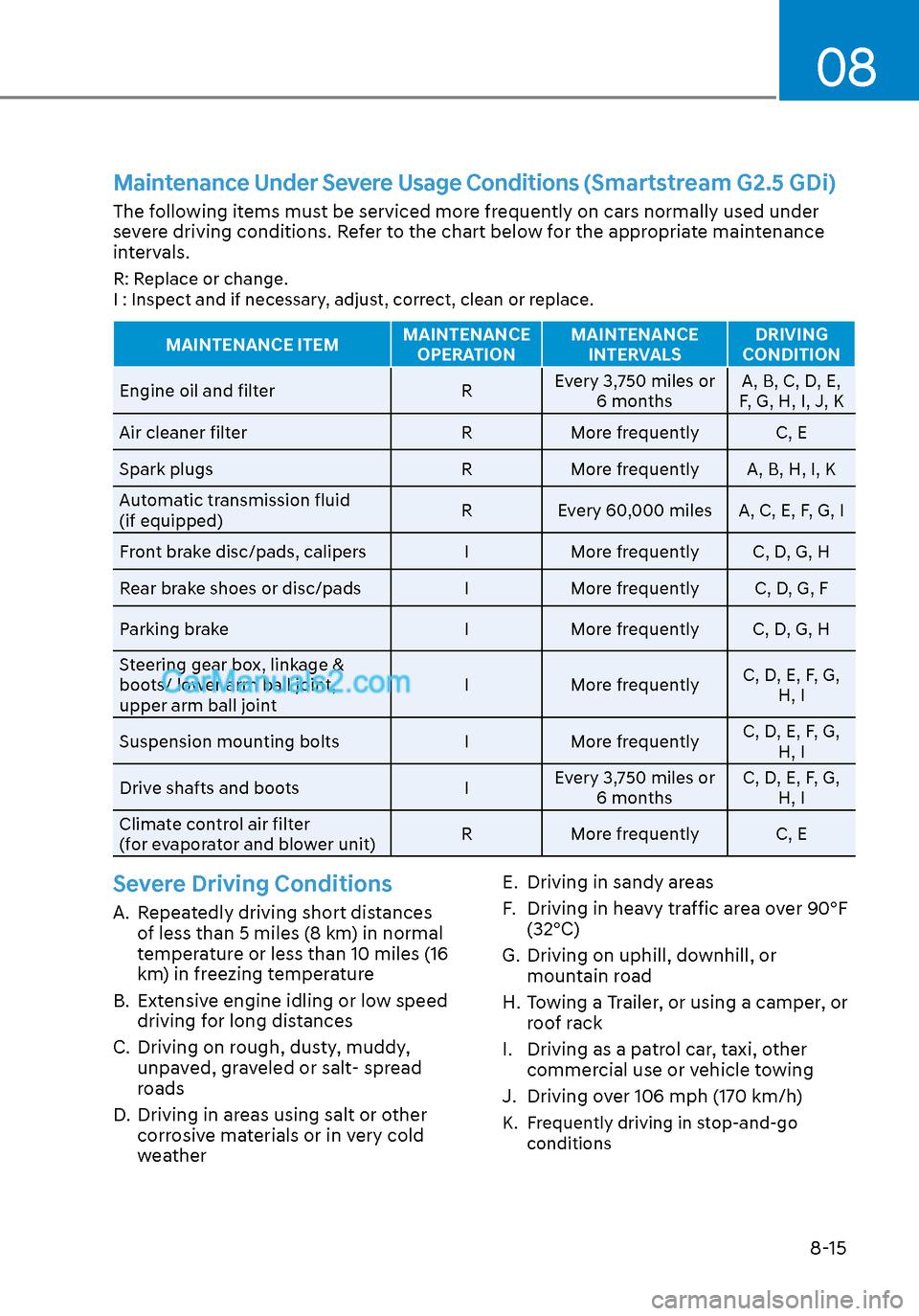
Maintenance Under Severe Usage Conditions (Smartstream G2.5 GDi)
The following items must be serviced more frequently on cars normally used under
severe driving conditions. Refer to the chart below for the appropriate maintenance
intervals.
R: Replace or change.
I : Inspect and if necessary, adjust, correct, clean or replace.
MAINTENANCE ITEMMAINTENANCE
OPERATION MAINTENANCE
INTERVALS DRIVING
CONDITION
Engine oil and filter RE
very 3,750 miles or
6 months A, B, C, D, E,
F, G, H, I, J, K
Air cleaner filter RMore frequently C, E
Spark plugs RMore frequently A, B, H, I, K
Automatic transmission fluid
(if equipped) R Every 60,000 miles A, C, E, F, G, I
Front brake disc/pads, calipers IMore frequently C, D, G, H
Rear brake shoes or disc/pads IMore frequently C, D, G, F
Parking brake IMore frequently C, D, G, H
Steering gear box, linkage &
boots/ lower arm ball joint,
upper arm ball joint I
More frequently C, D, E, F, G,
H, I
Suspension mounting bolts IMore frequently C, D, E, F, G,
H, I
Drive shafts and boots IEvery 3,750 miles or
6 months C, D, E, F, G,
H, I
Climate control air filter
(for evaporator and blower unit) R
More frequently C, E
Severe Driving Conditions
A. Repeatedly driving short distances
of less than 5 miles (8 km) in normal
temperature or less than 10 miles (16
km) in freezing temperature
B. Extensive engine idling or low speed driving for long distances
C. Driving on rough, dusty, muddy, unpaved, graveled or salt- spread
roads
D. Driving in areas using salt or other corrosive materials or in very cold
weather E. Driving in sandy areas
F. Driving in heavy traffic area over 90°F
(32°C)
G. Driving on uphill, downhill, or mountain road
H. Towing a Trailer, or using a camper, or roof rack
I. Driving as a patrol car, taxi, other commercial use or vehicle towing
J. Driving over 106 mph (170 km/h)
K. Frequently driving in stop-and-go conditions
Page 472 of 537
08
8-25
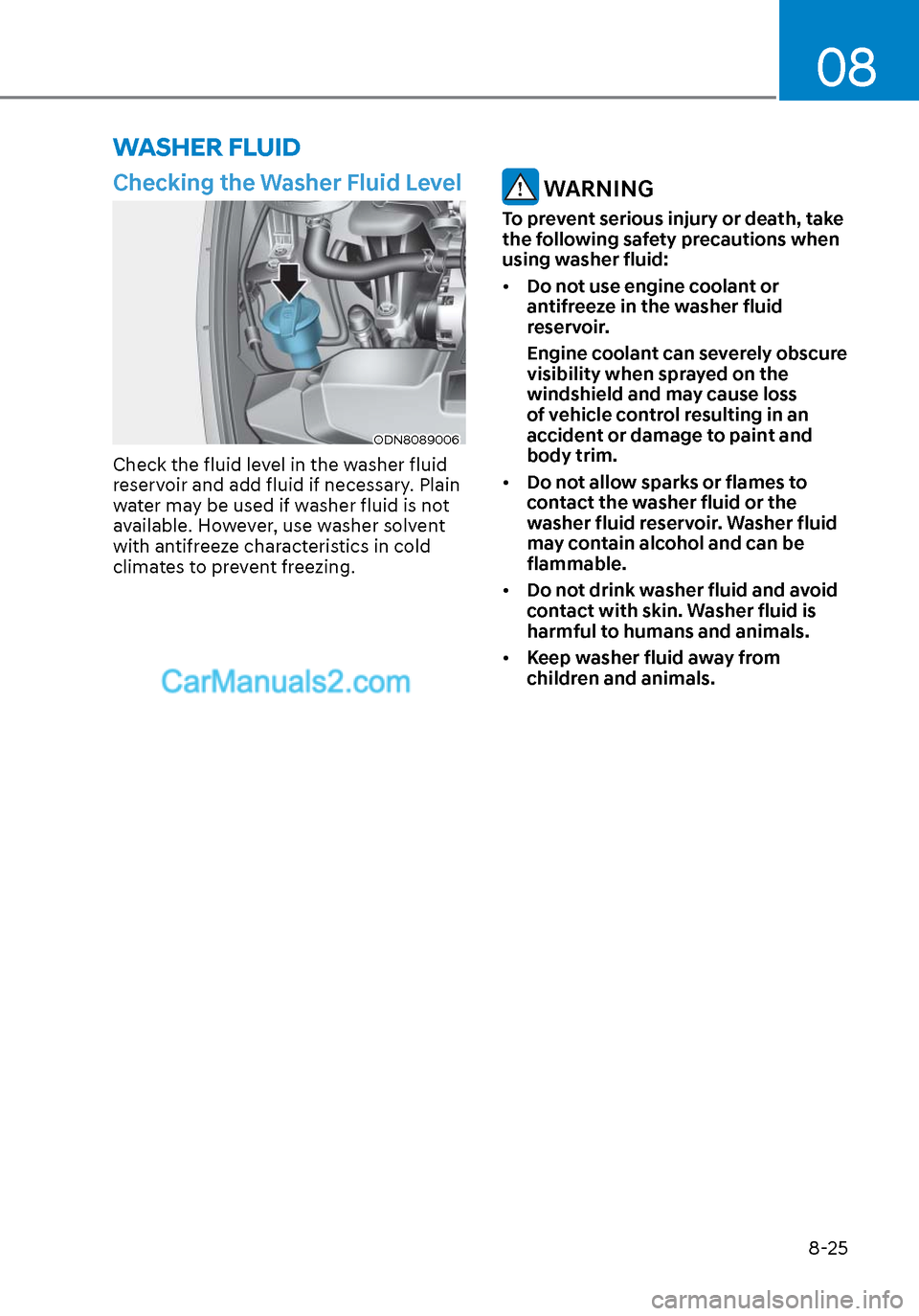
Checking the Washer Fluid Level
ODN8089006ODN8089006
Check the fluid level in the washer fluid
reservoir and add fluid if necessary. Plain
water may be used if washer fluid is not
available. However, use washer solvent
with antifreeze characteristics in cold
climates to prevent freezing.
WARNING
To prevent serious injury or death, take
the following safety precautions when
using washer fluid:
• Do not use engine coolant or
antifreeze in the washer fluid
reservoir.
Engine coolant can severely obscure
visibility when sprayed on the
windshield and may cause loss
of vehicle control resulting in an
accident or damage to paint and
body trim.
• Do not allow sparks or flames to
contact the washer fluid or the
washer fluid reservoir. Washer fluid
may contain alcohol and can be
flammable.
• Do not drink washer fluid and avoid
contact with skin. Washer fluid is
harmful to humans and animals.
• Keep washer fluid away from
children and animals.
WASHER FLUID