vent Hyundai Sonata 2020 Owner's Manual
[x] Cancel search | Manufacturer: HYUNDAI, Model Year: 2020, Model line: Sonata, Model: Hyundai Sonata 2020Pages: 537, PDF Size: 14.54 MB
Page 6 of 537

Introduction........................................................................\
............................. 1-2
Hyundai Motor America
........................................................................\
.........1-2
Guide to Hyundai Genuine Parts
...................................................................1-3
How to Use This Manual
........................................................................\
.........1-4
Safety Messages
........................................................................\
.....................1-4
Fuel Requirements
........................................................................\
..................1-5
Vehicle Modifications
........................................................................\
.............1 -7
Vehicle Break-In Process
........................................................................\
........1 -7
Vehicle Data Collection and Event Data Recorders
....................................1-8
Foreword
1. Foreword
1
Page 10 of 537
01
1-5
Your new vehicle is designed to obtain
maximum performance with UNLEADED
FUEL, as well as minimize exhaust
emissions and spark plug fouling.
Your new vehicle is designed to use only
unleaded fuel having an octane number
((R+M)/2) of 87 (Research Octane
Number 91) or higher. (Do not use
methanol blended fuels)
NOTICE
To prevent damage to the engine and
engine components, never add any fuel
system cleaning agents to the fuel tank
other than what has been specified.
Consult an authorized HYUNDAI dealer
for additional information.
WARNING
• Do not “top off” after the nozzle
automatically shuts off when
refueling.
• Always check that the fuel cap is
installed securely to prevent fuel
spillage in the event of an accident.
FUEL REQUIREMENTS
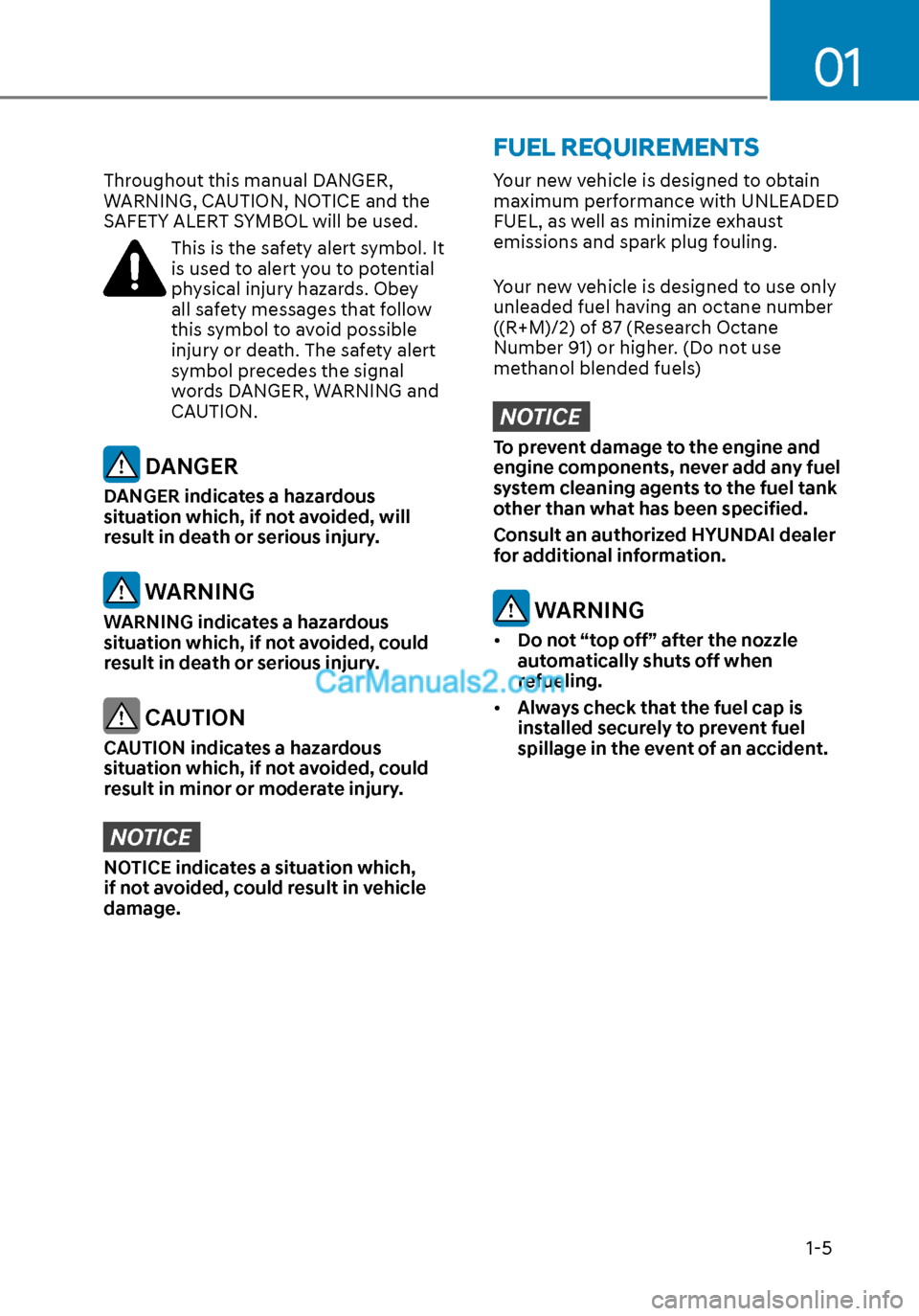
Throughout this manual DANGER,
WARNING, CAUTION, NOTICE and the
SAFETY ALERT SYMBOL will be used.
This is the safety alert symbol. It is used to alert you to potential
physical injury hazards. Obey
all safety messages that follow
this symbol to avoid possible
injury or death. The safety alert
symbol precedes the signal
words DANGER, WARNING and
CAUTION.
DANGER
DANGER indicates a hazardous
situation which, if not avoided, will
result in death or serious injury.
WARNING
WARNING indicates a hazardous
situation which, if not avoided, could
result in death or serious injury.
CAUTION
CAUTION indicates a hazardous
situation which, if not avoided, could
result in minor or moderate injury.
NOTICE
NOTICE indicates a situation which,
if not avoided, could result in vehicle
damage.
Page 11 of 537
Foreword
1-6
Gasoline containing alcohol or
methanol
Gasohol, a mixture of gasoline and
ethanol (also known as grain alcohol) are
being marketed along with or instead
of leaded or unleaded gasoline. For
example, “E15” is a gasohol comprised of
15% ethanol and 85% gasoline.
Do not use gasohol containing more than
15% ethanol, and do not use gasoline or
gasohol containing any methanol. Either
of these fuels may cause drivability
problems and damage to the fuel
system, engine control system and
emission control system.
Discontinue using gasohol of any kind if
drivability problems occur.
“E85” fuel is an alternative fuel
comprised of 85 percent ethanol and 15
percent gasoline, and is manufactured
exclusively for use in Flexible Fuel
Vehicles. “E85” is not compatible with
your vehicle. Use of “E85” may result in
poor engine performance and damage
to your vehicle’s engine and fuel system.
HYUNDAI recommends that customers
do not use fuel with an ethanol content
exceeding 15 percent.
NOTICE
To prevent damage to your vehicle’s
engine and fuel system:
• Never use gasohol which contains
methanol.
• Never use gasohol containing more
than 15% ethanol.
• Never use leaded fuel or leaded
gasohol.
• Never use “E85” fuel.
Your New Vehicle Limited Warranty
does not cover damage to the fuel
system or any performance problems
caused by the use of “E85” fuel.
Using Fuel Additives (except
Detergent Fuel Additives)
Using fuel additives such as:
- Silicone fuel additive
-Ferrocene (iron-based) fuel additive
-Other metallic-based fuel additives
may result in cylinder misfire, poor
acceleration, engine stalling, damage
to the catalyst, or abnormal corrosion,
and may cause damage to the engine
resulting in a reduction in the overall life
of the powertrain.
- The Malfunction Indicator Lamp (MIL)
may illuminate.
NOTICE
Damage to the fuel system or
performance problem caused by the
use of these fuels or fuel additives may
not be covered by your New Vehicle
Limited Warranty.
Gasoline containing MMT
Some gasoline contains harmful
manganese-based fuel additives such
as MMT (Methylcyclopentadienyl
Manganese Tricarbonyl).
HYUNDAI does not recommend the use
of gasoline containing MMT.
This type of fuel can reduce vehicle
performance and affect your emission
control system.
The malfunction indicator lamp on the
cluster may come on.
Page 12 of 537
01
1 -7
Detergent Fuel Additives
HYUNDAI recommends that you use
good quality gasolines treated with
detergent additives such as TOP TIER
Detergent Gasoline, which help prevent
deposit formation in the engine. These
gasolines will help the engine run
cleaner and enhance performance of
the Emission Control System. For more
information on TOP TIER Detergent
Gasoline, please go to the website (www.
toptiergas.com ).
For customers who do not use TOP Tier
Detergent Gasoline regularly, and have
problems starting or the engine does
not run smoothly, detergent-based
fuel additives that you can purchase
separately may be added to the gasoline.
If TOP TIER Detergent Gasoline is
not available, one bottle of additive
added to the fuel tank according to the
maintenance schedule is recommended
(refer to the Maintenance Schedule in
chapter 8).
Additives are available from your
authorized HYUNDAI dealer along with
information on how to use them. Do not
mix other additives.
Operation in foreign countries
If you are going to drive your vehicle in
another country, be sure to:
• Observe all regulations regarding
registration and insurance.
• Determine that acceptable fuel is
available. •
This vehicle should not be modified.
Modification of your vehicle could
affect its performance, safety or
durability and may even violate
governmental safety and emissions
regulations.
In addition, damage or performance
problems resulting from any
modification may not be covered
under warranty.
• If you use unauthorized electronic
devices, it may cause the vehicle to
operate abnormally, wire damage,
battery discharge and fire. For your
safety, do not use unauthorized
electronic devices.
VEHICLE BREAK-IN
PROCESS
By following a few simple precautions for
the first 600 miles (1,000 km) you may
add to the performance, economy and
life of your vehicle.
• Do not race the engine.
• While driving, keep your engine speed
(rpm, or revolutions per minute)
between 2,000 rpm and 4,000 rpm.
• Do not maintain a single speed for
long periods of time, either fast or
slow. Varying engine speed is needed
to properly break-in the engine.
• Avoid hard stops, except in
emergencies, to allow the brakes to
seat properly.
VEHICLE MODIFICATIONS
Page 13 of 537
Foreword
1-8
VEHICLE DATA COLLECTION
AND EVENT DATA
RECORDERS
This vehicle is equipped with an event
data recorder (EDR). The main purpose
of an EDR is to record, in certain crash
or near crash-like situations, such as
an air bag deployment or hitting a
road obstacle, data that will assist in
understanding how a vehicle’s systems
performed. The EDR is designed to
record data related to vehicle dynamics
and safety systems for a short period of
time, typically 30 seconds or less. The
EDR in this vehicle is designed to record
such data as:
• How various systems in your vehicle
were operating;
• Whether or not the driver and
passenger safety belts were buckled/
fastened;
• How far (if at all) the driver was
depressing the accelerator and/or
brake pedal; and,
• How fast the vehicle was traveling.
This data can help provide a better
understanding of the circumstances in
which crashes and injuries occur. NOTE:
EDR data is recorded by your vehicle
only if a non-trivial crash situation
occurs; no data is recorded by the EDR
under normal driving conditions and
no personal data (e.g., name, gender,
age, and crash location) are recorded.
However, other parties, such as law
enforcement, could combine the
EDR data with the type of personally
identifying data routinely acquired
during a crash investigation.
To read data recorded by an EDR,
special equipment is required, and
access to the vehicle or the EDR is
needed. In addition to the vehicle
manufacturer, other parties, such as
law enforcement, that have the special
equipment, can read the information if
they have access to the vehicle or the
EDR.
WARNING
CALIFORNIA PROPOSITION 65
WARNING
Items contained in motor vehicles or
emitted from them are known to the
State of California to cause cancer and
birth defects or reproductive harm.
These include:
• Gasoline and its vapors
• Engine exhaust
• Used engine oil
• Interior passenger compartment
components and materials
• Component parts which are subject
to heat and wear
In addition, battery posts, terminals and
related accessories contain lead, lead
compounds and other chemicals known
to the State of California to cause
cancer and reproductive harm.
For more information go to
https://www.p65warnings.ca.gov/
passenger-vehicle
Page 25 of 537
Vehicle Information
2-12
Recommended SAE Viscosity
Number
CAUTION
Always be sure to clean the area around
any filler plug, drain plug, or dipstick
before checking or draining any
lubricant. This is especially important
in dusty or sandy areas and when the
vehicle is used on unpaved roads.
Cleaning the plug and dipstick areas
will prevent dirt and grit from entering
the engine and other mechanisms that
could be damaged.Engine oil viscosity (thickness) has an
effect on fuel economy and cold weather
operating (engine start and engine oil
flowability). Lower viscosity engine oils
can provide better fuel economy and
cold weather performance, however,
higher viscosity engine oils are required
for satisfactory lubrication in hot
weather.
Using oils of any viscosity other than
those recommended could result in
engine damage.
When choosing an oil, consider the
range of temperature your vehicle will be
operated in before the next oil change.
Proceed to select the recommended oil
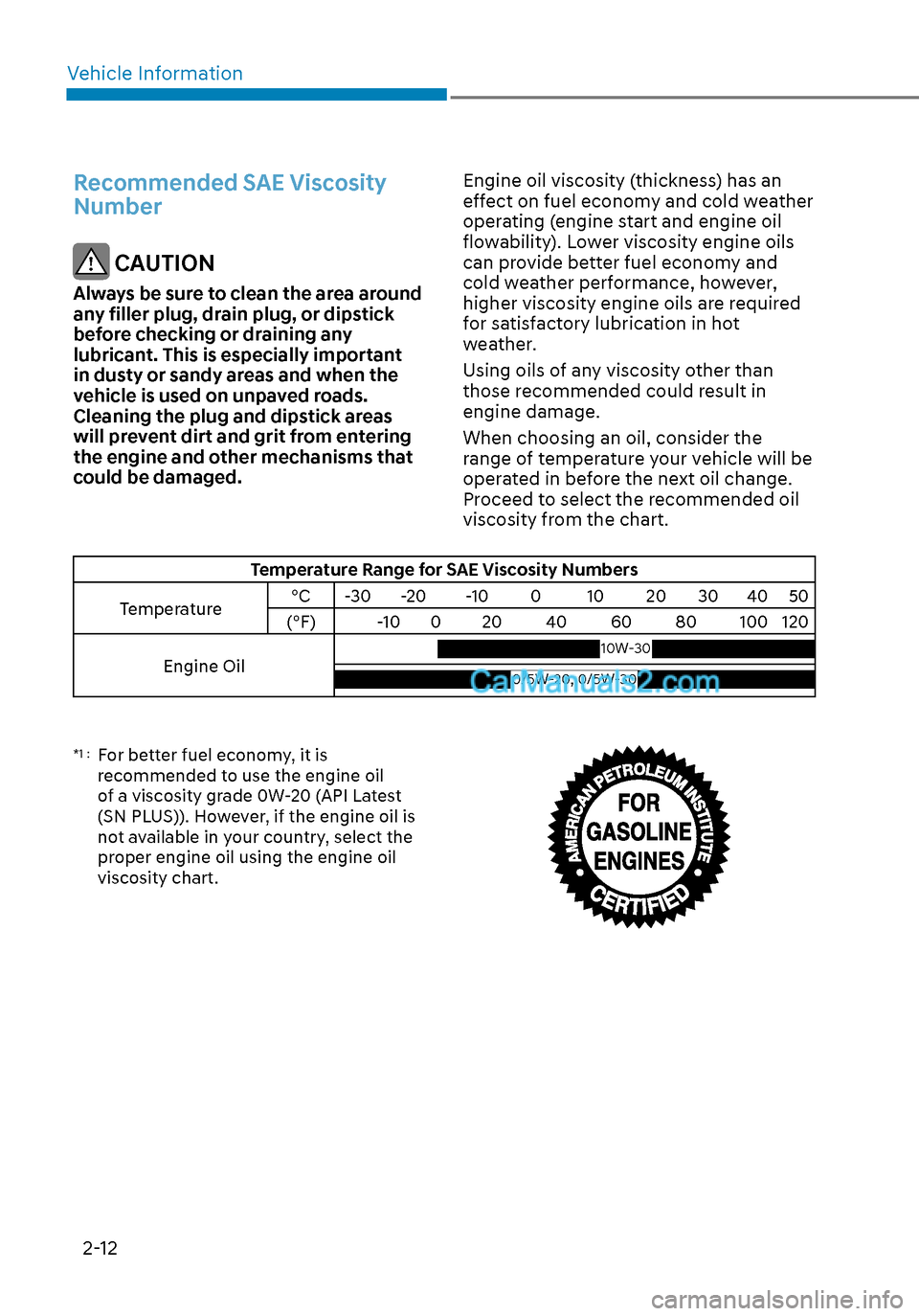
viscosity from the chart.
Temperature Range for SAE Viscosity Numbers
Temperature °C
-30 -20 -10 010 20304050
(°F) -10020 40 60 80100120
Engine Oil
10W-3010W-30
0/5W-20, 0/5W-300/5W-20, 0/5W-30
*1 : For better fuel economy, it is
recommended to use the engine oil
of a viscosity grade 0W-20 (API Latest
(SN PLUS)). However, if the engine oil is
not available in your country, select the
proper engine oil using the engine oil
viscosity chart.
Page 29 of 537
3. Seats & Safety System
3
Important Safety Precautions ....................................................................... 3-2
Always Wear Your Seat Belt ........................................................................\
............. 3-2
Restrain All Children ........................................................................\
......................... 3-2
Air Bag Hazards ........................................................................\
................................ 3-2
Driver Distraction ........................................................................\
............................. 3-2
Control Your Speed ........................................................................\
.......................... 3-2
Keep Your Vehicle in Safe Condition ....................................................................... 3-2
Seats .....................................................................\
.......................................... 3-3
Safety Precautions ........................................................................\
........................... 3-4
Front Seats ........................................................................\
........................................ 3-5
Rear Seats ........................................................................\
........................................3-10
Head Restraints ........................................................................\
................................3-11
Seat Warmers and Air Ventilation Seats ................................................................ 3-15
Seat Belts ........................................................................\
...............................3-19Seat Belt Safety Precautions ........................................................................\
..........3-19
Seat Belt Warning Light ........................................................................\
................. 3-20
Seat Belt Restraint System .....................................................................\
................ 3-21
Additional Seat Belt Safety Precautions ............................................................... 3-26
Care of Seat Belts ........................................................................\
........................... 3-28
Child Restraint System (CRS) ...................................................................... 3-29Children Always in the Rear ........................................................................\
........... 3-29
Selecting a Child Restraint System (CRS) ............................................................. 3-30
Installing a Child Restraint System (CRS) .............................................................. 3-31
Air Bag - Advanced Supplemental Restraint System ................................ 3-37Where Are the Air Bags? ........................................................................\
................ 3-39
How Does the Air Bag System Operate? ............................................................... 3-42
What to Expect After an Air Bag Inflates .............................................................. 3-46
Occupant Classification System (OCS) ................................................................. 3-47
Why Didn’t My Air Bag Go Off in a Collision? ....................................................... 3-52
SRS Care ........................................................................\
......................................... 3-56
Additional Safety Precautions ........................................................................\
....... 3-57
Air Bag Warning Labels ........................................................................\
.................. 3-57
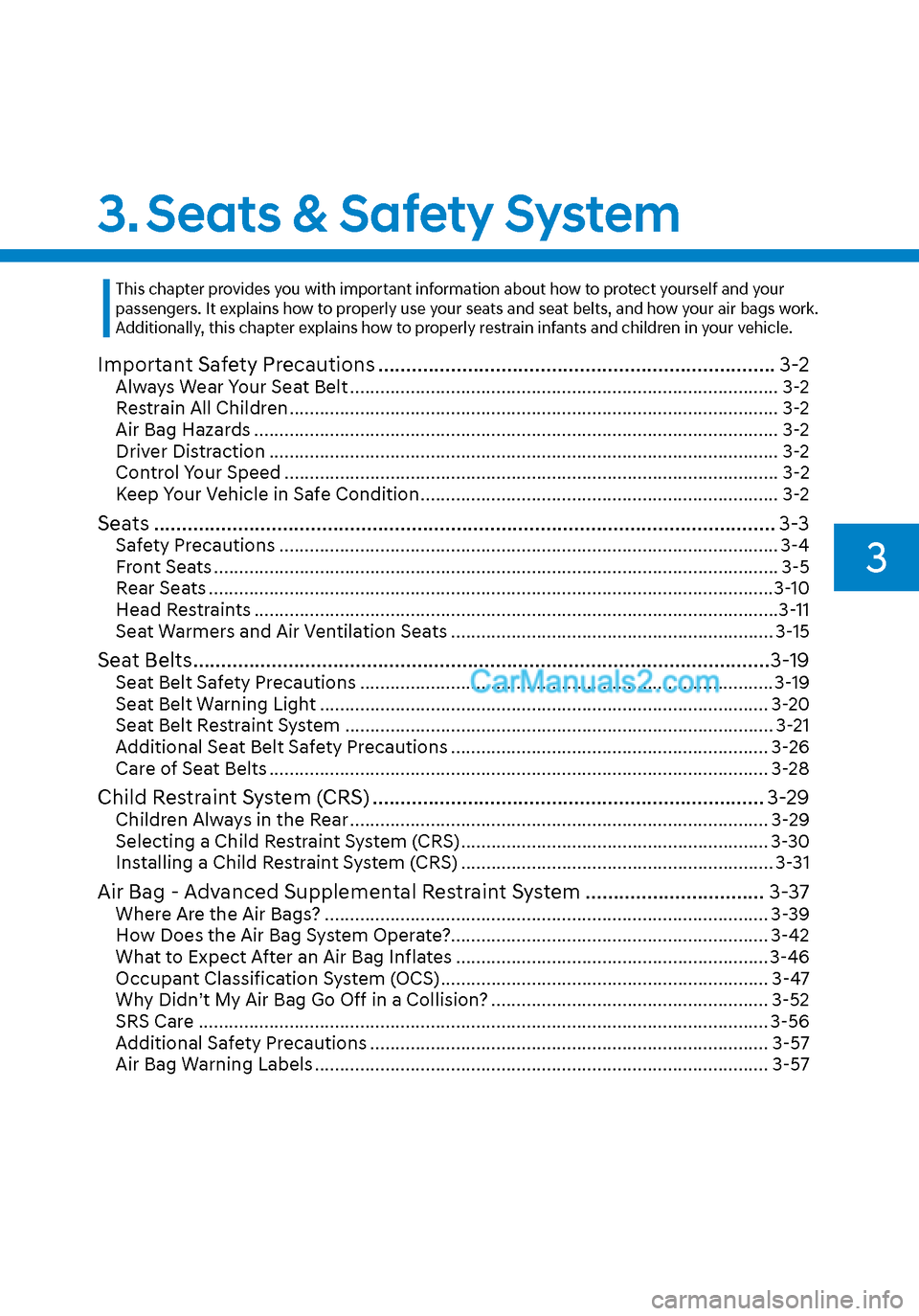
This chapter provides you with important information about how to protect yourself and your
passengers. It explains how to properly use your seats and seat belts, and how your air bags work.
Additionally, this chapter explains how to properly restrain infants and children in your vehicle.
Page 32 of 537
Seats & Safety System3-4
Safety Precautions
Adjusting the seats so that you are sitting
in a safe, comfortable position plays an
important role in driver and passenger
safety together with the seat belts and
air bags in an accident.
WARNING
Do not use a cushion that reduces
friction between the seat and the
passenger. The passenger’s hips may
slide under the lap portion of the seat
belt during an accident or a sudden
stop. Serious or fatal internal injuries
could result because the seat belt
cannot operate properly.
Air bags
You can take steps to reduce the risk
of being injured by an inflating air bag.
Sitting too close to an air bag greatly
increases the risk of injury in the event
the air bag inflates.
The National Highway Traffic Safety
Administration (NHTSA) recommends
that drivers allow at least 10 inches (25
cm) between the center of the steering
wheel and their chest.
WARNING
To reduce the risk of serious injury or
death from an inflating air bag, take the
following precautions:
• Adjust the driver’s seat as far to the
rear as possible while maintaining
the ability to maintain full control of
the vehicle.
• Adjust the front passenger seat as far
to the rear as possible.
• Hold the steering wheel by the rim
with hands at the 9 o’clock and 3
o’clock positions to minimize the risk
of injuries to your hands and arms. •
NEVER place anything or anyone
between the steering wheel and the
air bag.
• Do not allow the front passenger to
place feet or legs on the dashboard
to minimize the risk of leg injuries.
Seat belts
Always fasten your seat belt before
starting any trip.
At all times, passengers should sit
upright and be properly restrained.
Infants and small children must be
restrained in appropriate child restraint
systems. Adults and children who
have outgrown a booster seat must be
restrained using the seat belts.
WARNING
Take the following precautions when
adjusting your seat belt:
• NEVER use one seat belt for more
than one occupant.
• Always position the seatback upright
with the lap portion of the seat belt
snug and low across the hips.
• NEVER allow children or small infants
to ride on a passenger’s lap.
• Do not route the seat belt across your
neck, across sharp edges, or reroute
the shoulder strap away from your
body.
• Do not allow the seat belt to become
caught or jammed.
Page 33 of 537
03
3-5
Front Seats
WARNING
Take the following precautions when
adjusting your seat:
• NEVER attempt to adjust the seat
while the vehicle is moving. The seat
could respond with unexpected
movement and may cause loss
of vehicle control resulting in an
accident.
• Do not place anything under the
front seats. Loose objects in the
driver’s foot area could interfere
with the operation of the foot pedals,
causing an accident.
• Do not allow anything to interfere
with the normal position and proper
locking of the seatback.
• Do not place a cigarette lighter on
the floor or seat. When you operate
the seat, gas may exit out of the
lighter causing a fire.
• Use extreme caution when picking
up small objects trapped under the
seats or between the seat and the
center console. Your hands might be
cut or injured by the sharp edges of
the seat mechanism.
• If there are occupants in the rear
seats, be careful while adjusting the
front seat position.
• Make sure that the seat is locked in
place after the adjustment. If not,
the seat might move unexpectedly
resulting in an accident.
CAUTION
To prevent injury:
• Do not adjust your seat while
wearing your seat belt. Moving the
seat cushion forward may cause
strong pressure on your abdomen.
• Do not allow your hands or fingers to
get caught in the seat mechanisms
while the seat is moving.
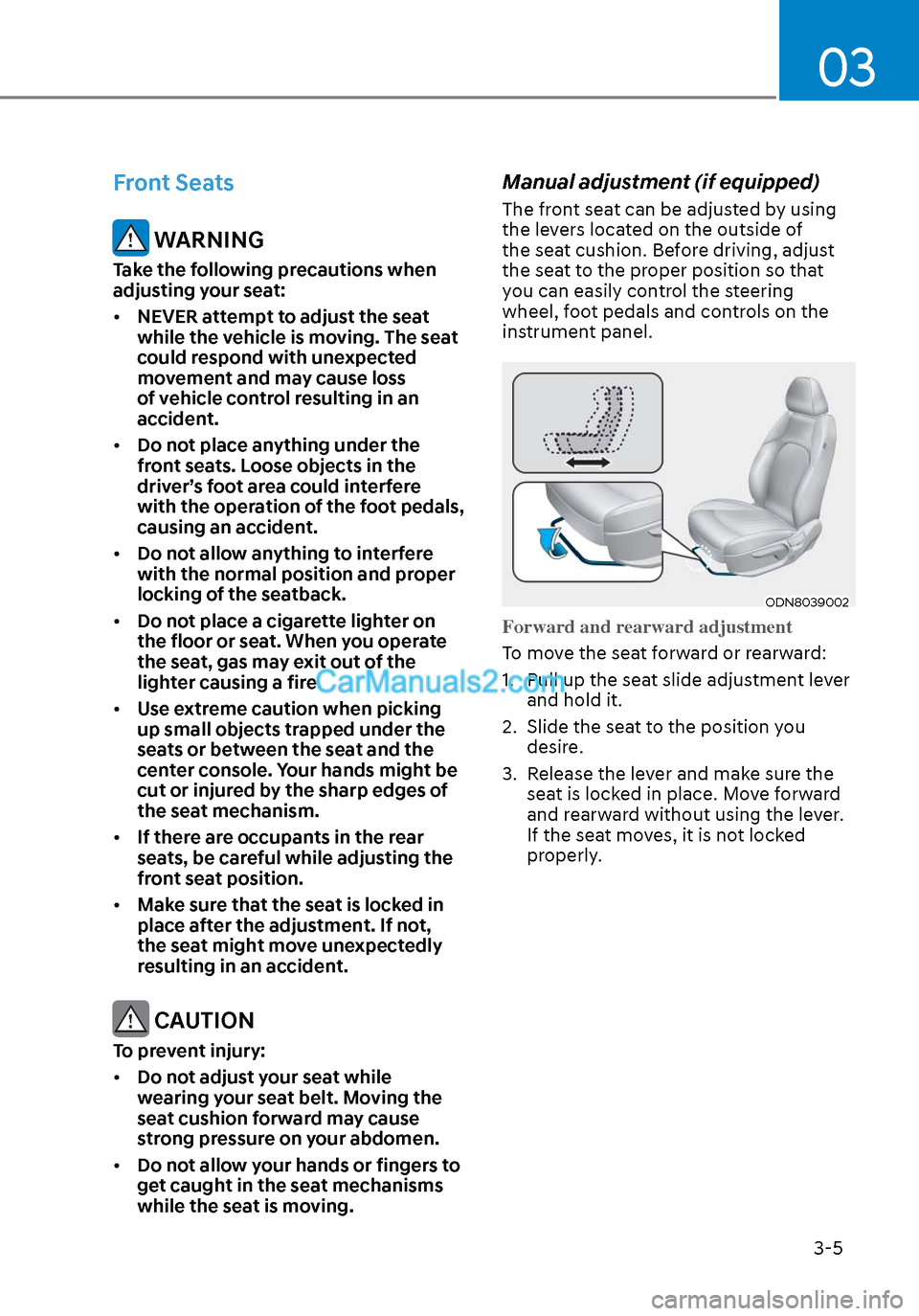
Manual adjustment (if equipped)
The front seat can be adjusted by using
the levers located on the outside of
the seat cushion. Before driving, adjust
the seat to the proper position so that
you can easily control the steering
wheel, foot pedals and controls on the
instrument panel.
ODN8039002ODN8039002
Forward and rearward adjustment
To move the seat forward or rearward:
1.
Pull up the seat slide adjustment lever
and hold it.
2. Slide the seat to the position you desire.
3. Release the lever and make sure the seat is locked in place. Move forward
and rearward without using the lever.
If the seat moves, it is not locked
properly.
Page 34 of 537
Seats & Safety System3-6
ODN8039003ODN8039003
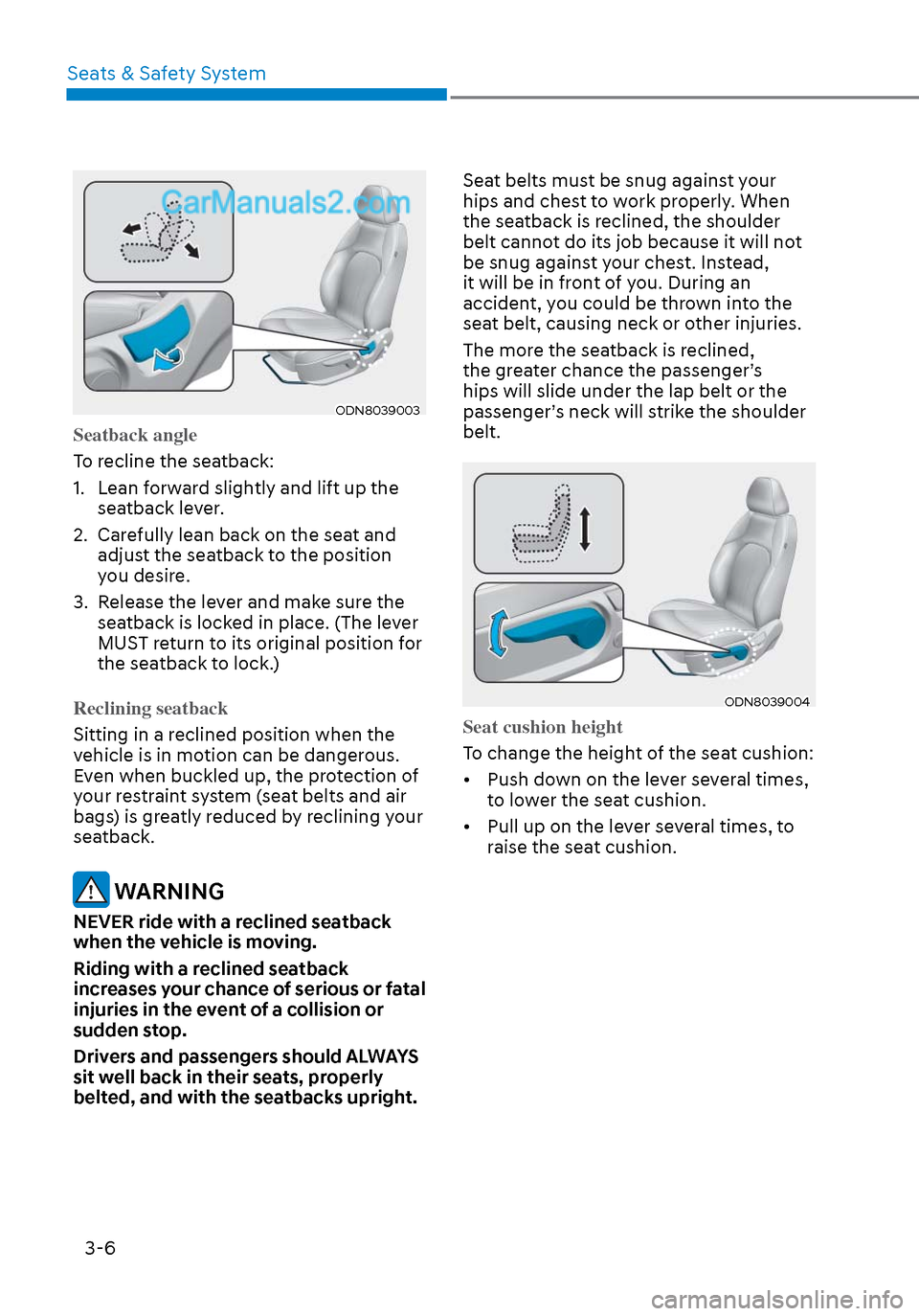
Seatback angle
To recline the seatback:
1.
Lean forward slightly and lift up the
seatback lever.
2. Carefully lean back on the seat and adjust the seatback to the position
you desire.
3. Release the lever and make sure the seatback is locked in place. (The lever
MUST return to its original position for
the seatback to lock.)
Reclining seatback
Sitting in a reclined position when the
v
ehicle is in motion can be dangerous.
Even when buckled up, the protection of
your restraint system (seat belts and air
bags) is greatly reduced by reclining your
seatback.
WARNING
NEVER ride with a reclined seatback
when the vehicle is moving.
Riding with a reclined seatback
increases your chance of serious or fatal
injuries in the event of a collision or
sudden stop.
Drivers and passengers should ALWAYS
sit well back in their seats, properly
belted, and with the seatbacks upright. Seat belts must be snug against your
hips and chest to work properly. When
the seatback is reclined, the shoulder
belt cannot do its job because it will not
be snug against your chest. Instead,
it will be in front of you. During an
accident, you could be thrown into the
seat belt, causing neck or other injuries.
The more the seatback is reclined,
the greater chance the passenger’s
hips will slide under the lap belt or the
passenger’s neck will strike the shoulder
belt.
ODN8039004ODN8039004
Seat cushion height
To change the height of the seat cushion:
•
Push down on the lever several times,
to lower the seat cushion.
• Pull up on the lever several times, to raise the seat cushion.