wheel HYUNDAI SONATA 2021 Owners Manual
[x] Cancel search | Manufacturer: HYUNDAI, Model Year: 2021, Model line: SONATA, Model: HYUNDAI SONATA 2021Pages: 546, PDF Size: 51.21 MB
Page 456 of 546

Tires and Wheels ........................................................................\
..................8- 34Tire Care ........................................................................\
..........................................8- 34
Recommended Cold Tire Inflation Pressures .......................................................8-34
Check Tire Inflation Pressure
........................................................................\
......... 8-35
Tire Rotation
........................................................................\
................................... 8-36
Wheel Alignment and Tire Balance
....................................................................... 8-
37
Tire Replacement
........................................................................\
........................... 8-38
Wheel Replacement
........................................................................\
....................... 8-39
Tire Traction
........................................................................\
.................................... 8-39
Tire Maintenance........................................................................\
............................ 8-39
Tire Sidewall Labeling
........................................................................\
.................... 8-39
Tire Terminology and Definitions
........................................................................\
.. 8-43
All Season Tir
es ........................................................................\
............................... 8-46
Summer Tires
........................................................................\
................................. 8-46
Snow Tires........................................................................\
.......................................8-46
Radial-Ply Tires
........................................................................\
............................... 8-46
Low Aspect Ratio Tires
........................................................................\
................... 8-47
Fuses ........................................................................\
.................................... 8-48Instrument Panel Fuse Replacement ....................................................................8-49
E ngine Compartment Panel Fuse Replacement ..................................................8-50
Fuse/Relay Panel Description........................................................................\
.........8-51
Light Bulbs ........................................................................\
............................ 8-57Headlamp, Parking Lamp, Daytime Running Light, Turn Signal Lamp,
Cornering Lamp and Side Marker
........................................................................\
. 8-57
Side R
epeater Lamp Replacement ...................................................................... 8-58
Rear Combination Light Bulb Replacement
.........................................................8-58
High Mounted Stop Lamp Replacement
.............................................................8-60
License Plate Light Bulb Replacement
................................................................ 8-60
In
terior Light Bulb Replacement
........................................................................\
... 8-61
Appearance Care ........................................................................\
................. 8-63Exterior Care ........................................................................\
................................... 8-63
In terior Care ........................................................................\
.................................... 8-67
Emission Control System ........................................................................\
....8-69
Calif ornia perchlorate notice
...................................................................... 8-
72
Consumer Information
........................................................................\
........ 8-73
Reporting Safety Defects
........................................................................\
.... 8
-74
8
Page 457 of 546

8-3
08
Tires and Wheels ........................................................................\
..................8-34Tire Care ........................................................................\
.......................................... 8-34
Recommended Cold Tire Inflation Pressures ....................................................... 8-34
Check Tire Inflation Pressure ........................................................................\
......... 8-35
Tire Rotation ........................................................................\
................................... 8-36
Wheel Alignment and Tire Balance ....................................................................... 8-37
Tire Replacement ........................................................................\
........................... 8-38
Wheel Replacement ........................................................................\
....................... 8-39
Tire Traction ........................................................................\
.................................... 8-39
Tire Maintenance........................................................................\
............................ 8-39
Tire Sidewall Labeling ........................................................................\
.................... 8-39
Tire Terminology and Definitions ........................................................................\
.. 8-43
All Season Tires ........................................................................\
............................... 8-46
Summer Tires ........................................................................\
................................. 8-46
Snow Tires........................................................................\
.......................................8-46
Radial-Ply Tires ........................................................................\
............................... 8-46
Low Aspect Ratio Tires ........................................................................\
................... 8-47
Fuses ........................................................................\
....................................8-48Instrument Panel Fuse Replacement .................................................................... 8-49
Engine Compartment Panel Fuse Replacement .................................................. 8-50
Fuse/Relay Panel Description........................................................................\
.........8-51
Light Bulbs ........................................................................\
............................ 8-57Headlamp, Parking Lamp, Daytime Running Light, Turn Signal Lamp,
Cornering Lamp and Side Marker ........................................................................\
. 8-57
Side Repeater Lamp Replacement ...................................................................... 8-58
Rear Combination Light Bulb Replacement ......................................................... 8-58
High Mounted Stop Lamp Replacement ............................................................. 8-60
License Plate Light Bulb Replacement ................................................................ 8-60
Interior Light Bulb Replacement ........................................................................\
... 8-61
Appearance Care ........................................................................\
................. 8-63Exterior Care ........................................................................\
................................... 8-63
Interior Care ........................................................................\
.................................... 8-67
Emission Control System ........................................................................\
.... 8-69
California perchlorate notice ...................................................................... 8-72
Consumer Information ........................................................................\
........ 8-73
Reporting Safety Defects ........................................................................\
.... 8 -74
1. Engine coolant reservoir
2.
Br
ake fluid reservoir
3.
Air cleaner
4.
E
ngine oil dipstick 5.
E ngine oil filler cap
6.
Windshield w
asher fluid reservoir
7.
F
use box
8.
Ba
ttery
EnginE CompartmEnt
„„Smartstream G1.6 T-GDi
„„Smartstream G2.5 GDi
The actual engine room in the vehicle may differ from the illustration.ODN8089103/ ODN8089048L
Page 460 of 546
Maintenance
8-6
While operating your vehicle:
• Note any changes in the sound of the
exhaust or any smell of exhaust fumes
in the vehicle.
• Check for vibrations in the steering
wheel. Notice if there is any increased
steering effort or looseness in the
steering wheel, or change in its
straight-ahead position.
• Notice if your vehicle constantly turns
slightly or “pulls” to one side when
traveling on smooth, level road.
• When stopping, listen and check for
unusual sounds, pulling to one side,
increased brake pedal travel or “hard-
to-push” brake pedal.
• If any slipping or changes in the
operation of your transmission occurs,
check the transmission fluid level.
• Check the automatic transmission P
(Park) function.
• Check the parking brake.
• Check for fluid leaks under your
vehicle (water dripping from the air
conditioning system during or after
use is normal).
At least monthly:
• Check coolant level in the engine
coolant reservoir.
• Check the operation of all exterior
lights, including the brake lights, turn
signals and hazard warning flashers.
• Check the inflation pressures of all
tires including the spare for tires that
are worn, show uneven wear, or are
damaged.
• Check for loose wheel lug nuts.
At least twice a year:
(i.e., every Spring and Autumn)
• Check radiator, heater and air
conditioning hoses for leaks or
damage.
• Check windshield washer spray and
wiper operation. Clean wiper blades
with a clean cloth dampened with
washer a fluid.
• Check headlamp alignment.
• Check muffler, exhaust pipes, shields
and clamps.
• Check the seat belts for wear and
function.
At least once a year:
• Clean body and door drain holes.
• Lubricate door hinges and hood
hinges.
• Lubricate door and hood locks and
latches.
• Lubricate door rubber weather strips.
• Lubricate door checker.
• Check the air conditioning system.
• Inspect and lubricate automatic
transmission linkage and controls.
• Clean the battery and terminals.
• Check the brake fluid level.
Page 472 of 546
Maintenance
8-18
Suspension Mounting Bolts
Check the suspension connections for
looseness or damage. Retighten to the
specified torque.
Steering Gear Box, Linkage &
Boots/Lower Arm Ball Joint
With the vehicle stopped and the engine
off, check for excessive freeplay in the
steering wheel. Check the linkage for
bends or damage. Check the dust boots
and ball joints for deterioration, cracks,
or damage.
Replace any damaged parts.
Drive Shafts and Boots
Check the drive shafts, boots and clamps
for cracks, deterioration, or damage.
Replace any damaged parts and, if
necessary, repack the grease.
Air Conditioning Refrigerant
Check the air conditioning lines and
connections for leakage and damage.
Page 473 of 546
08
8-19
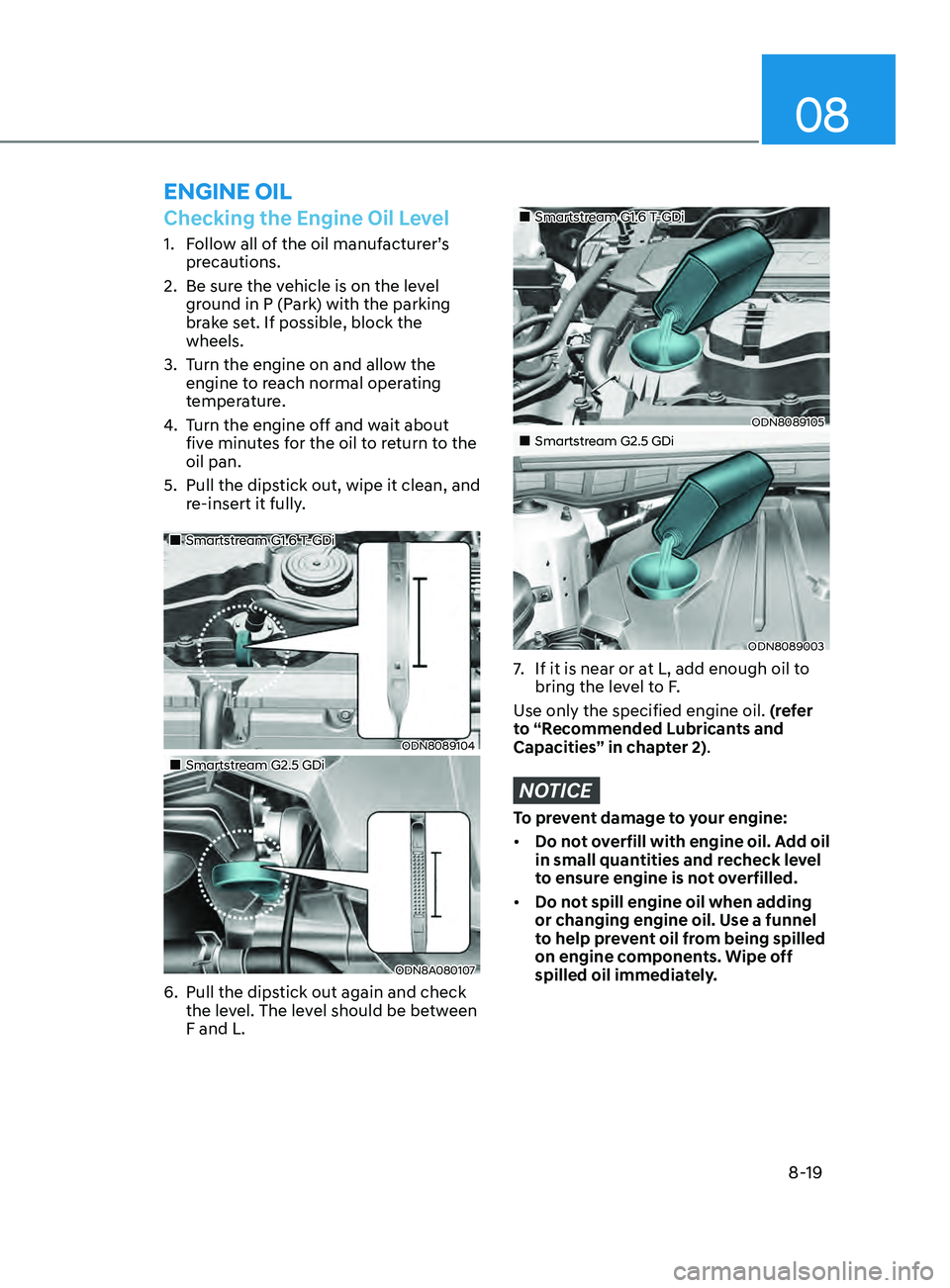
Checking the Engine Oil Level
1. Follow all of the oil manufacturer’s precautions.
2.
Be sur
e the vehicle is on the level
ground in P (Park) with the parking
brake set. If possible, block the
wheels.
3.
T
urn the engine on and allow the
engine to reach normal operating
temperature.
4.
T
urn the engine off and wait about
five minutes for the oil to return to the
oil pan.
5.
Pull the dips
tick out, wipe it clean, and
re-insert it fully.
„„Smartstream G1.6 T-GDi
ODN8089104
„„Smartstream G2.5 GDi
ODN8A080107
6. Pull the dips tick out again and check
the level. The level should be between
F and L.
„„Smartstream G1.6 T-GDi
ODN8089105
„„Smartstream G2.5 GDi
ODN8089003
7. If it is near or a t L, add enough oil to
bring the level to F.
Use only the specified engine oil. (refer
to “Recommended Lubricants and
Capacities” in chapter 2).
NOTICE
To prevent damage to your engine:
• Do not overfill with engine oil. Add oil
in small quantities and recheck level
to ensure engine is not overfilled.
• Do not spill engine oil when adding
or changing engine oil. Use a funnel
to help prevent oil from being spilled
on engine components. Wipe off
spilled oil immediately.
EnginE oil
Page 488 of 546
Maintenance
8-34
WARNING
Tire failure may cause loss of
vehicle control resulting in an
accident. To reduce risk of SERIOUS
INJURY or DEATH, take the
following precautions:
• Inspect your tires monthly for
proper inflation as well as wear
and damage.
• The recommended cold tire
pressure for your vehicle can be
found in this manual and on the
tire label located on the driver’s
side center pillar. Always use a
tire pressure gauge to measure
tire pressure. Tires with too
much or too little pressure wear
unevenly causing poor handling.
• Check the pressure of the
spare every time you check the
pressure of the other tires on
your vehicle.
• Replace tires that are worn, show
uneven wear, or are damaged.
Worn tires can cause loss of
braking effectiveness, steering
control, or traction.
• ALWAYS replace tires with
the same type, size, brand,
construction and tread pattern
as each tire that was originally
supplied with this vehicle. Using
tires and wheels other than the
recommended sizes could cause
unusual handling characteristics,
poor vehicle control, or
negatively affect your vehicle’s
Anti-Lock Brake System (ABS)
resulting in a serious accident.
Tire Care
For proper maintenance, safety, and
maximum fuel economy, you must
always maintain recommended
tire inflation pressures and stay
within the load limits and weight
distribution recommended for your
vehicle.
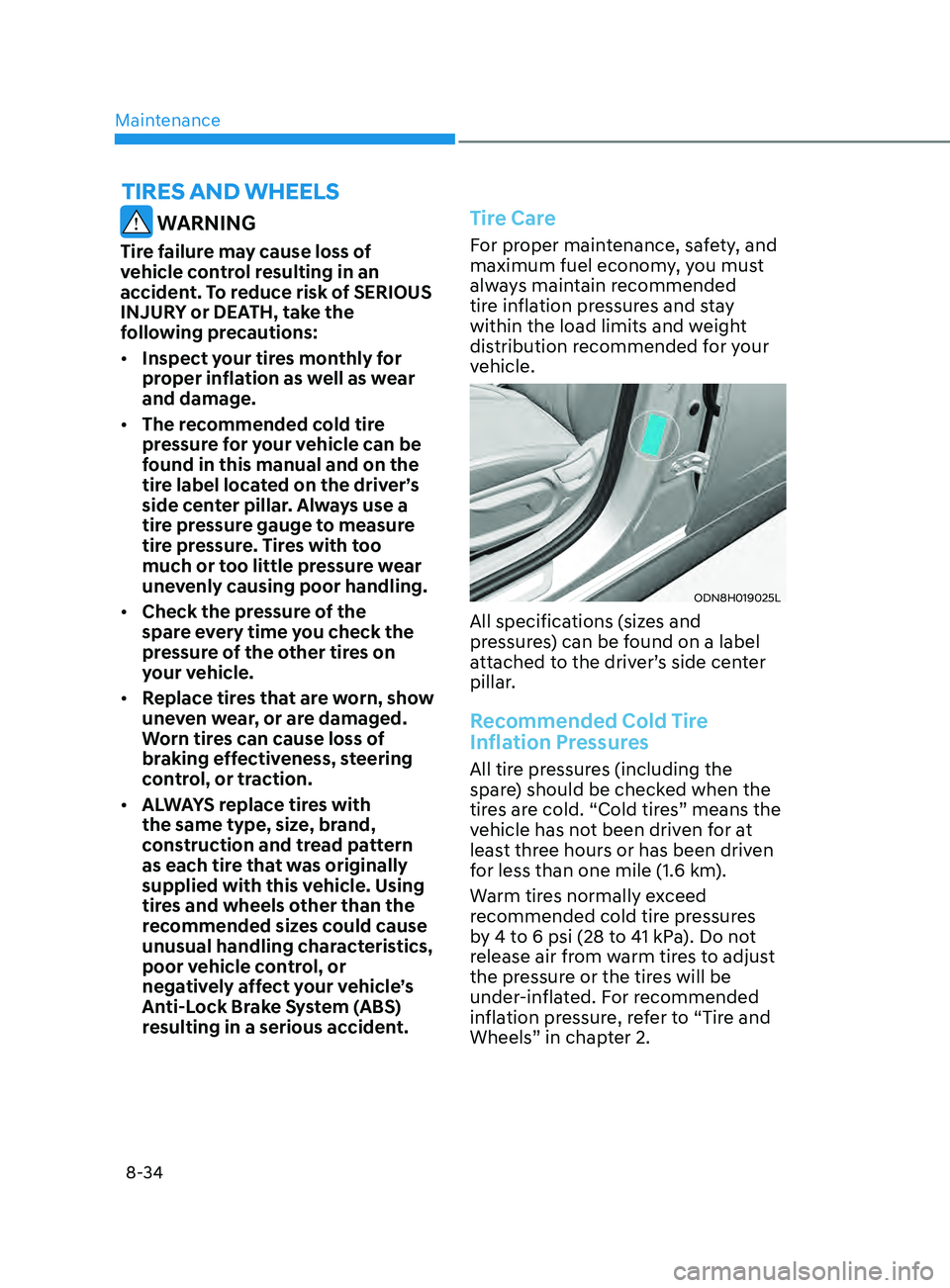
ODN8H019025L
All specifications (sizes and
pressures) can be found on a label
attached to the driver’s side center
pillar.
Recommended Cold Tire
Inflation Pressures
All tire pressures (including the
spare) should be checked when the
tires are cold. “Cold tires” means the
vehicle has not been driven for at
least three hours or has been driven
for less than one mile (1.6 km).
Warm tires normally exceed
recommended cold tire pressures
by 4 to 6 psi (28 to 41 kPa). Do not
release air from warm tires to adjust
the pressure or the tires will be
under-inflated. For recommended
inflation pressure, refer to “Tire and
Wheels” in chapter 2.
tirES and whEElS
Page 489 of 546
08
8-35
WARNING
Recommended pressures must be
maintained for the best ride, vehicle
handling, and minimum tire wear.
Over-inflation or under-inflation
can reduce tire life, adversely
affect vehicle handling, and lead to
sudden tire failure that could result
in loss of vehicle control resulting in
an accident.
Severe under-inflation can lead
to severe heat build-up, causing
blowouts, tread separation and
other tire failures that can result in
the loss of vehicle control resulting
in an accident. This risk is much
higher on hot days and when
driving for long periods at high
speeds.
CAUTION
• Under-inflation results in
excessive wear, poor handling
and reduced fuel economy.
Wheel deformation is also
possible. Keep your tire pressures
at the proper levels. If a tire
frequently needs refilling, have
it checked by an authorized
HYUNDAI dealer.
• Over-inflation produces a harsh
ride, excessive wear at the center
of the tire tread, and a greater
possibility of damage from road
hazards.
Check Tire Inflation Pressure
Check your tires, including the spare
tire, once a month or more.
How to check
Use a good quality tire pressure
gauge to check tire pressure. You
can not tell if your tires are properly
inflated simply by looking at them.
Radial tires may look properly
inflated when they are under-
inflated.
Remove the valve cap from the tire
valve stem. Press the tire gauge
firmly onto the valve to get a
pressure measurement. If the cold
tire inflation pressure matches the
recommended pressure on the tire
label located on the driver’s side
center pillar or in this manual. No
further adjustment is necessary. If
the pressure is low, add air until you
reach the recommended pressure.
Make sure to put the valve caps
back on the valve stems. Without
the valve cap, dirt or moisture could
get into the valve core and cause
air leakage. If a valve cap is missing,
install a new one as soon as possible.
If you overfill the tire, release air by
pushing on the metal stem in the
center of the tire valve. Recheck the
tire pressure with the tire gauge. Be
sure to put the valve caps back on
the valve stems. Without the valve
cap, dirt or moisture could get into
the valve core and cause air leakage.
If a valve cap is missing, install a new
one as soon as possible.
Page 490 of 546
Maintenance
8-36
A cold tire means the vehicle has
been sitting for 3 hours and driven
for less than 1 mile (1.6 km) in that 3
hour period.
Allow the tire to cool before
measuring the inflation pressure.
Always be sure the tire is cold before
inflating to the recommended
pressure.Tire Rotation
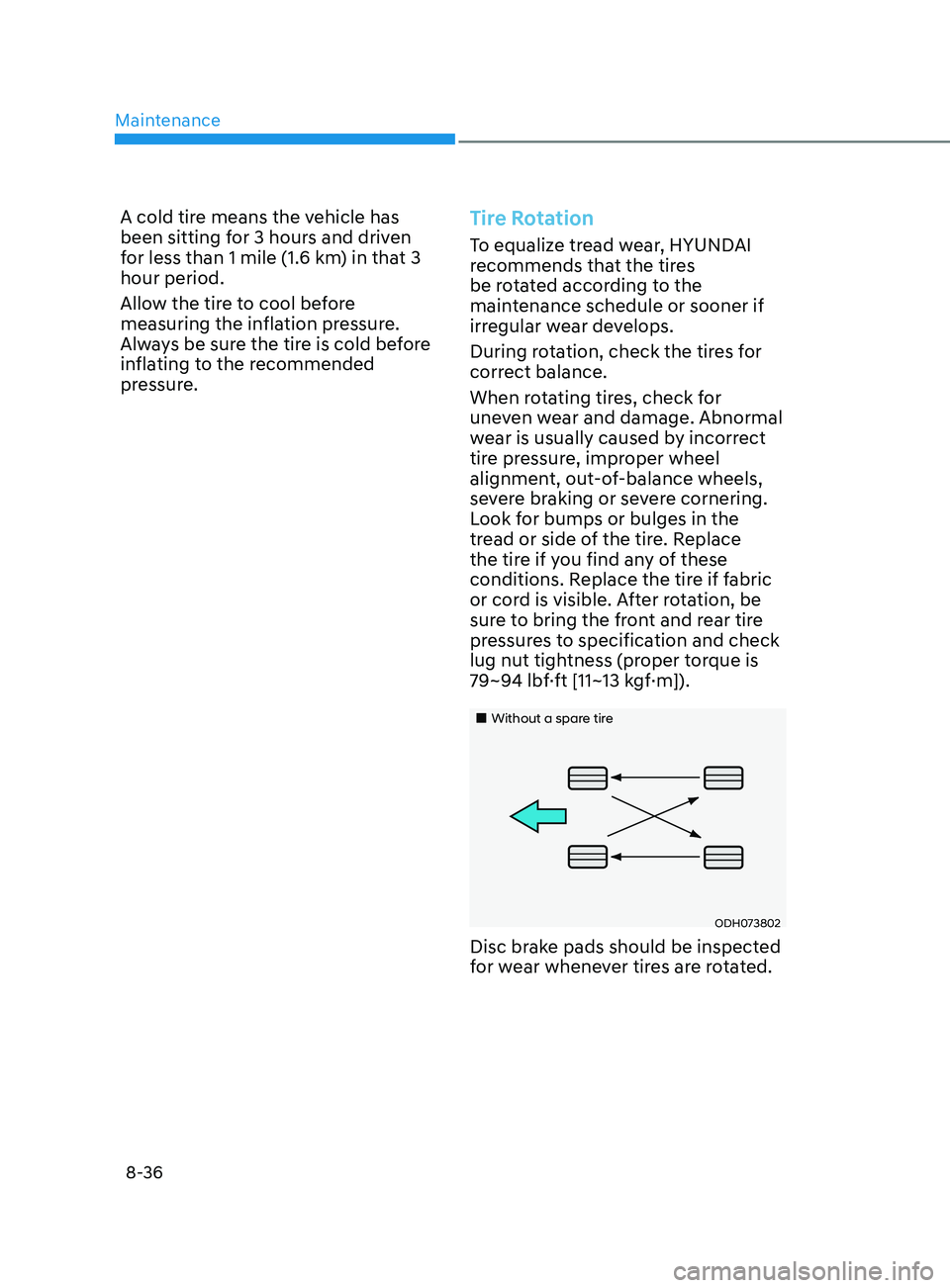
To equalize tread wear, HYUNDAI
recommends that the tires
be rotated according to the
maintenance schedule or sooner if
irregular wear develops.
During rotation, check the tires for
correct balance.
When rotating tires, check for
uneven wear and damage. Abnormal
wear is usually caused by incorrect
tire pressure, improper wheel
alignment, out-of-balance wheels,
severe braking or severe cornering.
Look for bumps or bulges in the
tread or side of the tire. Replace
the tire if you find any of these
conditions. Replace the tire if fabric
or cord is visible. After rotation, be
sure to bring the front and rear tire
pressures to specification and check
lug nut tightness (proper torque is
79~94 lbf·ft [11~13 kgf·m]).
„„Without a spare tire
ODH073802
Disc brake pads should be inspected
for wear whenever tires are rotated.
Page 491 of 546
08
8-37
Information
Tires that are asymmetrical or
directional can only be installed
on the wheel in one direction.
The outside and inside of an
asymmetrical tire is not easily
distinguishable. Pay careful
attention to the markings on the
sidewalls of the tires, noting the
“outside” marking and also the
rotating direction before installing
them on the vehicle.
WARNING
• Do not use the compact spare
tire for tire rotation.
• Do not mix bias ply and radial ply
tires under any circumstances.
This may cause unusual handling
characteristics that may cause
loss of vehicle control resulting in
an accident.
Wheel Alignment and Tire
Balance
The wheels on your vehicle were
aligned and balanced carefully at the
factory to give you the longest tire
life and best overall performance.
In most cases, you will not need to
have your wheels aligned again.
However, if you notice unusual tire
wear or your vehicle pulling one way
or the other, the alignment may need
to be reset.
If you notice your vehicle vibrating
when driving on a smooth road, your
wheels may need to be rebalanced.
NOTICE
Improper wheel weights can
damage your vehicle’s aluminum
wheels. Use only approved wheel
weights.
Page 492 of 546
Maintenance
8-38
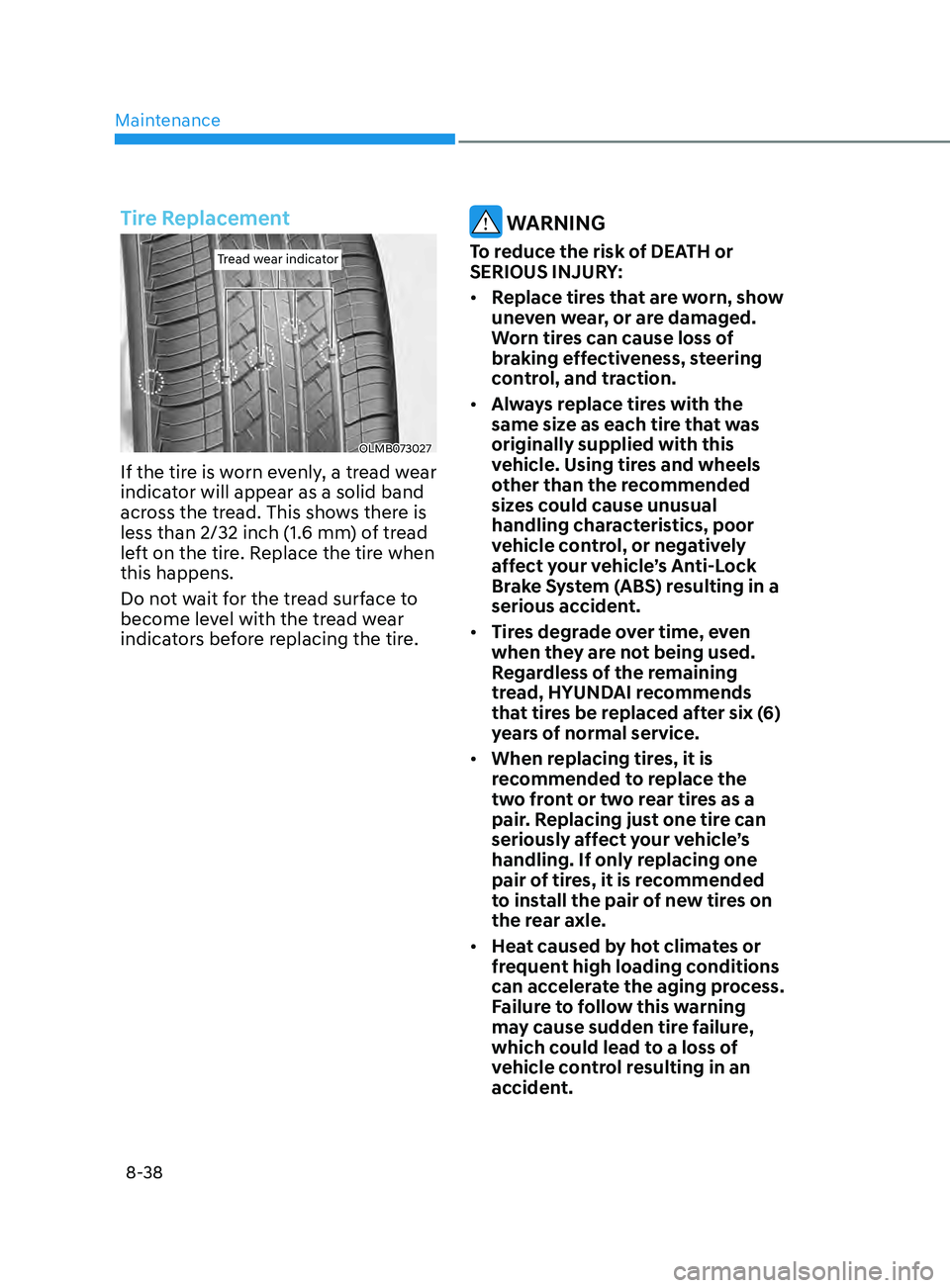
Tire Replacement
Tread wear indicatorTread wear indicator
OLMB073027
If the tire is worn evenly, a tread wear
indicator will appear as a solid band
across the tread. This shows there is
less than 2/32 inch (1.6 mm) of tread
left on the tire. Replace the tire when
this happens.
Do not wait for the tread surface to
become level with the tread wear
indicators before replacing the tire.
WARNING
To reduce the risk of DEATH or
SERIOUS INJURY:
• Replace tires that are worn, show
uneven wear, or are damaged.
Worn tires can cause loss of
braking effectiveness, steering
control, and traction.
• Always replace tires with the
same size as each tire that was
originally supplied with this
vehicle. Using tires and wheels
other than the recommended
sizes could cause unusual
handling characteristics, poor
vehicle control, or negatively
affect your vehicle’s Anti-Lock
Brake System (ABS) resulting in a
serious accident.
• Tires degrade over time, even
when they are not being used.
Regardless of the remaining
tread, HYUNDAI recommends
that tires be replaced after six (6)
years of normal service.
• When replacing tires, it is
recommended to replace the
two front or two rear tires as a
pair. Replacing just one tire can
seriously affect your vehicle’s
handling. If only replacing one
pair of tires, it is recommended
to install the pair of new tires on
the rear axle.
• Heat caused by hot climates or
frequent high loading conditions
can accelerate the aging process.
Failure to follow this warning
may cause sudden tire failure,
which could lead to a loss of
vehicle control resulting in an
accident.