Intake HYUNDAI SONATA 2021 User Guide
[x] Cancel search | Manufacturer: HYUNDAI, Model Year: 2021, Model line: SONATA, Model: HYUNDAI SONATA 2021Pages: 546, PDF Size: 51.21 MB
Page 270 of 546
Convenient Features
5-140
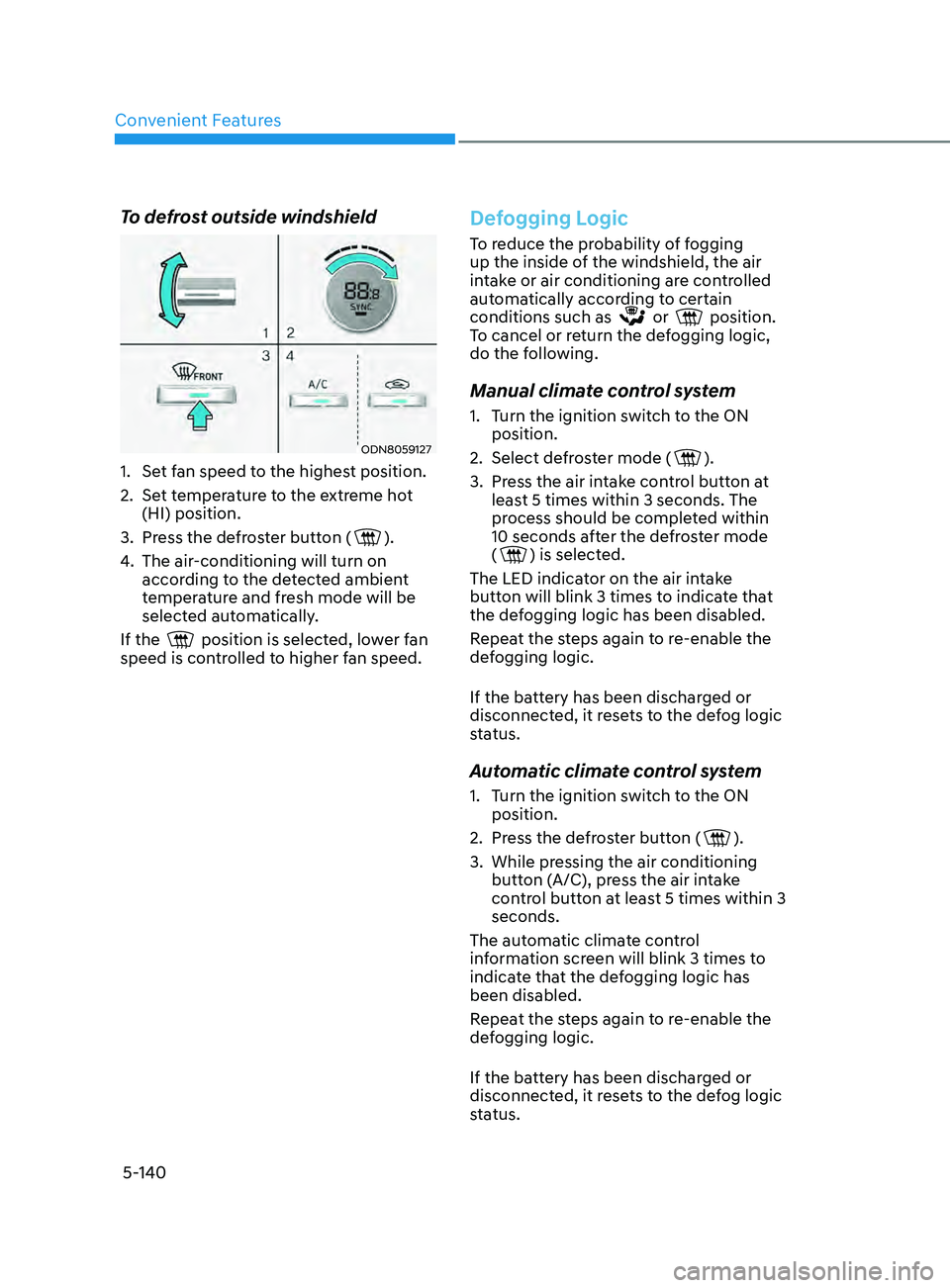
To defrost outside windshield
ODN8059127
1. Set fan speed to the highest position.
2.
Se
t temperature to the extreme hot
(HI) position.
3.
Pr
ess the defroster button (
).
4.
The air
-conditioning will turn on
according to the detected ambient
temperature and fresh mode will be
selected automatically.
If the
position is selected, lower fan
speed is controlled to higher fan speed.
Defogging Logic
To reduce the probability of fogging
up the inside of the windshield, the air
intake or air conditioning are controlled
automatically according to certain
conditions such as
or position.
To cancel or return the defogging logic,
do the following.
Manual climate control system
1. Turn the ignition switch to the ON position.
2.
Select de
froster mode (
).
3.
Pr
ess the air intake control button at
least 5 times within 3 seconds. The
process should be completed within
10 seconds after the defroster mode
(
) is selected.
The LED indicator on the air intake
button will blink 3 times to indicate that
the defogging logic has been disabled.
Repeat the steps again to re-enable the
defogging logic.
If the battery has been discharged or
disconnected, it resets to the defog logic
status.
Automatic climate control system
1. Turn the ignition switch to the ON position.
2.
Pr
ess the defroster button (
).
3.
While pr
essing the air conditioning
button (A/C), press the air intake
control button at least 5 times within 3
seconds.
The automatic climate control
information screen will blink 3 times to
indicate that the defogging logic has
been disabled.
Repeat the steps again to re-enable the
defogging logic.
If the battery has been discharged or
disconnected, it resets to the defog logic
status.
Page 271 of 546
05
5-141
Auto Defogging System (Only
for Automatic Climate Control
System, if equipped)
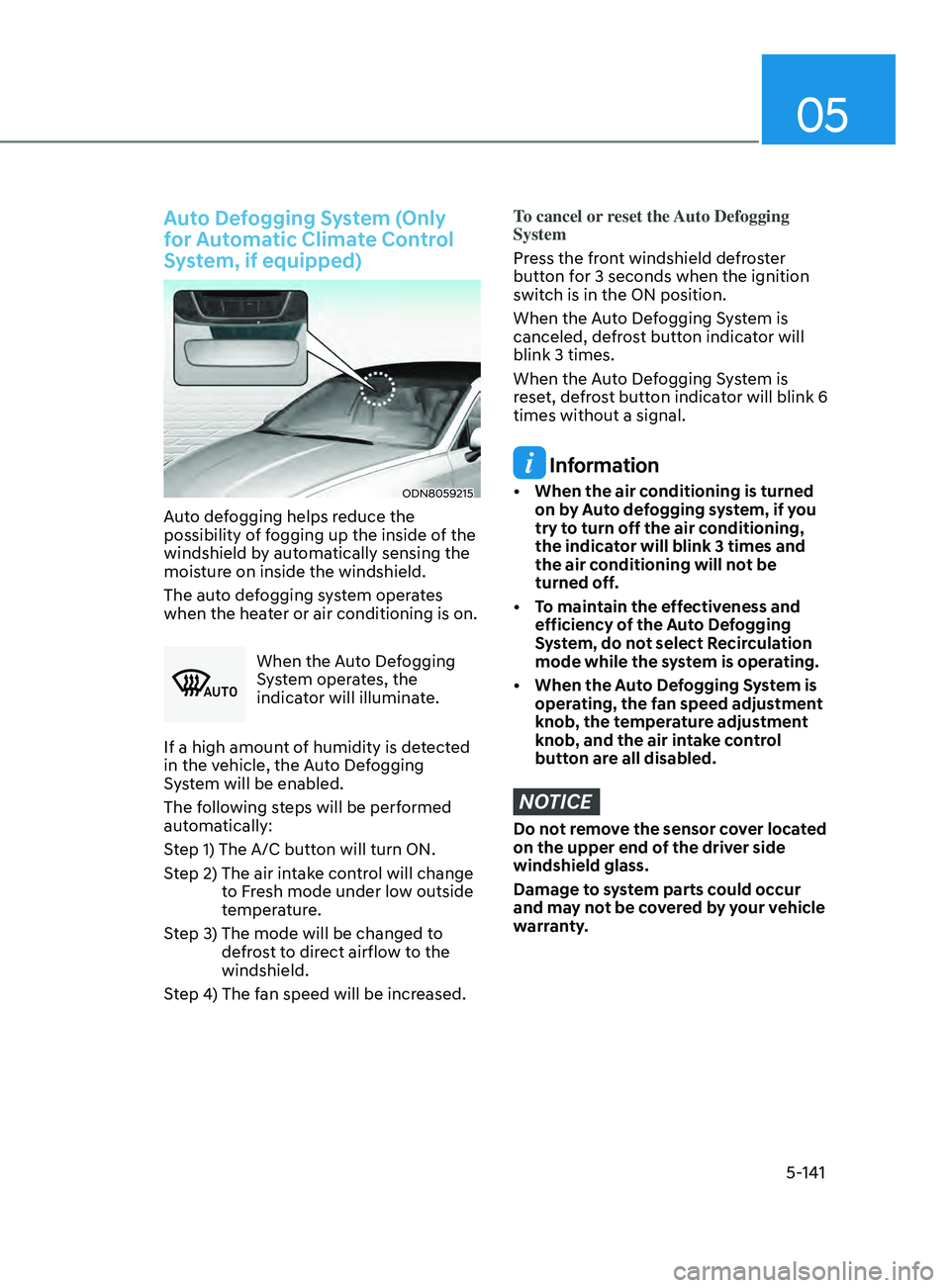
ODN8059215
Auto defogging helps reduce the
possibility of fogging up the inside of the
windshield by automatically sensing the
moisture on inside the windshield.
The auto defogging system operates
when the heater or air conditioning is on.
0024003800370032
When the Auto Defogging
System operates, the
indicator will illuminate.
If a high amount of humidity is detected
in the vehicle, the Auto Defogging
System will be enabled.
The following steps will be performed
automatically:
Step 1) The A/C button will turn ON.
Step 2)
The air in
take control will change
to Fresh mode under low outside
temperature.
Step 3)
The mode will be changed t
o
defrost to direct airflow to the
windshield.
Step 4)
The f
an speed will be increased.
To cancel or reset the Auto Defogging
System
Press the front windshield defroster
button for 3 seconds when the ignition
switch is in the ON position.
When the Auto Defogging System is
canceled, defrost button indicator will
blink 3 times.
When the Auto Defogging System is
reset, defrost button indicator will blink 6
times without a signal.
Information
• When the air c onditioning is turned
on by Auto defogging system, if you
try to turn off the air conditioning,
the indicator will blink 3 times and
the air conditioning will not be
turned off.
•
T
o maintain the effectiveness and
efficiency of the Auto Defogging
System, do not select Recirculation
mode while the system is operating.
•
When the A
uto Defogging System is
operating, the fan speed adjustment
knob, the temperature adjustment
knob, and the air intake control
button are all disabled.
NOTICE
Do not remove the sensor cover located
on the upper end of the driver side
windshield glass.
Damage to system parts could occur
and may not be covered by your vehicle
warranty.
Page 273 of 546
05
5-143
climATe conTrol ADDiTionAl feATUreS
Sunroof Inside Air Recirculation
(if equipped)
When the sunroof is opened, outside
(fresh) air will be automatically selected.
At this time, if you press the air intake
control button, recirculated air position
will be selected but will change back
to outside (fresh) air after 3 minutes.
When the sunroof is closed, the air
intake position will return to the original
position that was selected.
Automatic Ventilation
The system automatically selects the
fresh mode when the climate control
system operates Floor-Level or Bi-Level
for more than 5 minutes and the outdoor
temperature is under 59°F (15°C).
Page 288 of 546
6-4
WARNING
Carbon monoxide (CO) gas is toxic. Breathing CO can cause unconsciousness and
death.
Engine exhaust contains carbon monoxide which cannot be seen or smelled.
Do not inhale engine exhaust.
If at any time you smell engine exhaust inside the vehicle, open the windows
immediately. Exposure to CO can cause unconsciousness and death by asphyxiation.
Be sure the exhaust system does not leak.
The exhaust system should be checked whenever the vehicle is raised to change the
oil or for any other purpose. If you hear a change in the sound of the exhaust or if you
drive over something that strikes the underneath side of the vehicle, have the exhaust
system checked as soon as possible by an authorized HYUNDAI dealer.
Do not run the engine in an enclosed area.
Letting the engine idle in your garage, even with the garage door open, is a hazardous
practice. Run the engine only long enough to start the engine and to move the vehicle
out of the garage.
Avoid idling the engine for prolonged periods with people inside the vehicle.
If it is necessary to idle the engine for a prolonged period with people inside the
vehicle, be sure to do so only in an open area with the air intake set at "Fresh" and fan
control set to high so fresh air is drawn into the interior.
Keep the air intakes clear.
To assure proper operation of the ventilation system, keep the ventilation air intakes
located in front of the windshield clear of snow, ice, leaves, or other obstructions.
If you must drive with the trunk open:
Close all windows.
Open instrument panel air vents.
Set the air intake control at "Fresh", the air flow control at "Floor" or "Face", and the fan
control set to high.
WARNING
CALIFORNIA PROPOSITION 65 WARNING
Engine exhaust and a wide variety of automobile components including
components found in the interior furnishings in a vehicle, contain or emit harmful
chemicals known to the State of California to cause cancer and birth defects and
reproductive harm. In addition, certain fluids contained in vehicles and certain
products of components contain or emit chemicals known to the State of California
to cause cancer and birth defects or other reproductive harm.
While Driving
Page 462 of 546
Maintenance
8-8
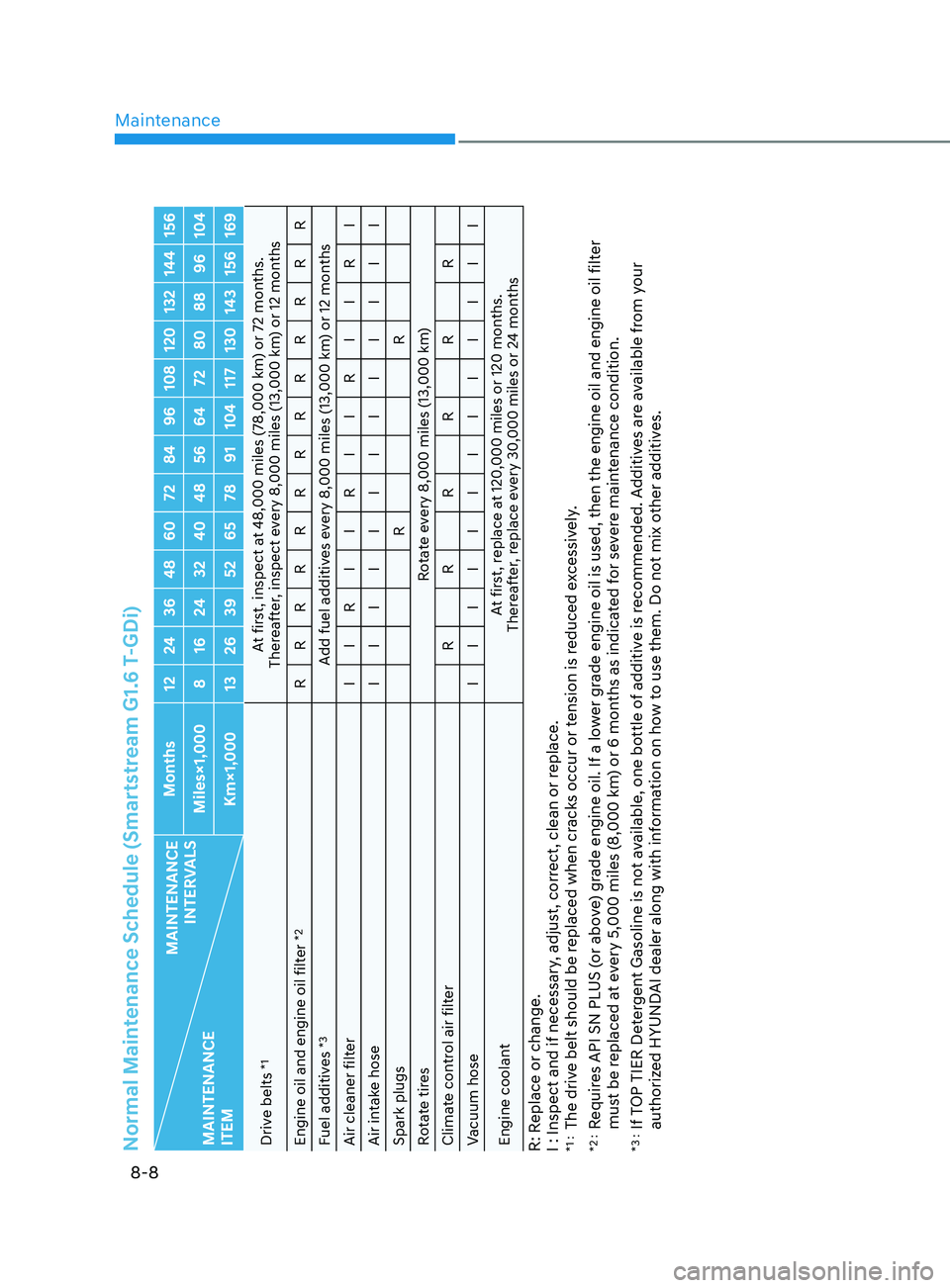
Normal Maintenance Schedule (Smartstream G1.6 T-GDi)
MAINTENANCE INTERVALS
MAINTENANCE
ITEM Months 12 24 36 48 60 72 84 96 108 120 132 144 156
Miles×1,000 8 16 24 32 40 48 56 64 72 80 88 96 104 Km×1,000 13 26 39 52 65 78 91 104 117 130 143 156 169
Drive belts
*1
At first, inspect at 48,000 miles (78,000 km) or 72 months.
Thereafter, inspect every 8,000 miles (13,000 km) or 12 months
Engine oil and engine oil filter
*2
R R R R R R R R R R R R R
Fuel additives
*3
Add fuel additives every 8,000 miles (13,000 km) or 12 months
Air cleaner filter I I R I I R I I R I I R I
Air intake hose I I I I I I I I I I I I I
Spark plugs RR
Rotate tires Rotate every 8,000 miles (13,000 km)
Climate control air filter R R R R R R
Vacuum hose I I I I I I I I I I I I I
Engine coolant At first, replace at 120,000 miles or 120 months.
Thereafter, replace every 30,000 miles or 24 months
R: Replace or change.
I : Inspect and if necessary, adjust, correct, clean or replace.*1 : The drive belt should be replaced when cracks occur or tension is reduced excessively.
*2 : Requires API SN PLUS (or above) grade engine oil. If a lower grade engine oil is used, then the engine oil and engine oil filter
must be replaced at every 5,000 miles (8,000 km) or 6 months as indicated for severe maintenance condition.
*3 : If TOP TIER Detergent Gasoline is not available, one bottle of additive is recommended. Additives are available from your
authorized HYUNDAI dealer along with information on how to use them. Do not mix other additives.
Page 466 of 546
Maintenance
8-12
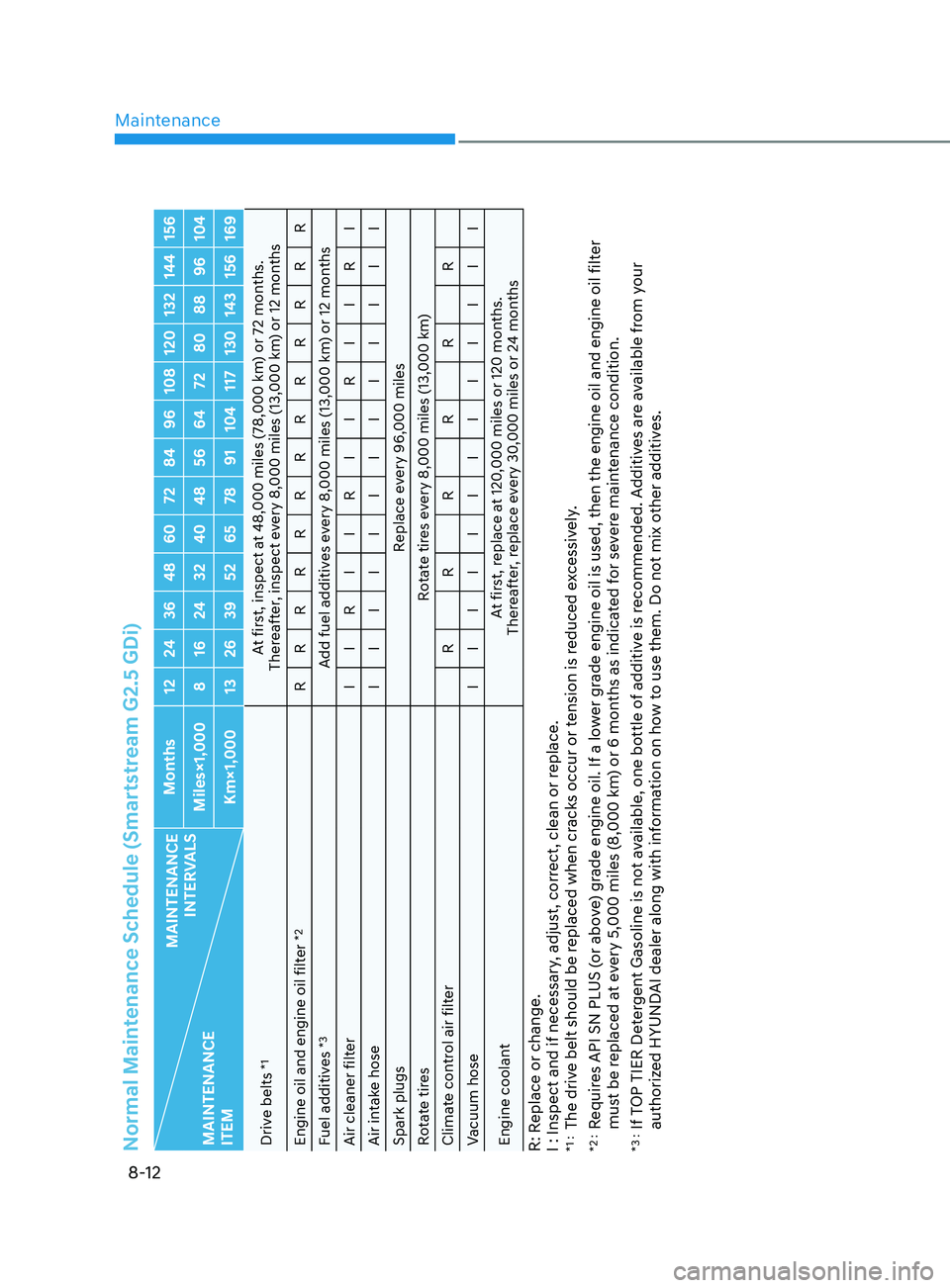
Normal Maintenance Schedule (Smartstream G2.5 GDi)
MAINTENANCE INTERVALS
MAINTENANCE
ITEM Months 12 24 36 48 60 72 84 96 108 120 132 144 156
Miles×1,000 8 16 24 32 40 48 56 64 72 80 88 96 104 Km×1,000 13 26 39 52 65 78 91 104 117 130 143 156 169
Drive belts
*1
At first, inspect at 48,000 miles (78,000 km) or 72 months.
Thereafter, inspect every 8,000 miles (13,000 km) or 12 months
Engine oil and engine oil filter
*2
R R R R R R R R R R R R R
Fuel additives
*3
Add fuel additives every 8,000 miles (13,000 km) or 12 months
Air cleaner filter I I R I I R I I R I I R I
Air intake hose I I I I I I I I I I I I I
Spark plugs Replace every 96,000 miles
Rotate tires Rotate tires every 8,000 miles (13,000 km)
Climate control air filter R R R R R R
Vacuum hose I I I I I I I I I I I I I
Engine coolant At first, replace at 120,000 miles or 120 months.
Thereafter, replace every 30,000 miles or 24 months
R: Replace or change.
I : Inspect and if necessary, adjust, correct, clean or replace.*1 : The drive belt should be replaced when cracks occur or tension is reduced excessively.
*2 : Requires API SN PLUS (or above) grade engine oil. If a lower grade engine oil is used, then the engine oil and engine oil filter
must be replaced at every 5,000 miles (8,000 km) or 6 months as indicated for severe maintenance condition.
*3 : If TOP TIER Detergent Gasoline is not available, one bottle of additive is recommended. Additives are available from your
authorized HYUNDAI dealer along with information on how to use them. Do not mix other additives.
Page 481 of 546
08
8-27
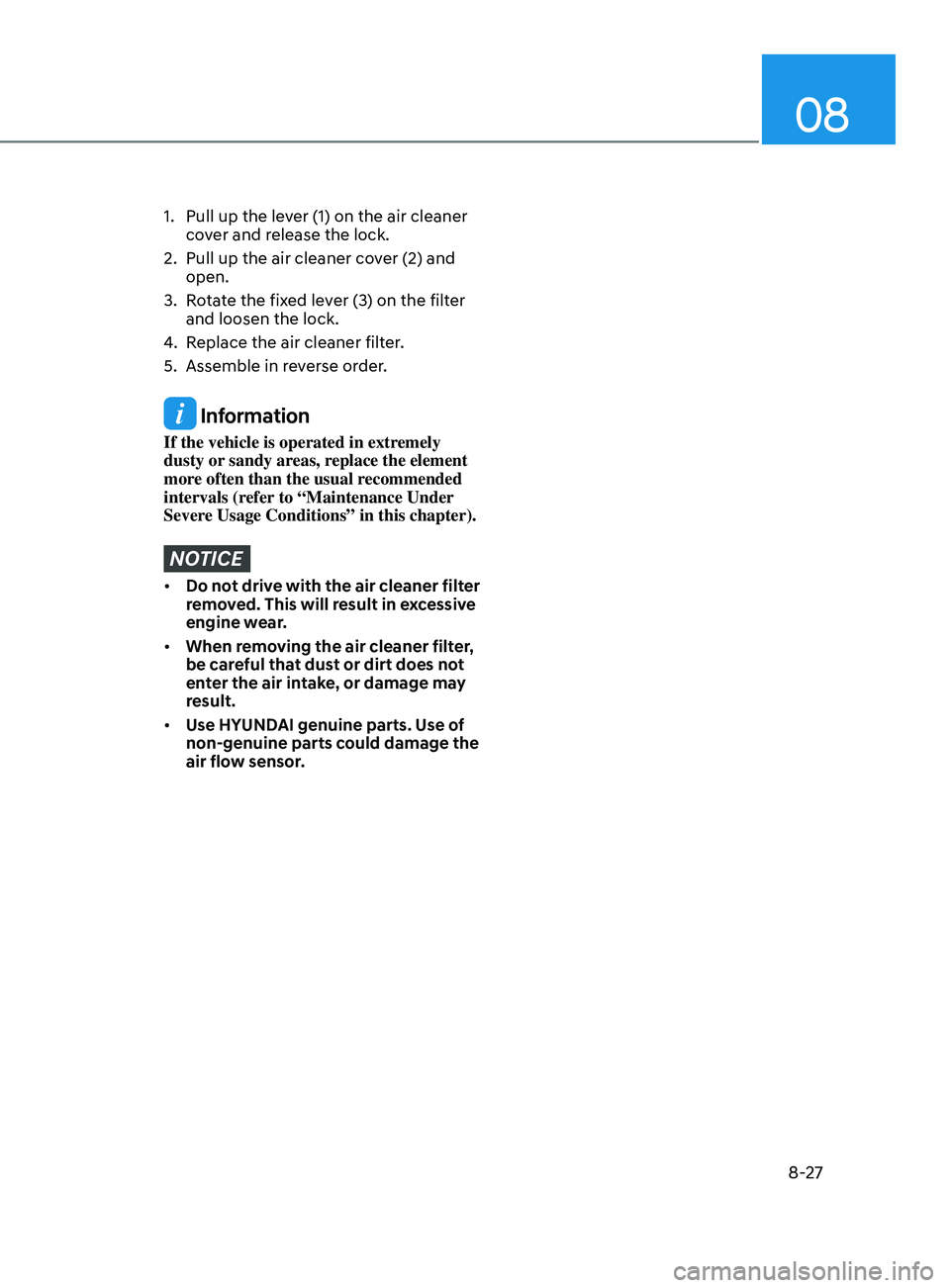
1. Pull up the lever (1) on the air cleaner
cover and release the lock.
2.
Pull up the air cleaner co
ver (2) and
open.
3.
R
otate the fixed lever (3) on the filter
and loosen the lock.
4.
R
eplace the air cleaner filter.
5.
Assemble in r
everse order.
Information
If the vehicle is operated in extremely
dusty or sandy areas, replace the element
more often than the usual recommended
intervals (refer to “Maintenance Under
Severe Usage Conditions” in this chapter).
NOTICE
• Do not drive with the air cleaner filter
removed. This will result in excessive
engine wear.
• When removing the air cleaner filter,
be careful that dust or dirt does not
enter the air intake, or damage may
result.
• Use HYUNDAI genuine parts. Use of
non-genuine parts could damage the
air flow sensor.
Page 524 of 546
Maintenance
8-70
1. Crankcase Emission Control System
The positive crankcase ventilation system
is employed to prevent air pollution
caused by blow-by gases being emitted
from the crankcase. This system supplies
fresh filtered air to the crankcase through
the air intake hose. Inside the crankcase,
the fresh air mixes with blow-by gases,
which then pass through the PCV valve
into the induction system.
2. Evaporative Emission Control System Including Onboard
Refueling Vapor Recovery
(ORVR)
The Evaporative Emission Control System
is designed to prevent fuel vapors from
escaping into the atmosphere. The
ORVR system is designed to allow the
vapors from the fuel tank to be loaded
into a canister while refueling at the gas
station, preventing the escape of fuel
vapors into the atmosphere.
Canister
Fuel vapors generated inside the fuel
tank are absorbed and stored in the
onboard canister. When the engine is
running, the fuel vapors absorbed in the
canister are drawn into the surge tank
through the purge control solenoid valve.
Purge Control Solenoid Valve (PCSV)
The purge control solenoid valve
is controlled by the Engine Control
Module (ECM); when the engine coolant
temperature is low during idling, the
PCSV closes so that evaporated fuel
is not taken into the engine. After the
engine warms-up during ordinary
driving, the PCSV opens to introduce
evaporated fuel to the engine.
3. Exhaust Emission Control System
The Exhaust Emission Control System is
a highly effective system which controls
exhaust emissions while maintaining
good vehicle performance.
When the engine starts or fails to start,
excessive attempts to restart the engine
may cause damage to the emission
system.
Engine exhaust (carbon monoxide)
precautions
• Carbon monoxide can be present
with other exhaust fumes. If you smell
exhaust fumes of any kind in your
vehicle, drive with all the windows
fully open. Have your vehicle checked
and repaired immediately.
WARNING
Engine exhaust gases contain carbon
monoxide (CO). Though colorless and
odorless, it is dangerous and could be
lethal if inhaled. Follow the instructions
on this page to avoid CO poisoning.
WARNING
CALIFORNIA PROPOSITION 65
WARNING
Engine exhaust and a wide variety of
automobile components and parts,
including components found in the
interior furnishings in a vehicle, contain
or emit chemicals known to the State
of California to cause cancer and
birth defects and reproductive harm.
In addition, certain fluids contained
in vehicles and certain products of
component wear contain or emit
chemicals known to the State of
California to cause cancer and birth
defects or other reproductive harm.
Page 531 of 546

I
I-3
Mode selection ........................................................................\
...................... 5-130
Instrument panel vents
........................................................................\
.......... 5-132
Temperature control
........................................................................\
.............. 5-132
Air intake control
........................................................................\
.................. 5-133
Fan speed control
........................................................................\
.................. 5-134
Air conditioning
........................................................................\
.................... 5-134
OFF mode........................................................................\
.............................. 5-134
System operation
........................................................................\
................... 5-135
System maintenance
........................................................................\
.............. 5-136
Air conditioning refrigerant label.................................................................. 5-137
Automatic transmission
........................................................................\
............... 6-13
Transmission ranges
........................................................................\
................ 6-14
Paddle shifter (manual shift mode)
................................................................. 6-19
Shift-lock system
........................................................................\
..................... 6-15
Good driving practices
........................................................................\
............ 6-18
Parking
........................................................................\
.................................... 6-16
Automatic ventilation
........................................................................\
................ 5-143
AUX, USB and iPod
® port ........................................................................\
........ 5-152
B
Battery
........................................................................\
......................................... 8-31
Battery recharging
........................................................................\
................... 8-32
Battery saver function
........................................................................\
.................. 5-79
Before driving
........................................................................\
................................ 6-5
Blind-Spot Collision Warning (BCW)
................................................................. 6-67
Blind-Spot Collision-Avoidance Assist (BCA)
................................................... 6-67
Blind-Spot View Monitor (BVM)
....................................................................... 6-94
Blue Link
® center ........................................................................\
....................... 5-154
Bluetooth® Wireless Technology hands-free ..................................................... 5-154
Brake fluid
........................................................................\
................................... 8-24
Brake system
........................................................................\
................................ 6-20
Power brakes
........................................................................\
........................... 6-20
Disc brakes wear indicator
........................................................................\
...... 6-20
Electronic Parking Brake (EPB)
..................................................................... 6-21
Auto Hold
........................................................................\
................................ 6-24
Anti-lock Brake System (ABS)
....................................................................... 6-27
Electronic Stability Control (ESC).................................................................. 6-29
Vehicle Stability Management (VSM)
............................................................ 6-31
Good braking practices
........................................................................\
........... 6-32
Page 540 of 546

Index
I-12
Manual climate control system ........................................................................\
.. 5-118
Heating and air conditioning
........................................................................\
. 5-119
Mode selection
........................................................................\
...................... 5-120
Instrument panel vents
........................................................................\
.......... 5-122
Temperature control
........................................................................\
.............. 5-122
Air intake control
........................................................................\
.................. 5-122
Fan speed control
........................................................................\
.................. 5-123
Air conditioning
........................................................................\
.................... 5-123
System operation
........................................................................\
................... 5-124
System maintenance
........................................................................\
.............. 5-125
Air conditioning refrigerant label.................................................................. 5-126
Mirrors
........................................................................\
......................................... 5-46
Inside rearview mirror
........................................................................\
............. 5-46
HomeLink
® system........................................................................\
.................. 5-47
Side view mirrors
........................................................................\
.................... 5-53
Adjusting the side view mirrors
...................................................................... 5-54
Folding the side view mirrors
........................................................................\
. 5-54
Reverse parking aid function
........................................................................\
.. 5-55
N
Navigation-based Smart Cruise Control (NSCC)
..............................................6-112
O
Occupant Classification System (OCS)
............................................................... 3-47
Odometer
........................................................................\
....................................... 4-5
Oil (Engine)
........................................................................\
................................. 8-19
Outside temperature gauge
........................................................................\
............ 4-5
Owner maintenance
........................................................................\
....................... 8-5
P
Panoramic sunroof
........................................................................\
....................... 5-60
Parking lamp position
........................................................................\
.................. 5-75
Passenger’s front air bag
........................................................................\
.............. 3-39
Power brakes
........................................................................\
................................ 6-20
Power outlet
........................................................................\
............................... 5-146
Power window lock switch
........................................................................\
.......... 5-59
Pre-tensioner seat belt
........................................................................\
.................. 3-24
Retractor pretensioner
........................................................................\
............. 3-24