maintenance HYUNDAI SONATA 2022 Service Manual
[x] Cancel search | Manufacturer: HYUNDAI, Model Year: 2022, Model line: SONATA, Model: HYUNDAI SONATA 2022Pages: 546, PDF Size: 51.21 MB
Page 480 of 546
Maintenance
8-26
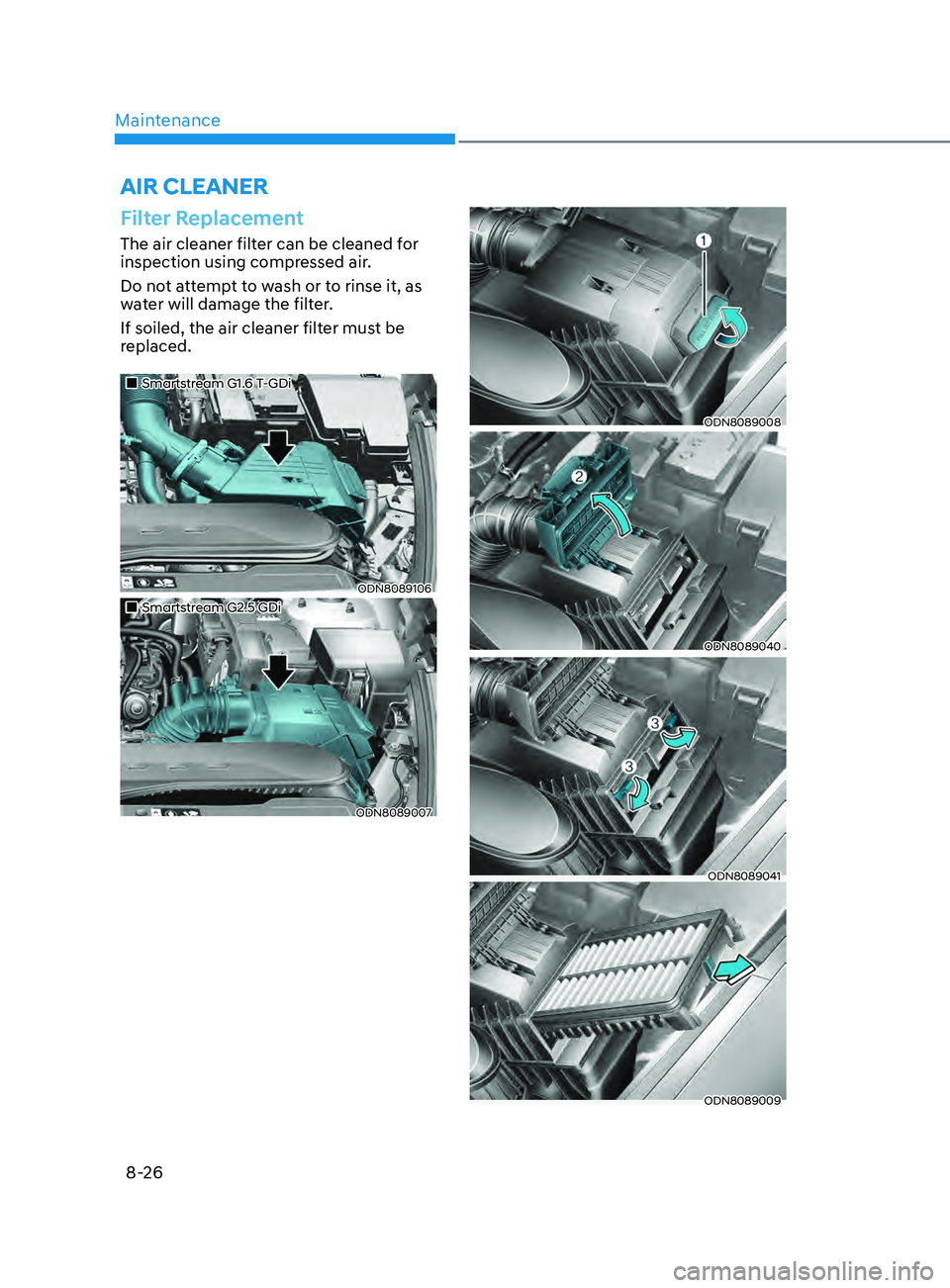
Filter Replacement
The air cleaner filter can be cleaned for
inspection using compressed air.
Do not attempt to wash or to rinse it, as
water will damage the filter.
If soiled, the air cleaner filter must be
replaced.
„„Smartstream G1.6 T-GDi
ODN8089106
„„Smartstream G2.5 GDi
ODN8089007
ODN8089008
ODN8089040
ODN8089041
ODN8089009
air ClEanEr
Page 481 of 546
08
8-27
1. Pull up the lever (1) on the air cleaner
cover and release the lock.
2.
Pull up the air cleaner co
ver (2) and
open.
3.
R
otate the fixed lever (3) on the filter
and loosen the lock.
4.
R
eplace the air cleaner filter.
5.
Assemble in r
everse order.
Information
If the vehicle is operated in extremely
dusty or sandy areas, replace the element
more often than the usual recommended
intervals (refer to “Maintenance Under
Severe Usage Conditions” in this chapter).
NOTICE
• Do not drive with the air cleaner filter
removed. This will result in excessive
engine wear.
• When removing the air cleaner filter,
be careful that dust or dirt does not
enter the air intake, or damage may
result.
• Use HYUNDAI genuine parts. Use of
non-genuine parts could damage the
air flow sensor.
Page 482 of 546
Maintenance8-28
ClimatE Control air filtEr
Filter Inspection
The climate control air filter should be
replaced according to the Maintenance
Schedule. If the vehicle is operated
in severely air-polluted cities or on
dusty rough roads for a long period, it
should be inspected more frequently
and replaced earlier. When you replace
the climate control air filter, replace it
performing the following procedure,
and be careful to avoid damaging other
components.
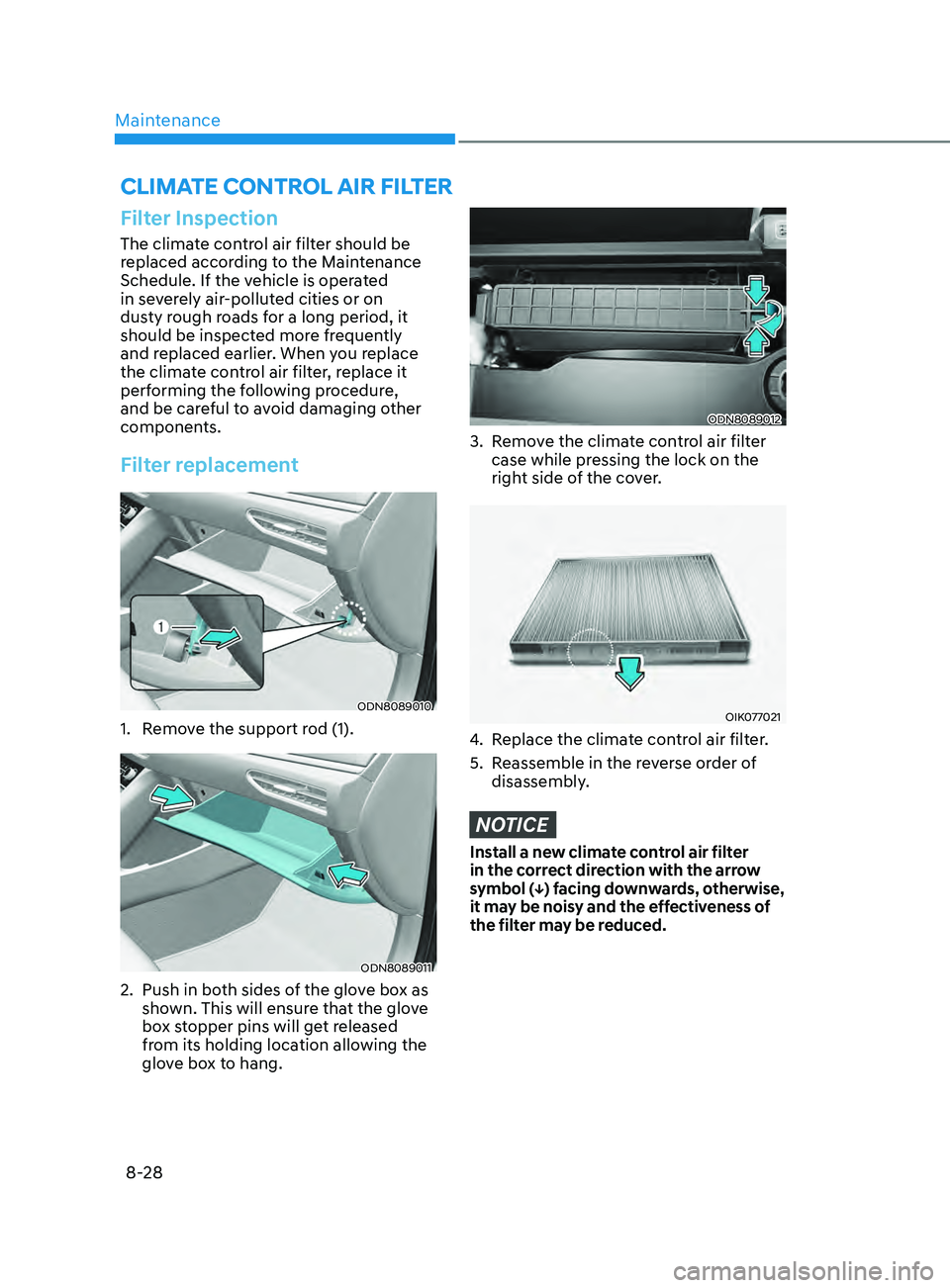
Filter replacement
ODN8089010
1. Remove the support rod (1).
ODN8089011
2. Push in bo th sides of the glove box as
shown. This will ensure that the glove
box stopper pins will get released
from its holding location allowing the
glove box to hang.
ODN8089012
3. Remove the climate control air filter case while pressing the lock on the
right side of the cover.
OIK077021
4. Replace the climate control air filter.
5.
R
eassemble in the reverse order of
disassembly.
NOTICE
Install a new climate control air filter
in the correct direction with the arrow
symbol (↓) facing downwards, otherwise,
it may be noisy and the effectiveness of
the filter may be reduced.
Page 484 of 546
Maintenance8-30
OLF074017
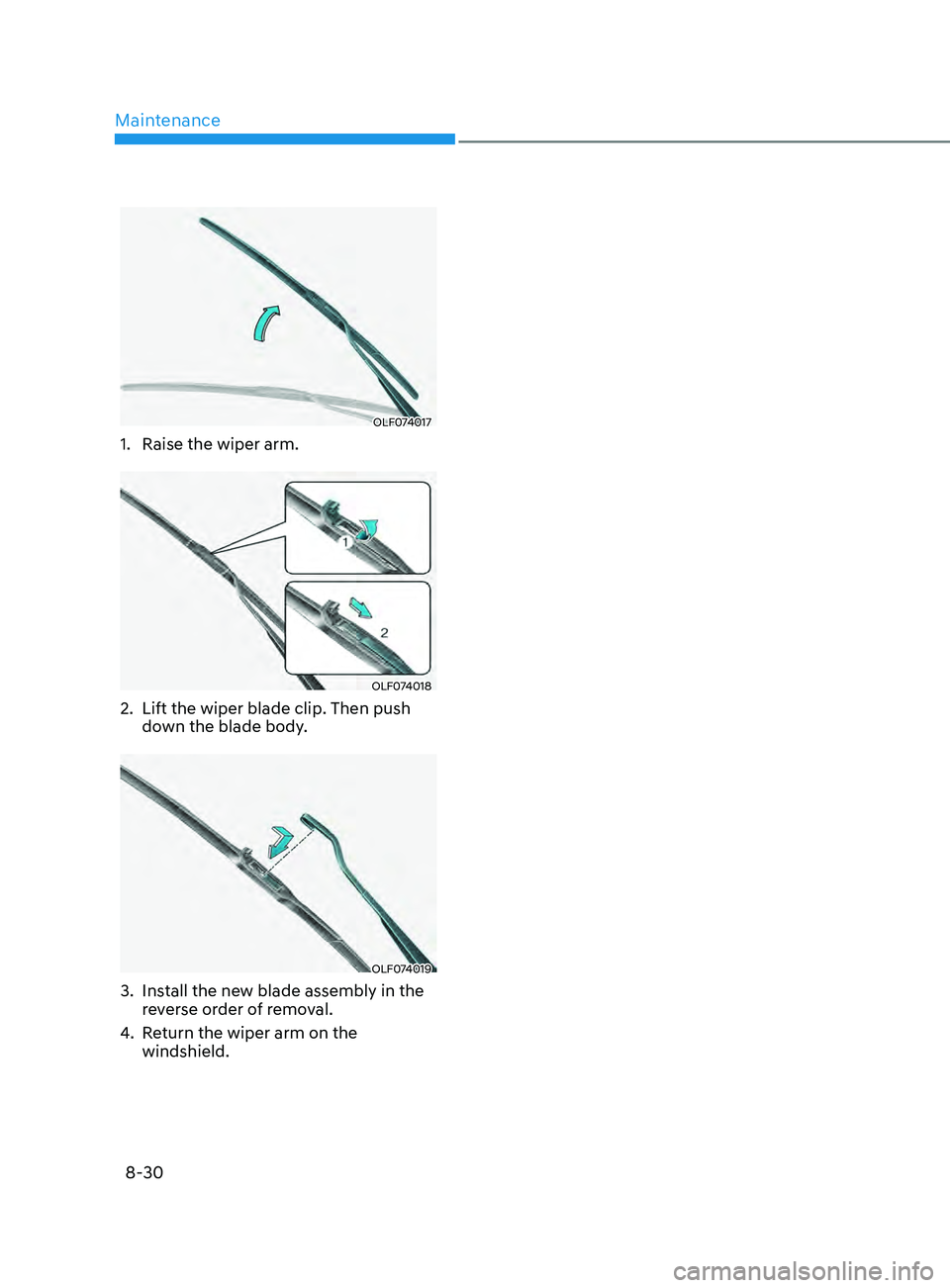
1. Raise the wiper arm.
OLF074018
2. Lift the wiper blade clip. Then push
do wn the blade body.
OLF074019
3. Install the new blade assembly in the reverse order of removal.
4.
R
eturn the wiper arm on the
windshield.
Page 486 of 546
Maintenance
8-32
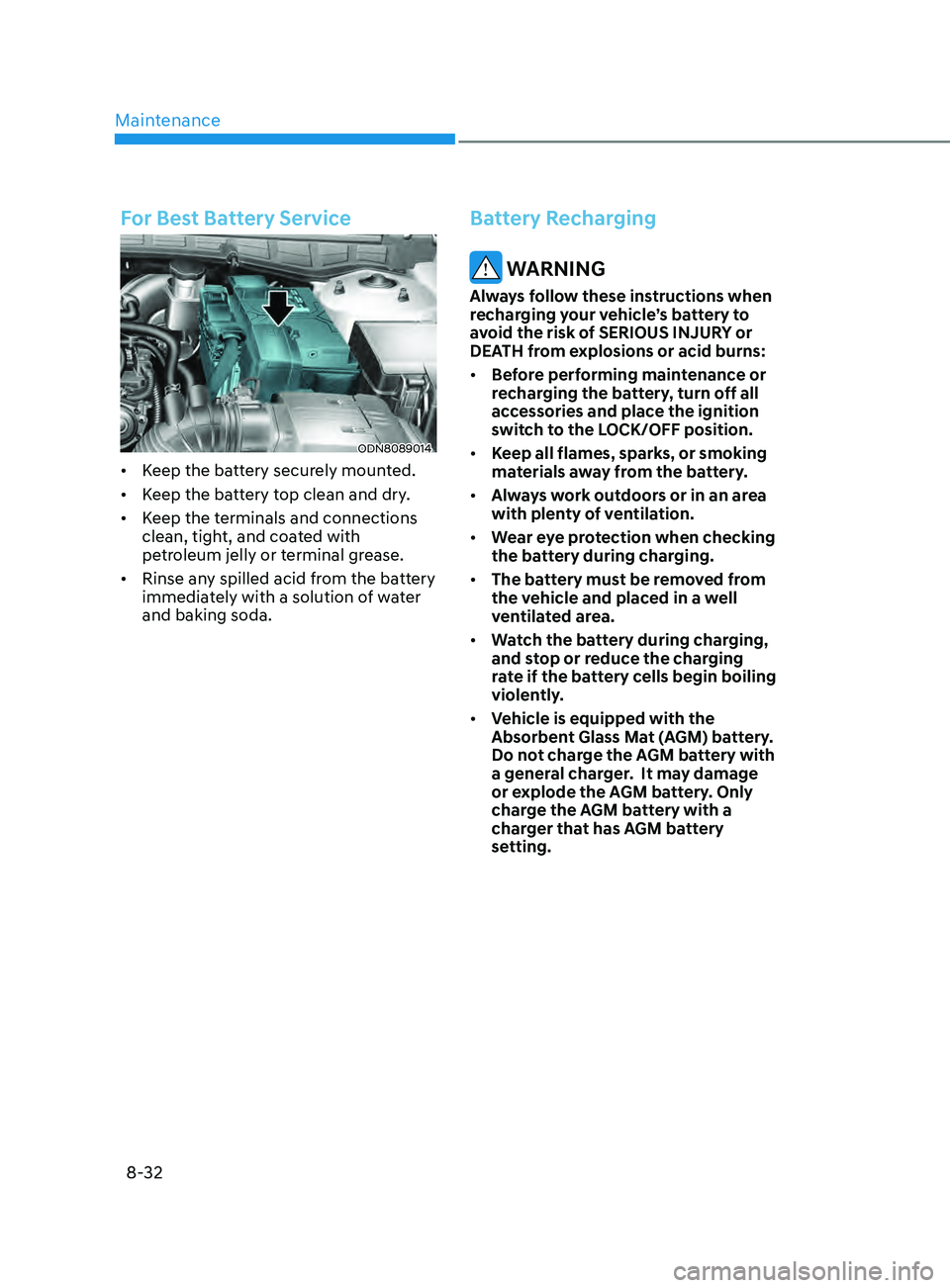
For Best Battery Service
ODN8089014
• Keep the battery securely mounted.
• Keep the battery top clean and dry.
• Keep the terminals and connections
clean, tight, and coated with
petroleum jelly or terminal grease.
• Rinse any spilled acid from the battery
immediately with a solution of water
and baking soda.
Battery Recharging
WARNING
Always follow these instructions when
recharging your vehicle’s battery to
avoid the risk of SERIOUS INJURY or
DEATH from explosions or acid burns:
• Before performing maintenance or
recharging the battery, turn off all
accessories and place the ignition
switch to the LOCK/OFF position.
• Keep all flames, sparks, or smoking
materials away from the battery.
• Always work outdoors or in an area
with plenty of ventilation.
• Wear eye protection when checking
the battery during charging.
• The battery must be removed from
the vehicle and placed in a well
ventilated area.
• Watch the battery during charging,
and stop or reduce the charging
rate if the battery cells begin boiling
violently.
• Vehicle is equipped with the
Absorbent Glass Mat (AGM) battery.
Do not charge the AGM battery with
a general charger. It may damage
or explode the AGM battery. Only
charge the AGM battery with a
charger that has AGM battery
setting.
Page 488 of 546
Maintenance
8-34
WARNING
Tire failure may cause loss of
vehicle control resulting in an
accident. To reduce risk of SERIOUS
INJURY or DEATH, take the
following precautions:
• Inspect your tires monthly for
proper inflation as well as wear
and damage.
• The recommended cold tire
pressure for your vehicle can be
found in this manual and on the
tire label located on the driver’s
side center pillar. Always use a
tire pressure gauge to measure
tire pressure. Tires with too
much or too little pressure wear
unevenly causing poor handling.
• Check the pressure of the
spare every time you check the
pressure of the other tires on
your vehicle.
• Replace tires that are worn, show
uneven wear, or are damaged.
Worn tires can cause loss of
braking effectiveness, steering
control, or traction.
• ALWAYS replace tires with
the same type, size, brand,
construction and tread pattern
as each tire that was originally
supplied with this vehicle. Using
tires and wheels other than the
recommended sizes could cause
unusual handling characteristics,
poor vehicle control, or
negatively affect your vehicle’s
Anti-Lock Brake System (ABS)
resulting in a serious accident.
Tire Care
For proper maintenance, safety, and
maximum fuel economy, you must
always maintain recommended
tire inflation pressures and stay
within the load limits and weight
distribution recommended for your
vehicle.
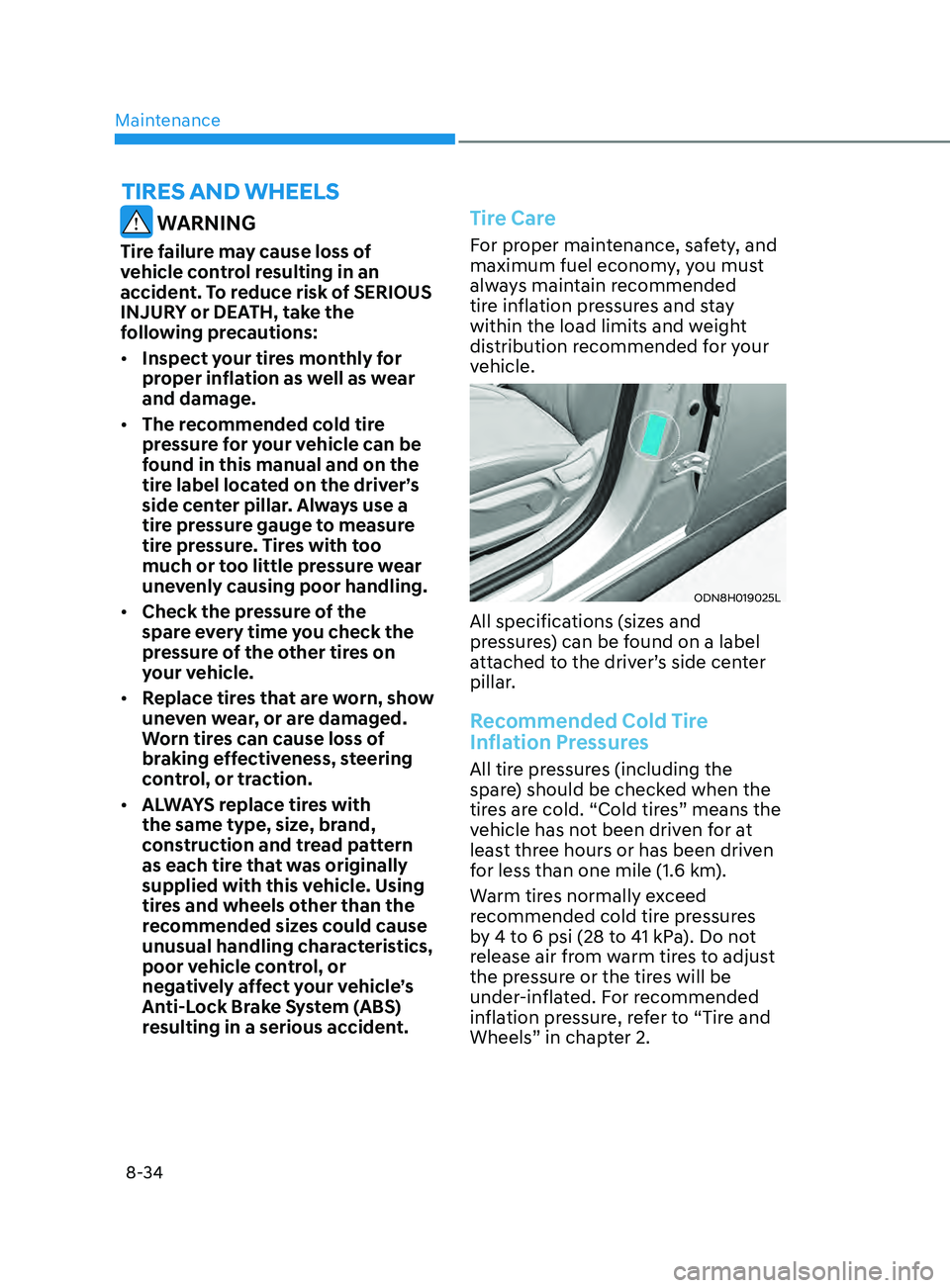
ODN8H019025L
All specifications (sizes and
pressures) can be found on a label
attached to the driver’s side center
pillar.
Recommended Cold Tire
Inflation Pressures
All tire pressures (including the
spare) should be checked when the
tires are cold. “Cold tires” means the
vehicle has not been driven for at
least three hours or has been driven
for less than one mile (1.6 km).
Warm tires normally exceed
recommended cold tire pressures
by 4 to 6 psi (28 to 41 kPa). Do not
release air from warm tires to adjust
the pressure or the tires will be
under-inflated. For recommended
inflation pressure, refer to “Tire and
Wheels” in chapter 2.
tirES and whEElS
Page 490 of 546
Maintenance
8-36
A cold tire means the vehicle has
been sitting for 3 hours and driven
for less than 1 mile (1.6 km) in that 3
hour period.
Allow the tire to cool before
measuring the inflation pressure.
Always be sure the tire is cold before
inflating to the recommended
pressure.Tire Rotation
To equalize tread wear, HYUNDAI
recommends that the tires
be rotated according to the
maintenance schedule or sooner if
irregular wear develops.
During rotation, check the tires for
correct balance.
When rotating tires, check for
uneven wear and damage. Abnormal
wear is usually caused by incorrect
tire pressure, improper wheel
alignment, out-of-balance wheels,
severe braking or severe cornering.
Look for bumps or bulges in the
tread or side of the tire. Replace
the tire if you find any of these
conditions. Replace the tire if fabric
or cord is visible. After rotation, be
sure to bring the front and rear tire
pressures to specification and check
lug nut tightness (proper torque is
79~94 lbf·ft [11~13 kgf·m]).
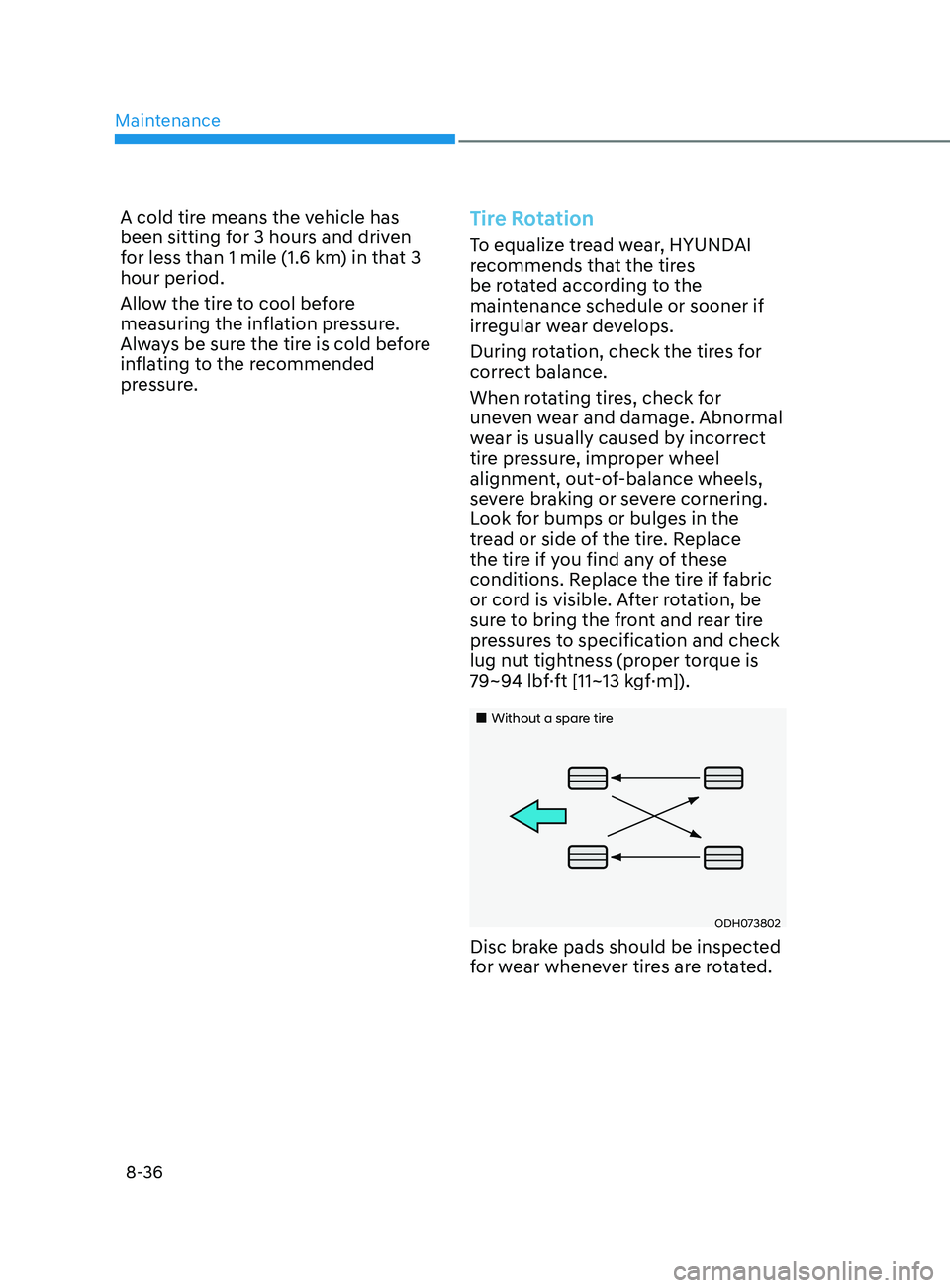
„„Without a spare tire
ODH073802
Disc brake pads should be inspected
for wear whenever tires are rotated.
Page 492 of 546
Maintenance
8-38
Tire Replacement
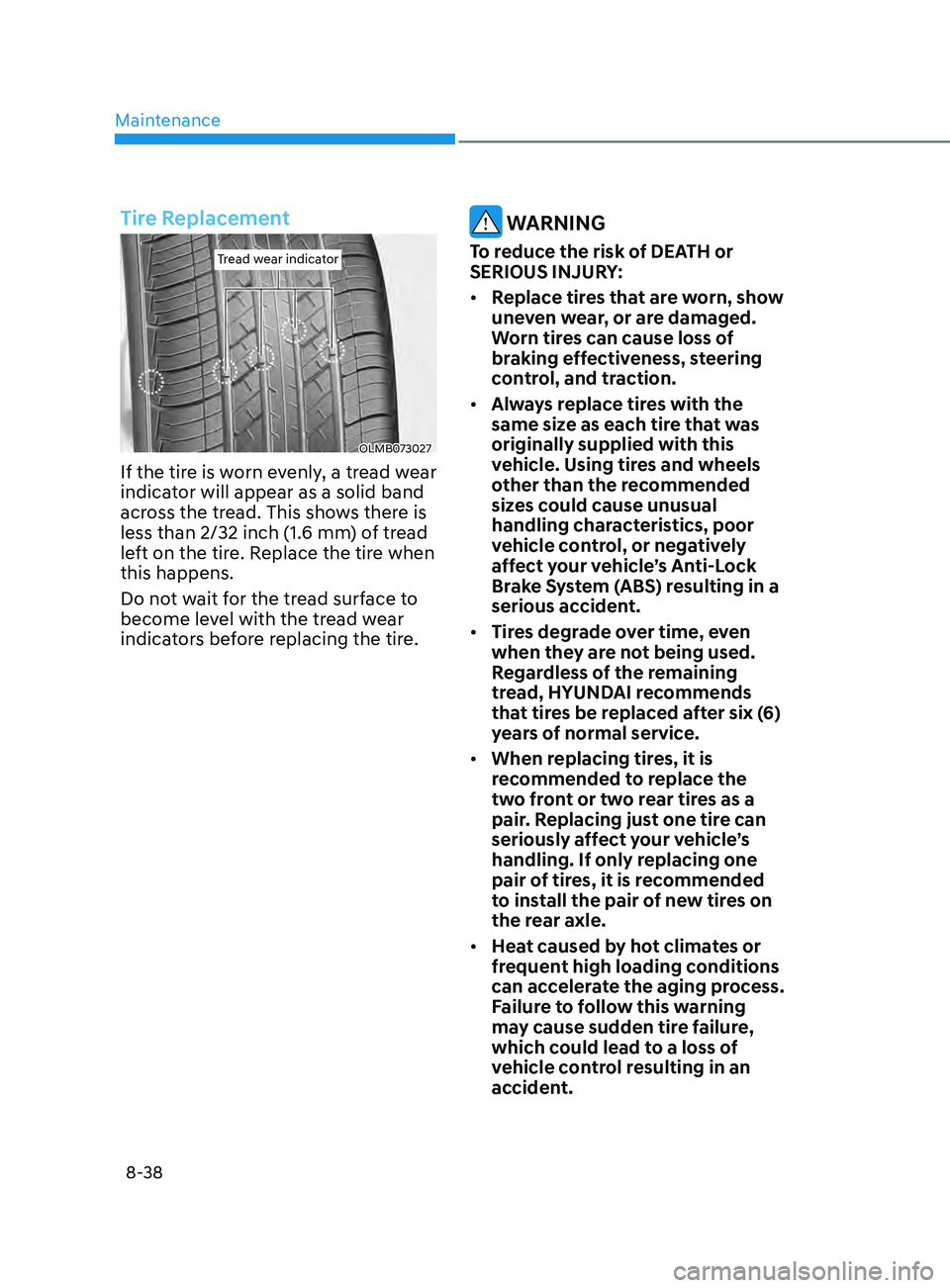
Tread wear indicatorTread wear indicator
OLMB073027
If the tire is worn evenly, a tread wear
indicator will appear as a solid band
across the tread. This shows there is
less than 2/32 inch (1.6 mm) of tread
left on the tire. Replace the tire when
this happens.
Do not wait for the tread surface to
become level with the tread wear
indicators before replacing the tire.
WARNING
To reduce the risk of DEATH or
SERIOUS INJURY:
• Replace tires that are worn, show
uneven wear, or are damaged.
Worn tires can cause loss of
braking effectiveness, steering
control, and traction.
• Always replace tires with the
same size as each tire that was
originally supplied with this
vehicle. Using tires and wheels
other than the recommended
sizes could cause unusual
handling characteristics, poor
vehicle control, or negatively
affect your vehicle’s Anti-Lock
Brake System (ABS) resulting in a
serious accident.
• Tires degrade over time, even
when they are not being used.
Regardless of the remaining
tread, HYUNDAI recommends
that tires be replaced after six (6)
years of normal service.
• When replacing tires, it is
recommended to replace the
two front or two rear tires as a
pair. Replacing just one tire can
seriously affect your vehicle’s
handling. If only replacing one
pair of tires, it is recommended
to install the pair of new tires on
the rear axle.
• Heat caused by hot climates or
frequent high loading conditions
can accelerate the aging process.
Failure to follow this warning
may cause sudden tire failure,
which could lead to a loss of
vehicle control resulting in an
accident.
Page 493 of 546
08
8-39
Compact spare tire replacement
A compact spare tire has a shorter
tread life than a regular size tire.
Replace it when you can see the
tread wear indicator bars on the tire.
The replacement compact spare tire
should be the same size and design
tire as the one provided with your
new vehicle and should be mounted
on the same compact spare tire
wheel. The compact spare tire is
not designed to be mounted on a
regular size wheel, and the compact
spare tire wheel is not designed for
mounting a regular size tire.
WARNING
The original tire should be repaired
or replaced as soon as possible to
avoid failure of the spare and loss
of vehicle control resulting in an
accident. The compact spare tire
is for emergency use only. Do not
operate your vehicle over 50 mph
(80 km/h) when using the compact
spare tire.
Wheel Replacement
When replacing the metal wheels
for any reason, make sure the new
wheels are equivalent to the original
factory units in diameter, rim width
and offset.
Tire Traction
Tire traction can be reduced if you
drive on worn tires, tires that are
improperly inflated or on slippery
road surfaces. Tires should be
replaced when the tread depth is at
least 2/32 inch (1.6 mm). To reduce
the possibility of losing control, slow
down whenever there is rain, snow
or ice on the road.
Tire Maintenance
In addition to proper inflation,
correct wheel alignment helps to
decrease tire wear. If you find a tire
is worn unevenly, have your dealer
check the wheel alignment.
When you have new tires installed,
make sure they are balanced. This
will increase vehicle ride comfort
and tire life. Additionally, a tire
should always be rebalanced if it is
removed from the wheel.
Tire Sidewall Labeling
This information identifies and
describes the fundamental
characteristics of the tire and also
provides the tire identification
number (TIN) for safety standard
certification. The TIN can be used to
identify the tire in case of a recall.
Page 494 of 546
Maintenance
8-40
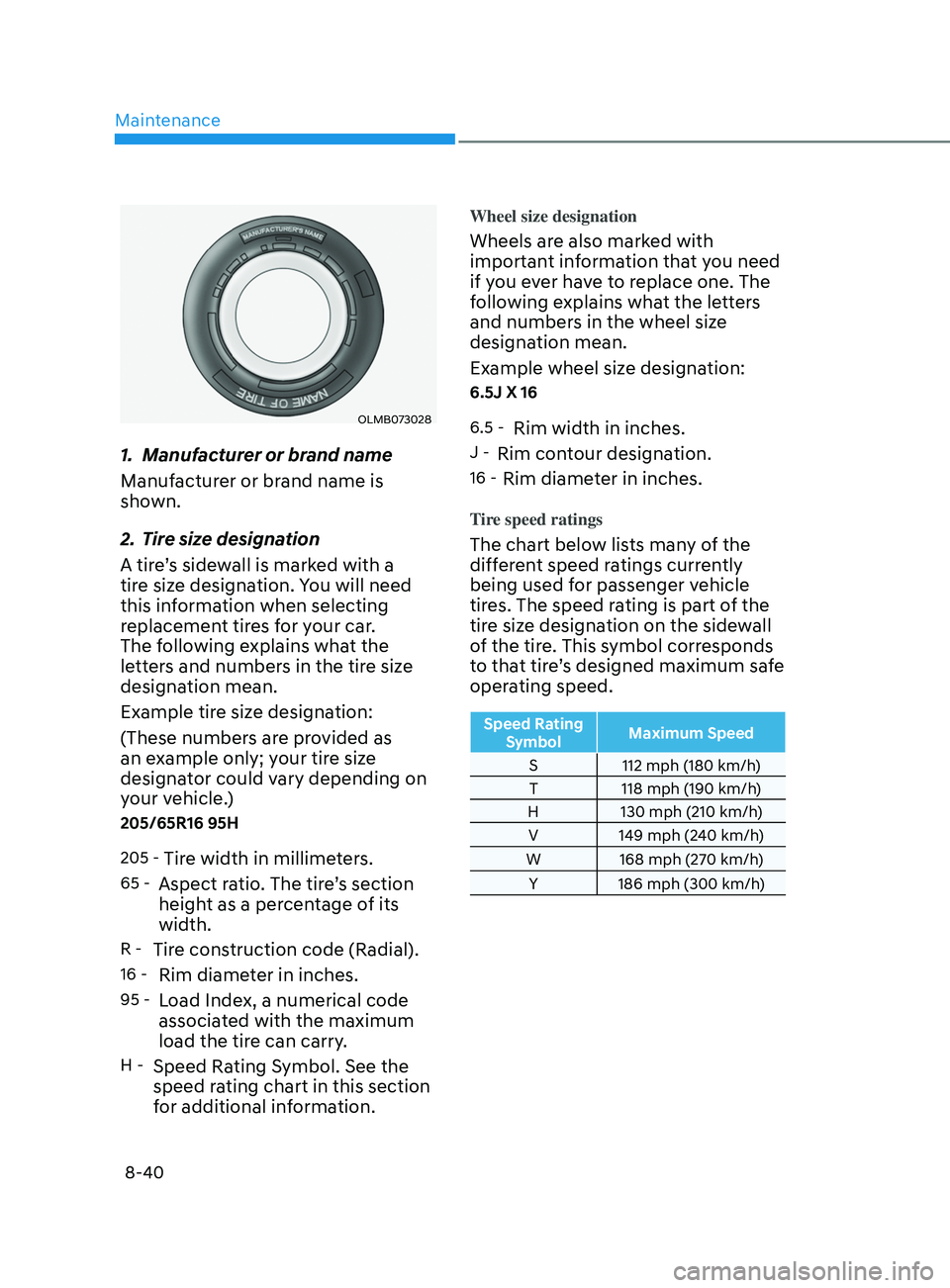
OLMB073028
1. Manufacturer or brand name
Manufacturer or brand name is
shown.
2.
Tir
e size designation
A tire’s sidewall is marked with a
tire size designation. You will need
this information when selecting
replacement tires for your car.
The following explains what the
letters and numbers in the tire size
designation mean.
Example tire size designation:
(These numbers are provided as
an example only; your tire size
designator could vary depending on
your vehicle.)
205/65R16 95H
205 -
Tire width in millimeters.
65 -Aspect ratio. The tire’s section
height as a percentage of its
width.
R -Tire construction code (Radial).
16 -Rim diameter in inches.
95 -Load Index, a numerical code
associated with the maximum
load the tire can carry.
H -Speed Rating Symbol. See the
speed rating chart in this section
for additional information.
Wheel size designation
Wheels are also marked with
important information that you need
if you ever have to replace one. The
following explains what the letters
and numbers in the wheel size
designation mean.
Example wheel size designation:
6.5J X 16
6.5 -
Rim width in inches.
J -Rim contour designation.
16 -Rim diameter in inches.
Tire speed ratings
The chart below lists many of the
different speed ratings currently
being used for passenger vehicle
tires. The speed rating is part of the
tire size designation on the sidewall
of the tire. This symbol corresponds
to that tire’s designed maximum safe
operating speed.
Speed Rating Symbol Maximum Speed
S 112 mph (180 km/h)
T 118 mph (190 km/h)
H 130 mph (210 km/h)
V 149 mph (240 km/h)
W 168 mph (270 km/h) Y 186 mph (300 km/h)