battery HYUNDAI SONATA 2023 Workshop Manual
[x] Cancel search | Manufacturer: HYUNDAI, Model Year: 2023, Model line: SONATA, Model: HYUNDAI SONATA 2023Pages: 555, PDF Size: 42.72 MB
Page 487 of 555
08
8-17
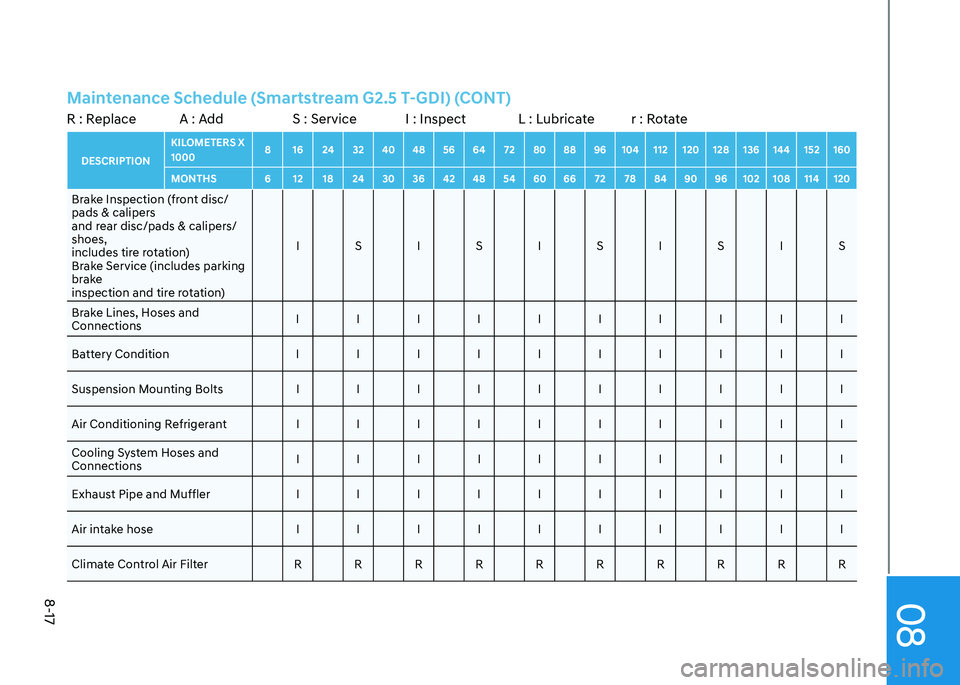
Maintenance Schedule (Smartstream G2.5 T-GDI) (CONT)R : Replace A : Add S : Service I : Inspect L : Lubricate r : RotateDESCRIPTIONKILOMETERS X 1000
8 16 24 32 40 48 56 64 72 80 88 96 104 112 120 128 136 144 152 160
MONTHS 6 12 18 24 30 36 42 48 54 60 66 72 78 84 90 96 102 108 114 120Brake Inspection (front disc/
pads & calipers
and rear disc/pads & calipers/shoes,
includes tire rotation)
Brake Service (includes parking
brake
inspection and tire rotation) I S I S I S I S I S
Brake Lines, Hoses and Connections I I I I I I I I I I
Battery Condition I I I I I I I I I I Suspension Mounting Bolts I I I I I I I I I I Air Conditioning Refrigerant I I I I I I I I I ICooling System Hoses and Connections I I I I I I I I I I
Exhaust Pipe and Muffler I I I I I I I I I I Air intake hose I I I I I I I I I I
Climate Control Air Filter R R R R R R R R R R
Page 498 of 555
Maintenance
8-28
WARNING
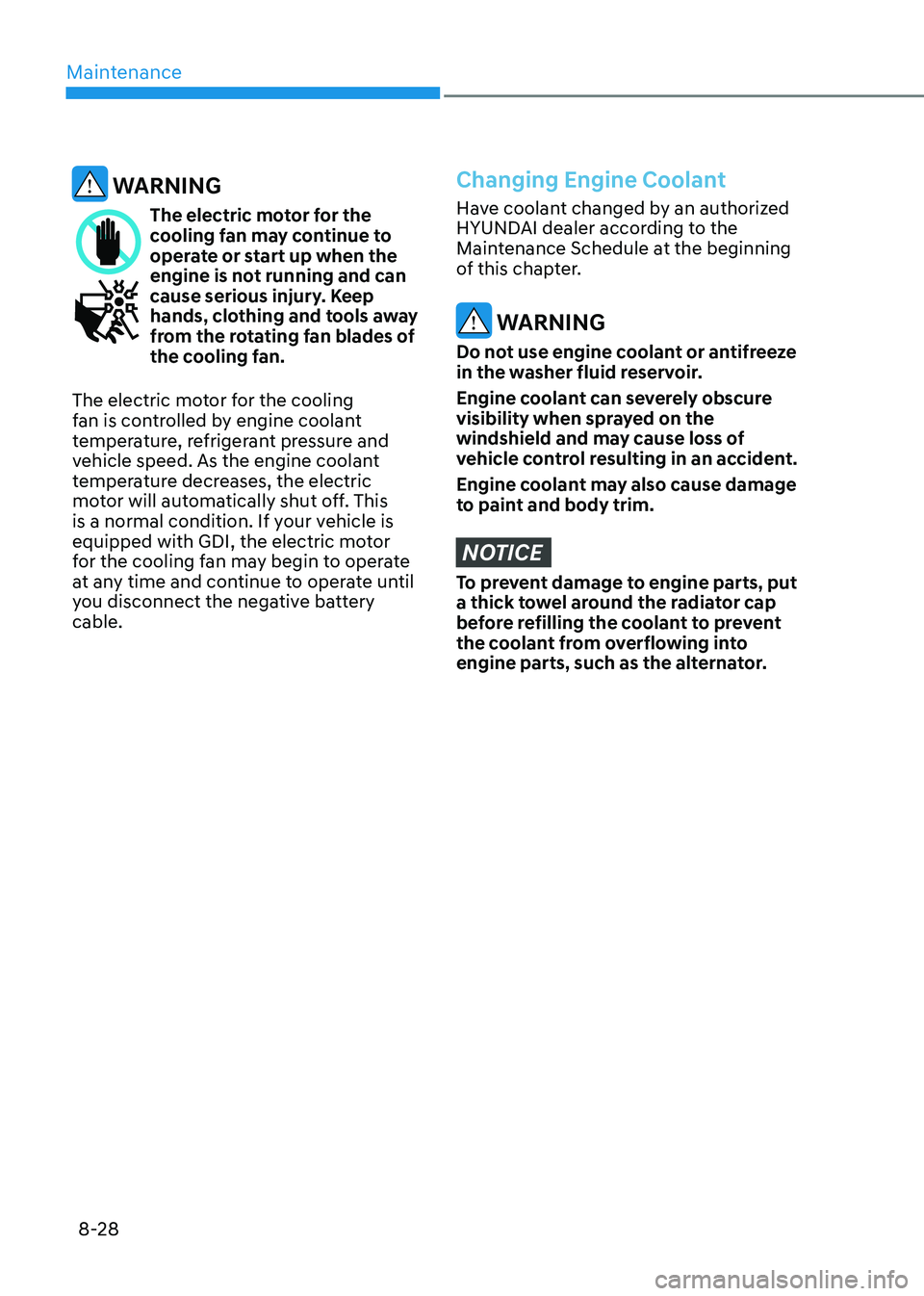
The electric motor for the
cooling fan may continue to
operate or start up when the
engine is not running and can
cause serious injury. Keep
hands, clothing and tools away
from the rotating fan blades of
the cooling fan.
The electric motor for the cooling
fan is controlled by engine coolant
temperature, refrigerant pressure and
vehicle speed. As the engine coolant
temperature decreases, the electric
motor will automatically shut off. This
is a normal condition. If your vehicle is
equipped with GDI, the electric motor
for the cooling fan may begin to operate
at any time and continue to operate until
you disconnect the negative battery cable.
Changing Engine Coolant
Have coolant changed by an authorized
HYUNDAI dealer according to the
Maintenance Schedule at the beginning
of this chapter.
WARNING
Do not use engine coolant or antifreeze
in the washer fluid reservoir.
Engine coolant can severely obscure
visibility when sprayed on the
windshield and may cause loss of
vehicle control resulting in an accident.
Engine coolant may also cause damage
to paint and body trim.
NOTICE
To prevent damage to engine parts, put
a thick towel around the radiator cap
before refilling the coolant to prevent
the coolant from overflowing into
engine parts, such as the alternator.
Page 506 of 555
Maintenance
8-36
WARNING
To prevent SERIOUS INJURY or DEATH
to you or bystanders, always follow
these precautions when working near
or handling the battery:
Always read and follow
instructions carefully when
handling a battery.
Wear eye protection designed
to protect the eyes from acid splashes.
Keep all flames, sparks, or
smoking materials away from
the battery.
Hydrogen is always present
in battery cells, is highly
combustible, and may explode
if ignited.
Keep batteries out of reach of
children.
Batteries contain sulfuric acid
which is highly corrosive. Do
not allow acid to contact your
eyes, skin or clothing.
If acid gets into your eyes, flush your
eyes with clean water for at least 15
minutes and get immediate medical
attention. If acid gets on your skin,
thoroughly wash the area. If you feel
pain or a burning sensation, get medical
attention immediately. • When lifting a plastic-cased battery,
excessive pressure on the case may
cause battery acid to leak. Lift with a
battery carrier or with your hands on
opposite corners.
• Do not attempt to jump start your
vehicle if your battery is frozen.
• NEVER attempt to recharge the
battery when the vehicle’s battery
cables are connected to the battery.
• The electrical ignition system works
with high voltage. NEVER touch
these components with the engine
running or when the ignition switch is in the ON position.
NOTICE
• When you do not use the vehicle for a
long time in a low temperature area,
disconnect the battery and keep it
indoors.
• Always charge the battery fully to
prevent battery case damage in low
temperature areas.
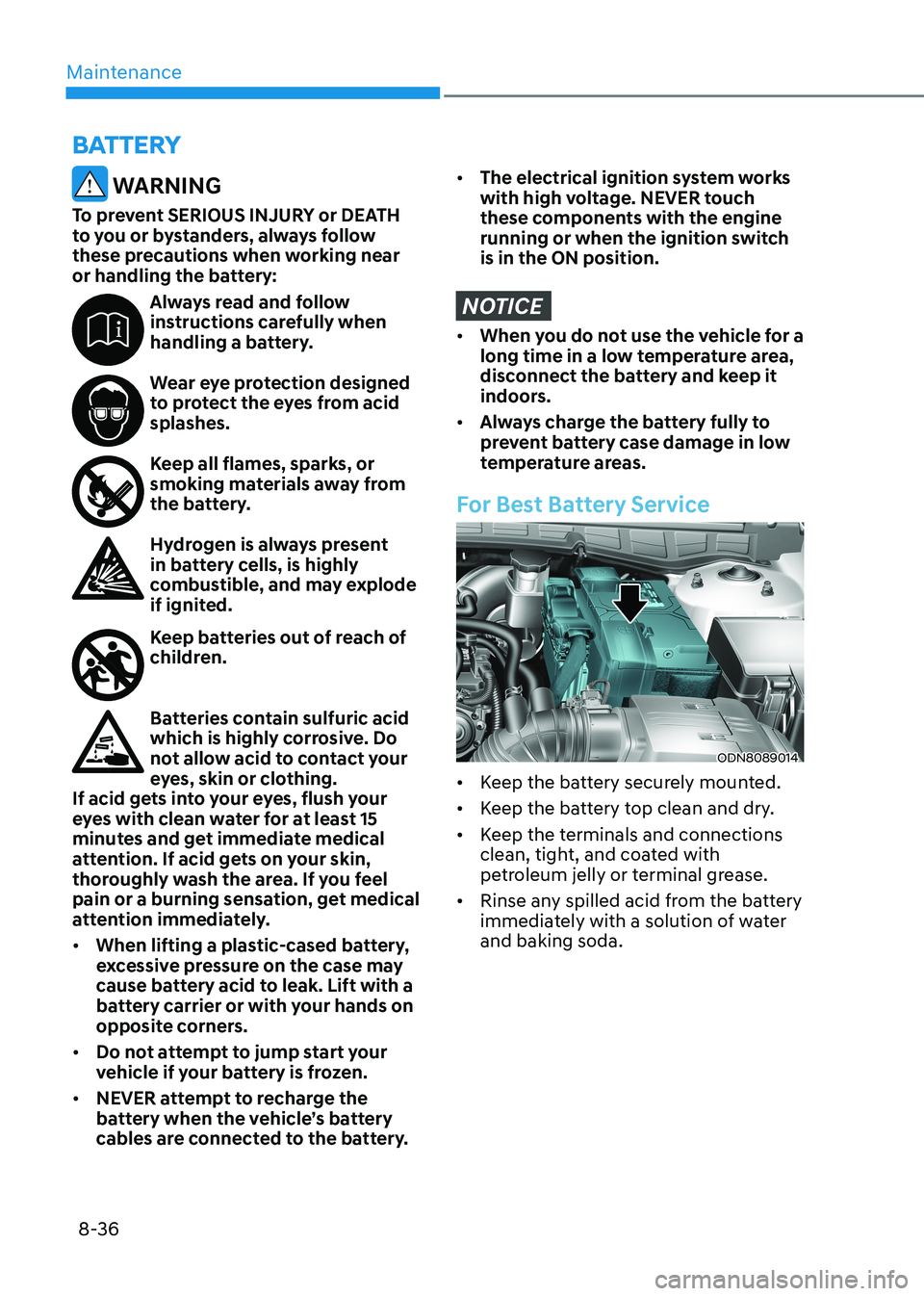
For Best Battery Service
ODN8089014
• Keep the battery securely mounted.
• Keep the battery top clean and dry.
• Keep the terminals and connections
clean, tight, and coated with
petroleum jelly or terminal grease.
• Rinse any spilled acid from the battery
immediately with a solution of water and baking soda.
BattEry
Page 507 of 555
08
8-37
Battery Recharging
WARNING
Always follow these instructions when
recharging your vehicle’s battery to
avoid the risk of SERIOUS INJURY or
DEATH from explosions or acid burns: • Before performing maintenance or
recharging the battery, turn off all
accessories and place the ignition
switch to the LOCK/OFF position.
• Keep all flames, sparks, or smoking
materials away from the battery.
• Always work outdoors or in an area
with plenty of ventilation.
• Wear eye protection when checking
the battery during charging.
• The battery must be removed from
the vehicle and placed in a well
ventilated area.
• Watch the battery during charging,
and stop or reduce the charging
rate if the battery cells begin boiling
violently.
• Vehicle is equipped with the
Absorbent Glass Mat (AGM) battery.
Do not charge the AGM battery with
a general charger. It may damage
or explode the AGM battery. Only
charge the AGM battery with a
charger that has AGM battery
setting.
• The negative battery cable must
be removed first to disconnect
the battery and installed last
to reconnect with the battery.
Disconnect the battery charger in the
following order:
1. Turn off the battery charger main
switch.
2. Unhook the negative clamp from the negative battery terminal.
3. Unhook the positive clamp from the positive battery terminal.
• Always use a genuine HYUNDAI
approved battery when you replace
the battery. By jump starting
After a jump start, idle the engine
with the headlights ON for 20-30
minutes before shutting the engine
off. The vehicle may not restart if you
shut it off before the battery had a
chance to adequately recharge. See
“Jump Starting” in chapter 7 for more
information on jump starting procedures.
Information
An inappropriately disposed battery can be harmful to
the environment and human health. Dispose of the battery
according to your local law(s) or
regulations.
Reset Features
The following items may need to be reset
after the battery has been discharged or
the battery has been disconnected. See
chapter 3 or 4 for: •
Power Windows
• Trip Computer
• Climate Control System
• Clock
• Audio System
• Sunroof
Page 517 of 555
08
8-47
Pneumatic tire
A mechanical device made of rubber,
chemicals, fabric and steel or other
materials, that, when mounted on an
automotive wheel provides the traction
and contains the gas or fluid that
sustains the load.
Pneumatic options weight
The combined weight of installed regular
production options weighing over 2.3
kg (5 lb.) in excess of the standard items
which they replace, not previously
considered in curb weight or accessory
weight, including heavy duty breaks, ride
levelers, roof rack, heavy duty battery, and special trim.
Recommended Inflation Pressure
Vehicle manufacturer’s recommended
tire inflation pressure as shown on the
tire placard.
Radial Ply Tire
A pneumatic tire in which the ply cords
that extend to the beads are laid at 90
degrees to the centerline of the tread. Rim
A metal support for a tire and upon
which the tire beads are seated.
Sidewall
The portion of a tire between the tread and the bead.
Speed Rating
An alphanumeric code assigned to a tire
indicating the maximum speed at which
a tire can operate.
Traction
The friction between the tire and
the road surface. The amount of grip
provided.
Tread
The portion of a tire that comes into
contact with the road.
Treadwear Indicators
Narrow bands, sometimes called “wear
bars”, that show across the tread of a tire
when only 1.6 mm (1/16 inch) of tread
remains.
UTQGS
Uniform Tire Quality Grading Standards
is a tire information system that provides
consumers with ratings for a tire’s
traction, temperature and treadwear.
Ratings are determined by tire
manufacturers using government testing
procedures. The ratings are molded into
the sidewall of the tire.
Vehicle Capacity Weight
The number of designated seating
positions multiplied by 68 kg (150 lbs.)
plus the rated cargo and luggage load.
Vehicle Maximum Load on the Tire
Load on an individual tire due to curb
and accessory weight plus maximum
occupant and cargo weight.
Vehicle Normal Load on the Tire
Load on an individual tire that is
determined by distributing to each axle
its share of the curb weight, accessory
weight, and normal occupant weight and
dividing by 2.
Vehicle Placard
A label permanently attached to a
vehicle showing the original equipment
tire size and recommended inflation
pressure.
Page 520 of 555
Maintenance
8-50
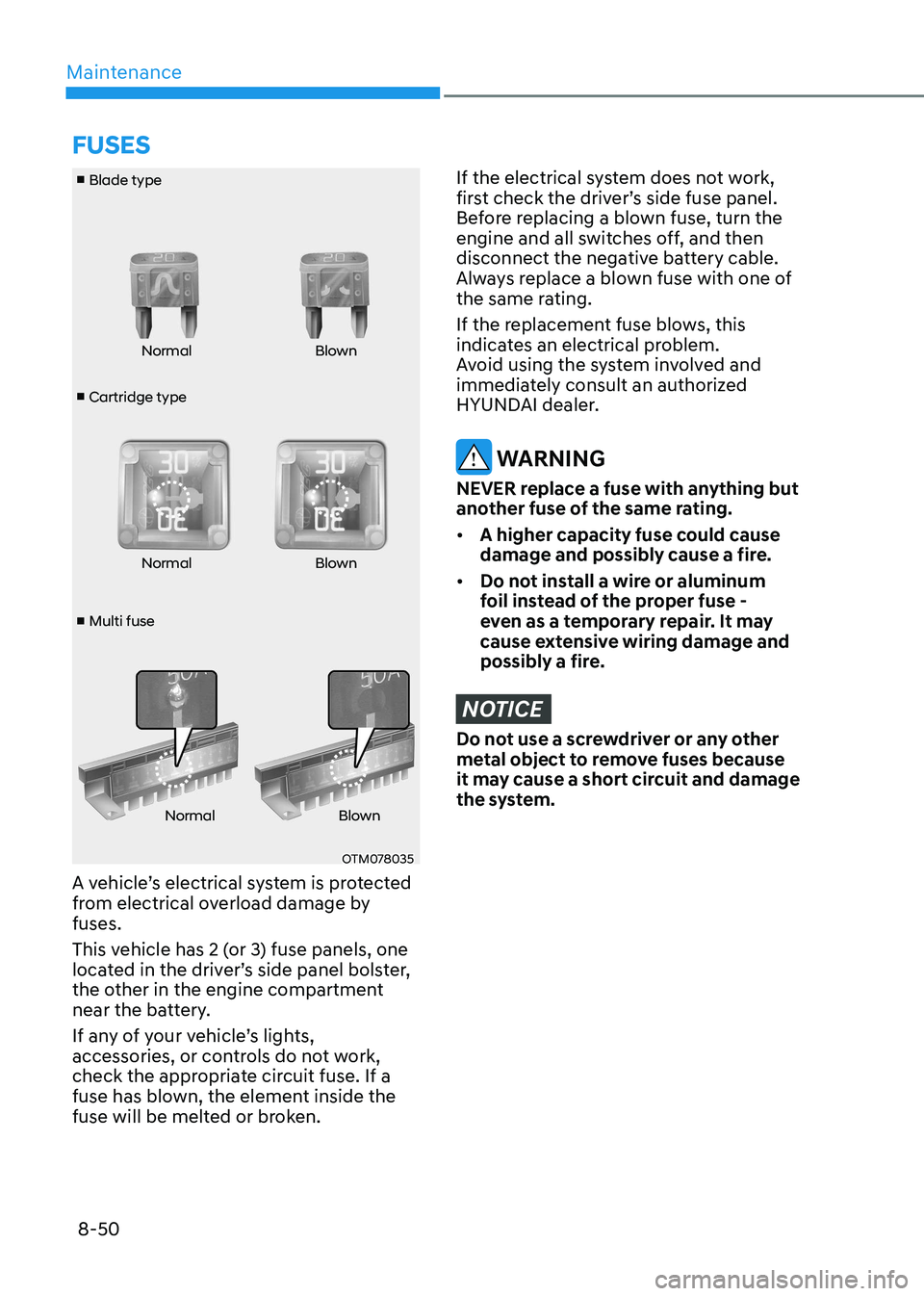
■ Cartridge type
■ Blade type
■ Multi fuse Normal Blown
Normal Blown
Normal Blown
OTM078035
A vehicle’s electrical system is protected
from electrical overload damage by fuses.
This vehicle has 2 (or 3) fuse panels, one
located in the driver’s side panel bolster,
the other in the engine compartment
near the battery.
If any of your vehicle’s lights,
accessories, or controls do not work,
check the appropriate circuit fuse. If a
fuse has blown, the element inside the
fuse will be melted or broken.
If the electrical system does not work,
first check the driver’s side fuse panel.
Before replacing a blown fuse, turn the
engine and all switches off, and then
disconnect the negative battery cable.
Always replace a blown fuse with one of
the same rating.
If the replacement fuse blows, this
indicates an electrical problem.
Avoid using the system involved and
immediately consult an authorized
HYUNDAI dealer.
WARNING
NEVER replace a fuse with anything but
another fuse of the same rating. • A higher capacity fuse could cause
damage and possibly cause a fire.
• Do not install a wire or aluminum
foil instead of the proper fuse -
even as a temporary repair. It may
cause extensive wiring damage and
possibly a fire.
NOTICE
Do not use a screwdriver or any other
metal object to remove fuses because
it may cause a short circuit and damage
the system.
fUSES
Page 522 of 555
Maintenance
8-52
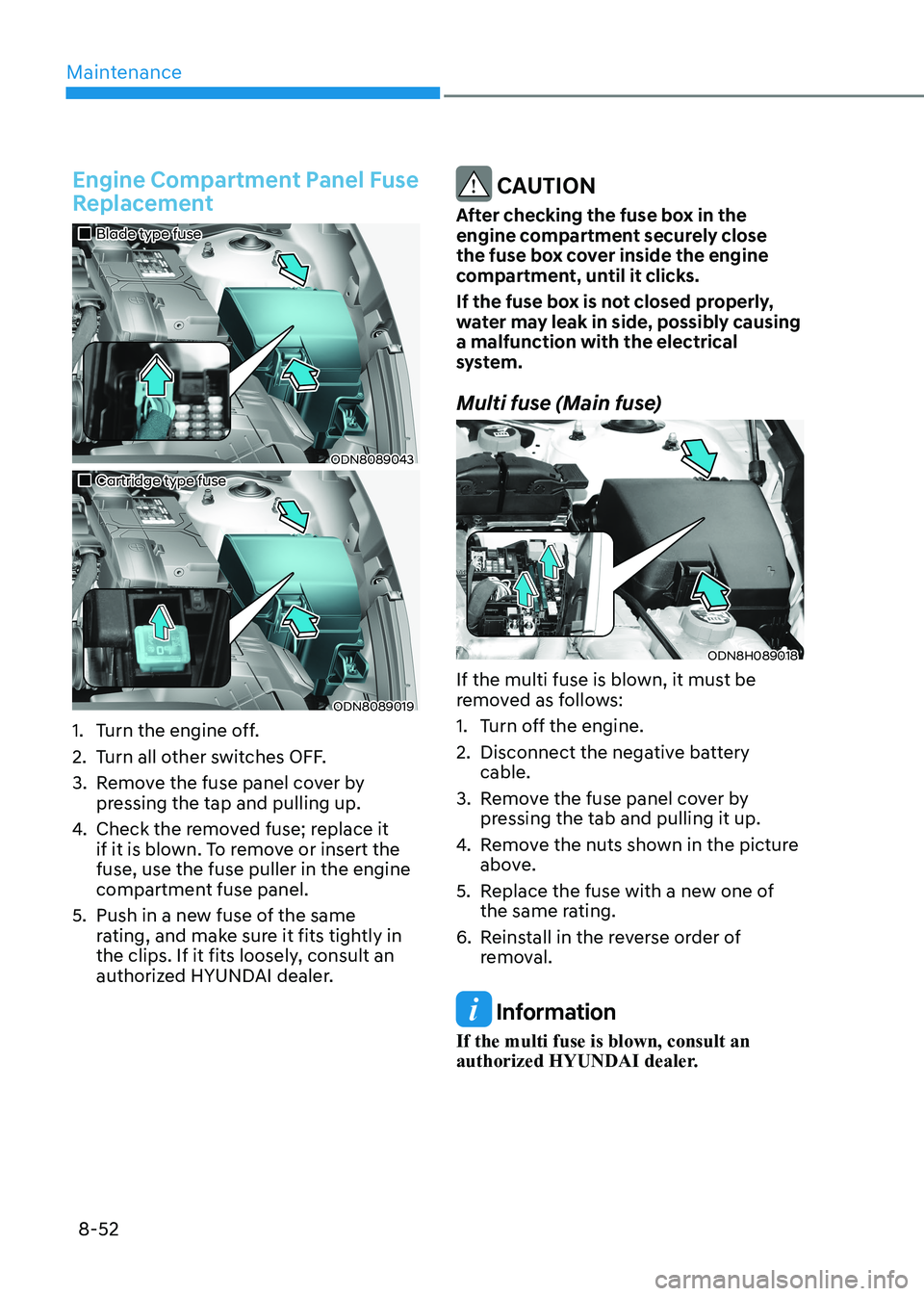
Engine Compartment Panel Fuse
Replacement
„„Blade type fuse
ODN8089043
„„Cartridge type fuse
ODN8089019
1. Turn the engine off.
2. Turn all other switches OFF.
3. Remove the fuse panel cover by pressing the tap and pulling up.
4. Check the removed fuse; replace it
if it is blown. To remove or insert the fuse, use the fuse puller in the engine
compartment fuse panel.
5. Push in a new fuse of the same rating, and make sure it fits tightly in
the clips. If it fits loosely, consult an
authorized HYUNDAI dealer.
CAUTION
After checking the fuse box in the
engine compartment securely close
the fuse box cover inside the engine
compartment, until it clicks.
If the fuse box is not closed properly,
water may leak in side, possibly causing a malfunction with the electrical
system.
Multi fuse (Main fuse)
ODN8H089018
If the multi fuse is blown, it must be
removed as follows:
1. Turn off the engine.
2. Disconnect the negative battery cable.
3. Remove the fuse panel cover by pressing the tab and pulling it up.
4. Remove the nuts shown in the picture
above.
5. Replace the fuse with a new one of the same rating.
6. Reinstall in the reverse order of removal.
Information
If the multi fuse is blown, consult an
authorized HYUNDAI dealer.
Page 527 of 555
08
8-57
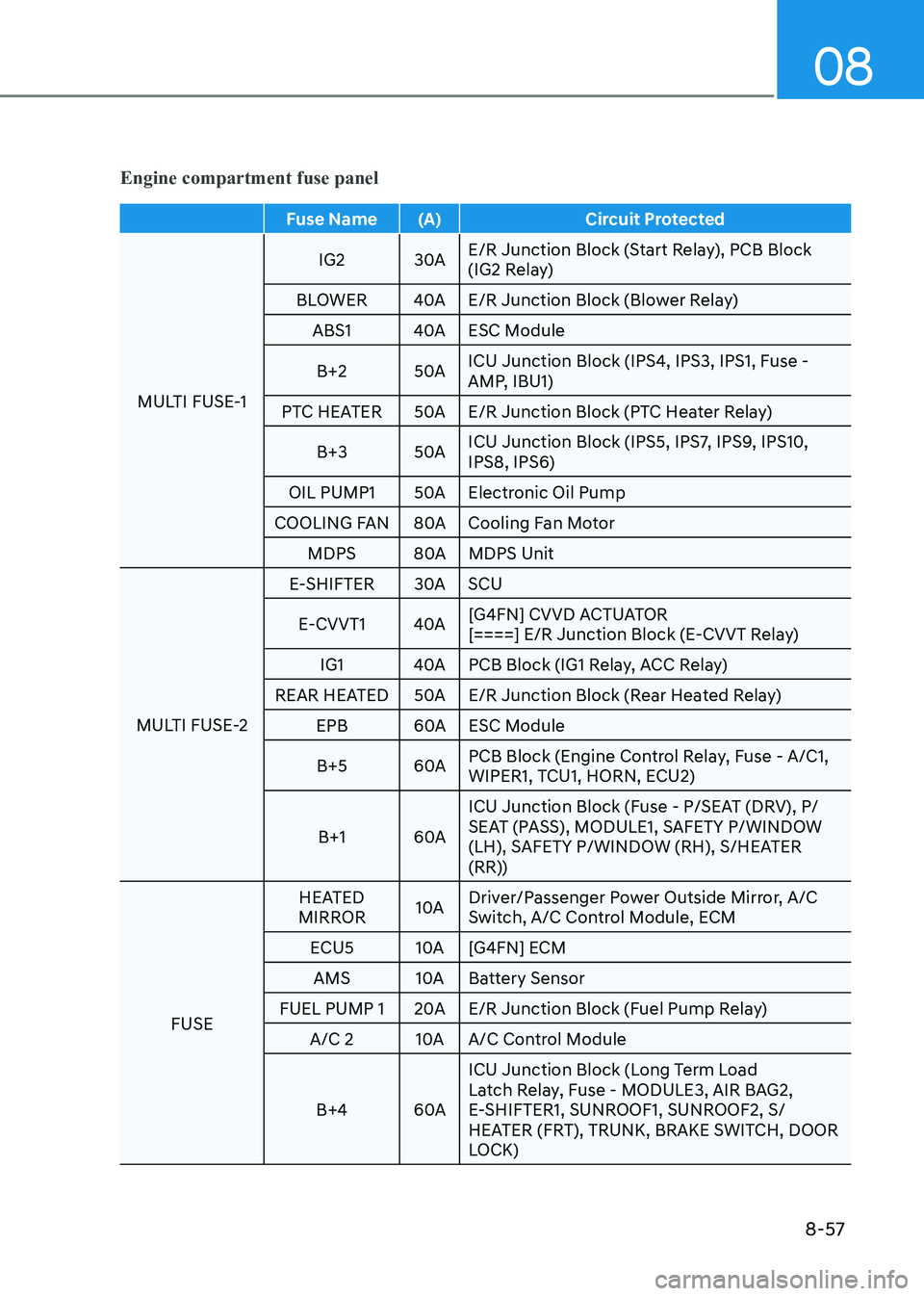
Engine compartment fuse panel
Fuse Name (A) Circuit Protected
MULTI FUSE-1 IG2 30A
E/R Junction Block (Start Relay), PCB Block
(IG2 Relay)
BLOWER 40A E/R Junction Block (Blower Relay) ABS1 40A ESC Module
B+2 50A ICU Junction Block (IPS4, IPS3, IPS1, Fuse -
AMP, IBU1)
PTC HEATER 50A E/R Junction Block (PTC Heater Relay)
B+3 50A ICU Junction Block (IPS5, IPS7, IPS9, IPS10, IPS8, IPS6)
OIL PUMP1 50A Electronic Oil Pump
COOLING FAN 80A Cooling Fan Motor MDPS 80A MDPS Unit
MULTI FUSE-2 E-SHIFTER 30A SCU
E-CVVT1 40A [G4FN] CVVD ACTUATOR
[====] E/R Junction Block (E-CVVT Relay)
IG1 40A PCB Block (IG1 Relay, ACC Relay)
REAR HEATED 50A E/R Junction Block (Rear Heated Relay)
EPB 60A ESC Module
B+5 60A PCB Block (Engine Control Relay, Fuse - A/C1,
WIPER1, TCU1, HORN, ECU2)
B+1 60A ICU Junction Block (Fuse - P/SEAT (DRV), P/
SEAT (PASS), MODULE1, SAFETY P/WINDOW
(LH), SAFETY P/WINDOW (RH), S/HEATER
(RR))
FUSE HEATED
MIRROR 10A Driver/Passenger Power Outside Mirror, A/C
Switch, A/C Control Module, ECM
ECU5 10A [G4FN] ECM AMS 10A Battery Sensor
FUEL PUMP 1 20A E/R Junction Block (Fuel Pump Relay) A/C 2 10A A/C Control Module
B+4 60A ICU Junction Block (Long Term Load
Latch Relay, Fuse - MODULE3, AIR BAG2,
E-SHIFTER1, SUNROOF1, SUNROOF2, S/
HEATER (FRT), TRUNK, BRAKE SWITCH, DOOR
LOCK)
Page 530 of 555
Maintenance
8-60
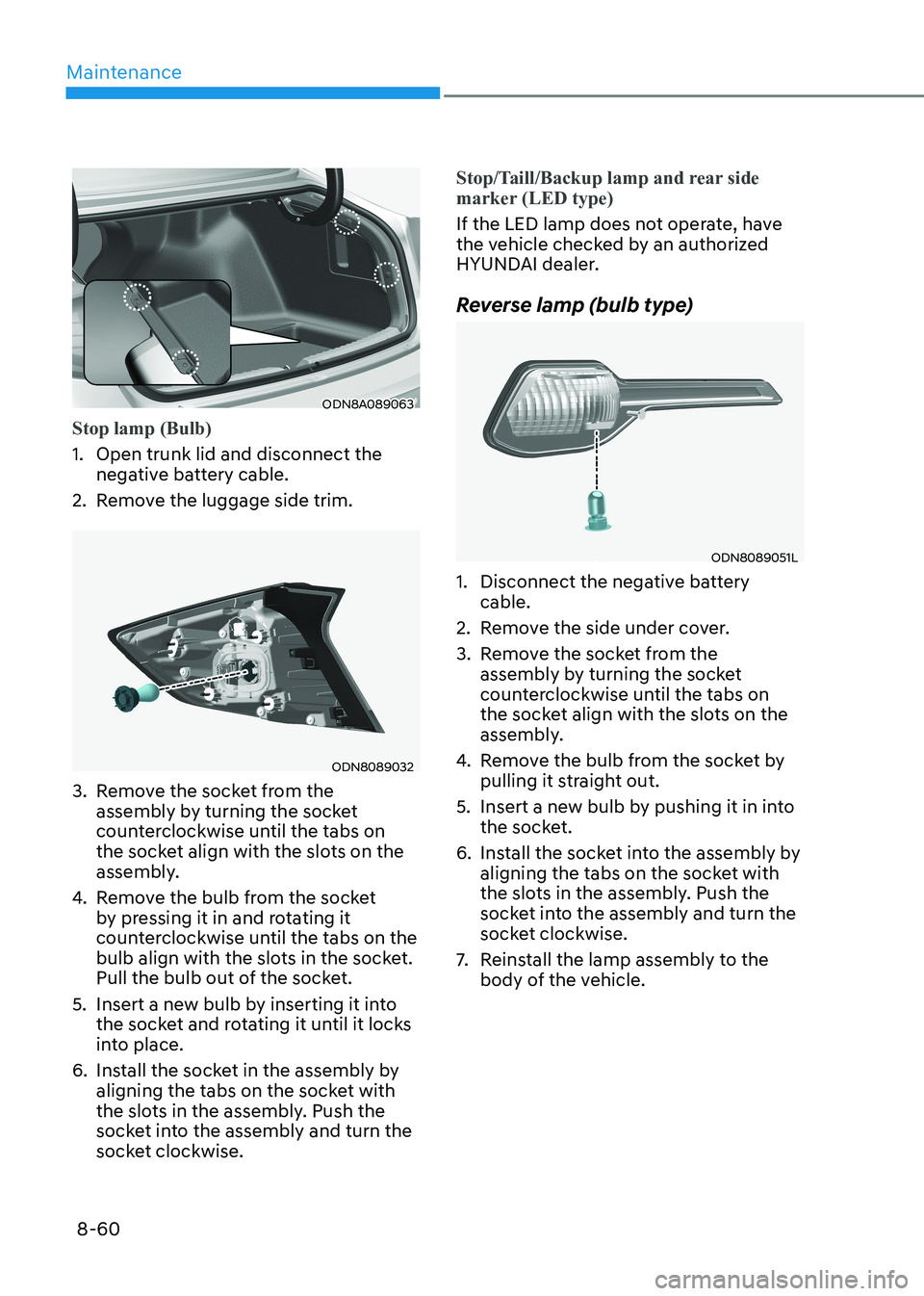
ODN8A089063
Stop lamp (Bulb)
1. Open trunk lid and disconnect the negative battery cable.
2. Remove the luggage side trim.
ODN8089032
3. Remove the socket from the assembly by turning the socket
counterclockwise until the tabs on
the socket align with the slots on the
assembly.
4. Remove the bulb from the socket
by pressing it in and rotating it
counterclockwise until the tabs on the
bulb align with the slots in the socket.
Pull the bulb out of the socket.
5. Insert a new bulb by inserting it into the socket and rotating it until it locks
into place.
6. Install the socket in the assembly by aligning the tabs on the socket with
the slots in the assembly. Push the
socket into the assembly and turn the
socket clockwise.
Stop/Taill/Backup lamp and rear side
marker (LED type)
If the LED lamp does not operate, have
the vehicle checked by an authorized
HYUNDAI dealer.
Reverse lamp (bulb type)
ODN8089051L
1. Disconnect the negative battery cable.
2. Remove the side under cover.
3. Remove the socket from the assembly by turning the socket
counterclockwise until the tabs on
the socket align with the slots on the
assembly.
4. Remove the bulb from the socket by
pulling it straight out.
5. Insert a new bulb by pushing it in into the socket.
6. Install the socket into the assembly by aligning the tabs on the socket with
the slots in the assembly. Push the
socket into the assembly and turn the
socket clockwise.
7. Reinstall the lamp assembly to the
body of the vehicle.
Page 545 of 555
I
I-3
B
Basic Troubleshooting Guide .............................................................................. 7-20
Battery ................................................................................................................. 8-36
Battery Recharging ........................................................................................... 8-37
For Best Battery Service .................................................................................. 8-36
Reset Features .................................................................................................. 8-37
Before Driving ....................................................................................................... 6-5
Before Entering the Vehicle ............................................................................... 6-5
Before Starting ................................................................................................... 6-5
Blind View Monitor (BVM) ............................................................................. 6-104
Blind-Spot Collision Warning (BCW) /
Blind-Spot Collision-Avoidance Assist (BCA) ...................................................6-77
Detecting Sensors (Front View Camera and Rear Corner Radar) ....................6-82
Limitations of the System ................................................................................ 6-85
System Description .......................................................................................... 6-77
System Setting and Activation ......................................................................... 6-78
Warning and System Control ........................................................................... 6-80
Brake Fluid .......................................................................................................... 8-29
Checking the Brake Fluid Level ....................................................................... 8-29
Brake System ....................................................................................................... 6-30
Anti-Lock Brake System (ABS) ...................................................................... 6-37
Auto Hold ......................................................................................................... 6-34
Disc Brakes Wear Indicator .............................................................................. 6-30
Electronic Parking Brake (EPB) ...................................................................... 6-31
Electronic Stability Control (ESC) ................................................................... 6-39
Good Braking Practices .................................................................................... 6-42
Hill-Start Assist Control (HAC) ....................................................................... 6-42
Power Brakes .................................................................................................... 6-30
Vehicle Stability Management (VSM) .............................................................6-41
Bulb Wattage ........................................................................................................ 2-11
C Child Restraint System (CRS) ............................................................................. 3-29
Children Always in the Rear ............................................................................ 3-29
Installing a Child Restraint System (CRS) .......................................................3-31
Selecting a Child Restraint System (CRS) .......................................................3-30
Climate Control Additional Features ................................................................. 5-130
Automatic Ventilation .................................................................................... 5-130
Sunroof Inside Air Recirculation ................................................................... 5-130